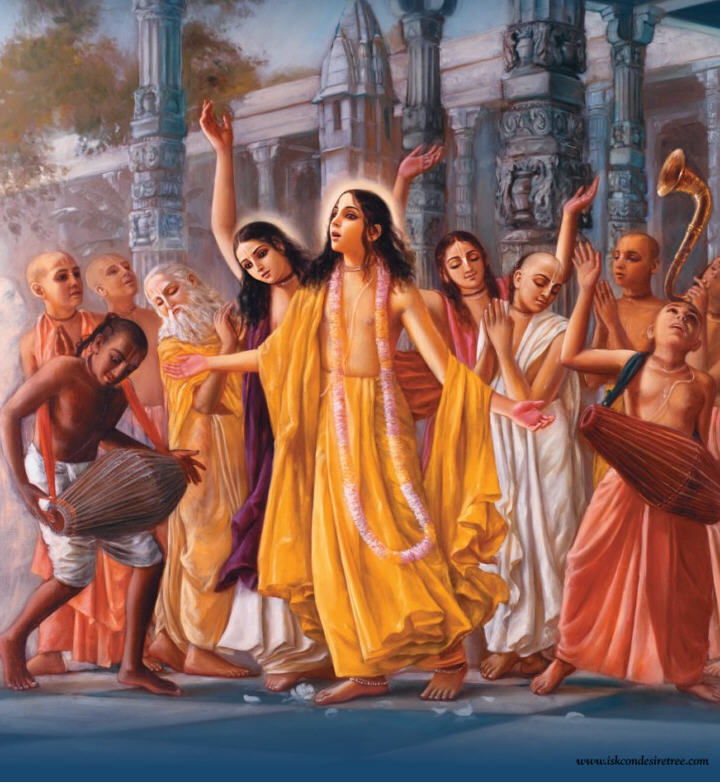
Sri Chaitanya-charitamrita does not need many words to say what mattered most about Mukunda Datta: he was Mahaprabhu's class friend, and Lord Chaitanya danced when he sang. Almost everything else told about him in the earliest years of the sankirtana movement is a variation on that one fact.
Songs After the Return from Gaya #
After Mahaprabhu's journey to Gaya, the debating classmate of the school years disappears from the story for a while. At Gaya the Lord received diksha from Ishvara Puri. He came back to Navadvipa a changed man, overwhelmed with divine love for Krishna in a way none of His old students could fully follow. Mukunda Datta was one of those who could. He recited verses from Srimad-Bhagavatam and sang kirtanas suited to the moods that were sweeping through the Lord. All the accounts say that this brought Mahaprabhu real comfort at a time when very few people around Him understood what was happening to Him at all. It is said that even Advaita Acharya and Ishvara Puri were carried into the same ecstasy when they heard Mukunda sing during this period.
Leading Kirtana at Srivasa's Courtyard #
Once the sankirtana movement gathered strength at Srivasa Pandita's house in Navadvipa, Mukunda Datta became one of its regular leaders. On ekadashi mornings the devotees split into separate kirtana parties. Srivasa Pandita headed one group and Mukunda another. When Mukunda sang in Srivasa's courtyard on ordinary evenings, Mahaprabhu danced to his voice in particular. Krishnadasa Kaviraja Goswami thought this detail worth recording as Mukunda's defining quality, ahead of anything else about him.
The Twenty-One Hours of Sata-Prahariya #
The event most closely connected with Mukunda's voice is the sata-prahariya-bhava. On this extraordinary occasion, Sri Chaitanya Mahaprabhu displayed an unbroken ecstatic manifestation lasting twenty-one hours. Mukunda Datta began the entire event with his singing. Later, during the ceremonial bathing that formed part of it, he sang again. The devotees around him wept or danced, unable to hold back what they were witnessing. This place of honour means a great deal in the tradition. Many devotees were present at this, one of the most celebrated displays of divine ecstasy in the Lord's Navadvipa years. Yet it was Mukunda's singing that both opened it and carried its most solemn moment.
Dancing as the Goddess of Fortune #
On another night, at the house of Chandrashekhara Acharya, Mahaprabhu dressed Himself as the goddess of fortune and danced before the assembled devotees. This is one of the more startling and tender of His Navadvipa pastimes. Mukunda Datta began the first song of that evening as well. By this point in the story, this is more a pattern than a coincidence. Whenever the devotees needed a voice to open a kirtana, it was Mukunda who started it. This was so in times of joy, and also in the strangest and most intimate of the Lord's early pastimes.
Khadajathiya Beta #
None of this made Mukunda a simple or uncomplicated figure. Sri Chaitanya-bhagavata records that Mahaprabhu sometimes scolded him, half in play and half seriously. He called him khadajathiya beta, a Bengali term of rebuke. This was because Mukunda kept attending gatherings held by all sorts of nondevotees, not only the pure Vaishnavas of Srivasa's courtyard. It is the first hint of a restlessness in Mukunda's character. That restlessness would later cause him far more serious trouble than a scolding. It is the subject of the offense to Bhakti-devi, the most dramatic single episode told about him.
Later, after He had taken the sannyasa order, Mahaprabhu's own words about Mukunda still showed the same two sides. He felt deep affection for Mukunda's devotion, and He also plainly recognised Mukunda's own inner struggle to be worthy of it. At Jagannatha Puri, just before He set out on His tour of South India, Mahaprabhu told the devotees that Mukunda grew unhappy simply watching Him keep the austere rules of sannyasa. These rules meant lying on the ground and bathing three times a day even in winter. He said that seeing Mukunda's silent unhappiness made the Lord twice as unhappy in turn. It is a small remark, but it says something that no formal praise could. Whatever restlessness marked Mukunda's youth, by the end Mahaprabhu felt from him a devotion so attentive that it noticed every discomfort the Lord Himself tried not to show.
A voice, in other words, was never all Mukunda Datta had to offer. But it may be the gift the tradition remembers most easily, because it announced itself the moment he opened his mouth, in a courtyard full of people who never tired of hearing it.
