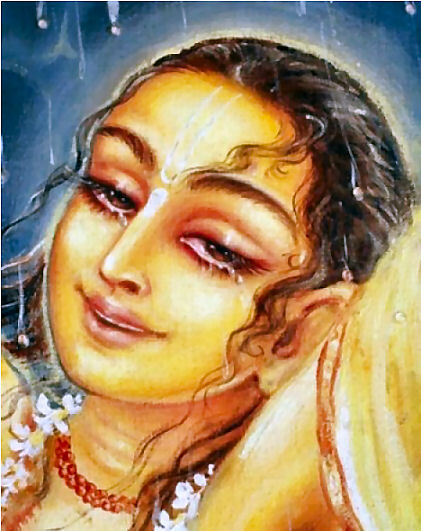
No source records the year Mukunda Datta was born or the year he died. What survives instead is a date on the Gaudiya Vaishnava calendar, a burial site at Puri, a spiritual identity from Krishna's own pastimes, and a brother whose fame, in the end, grew to rival his own.
The Day of Snana Yatra #
The tradition places Mukunda Datta's disappearance on the full moon day of the month of Jyeshtha. This is the very day of Snana Yatra, Lord Jagannatha's annual bathing festival at Puri. This is recorded independently in two places. A biography compiled by Srila Bhakti Ballabh Tirtha Goswami Maharaj states it directly. And in a 1976 room conversation in Detroit, Srila Prabhupada's own disciple Madhavananda dasa can be heard mentioning it, almost in passing. He noted that the day was Snana Yatra, the disappearance day of Mukunda Datta and Sridhara Pandita, and that Syamananda Gosvami's disappearance fell on the following day. The two sources are very different in kind. One is a formal biography, and the other is a casual remark caught on tape decades later. Yet both agree on the same tithi. For a disappearance with no recorded year, that is about as much confirmation as one can reasonably expect.
The Sixty-Four Samadhis #
Tradition places Mukunda Datta's samadhi within the area at Jagannatha Puri known as the Sixty-Four Samadhis, alongside memorials to several other devotees of Mahaprabhu's own generation. No year is given for the samadhi, just as no year is given for the date. But the place itself tells us something. It puts Mukunda's resting place among the Lord's closest Bengali associates. It is in the pilgrimage town he had returned to year after year, for a decade of his life, simply to see Mahaprabhu again. Earlier, in this same town, he had stood beside Gopinatha Acharya defending Mahaprabhu's honor before Sarvabhauma Bhattacharya. From this town he later set out with the Lord toward Vrindavana. On the way, he helped a Muslim governor at the Orissa border arrange safe passage for the Lord. Both stories are told on sannyasa and the years at Jagannatha Puri.
His Brother Vasudeva Datta #
Mukunda's family did not end its service to Mahaprabhu with him. His elder brother, Vasudeva Datta, went on to become one of the most celebrated devotees in the entire Chaitanya-charitamrita. He is the devotee about whom Mahaprabhu vowed, three times over, that His own body existed only to give him pleasure. Vasudeva also wanted to take upon himself the sinful reactions of every living being, so that Mahaprabhu could deliver them all. Vasudeva Datta later initiated Yadunandana Acharya, who in turn became the spiritual master of Raghunatha Dasa Goswami. So a line of teachers going back to the two Datta brothers of Chittagong reaches, a generation later, into the guru-parampara of one of the Six Goswamis of Vrindavana themselves. Vasudeva Datta also established a temple of Madana-gopala at Mamagachi, near the birthplace of Vrindavana Dasa Thakura. The Gaudiya Matha has maintained this temple ever since Srila Bhaktisiddhanta Sarasvati Thakura began the Navadvipa-parikrama and made it one of the pilgrimage's regular stops.
Madhukantha, the Singer of Vraja #
Kavi Karnapura's Gaura-ganoddesha-dipika gives Mukunda Datta a name from beyond this one lifetime. He says that in Krishna's own Vrindavana pastimes, Mukunda and Vasudeva Datta were Madhukantha and Madhuvrata. They were two singers whose voices belonged to Vraja before either brother was ever born in Chittagong. It is hard to imagine a more fitting identity for Mukunda. As a boy, he lost debates to his classmate at Gangadasa Pandita's tol. As a singer, his voice alone could make Sri Chaitanya Mahaprabhu dance. For a short time he was famously kept from the Lord's mercy for keeping the wrong company. And he was the one person in Navadvipa who knew enough to hand Gadadhara Pandit the single verse that changed his life. In every one of those roles, the throat that the tradition calls sweet as honey was always the thing that mattered most.
No portrait of Mukunda Datta survives in any independent historical record, and no scholar can fix the years of his birth or death. For five hundred years, only memory and manuscripts have carried what survives of him. What has survived is one simple fact, repeated in text after text. When this particular man opened his mouth to sing, the Supreme Lord Himself could not stay still.
