Srila Mukunda Datta
Class friend and favorite singer of Sri Chaitanya Mahaprabhu
The complete life, on one page: The main biography and every pastime page, in order, in one place
Introduction
Sri Mukunda Datta was one of Sri Chaitanya Mahaprabhu's earliest friends in Navadvipa. He was His classmate before either of them had any public reputation for holiness. By the Lord's own account, Mukunda was the singer whose kirtana moved Him more than almost anyone else's. Mukunda came from a family of physicians in Chittagong, in the far east of Bengal. Among the devotees of Navadvipa, Mukunda alone knew what Pundarika Vidyanidhi really was, and it was he who took Gadadhara Pandit to meet him. In this way he began one of the tradition's best-loved stories, the story of a wrong judgment put right.
| Detail | Description |
|---|---|
| Native place | Chanhara (Chakrashala, by one later account), Patiya, Chittagong district, Bengal |
| Family | Elder brother Vasudeva Datta; remembered as Ambastha physicians |
| Role | Class friend and favorite singer of Sri Chaitanya Mahaprabhu |
| Identity | Madhukantha, a singer of Vraja (Gaura-ganoddesha-dipika 140; Chaitanya-charitamrita Adi 10.40 purport) |
| Best-known deed | Introduced Gadadhara Pandit to Pundarika Vidyanidhi |
| Disappearance | Jyeshtha purnima, the day of Snana Yatra (year not recorded) |
Scriptural evidence for the introduction (2)
śrī-mukunda-datta śākhā — prabhura samādhyāyī
yāṅhāra kīrtane nāce caitanya-gosāñi
Word for word
śrī-mukunda-datta: Śrī Mukunda Datta; śākhā: another branch; prabhura: of Lord Śrī Caitanya Mahāprabhu; samādhyāyī: class friend; yāṅhāra: whose; kīrtane: in saṅkīrtana; nāce: dances; caitanya-gosāñi: Śrī Caitanya Mahāprabhu.
Mukunda Datta, a class friend of Lord Caitanya's, was another branch of the Caitanya tree. Lord Caitanya danced while he sang.
From the purport: Purport excerpt: "When Lord Caitanya was a student, Mukunda Datta was His class friend, and they frequently engaged in logical arguments."
The defining verse of Sri Chaitanya-charitamrita naming Mukunda Datta as a branch of the Chaitanya tree and Mahaprabhu's class friend.
व्रजे स्थितौ गायकौ यौ मधुकण्ठ मधुव्रतौ ।
मुकुन्द वासुदेवौ तौ दत्तौ गौराङ्ग गायकौ ॥१४०॥
vraje sthitau gāyakau yau
madhukaṇṭha-madhuvratau
mukunda-vāsudevau tau
dattau gaurāṅga-gāyakau
In Vraja there were two very nice singers named Madhukaṇṭha and Madhuvrata. They appeared in caitanya-līlā as Mukunda and Vāsudeva Datta, who were singers in the society of Lord Caitanya Mahāprabhu.
Kavi Karnapura's identification of Mukunda Datta as Madhukantha, a singer of Vraja (his brother Vasudeva Datta is Madhuvrata). Sanskrit: diacritic edition of the Gaura-ganoddesha-dipika; translation: Srila Prabhupada, CC Adi 10.40 purport.
Chapter 1
A Physician's Family from Chittagong
Two brothers, a village in Chittagong, and a schoolyard rivalry with the future Sri Chaitanya Mahaprabhu
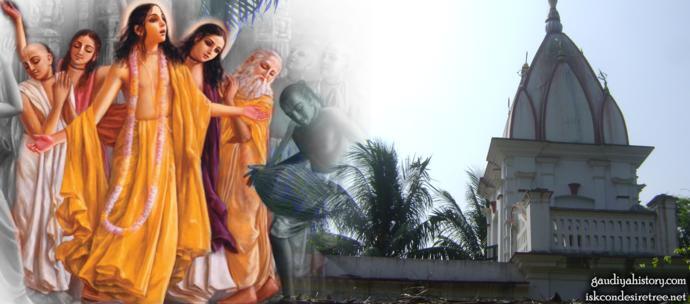
Two brothers from a family of physicians in Chittagong, at the eastern edge of Bengal, came to Navadvipa to study. One of them ended up sharing a classroom with the boy who would become Sri Chaitanya Mahaprabhu.
| Detail | Description |
|---|---|
| Native place | Chanhara, Patiya police station, Chittagong district (named Chakrashala in one later source) |
| Family | Ambastha physicians, surname Datta |
| Elder brother | Vasudeva Datta, later one of Mahaprabhu's most celebrated devotees |
| School | Gangadasa Pandita's tol, Navadvipa |
| Classmate | Nimai Pandit, the future Sri Chaitanya Mahaprabhu |
A Village Called Chanhara #
Srila Prabhupada's purport to Sri Chaitanya-charitamrita places Mukunda Datta's birth in the village of Chanhara, under the Patiya police station of the Chittagong district. He notes that this village was about twenty miles from the home of Pundarika Vidyanidhi. This is the same devotee whom Mukunda would one day introduce to Gadadhara Pandit. A later compiled biography gives the village a different name, Chakrashala. It adds that the family was remembered locally as Ambastha physicians, a Bengali community traditionally connected with the practice of medicine. The two accounts do not agree on the village's name, and nothing in the sources settles the difference. But both agree on the district, the family's trade, and the distance to Pundarika Vidyanidhi's home. So the difference is only a small detail, not a real dispute.
The Ambastha Physicians of Datta #
Mukunda's elder brother was Vasudeva Datta. Gaudiya Vaishnavas remember his name with almost as much honour as Mukunda's own. Krishnadasa Kaviraja Goswami calls Vasudeva the nineteenth branch of the Chaitanya tree, and says his qualities could not be described even with a thousand mouths. Mahaprabhu vowed three separate times that His own body existed only to give Vasudeva pleasure. The two brothers came from a single household of physicians in Chittagong and arrived in Navadvipa together. This is one of the more unusual family stories among Mahaprabhu's early associates. Most of them came to Him one at a time, not as brothers already devoted to each other.
Fellow Students at Gangadasa Pandita's Tol #
Many Vaishnava families from Chittagong had settled near the Ganges in Navadvipa, to study and to live close to the sacred river. In this community Mukunda joined the tol, or school, of Gangadasa Pandita. At the same tol, a very quick student named Nimai Pandit was already ahead of every teacher in Navadvipa except Gangadasa himself. Sri Chaitanya-bhagavata describes at some length what happened when the two of them met. At first there was no devotion between them, only rivalry. Nimai clearly enjoyed cornering Mukunda with tricks of logic. Their debates happened often enough that Krishnadasa Kaviraja Goswami mentions them specifically when introducing Mukunda in Sri Chaitanya-charitamrita.
An Admiration He Could Not Admit #
One exchange in particular survives in some detail. Mukunda had been cornered once too often on a point of grammar, so he tried changing the terms of the contest. Grammar, he said, was a child's subject; let Nimai answer him instead in alankara, the far harder study of poetic figures of speech. Nimai did, effortlessly. He established an argument, refuted it, and established it again, in a display that left Mukunda unable to find a weakness anywhere in it. Alone with his thoughts afterward, Mukunda came to the conclusion that no ordinary human being could possibly hold that much learning. He was in no position to say this aloud among his fellow students. Most of them went out of their way to avoid the young logician's company entirely. If only, Mukunda thought, this brilliant, exhausting classmate of his were also a devotee of Krishna. He would never leave His company again.
As Mukunda watched Nimai walk away from another debate he had just won, he had no way of knowing what lay ahead. The wish would be granted more completely than he could have imagined. The friendship beginning in that schoolyard would carry him through the first ecstatic years of the sankirtana movement, to Srivasa Pandita's courtyard and, eventually, all the way to Jagannatha Puri.
Looking back, this beginning was very ordinary. In Gangadasa Pandita's tol, nothing marked Mukunda Datta out as a future companion of the Supreme Lord. He had only a sharp mind, a habit of losing arguments to a classmate he privately admired, and a family recently arrived from Chittagong. The tradition does not add omens or predictions to his early years. It simply records a friendship that, in time, turned out to matter more than either boy could have guessed.
Chapter 2
The Voice Mahaprabhu Loved to Hear
Mukunda Datta's place as lead singer through sankirtana's first ecstatic years in Navadvipa
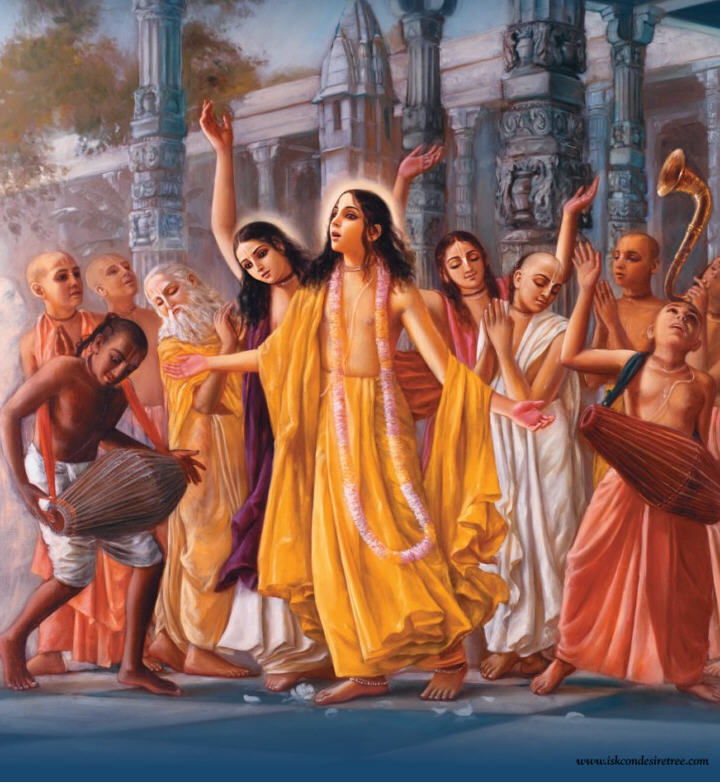
Sri Chaitanya-charitamrita does not need many words to say what mattered most about Mukunda Datta: he was Mahaprabhu's class friend, and Lord Chaitanya danced when he sang. Almost everything else told about him in the earliest years of the sankirtana movement is a variation on that one fact.
Songs After the Return from Gaya #
After Mahaprabhu's journey to Gaya, the debating classmate of the school years disappears from the story for a while. At Gaya the Lord received diksha from Ishvara Puri. He came back to Navadvipa a changed man, overwhelmed with divine love for Krishna in a way none of His old students could fully follow. Mukunda Datta was one of those who could. He recited verses from Srimad-Bhagavatam and sang kirtanas suited to the moods that were sweeping through the Lord. All the accounts say that this brought Mahaprabhu real comfort at a time when very few people around Him understood what was happening to Him at all. It is said that even Advaita Acharya and Ishvara Puri were carried into the same ecstasy when they heard Mukunda sing during this period.
Leading Kirtana at Srivasa's Courtyard #
Once the sankirtana movement gathered strength at Srivasa Pandita's house in Navadvipa, Mukunda Datta became one of its regular leaders. On ekadashi mornings the devotees split into separate kirtana parties. Srivasa Pandita headed one group and Mukunda another. When Mukunda sang in Srivasa's courtyard on ordinary evenings, Mahaprabhu danced to his voice in particular. Krishnadasa Kaviraja Goswami thought this detail worth recording as Mukunda's defining quality, ahead of anything else about him.
The Twenty-One Hours of Sata-Prahariya #
The event most closely connected with Mukunda's voice is the sata-prahariya-bhava. On this extraordinary occasion, Sri Chaitanya Mahaprabhu displayed an unbroken ecstatic manifestation lasting twenty-one hours. Mukunda Datta began the entire event with his singing. Later, during the ceremonial bathing that formed part of it, he sang again. The devotees around him wept or danced, unable to hold back what they were witnessing. This place of honour means a great deal in the tradition. Many devotees were present at this, one of the most celebrated displays of divine ecstasy in the Lord's Navadvipa years. Yet it was Mukunda's singing that both opened it and carried its most solemn moment.
Dancing as the Goddess of Fortune #
On another night, at the house of Chandrashekhara Acharya, Mahaprabhu dressed Himself as the goddess of fortune and danced before the assembled devotees. This is one of the more startling and tender of His Navadvipa pastimes. Mukunda Datta began the first song of that evening as well. By this point in the story, this is more a pattern than a coincidence. Whenever the devotees needed a voice to open a kirtana, it was Mukunda who started it. This was so in times of joy, and also in the strangest and most intimate of the Lord's early pastimes.
Khadajathiya Beta #
None of this made Mukunda a simple or uncomplicated figure. Sri Chaitanya-bhagavata records that Mahaprabhu sometimes scolded him, half in play and half seriously. He called him khadajathiya beta, a Bengali term of rebuke. This was because Mukunda kept attending gatherings held by all sorts of nondevotees, not only the pure Vaishnavas of Srivasa's courtyard. It is the first hint of a restlessness in Mukunda's character. That restlessness would later cause him far more serious trouble than a scolding. It is the subject of the offense to Bhakti-devi, the most dramatic single episode told about him.
Later, after He had taken the sannyasa order, Mahaprabhu's own words about Mukunda still showed the same two sides. He felt deep affection for Mukunda's devotion, and He also plainly recognised Mukunda's own inner struggle to be worthy of it. At Jagannatha Puri, just before He set out on His tour of South India, Mahaprabhu told the devotees that Mukunda grew unhappy simply watching Him keep the austere rules of sannyasa. These rules meant lying on the ground and bathing three times a day even in winter. He said that seeing Mukunda's silent unhappiness made the Lord twice as unhappy in turn. It is a small remark, but it says something that no formal praise could. Whatever restlessness marked Mukunda's youth, by the end Mahaprabhu felt from him a devotion so attentive that it noticed every discomfort the Lord Himself tried not to show.
A voice, in other words, was never all Mukunda Datta had to offer. But it may be the gift the tradition remembers most easily, because it announced itself the moment he opened his mouth, in a courtyard full of people who never tired of hearing it.
Chapter 3
The Offense to Bhakti-Devi
Why Mahaprabhu once left Mukunda Datta standing at the door, and the mercy that followed
Mukunda Datta was a gifted singer, but he had a habit that in the end brought him trouble. He tried to keep a place in more than one world. Among devotees he glorified bhakti. But among philosophers of a very different kind, he discussed something else entirely. Mahaprabhu missed nothing, and He made Mukunda answer for it. The way He did this became one of the most quoted episodes in Mukunda's life.
A Foot in Both Worlds #
As the tradition describes it, Mukunda's fault was not disbelief. It was a habit of mixing with every kind of thinker, without choosing carefully. He would speak of bhakti to the devotees at Srivasa Pandita's courtyard. Then he would go and debate worldly subjects with karmis. Most seriously, he would sit with Mayavadi impersonalists to hear their discourses on the Yoga-vasistha-Ramayana. This text is full of the philosophy that Mahaprabhu spent His life opposing. It was the same restlessness already seen in the khadajathiya beta rebukes told on the singer's page, only now it had grown serious enough to matter. In effect, the tradition says, he was treating bhakti as just one more school of thought among several equally valid ones. He did not treat it as the one thing devotional service actually is. He glorified it to bhaktas, argued worldly points with karmis, and discussed impersonalism with Mayavadis, as though the same man could sincerely belong to all three audiences. That is remembered as an offense against Bhakti-devi herself.
Left Standing at the Door #
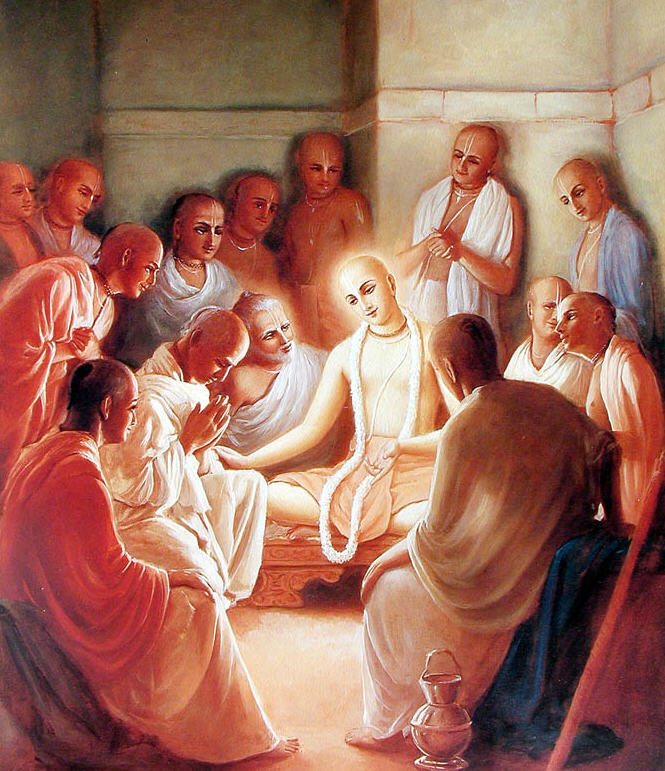
The correction came during Mahaprabhu's maha-prakasha-lila at Srivasa Angana. On that extraordinary occasion, the Lord sat as though on Vishnu's own throne. He called the devotees to Him one by one and blessed each of them according to what was in their hearts. Mukunda Datta was left standing outside. The other devotees pleaded with Mahaprabhu on his behalf, and He explained exactly why, in words Srila Prabhupada later preserved: "I shall not soon be pleased with Mukunda Datta, for though he explains devotional service among devotees, he then goes to Mayavadis to hear from them the Yoga-vasistha-Ramayana, which is full of Mayavada philosophy. For this I am greatly displeased with him." Mukunda was standing outside and heard this. Strangely, he was glad. He was glad that the Lord's words at least left open the hope that He would be pleased with him in time, even if not yet.
Ten Million Births #
The fuller account in Sri Chaitanya-bhagavata takes the episode further and makes it much more intense. Mukunda was pained beyond bearing by Mahaprabhu's rebuke, and he decided to give up his own body as atonement. He had Srivasa Pandita ask the Lord for him whether there was any hope at all of receiving His mercy in some future life. Mahaprabhu's answer was that Mukunda would receive it after ten million births. Mukunda did not despair. Instead he danced where he stood, repeating that the Lord's word could never be false. He was glad, because even ten million births meant that the mercy would still come one day.
A Debt Cancelled at Once #
At that moment Mahaprabhu's mercy overcame the punishment He Himself had just given. Mukunda had faith in a promise that gave him almost nothing to hope for, and this moved the Lord. He freed Mukunda from the offense at once and revealed His opulent form to him on the spot. Completely reversing His earlier rebuke, He declared that He would forever reside on Mukunda's tongue. He also declared that wherever He appeared, Mukunda would have a place singing for Him. The tradition tells this story again and again. It is told as proof that no punishment the Lord gives, however severe, can outlast genuine faith in Him for even a moment.
Two sources describe in slightly different ways how Mukunda was forgiven after being left outside. In Srila Prabhupada's purport, the Lord simply softens once He sees that Mukunda is giving up the Mayavadis for good. The fuller Chaitanya-bhagavata story builds up to the dramatic exchange over the punishment of ten million births. But neither account leaves any doubt about the outcome. After this, the same devotee who could not tell a Mayavadi text from a devotional one is remembered mainly for a promise that his voice would always belong to Mahaprabhu. That promise was fulfilled for the rest of his life. One clear example is the story told on introducing Gadadhara Pandit to Pundarika Vidyanidhi.
Scriptural evidence for this chapter (1)
mukunda-dattere kaila daṇḍa-parasāda
khaṇḍila tāhāra cittera saba avasāda
Word for word
mukunda-dattere: unto Mukunda Datta; kaila: did; daṇḍa: punishment; parasāda: benediction; khaṇḍila: vanquished; tāhāra: his; cittera: of the mind; saba: all kinds of; avasāda: depressions.
Lord Sri Caitanya Mahaprabhu blessed Mukunda Datta with punishment and in that way vanquished all his mental depression.
From the purport: Purport excerpt: "I shall not soon be pleased with Mukunda Datta, for though he explains devotional service among devotees, he then goes to Māyāvādīs to hear from them the Yoga-vāśiṣṭha-rāmāyaṇa, which is full of Māyāvāda philosophy."
Srila Prabhupada's purport recounting why Mukunda Datta was, for a time, excluded from Mahaprabhu's maha-prakasha-lila blessings, the episode told in full here.
Chapter 4
Introducing Gadadhara Pandit to Pundarika Vidyanidhi
The one devotee in Navadvipa who knew what Pundarika Vidyanidhi's opulence concealed
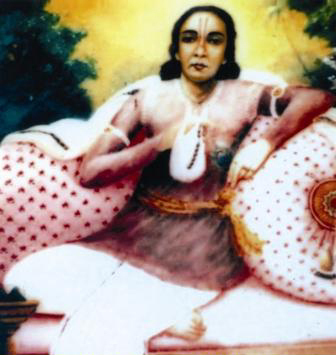
Of everyone in Navadvipa, only Mukunda Datta knew what Pundarika Vidyanidhi's wealth and worldliness actually concealed. It was Mukunda who decided, one ordinary day, that a young brahmachari named Gadadhara Pandit needed to find out.
A Secret Kept from Nabadwip #
Pundarika Vidyanidhi came to Navadvipa from Chittagong in the guise of a wealthy, sense-enjoying man of the world, and he made no effort to look like anything else. Almost no one there could see past it. Mukunda Datta could. He had lived in Chittagong himself, and had known Pundarika Vidyanidhi long before either of them settled near the Ganges. And behind the disguise there was something deeper still. Kavi Karnapura's Gaura-ganoddesha-dipika identifies Pundarika, surprisingly, as Vrishabhanu Maharaja, the father of Srimati Radharani in Krishna's own pastimes. This is the very reason Mahaprabhu Himself would sometimes weep and call out for him as "father." None of that could be seen from the outside, in a man reclining on bolster cushions with betel and attendants at hand. Mukunda kept the knowledge largely to himself. He waited until the day he judged that someone else was ready to be shown it.
Taking Gadadhara to See Him #
That someone was Gadadhara Pandit, a twenty-year-old brahmachari. Since childhood he had not cared for comfort, and by nature he tended to take outward things seriously. Mukunda told him one day that he was going to introduce him to a most exceptional Vaishnava, and took him along. Gadadhara found a man reclining on an expensive bed under a canopy. The sheets are described as white as the foam of milk. Scented pan lay within reach in a jeweled box, and servants were fanning him. Gadadhara could not fit any of this with what Mukunda had promised him. The doubt showed plainly on his face.
The Verse That Broke the Disguise #
Mukunda saw it, and did the one thing that would settle it. He recited aloud a verse spoken by Uddhava in the Third Canto of Srimad-Bhagavatam. In it Uddhava marvels that Krishna gave the position of a nurse to the demoness Putana, who had come with poison on her breast to kill Him. He asks where a more merciful shelter than that could possibly be found. The effect on Pundarika Vidyanidhi was immediate. He cried out, fell to the ground, and showed all the ecstatic symptoms that the Vaishnava manuals describe. He tore at the fine bedding and wailed that the Lord's mercy had been withheld from him, and then he fell unconscious for hours. Mukunda alone knew which verse would have this effect, and he chose it. That single verse was enough to strip away Pundarika's entire disguise. It happened in front of Gadadhara, who had judged the outward show correctly for what it seemed, but had completely missed what lay underneath.
What Came of It #
Gadadhara understood immediately that he had committed a serious offense by judging a devotee by his outward circumstances. The remedy was initiation from the very man Gadadhara had misjudged. It came about through Mahaprabhu's guidance and through the force of what Mukunda's recitation had just revealed. When Pundarika Vidyanidhi returned to ordinary consciousness, he gave no sign of what had just happened. Gadadhara took the idea back to Mukunda before acting on it. One account describes Mukunda as much delighted at the request. In this account Mukunda carried it to Pundarika Vidyanidhi himself, who happily set a date for the initiation, and Mahaprabhu gave His approval. On the day that had been set, Pundarika Vidyanidhi initiated Gadadhara Pandit and remained his spiritual master for life. A second initiation followed years later at Jagannatha Puri. Gadadhara Pandit's own page, initiation from Pundarika Vidyanidhi, gives the fullest account of that side of the story. It explains how the two Chaitanya-charitamrita passages describing it fit together, and what the episode is traditionally taken to teach about judging a Vaishnava by appearances.
Mukunda Datta's part in the story ends there. He supplied the introduction and the one verse that mattered, and then he stepped back. This pattern appears everywhere else in his life too. He is almost never the main person in a pastime. He is the friend standing just to the side of it. He holds the one piece of knowledge, or the one line of scripture, that the moment actually needed. It happens again here. By any fair measure this story belongs to Gadadhara Pandit and Pundarika Vidyanidhi, except that neither man would have met the other without him.
Scriptural evidence for this chapter (1)
अहो बकी यं स्तनकालकूटं जिघांसयापाययदप्यसाध्वी ।
लेभे गतिं धात्र्युचितां ततोऽन्यं कं वा दयालुं शरणं व्रजेम ॥
aho bakī yaṁ stana-kāla-kūṭaṁ
jighāṁsayāpāyayad apy asādhvī
lebhe gatiṁ dhātry-ucitāṁ tato 'nyaṁ
kaṁ vā dayāluṁ śaraṇaṁ vrajema
Word for word
aho: alas; bakī: the she-demon (Pūtanā); yam: whom; stana: of her breast; kāla: deadly; kūṭam: poison; jighāṁsayā: out of envy; apāyayat: nourished; api: although; asādhvī: unfaithful; lebhe: achieved; gatim: destination; dhātrī-ucitām: just suitable for the nurse; tataḥ: beyond whom; anyam: other; kam: who else; vā: certainly; dayālum: merciful; śaraṇam: shelter; vrajema: shall I take.
Alas, how shall I take shelter of one more merciful than He who granted the position of mother to a she-demon [Putana] although she was unfaithful and prepared deadly poison to be sucked from her breast?
The verse Mukunda Datta recited to Gadadhara Pandit (Uddhava's wonder at Krishna's mercy toward Putana), which instantly broke Pundarika Vidyanidhi's outward disguise.
Chapter 5
Sannyasa and the Years at Jagannatha Puri
From the night before Katwa to a decade of yearly journeys to see the Lord at Puri
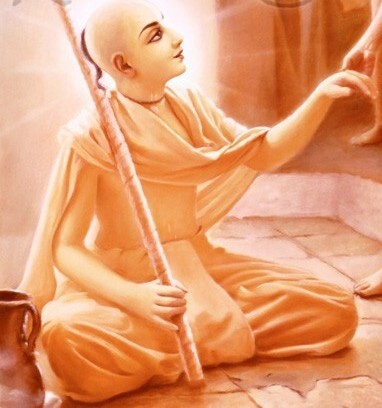
When Mahaprabhu could no longer contain His desire to renounce the world, the first house He went to, before He told anyone else, was Mukunda Datta's. It was the opening scene of a decade in which Mukunda would be present for nearly every major turn in the Lord's life at Jagannatha Puri.
The Night Before Katwa #
When Mukunda heard what Mahaprabhu intended, he begged Him to wait, and to continue the sankirtana movement a few days longer before taking sannyasa. The plea did not change Mahaprabhu's mind, but it earned Mukunda a place at the center of what followed. Nityananda Prabhu told Gadadhara Pandit, Chandrashekhara Acharya and Mukunda Datta that the sannyasa would go ahead. They all went to Katwa and arranged the kirtana and the items the ceremony required. Sri Chaitanya-charitamrita itself states very plainly who was with Him at the ceremony. When Mahaprabhu accepted sannyasa, three people were with Him to see to everything necessary: Nityananda Prabhu, Chandrashekhara Acharya, and Mukunda Datta.
The Broken Staff at Jaleshvara #
After the sannyasa, Mukunda followed the Lord toward Jagannatha Puri, along with the small circle closest to Him. At Jaleshvara, Nityananda Prabhu famously broke Mahaprabhu's sannyasa staff. It was an act of loving boldness toward the Lord's new symbol of renunciation, and Mukunda Datta was present to see it happen. From this point on, even after he had returned to Bengal, Mukunda made the journey to Puri every single year to see Mahaprabhu again. The tradition records this discipline simply, without adding anything to it. It is as though the plain fact of a yearly pilgrimage said everything that needed to be said about how strongly he was attached to the Lord.
Announcing the Lord to Sarvabhauma Bhattacharya #
On one of the earliest of these journeys, Mukunda arrived at Puri with Nityananda Prabhu and the rest of the party. There he met again Gopinatha Acharya, an old acquaintance from before. It was Mukunda who explained to him, in detail, that Mahaprabhu had taken sannyasa and come to see Lord Jagannatha, and that the party had just arrived looking for Him. Gopinatha Acharya recognized Mahaprabhu's true nature immediately. He took Mukunda with him to the house of his brother-in-law, the great logician Sarvabhauma Bhattacharya, where Mahaprabhu was staying. When Sarvabhauma later made philosophical statements that pained the devotees, it was Gopinatha Acharya and Mukunda Datta together who objected. Mahaprabhu gently corrected them both. He defended Sarvabhauma's sincerity, even while He worked over the following days to free him from Mayavada philosophy for good. This one small episode shows two sides of Mukunda together. He was eager to protect the Lord's honor, and he was willing to be corrected when that eagerness went too far.
Guiding a Muslim Governor Toward the Ganges #
Years later, on the road toward Vrindavana, Mahaprabhu's party met a Muslim governor. He fell to the ground in tears at the mere sight of the Lord and begged to be allowed to serve. It was Mukunda Datta who stepped forward with a practical request. He asked the governor to help Mahaprabhu travel on to the bank of the Ganges. The governor did so gladly. He sent boats the next morning and personally received the Lord on the other side. It is a brief moment, easy to miss beside the governor's own dramatic conversion. But it shows a side of Mukunda seen nowhere else in his story. He was the well-spoken associate whom the other devotees could rely on to deal plainly and effectively with officials and strangers.
Leading Kirtana Before Jagannatha's Chariot #
At Puri, Mukunda took his place in the inner circle that had gathered there, which included Svarupa Damodara Goswami, Ramananda Raya, and Haridasa Thakura. During Ratha-yatra he led the third of seven sankirtana parties that performed before Lord Jagannatha's chariot. Haridasa Thakura was that party's principal dancer. According to the fuller Puri-era accounts, Mukunda was also present when Raghunatha Dasa Goswami first arrived to see Mahaprabhu, and when the aged Brahmananda Bharati came seeking the Lord's darshan. This decade began with a plea to delay sannyasa. By its end, Mukunda had a part in nearly every event of the Lord's life at Puri. He was never at the center of any of it, but he was present for almost all of it.
Scriptural evidence for this chapter (2)
mukunda hayena duḥkhī dekhi' sannyāsa-dharma
tina-bāre śīte snāna, bhūmite śayana
antare duḥkhī mukunda, nāhi kahe mukhe
ihāra duḥkha dekhi' mora dvi-guṇa haye duḥkhe
Word for word
mukunda: Mukunda; hayena: becomes; duḥkhī: unhappy; dekhi': seeing; sannyāsa-dharma: regulative principles of the renounced order; tina-bāre: three times; śīte: in winter; snāna: bath; bhūmite: on the ground; śayana: lying down; antare: within himself; nāhi kahe mukhe: does not say; ihāra duḥkha: his unhappiness; mora: My; dvi-guṇa: twice; duḥkhe: unhappiness.
"Being a sannyasi, I have a duty to lie down on the ground and to take a bath three times a day, even during the winter. But Mukunda becomes very unhappy when he sees My severe austerities. Of course, Mukunda does not say anything, but I know that he is very unhappy within, and upon seeing him unhappy, I become twice as unhappy."
Mahaprabhu's own words, spoken during His South India tour, describing Mukunda Datta's silent grief over the Lord's austerities: the source of the quotation used here.
saṅge nityānanda, candraśekhara ācārya
mukunda-datta, — ei tina kaila sarva kārya
Word for word
saṅge: in His company; nityānanda: Nityānanda Prabhu; candraśekhara ācārya: Candraśekhara Ācārya; mukunda-datta: Mukunda Datta; ei tina: these three; kaila: performed; sarva: all; kārya: necessary activities.
When Sri Chaitanya Mahaprabhu accepted sannyasa, three personalities were with Him to perform all the necessary activities. They were Nityananda Prabhu, Chandrashekhara Acharya and Mukunda Datta.
Names the three devotees who arranged the kirtana and paraphernalia for Mahaprabhu's sannyasa at Katwa, including Mukunda Datta.
Chapter 6
Disappearance and Legacy
A singer remembered on the day of Snana Yatra, and a family that gave Mahaprabhu two of His most cherished devotees
No source records the year Mukunda Datta was born or the year he died. What survives instead is a date on the Gaudiya Vaishnava calendar, a burial site at Puri, a spiritual identity from Krishna's own pastimes, and a brother whose fame, in the end, grew to rival his own.
The Day of Snana Yatra #
The tradition places Mukunda Datta's disappearance on the full moon day of the month of Jyeshtha. This is the very day of Snana Yatra, Lord Jagannatha's annual bathing festival at Puri. This is recorded independently in two places. A biography compiled by Srila Bhakti Ballabh Tirtha Goswami Maharaj states it directly. And in a 1976 room conversation in Detroit, Srila Prabhupada's own disciple Madhavananda dasa can be heard mentioning it, almost in passing. He noted that the day was Snana Yatra, the disappearance day of Mukunda Datta and Sridhara Pandita, and that Syamananda Gosvami's disappearance fell on the following day. The two sources are very different in kind. One is a formal biography, and the other is a casual remark caught on tape decades later. Yet both agree on the same tithi. For a disappearance with no recorded year, that is about as much confirmation as one can reasonably expect.
The Sixty-Four Samadhis #
Tradition places Mukunda Datta's samadhi within the area at Jagannatha Puri known as the Sixty-Four Samadhis, alongside memorials to several other devotees of Mahaprabhu's own generation. No year is given for the samadhi, just as no year is given for the date. But the place itself tells us something. It puts Mukunda's resting place among the Lord's closest Bengali associates. It is in the pilgrimage town he had returned to year after year, for a decade of his life, simply to see Mahaprabhu again. Earlier, in this same town, he had stood beside Gopinatha Acharya defending Mahaprabhu's honor before Sarvabhauma Bhattacharya. From this town he later set out with the Lord toward Vrindavana. On the way, he helped a Muslim governor at the Orissa border arrange safe passage for the Lord. Both stories are told on sannyasa and the years at Jagannatha Puri.
His Brother Vasudeva Datta #
Mukunda's family did not end its service to Mahaprabhu with him. His elder brother, Vasudeva Datta, went on to become one of the most celebrated devotees in the entire Chaitanya-charitamrita. He is the devotee about whom Mahaprabhu vowed, three times over, that His own body existed only to give him pleasure. Vasudeva also wanted to take upon himself the sinful reactions of every living being, so that Mahaprabhu could deliver them all. Vasudeva Datta later initiated Yadunandana Acharya, who in turn became the spiritual master of Raghunatha Dasa Goswami. So a line of teachers going back to the two Datta brothers of Chittagong reaches, a generation later, into the guru-parampara of one of the Six Goswamis of Vrindavana themselves. Vasudeva Datta also established a temple of Madana-gopala at Mamagachi, near the birthplace of Vrindavana Dasa Thakura. The Gaudiya Matha has maintained this temple ever since Srila Bhaktisiddhanta Sarasvati Thakura began the Navadvipa-parikrama and made it one of the pilgrimage's regular stops.
Madhukantha, the Singer of Vraja #
Kavi Karnapura's Gaura-ganoddesha-dipika gives Mukunda Datta a name from beyond this one lifetime. He says that in Krishna's own Vrindavana pastimes, Mukunda and Vasudeva Datta were Madhukantha and Madhuvrata. They were two singers whose voices belonged to Vraja before either brother was ever born in Chittagong. It is hard to imagine a more fitting identity for Mukunda. As a boy, he lost debates to his classmate at Gangadasa Pandita's tol. As a singer, his voice alone could make Sri Chaitanya Mahaprabhu dance. For a short time he was famously kept from the Lord's mercy for keeping the wrong company. And he was the one person in Navadvipa who knew enough to hand Gadadhara Pandit the single verse that changed his life. In every one of those roles, the throat that the tradition calls sweet as honey was always the thing that mattered most.
No portrait of Mukunda Datta survives in any independent historical record, and no scholar can fix the years of his birth or death. For five hundred years, only memory and manuscripts have carried what survives of him. What has survived is one simple fact, repeated in text after text. When this particular man opened his mouth to sing, the Supreme Lord Himself could not stay still.
Scriptural evidence for this chapter (1)
vāsudeva datta — prabhura bhṛtya mahāśaya
sahasra-mukhe yāṅra guṇa kahile nā haya
Word for word
vāsudeva datta: Vāsudeva Datta; prabhura: of Lord Śrī Caitanya Mahāprabhu; bhṛtya: servant; mahāśaya: great personality; sahasra-mukhe: with thousands of mouths; yāṅra: whose; guṇa: qualities; kahile: describing; nā: never; haya: becomes fulfilled.
Vasudeva Datta, the nineteenth branch of the Sri Chaitanya tree, was a great personality and a most confidential devotee of the Lord. One could not describe his qualities even with thousands of mouths.
From the purport: Purport excerpt: "Vāsudeva Datta, the brother of Mukunda Datta, was also a resident of Caṭṭagrāma."
Establishes Vasudeva Datta as Mukunda Datta's elder brother, central to the account here of the Datta family's wider legacy.
- Sri Chaitanya-charitamrita, Adi-lila 10.40-42 (Bhaktivedanta VedaBase)
- Sri Chaitanya-charitamrita, Adi-lila 17.65, purport (Bhaktivedanta VedaBase)
- Sri Chaitanya-charitamrita, Madhya-lila 6-7, 10, 16, Antya-lila 6 (Bhaktivedanta VedaBase)
- Mukunda Datta – Biography, Gaudiya History
- Mukunda Datta, Gaudiya History (alternate retelling)
- Sri Mukunda Datta Thakura, in Sri Chaitanya: His Life and Associates by Srila Bhakti Ballabh Tirtha Goswami Maharaj
- Interview with Jackie Vaughn, State Representative, 12 June 1976, Detroit (Bhaktivedanta VedaBase)
