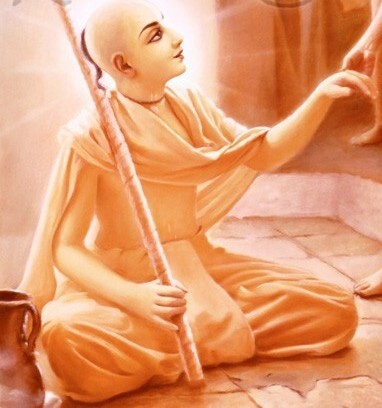
When Mahaprabhu could no longer contain His desire to renounce the world, the first house He went to, before He told anyone else, was Mukunda Datta's. It was the opening scene of a decade in which Mukunda would be present for nearly every major turn in the Lord's life at Jagannatha Puri.
The Night Before Katwa #
When Mukunda heard what Mahaprabhu intended, he begged Him to wait, and to continue the sankirtana movement a few days longer before taking sannyasa. The plea did not change Mahaprabhu's mind, but it earned Mukunda a place at the center of what followed. Nityananda Prabhu told Gadadhara Pandit, Chandrashekhara Acharya and Mukunda Datta that the sannyasa would go ahead. They all went to Katwa and arranged the kirtana and the items the ceremony required. Sri Chaitanya-charitamrita itself states very plainly who was with Him at the ceremony. When Mahaprabhu accepted sannyasa, three people were with Him to see to everything necessary: Nityananda Prabhu, Chandrashekhara Acharya, and Mukunda Datta.
The Broken Staff at Jaleshvara #
After the sannyasa, Mukunda followed the Lord toward Jagannatha Puri, along with the small circle closest to Him. At Jaleshvara, Nityananda Prabhu famously broke Mahaprabhu's sannyasa staff. It was an act of loving boldness toward the Lord's new symbol of renunciation, and Mukunda Datta was present to see it happen. From this point on, even after he had returned to Bengal, Mukunda made the journey to Puri every single year to see Mahaprabhu again. The tradition records this discipline simply, without adding anything to it. It is as though the plain fact of a yearly pilgrimage said everything that needed to be said about how strongly he was attached to the Lord.
Announcing the Lord to Sarvabhauma Bhattacharya #
On one of the earliest of these journeys, Mukunda arrived at Puri with Nityananda Prabhu and the rest of the party. There he met again Gopinatha Acharya, an old acquaintance from before. It was Mukunda who explained to him, in detail, that Mahaprabhu had taken sannyasa and come to see Lord Jagannatha, and that the party had just arrived looking for Him. Gopinatha Acharya recognized Mahaprabhu's true nature immediately. He took Mukunda with him to the house of his brother-in-law, the great logician Sarvabhauma Bhattacharya, where Mahaprabhu was staying. When Sarvabhauma later made philosophical statements that pained the devotees, it was Gopinatha Acharya and Mukunda Datta together who objected. Mahaprabhu gently corrected them both. He defended Sarvabhauma's sincerity, even while He worked over the following days to free him from Mayavada philosophy for good. This one small episode shows two sides of Mukunda together. He was eager to protect the Lord's honor, and he was willing to be corrected when that eagerness went too far.
Guiding a Muslim Governor Toward the Ganges #
Years later, on the road toward Vrindavana, Mahaprabhu's party met a Muslim governor. He fell to the ground in tears at the mere sight of the Lord and begged to be allowed to serve. It was Mukunda Datta who stepped forward with a practical request. He asked the governor to help Mahaprabhu travel on to the bank of the Ganges. The governor did so gladly. He sent boats the next morning and personally received the Lord on the other side. It is a brief moment, easy to miss beside the governor's own dramatic conversion. But it shows a side of Mukunda seen nowhere else in his story. He was the well-spoken associate whom the other devotees could rely on to deal plainly and effectively with officials and strangers.
Leading Kirtana Before Jagannatha's Chariot #
At Puri, Mukunda took his place in the inner circle that had gathered there, which included Svarupa Damodara Goswami, Ramananda Raya, and Haridasa Thakura. During Ratha-yatra he led the third of seven sankirtana parties that performed before Lord Jagannatha's chariot. Haridasa Thakura was that party's principal dancer. According to the fuller Puri-era accounts, Mukunda was also present when Raghunatha Dasa Goswami first arrived to see Mahaprabhu, and when the aged Brahmananda Bharati came seeking the Lord's darshan. This decade began with a plea to delay sannyasa. By its end, Mukunda had a part in nearly every event of the Lord's life at Puri. He was never at the center of any of it, but he was present for almost all of it.
