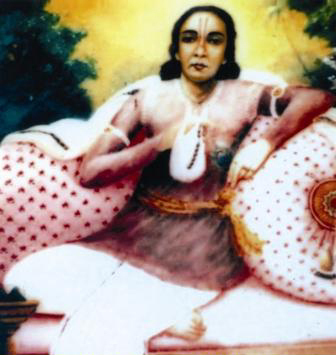
Of everyone in Navadvipa, only Mukunda Datta knew what Pundarika Vidyanidhi's wealth and worldliness actually concealed. It was Mukunda who decided, one ordinary day, that a young brahmachari named Gadadhara Pandit needed to find out.
A Secret Kept from Nabadwip #
Pundarika Vidyanidhi came to Navadvipa from Chittagong in the guise of a wealthy, sense-enjoying man of the world, and he made no effort to look like anything else. Almost no one there could see past it. Mukunda Datta could. He had lived in Chittagong himself, and had known Pundarika Vidyanidhi long before either of them settled near the Ganges. And behind the disguise there was something deeper still. Kavi Karnapura's Gaura-ganoddesha-dipika identifies Pundarika, surprisingly, as Vrishabhanu Maharaja, the father of Srimati Radharani in Krishna's own pastimes. This is the very reason Mahaprabhu Himself would sometimes weep and call out for him as "father." None of that could be seen from the outside, in a man reclining on bolster cushions with betel and attendants at hand. Mukunda kept the knowledge largely to himself. He waited until the day he judged that someone else was ready to be shown it.
Taking Gadadhara to See Him #
That someone was Gadadhara Pandit, a twenty-year-old brahmachari. Since childhood he had not cared for comfort, and by nature he tended to take outward things seriously. Mukunda told him one day that he was going to introduce him to a most exceptional Vaishnava, and took him along. Gadadhara found a man reclining on an expensive bed under a canopy. The sheets are described as white as the foam of milk. Scented pan lay within reach in a jeweled box, and servants were fanning him. Gadadhara could not fit any of this with what Mukunda had promised him. The doubt showed plainly on his face.
The Verse That Broke the Disguise #
Mukunda saw it, and did the one thing that would settle it. He recited aloud a verse spoken by Uddhava in the Third Canto of Srimad-Bhagavatam. In it Uddhava marvels that Krishna gave the position of a nurse to the demoness Putana, who had come with poison on her breast to kill Him. He asks where a more merciful shelter than that could possibly be found. The effect on Pundarika Vidyanidhi was immediate. He cried out, fell to the ground, and showed all the ecstatic symptoms that the Vaishnava manuals describe. He tore at the fine bedding and wailed that the Lord's mercy had been withheld from him, and then he fell unconscious for hours. Mukunda alone knew which verse would have this effect, and he chose it. That single verse was enough to strip away Pundarika's entire disguise. It happened in front of Gadadhara, who had judged the outward show correctly for what it seemed, but had completely missed what lay underneath.
What Came of It #
Gadadhara understood immediately that he had committed a serious offense by judging a devotee by his outward circumstances. The remedy was initiation from the very man Gadadhara had misjudged. It came about through Mahaprabhu's guidance and through the force of what Mukunda's recitation had just revealed. When Pundarika Vidyanidhi returned to ordinary consciousness, he gave no sign of what had just happened. Gadadhara took the idea back to Mukunda before acting on it. One account describes Mukunda as much delighted at the request. In this account Mukunda carried it to Pundarika Vidyanidhi himself, who happily set a date for the initiation, and Mahaprabhu gave His approval. On the day that had been set, Pundarika Vidyanidhi initiated Gadadhara Pandit and remained his spiritual master for life. A second initiation followed years later at Jagannatha Puri. Gadadhara Pandit's own page, initiation from Pundarika Vidyanidhi, gives the fullest account of that side of the story. It explains how the two Chaitanya-charitamrita passages describing it fit together, and what the episode is traditionally taken to teach about judging a Vaishnava by appearances.
Mukunda Datta's part in the story ends there. He supplied the introduction and the one verse that mattered, and then he stepped back. This pattern appears everywhere else in his life too. He is almost never the main person in a pastime. He is the friend standing just to the side of it. He holds the one piece of knowledge, or the one line of scripture, that the moment actually needed. It happens again here. By any fair measure this story belongs to Gadadhara Pandit and Pundarika Vidyanidhi, except that neither man would have met the other without him.
