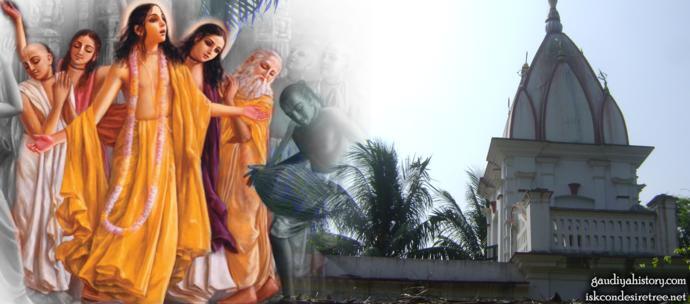
Two brothers from a family of physicians in Chittagong, at the eastern edge of Bengal, came to Navadvipa to study. One of them ended up sharing a classroom with the boy who would become Sri Chaitanya Mahaprabhu.
| Detail | Description |
|---|---|
| Native place | Chanhara, Patiya police station, Chittagong district (named Chakrashala in one later source) |
| Family | Ambastha physicians, surname Datta |
| Elder brother | Vasudeva Datta, later one of Mahaprabhu's most celebrated devotees |
| School | Gangadasa Pandita's tol, Navadvipa |
| Classmate | Nimai Pandit, the future Sri Chaitanya Mahaprabhu |
A Village Called Chanhara #
Srila Prabhupada's purport to Sri Chaitanya-charitamrita places Mukunda Datta's birth in the village of Chanhara, under the Patiya police station of the Chittagong district. He notes that this village was about twenty miles from the home of Pundarika Vidyanidhi. This is the same devotee whom Mukunda would one day introduce to Gadadhara Pandit. A later compiled biography gives the village a different name, Chakrashala. It adds that the family was remembered locally as Ambastha physicians, a Bengali community traditionally connected with the practice of medicine. The two accounts do not agree on the village's name, and nothing in the sources settles the difference. But both agree on the district, the family's trade, and the distance to Pundarika Vidyanidhi's home. So the difference is only a small detail, not a real dispute.
The Ambastha Physicians of Datta #
Mukunda's elder brother was Vasudeva Datta. Gaudiya Vaishnavas remember his name with almost as much honour as Mukunda's own. Krishnadasa Kaviraja Goswami calls Vasudeva the nineteenth branch of the Chaitanya tree, and says his qualities could not be described even with a thousand mouths. Mahaprabhu vowed three separate times that His own body existed only to give Vasudeva pleasure. The two brothers came from a single household of physicians in Chittagong and arrived in Navadvipa together. This is one of the more unusual family stories among Mahaprabhu's early associates. Most of them came to Him one at a time, not as brothers already devoted to each other.
Fellow Students at Gangadasa Pandita's Tol #
Many Vaishnava families from Chittagong had settled near the Ganges in Navadvipa, to study and to live close to the sacred river. In this community Mukunda joined the tol, or school, of Gangadasa Pandita. At the same tol, a very quick student named Nimai Pandit was already ahead of every teacher in Navadvipa except Gangadasa himself. Sri Chaitanya-bhagavata describes at some length what happened when the two of them met. At first there was no devotion between them, only rivalry. Nimai clearly enjoyed cornering Mukunda with tricks of logic. Their debates happened often enough that Krishnadasa Kaviraja Goswami mentions them specifically when introducing Mukunda in Sri Chaitanya-charitamrita.
An Admiration He Could Not Admit #
One exchange in particular survives in some detail. Mukunda had been cornered once too often on a point of grammar, so he tried changing the terms of the contest. Grammar, he said, was a child's subject; let Nimai answer him instead in alankara, the far harder study of poetic figures of speech. Nimai did, effortlessly. He established an argument, refuted it, and established it again, in a display that left Mukunda unable to find a weakness anywhere in it. Alone with his thoughts afterward, Mukunda came to the conclusion that no ordinary human being could possibly hold that much learning. He was in no position to say this aloud among his fellow students. Most of them went out of their way to avoid the young logician's company entirely. If only, Mukunda thought, this brilliant, exhausting classmate of his were also a devotee of Krishna. He would never leave His company again.
As Mukunda watched Nimai walk away from another debate he had just won, he had no way of knowing what lay ahead. The wish would be granted more completely than he could have imagined. The friendship beginning in that schoolyard would carry him through the first ecstatic years of the sankirtana movement, to Srivasa Pandita's courtyard and, eventually, all the way to Jagannatha Puri.
Looking back, this beginning was very ordinary. In Gangadasa Pandita's tol, nothing marked Mukunda Datta out as a future companion of the Supreme Lord. He had only a sharp mind, a habit of losing arguments to a classmate he privately admired, and a family recently arrived from Chittagong. The tradition does not add omens or predictions to his early years. It simply records a friendship that, in time, turned out to matter more than either boy could have guessed.
