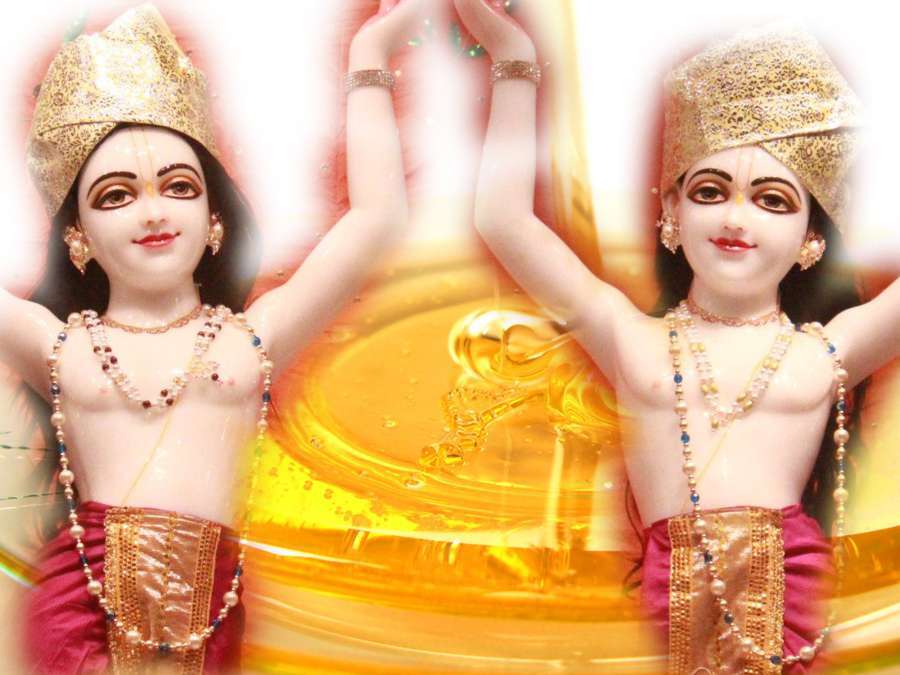
Gaudiya Vaishnava tradition remembers two pastimes from Narahari Sarkar Thakura's years at Srikhanda with special affection. Both show the same thing about him. Outwardly he lived as a Bengali physician's son, but he had a confidential identity from Krishna's own pastimes in Vraja. The Gaura-ganoddesha-dipika identifies Narahari as the gopi Madhumati, one of Radha's intimate friends. Her special service to Radha and Govinda is to supply Them with honey.
| Detail | Description |
|---|---|
| Setting | Srikhanda, Bardhaman district, Bengal |
| Pastime 1 | The Madhu-pushkarini, a pond that turned to honey for Nityananda Prabhu |
| Pastime 2 | Three Deities of Gauranga, carved after a dream instruction |
| Deity locations | Srikhanda, Katwa, and Ganganagara |
| Spiritual identity | Madhumati, an intimate gopi friend of Srimati Radharani, per the Gaura-ganoddesha-dipika |
The Pond That Turned to Honey #
According to Gaudiya Vaishnava tradition, Nityananda Prabhu once arrived at Narahari's home at Srikhanda. In a playful mood, He asked Narahari directly where his honey was. This was a clear reference to Narahari's own confidential service as Madhumati in Krishna's pastimes. Narahari went at once to a pond near his house and filled a pot with its ordinary water. The water itself turned to honey of wonderful sweetness. Nityananda Prabhu and the associates with Him drank from it until they were fully satisfied. The pond has been known ever since as Madhu-pushkarini, the honey pond, and people still show it at Srikhanda as a holy place. Compared with Mahaprabhu's whole movement, this is a small pastime. But it is remembered because it shows two sides of Narahari. Outwardly he was humble, a village physician's son fanning the Lord with a camara. Inwardly he had a very intimate identity in Krishna's own eternal pastimes.
Three Deities From a Dream #
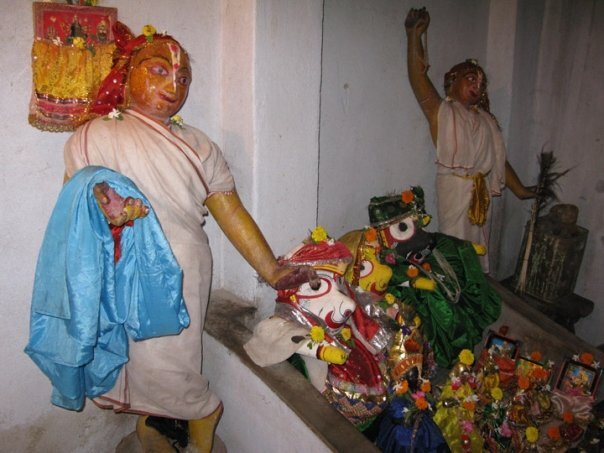
The second pastime is about Deity worship, not a single miraculous event. Mahaprabhu is said to have appeared to Narahari in a dream after He Himself had accepted sannyasa. He instructed Narahari to carve Deities of Him in His ecstatic form, dancing in kirtana. Narahari did so and made three such Deities of Gauranga. They came to be installed and worshiped at three separate places connected with him and his family: Srikhanda itself, nearby Katwa, and Ganganagara. Devotees still worship these Deities today. Together with the honey pond, this pastime is often told to show how closely Mahaprabhu stayed involved in the devotional life of the Srikhanda Vaishnavas, even after He left Bengal for Jagannatha Puri. Later generations of Narahari's own tradition are also remembered for installing more Deities in his honor and in Mahaprabhu's. One example is a pair of Gaura-Gadadhara Deities still served at a small math connected to his line at Jagannatha Puri itself. This is separate from the original three Deities. But it shows how far this one Srikhanda physician's devotional household finally reached.
Miracle and Ordinary Devotion Together #
In both pastimes, Narahari himself is described as making very little of what happened. No source shows him claiming any special status because of the honey pond or the dream instruction. In every other account of his life he is simply the man fanning the Lord with a camara, the uncle watching over his nephew Raghunandana Thakura, and later the guru who ordered Lochana Dasa Thakura to write Sri Chaitanya-mangala. Real, specific, named miracle-pastimes, side by side with a very humble outward life, are typical of how Gaudiya Vaishnava devotional biographies describe Mahaprabhu's own intimate associates. These pastimes are told in that spirit, not as proof of any special status that Narahari claimed for himself. The fuller account of his place among the wider Srikhanda circle continues on Leader of the Srikhanda Vaishnavas.
