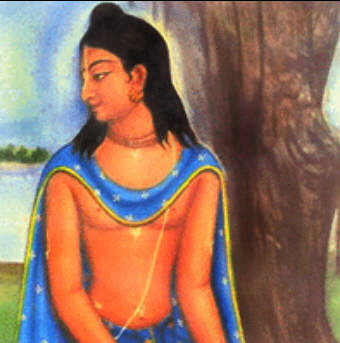
Narahari Sarkar Thakura was born at Srikhanda, a village a few miles from Katwa on the Bardhaman side of Bengal. His family belonged to the vaidya community, Bengal's hereditary caste of physicians. His father was Narayana Dasa and his mother Goyi, the daughter of one Murari Sena. He had two brothers: Mukunda Dasa, the eldest of the three, and Madhava Dasa. Mukunda Dasa rose as high in the family profession as a Bengali physician of his day could go. For a period he served as physician to the Muslim ruler at Gaur, then Bengal's capital. Narahari himself is recorded as having done the same for a time, serving briefly at the same court. Then his life turned firmly away from medicine toward devotional service. Mukunda Dasa's son, Raghunandana Thakura, grew up in this household. By tradition's account, as he was raised, he received special affection and guidance from his uncle Narahari.
| Detail | Description |
|---|---|
| Birthplace | Srikhanda, Bardhaman district, Bengal |
| Family | Father Narayana Dasa, mother Goyi; brothers Mukunda Dasa and Madhava Dasa |
| Family profession | Vaidya (hereditary physician); Narahari himself served briefly at the court of Gaur |
| Entry into Mahaprabhu's service | Through the constant presence of Gadadhara Pandit |
| Personal service | Fanning Sri Chaitanya Mahaprabhu with a camara during kirtana |
A Village of Physicians and Poets #
Srikhanda was no ordinary village. Sri Chaitanya-charitamrita names a whole group of its residents among the great branches of Mahaprabhu's own tree of mercy. They are Mukunda Dasa and his son Raghunandana together, Narahari himself, and two more residents, Chiranjiva and Sulocana. Chiranjiva's own two sons, Ramachandra Kaviraja and the poet Govinda Dasa Kaviraja, went on to become celebrated Vaishnavas themselves. Ramachandra became a disciple of Shrinivasa Acharya and a close associate of Narottama Dasa Thakura. So Narahari grew up in a village whose devotion and poetry were already unusually rich, even before Mahaprabhu's sankirtana movement reached it. This background shows clearly in the fine quality of his own later Sanskrit and Bengali poetry.
Verses on Radha and Krishna, Then on Gauranga #
Before he ever entered Mahaprabhu's personal circle, Narahari had already begun writing devotional verse on the pastimes of Radha and Krishna, in the manner of the Vaishnava poets of his generation. What changed his subject was Mahaprabhu Himself. Tradition records that Narahari came into the Lord's association through Gadadhara Pandit, who was constantly at Mahaprabhu's side. Once he had entered that circle, his poetry itself turned toward Gauranga's own form and pastimes. Some later literary historians treat this change as the beginning of a whole devotional style. These were songs meditating on Chaitanya Mahaprabhu's own person, not only on Krishna's Vraja pastimes. In the years that followed, Narahari became known for his singing and composing. He was known just as much for his personal service, which gave him a lasting place in Mahaprabhu's own worship. He fanned the Lord with a camara, a yak-tail whisk, during kirtana.
A Service Still Sung of Today #
Of all the details of Narahari's outward life, this single act of personal service is the one that has lasted longest. Srila Bhaktivinoda Thakura's own Gaura-arati is a song sung in Gaudiya Vaishnava temples at the opening of daily worship. It names Narahari directly among those who fan Mahaprabhu with camaras while other associates sing along. This line is still sung today, more than four centuries later, wherever this arati is performed. Sri Chaitanya-charitamrita itself places Narahari exactly within Srikhanda's circle of devotees. It names Mukunda Dasa and Raghunandana together as the thirty-ninth great branch of Mahaprabhu's tree of mercy, Narahari himself as the fortieth, and Chiranjiva and Sulocana as the forty-first and forty-second. Some later Gaudiya Vaishnava writers use the title "Sarkar Thakura" itself as a sign of his recognized share in Gauranga-prema, love for Mahaprabhu's own person. For them it is not only a family surname. But vaidya families of Bengal did commonly carry the title Sarkar. And Narahari's own household is generally described using it in that ordinary sense as well.
From this settled place at the heart of one Bengali village's devotional life, Narahari's story goes on. His two miracle-pastimes are told on The Honey Pond and the Gauranga Deities. His leading role among the wider Srikhanda Vaishnavas is told on Leader of the Srikhanda Vaishnavas. In time he became Lochana Dasa Thakura's own guru, and this is told in full on Guru to Lochana Dasa Thakura.
