Srila Narahari Sarkar Thakura
Leader of the Srikhanda Vaishnavas and Guru of Lochana Dasa Thakura
The complete life, on one page: The main biography and every pastime page, in order, in one place
Introduction
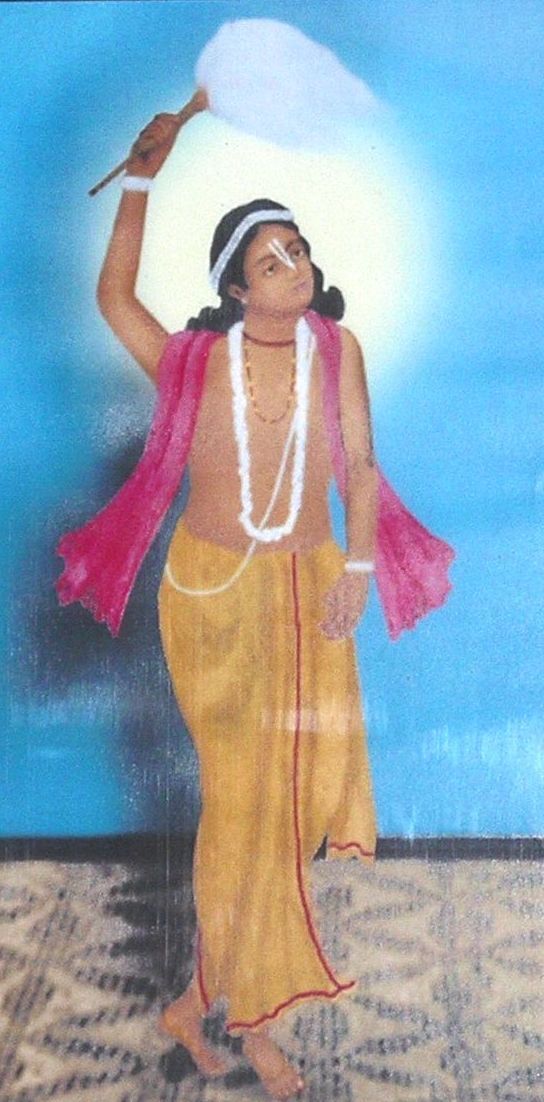
Srila Narahari Sarkar Thakura was one of Sri Chaitanya Mahaprabhu's own associates during the Lord's manifest pastimes. He was born a few years before Mahaprabhu Himself, into a vaidya (physician) family at Srikhanda, a village near Katwa in Bengal. Sri Chaitanya-charitamrita names him among the great branches of Mahaprabhu's own tree of mercy. Srila Prabhupada's purport there records that Lochana Dasa Thakura, the celebrated author of Sri Chaitanya-mangala, was his disciple. He was also uncle to Raghunandana Thakura, the child devotee of Srikhanda who fed the family Deity of Gopinatha with his own hands.
One point needs to be made clear here, because two very similar names have long been confused in Gaudiya Vaishnava writing. This name belongs to Narahari Sarkar Thakura, the Srikhanda associate who served during Mahaprabhu's own lifetime. He is not Narahari Chakravarti Thakura, also called Ghanashyama Dasa. Narahari Chakravarti was a cook-priest based in Vrindavana, who lived a full century and more later. He was a follower of Vishvanatha Chakravarti Thakura's line, and he wrote Bhakti-ratnakara and Narottama-vilasa. Because the names are almost the same, some later summaries have mixed up the two. But they belonged to completely different generations of the tradition, more than a hundred years apart.
| Detail | Description |
|---|---|
| Birth | c. 1479-80 AD (Shaka 1401/1402), some years before Sri Chaitanya Mahaprabhu's own appearance |
| Birthplace | Srikhanda, near Katwa, Bardhaman district, Bengal, into a vaidya (physician) family |
| Parents | Narayana Dasa (father) and Goyi (mother) |
| Brothers | Mukunda Dasa (elder) and Madhava Dasa; Mukunda's son was Raghunandana Thakura |
| Identity | The gopi Madhumati, Srimati Radharani's dear friend in Vrindavana (Gaura-ganoddesha-dipika 177) |
| Major works | Sri Krishna-bhajanamrita, Bhakti-chandrika-patala, Sri Chaitanya-sahasranama, and shorter devotional poems |
| Chief disciple | Lochana Dasa Thakura, author of Sri Chaitanya-mangala |
| Disappearance | Krishna Ekadashi of Agrahayana month; the year itself is disputed (see below) |
Scriptural evidence for the introduction (3)
khandavasi mukunda-dasa, sri-raghunandana
narahari-dasa, ciranjiva, sulocana
ei saba mahasakha -- caitanya-krpadhama
prema-phala-phula kare yahan tahan dana
Word for word
khanda-vasi mukunda-dasa -- Mukunda dasa, a resident of Srikhanda; sri-raghunandana -- Raghunandana; narahari-dasa -- Narahari dasa; ciranjiva -- Ciranjiva; sulocana -- Sulocana; ei saba -- all of them; maha-sakha -- great branches; caitanya-krpa-dhama -- of Lord Sri Caitanya Mahaprabhu, the reservoir of mercy; prema -- love of God; phala -- fruit; phula -- flower; kare -- does; yahan -- anywhere; tahan -- everywhere; dana -- distribution.
Sri Khandavasi Mukunda and his son Raghunandana were the thirty-ninth branch of the tree, Narahari was the fortieth, Ciranjiva the forty-first and Sulocana the forty-second. They were all big branches of the all-merciful tree of Caitanya Mahaprabhu. They distributed the fruits and flowers of love of Godhead anywhere and everywhere.
From the purport: Purport excerpt: "Narahari dasa Sarakara was a very famous devotee. Locana dasa Thakura, the celebrated author of Sri Caitanya-mangala, was his disciple."
The primary textual basis for Narahari Sarkar Thakura's place among Sri Chaitanya Mahaprabhu's own associates and for his discipleship link to Lochana Dasa Thakura.
narahari-adi kori' camara dhulaya
sanjaya-mukunda-vasu-ghosa-adi gaya
Narahari Sarakara and other associates fan the Lord with camaras (yak-tail whisks) while devotees headed by Sanjaya Pandita, Mukunda Datta, and Vasu Ghosha sing in accompaniment.
A verse of Srila Bhaktivinoda Thakura's own arati song, sung daily in Gaudiya Vaishnava temple worship, that names Narahari Sarkar Thakura's personal service to Sri Chaitanya Mahaprabhu; the source for the pull-quote here.
पुरा मधुमती प्राणसखी वृन्दावने स्थिता ।
अधुना नरहर्याख्यः सरकारः प्रभोः प्रियः ॥१७७॥
purā madhumatī prāṇa-sakhī vṛndāvane sthitā |
adhunā narahary-ākhyaḥ sarakāraḥ prabhoḥ priyaḥ ||177||
Srimati Radharani's dear friend, the vraja-gopi named Madhumati-devi, appeared as Narahari Sarakara, who was very dear to Lord Caitanya.
Kavi Karnapura identifies Narahari Sarakara of Srikhanda as Madhumati, a dear friend (prana-sakhi) of Vrindavana. Sanskrit: diacritic edition of the Gaura-ganoddesha-dipika; English translation as published at bvmlu.org.
Chapter 1
Birth and Entry into Mahaprabhu's Service
A physician's son of Srikhanda who came into Sri Chaitanya Mahaprabhu's personal circle through Gadadhara Pandit.
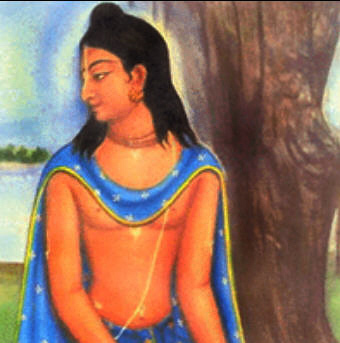
Narahari Sarkar Thakura was born at Srikhanda, a village a few miles from Katwa on the Bardhaman side of Bengal. His family belonged to the vaidya community, Bengal's hereditary caste of physicians. His father was Narayana Dasa and his mother Goyi, the daughter of one Murari Sena. He had two brothers: Mukunda Dasa, the eldest of the three, and Madhava Dasa. Mukunda Dasa rose as high in the family profession as a Bengali physician of his day could go. For a period he served as physician to the Muslim ruler at Gaur, then Bengal's capital. Narahari himself is recorded as having done the same for a time, serving briefly at the same court. Then his life turned firmly away from medicine toward devotional service. Mukunda Dasa's son, Raghunandana Thakura, grew up in this household. By tradition's account, as he was raised, he received special affection and guidance from his uncle Narahari.
| Detail | Description |
|---|---|
| Birthplace | Srikhanda, Bardhaman district, Bengal |
| Family | Father Narayana Dasa, mother Goyi; brothers Mukunda Dasa and Madhava Dasa |
| Family profession | Vaidya (hereditary physician); Narahari himself served briefly at the court of Gaur |
| Entry into Mahaprabhu's service | Through the constant presence of Gadadhara Pandit |
| Personal service | Fanning Sri Chaitanya Mahaprabhu with a camara during kirtana |
A Village of Physicians and Poets #
Srikhanda was no ordinary village. Sri Chaitanya-charitamrita names a whole group of its residents among the great branches of Mahaprabhu's own tree of mercy. They are Mukunda Dasa and his son Raghunandana together, Narahari himself, and two more residents, Chiranjiva and Sulocana. Chiranjiva's own two sons, Ramachandra Kaviraja and the poet Govinda Dasa Kaviraja, went on to become celebrated Vaishnavas themselves. Ramachandra became a disciple of Shrinivasa Acharya and a close associate of Narottama Dasa Thakura. So Narahari grew up in a village whose devotion and poetry were already unusually rich, even before Mahaprabhu's sankirtana movement reached it. This background shows clearly in the fine quality of his own later Sanskrit and Bengali poetry.
Verses on Radha and Krishna, Then on Gauranga #
Before he ever entered Mahaprabhu's personal circle, Narahari had already begun writing devotional verse on the pastimes of Radha and Krishna, in the manner of the Vaishnava poets of his generation. What changed his subject was Mahaprabhu Himself. Tradition records that Narahari came into the Lord's association through Gadadhara Pandit, who was constantly at Mahaprabhu's side. Once he had entered that circle, his poetry itself turned toward Gauranga's own form and pastimes. Some later literary historians treat this change as the beginning of a whole devotional style. These were songs meditating on Chaitanya Mahaprabhu's own person, not only on Krishna's Vraja pastimes. In the years that followed, Narahari became known for his singing and composing. He was known just as much for his personal service, which gave him a lasting place in Mahaprabhu's own worship. He fanned the Lord with a camara, a yak-tail whisk, during kirtana.
A Service Still Sung of Today #
Of all the details of Narahari's outward life, this single act of personal service is the one that has lasted longest. Srila Bhaktivinoda Thakura's own Gaura-arati is a song sung in Gaudiya Vaishnava temples at the opening of daily worship. It names Narahari directly among those who fan Mahaprabhu with camaras while other associates sing along. This line is still sung today, more than four centuries later, wherever this arati is performed. Sri Chaitanya-charitamrita itself places Narahari exactly within Srikhanda's circle of devotees. It names Mukunda Dasa and Raghunandana together as the thirty-ninth great branch of Mahaprabhu's tree of mercy, Narahari himself as the fortieth, and Chiranjiva and Sulocana as the forty-first and forty-second. Some later Gaudiya Vaishnava writers use the title "Sarkar Thakura" itself as a sign of his recognized share in Gauranga-prema, love for Mahaprabhu's own person. For them it is not only a family surname. But vaidya families of Bengal did commonly carry the title Sarkar. And Narahari's own household is generally described using it in that ordinary sense as well.
From this settled place at the heart of one Bengali village's devotional life, Narahari's story goes on. His two miracle-pastimes are told on The Honey Pond and the Gauranga Deities. His leading role among the wider Srikhanda Vaishnavas is told on Leader of the Srikhanda Vaishnavas. In time he became Lochana Dasa Thakura's own guru, and this is told in full on Guru to Lochana Dasa Thakura.
Chapter 2
The Honey Pond and the Gauranga Deities
Two celebrated Srikhanda pastimes: a pond that turned to honey, and three Deities carved at the Lord's own instruction.
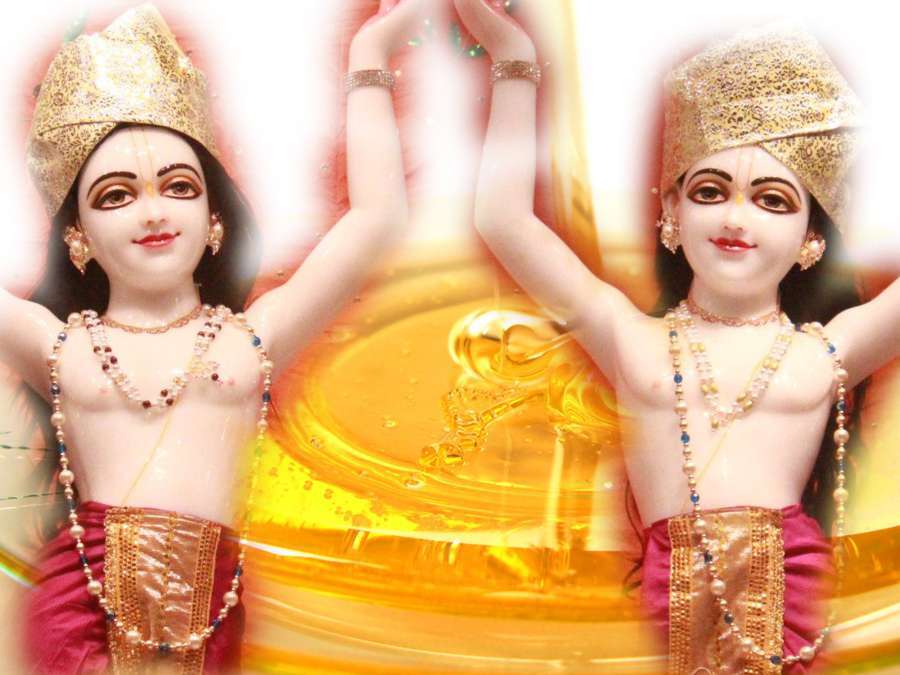
Gaudiya Vaishnava tradition remembers two pastimes from Narahari Sarkar Thakura's years at Srikhanda with special affection. Both show the same thing about him. Outwardly he lived as a Bengali physician's son, but he had a confidential identity from Krishna's own pastimes in Vraja. The Gaura-ganoddesha-dipika identifies Narahari as the gopi Madhumati, one of Radha's intimate friends. Her special service to Radha and Govinda is to supply Them with honey.
| Detail | Description |
|---|---|
| Setting | Srikhanda, Bardhaman district, Bengal |
| Pastime 1 | The Madhu-pushkarini, a pond that turned to honey for Nityananda Prabhu |
| Pastime 2 | Three Deities of Gauranga, carved after a dream instruction |
| Deity locations | Srikhanda, Katwa, and Ganganagara |
| Spiritual identity | Madhumati, an intimate gopi friend of Srimati Radharani, per the Gaura-ganoddesha-dipika |
The Pond That Turned to Honey #
According to Gaudiya Vaishnava tradition, Nityananda Prabhu once arrived at Narahari's home at Srikhanda. In a playful mood, He asked Narahari directly where his honey was. This was a clear reference to Narahari's own confidential service as Madhumati in Krishna's pastimes. Narahari went at once to a pond near his house and filled a pot with its ordinary water. The water itself turned to honey of wonderful sweetness. Nityananda Prabhu and the associates with Him drank from it until they were fully satisfied. The pond has been known ever since as Madhu-pushkarini, the honey pond, and people still show it at Srikhanda as a holy place. Compared with Mahaprabhu's whole movement, this is a small pastime. But it is remembered because it shows two sides of Narahari. Outwardly he was humble, a village physician's son fanning the Lord with a camara. Inwardly he had a very intimate identity in Krishna's own eternal pastimes.
Three Deities From a Dream #
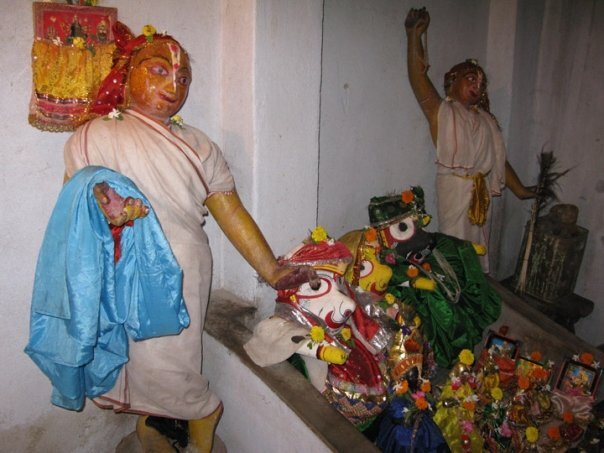
The second pastime is about Deity worship, not a single miraculous event. Mahaprabhu is said to have appeared to Narahari in a dream after He Himself had accepted sannyasa. He instructed Narahari to carve Deities of Him in His ecstatic form, dancing in kirtana. Narahari did so and made three such Deities of Gauranga. They came to be installed and worshiped at three separate places connected with him and his family: Srikhanda itself, nearby Katwa, and Ganganagara. Devotees still worship these Deities today. Together with the honey pond, this pastime is often told to show how closely Mahaprabhu stayed involved in the devotional life of the Srikhanda Vaishnavas, even after He left Bengal for Jagannatha Puri. Later generations of Narahari's own tradition are also remembered for installing more Deities in his honor and in Mahaprabhu's. One example is a pair of Gaura-Gadadhara Deities still served at a small math connected to his line at Jagannatha Puri itself. This is separate from the original three Deities. But it shows how far this one Srikhanda physician's devotional household finally reached.
Miracle and Ordinary Devotion Together #
In both pastimes, Narahari himself is described as making very little of what happened. No source shows him claiming any special status because of the honey pond or the dream instruction. In every other account of his life he is simply the man fanning the Lord with a camara, the uncle watching over his nephew Raghunandana Thakura, and later the guru who ordered Lochana Dasa Thakura to write Sri Chaitanya-mangala. Real, specific, named miracle-pastimes, side by side with a very humble outward life, are typical of how Gaudiya Vaishnava devotional biographies describe Mahaprabhu's own intimate associates. These pastimes are told in that spirit, not as proof of any special status that Narahari claimed for himself. The fuller account of his place among the wider Srikhanda circle continues on Leader of the Srikhanda Vaishnavas.
Chapter 3
Leader of the Srikhanda Vaishnavas
Alongside Mukunda Dasa and Raghunandana Thakura, at the center of one of Bengal's most celebrated devotional circles.
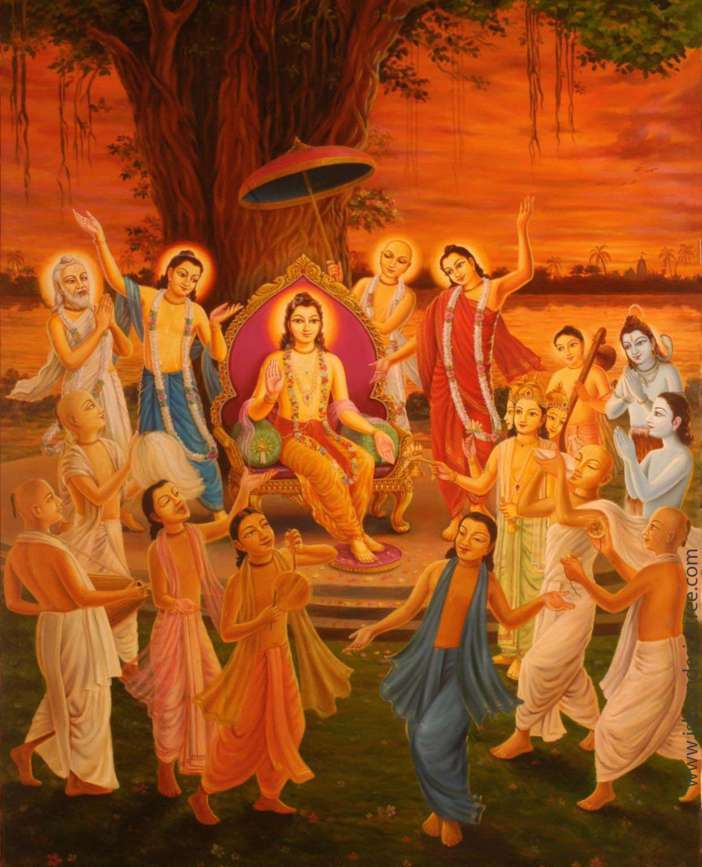
Narahari Sarkar Thakura was never alone at Srikhanda. Sri Chaitanya-charitamrita's own list of the village's great devotees names him together with his brother Mukunda Dasa, his nephew Raghunandana Thakura, and two more residents, Chiranjiva and Sulocana. Year after year, these devotees of Khanda took part in Mahaprabhu's own pastimes together, as one well-known party.
| Detail | Description |
|---|---|
| Annual journey | Srikhanda to Advaita Acharya's home at Shantipur, then on to Jagannatha Puri for chaturmasya |
| Textual source | Sri Chaitanya-charitamrita, Madhya-lila 10.85-90 |
| At Ratha-yatra | Danced together with Raghunandana in the Khanda sankirtana party (Madhya 13.46) |
| Role assigned by Mahaprabhu | To remain always in the association of devotees |
The Yearly Road to Puri #
Nearly every year during Mahaprabhu's own years at Jagannatha Puri, the Srikhanda party set out together on the same journey. They went first to Advaita Acharya's own house at Shantipur, where a much larger gathering of Bengali Vaishnavas met. Then they went on to Puri itself for chaturmasya. Sri Chaitanya-charitamrita records the devotees coming to Advaita Acharya's home from villages across Bengal, receiving His embrace, and setting out together after a festival of two or three days. Raghunandana Thakura's own life story describes the same yearly journey from his side, because Raghunandana made it at his uncle's side nearly every year of his life. The two accounts describe one and the same road.
Dancing Together at Ratha-yatra #
Once the Srikhanda party reached Puri, they did not simply watch the Ratha-yatra festival. Sri Chaitanya-charitamrita records that the people of Khanda formed their own sankirtana party among the many parties singing before Lord Jagannatha's chariot. It names Narahari Prabhu and Raghunandana dancing together in it, uncle and nephew side by side. This was one of the largest devotional gatherings of Mahaprabhu's own lifetime. It is a small detail, only a single verse. But it is one of the few places where Sri Chaitanya-charitamrita does more than name Narahari in a list of devotees. Here he is actually present, moving and singing, in a specific scene.
A Guest at Kheturi #
Decades later, the Srikhanda circle traveled together again, this time for one of the largest gatherings Gaudiya Vaishnavism has ever seen. This was the Kheturi Mahotsava, organized by Narottama Dasa Thakura with Jahnava Devi presiding, for the installation of six Deities. The Kheturi Festival names the arrivals directly: "Narahari Sarkara and Raghunandana from Shri Khanda," traveling with dozens of other named Vaishnavas from across Bengal. These included their own Srikhanda neighbor Ramachandra Kaviraja. By this time Narahari was well past his youth, but he still made the journey at his nephew's side. This shows, as clearly as any single pastime, that Narahari still had an important place in Bengali Vaishnava life.
Told to Remain Among Devotees #
Sri Chaitanya-charitamrita itself records this moment directly. It comes in the same passage that tells of Raghunandana's boyhood devotion to the family Deity (The Boy Who Fed Sri Gopinatha). Mahaprabhu gave Srikhanda's three main men three different duties. Mukunda Dasa was to earn his wealth honestly. Raghunandana was to serve the Deity in the temple. And Narahari, in Krishnadasa Kaviraja Goswami's own words, was told, "I wish you to remain here with My devotees," a role that Prabhupada's purport describes simply as Narahari's duty "to remain with the Lord's devotees," no smaller a service than the other two. This duty fits everything else known about Narahari's life. He entered Mahaprabhu's service through another devotee's company. His own personal service was done in the middle of a kirtana party, not alone. And he later became a guru, not by looking for disciples, but by receiving one who came to him, Lochana Dasa Thakura. That final relationship, and the order that produced Sri Chaitanya-mangala, is told on Guru to Lochana Dasa Thakura.
Scriptural evidence for this chapter (2)
khandera sampradaya kare anyatra kirtana
narahari nace tahan sri-raghunandana
Word for word
khandera -- of the place named Khanda; sampradaya -- party; kare -- performs; anyatra -- in a different place; kirtana -- chanting; narahari -- Narahari; nace -- dances; tahan -- there; sri-raghunandana -- Raghunandana.
Another party was formed by the people of Khanda. These people were singing in a different place. In that group, Narahari Prabhu and Raghunandana were dancing.
Places Narahari Sarkar Thakura and his nephew Raghunandana Thakura together, by name, dancing in the Srikhanda sankirtana party at the Ratha-yatra festival in Jagannatha Puri.
raghunandanera karya -- krishnera sevana, krishna-seva vina inhara anya nahi mana ... narahari rahu amara bhakta-gana-sane, ei tina karya sada karaha tina jane.
"Raghunandana is constantly engaged in serving Lord Krishna in the temple... Furthermore, it is the duty of Raghunandana to always engage in Lord Krishna's service. He has no other intention but the service of Lord Krishna." Sri Chaitanya Mahaprabhu then ordered Narahari, "I wish you to remain here with My devotees. In this way the three of you should always execute these three duties for the service of the Lord."
From the purport: Purport excerpt: "Mukunda was to earn money and follow the religious principles, whereas Narahari was to remain with the Lord's devotees, and Raghunandana was to engage in the Lord's service in the temple."
Sri Chaitanya Mahaprabhu's own direct order to Narahari Sarkar Thakura, in Krishnadasa Kaviraja Goswami's words, assigning him the specific duty of remaining always among devotees.
Chapter 4
Guru to Lochana Dasa Thakura
The order that produced Sri Chaitanya-mangala, and what it meant that a Srikhanda poet's own disciple wrote it.
A young man named Lochana Dasa came to Srikhanda from the nearby village of Kograma. By that time Narahari Sarkar Thakura was already a skilled poet and composer. He was the author of devotional verse in Sanskrit and Bengali. Since he had entered Mahaprabhu's circle, his verse had begun to focus more and more on Gauranga Himself and His pastimes. Lochana Dasa Thakura came to this household, already full of poetry and devotion, seeking shelter and initiation.
| Detail | Description |
|---|---|
| Disciple | Lochana Dasa Thakura, of Kograma, near the Ajaya River, Katwa |
| Training given | Kirtana, at Narahari's own ashram in Srikhanda |
| Order given | To compose, in Bengali, a full account of Mahaprabhu's life |
| Result | Sri Chaitanya-mangala, completed 1537 |
Taking In a Disciple From Kograma #
A fuller account is given on Lochana Dasa Thakura's page, Discipleship Under Narahari Sarkara Thakura. According to it, Lochana Dasa Thakura lived at Narahari's ashram in Srikhanda after receiving initiation from him. There he learned the art of kirtana directly under his guru's own guidance. This was the same personal service, fanning and singing before Mahaprabhu, that had given Narahari his own place among the Lord's associates. Lochana Dasa Thakura's own later writing shows clearly how fully he felt he depended on Narahari. In the opening prayer of Sri Chaitanya-mangala itself he addresses his guru directly. All through the work he comes back again and again to that same dependence, as the one thing that made his writing possible at all. From Narahari's side, much less about the relationship is recorded. Gaudiya Vaishnava sources say little about what he himself felt or said about his disciple's growing book while it was being written. We note this gap here and do not fill it with invented detail.
An Order in a Vernacular Language #
Narahari asked his disciple for something specific. It was not only devotional practice, but a particular literary work, written in Bengali and not in Sanskrit. In this way, people without scholarly training could enter directly into the sweetness of Mahaprabhu's own pastimes. This request fits naturally with what is known of Narahari's own career as a writer. Over the course of his life, he himself had moved from Sanskrit compositions toward devotional songs in the everyday language of Bengal. He plainly wanted Mahaprabhu's life told in the language that ordinary Bengali villagers actually spoke. Lochana Dasa Thakura spent years carrying out that order. He worked from an existing Sanskrit account by Murari Gupta, as it was related through Damodara Pandita. He completed Sri Chaitanya-mangala in 1537, in the Panchali verse-style of eastern Bengal.
A Legacy Carried Forward by Another's Hand #
Sri Chaitanya-mangala went on to become one of the two main poetic biographies of Mahaprabhu still read today, alongside Krishnadasa Kaviraja Goswami's own Sri Chaitanya-charitamrita. It carries Narahari's name and wish inside it as plainly as it carries Lochana Dasa Thakura's own. In a real sense, this was Narahari's most important act as a guru. It was not a miracle or a public teaching. It was a single order given to one disciple. When that order was carried out, it shaped how generations of Bengali Vaishnavas would come to know Mahaprabhu's own life. The fuller story of how Lochana Dasa Thakura composed that work is told on Writing Sri Chaitanya-mangala. That page also covers the honest disagreement among sources over how it came to be told apart from Vrindavana Dasa Thakura's earlier Chaitanya-bhagavata. Narahari's own further writings, and the honest questions later Gaudiya Vaishnava tradition raised about one kind of Srikhanda's devotional poetry, are told on Works, Disappearance, and a Later Controversy Honestly Noted.
Chapter 5
Works, Disappearance, and a Later Controversy Honestly Noted
His own devotional writings, the disputed date of his disappearance, and how later Gaudiya Vaishnava tradition judged a movement sometimes traced to Srikhanda.
Narahari Sarkar Thakura left behind devotional writings of his own. They are separate from anything written about him by his disciples or by later Gaudiya Vaishnava historians. Several works are attributed to him by name: Sri Krishna-bhajanamrita, a Sanskrit meditation on devotional practice; Bhakti-chandrika-patala; Sri Chaitanya-sahasranama, a thousand-name hymn to Mahaprabhu in the traditional sahasranama form; and shorter poems including a Sachinandanashtaka and a Radhashtaka. Taken together, they show a writer moving between Sanskrit scholarship and Bengali devotional song. They also show him moving from verses on Krishna's own pastimes toward verses on Gauranga, more and more over the course of his life. For one of his verses, we know how it was later used. The Bhakti-ratnakara records that late in his own life, his nephew Raghunandana Thakura quoted a verse of Narahari's to comfort Shrinivasa Acharya. The verse was about the anxieties that would trouble Vaishnavas after the disappearance of Mahaprabhu and Nityananda Prabhu. So a generation after Narahari composed them, his own words were still being used to steady a fellow devotee's heart.
| Detail | Description |
|---|---|
| Major works | Sri Krishna-bhajanamrita, Bhakti-chandrika-patala, Sri Chaitanya-sahasranama |
| Shorter works | Sachinandanashtaka, Radhashtaka, and other stray verses |
| Disappearance | Krishna Ekadashi, month of Agrahayana; year disputed (c. 1540 to 1582 across sources) |
| Samadhi | Traditionally placed at Radha-kunda |
A Contested Disappearance Date #
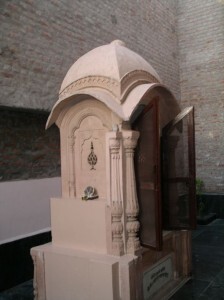
Sources do not agree on when Narahari Sarkar Thakura passed away. Some place his disappearance around 1540, only a few years after Mahaprabhu's own disappearance. Others, following family and disciplic tradition, give a date as late as 1582, which would mean he lived a full century. This disagreement is not resolved here. Both a fairly early date and a fairly late date appear in respected Gaudiya Vaishnava sources, and no single account settles the question. The sources do agree on the day in the lunar calendar: Krishna Ekadashi of the month of Agrahayana. It is observed to this day as his disappearance anniversary. They also agree that his samadhi is traditionally placed at Radha-kunda. According to the Bhakti-ratnakara, his own disciple Lochana Dasa Thakura was present at his disappearance festival, giving out sandalwood paste and garlands to the devotees gathered there.
A Later Controversy, Honestly Noted #
One more point should be stated honestly, not passed over in silence. Literary historians have studied the devotional poetry that grew out of Srikhanda. Some of it is attributed to Narahari himself, and some to Lochana Dasa Thakura after him. These historians have noted an early type of verse that meditates deeply and personally on Mahaprabhu's own beauty. Scholars sometimes label this "gaura-nagara" sentiment. In poetry of this kind, Gauranga is treated as the object of the kind of intimate love usually reserved for Krishna. No source shows Narahari or Lochana Dasa Thakura teaching any sadhana, or spiritual practice, based on that sentiment. What exists is a handful of poetic lines, not an instruction. In later generations, however, a separate and more fully developed devotional movement calling itself "Gauranga-nagari" did appear in some Bengali Vaishnava circles. Srila Bhaktivinoda Thakura and Srila Bhaktisiddhanta Sarasvati Thakura both firmly rejected it. They counted it among the recognized apasampradayas, or deviant offshoots, that broke away from the main Gaudiya Vaishnava sampradaya after Mahaprabhu's own disappearance. Sri Chaitanya-charitamrita's own account of Narahari, discussed on the main biography page, has no such doubt about him at all. It names him, with no reservation, as one of the great, pure branches of Mahaprabhu's own tree of mercy (Adi-lila 10.78-79). Srila Prabhupada's purport to those verses adds that he was the guru of the very disciple who gave Bengal one of its two great poetic lives of Mahaprabhu.
What Remained #
Narahari Sarkar Thakura's own writings did not spread as widely in later centuries as his disciple's Sri Chaitanya-mangala, but his name has never faded from Gaudiya Vaishnava memory. It survives in the branch-list of Sri Chaitanya-charitamrita itself and in the Madhu-pushkarini still shown at Srikhanda. It survives in the three Deities of Gauranga still worshiped at Srikhanda, Katwa and Ganganagara, and in his nephew Raghunandana Thakura's own line of Deity service. It also survives in a single line of Bhaktivinoda Thakura's Gaura-arati, sung daily by Gaudiya Vaishnavas the world over. That line still names him fanning Mahaprabhu with a camara. This small, humble service turned out to be the most lasting image of his whole life.
Scriptural evidence for this chapter (1)
krishna-caitanya-candrena nityanandena samhrite
avatare kalav asmin vaishnavah sarva eva hi
bhavishyanti sadodvignah kale kale dine dine
prayah sandigdha-hridaya uttametara-madhyamah
Once our Lord Krishna Chaitanya and his companion Nityananda Prabhu have ended their incarnation, the Vaishnavas in this age of Kali will be anxious with every passing day. Whether very advanced, somewhat advanced or neophyte, their hearts will nearly always be filled with doubt.
A surviving verse composed by Narahari Sarkar Thakura himself, later quoted by his nephew Raghunandana Thakura to comfort Shrinivasa Acharya shortly before Raghunandana's own disappearance -- one of the few of Narahari's own verses preserved with a known narrative context.
Closing
A Physician's Family at Srikhanda #
Narahari Sarkar Thakura was born at Srikhanda into a Bengali vaidya household, the hereditary physician caste. He was the son of Narayana Dasa and Goyi. He had two brothers. The eldest, Mukunda Dasa, served for a time as physician to the Muslim ruler at Gaur, and the other was Madhava Dasa. Narahari himself is also recorded as having served briefly as a court physician in the same city, before his life turned firmly toward devotional service. Mukunda Dasa's own son, Raghunandana, grew up close to his uncle and was lovingly cared for by him. Sri Chaitanya-charitamrita's own list of Srikhanda's great devotees does not stop with this family. It also names Chiranjiva and Sulocana as fellow residents. Chiranjiva's two sons, Ramachandra Kaviraja and the poet Govinda Dasa Kaviraja, later became celebrated Vaishnavas themselves. So Srikhanda had not one household of devotees but several, linked to one another by marriage and other ties.
Entering Sri Chaitanya Mahaprabhu's Service #
Before he ever met Mahaprabhu, Narahari had already begun composing devotional verses on the pastimes of Radha and Krishna. Tradition records that he came into the Lord's personal association through Gadadhara Pandit, who was always at Mahaprabhu's side. Once Narahari was inside that circle, his poetry turned toward Gauranga Himself. His personal service was to fan the Lord with a camara, a yak-tail whisk, during kirtana. It was a small, humble task. Gaudiya Vaishnavas still remember him by it whenever Bhaktivinoda Thakura's own Gaura-arati is sung, because the song names Narahari among those who fan the Lord. Krishnadasa Kaviraja Goswami places Narahari exactly among Srikhanda's devotees. He names Mukunda Dasa and Raghunandana together as the tree's thirty-ninth branch, Narahari himself as the fortieth, and Chiranjiva and Sulocana as the forty-first and forty-second.
Disappearance and Legacy #
Narahari Sarkar Thakura passed away on Krishna Ekadashi of Agrahayana. Sources disagree sharply on the year. Some place it around 1540 and others as late as 1582. We state this gap honestly here instead of trying to settle it. His samadhi is traditionally placed at Radha-kunda. According to the Bhakti-ratnakara, his own disciple Lochana Dasa Thakura was present at his guru's disappearance festival, distributing sandalwood paste and garlands to the assembled guests. He left behind more than a shrine. Narahari wished that ordinary Bengali readers should be able to enter Mahaprabhu's pastimes. Lochana Dasa Thakura's Sri Chaitanya-mangala carried this wish of Narahari's out into the wider Gaudiya Vaishnava world. At Srikhanda, meanwhile, his nephew Raghunandana's line of Deity worship continued for generations. His name is still spoken today, wherever Gaudiya Vaishnavas sing Bhaktivinoda Thakura's Gaura-arati at the start of temple worship.
At a Glance
- A vaidya physician's son of Srikhanda, named directly in Sri Chaitanya-charitamrita as the fortieth great branch of Mahaprabhu's tree of mercy.
- Entered Mahaprabhu's personal service through Gadadhara Pandit, and became known for fanning the Lord with a camara, a service still sung of by name in Bhaktivinoda Thakura's Gaura-arati.
- Guru of Lochana Dasa Thakura, whom he personally ordered to compose Sri Chaitanya-mangala.
- Uncle of Raghunandana Thakura and younger brother of Mukunda Dasa, together forming one devotional household at the heart of the Srikhanda Vaishnava circle.
- Not to be confused with the much later Narahari Chakravarti Thakura (Ghanashyama Dasa), the Vrindavana-based author of Bhakti-ratnakara.
- Sri Chaitanya-charitamrita, Adi-lila 10.78-79, with Prabhupada's purport
- Sri Chaitanya-charitamrita, Madhya-lila 13.46
- Narahari Sarakara Thakura - Biography, Gaudiya History
- Narahari Sarakara Thakura, Gaudiya History
- Narahari Sarakara Thakura, Gaudiya History (part 2)
- Narahari Chakravarti Thakura, Gaudiya History (for disambiguation)
- The Sacred Legacy of Srikhanda: Narahari Sarakara Thakura, ISKCON Bangalore
- Narahari Sarkar, Mukunda Das & Raghunandana, The Gaudiya Treasures of Bengal
- Srila Narahari Sarkar Thakura, Shyam Das Baba
- Srila Narahari Sarakara Thakura - Disappearance, ISKCON Desire Tree
- Narahari Sarakara Thakura, Stephen Knapp
- Gaura Arati lyrics (verse 4, camara service), lyricstranslate.com
- Gaura Arati, Sri Krishna Balaram Mandir
- Gaura-Nagara Bhava, Swami Tripurari (context on the apasampradaya note)
