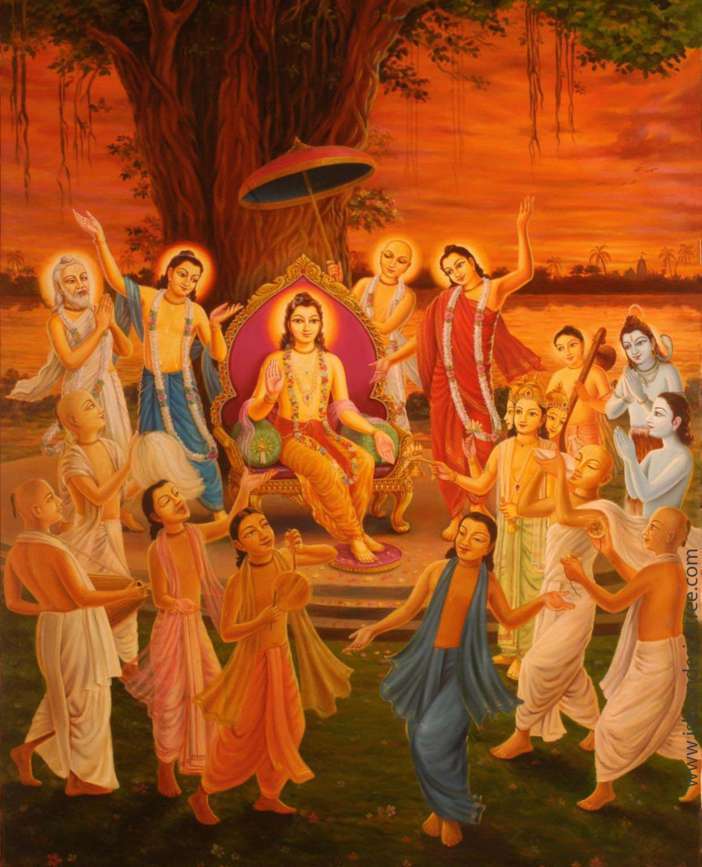
Narahari Sarkar Thakura was never alone at Srikhanda. Sri Chaitanya-charitamrita's own list of the village's great devotees names him together with his brother Mukunda Dasa, his nephew Raghunandana Thakura, and two more residents, Chiranjiva and Sulocana. Year after year, these devotees of Khanda took part in Mahaprabhu's own pastimes together, as one well-known party.
| Detail | Description |
|---|---|
| Annual journey | Srikhanda to Advaita Acharya's home at Shantipur, then on to Jagannatha Puri for chaturmasya |
| Textual source | Sri Chaitanya-charitamrita, Madhya-lila 10.85-90 |
| At Ratha-yatra | Danced together with Raghunandana in the Khanda sankirtana party (Madhya 13.46) |
| Role assigned by Mahaprabhu | To remain always in the association of devotees |
The Yearly Road to Puri #
Nearly every year during Mahaprabhu's own years at Jagannatha Puri, the Srikhanda party set out together on the same journey. They went first to Advaita Acharya's own house at Shantipur, where a much larger gathering of Bengali Vaishnavas met. Then they went on to Puri itself for chaturmasya. Sri Chaitanya-charitamrita records the devotees coming to Advaita Acharya's home from villages across Bengal, receiving His embrace, and setting out together after a festival of two or three days. Raghunandana Thakura's own life story describes the same yearly journey from his side, because Raghunandana made it at his uncle's side nearly every year of his life. The two accounts describe one and the same road.
Dancing Together at Ratha-yatra #
Once the Srikhanda party reached Puri, they did not simply watch the Ratha-yatra festival. Sri Chaitanya-charitamrita records that the people of Khanda formed their own sankirtana party among the many parties singing before Lord Jagannatha's chariot. It names Narahari Prabhu and Raghunandana dancing together in it, uncle and nephew side by side. This was one of the largest devotional gatherings of Mahaprabhu's own lifetime. It is a small detail, only a single verse. But it is one of the few places where Sri Chaitanya-charitamrita does more than name Narahari in a list of devotees. Here he is actually present, moving and singing, in a specific scene.
A Guest at Kheturi #
Decades later, the Srikhanda circle traveled together again, this time for one of the largest gatherings Gaudiya Vaishnavism has ever seen. This was the Kheturi Mahotsava, organized by Narottama Dasa Thakura with Jahnava Devi presiding, for the installation of six Deities. The Kheturi Festival names the arrivals directly: "Narahari Sarkara and Raghunandana from Shri Khanda," traveling with dozens of other named Vaishnavas from across Bengal. These included their own Srikhanda neighbor Ramachandra Kaviraja. By this time Narahari was well past his youth, but he still made the journey at his nephew's side. This shows, as clearly as any single pastime, that Narahari still had an important place in Bengali Vaishnava life.
Told to Remain Among Devotees #
Sri Chaitanya-charitamrita itself records this moment directly. It comes in the same passage that tells of Raghunandana's boyhood devotion to the family Deity (The Boy Who Fed Sri Gopinatha). Mahaprabhu gave Srikhanda's three main men three different duties. Mukunda Dasa was to earn his wealth honestly. Raghunandana was to serve the Deity in the temple. And Narahari, in Krishnadasa Kaviraja Goswami's own words, was told, "I wish you to remain here with My devotees," a role that Prabhupada's purport describes simply as Narahari's duty "to remain with the Lord's devotees," no smaller a service than the other two. This duty fits everything else known about Narahari's life. He entered Mahaprabhu's service through another devotee's company. His own personal service was done in the middle of a kirtana party, not alone. And he later became a guru, not by looking for disciples, but by receiving one who came to him, Lochana Dasa Thakura. That final relationship, and the order that produced Sri Chaitanya-mangala, is told on Guru to Lochana Dasa Thakura.
