Narahari Sarkar Thakura left behind devotional writings of his own. They are separate from anything written about him by his disciples or by later Gaudiya Vaishnava historians. Several works are attributed to him by name: Sri Krishna-bhajanamrita, a Sanskrit meditation on devotional practice; Bhakti-chandrika-patala; Sri Chaitanya-sahasranama, a thousand-name hymn to Mahaprabhu in the traditional sahasranama form; and shorter poems including a Sachinandanashtaka and a Radhashtaka. Taken together, they show a writer moving between Sanskrit scholarship and Bengali devotional song. They also show him moving from verses on Krishna's own pastimes toward verses on Gauranga, more and more over the course of his life. For one of his verses, we know how it was later used. The Bhakti-ratnakara records that late in his own life, his nephew Raghunandana Thakura quoted a verse of Narahari's to comfort Shrinivasa Acharya. The verse was about the anxieties that would trouble Vaishnavas after the disappearance of Mahaprabhu and Nityananda Prabhu. So a generation after Narahari composed them, his own words were still being used to steady a fellow devotee's heart.
| Detail | Description |
|---|---|
| Major works | Sri Krishna-bhajanamrita, Bhakti-chandrika-patala, Sri Chaitanya-sahasranama |
| Shorter works | Sachinandanashtaka, Radhashtaka, and other stray verses |
| Disappearance | Krishna Ekadashi, month of Agrahayana; year disputed (c. 1540 to 1582 across sources) |
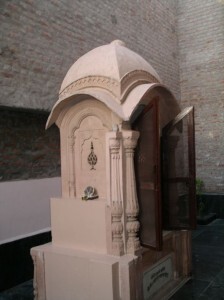
| Samadhi | Traditionally placed at Radha-kunda |
A Contested Disappearance Date #
Sources do not agree on when Narahari Sarkar Thakura passed away. Some place his disappearance around 1540, only a few years after Mahaprabhu's own disappearance. Others, following family and disciplic tradition, give a date as late as 1582, which would mean he lived a full century. This disagreement is not resolved here. Both a fairly early date and a fairly late date appear in respected Gaudiya Vaishnava sources, and no single account settles the question. The sources do agree on the day in the lunar calendar: Krishna Ekadashi of the month of Agrahayana. It is observed to this day as his disappearance anniversary. They also agree that his samadhi is traditionally placed at Radha-kunda. According to the Bhakti-ratnakara, his own disciple Lochana Dasa Thakura was present at his disappearance festival, giving out sandalwood paste and garlands to the devotees gathered there.
A Later Controversy, Honestly Noted #
One more point should be stated honestly, not passed over in silence. Literary historians have studied the devotional poetry that grew out of Srikhanda. Some of it is attributed to Narahari himself, and some to Lochana Dasa Thakura after him. These historians have noted an early type of verse that meditates deeply and personally on Mahaprabhu's own beauty. Scholars sometimes label this "gaura-nagara" sentiment. In poetry of this kind, Gauranga is treated as the object of the kind of intimate love usually reserved for Krishna. No source shows Narahari or Lochana Dasa Thakura teaching any sadhana, or spiritual practice, based on that sentiment. What exists is a handful of poetic lines, not an instruction. In later generations, however, a separate and more fully developed devotional movement calling itself "Gauranga-nagari" did appear in some Bengali Vaishnava circles. Srila Bhaktivinoda Thakura and Srila Bhaktisiddhanta Sarasvati Thakura both firmly rejected it. They counted it among the recognized apasampradayas, or deviant offshoots, that broke away from the main Gaudiya Vaishnava sampradaya after Mahaprabhu's own disappearance. Sri Chaitanya-charitamrita's own account of Narahari, discussed on the main biography page, has no such doubt about him at all. It names him, with no reservation, as one of the great, pure branches of Mahaprabhu's own tree of mercy (Adi-lila 10.78-79). Srila Prabhupada's purport to those verses adds that he was the guru of the very disciple who gave Bengal one of its two great poetic lives of Mahaprabhu.
What Remained #
Narahari Sarkar Thakura's own writings did not spread as widely in later centuries as his disciple's Sri Chaitanya-mangala, but his name has never faded from Gaudiya Vaishnava memory. It survives in the branch-list of Sri Chaitanya-charitamrita itself and in the Madhu-pushkarini still shown at Srikhanda. It survives in the three Deities of Gauranga still worshiped at Srikhanda, Katwa and Ganganagara, and in his nephew Raghunandana Thakura's own line of Deity service. It also survives in a single line of Bhaktivinoda Thakura's Gaura-arati, sung daily by Gaudiya Vaishnavas the world over. That line still names him fanning Mahaprabhu with a camara. This small, humble service turned out to be the most lasting image of his whole life.
