Anyone searching for the author of Sri Prema-vilasa should have the answer up front: it was not Narayana Pandita. It was Nityananda Dasa, a disciple of Jahnava Mata, and the book itself says so.
A Book Sometimes Mistaken for His #
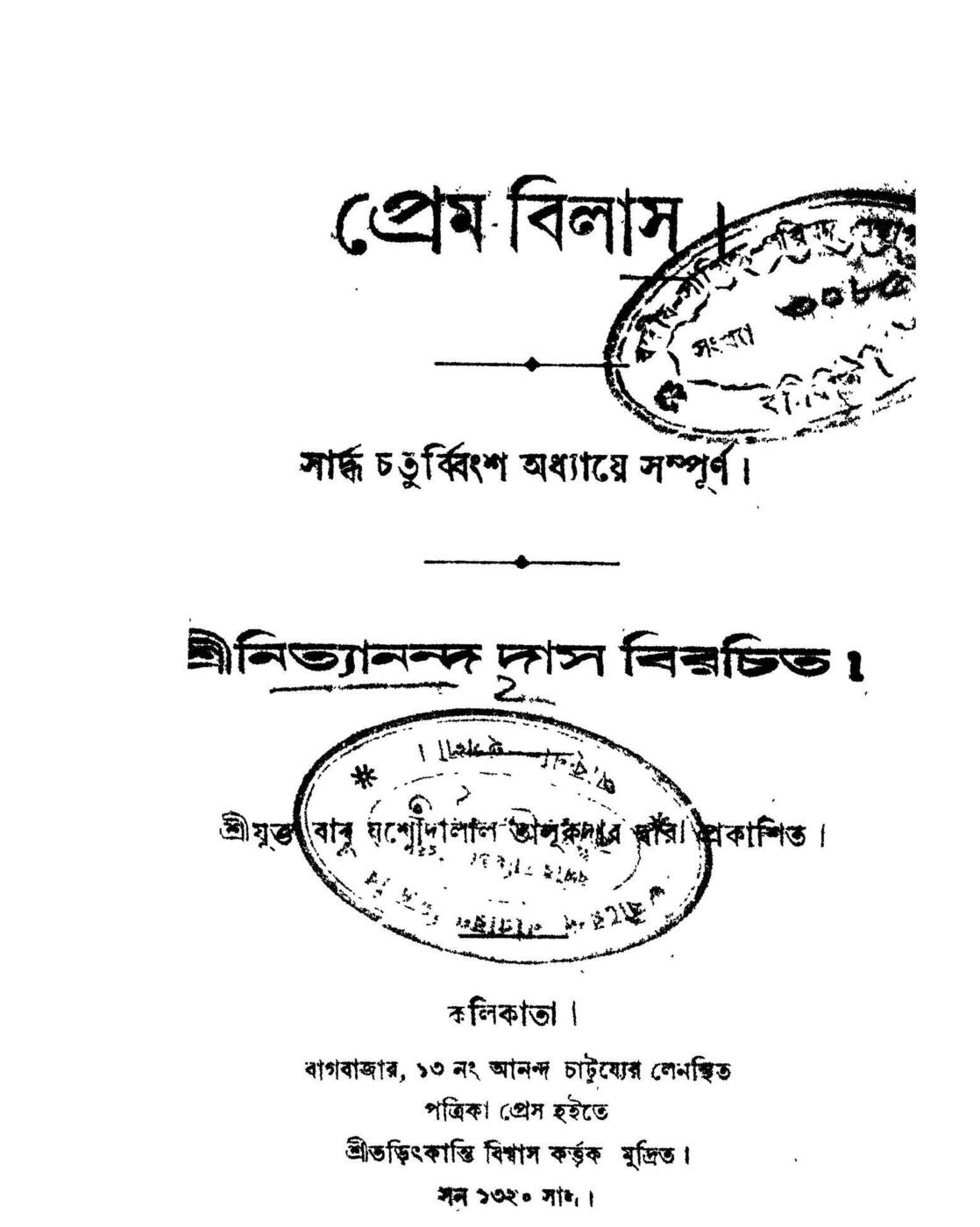
Sri Prema-vilasa is one of the earliest Bengali devotional histories of Nityananda Prabhu's family line at Khardaha. A devotee named Narayana Pandita really does appear among Chaitanya Mahaprabhu's own associates. So it is easy to understand how the two could get mixed up in a casual reference. But no available source makes that connection. The clearest evidence against it is the book's own title page. The original 1913 Bengali printed edition, now scanned and free to view on archive.org, names its author in large type as Sri Nityananda Dasa, not Narayana Pandita. The same title page records that the edition was published from the Bagbazar area of Calcutta and sponsored by Babu Jashodalal Talukdar. It was printed by Taditkanti Vishwas at the Patrika Press, in the Bengali year 1320, which is 1913 in the common era. None of that publication history involves anyone named Narayana Pandita either.
Nityananda Dasa, Disciple of Jahnava Mata #
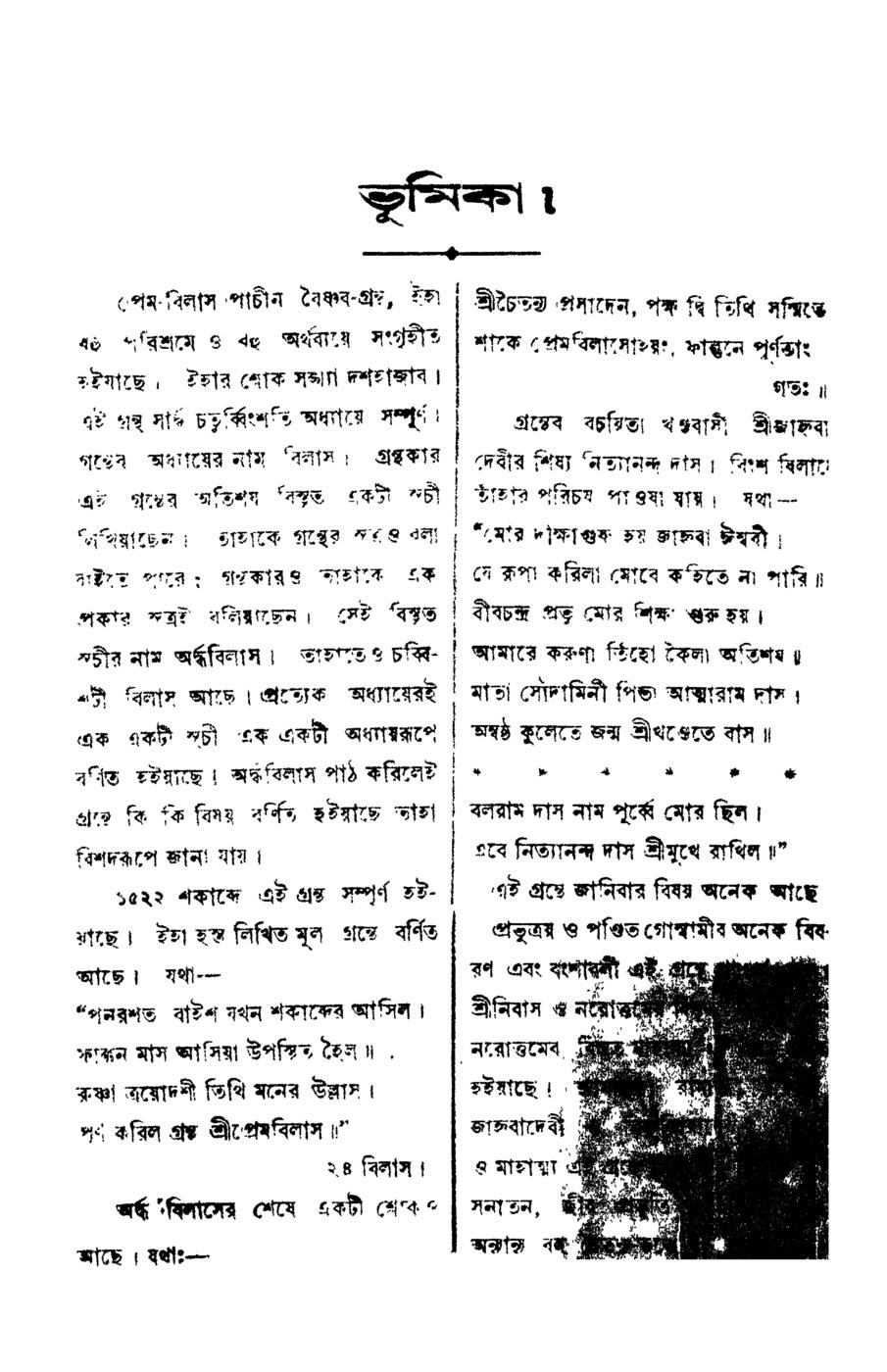
The book's own introduction gives even more detail. In verses it quotes from the book itself, the author gives his family background directly. His mother was Sodamini and his father was Atmarama Dasa. He was born into an Ambastha family, and he lived at Srikhanda. He states that his name before initiation was Balarama Dasa, and that his diksha-guru gave him the name Nityananda Dasa. The same passage names this diksha-guru as Jahnava Devi of Khardaha. In the book's closing lines, he also states that he completed it in the Shaka year 1522. By most calculations this is the early seventeenth century. He wrote its first eighteen chapters at Srikhanda, two more at Khardaha, and the last four while staying at Katwa. None of these details of his life have anything to do with the Narayana Pandita of Shrivasa Thakura's circle. That Narayana Pandita belongs to an entirely earlier generation. He lived in the time of Chaitanya Mahaprabhu Himself, not in the time of the acharyas who followed Nityananda Prabhu.
What the Book Actually Contains #
Sri Prema-vilasa runs to twenty-four and a half chapters, called vilasas. It covers the pastimes of Nityananda Prabhu and of the generations of Vaishnavas who carried on his mission from Khardaha. It says a great deal about Shrinivasa Acharya, Narottama Dasa Thakura and Shyamananda Pandit. These are the three preachers usually credited with carrying the movement forward in its second generation. Nityananda Dasa presents himself as having traveled with Jahnava Mata as her personal attendant for part of this period. For this reason, parts of the book claim to be an eyewitness account, not a collection of what he heard from others.
Value and Limits as a Source #
That eyewitness claim has not saved the book from serious doubt among scholars. Historians S. K. De and Biman Bihari Majumdar, both experts on early Gaudiya Vaishnava literature, have recorded that they distrust Sri Prema-vilasa. They consider its final chapters especially unreliable. The clearest example of the problem is in the order of events. The book describes Krishnadasa Kaviraja Goswami dying before Raghunatha Dasa Goswami. But independent evidence shows the reverse. Raghunatha Dasa Goswami left his body around 1584, while Krishnadasa Kaviraja Goswami was still alive as late as 1608. The book claims to have been finished around 1610, yet it gets the order of these two well-known deaths backward. So its later material must be read with real caution. At the same time, other researchers have studied the book closely. One of them is the Gaudiya history researcher who writes as Jagadananda Das. They describe its earlier chapters, and its reports on Shrinivasa, Narottama and Shyamananda, as simple, credible, and worth taking seriously, not something to reject outright. The honest view lies between these two opinions. Sri Prema-vilasa is a genuine and often valuable early source for the Nityananda-vamsa tradition. It was written by a devotee who really may have traveled with Jahnava Mata. But it is not equally reliable in every part, and careful readers of Gaudiya Vaishnava history treat its later chapters with real caution. And no available evidence shows it to be a work by Narayana Pandita.
