Srila Narayana Pandita
An Associate of Shrivasa Thakura
The complete life, on one page: The main biography and every pastime page, in order, in one place
Introduction
Narayana Pandita appears in Sri Chaitanya-charitamrita as the fourteenth of the many "branches" that grew from the tree of Chaitanya Mahaprabhu's own life. He was one of dozens of devotees named by Krishnadasa Kaviraja Goswami, with a single verse for each, so that no one who had served the Lord in Nadia would be left out of the record. He was an associate of Shrivasa Thakura. The only clear episode recorded about him is a journey he made to Jagannatha Puri. There is also a mix-up to correct. Some modern reference lists link a "Narayana Pandita" with the writing of Sri Prema-vilasa, an important Bengali life of Nityananda Prabhu and the generations who followed him. But every available source, including the book's own printed title page, names its author as Nityananda Dasa, a disciple of Jahnava Mata, not Narayana Pandita. The two should not be treated as one person, and so we state this difference clearly at the very start.
| Detail | Description |
|---|---|
| Era | Contemporary of Chaitanya Mahaprabhu, early sixteenth century |
| Documented as | The fourteenth of the "branches" of the Chaitanya tree |
| Associated with | Shrivasa Thakura's household at Nabadwip |
| Primary source | Sri Chaitanya-charitamrita, Adi-lila 10.36, citing Chaitanya-bhagavata, Antya-khanda 8.36 |
| One documented episode | A journey to Jagannatha Puri with Rama Pandita, Shrivasa Thakura's brother |
| Often confused with | The real author of Sri Prema-vilasa, who was Nityananda Dasa, not Narayana Pandita |
| Birth and disappearance | Not recorded in the available sources |
Scriptural evidence for the introduction (2)
নারায়ণ–পণ্ডিত এক বড়ই উদার ।
চৈতন্যচরণ বিনু নাহি জানে আর ॥ ৩৬ ॥
nārāyaṇa-paṇḍita eka baḍa-i udāra
caitanya-caraṇa vinu nāhi jāne āra
Word for word
nārāyaṇa-paṇḍita: Nārāyaṇa Paṇḍita; eka: one; baḍa-i: very; udāra: liberal; caitanya-caraṇa: the lotus feet of Lord Caitanya; vinu: except; nāhi: not; jāne: know; āra: anything else.
Narayana Pandita, the fourteenth branch, a great and liberal devotee, did not know any shelter but Lord Chaitanya's lotus feet.
From the purport: Purport excerpt: "Narayana Pandita was one of the associates of Srivasa Thakura. It is mentioned in the Caitanya-bhagavata, Antya-khanda, eighth chapter, verse 36, that he went to see Sri Caitanya Mahaprabhu at Jagannatha Puri with the Thakura's brother Sri Rama Pandita."
The single verse Chaitanya-charitamrita devotes to Narayana Pandita, identifying him within the shakha-nirdesha list of the Lord's associates and giving the only two biographical facts about him that survive.
The Supreme Personality of Godhead said: Son of Prtha, a transcendentalist engaged in auspicious activities does not meet with destruction either in this world or in the spiritual world; one who does good, My friend, is never overcome by evil.
Krishna's own assurance that no sincere step in devotional life is ever wasted, however sparse the historical record left behind, cited here for Narayana Pandita's thinly documented but genuine devotion.
Chapter 1
The Journey to Jagannatha Puri
The one documented episode of his life: a pilgrimage from Bengal to see Chaitanya Mahaprabhu, made alongside Shrivasa Thakura's brother
Chaitanya-charitamrita gives Narayana Pandita exactly one fact about his life beyond his name and his devotion. He traveled to Jagannatha Puri to see Chaitanya Mahaprabhu, and he did not go alone. It is the only episode of his life that the record keeps. Even this is known only because Srila Prabhupada, in his purport to the branch-list verse, passed it on from an older source.
Why Devotees Traveled to Puri #
After Chaitanya Mahaprabhu accepted the sannyasa order and settled at Jagannatha Puri, He stayed mostly apart from His Bengali devotees. They could no longer simply walk to His house in Nabadwip as they once had. Shrivasa Thakura himself is remembered as traveling from Bengal to Puri every year for the Ratha-yatra festival. He was part of a wider yearly movement of devotees who made the same journey to be near the Lord for as long as the festival lasted. Narayana Pandita's own trip almost certainly belongs to this yearly journey. He was a member of Shrivasa's circle, making the same pilgrimage that many others in that household made. It was not a single event that happened only once.
The Journey with Rama Pandita #
This visit is more than a passing mention, because a companion is named. According to Chaitanya-bhagavata's Antya-khanda, Narayana Pandita went together with Rama Pandita, Shrivasa Thakura's own brother. Traveling with the brother of that household suggests that Narayana Pandita was not a distant well-wisher. He was someone really close to that household, trusted enough, or simply eager enough, to make the long journey from Bengal to Odisha at Rama Pandita's side. Chaitanya-charitamrita does not say what happened once they arrived, whether they were received formally, or how long they stayed. The source that keeps this detail only records that the trip took place. It does not describe it.
Possibly Named Again at Puri #
Two later passages in Chaitanya-charitamrita's Madhya-lila name a devotee called, in one case, "Pandita Narayana" and in the other simply "Narayana," both in scenes set at Jagannatha Puri. In the first, he is listed beside Murari Gupta and Haridasa Thakura among the devotees gathered to see the Lord. If it is the same man, he was in very good company, since both of them were among the most senior devotees present at Puri in those years. In the second, he is one of five devotees, including Raghava Pandita and Damodara Pandita, who responded when Svarupa Damodara sang. Both scenes fit well with the Narayana Pandita of Shrivasa Thakura's circle coming again to Puri, the same place where his one recorded journey had already taken him. But the text never clearly says that these are the same person, and no available source settles the question either way. We can honestly say only this much: a devotee with his name appeared in the same place, among the same kind of company, more than once.
Why the Detail Still Matters #
A journey with a named companion to a named place is a small thing, compared with the long, well-recorded lives of acharyas who left behind their own books. Still, it matters. It is the difference between a name on a list and a person who did something clear enough to be remembered for it. For a devotee about whom so little is recorded, that difference is almost all we have. Once again, nothing in this journey, or in any other mention of Narayana Pandita in Chaitanya-charitamrita, connects him with writing Sri Prema-vilasa. That book, and the very different life of its own author, are covered separately on Sri Prema-vilasa and Its True Author.
Scriptural evidence for this chapter (2)
“Here are Murari Gupta, Pandita Narayana and Haridasa Thakura, the deliverer of the whole universe.”
Names a 'Pandita Narayana' among devotees at Jagannatha Puri; consistent with, but not explicitly confirmed by the text as, the same Narayana Pandita of the branch list.
The five who responded to the singing of Svarupa Damodara were Damodara Pandita, Narayana, Govinda Datta, Raghava Pandita and Sri Govindananda.
A 'Narayana' appears again at Jagannatha Puri in a small kirtana group; again plausible but not confirmed as the same Narayana Pandita.
Chapter 2
Sri Prema-vilasa and Its True Author
What the book actually is, who really wrote it, and why it is the work of a different Nityananda-vamsa devotee, not of Narayana Pandita
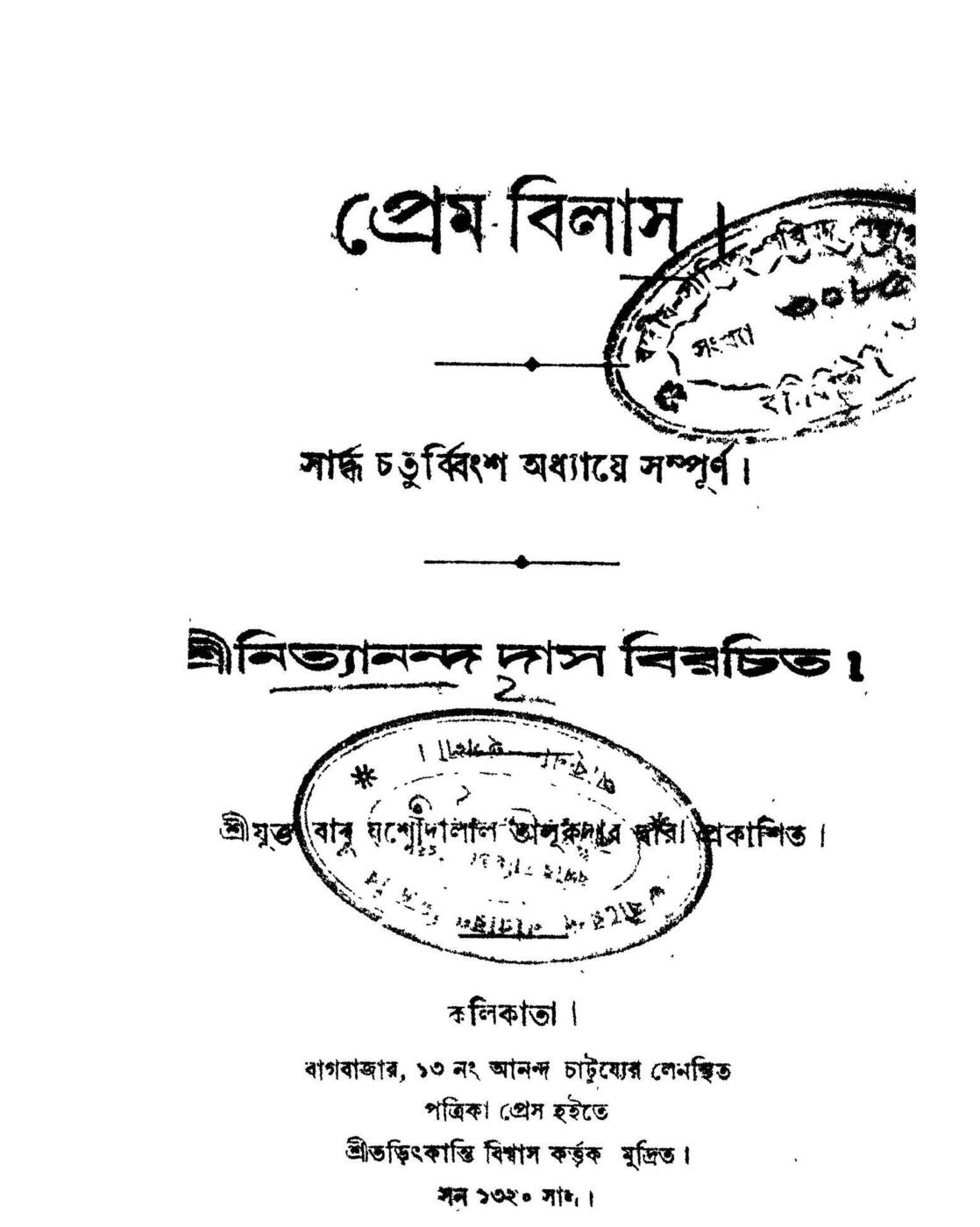
Anyone searching for the author of Sri Prema-vilasa should have the answer up front: it was not Narayana Pandita. It was Nityananda Dasa, a disciple of Jahnava Mata, and the book itself says so.
A Book Sometimes Mistaken for His #
Sri Prema-vilasa is one of the earliest Bengali devotional histories of Nityananda Prabhu's family line at Khardaha. A devotee named Narayana Pandita really does appear among Chaitanya Mahaprabhu's own associates. So it is easy to understand how the two could get mixed up in a casual reference. But no available source makes that connection. The clearest evidence against it is the book's own title page. The original 1913 Bengali printed edition, now scanned and free to view on archive.org, names its author in large type as Sri Nityananda Dasa, not Narayana Pandita. The same title page records that the edition was published from the Bagbazar area of Calcutta and sponsored by Babu Jashodalal Talukdar. It was printed by Taditkanti Vishwas at the Patrika Press, in the Bengali year 1320, which is 1913 in the common era. None of that publication history involves anyone named Narayana Pandita either.
Nityananda Dasa, Disciple of Jahnava Mata #
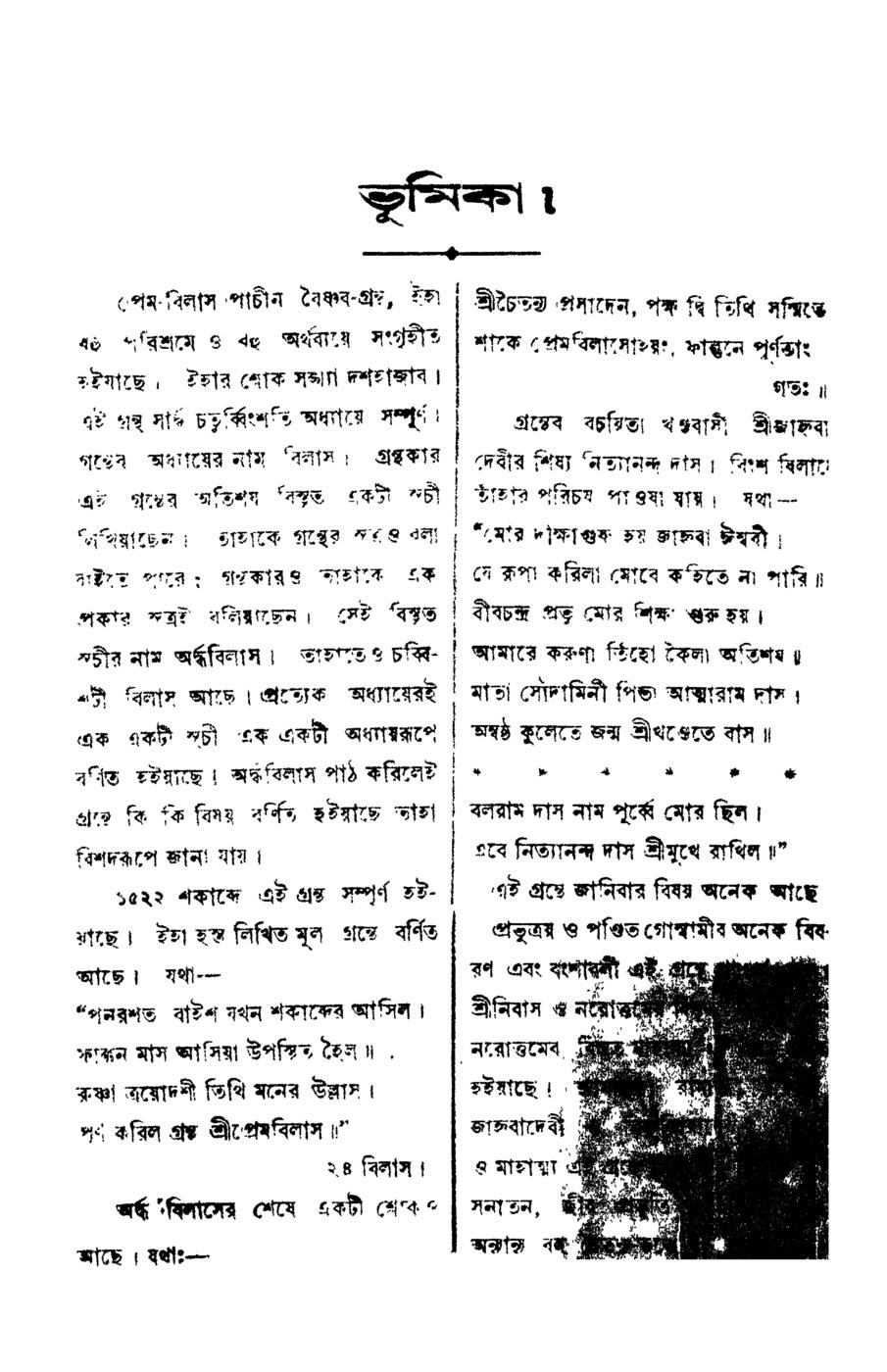
The book's own introduction gives even more detail. In verses it quotes from the book itself, the author gives his family background directly. His mother was Sodamini and his father was Atmarama Dasa. He was born into an Ambastha family, and he lived at Srikhanda. He states that his name before initiation was Balarama Dasa, and that his diksha-guru gave him the name Nityananda Dasa. The same passage names this diksha-guru as Jahnava Devi of Khardaha. In the book's closing lines, he also states that he completed it in the Shaka year 1522. By most calculations this is the early seventeenth century. He wrote its first eighteen chapters at Srikhanda, two more at Khardaha, and the last four while staying at Katwa. None of these details of his life have anything to do with the Narayana Pandita of Shrivasa Thakura's circle. That Narayana Pandita belongs to an entirely earlier generation. He lived in the time of Chaitanya Mahaprabhu Himself, not in the time of the acharyas who followed Nityananda Prabhu.
What the Book Actually Contains #
Sri Prema-vilasa runs to twenty-four and a half chapters, called vilasas. It covers the pastimes of Nityananda Prabhu and of the generations of Vaishnavas who carried on his mission from Khardaha. It says a great deal about Shrinivasa Acharya, Narottama Dasa Thakura and Shyamananda Pandit. These are the three preachers usually credited with carrying the movement forward in its second generation. Nityananda Dasa presents himself as having traveled with Jahnava Mata as her personal attendant for part of this period. For this reason, parts of the book claim to be an eyewitness account, not a collection of what he heard from others.
Value and Limits as a Source #
That eyewitness claim has not saved the book from serious doubt among scholars. Historians S. K. De and Biman Bihari Majumdar, both experts on early Gaudiya Vaishnava literature, have recorded that they distrust Sri Prema-vilasa. They consider its final chapters especially unreliable. The clearest example of the problem is in the order of events. The book describes Krishnadasa Kaviraja Goswami dying before Raghunatha Dasa Goswami. But independent evidence shows the reverse. Raghunatha Dasa Goswami left his body around 1584, while Krishnadasa Kaviraja Goswami was still alive as late as 1608. The book claims to have been finished around 1610, yet it gets the order of these two well-known deaths backward. So its later material must be read with real caution. At the same time, other researchers have studied the book closely. One of them is the Gaudiya history researcher who writes as Jagadananda Das. They describe its earlier chapters, and its reports on Shrinivasa, Narottama and Shyamananda, as simple, credible, and worth taking seriously, not something to reject outright. The honest view lies between these two opinions. Sri Prema-vilasa is a genuine and often valuable early source for the Nityananda-vamsa tradition. It was written by a devotee who really may have traveled with Jahnava Mata. But it is not equally reliable in every part, and careful readers of Gaudiya Vaishnava history treat its later chapters with real caution. And no available evidence shows it to be a work by Narayana Pandita.
Closing
One of the Branches of the Chaitanya Tree #
Chapter Ten of Chaitanya-charitamrita's Adi-lila is given entirely to listing the "trunk, branches and sub-branches" of the tree that grew out of Chaitanya Mahaprabhu. It is a long list of names. Krishnadasa Kaviraja Goswami takes each devotee in turn, gives him a single verse, and moves on to the next. In this way even the most modest follower has some line of scripture to his name. Narayana Pandita is the fourteenth branch in that list. The verse itself says only that he was "a great and liberal devotee" who "did not know any shelter but Lord Chaitanya's lotus feet." It describes only his devotion and gives no details of his life. Srila Prabhupada's purport to the verse adds two facts, and the rest of his story depends on them. First, Narayana Pandita was one of the associates of Shrivasa Thakura. Second, the Chaitanya-bhagavata records him going to see Chaitanya Mahaprabhu at Jagannatha Puri together with Rama Pandita, Shrivasa Thakura's brother. The verses on either side name Pradyumna Brahmachari as the thirteenth branch and Shriman Pandita as the fifteenth. Chaitanya-charitamrita happens to say a little more about these two devotees. This only shows how little is recorded about Narayana Pandita himself.
An Associate of Shrivasa Thakura's Household #
Shrivasa Thakura's house at Nabadwip was where the sankirtana movement itself began. It drew a wide circle of devotees around his family, among them his wife Malini Devi and his brothers Sripati, Srirama (Rama Pandita) and Srikanta. Narayana Pandita's one recorded connection is to this circle. But Chaitanya-charitamrita does not say whether he was a relative, a neighbor, or simply someone who regularly came to the nightly chanting. Later in the text, a "Pandita Narayana" is named again among the devotees who gathered to see the Lord at Jagannatha Puri, along with Murari Gupta and Haridasa Thakura. A "Narayana" also appears once more at Puri, in a small group that responded to Svarupa Damodara's singing. With him in that group were Damodara Pandita, Govinda Datta, Raghava Pandita and Govindananda. Both settings fit the Narayana Pandita of the branch list, a companion of Shrivasa's household who was present at Puri. But Chaitanya-charitamrita never clearly says that all three references are to the same man, so we should not assume more than the text itself says.
What the Record Leaves Open #
No available source gives a birth year, a disappearance date, a family name, or a place of origin for Narayana Pandita. No separate spiritual identity for him is recorded in Gaura-ganoddesha-dipika or in any other known traditional source. What survives is a single verse of scripture, a purport that names his circle, and a name that seems to appear twice more at Jagannatha Puri. But there is no confirmation that it is the same man each time. That is very little, compared with acharyas who left behind whole books or long, well-recorded lives. Still, it is an honest record. Lord Krishna Himself gives this assurance: "Son of Pritha, a transcendentalist engaged in auspicious activities does not meet with destruction either in this world or in the spiritual world; one who does good, My friend, is never overcome by evil" (Bhagavad-gita 6.40). Not a single step taken on the path of bhakti is ever wasted, however faint a mark it leaves in history. Chaitanya-charitamrita's own way is to name even the least-known of the Lord's associates, instead of passing over them in silence. This is part of why even a little-known devotee like Narayana Pandita still has a place in the record at all.
- Sri Chaitanya-charitamrita, Adi-lila 10.36 (with Srila Prabhupada's purport)
- Sri Chaitanya-charitamrita, Madhya-lila 11.86
- Sri Chaitanya-charitamrita, Madhya-lila 13.37
- Narayana Pandita (Gaudiya History biography index)
- Srivasa Pandit (Gaudiya History biography)
- Prema Vilasa, by Sri Nityananda Das (1913 Bengali edition, scanned)
