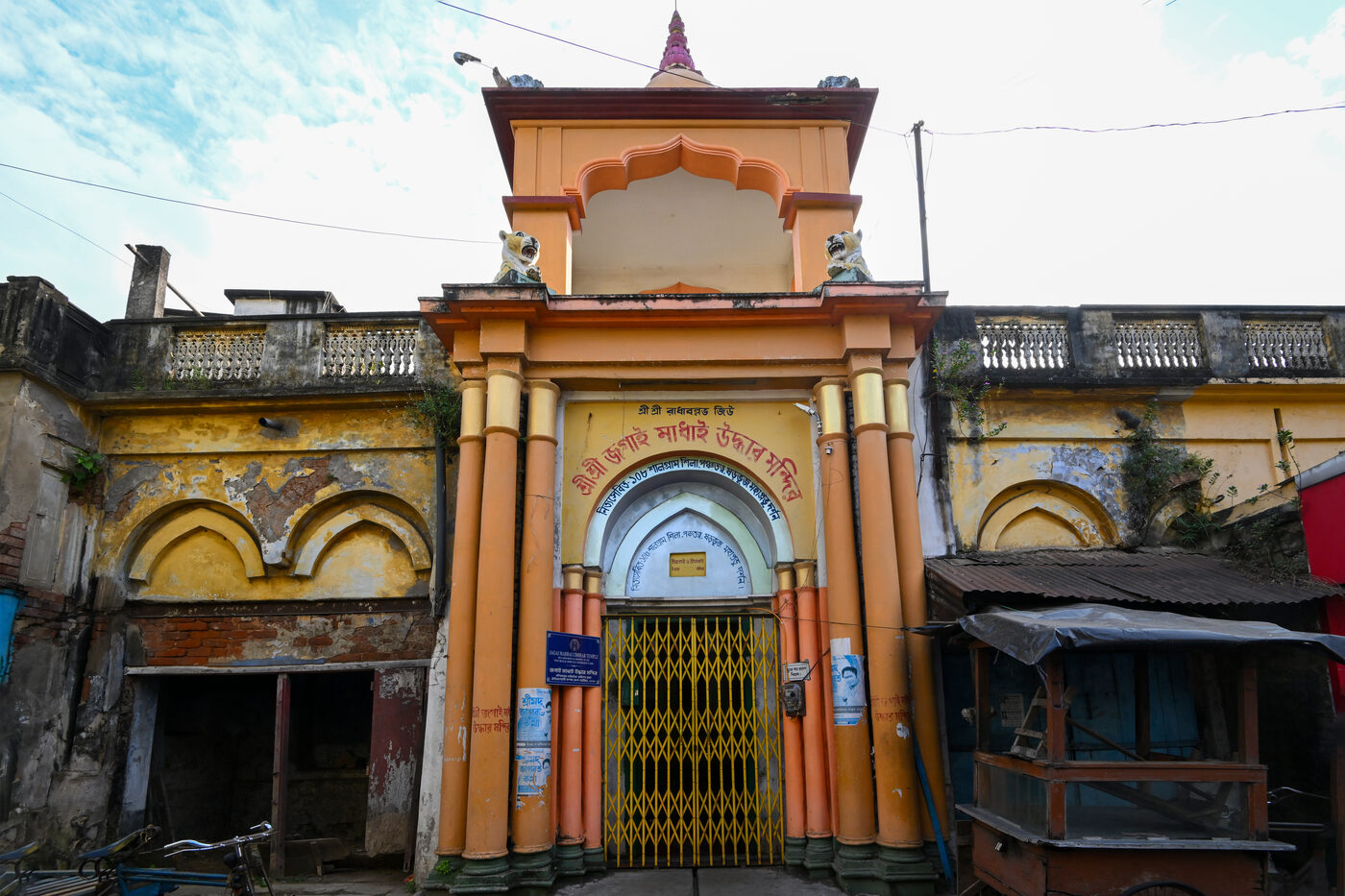
The episode of Jagai and Madhai is usually told as a story about Sri Chaitanya Mahaprabhu. Told that way, it is a story about anger and forgiveness. The Lord raises His disc against two criminals and then puts it down. Told from Nityananda Prabhu's side, it is a different story altogether, and a harder one. From his side, the interesting question is not why the Lord gave up His anger. It is why Nityananda went near the brothers in the first place, and then why, after being chased off once, he went back.
The Order to Beg Door to Door #
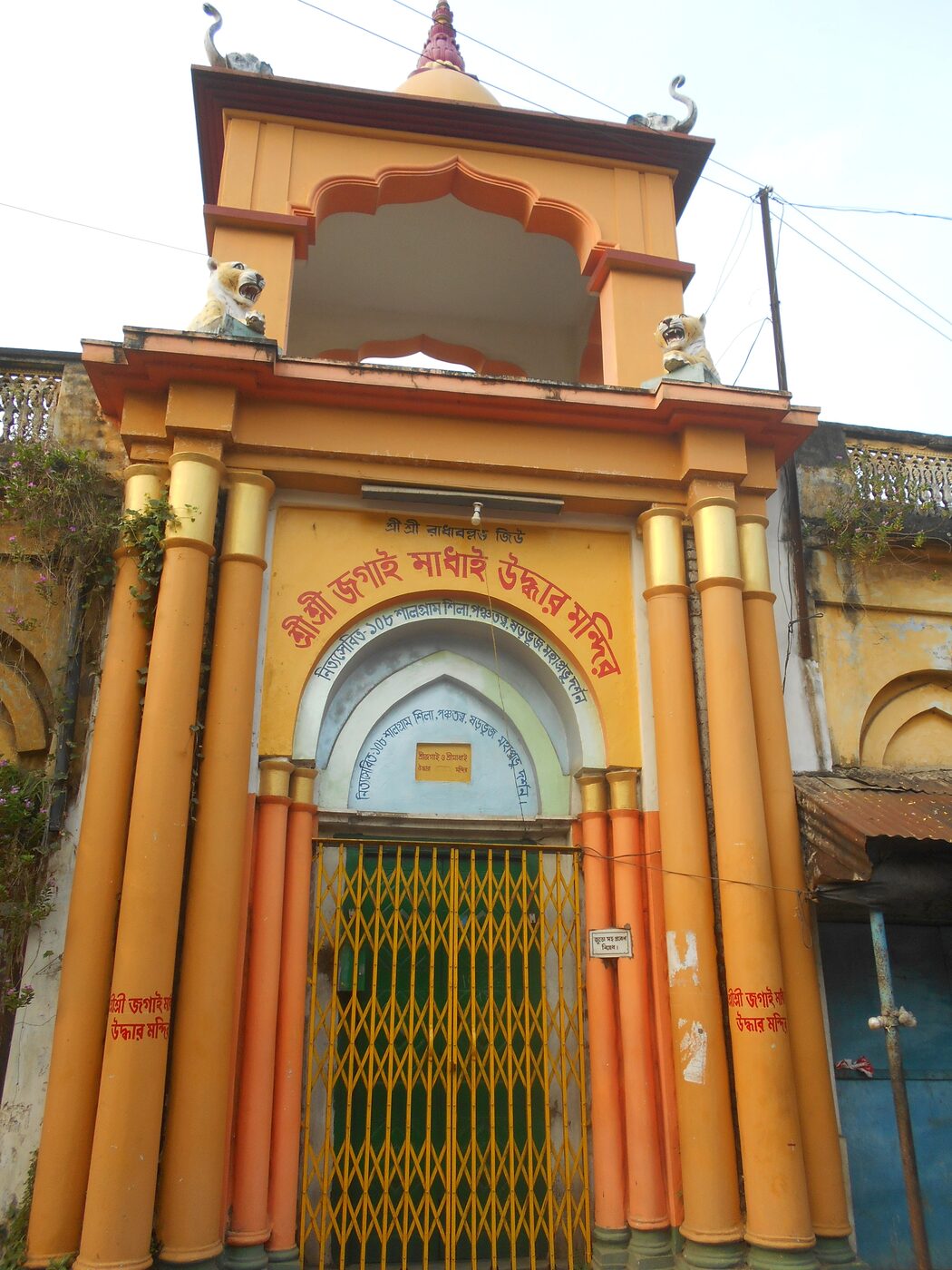
It all begins with an order that had no clear earlier example in the religious life of that time. Chaitanya Mahaprabhu instructed Nityananda Prabhu and Haridasa Thakura to go through Nabadwip door to door and beg. But they were not to beg for food. At every house they were to ask the householder to worship Krishna, chant Krishna's names and follow Krishna's instructions, and then move on. At the end of the day they were to report the results. The devotees who heard the instruction laughed at the idea of begging for such things. The two of them took it literally and went out.
The Reception in Nabadwip #
The two preachers got a mixed reception, of a kind that anyone who has done this work since would recognise. Pious householders were delighted, invited them in and promised to do as they were asked. Others thought they were madmen, and said the same about the Lord who had sent them. Some people had been shut out of the nightly kirtana at Srivasa Pandit's house and resented it. They went further than words. The Chaitanya-bhagavata records that the two preachers were attacked and threatened with legal action by the local authority. Vrindavana Dasa comments that they were empowered by Chaitanya, so they paid no attention and carried on. Put simply, this was the first organised door-to-door preaching campaign in the history of the movement, and Nityananda Prabhu was one of the two men carrying it out. Everything he did for the next thirty years grew out of this assignment.
Meeting Jagai and Madhai in the Street #
At some point in that campaign the two of them came upon Jagai and Madhai in the street. The brothers were brahmanas of Nabadwip by birth, but they had given up every part of a brahmana's life. They were drunk more or less all the time. They ate meat, robbed people and set fires. They were so feared that the whole town arranged its life around them. Vrindavana Dasa does not describe what Nityananda and Haridasa felt on seeing them as pity in the ordinary sense. He says their hearts wept. The two talked it over. They decided that these brothers were the clearest possible example of what Mahaprabhu had come to do. They also decided to give them the Lord's message, even though they knew what was likely to follow. So they called out to them across the street to worship Krishna.
The First Attempt and the Chase #
The brothers took this as a disturbance of their afternoon and came after them, and the two preachers ran. That was the first attempt, and the biographies say plainly that they were chased off. They went to Chaitanya Mahaprabhu and described what they had seen. They asked Him to prove that He truly was Patita-pavana, the deliverer of the fallen, by delivering these two.
Advaita Acharya on Three Drunkards #
At this stage of the story Advaita Acharya makes a dry, humorous remark. Haridasa Thakura, still shaken, described how restless Nityananda had been and what it had nearly cost them both. Advaita Acharya replied that this was no surprise. Drunkards belong in the company of drunkards, he said, so it was quite fitting that three of them should be found together. Nityananda was intoxicated with love of Krishna, and the brothers with wine. Haridasa, who had taken vows, had no business there at all. Among the Nabadwip devotees, a remark like this counted as praise.
The Offence They Had Never Committed #
Vrindavana Dasa adds one remark that carries much of the teaching of the episode. For all their sins, Jagai and Madhai had never in their lives committed an offence against a Vaishnava. They had simply never had the chance. In Gaudiya theology, that makes the difference between a debt that the holy name can clear and a debt that it cannot. The biographer points it out because of what is about to happen.
The Brothers at the Ganges Ghat #
Some time afterwards the brothers camped on the bank of the Ganges at the ghat where Mahaprabhu bathed, and this frightened the neighbourhood very much. At night they heard the sound of the kirtana. In their drunken state they assumed it was being performed for the goddess Mangalachandi, and they danced to it. Then Nityananda Prabhu went to them again, at night, alone.
The Decision to Go Back Alone at Night #
The tradition sees this decision as the clearest statement of who Nityananda was, and it deserves a closer look. He had already been chased through the streets by these men. No new order made him go on this visit. The door-to-door assignment did not require a second try at a household that had thrown him out. There was no one watching. All the accounts agree that he knew fully what he was walking into. He went anyway. In his view, the fact that they were the worst men in Nabadwip was the reason to go, not the reason to stay away.
The Blow From the Broken Earthen Pot #
Madhai picked up a broken earthen pot and threw it. It struck Nityananda on the head and the blood ran down. His reply, as it is recorded, is the sentence for which Bengal has remembered him ever since. He said that Madhai might strike him again if he liked, so long as he would chant the name of Krishna. Jagai, drunk as he was, took hold of his brother and stopped him. He scolded Madhai for what he had done to a man who had come to them with nothing but good.
The Sudarshana Disc and the Plea for Jagai #
Chaitanya Mahaprabhu arrived with the devotees, saw the blood on Nityananda's body, and called for the Sudarshana disc. The Chaitanya-bhagavata says that the two brothers saw it with their own eyes. What Nityananda did at that moment is the second half of his part in the episode, and it is more than a simple plea for mercy. He told the Lord that Jagai had protected him. In this way he was pleading Jagai's case. With his own head still bleeding, he pointed the Lord to the one decent act done by either brother in years, and he built his whole case on it. Mahaprabhu accepted it and gave love of God to Jagai on the spot.
Madhai Sent to Nityananda for Forgiveness #
Madhai watched his brother receive what he himself had just lost the right to receive. He broke down and threw himself at Chaitanya Mahaprabhu's feet. The Lord refused him. This refusal was not revenge. It was exact according to the teaching. The offence had not been committed against Chaitanya Mahaprabhu, and He would not take it upon Himself to cancel a debt owed to somebody else. He sent Madhai to the feet of Nityananda Prabhu. Then He turned to Nityananda and said that since the man had fallen at his feet, it was proper for him to be merciful. According to the text, Nityananda answered by offering whatever spiritual credit he himself possessed in exchange for Madhai's forgiveness. Then, on the Lord's order, Nityananda took hold of the man who had cut his head open a few minutes earlier and embraced him. The Chaitanya-bhagavata says that Nityananda entered into Madhai's body and filled him with his own energies.
The Brothers Declared Maha Bhagavatas #
The rest followed quickly. Mahaprabhu forbade the brothers to sin again and accepted the burden of their past. He brought them into the house. When love of God had brought them both to rolling on the ground, He declared them maha-bhagavatas. He instructed the devotees to treat them as such, and He warned what would happen to anyone who did otherwise. The Vaishnavas blessed them. The text says, quite sternly, that the brothers' sinful reactions were transferred to those who speak ill of Vaishnavas. Local tradition at Nabadwip still points to a ghat on the Ganges as the place where Madhai did his penance by serving pilgrims.
Rupa and Sanatana at Ramakeli #
Krishnadasa Kaviraja gives the whole affair a single line in the Chaitanya-charitamrita, because Vrindavana Dasa had told it fully and there was no need to repeat him. But the episode appears again in his book at an important moment. Years later, at Ramakeli, two ministers of the Sultan of Bengal fell before Chaitanya Mahaprabhu. They told Him that delivering Jagai and Madhai had cost Him nothing. Those brothers, they said, were brahmanas of a holy town, and their only fault was addiction to sin. But the ministers themselves were servants of meat-eaters, and fallen millions of times further. Those two men became Rupa and Sanatana Goswami. What matters here is what their prayer takes for granted. By the 1510s, the deliverance of Jagai and Madhai had already become the standard, known to all, for how far the Lord's mercy would reach. Everyone else measured their own hopeless state against it. And it became that standard because one man had walked back down a dark street towards two drunks who had already chased him once.
Why the Episode Defines His Character #
That is why Gaudiya Vaishnavas see this episode as the one that defines Nityananda Prabhu's character, not just as one incident in it. The title Patita-pavana is not a compliment. It is a claim that needs proof, and proof of that kind can only come from somebody who is ready to be injured. Chaitanya Mahaprabhu had the disc; Nityananda had the wound. The way the story ends is important too. The Lord Himself will not forgive an offence committed against His servant, and He sends the offender back to that servant. This is the reason the tradition insists that the way to Chaitanya Mahaprabhu runs through Nityananda Prabhu and not around him. That doctrine is set out on the page on the mercy of Nitai, but its evidence is here, in a broken pot and a man who did not put his hand to his head.
