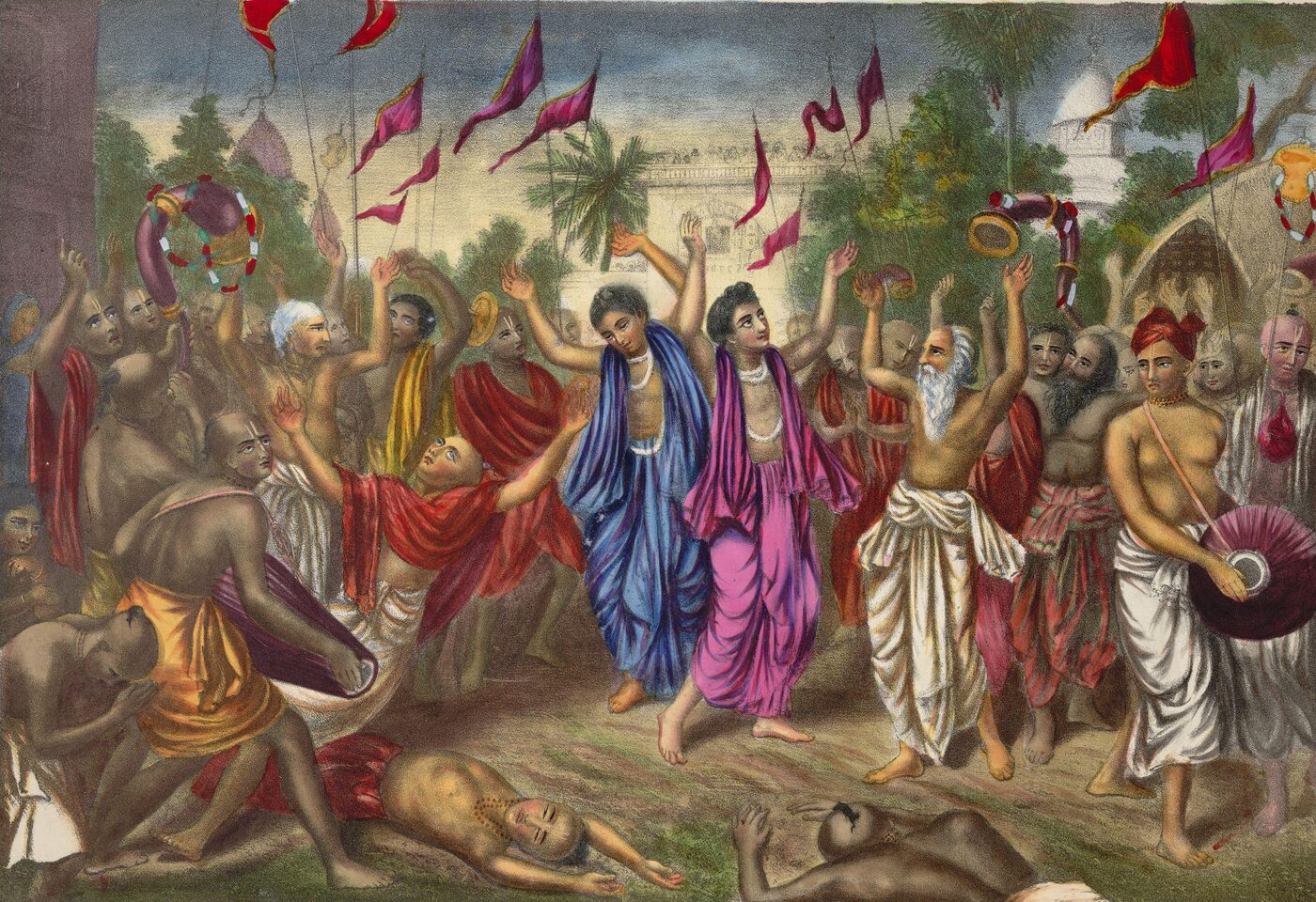
In January 1510 Chaitanya Mahaprabhu accepted sannyasa at Katwa. Three men went with Him to make the arrangements, and Nityananda Prabhu was one of them. Nityananda was also with Him on the road to Jagannatha Puri a few weeks later. On that road he did something that showed, more than any other single act, what kind of associate he was.
| Detail | Description |
|---|---|
| Appointment | Ordered by Chaitanya Mahaprabhu to preach throughout Bengal |
| Duration | Roughly thirty years |
| Headquarters | Khardaha, on the Ganges north of Calcutta |
| Centres | Nabadwip, Panihati, Saptagram, Ambika Kalna, Barahanagar, Naihati, Jhamatpura |
| Branch leaders | More than seventy-five, named in the eleventh chapter of the Adi-lila |
| Best known festival | The Danda Mahotsava at Panihati |
Breaking the Sannyasa Danda at Kamalapura #
At Kamalapura the Lord bathed in the Bhargi river and handed His sannyasa staff to Nityananda to hold. While He went on to the Siva temple at Kapotesvara, Nityananda broke the staff into three pieces and threw it into the water. A sannyasi's danda is not a walking stick. It is the visible sign of the sannyasa order. So destroying it looked, at first sight, like open disobedience by the man who had been given it to look after. When the Lord came back and asked for it, Nityananda said that He had fallen in ecstasy and that the two of them had come down on it together. Mahaprabhu was angry. Krishnadasa Kaviraja then records, with unusual honesty, that the devotees could not understand any of it. They could not understand why Nityananda broke the staff, or why the Lord allowed it, or why He was angry after allowing it. Nobody, he says, could understand the real purpose of the two Lords. Gaudiya commentators have offered explanations since. But for a biography of Nityananda the point is simpler. He was the one person in the movement who would do such a thing, and Chaitanya Mahaprabhu kept him anyway.
The Appointment to Preach in Bengal #
Not long afterwards, an arrangement was made that would shape the rest of both their lives. Chaitanya Mahaprabhu settled at Jagannatha Puri, and for the last eighteen years of His manifest life He practically never left it. He handed Bengal, the movement's home and all its people, to Nityananda. Krishnadasa Kaviraja mentions the appointment in a single clause, in the middle of a list of devotees, as a fact everybody already knew. He writes that when Nityananda Prabhu was ordered to go to Bengal to preach, two of Mahaprabhu's own men were told to go with Him. The Chaitanya-bhagavata describes the order more fully and more directly. There it is an instruction to deliver everyone, without asking who deserved it. For roughly thirty years, that is what he did.
The Geography of the Mission #
The places of the mission are worth listing, because they are not the stops of a pilgrimage. They are the towns of a whole province where he worked steadily. Nabadwip, where it had begun. Khardaha on the Ganges north of what is now Calcutta, where he eventually settled with his family. Panihati, a few miles further up the river. Saptagram on the Sarasvati in Hooghly, then a major inland port. Ambika Kalna, Barahanagar, Naihati, Jhamatpura, and back to the Birbhum country of his birth. He travelled with a large party of kirtana singers, servants and companions. Krishnadasa Kaviraja describes a scene at Panihati. He notes the crowd of devotees seated on the ground around Him, and the great influence of the man, which astonished a visitor who saw it for the first time.
The Seventy Five Branches of His Line #
The clearest evidence of what he actually built is a list. The eleventh chapter of the Adi-lila is given to listing the branches of Nityananda Prabhu's line. It names more than seventy-five individuals. It begins with his son Virabhadra Gosani and runs through Ramadasa, Gadadhara Dasa, Madhava Ghosh and Vasudeva Ghosh, Uddharana Datta, Gauridasa Pandita, Sundarananda, Kamalakara Pippalai, Mahesa Pandita, Dhananjaya Pandita, Parameshvara Dasa and Jagadisa Pandita. It also includes physicians, singers, dancers and a good many men of whom nothing is known except their names and the fact that they belonged to him. Twelve of them are identified as the twelve gopalas, the cowherd boys of Vraja who had come again. Krishnadasa Kaviraja ends the list by saying that these branches were loaded with ripe fruit and distributed it to everyone they met. He also says that each of them had the independent power to give Krishna to anybody. In the language of devotional biography, this describes a movement with many capable local leaders all across the province. No other associate of Chaitanya Mahaprabhu has a chapter like it.
Uddharana Datta and the Suvarna Vanik Community #
But the most important thing Nityananda did in Bengal was not to organise people. It was to change society, and it can be seen in the life of a single follower. Uddharana Datta Thakura of Saptagram was a suvarna-vanik, a member of the gold-merchant and banking community. For centuries that community had been formally shut out of respectable Hindu society in Bengal. The traditional explanation is a quarrel between the ruler Ballal Sena and the great banker Gauri Sena. The king had been borrowing huge sums from Gauri Sena, and in the end the banker stopped lending. The king's revenge was to have the whole caste shut out of society. Nityananda Prabhu came to Saptagram, stayed in Uddharana Datta's house, ate there, and made him one of the twelve gopalas. The Chaitanya-bhagavata states plainly that the entire suvarna-vanik community was purified through him. Srila Bhaktisiddhanta Sarasvati Thakura recorded the history in his commentary, and Srila Prabhupada, who came from that same community and whose family had visited Uddharana Datta's temple in his childhood, set it out in his purport. This is how the caste barrier was really broken in sixteenth-century Bengal. It was not broken by an argument. It was broken by a man of spotless brahmana birth who was also a recognised avadhuta. He sat down to eat in a house where such a man was not supposed to eat, and then he did it again in the next town.
Raghunatha Dasa Comes to Panihati #
The best-documented single event of the Bengal years is the festival at Panihati. It shows his whole method in one small scene. Raghunatha Dasa was the son of an extremely rich landholding family at Saptagram, and he had been trying for years to run away and join Chaitanya Mahaprabhu. His father kept having him brought back, and in the end guards were posted. One day he went instead to Nityananda Prabhu, who was at Panihati sitting under a tree on a rock by the Ganges with his party around him. Raghunatha offered his obeisances from a distance and would not come near. Nityananda called him. When Raghunatha still would not come, Nityananda caught hold of him and put his own feet on Raghunatha's head. Then, laughing, Nityananda announced the punishment. Raghunatha, he said, was a thief who tried to slip away without giving himself up, and he must be punished. He was to hold a festival and feed all the assembled devotees chipped rice and yogurt.
The Festival of Chipped Rice and Yogurt #
Raghunatha sent his men into the village to buy all the food they could find. The crowd grew so fast that he had to send to other villages. He bought four hundred large earthen pots, and then five or seven very large ones in which a brahmana soaked chipped rice in hot milk. Everyone present was given two pots, one of chipped rice with condensed milk and one with yogurt, sugar and bananas. Brahmanas who could not find a place on the platform went down to the bank of the Ganges, and those who could not find a place on the bank stood in the water and ate there. Shopkeepers from surrounding villages arrived to sell chipped rice, yogurt and bananas. Raghunatha bought their entire stock, paid them, and then fed them the food they had brought. Anyone who came to see what was going on was fed as well. Then, Krishnadasa Kaviraja says, Nityananda in meditation brought Chaitanya Mahaprabhu to the spot and stood up to receive Him. As a joke, he went from pot to pot pushing a morsel into His mouth, and then he sat the Lord down and ate beside Him. The comment that follows is the biographer's own: who can understand the influence of Nityananda Prabhu, who is so powerful that He induced Chaitanya Mahaprabhu to come and eat chipped rice on the bank of the Ganges? At the end of the festival, Nityananda had the whole assembly bless Raghunatha, and he put his own feet on the young man's head. Raghunatha Dasa left home shortly afterwards. He went to Puri and became one of the Six Goswamis of Vrindavana. The festival is still kept every year at Panihati as the Danda Mahotsava, the Festival of the Punishment.
The Punishment That Was a Picnic #
Notice what the punishment consisted of. It was a picnic. That was no accident. It was the whole preaching method. Nityananda Prabhu never asked anyone for a qualification before letting them in. The only doorway he set up was food, singing and company, all of it in the open air and free, so that nobody could fail to step through it. Then he left the rest to what happens when people have chanted and eaten together for a day. The householders of Bengal did not have to renounce anything, learn Sanskrit, or leave their trades. All they had to do was come.
How Bengal Became a Mass Movement #
That is why the tradition regards this appointment as the reason Gaudiya Vaishnavism became a mass movement, and not just a school of thought. Chaitanya Mahaprabhu's own preaching after 1510 was concentrated in Puri and in two long journeys. The Six Goswamis in Vrindavana produced the theology, and produced it magnificently. But they were six celibate scholars living under trees in another province, and they did not build congregations. The congregations were built in Bengal, by Nityananda Prabhu and the seventy-five men whose names Krishnadasa Kaviraja preserved, among ordinary householders in ordinary towns. Chaitanya Mahaprabhu disappeared in 1534, and the first generation of devotees began to leave this world after Him. What remained then was that Bengali householder community. Every later Gaudiya lineage, including the ones that eventually carried the movement out of India, grew from it.
