The clearest statement of what Gaudiya Vaishnavas mean by the mercy of Nityananda Prabhu is not a fixed formula of teaching. It is a personal confession by Krishnadasa Kaviraja about his own life. He placed it at the end of the fifth chapter of the Adi-lila of his own book. He warns that the matter is very private, and that he is revealing it only in order to make the mercy known.
Minaketana Ramadasa and the Offended Brahmana #
He begins with a servant of Nityananda named Minaketana Ramadasa, who came to his house in Bengal for a night of sankirtana. Ramadasa was almost always in a state of ecstasy. He wept all the time. Sometimes he climbed onto the shoulders of people offering him obeisances, or hit them lightly with his flute. He shouted the name of Nityananda in a way that disturbed everybody present. A respectable brahmana named Gunarnava Mishra, who was engaged in Deity worship at the time, did not stand up when Ramadasa entered the courtyard. Ramadasa noticed, and remarked that here was a second Romaharshana, the reciter of the Puranas who had failed to rise when Balarama came into the assembly. Then, at the end of the festival, he fell into a dispute with Krishnadasa Kaviraja's own brother, who had firm faith in Chaitanya Mahaprabhu and only a faint glimmer of it in Nityananda.
Half a Hen and the Dream at Jhamatpura #
Krishnadasa scolded his brother, and his words have become one of the tradition's best-known arguments. He told him that the two brothers, Chaitanya and Nityananda, are one body and one identity. To accept one and slight the other is the thinking of a man who wants to keep half a hen, keeping the half that lays eggs and cutting off the half that eats grain. It would be better to be an honest atheist and reject them both than to be a hypocrite who accepts one and speaks badly of the other. Ramadasa broke his flute and left in anger, and Krishnadasa's brother, the text says, fell down. That night, at the village of Jhamatpura near Naihati, Nityananda Prabhu appeared to Krishnadasa in a dream. Krishnadasa describes what he saw at length, and the tone of the description stands out. Nityananda was a tall, powerfully built figure of blackish complexion, in silk cloth and turban. He had gold at the ears and wrists, ankle bells, a garland and sandalwood paste. A red stick moved in His hand, and He moved like a maddened elephant. Around Him were devotees dressed as cowherd boys, chanting. He put His feet on Krishnadasa's head, told him repeatedly to get up, and then said one sentence: do not be afraid, go to Vrindavana, and there you will attain everything. Krishnadasa fainted and woke at daybreak. He understood that he had been ordered, and he left that very moment. The Chaitanya-charitamrita exists because of that dream.
What the Mercy Gave Krishnadasa Kaviraja #
The next part of the text is the reason this chapter is quoted more than almost any other in Gaudiya literature. Krishnadasa Kaviraja lists what Nityananda's mercy actually gave him. It gave him shelter in Vrindavana and the feet of Rupa and Sanatana Goswami. It gave him the shelter of Raghunatha Dasa Goswami and the refuge of Svarupa Damodara. It gave him the conclusions of devotional service from Sanatana and the taste of it from Rupa. And finally it gave him Radha and Govinda themselves. Then he speaks harshly about himself. He is more sinful than Jagai and Madhai, he says, and lower than the worms in stool, and anyone who hears his name loses the merit of his pious acts. Who in this world but Nityananda could have shown mercy to such a person? Then comes the sentence that carries the teaching: because He is intoxicated by ecstatic love and is an incarnation of mercy, He does not distinguish between the good and the bad; He delivers everyone who falls down before Him.
Mercy Without an Entrance Examination #
That last line is the whole teaching. It should be read carefully, because it is easily mistaken for mere sentiment. It does not say that conduct is unimportant. The same author is severe about offence and about the danger of hypocrisy. What it says is that there is no entrance examination. Every other path to the Absolute described in the Indian tradition first asks something of the seeker: learning, ritual purity, caste standing, celibacy, austerity, mental discipline, some measurable seriousness. The claim made about Nityananda Prabhu is that he gives his mercy before a person is qualified, and that the mercy itself then makes the person qualified. He does not sort out the seekers. He delivers the ones who fall at his feet, and falling at his feet is the only requirement.
Guru Tattva and Balarama as Adi Guru #
Behind that lies the doctrine of guru-tattva, and here the theology becomes exact. Balarama is Krishna's first expansion, and His whole nature is service. Gaudiya Vaishnavism identifies Him as the adi-guru, the original spiritual master. On this understanding, the function of the guru is not just one office among several that a great devotee might hold. It is Balarama's own function, embodied. Bhaktisiddhanta Sarasvati Thakura put it as briefly as anyone has: Nityananda alone possesses the distinctive function of the guru, and in Him that function is embodied; He is the servant-God. Krishnadasa Kaviraja states his own position in the very first chapter of his book. There he records that Nityananda Rama is the plenary manifestation of the Lord, and that Krishnadasa himself has been initiated by Him. Then he sets out the principle in general terms. Although he knows his spiritual master to be a servant of Chaitanya, he knows Him also as a plenary manifestation of the Lord. This is because, according to all the revealed scriptures, the spiritual master is nondifferent from Krishna, and Krishna in the form of the spiritual master delivers His devotees. In the fifth chapter he notes that Nityananda serves Chaitanya sometimes as guru, sometimes as friend and sometimes as servant, exactly as Balarama did in Vraja. All three roles are real, and the first of them, the guru, is the one addressed to us.
Why Vaishnavas Approach Through Nityananda #
Why, then, do Gaudiya Vaishnavas approach Chaitanya Mahaprabhu through Nityananda rather than directly? Three answers are given, and they are of different kinds.
Why the Lord Needs an Introducer #
The first answer comes from who Chaitanya Mahaprabhu is. Chaitanya Mahaprabhu is Krishna who has taken the mood and complexion of His own greatest devotee in order to taste love from the devotee's side. So He is not simply there to be approached directly. In that descent He is turned, so to speak, the other way, into the position of the devotee. Somebody has to make the introduction, and that work of introducing belongs to Balarama. To go to the Lord without a guru is to arrive unannounced. The tradition holds that this simply does not work. The reason is not a matter of formal rules. It is that the ability to recognise Him has to be given by someone who already has it.
The One Debt the Holy Name Cannot Clear #
The second answer is moral, and it is the one that matters most in practice. Gaudiya theology holds that the holy name will burn up any quantity of ordinary sin. But there is exactly one thing it will not remove by itself: an offence committed at the feet of a Vaishnava. That kind of debt is owed to a person, and only the person it is owed to can cancel it. In Nityananda Prabhu's case this is not just an idea. Madhai had cut Nityananda's head open with a broken pot. When Madhai threw himself before Chaitanya Mahaprabhu, the Lord refused him and sent him to Nityananda's feet, because the debt was not owed to Him. It was Nityananda who forgave, and who then offered his own spiritual credit in exchange for the forgiveness. The full episode is told here. The conclusion the tradition draws is practical, not sentimental. The safest door into the movement is the one man who, as the story shows, refused to take offence even when he was offended in the most direct way possible.
Everyone Has Claimed It Through Him #
The third answer comes from experience, as the tradition understands it. Everyone who has claimed the mercy has claimed it through him. Krishnadasa Kaviraja says this plainly about himself. By writing it into the fifth chapter of a book about somebody else, he made his own life the lasting example.
Patita Pavana as a Claim Requiring Proof #
The name that gathers all of this together is patita-pavana, the deliverer of the fallen. In Gaudiya literature this name is treated less as a title of honour than as a claim that needs proof. When Rupa and Sanatana Goswami first fell before Chaitanya Mahaprabhu at Ramakeli, they told Him that delivering Jagai and Madhai had cost Him very little. Those two, they said, were brahmanas of a holy town, and their only fault was addiction to sin. But if He would deliver two servants of meat-eaters, the name would be truly earned. They were not simply being humble. They were pointing out that a title of that kind has to be proved with the most fallen people, or it means nothing. Bengali Vaishnavism has always understood Nityananda Prabhu as the one who gave that proof, and gave it at his own cost.
The Song on the Lotus Feet of Nitai #
Two centuries of Bengali devotional song rest on this. Narottama Dasa Thakura, whose songs are sung daily in Gaudiya temples, wrote a short song on the lotus feet of Nitai, and it has become the standard statement of this teaching. The song says that those feet are the shelter of everyone who has no other shelter, and that they are cooling, like the shade of a tree. A man who does not want that shade is deliberately drinking poison. Nitai asks nothing of the sinner, and that is why the sinner has any hope at all. And, in the line everybody knows, when the mercy of Nitai is obtained one attains Radha and Krishna. That last line puts the entire doctrine into eight syllables of Bengali. The declared goal of Gaudiya Vaishnavism is the service of Radha and Krishna in Vrindavana. It is the highest goal the tradition can name, and the hardest to reach. Yet the path to it that the tradition actually recommends is not austerity or scholarship. It is the mercy of a man who never turned anyone away. Narottama then does what Krishnadasa Kaviraja did. He adds that he himself is the most fallen and the most degraded, and that he is singing this because he has nothing else to offer.
The Hard Edge of the Doctrine #
There is a hard side to this teaching, and it should be stated honestly. The same literature that praises Nityananda's mercy without limit is severe about the results of disrespecting him, and the passage about the half a hen is the mildest form of it. This is less a threat than a point that follows from the teaching itself. To reject the one who introduces you is to stay unintroduced. The tradition holds that a person who honours Chaitanya Mahaprabhu while dismissing His servant has misunderstood the nature of the One he honours. Nityananda Prabhu himself, as was his nature, never made this argument on his own behalf. It is made by his followers, and usually by followers who are painfully aware of their own past faults.
How the Doctrine Shows Itself in Practice #
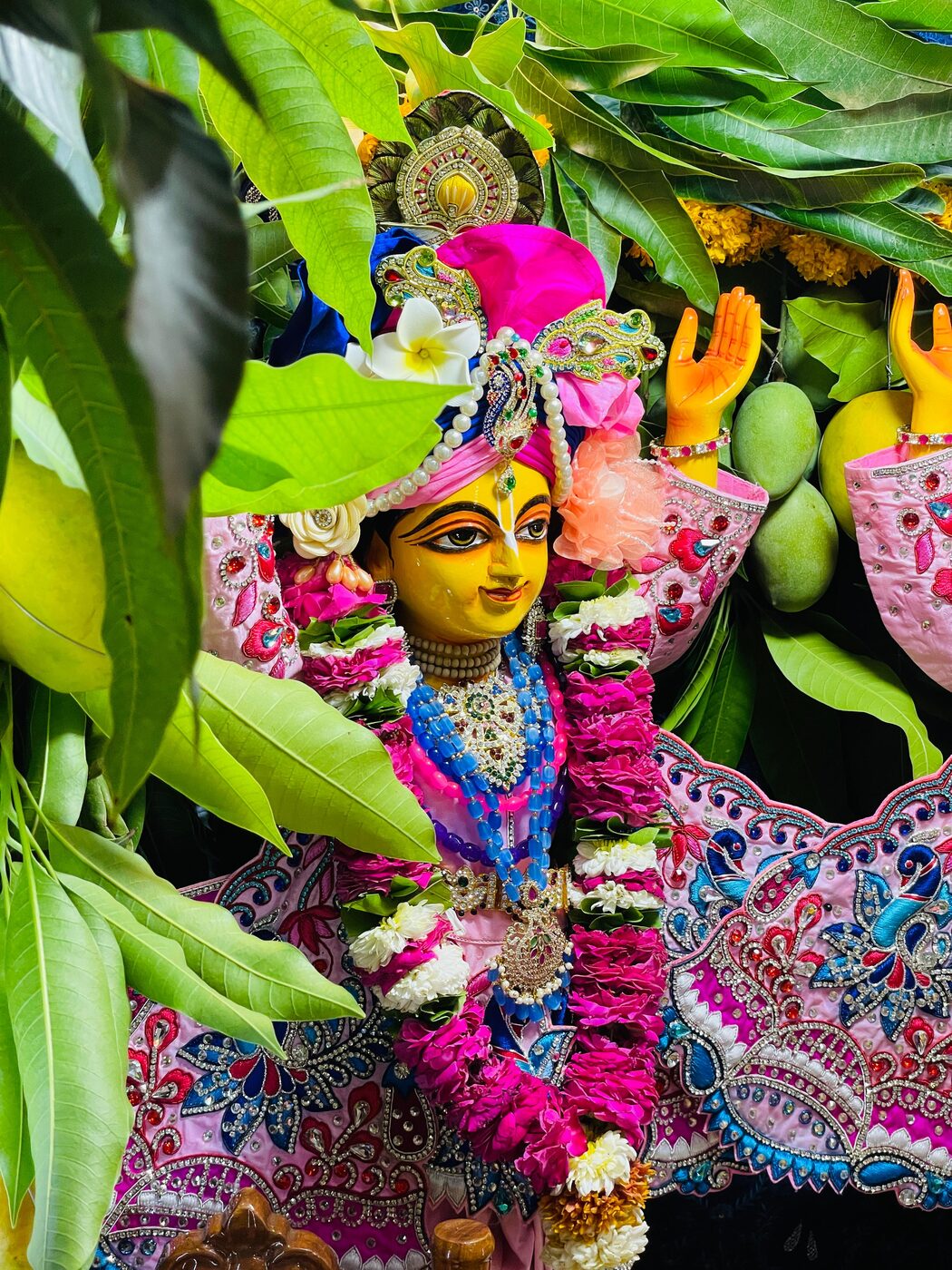
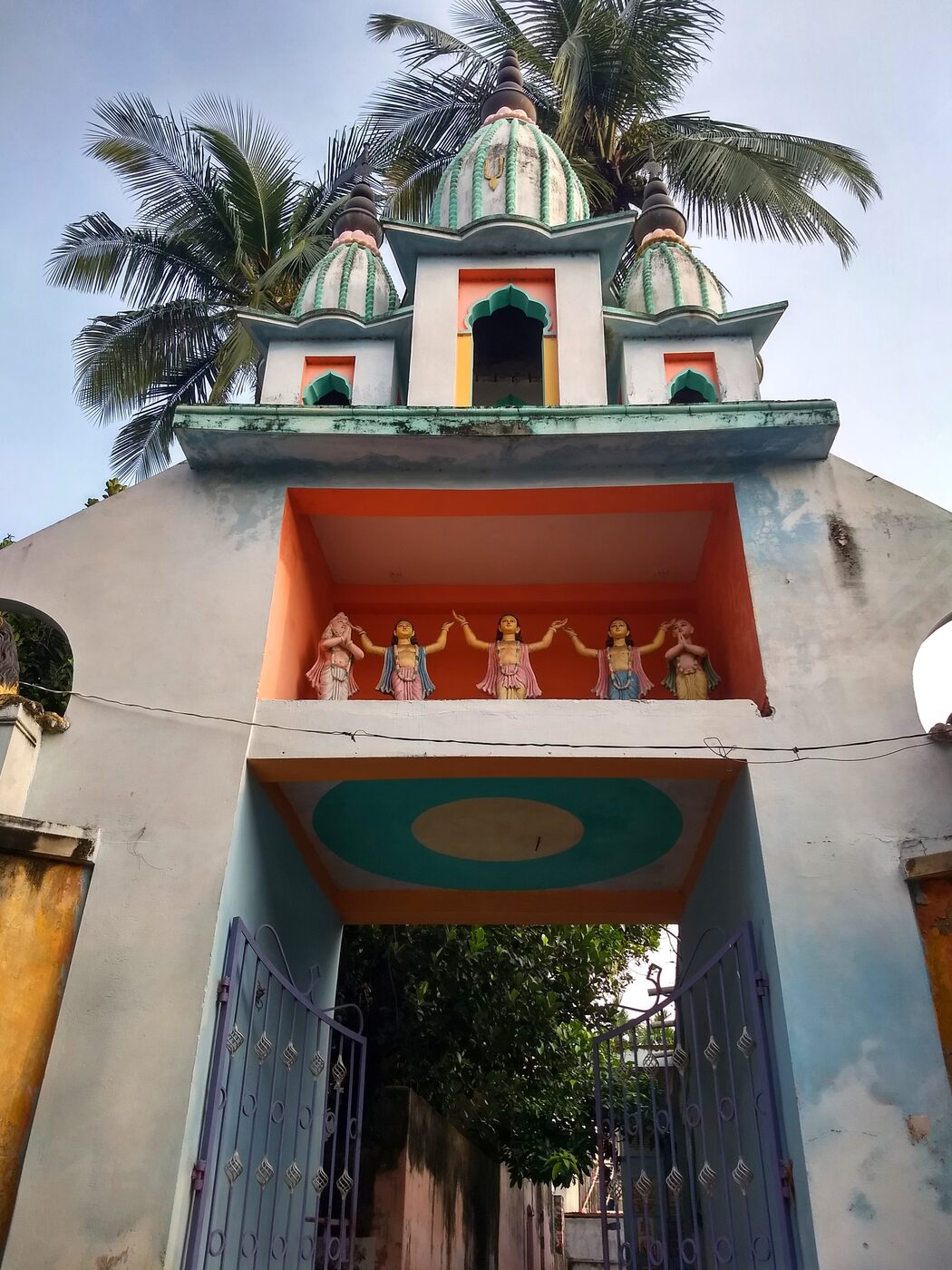
In practice the doctrine shows itself in ordinary ways. His appearance day, Nityananda Trayodasi, is kept a few weeks before Gaura Purnima. In the Panca-tattva mantra his name is chanted immediately after Chaitanya Mahaprabhu's and before the other three. Bengali Vaishnavas greet each other with the two names paired, the servant's placed first. And in almost every Gaudiya temple in the world, the Deity of Chaitanya Mahaprabhu stands with Nityananda Prabhu beside Him, arms raised, and is not installed alone.
