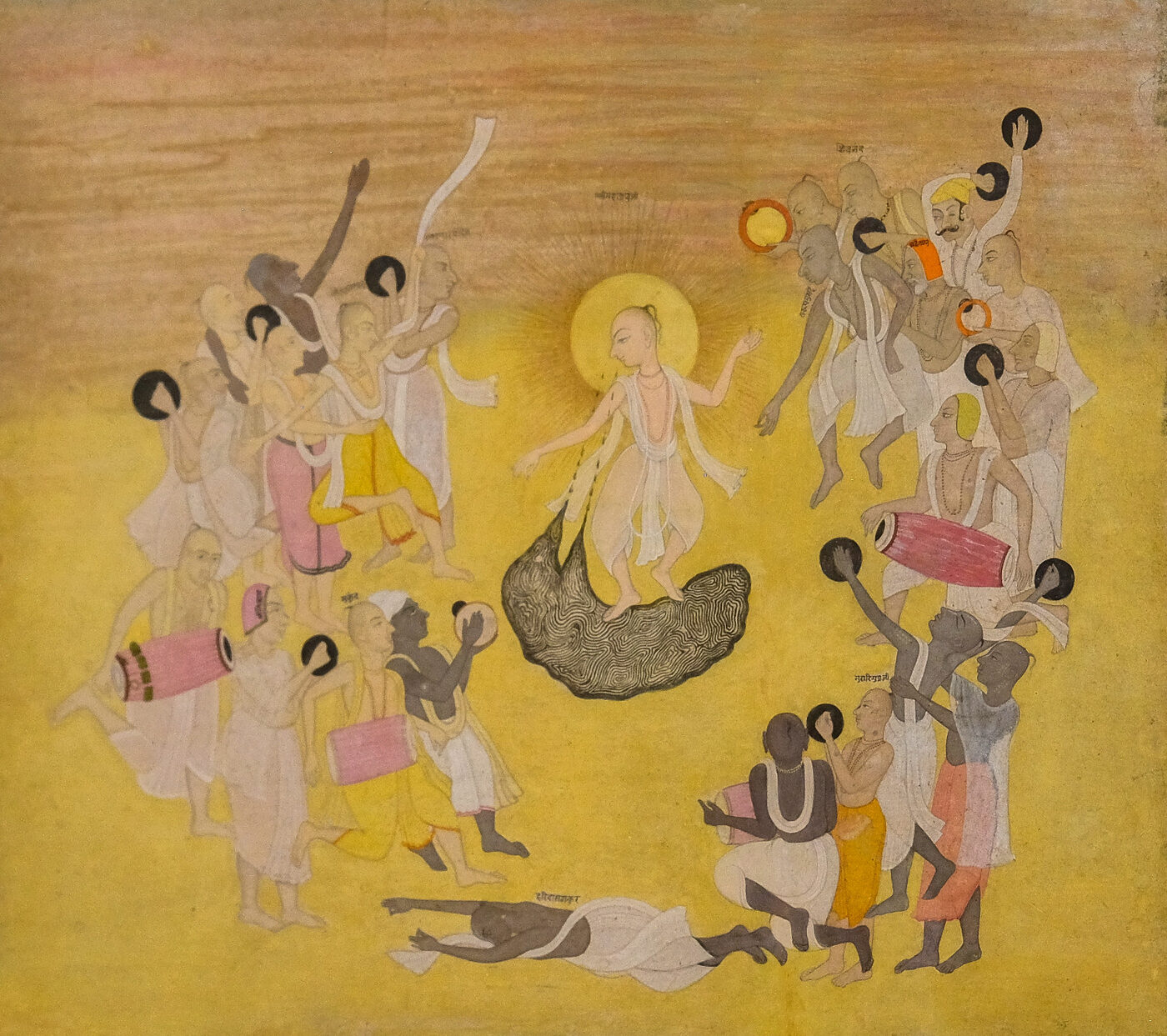
By about 1506, news reached Nityananda Prabhu in Vrindavana. It was the news he had been waiting twenty years to hear. Nimai Pandita of Nabadwip, the young logician whose reputation had filled Bengal, had gone to Gaya, received initiation from Ishvara Puri, and come back a different man. He wept at the name of Krishna, fell unconscious in the street, and had begun gathering a small circle of devotees in the courtyard of Srivasa Pandit to chant through the night. Nityananda left Vrindavana at once and walked to Nabadwip.
| Detail | Description |
|---|---|
| Year | About 1506 |
| Place | The house of Nandana Acharya, on the Ganges bank at Mayapur |
| Ages | Nityananda about thirty-two, Mahaprabhu about twenty |
| Sent to search | Srivasa Pandit and Haridasa Thakura |
| Forms revealed | Six-armed, four-armed and two-armed |
Hiding at the House of Nandana Acharya #
What Nityananda did when he arrived was typical of him, and it is the first thing the biographies stress. He announced himself to nobody. He went quietly to the house of a devotee named Nandana Acharya, on the Ganges bank at Mayapur, and stayed there without telling anyone who he was. Nandana Acharya did know. He felt his life was fulfilled, and he too said nothing. Nityananda had crossed the subcontinent to reach this town. Yet he chose to sit still in a stranger's house and wait to be found. That is not what one would expect. The tradition sees it as the proper behaviour of a servant, who does not put himself forward but waits to be called.
The Dream of the Palm Tree Chariot #
The next morning Chaitanya Mahaprabhu told the devotees about a dream. He had seen a chariot with a flag marked with a palm tree, which is Balarama's sign. On the chariot was an extraordinary person who was asking the way to the house of Nimai Pandita. That person, He said, had arrived in Nabadwip during the night, and they were to go and find Him. Srivasa Pandit and Haridasa Thakura were sent out. They went through the whole town, house by house and market by market, asking whether any remarkable visitor had come, and came back with nothing. Mahaprabhu, the accounts say, smiled at this, got up, and led the way Himself. The party walked to the house of Nandana Acharya.
The Meeting at the Door #
The Chaitanya-bhagavata describes the meeting as one of silence. Nityananda saw the shining light approaching and came to the door. The two of them stood looking at each other without speaking, unable to move. Then Nityananda fell to the ground. Mahaprabhu picked him up and embraced him, and both of them wept. Nityananda was then about thirty-two years old, and Mahaprabhu about twenty. By the normal rules of Bengali society, an older man from an unrelated family and a younger householder pandit had no special tie to each other at all.
The Reading From the Srimad Bhagavatam #
Vrindavana Dasa records that Mahaprabhu then asked Srivasa Pandit to read from the Srimad-Bhagavatam. He records that the passage read was the description of Krishna entering the forest of Vrindavana with the cowherd boys. Krishna wore yellow cloth and a peacock feather in His hair, and He filled His flute with the nectar of His lips. Nityananda lost consciousness before the reading was finished. This is a small but very deliberate detail in the story. Of all the verses that might have been chosen for the occasion, the one chosen describes the exact scene in which the two of them had walked side by side in a previous descent.
The Six Armed and Four Armed Forms #
Krishnadasa Kaviraja sums up what happened over the following days in a few verses of the Adi-lila. Chaitanya Mahaprabhu revealed to Nityananda Prabhu a six-armed form holding a conchshell, a disc, a club, a lotus, a bow and a flute. This one form shows the teaching of the whole meeting in a single picture. The conch, disc, club and lotus belong to Vishnu, the bow to Ramachandra and the flute to Krishna. Together the six items say that the young man of Nabadwip, who would soon take sannyasa, contains all three. The Lord then showed him a four-armed form, and finally the two-armed form of Krishna, the son of Nanda Maharaja, bluish, dressed in yellow and playing the flute. The tradition holds that very few people in Mahaprabhu's whole life were shown this sequence. It also holds that the order itself, from the combined form down to the original one, was a way of showing who He was.
The Vyasa Puja and the Musala #
Then came an exchange that the biographers clearly enjoyed. Nityananda arranged to perform Vyasa-puja, the formal worship offered to the spiritual master, and he made Chaitanya Mahaprabhu the one to be worshipped. Mahaprabhu accepted the worship. Then, in ecstasy, feeling Himself to be Nityananda, He took up the musala, the plough-like weapon of Balarama. In this way each of them was insisting, in the only way open to him, that the other was the master. Krishnadasa Kaviraja says elsewhere that this mixing of roles was permanent. Nityananda serves Chaitanya sometimes as His guru, sometimes as His friend and sometimes as His servant, just as Balarama did with Krishna in Vraja. Krishnadasa Kaviraja also says that although Nityananda's own incarnations are unlimited, He describes Himself as Chaitanya's servant. Shortly afterwards, the Adi-lila adds, Sachi Devi looked at the two of them in her own house and saw Krishna and Balarama.
The Two Biographies and Their Purposes #
Here it helps to be clear about the sources. The Chaitanya-charitamrita tells this whole episode in only six verses. This is because Krishnadasa Kaviraja was writing decades later, and he knew that Vrindavana Dasa Thakura had already covered it. The full story, with the dream, the failed search and the meeting at the door, is found in the Chaitanya-bhagavata. That book was written in Bengal while people who remembered the events were still alive, and it was written on Nityananda Prabhu's own instruction. A reader who wants the details has to go to this Bengali book. A reader who wants a short summary of the teaching will find it in the Charitamrita, with its many Sanskrit quotations. The two do not conflict, but they were written for different purposes.
The Second Pole of the Movement #
What did the two of them recognise in each other? The tradition gives a plain answer in the closing summary of the same chapter. The former son of Nanda Maharaja is now Chaitanya Mahaprabhu, and the former Baladeva, Krishna's brother, is now Nityananda Prabhu. But this recognition also had practical results, and they showed at once. From this point on, Nityananda is not just one follower among many. He becomes the second pole of the movement, alongside Mahaprabhu. In the Panca-tattva, the five features in which the Lord appears in order to distribute love of God, he stands next to Chaitanya Mahaprabhu and before Advaita Acharya, Gadadhara Pandit and Srivasa Thakura. When the sankirtana went out into the streets of Nabadwip, Mahaprabhu danced in one party and Nityananda moved with Him. When Mahaprabhu accepted sannyasa at Katwa in 1510, three men went with Him to make the arrangements, and Nityananda was one of them. Within a year or two of the meeting, the Lord wanted the holy name taken door to door through Nabadwip to people who had no interest in it at all. The man He sent was Nityananda. That task ended in blood, and the story is told here.
Concealment and the Reversal of Protocol #
Gaudiya Vaishnavas take two lessons from the episode. The first is the way he hid himself. Nityananda Prabhu had every reason to arrive in Nabadwip and announce himself, but he did the opposite. The tradition reads this as a lasting instruction about how a spiritual master behaves. He does not advertise himself, and the disciple must go looking for him. The second lesson is the reversal of roles at the Vyasa-puja. Their religious culture was carefully arranged around who must bow to whom. Yet the two central figures of the new movement spent their first weeks together each trying to give the other the higher seat. Whatever else the sankirtana movement was going to be, it was not going to be an institution built on rank.
