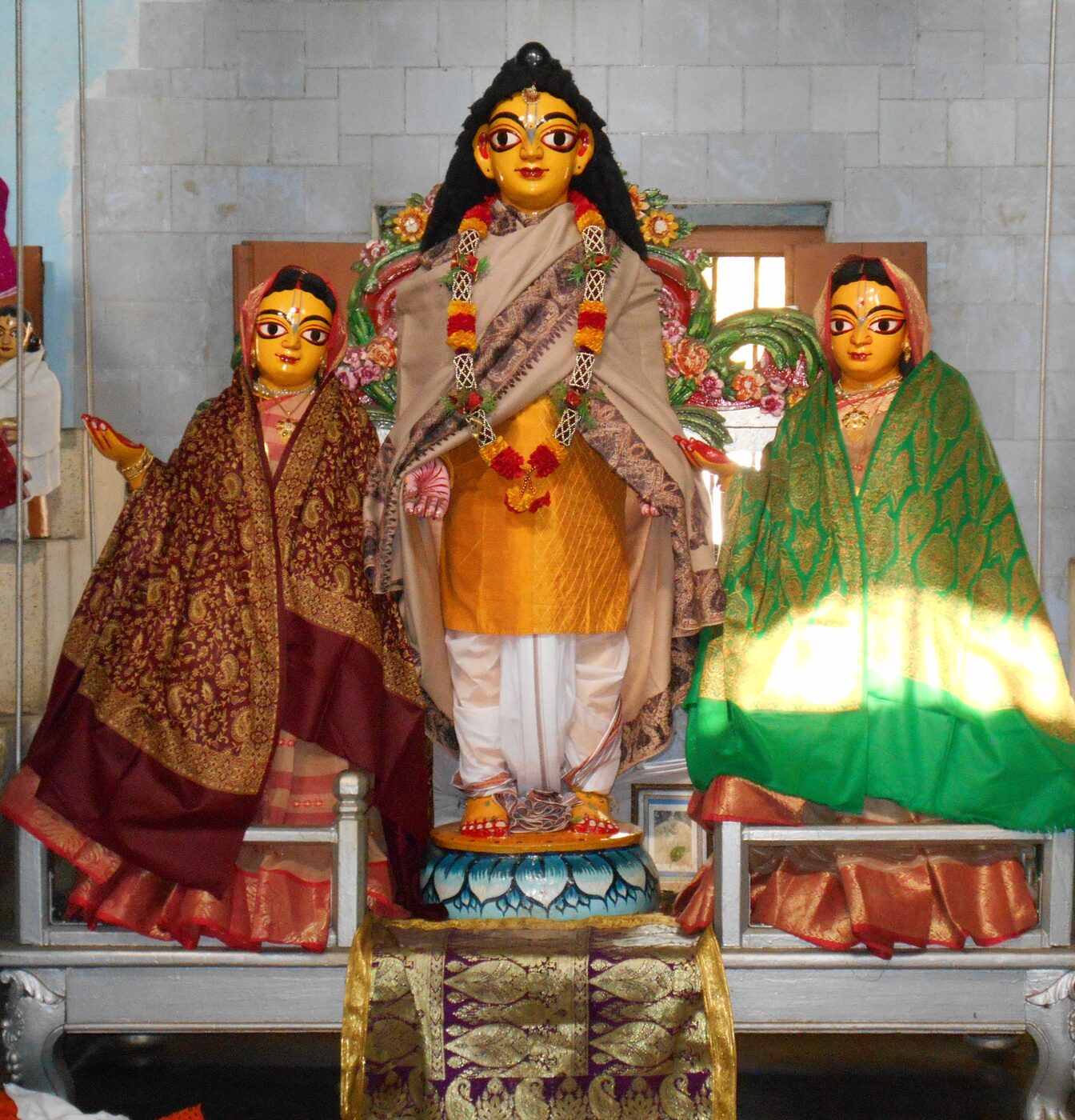
Nityananda Prabhu spent the first half of his life as an avadhuta. The word describes a renounced person who has gone beyond all rules, and it described him exactly. He had left home at twelve and wandered India for twenty years. He kept no fixed home and no fixed practice, and he regularly behaved in ways that shocked orthodox Bengal. He ended his life as a married householder at Khardaha, with two wives, a son and a daughter. This is one of the more surprising turns in Gaudiya history, and the tradition is quite clear about whose idea it was.
| Person | Relation |
|---|---|
| Suryadasa Sarakhela | Father of both wives, accountant to the ruler of Gauda |
| Gauridasa Pandita | Brother of Suryadasa, one of the twelve gopalas |
| Vasudha | The elder daughter, first wife |
| Jahnava | The younger daughter, second wife, known as Jahnava Mata |
| Virabhadra | Son of Vasudha, also called Virachandra |
| Ganga Devi | Daughter of Vasudha |
Why Mahaprabhu Told Him to Marry #
The later Bengali biographies record that Chaitanya Mahaprabhu took him aside and spoke to him plainly. If Nityananda also confined himself to the austerities of a renunciant, who would deliver the people sunk in material life, and how would the work continue? He should go back to Gauda, accept household life, and preach from inside it, so that ordinary people had an example they could actually copy. This is not recorded in the Chaitanya-charitamrita, and the reader should know that. It comes from the Bhakti-ratnakara, the Premavilasa and the many Bengali devotional biographies that grew up around the Nityananda line. But the reasoning behind it fits fully with everything else about the mission in Bengal, which was aimed at householders from beginning to end. An avadhuta cannot be imitated. A married man running a congregation can.
The Family of Suryadasa Sarakhela #
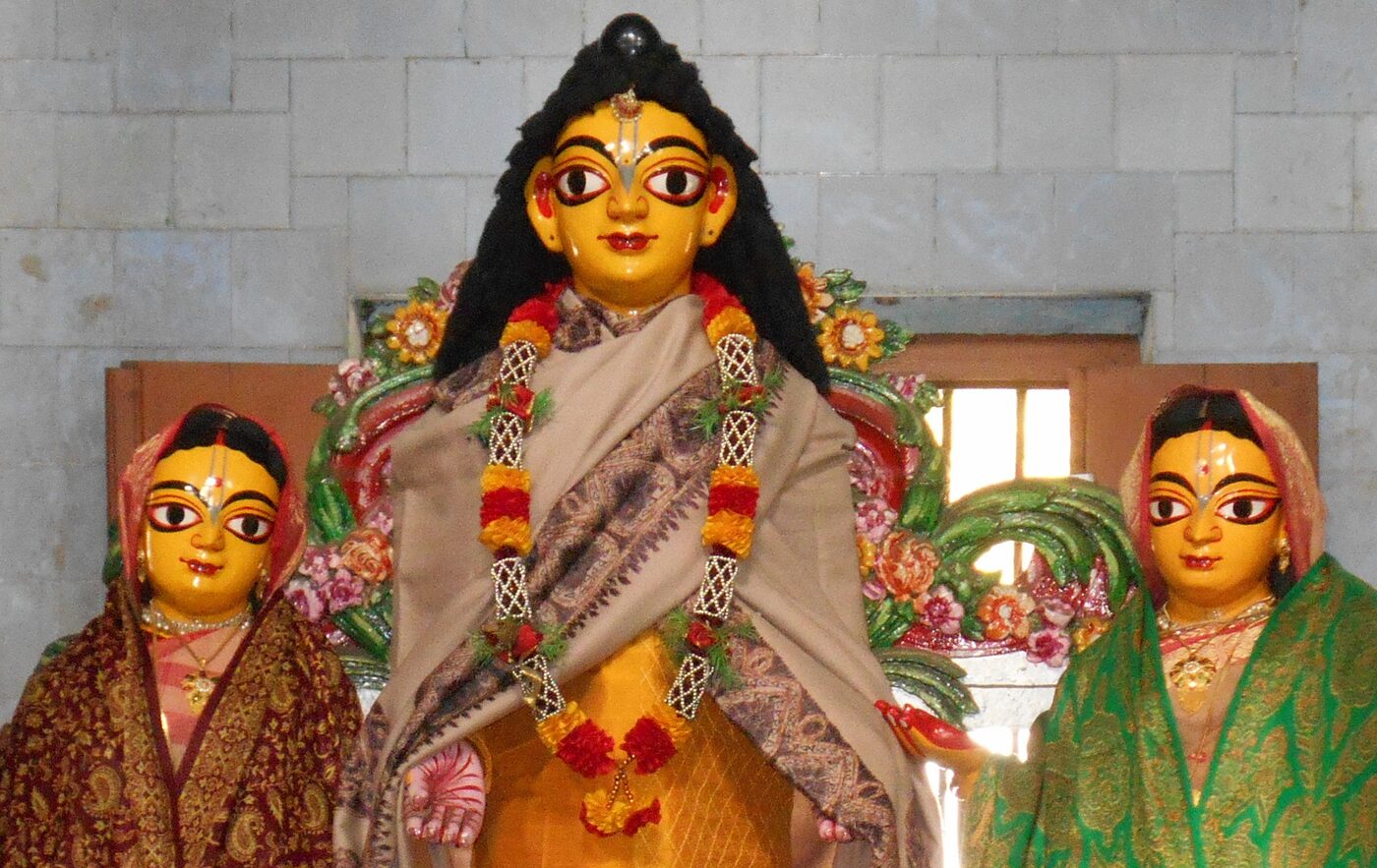
The family he married into was already inside the movement. Suryadasa Sarakhela lived at Saligrama. His title Sarakhela shows that he kept accounts for the ruler of Gauda. He had several brothers. One of them was Gauridasa Pandita, one of the twelve gopalas and among the most devoted of all Nityananda's followers. Another was Krishnadasa Sarakhela. The Chaitanya-charitamrita's list of Nityananda's devotees names him together with his brother, as a reservoir of love of God. Suryadasa had two daughters, Vasudha the elder and Jahnava the younger.
The Refusal and the Restoring of Vasudha #
The traditional account of the marriage is dramatic. It comes from the later biographies, not from the two great ones, so it should be read as what the tradition preserves, not as documented history. In that account Nityananda came to Suryadasa's house, accompanied by Uddharana Datta Thakura, and asked for Vasudha's hand. He was refused. Suryadasa could not bring himself to give his daughter to a man who had given up his caste position. Nityananda left. Vasudha had understood who had come for her, and she collapsed. Gauridasa Pandita came and fell at his elder brother's feet to beg him to change his mind. But by then Vasudha had already been carried to the Ganges for her last rites. Nityananda came to the riverside. Suryadasa fell at his feet and asked for his daughter's life. Nityananda answered that he would bring her back on condition that the marriage took place, and Suryadasa agreed. The accounts describe her waking and looking at him. Suryadasa then asked him to go through the customary purification rites and accept the sacred thread. Nityananda agreed without argument. He remarked that in this matter he was not the one in charge, and that the only master was Chaitanya. Some days later, while Jahnava was serving him his meal, her veil slipped. Nityananda understood that she too was his own energy, and he asked for her as well. Suryadasa answered that he had nothing left that he could refuse.
Marriage and Settling at Khardaha #
They were married and spent a few days at Saligrama. Then they went on the round of visits that any Bengali bridegroom makes. At Nabadwip, Sachi Devi received the two brides with great affection. At Advaita Acharya's house in Shantipur, Sita Thakurani took them into her lap and blessed them. Afterwards Nityananda settled at Khardaha, on the Ganges north of present-day Calcutta, and Khardaha became the headquarters of the Bengal mission.
The Children of Vasudha #
Vasudha bore eight sons and one daughter. Seven of the sons died in infancy. The two children who survived were the daughter Ganga Devi and the youngest son, Virabhadra, also called Virachandra. Vasudha herself died soon after their birth, and Jahnava, who had no children of her own, raised them. The accounts say that Virabhadra was her particular favourite, and it was Jahnava who eventually gave him initiation.
Virabhadra Gosani the Topmost Branch #
At the start of the eleventh chapter of the Adi-lila, Krishnadasa Kaviraja describes Virabhadra Gosani's place in the tradition in the strongest possible words. He calls him the greatest branch after Nityananda Prabhu himself. He describes him as the main pillar of the hall of devotional service built by Chaitanya Mahaprabhu. He says that it is by Virabhadra's mercy that people all over the world have the chance to chant the names of Chaitanya and Nityananda. And before beginning to write the Chaitanya-charitamrita, he takes shelter of Virabhadra's feet. A tradition preserved by the Nedadi sampradaya holds that Virabhadra brought twelve hundred Nedas, former Buddhist monks, into the Vaishnava community and set them to dig the great tank called Svetaganga at Ekachakra. He built the temple at Ekachakra that his father had never built. The villages of Viracandrapura and Virabhadrapura beside the birthplace carry his name.
Jahnava Mata and the Second Generation #
But it is the later life of Jahnava Devi, remembered throughout Bengal simply as Jahnava Mata, that makes her story so important. Chaitanya Mahaprabhu disappeared in 1534, and Nityananda Prabhu, Advaita Acharya and Srivasa Pandit followed within a few years. The movement was then left without any of the figures around whom it had been organised. The person who filled that gap was Nityananda Prabhu's widow.
She did it without any of the usual supports. She held no official post, and in sixteenth-century Bengal a widow was not expected to lead anything. The Vaishnavas of her time accepted her, and the records show no sign of any dispute about it. She gave initiation to her stepson Virabhadra and to a large number of other people. In other words, she served as a diksha-guru. Narottama Dasa Thakura, Srinivasa Acharya and Shyamananda Prabhu, the three men who carried the movement forward in its second generation, accepted her as the foremost Vaishnava in Bengal.
The Festival at Kheturi #
The clearest sign of this came at the festival at Kheturi. Narottama Dasa Thakura organised it, and it is generally regarded as the moment when the second generation of Gaudiya Vaishnavism became firmly established. It included the first recorded celebration of Chaitanya Mahaprabhu's appearance day after His disappearance, and six Deities were installed. Jahnava Mata was invited, given the highest honour, and asked on the opening day to take charge of the whole event. She did so. She directed the kirtana and oversaw the Deity worship. She told Srinivasa Acharya to distribute garlands and sandalwood paste, and she accepted them herself. During the kirtana the assembled devotees experienced what they took to be Mahaprabhu's presence. It was she who told them what had happened, that Mahaprabhu appears wherever the holy name is sung together. Then she instructed them to begin playing with the festival colours. The next morning she cooked the offering herself, distributed it, and ate only after everybody else had been fed.
Her Journeys to Vraja and Jahnava Radhika #
Afterwards she travelled to Vraja, as she had done at least once before. The accounts say that on an earlier visit Rupa Goswami himself had explained the literature to her. They also say that Raghunatha Dasa Goswami, well known as the strictest of the Six and the one who most kept away from company, spent a great deal of time showing her the area of Radha-kunda. More than any other single person, she is given credit for joining the Bengali wing of the movement and the Vrindavana wing into one body. This was at a time when the two might easily have drifted apart. In a vision she was told that the small Radha deity beside Gopinatha at Vrindavana should be replaced by a larger one. She had it made in Bengal and brought it there. The deity installed at Gopinatha's left is still called Jahnava Radhika, and the original went to Jaipur.
A Woman at the Head of the Movement #
Gaudiya Vaishnavas do not usually present her as a reformer, and she did not present herself that way. But it is worth naming what happened, because the tradition has never disowned it. In the middle of the sixteenth century a woman held the acknowledged spiritual leadership of a movement full of brahmana men, initiated disciples, presided over its central assembly, and negotiated its most important institutional relationship, and the sources treat this as unremarkable. That was possible because the movement's own logic had already made it possible: the qualification for teaching, in Chaitanya Mahaprabhu's stated position, is knowledge of Krishna and nothing else, neither birth nor status. Jahnava Mata is what that principle looks like when it is applied without flinching. She is worshipped today beside Nityananda Prabhu in temples throughout Bengal, and at Ekachakra she stands on the right-hand side of the Deity of Banka Raya.
The Nityananda Vamsa and Hereditary Succession #
The two marriages had one further result. Through Virabhadra and Ganga, Nityananda Prabhu's line became a family, and the hereditary Goswami households of the Nityananda-vamsa have carried the worship in Bengal ever since. Hereditary succession later became a disputed question in Gaudiya Vaishnavism. In the twentieth century, Srila Bhaktisiddhanta Sarasvati Thakura's reforms were aimed largely at its misuse. But in the decades just after 1534, every founder of the movement passed away within a few years of each other. In those years it was the family at Khardaha, and above all the woman at its head, that kept the movement standing.
