Sri Nityananda Prabhu
Patita-pavana, the Deliverer of the Fallen
The complete life, on one page: The main biography and every pastime page, in order, in one place
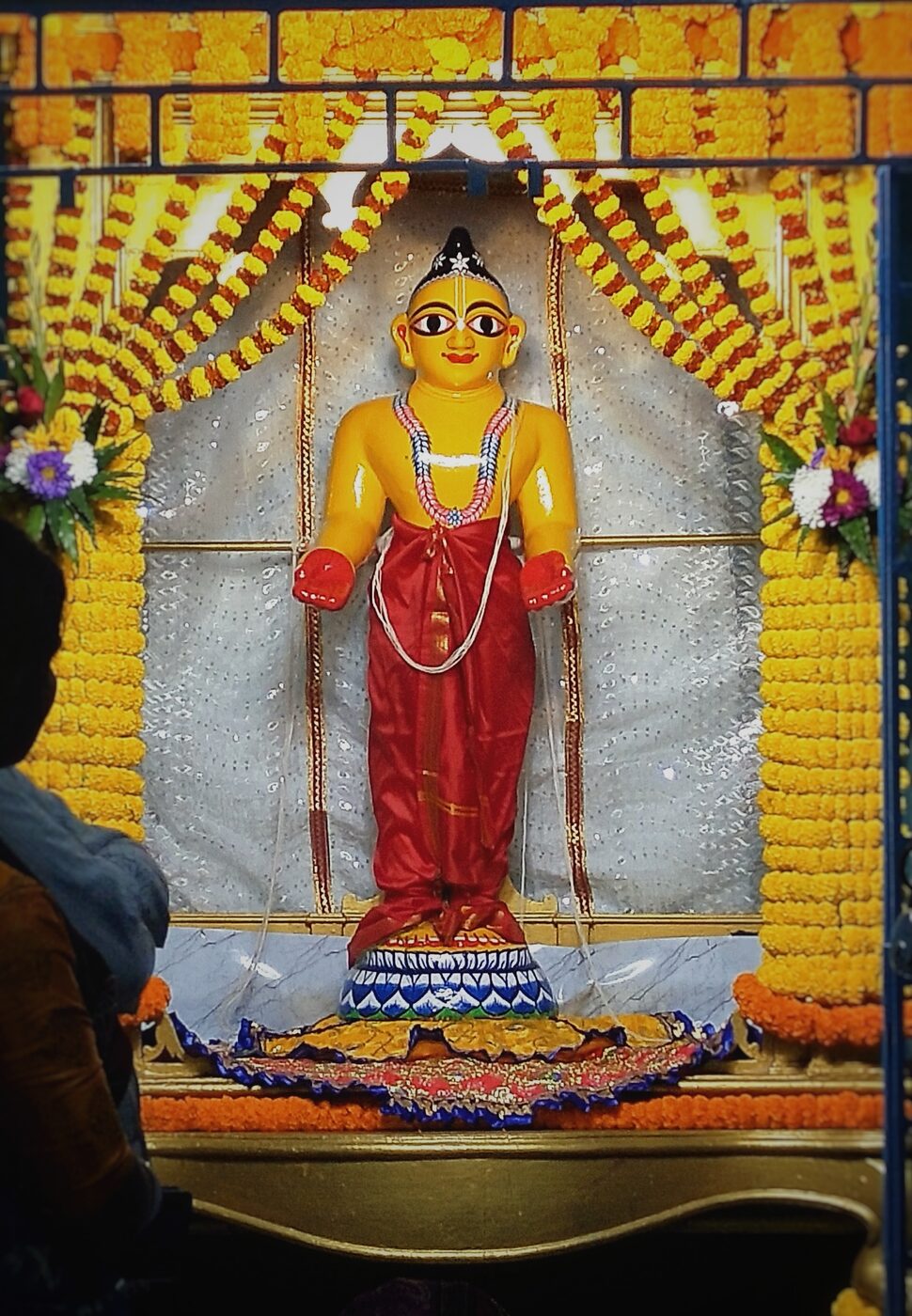
Introduction
Sri Nityananda Prabhu is the second member of the Panca-tattva and, in Gaudiya Vaishnava theology, the principle of the spiritual master himself. Sri Chaitanya Mahaprabhu is Krishna appearing as His own devotee, and Nityananda Prabhu is understood to be Balarama. Balarama is Krishna's elder brother and His first expansion. He is also the source of all service to Krishna. Vaishnavas therefore approach Mahaprabhu through Nityananda Prabhu rather than directly, on the principle that one reaches the Lord by the mercy of the Lord's servant. The pairing is so fundamental to Bengali devotional life that the two are almost never named separately: they are simply Gaura-Nitai.
| Detail | Description |
|---|---|
| Identity | Balarama, the second member of the Panca-tattva (Gaura-ganoddesha-dipika 11; Chaitanya-charitamrita Madhya 1.28) |
| Advent | Ekachakra, Birbhum district, Bengal, around 1474 |
| Parents | Hadai Ojha (Hadai Pandita) and Padmavati Devi |
| Wives | Vasudha and Jahnava, daughters of Suryadasa Sarakhela |
| Field of work | Bengal, by the order of Sri Chaitanya Mahaprabhu |
| Known as | Patita-pavana, the deliverer of the fallen |
Scriptural evidence for the introduction (2)
अस्यार्थो विवृतस्तैर्यः स सङ्क्षिप्य विलिख्यते ।
भक्तरूपो गौरचन्द्रो यतोऽसौ नन्दनन्दनः ॥
भक्तस्वरूपो नित्यानन्दो व्रजे यः श्रीहलायुधः ।
भक्तावतार आचार्योऽद्वैतो यः श्रीसदाशिवः ॥
भक्ताख्याः श्रीनिवासाद्या यतस्ते भक्तरूपिनः ।
भक्तशक्तिर्द्विजाग्रण्यः श्रीगदाधरपण्डितः ॥११॥
asyārtho vivṛtas tair yaḥ sa saṅkṣipya vilikhyate |
bhakta-rūpo gauracandro yato’sau nanda-nandanaḥ ||
bhakta-svarūpo nityānando vraje yaḥ śrī-halāyudhaḥ |
bhaktāvatāra ācāryo’dvaito yaḥ śrī-sadāśivaḥ ||
bhaktākhyāḥ śrīnivāsādyā yatas te bhakta-rūpinaḥ |
bhakta-śaktir dvijāgraṇyaḥ śrī-gadādhara-paṇḍitaḥ ||11||
I shall now summarily explain the meaning of these words. In this Panca-tattva, the bhakta-rupa (form of a devotee) is Lord Caitanya Mahaprabhu, who formerly appeared as Lord Krsna, the son of Nanda Maharaja. The bhakta-svarupa (devotional incarnation) is Lord Nityananda, who formerly appeared in Vrajabhumi as Lord Balarama. The bhaktavatara (devotional manifestation) is Lord Advaita Acarya, who is not different from Lord Sadasiva. The bhaktakhya (pure devotee) is Srinivasa and the other great devotees as well. The bhakta-sakti (devotional energy) is Gadadhara Pandita, the foremost of brahmanas.
From the purport: Describing such individual service, the Gaura-gaṇoddeśa-dīpikā (11-16) declares that although Lord Caitanya Mahāprabhu appeared as a devotee, He is none other than the son of Nanda Mahārāja. Similarly, although Śrī Nityānanda Prabhu appeared as Lord Caitanya's assistant, He is none other than Baladeva, the carrier of the plow.
Kavi Karnapura's summary of the Panca-tattva: Nityananda Prabhu is the bhakta-svarupa, who in Vraja is Balarama (Sri Halayudha). Sanskrit: diacritic edition of the Gaura-ganoddesha-dipika; English translation as published at bvmlu.org. Purport excerpt: Srila Prabhupada, Chaitanya-charitamrita Adi 17.301.
যদ্যপি আপনি হয়ে প্রভু বলরাম ।
তথাপি চৈতন্যের করে দাস-অভিমান ॥ ২৮ ॥
yadyapi āpani haye prabhu balarāma
tathāpi caitanyera kare dāsa-abhimāna
Although Nityānanda Prabhu is none other than Balarāma Himself, He nonetheless always thinks of Himself as the eternal servant of Lord Śrī Caitanya Mahāprabhu.
Krishnadasa Kaviraja Goswami states in one verse both that Nityananda Prabhu is Balarama Himself and that He always thinks of Himself as Sri Chaitanya Mahaprabhu's servant.
Chapter 1
The Advent at Ekachakra
A village in Birbhum, a schoolmaster's son, and the reason Balarama always arrives before Krishna does
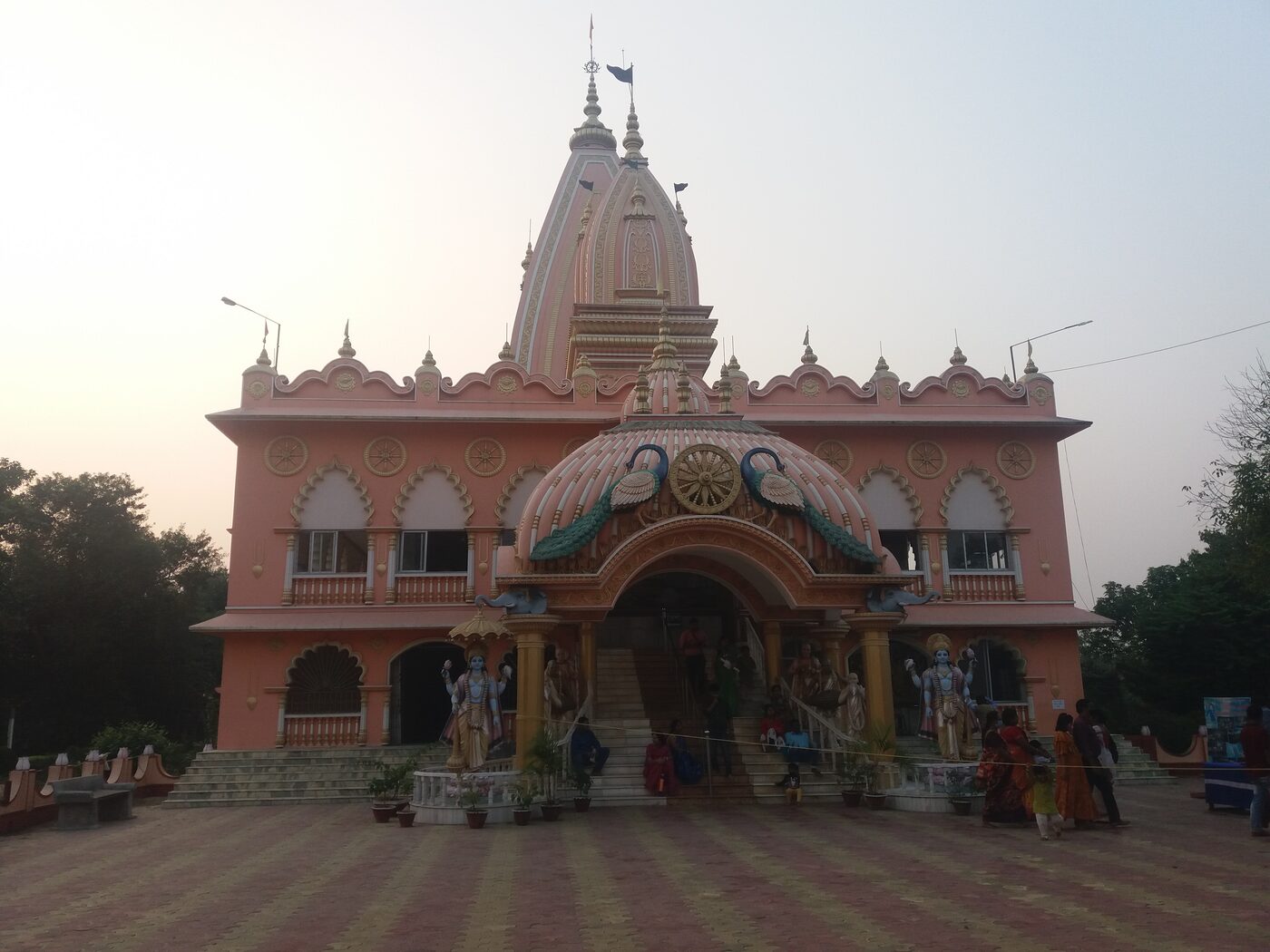
Ekachakra is not the kind of place from which movements are expected to start. It lies in the district of Birbhum, in the part of western Bengal that the old texts call Radhadesha, literally the country where the Ganges is not visible. Nabadwip, some sixty miles to the east, was the most famous centre of Sanskrit learning in the province. It was a town of logicians and grammarians, where a young scholar could make a national reputation. Ekachakra was farmland. Its small hamlets were spread out in a long line. It had a small river called the Maudesvara, which local people treated as their Yamuna. It also had a shrine of Siva, a tamarind tree and a village schoolmaster. Sri Nityananda Prabhu was born in that schoolmaster's house, in about 1474.
| Detail | Description |
|---|---|
| Date | Thirteenth day of the bright fortnight of Magha, Saka 1395, early 1474 |
| Place | Ekachakra, Birbhum district, in Radhadesha |
| Father | Hadai Ojha, also called Hadai Pandita |
| Mother | Padmavati Devi |
| Observed as | Nityananda Trayodasi |
| Identity | Balarama, the elder brother of Krishna |
Hadai Pandita and Padmavati Devi #
His father was Hadai Ojha, also known as Hadai Pandita. The second name simply shows that he was a learned brahmana who taught. According to the family trees, he was the son of Sundaramalla Nakadi Baduri, a brahmana of the Radha clan. He kept a primary school close to his own house, and he maintained the worship of a Siva deity called Bhandisvara on the northern side of the village. His wife was Padmavati Devi. The Vaishnava biographies say almost nothing about the couple's life, except that they were poor, respectable and devoted to God, and that they loved this son more than anything in the world. This detail matters, because it is what makes the next chapter of his life so painful.
The Date of the Advent and Nityananda Trayodasi #
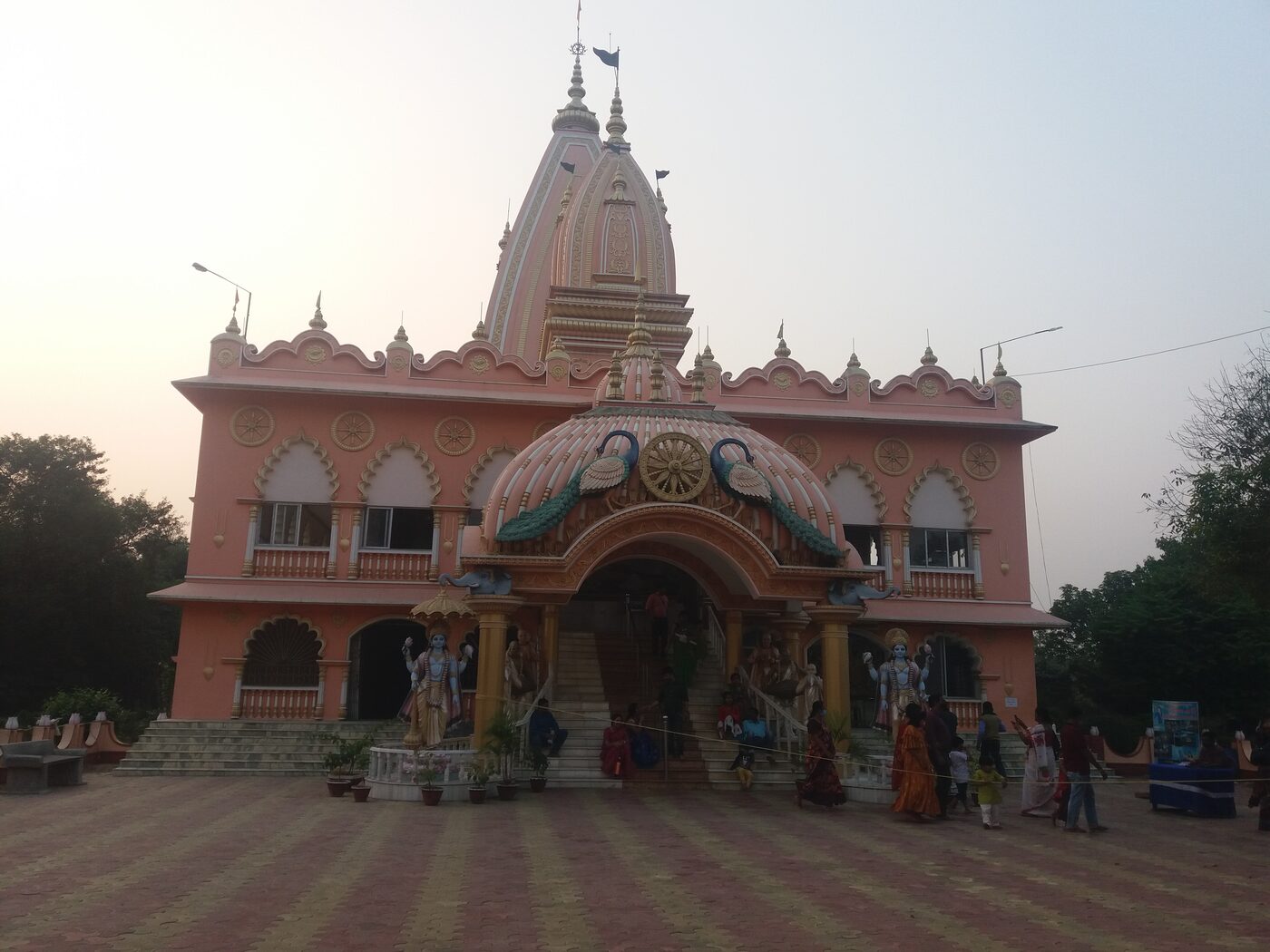
The date given by the tradition is the thirteenth day of the bright fortnight of the month of Magha in the Saka year 1395. This corresponds to the early part of 1474 by the Western calendar, though some authorities give 1473. The day is kept across the Gaudiya world as Nityananda Trayodasi. Fittingly, it falls a few weeks before Gaura Purnima, just as Nityananda Prabhu appeared before Mahaprabhu. He was thus about twelve years older than Sri Chaitanya Mahaprabhu, who was born at Nabadwip in February 1486. The household called him Nitai. The name has stayed so firmly that in Bengal the two of them are still spoken of together as Nitai-Gaura, with the servant's name placed first.
The Signs at the Birth and the Shout at Ekachakra #
Vrindavana Dasa Thakura wrote the Chaitanya-bhagavata, which is the source for almost everything we know of these years. He records that auspicious signs came with the birth and that hardship in the surrounding country lifted. He also says that twelve years later, on the day Mahaprabhu appeared at Nabadwip, the boy at Ekachakra shouted aloud with joy. The sound carried so far that people said a thunderbolt had struck. Nobody understood what had really happened. These things are known only from devotional literature, and the tradition reports them as such. But on one point the tradition is completely firm. It holds that the child born in Hadai Pandita's house was Balarama, the elder brother of Krishna, who had come down to this world first.
Why Balarama Appears Before Krishna #
The fact that Balarama came first carries the theological weight of the whole episode, so it should be explained plainly. A reader new to this may fairly ask why the helper should arrive before the master. Krishnadasa Kaviraja answers this in the fifth chapter of the Adi-lila. He says that Balarama is not a helper at all in the ordinary sense. Krishna is the source of all incarnations. Balarama is His second body, the same identity in a different form, His first expansion. Balarama exists to assist Krishna's pastimes, and in every one of His forms He tastes the bliss of serving Krishna. When that original Krishna appeared at Nabadwip as Chaitanya Mahaprabhu, Balarama appeared with Him as Nityananda. The relation between Them is not about who is higher in rank. It is about the work each one does.
The Sandhini Potency and the Expansions of Sankarshana #
And this work comes first. In Gaudiya theology Balarama is the sandhini potency, the energy of existence. He provides the ground on which anything at all can happen. Krishnadasa Kaviraja works this out through a long chain of expansions, from Balarama as the original Sankarshana, to Maha-sankarshana in the spiritual sky, to the three Vishnu forms who lie on the Causal Ocean, the Garbha Ocean and the ocean of milk, to Ananta Sesa who bears the worlds. The universes rest on Him. So do the living beings, of whom Sankarshana is called the shelter. If the Lord is to appear anywhere, the place, the associates and all the things used in that appearance are extensions of Balarama. That is why, whenever the Lord descends, Balarama comes first. Vraja itself followed this order. In the Bhagavatam the son of Rohini is born before the son of Devaki. When Garga Muni performs the secret name-giving ceremony, he names Him Rama for the joy He gives, Bala for His strength, and Sankarshana because He joins two families together.
The Adi Guru and the Twelve Year Gap #
The tradition gives one more reason, and it belongs to Nityananda in particular, not to Balarama in general. Chaitanya Mahaprabhu came to distribute love of God without conditions. A gift of that kind needs someone to carry it to people's doors. To introduce a soul to the Lord, and to make that soul fit to be introduced, is the work of the spiritual master. Gaudiya Vaishnavism holds that this work belongs originally to Balarama, that He is the adi-guru, and that Nityananda Prabhu is guru-tattva in person. Seen in this way, the twelve years between Ekachakra and Nabadwip are not an accident of the calendar. The teacher is in place before the lesson begins. This teaching is taken up more fully on the page on the mercy of Nitai.
Garbhavasa and the Banka Raya Temple #
The birthplace itself is still there, and is one of the main pilgrimage sites of the Gaudiya world. The spot where the birth took place is called Garbhavasa. Long ago land was given to support the worship there, and the Maharaja of Dinajpur added a large donation. Half a mile away stands the temple whose central Deity is Banka Raya, also called Bankima Raya, a form of Krishna. According to the priests of Ekachakra, Nityananda Prabhu Himself recovered this Deity from the water at the Kadamba-khandi ghat on the little river and installed Him. A deity of Srimati Radharani found under a nima tree at Bhaddapura, in the neighbouring village of Viracandrapura, was placed at His side. She is still known locally as the mistress of Bhaddapura. Jahnava Mata now stands on Banka Raya's right. The temple was struck by lightning in 1924 and rebuilt. The surrounding villages of Viracandrapura and Virabhadrapura carry the name of Nityananda's son. The verse of the Chaitanya-charitamrita does no more than note that Nityananda Prabhu took birth in Radhadesha. But in his purport to that verse, Srila Prabhupada set down the geography of the whole area. It is one of the longest geographical purports in the book, and a sign of how much the place matters to the tradition.
What the Birthplace Says About the Mission #
For Gaudiya Vaishnavas, the place of this advent shows, in the end, which direction the mission would take. The movement's own story does not begin in the university town. It begins in a village on the wrong side of the river, in the house of a man who taught children their letters. It begins with a boy whose whole later life was spent going to people no one else would go to. Where Nityananda Prabhu chose to be born already points to everything he is remembered for. He preached door to door in Nabadwip. He spent decades in the Bengali countryside, not in Puri with the Lord. He was ready to be struck on the head by a drunkard instead of walking past him.
Scriptural evidence for this chapter (8)
সর্ব–অবতারী কৃষ্ণ স্বয়ং ভগবান্ ।
তাঁহার দ্বিতীয় দেহ শ্রীবলরাম ॥ ৪ ॥
sarva-avatārī kṛṣṇa svayaṁ bhagavān
tāṅhāra dvitīya deha śrī-balarāma
Word for word
sarva-avatārī: the source of all incarnations; kṛṣṇa: Lord Kṛṣṇa; svayam: personally; bhagavān: the Supreme Personality of Godhead; tāṅhāra: His; dvitīya: second; deha: expansion of the body; śrī-balarāma: Lord Balarāma.
The Supreme Personality of Godhead, Kṛṣṇa, is the fountainhead of all incarnations. Lord Balarāma is His second body.
Krishna is the fountainhead of all incarnations and Balarama is His second body, the verse on which the whole theology of Nityananda's advent rests.
একই স্বরূপ দোঁহে, ভিন্নমাত্র কায় ।
আদ্য কায়ব্যূহ, কৃষ্ণলীলার সহায় ॥ ৫ ॥
eka-i svarūpa doṅhe, bhinna-mātra kāya
ādya kāya-vyūha, kṛṣṇa-līlāra sahāya
Word for word
eka-i: one; svarūpa: identity; doṅhe: both of Them; bhinna-mātra kāya: only two different bodies; ādya: original; kāya-vyūha: quadruple expansions; kṛṣṇa-līlāra: in the pastimes of Lord Kṛṣṇa; sahāya: assistance.
These two are one and the same identity. They differ only in form. Lord Balarāma is the first bodily expansion of Kṛṣṇa, and He assists in Lord Kṛṣṇa’s transcendental pastimes.
The two are one identity differing only in form; Balarama is the first bodily expansion and assists Krishna's pastimes.
সেই কৃষ্ণ—নবদ্বীপে শ্রীচৈতন্যচন্দ্র ।
সেই বলরাম—সঙ্গে শ্রীনিত্যানন্দ ॥ ৬ ॥
sei kṛṣṇa — navadvīpe śrī-caitanya-candra
sei balarāma — saṅge śrī-nityānanda
Word for word
sei kṛṣṇa: that original Kṛṣṇa; navadvīpe: at Navadvīpa; śrī-caitanya-candra: Lord Śrī Caitanya Mahāprabhu; sei balarāma: that Lord Balarāma; saṅge: with Him; śrī-nityānanda: Lord Nityānanda.
That original Lord Kṛṣṇa appeared in Navadvīpa as Lord Caitanya, and Balarāma appeared with Him as Lord Nityānanda.
The verse that states the identification directly: Krishna appeared in Nabadwip as Chaitanya, and Balarama appeared with Him as Nityananda.
সর্বরূপে আস্বাদয়ে কৃষ্ণ–সেবানন্দ ।
সেই বলরাম—গৌরসঙ্গে নিত্যানন্দ ॥ ১১ ॥
sarva-rūpe āsvādaye kṛṣṇa-sevānanda
sei balarāma — gaura-saṅge nityānanda
Word for word
sarva-rūpe: in all these forms; āsvādaye: tastes; kṛṣṇa-sevā-ānanda: the transcendental bliss of serving Kṛṣṇa; sei balarāma: that Lord Balarāma; gaura-saṅge: with Gaurasundara; nityānanda: Lord Nityānanda.
In all the forms He tastes the transcendental bliss of serving Kṛṣṇa. That same Balarāma is Lord Nityānanda, the companion of Lord Gaurasundara.
In all His forms Balarama tastes the bliss of serving Krishna, and that same Balarama is Nityananda, the companion of Gaurasundara.
মায়াভর্তাজাণ্ডসঙ্ঘাশ্রয়াঙ্গঃ
শেতে সাক্ষাৎ কারণাম্ভোধি–মধ্যে ।
যস্যৈকাংশঃ শ্রীপুমানাদিদেব–
স্তং শ্রীনিত্যানন্দরামং প্রপদ্যে ॥ ৫০ ॥
māyā-bhartājāṇḍa-saṅghāśrayāṅgaḥ
śete sākṣāt kāraṇāmbhodhi-madhye
yasyaikāṁśaḥ śrī-pumān ādi-devas
taṁ śrī-nityānanda-rāmaṁ prapadye
Word for word
māyā-bhartā: the master of the illusory energy; aja-aṇḍa-saṅgha: of the multitude of universes; āśraya: the shelter; aṅgaḥ: whose body; śete: He lies; sākṣāt: directly; kāraṇa-ambhodhi-madhye: in the midst of the Causal Ocean; yasya: whose; eka-aṁśaḥ: one portion; śrī-pumān: the Supreme Person; ādi-devaḥ: the original puruṣa incarnation; tam: to Him; śrī-nityānanda-rāmam: to Lord Balarāma in the form of Lord Nityānanda; prapadye: I surrender.
I offer my full obeisances unto the feet of Śrī Nityānanda Rāma, whose partial representation called Kāraṇodakaśāyī Viṣṇu, lying on the Kāraṇa Ocean, is the original puruṣa, the master of the illusory energy, and the shelter of all the universes.
Nityananda Rama as the source of the original purusha lying on the Causal Ocean, master of the illusory energy and shelter of all the universes.
সঙ্কর্ষণঃ কারণতোয়শায়ী
গর্ভোদশায়ী চ পয়োব্ধিশায়ী ।
শেষশ্চ যস্যাংশকলাঃ স নিত্যা–
নন্দাখ্যরামঃ শরণং মমাস্তু ॥ ৭ ॥
saṅkarṣaṇaḥ kāraṇa-toya-śāyī
garbhoda-śāyī ca payo ’bdhi-śāyī
śeṣaś ca yasyāṁśa-kalāḥ sa nityā-
nandākhya-rāmaḥ śaraṇaṁ mamāstu
Word for word
saṅkarṣaṇaḥ: Mahā-Saṅkarṣaṇa in the spiritual sky; kāraṇa-toya-śāyī: Kāraṇodakaśāyī Viṣṇu, who lies in the Causal Ocean; garbha-uda-śāyī: Garbhodakaśāyī Viṣṇu, who lies in the Garbhodaka Ocean of the universe; ca: and; payaḥ-abdhi-śāyī: Kṣīrodakaśāyī Viṣṇu, who lies in the ocean of milk; śeṣaḥ: Śeṣa Nāga, the couch of Viṣṇu; ca: and; yasya: whose; aṁśa: plenary portions; kalāḥ: and parts of the plenary portions; saḥ: He; nityānanda-ākhya: known as Lord Nityānanda; rāmaḥ: Lord Balarāma; śaraṇam: shelter; mama: my; astu: let there be.
May Śrī Nityānanda Rāma be the object of my constant remembrance. Saṅkarṣaṇa, Śeṣa Nāga and the Viṣṇus who lie on the Kāraṇa Ocean, Garbha Ocean and ocean of milk are His plenary portions and the portions of His plenary portions.
Krishnadasa Kaviraja's invocation of Nityananda Rama, of whom Sankarshana, Sesa Naga and the three Vishnus are plenary portions.
श्रीगर्ग उवाच
अयं हि रोहिणीपुत्रो रमयन् सुहृदो गुणै: ।
आख्यास्यते राम इति बलाधिक्याद्बलं विदु: ।
यदूनामपृथग्भावात् सङ्कर्षणमुशन्त्यपि ॥ १२ ॥
śrī-garga uvāca
ayaṁ hi rohiṇī-putro
ramayan suhṛdo guṇaiḥ
ākhyāsyate rāma iti
balādhikyād balaṁ viduḥ
yadūnām apṛthag-bhāvāt
saṅkarṣaṇam uśanty api
Word for word
śrī-gargaḥ uvāca: Garga Muni said; ayam: this; hi: indeed; rohiṇī-putraḥ: the son of Rohiṇī; ramayan: pleasing; suhṛdaḥ: all His friends and relatives; guṇaiḥ: by transcendental qualities; ākhyāsyate: will be called; rāmaḥ: by the name Rāma, the supreme enjoyer; iti: in this way; bala-ādhikyāt: because of extraordinary strength; balam viduḥ: will be known as Balarāma; yadūnām: of the Yadu dynasty; apṛthak-bhāvāt: because of not being separated from you; saṅkarṣaṇam: by the name Saṅkarṣaṇa, or uniting two families; uśanti: attracts; api: also.
Garga Muni said: This child, the son of Rohiṇī, will give all happiness to His relatives and friends by His transcendental qualities. Therefore He will be known as Rāma. And because He will manifest extraordinary bodily strength, He will also be known as Bala. Moreover, because He unites two families — Vasudeva’s family and the family of Nanda Mahārāja — He will be known as Saṅkarṣaṇa.
Garga Muni names the son of Rohini: Rama for the joy He gives, Bala for His strength, Sankarshana because He unites two families.
রাঢ়দেশে জন্মিলা ঠাকুর নিত্যানন্দ ।
গঙ্গাদাস পণ্ডিত, গুপ্ত মুরারি, মুকুন্দ ॥ ৬১ ॥
rāḍhadeśe janmilā ṭhākura nityānanda
gaṅgādāsa paṇḍita, gupta murāri, mukunda
Word for word
rāḍha-deśe: the place where there is no Ganges; janmilā: took birth; ṭhākura nityānanda: Nityānanda Prabhu; gaṅgādāsa paṇḍita: Gaṅgādāsa Paṇḍita; gupta murāri: Murāri Gupta; mukunda: Mukunda.
In Rāḍhadeśa, the part of Bengal where the Ganges is not visible, Nityānanda Prabhu, Gaṅgādāsa Paṇḍita, Murāri Gupta and Mukunda took birth.
The verse recording that Nityananda Prabhu took birth in Radhadesha; its purport preserves the whole topography of Ekachakra.
Chapter 2
Childhood Pastimes at Ekachakra
Twelve years of village theatre in which a boy and his friends acted out the pastimes of Krishna, and nobody could explain how he knew them
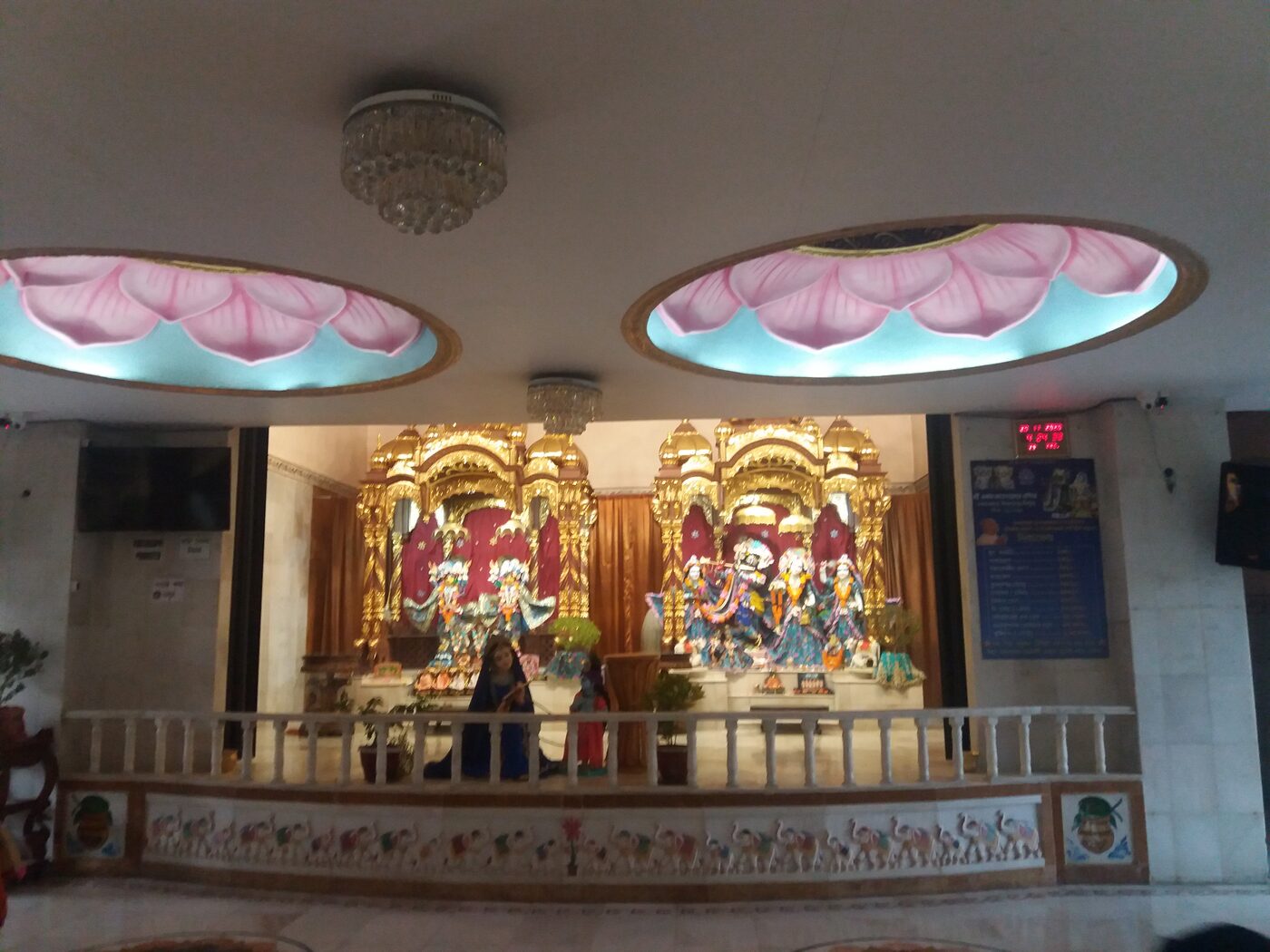
Every account of Nityananda Prabhu's boyhood at Ekachakra agrees on one striking fact: he did not play games. He staged plays. From the time he could organise other children, he gave his whole day to acting out the pastimes of Krishna and of the other descents of Vishnu. The boys of the village took the parts, and the parents and neighbours watched. Vrindavana Dasa Thakura gives the ninth chapter of the Adi-khanda of his Chaitanya-bhagavata to these performances. The detail he records is unusually specific. That is why the episode has stayed alive in the minds of Bengali Vaishnavas for five hundred years. Almost nothing of it appears in the Chaitanya-charitamrita, which was written later and about a different subject. If we know these stories at all, it is only because Vrindavana Dasa thought them worth recording.
How the Plays Were Staged #
The performances had a fixed method. Nityananda would set the scene, assign the roles and coach the lines; the other children knew what to say because he had taught them.
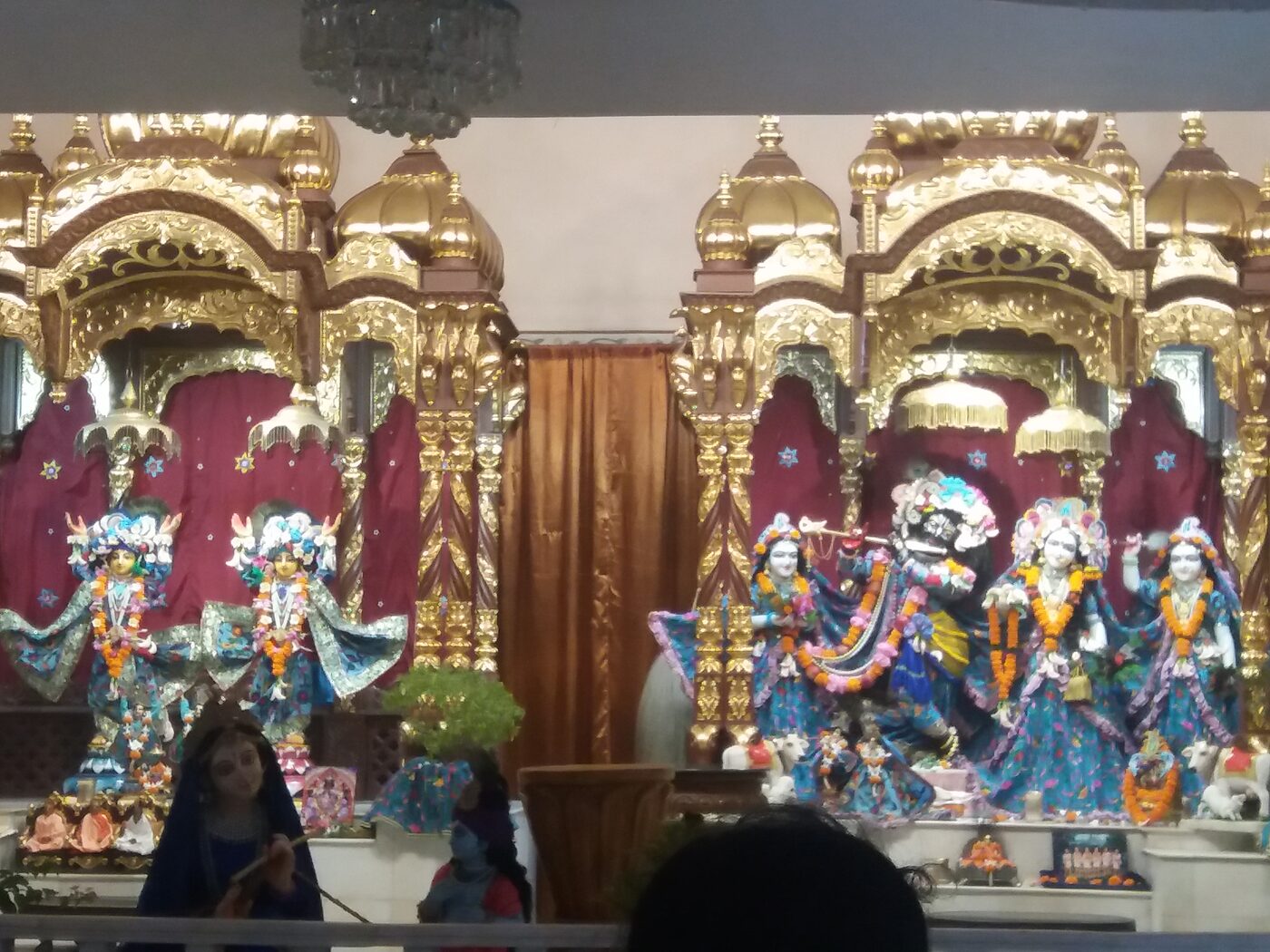
The Assembly of the Demigods #
One of the earliest and most often repeated plays was the assembly of the demigods. A boy would be dressed as the Earth, suffering under the burden of wicked kings. The others took the parts of the gods. Then the whole company would walk down to the riverbank to pray to Kshirodakasayi Vishnu, who lies on the ocean of milk. A boy hidden out of sight would then answer in a deep voice that he would soon be born in the cowherd country of Mathura.
The Prison of Kamsa and the Midnight Birth #
From there the cycle ran through the whole of Krishna's life in order: the marriage of Vasudeva and Devaki; the family's playhouse converted into Kamsa's prison; the midnight birth; Vasudeva carrying the child across the Yamuna to Nanda's village and bringing Yogamaya back in his place.
The Vraja Pastimes Enacted in the Village #
Then the Vraja pastimes. A boy dressed as Putana while another climbed up to take her breast. A cart built of reeds, made in order to be broken. Serpents made from the leaves of trees, and a boy who went into the village pond and floated there motionless until Nityananda revived him. A grove of palms, where the demon Dhenuka was killed and the fruit tasted. Toy figures named Baka, Agha and Vatsa, made to be destroyed. The boys raided the village milkman's house for curd and butter, copying Krishna exactly, and the milkman's family seem to have put up with this very patiently. The cows taken out to pasture and brought home in the late afternoon with the boys blowing buffalo horns. The lifting of Govardhana Hill.
The Replica of Mathura and the Death of Kamsa #
A model of Vrindavana was built somewhere in the fields, and later a model of Mathura. It had garland-makers, and one boy was dressed as Kubja. There was also a bow, which Nityananda broke with a great noise. Then he defeated the elephant Kuvalayapida, the wrestlers Chanura and Mustika, and finally Kamsa, who was dragged off by the hair.
Weeping With the Gopis When Akrura Came #
One of these performances is remembered for a different reason. When the boy playing Akrura arrived to take Krishna and Balarama away from Vrindavana to Mathura, Nityananda did not act the part of the departing brother. He wept as the gopis wept, in the mood of those left behind. The biographies say that the tears ran down in streams in full view of the other children, who did not understand what they were looking at. This is the detail that separates the Ekachakra plays from children's imitation. At times, the boy who organised the drama was not acting at all.
The Rama Cycle and the Role of Lakshmana #
The Rama cycle was staged as thoroughly as the Krishna cycle. Verandah plants were chopped down and thrown into the water as boulders while the children, playing monkeys, built the bridge to Lanka and shouted the victory of Raghunatha. All the accounts agree that Nityananda's own favourite role was Lakshmana. The tradition finds this entirely natural. Krishnadasa Kaviraja states that Nityananda Svarupa had earlier appeared as Lakshmana and served Ramachandra as His younger brother. As Lakshmana, He silently bore what He could not prevent. As Lakshmana, Nityananda stormed into Sugriva's palace, bow in hand, to scold him for enjoying himself while Rama grieved on the mountain. As Lakshmana he scolded Parashurama. As Lakshmana he received the frightened monkeys, embraced them, and led them to his master.
The Fall of Lakshmana and the Lotus Flower #
The most famous of all the Ekachakra incidents came out of that cycle, and it very nearly ended badly. In the scene of Lakshmana's fall, a boy playing Ravana threw a lotus flower at him in place of the fatal weapon. Nityananda dropped where he stood and did not move. He had told the children beforehand: when I fall, gather round and weep, and then send Hanuman for the medicine, and I will revive when it is applied. But when it actually happened, the children panicked and completely forgot the instruction. They wept, called out to him to get up, and could find no sign of life anywhere in his body. Hadai Pandita and Padmavati came running, found their son apparently dead, and fainted on the spot. The village gathered. Someone in the crowd remembered that an actor playing Dasaratha had once really died on stage. The biographies are careful to say that this was a bystander, not one of the players. Someone else said that the boy was only acting his part and would recover as soon as Hanuman brought the medicine. That remark reminded the children of their own script.
Hanuman and the Journey for the Medicine #
What followed was a piece of theatre that has been retold in Bengal ever since. The boy playing Hanuman set off. Another boy, dressed as a sage, delayed Hanuman with an offer of fruits and roots, and Hanuman politely refused. At a lake, a third boy, playing a crocodile, caught Hanuman's ankles under the water. The crocodile was dragged out and beaten. A fourth boy, dressed as a demon, threatened to eat Hanuman, and the two fought until Hanuman won. At last Hanuman reached the mountain, defeated a party of Gandharvas, and carried it back on his head. Another child, playing the physician, applied the medicine to Nityananda's nose, and he sat up. The village laughed with relief, and Hadai Pandita took his son into his arms. Everybody asked the question they had been asking for years: where did you learn all this. Nityananda answered that these were his own pastimes, and that he was only repeating what he had said in earlier lives. Nobody took his answer seriously.
Where Did You Learn All This #
That question is, in fact, the point of the whole chapter. These were village children in Radhadesha in the fifteenth century. They had not read the Bhagavatam and their parents mostly could not have read it to them. Nobody had taught Nityananda the sequence of Krishna's pastimes, the names of the demons, or the speeches. The neighbours said openly that they had never seen anything like it and could not explain it. The biographies state that, by the influence of the Lord's own illusory energy, nobody at Ekachakra recognised who was living among them. Gaudiya Vaishnavas see these twelve years as a hidden rehearsal. They see them as preaching done before the mission had begun. They also see them as an early use of the one talent that would mark Nityananda's whole life: the ability to draw ordinary people into Krishna's pastimes without asking them for any qualification first. The children left their homes and their parents to be with him, and the parents did not object. At one point Vrindavana Dasa breaks off his account to offer his obeisances to those boys, whose names nobody knows.
Visramatala Bakulatala and Hantugada #
The places are still shown. A short walk from the Banka Raya temple is a spot called Visramatala, where the tradition says he enacted the rasa-lila and the other Vrindavana pastimes with his friends. Near Garbhavasa is Bakulatala, named for a bakula tree under which the boys played a rough game called jhala-jhapeta. The tree is very old. Its branches and smaller branches are said to look like the hoods of serpents, and local devotees believe this is Ananta, appearing in that form at Nityananda's wish. The story attached to it is that the tree once had two trunks. When his playmates found it awkward to jump from the branches of one to the branches of the other, he is said to have merged the two into one. A little further off is Hantugada, where he is said to have distributed chipped rice and yogurt to the village, kneeling down to take it himself. Forty years later at Panihati, he would make this same dish, and this same posture of a servant, famous. Fairs are still held there on his appearance day and at Goshthashtami.
The Childhood as a Statement of Method #
Seen in the light of what came later, the childhood is not just a charming beginning. It already shows his method. Nityananda Prabhu never, at any point in his life, taught by argument. He set up something that other people could take part in, and he let their taking part do the work. It began with a schoolmaster's son giving the boys of a little-known Birbhum village the parts of the cowherds of Vraja. It ended with a whole province of Bengal singing in the streets.
Scriptural evidence for this chapter (7)
নিত্যানন্দ–স্বরূপ পূর্বে হইলা লক্ষ্মণ ।
লঘুভ্রাতা হৈয়া করে রামের সেবন ॥ ১৪৯ ॥
nityānanda-svarūpa pūrve ha-iyā lakṣmaṇa
laghu-bhrātā haiyā kare rāmera sevana
Word for word
nityānanda-svarūpa: Lord Nityānanda Svarūpa; pūrve: formerly; ha-iyā: becoming; lakṣmaṇa: Lakṣmaṇa, Lord Rāmacandra’s younger brother; laghu-bhrātrā haiyā: becoming the younger brother; kare: does; rāmera sevana: service to Lord Rāmacandra.
Lord Nityānanda Svarūpa formerly appeared as Lakṣmaṇa and served Lord Rāmacandra as His younger brother.
Nityananda Svarupa formerly appeared as Lakshmana and served Ramachandra as His younger brother, the role the boy at Ekachakra took most often.
রামের চরিত্র সব,—দুঃখের কারণ ।
স্বতন্ত্র লীলায় দুঃখ সহেন লক্ষ্মণ ॥ ১৫০ ॥
rāmera caritra saba, — duḥkhera kāraṇa
svatantra līlāya duḥkha sahena lakṣmaṇa
Word for word
rāmera caritra saba: all the activities of Lord Rāmacandra; duḥkhera kāraṇa: causes of suffering; sva-tantra: although independent; līlāya: in the pastimes; duḥkha: unhappiness; sahena lakṣmaṇa: Lakṣmaṇa tolerates.
The activities of Lord Rāma were full of suffering, but Lakṣmaṇa, of His own accord, tolerated that suffering.
Lakshmana tolerated the suffering of Rama's pastimes of His own accord, the temperament the childhood plays rehearsed.
রাম–লক্ষ্মণ—কৃষ্ণ–রামের অংশবিশেষ ।
অবতার–কালে দোঁহে দোঁহাতে প্রবেশ ॥ ১৫৩ ॥
rāma-lakṣmaṇa — kṛṣṇa-rāmera aṁśa-viśeṣa
avatāra-kāle doṅhe doṅhāte praveśa
Word for word
rāma-lakṣmaṇa: Rāmacandra and Lakṣmaṇa; kṛṣṇa-rāmera aṁśa-viśeṣa: particular expansions of Lord Kṛṣṇa and Lord Balarāma; avatāra-kāle: at the time of incarnation; doṅhe: both of Them (Rāma and Lakṣmaṇa); doṅhāte praveśa: entered into Them both (Kṛṣṇa and Balarāma).
Śrī Rāma and Śrī Lakṣmaṇa, who are plenary portions of Lord Kṛṣṇa and Lord Balarāma respectively, entered into Them at the time of Kṛṣṇa’s and Balarāma’s appearance.
Rama and Lakshmana entered into Krishna and Balarama at the time of Their appearance, which is why the two cycles could be played by the same boy.
সর্বরূপে আস্বাদয়ে কৃষ্ণ–সেবানন্দ ।
সেই বলরাম—গৌরসঙ্গে নিত্যানন্দ ॥ ১১ ॥
sarva-rūpe āsvādaye kṛṣṇa-sevānanda
sei balarāma — gaura-saṅge nityānanda
Word for word
sarva-rūpe: in all these forms; āsvādaye: tastes; kṛṣṇa-sevā-ānanda: the transcendental bliss of serving Kṛṣṇa; sei balarāma: that Lord Balarāma; gaura-saṅge: with Gaurasundara; nityānanda: Lord Nityānanda.
In all the forms He tastes the transcendental bliss of serving Kṛṣṇa. That same Balarāma is Lord Nityānanda, the companion of Lord Gaurasundara.
In every form He takes, Balarama tastes the bliss of serving Krishna, the principle underlying twelve years of enacting Krishna's pastimes.
রাঢ়দেশে জন্মিলা ঠাকুর নিত্যানন্দ ।
গঙ্গাদাস পণ্ডিত, গুপ্ত মুরারি, মুকুন্দ ॥ ৬১ ॥
rāḍhadeśe janmilā ṭhākura nityānanda
gaṅgādāsa paṇḍita, gupta murāri, mukunda
Word for word
rāḍha-deśe: the place where there is no Ganges; janmilā: took birth; ṭhākura nityānanda: Nityānanda Prabhu; gaṅgādāsa paṇḍita: Gaṅgādāsa Paṇḍita; gupta murāri: Murāri Gupta; mukunda: Mukunda.
In Rāḍhadeśa, the part of Bengal where the Ganges is not visible, Nityānanda Prabhu, Gaṅgādāsa Paṇḍita, Murāri Gupta and Mukunda took birth.
The purport preserves Visramatala, Bakulatala and Hantugada, the sites of the childhood games, as they still stand at Ekachakra.
নিত্যানন্দের গণ যত,—সব ব্রজসখা ।
শৃঙ্গ–বেত্র–গোপবেশ, শিরে শিখিপাখা ॥ ২১ ॥
nityānandera gaṇa yata — saba vraja-sakhā
śṛṅga-vetra-gopaveśa, śire śikhi-pākhā
Word for word
nityānandera: of Lord Nityānanda Prabhu; gaṇa: followers; yata: all; saba: all; vraja-sakhā: residents of Vṛndāvana; śṛṅga: horn; vetra: cane stick; gopa-veśa: dressed like a cowherd boy; śire: on the head; śikhi-pākhā: the plume of a peacock.
All the associates of Lord Nityānanda were formerly cowherd boys in Vrajabhūmi. Their symbolic representations were the horns and sticks they carried, their cowherd dress and the peacock plumes on their heads.
Nityananda's associates were formerly cowherd boys of Vrajabhumi, carrying horns, sticks and peacock plumes, the adult form of the Ekachakra games.
বৃন্দাবনদাস—নারায়ণীর নন্দন ।
চৈতন্য–মঙ্গল’ যেঁহো করিল রচন ॥ ৫৪ ॥
vṛndāvana-dāsa — nārāyaṇīra nandana
‘caitanya-maṅgala’ yeṅho karila racana
Word for word
vṛndāvana-dāsa: Śrīla Vṛndāvana dāsa Ṭhākura; nārāyaṇīra nandana: son of Nārāyaṇī; caitanya-maṅgala: the book of the name Caitanya-maṅgala; yeṅho: who; karila: did; racana: composition.
Vṛndāvana dāsa Ṭhākura, the son of Śrīmatī Nārāyaṇī, composed Śrī Caitanya-maṅgala [later known as Śrī Caitanya-bhāgavata].
Vrindavana Dasa Thakura, the author of the Chaitanya-bhagavata, from which the entire record of these childhood pastimes comes.
Chapter 3
Twenty Years of Pilgrimage
A guest's request that could not be refused, a father who never recovered, and two decades on the roads of India
A sannyasi came to Ekachakra when Nityananda was twelve years old and asked directions to the house of Hadai Pandita. He was given food and a place to stay, as any sannyasi guest would have been in a devout brahmana household. What happened next is told, with small variations, in every biography of Nityananda Prabhu, and it is the turning point of his early life.
| Stage of the Journey | Places Visited |
|---|---|
| Setting out | Vakresvara, Vaidyanatha, Gaya |
| The Ganges cities | Kashi, Prayag |
| Vraja | Mathura, Vrindavana, Govardhana, Gokula |
| North and west | Hastinapura, Kurukshetra, Naimisharanya, Dvaraka, Siddhapura |
| Ayodhya and the north | Ayodhya, Haridwar, Badarikashrama |
| The south | Kanchi, Sri Rangam, Madurai, Setubandha, Rameshvaram |
| The end of the journey | Jagannatha Puri |
The Promise Given Before the Meal #
Before he would eat, the sannyasi asked his host to promise in advance that a request of his would be granted. Hadai Pandita gave the promise. A guest who asks for hospitality on those terms is not to be refused. In the custom of those times, a promise given to a sannyasi at the door, with no conditions attached, could not be broken. The meal was taken. Then, as he was about to leave, the guest named what he wanted. He was travelling alone to the holy places and needed a companion, and he asked for the boy.
Hadai Pandita Gives Away His Son #
Hadai Pandita had one surviving son. Everything the biographies say about Hadai Pandita comes back to how much he loved the boy. The traditional accounts describe him standing there, thinking of the only example that could help him. That was Dasaratha, who had given Rama and Lakshmana into the hands of Vishvamitra and let them go into the forest rather than break his word to a sage. Hadai Pandita went in to his wife and asked her what he should do, and Padmavati answered that whatever he decided, she would accept. He came back out with tears in his eyes and told the sannyasi that if he really wanted the boy, he could take him. The biographers say that Nityananda wanted to go and had been waiting for the chance, but he would not have broken his parents' hearts himself. So when the request came from outside, he took it as the arrangement he had been waiting for. He comforted his mother and father, and left.
The Grief and Death of Hadai Pandita #
Hadai Pandita collapsed as soon as his son was out of sight, and all the accounts agree that he never recovered. He could not eat and could not sleep. He is described as remembering, over and over, that he had never in his life let the boy out of his sight even to walk to the market. The tradition holds that he lived on for some time only because his mind was continuously fixed on the Supreme Lord, and that he eventually died of the grief. It is one of the harshest passages in Gaudiya devotional biography, and the tradition has never softened it. The deliverer of the fallen begins his public life by leaving behind a household that was destroyed by his going.
Lakshmipati Tirtha and the Disputed Identity #
The sources really do differ about who the sannyasi was, so we set out the disagreement here instead of hiding it. Vrindavana Dasa Thakura's Chaitanya-bhagavata simply says that a sannyasi came. Later Bengali tradition names him as Lakshmipati Tirtha, a senior figure of the Madhva line. Narahari Chakravarti's Bhakti-ratnakara tells the story differently again. In that version the boy left Ekachakra with an unnamed sannyasi. Nityananda met Lakshmipati only later and further south, at Pandharpur. Lakshmipati was visiting a brahmana disciple there, and Nityananda happened to be staying in that disciple's house without being recognised. In that account, one night Lakshmipati was singing of Balarama and weeping over his own unworthiness. He was then given a dream in which Balarama appeared. Balarama told him that a brahmana's son in the dress of an avadhuta had come to that village and would become his disciple, and He spoke a mantra into his ear. The next morning Nityananda came and asked Lakshmipati for initiation, and Lakshmipati gave it.
Who Initiated Nityananda Prabhu #
The question of who initiated Nityananda Prabhu is not settled even within the tradition itself. The Premavilasa says Ishvara Puri. Jiva Goswami says Sankarshana Puri, a disciple of Madhavendra Puri. The Bhakti-ratnakara says it was Lakshmipati, who was Madhavendra Puri's own guru. As Gaudiya historians have noted, this line of gurus would make Nityananda a godbrother of Madhavendra Puri, who is Chaitanya Mahaprabhu's spiritual grandfather. That would place Nityananda two generations above Mahaprabhu, and it does not fit well with the easy, brotherly relationship Nityananda and Mahaprabhu plainly had. The Chaitanya-bhagavata records something simpler and probably safer. Madhavendra Puri treated Nityananda as a friend and equal, while Nityananda treated Madhavendra Puri with the respect due to a guru.
Gaya Kashi Prayag and Vraja #
The pilgrimage itself lasted about twenty years, from his twelfth to his thirty-second year. Vrindavana Dasa records the route in such detail that it is worth following place by place. He began close to home, at the temple of Vakresvara and the groves of Vaidyanatha. Then he went to Gaya, and on to Kashi, where he bathed in the Ganges and could not drink enough of the water. At Prayag he kept the month of Magha, with the usual morning bath where the rivers meet. Then he went to Mathura, which the biographies call the place of his previous appearance. There he played in the Yamuna at Vishrama-ghata, circled Govardhana Hill, and walked through all twelve forests of Vrindavana. At Gokula he sat down in the house of Nanda Maharaja and wept.
Dvaraka the South and Rameshvaram #
From there the route runs the length and breadth of the subcontinent. At Hastinapura he wept at the home of the Pandavas and called aloud on Balarama, the holder of the plough, to deliver everyone. At Dvaraka he bathed in the sea. He went on to Siddhapura, and to Matsya-tirtha, where he distributed cooked rice at a large festival. He visited both Siva-Kanchi and Vishnu-Kanchi, and the account says he laughed at the bitter quarrel between the followers of the two. He went to Kurukshetra, to Naimisharanya, to the western Sarasvati. At Ayodhya he wept at Rama's birthplace. In the country of Guhaka the boatman, he is said to have lost consciousness for three days, remembering the devotion of a man whom the strict society of the time treated as untouchable. He bathed in the Sarayu, the Gomati and the Gandaki, climbed Mount Mahendra to bow to Parashurama, and went up to Haridwar. He travelled through the Dravida country, Venkata, Kanchi, the Kaveri and Sri Rangam, where he stayed for some time. He went south to Madurai, the Tamraparni and the Malaya hills. Then he went north again to Badarikashrama, where he stayed in seclusion and, the biographies say, met Vyasadeva. He came at last to Setubandha and Rameshvaram at the southern tip of the peninsula, and to Jagannatha Puri. There he is described as fainting at the first sight of the disc on top of the temple, and then losing consciousness again and again before the Deity.
The Story of Saksi Gopala at Kataka #
Only one episode from these twenty years appears in the Chaitanya-charitamrita, and even that one is told only indirectly. In 1510, when Chaitanya Mahaprabhu was travelling to Puri and reached Kataka, Nityananda told Him the story of Saksi-gopala. This is the Deity who walked from Vrindavana to Vidyanagara to give evidence for a brahmana in a lawsuit. Nityananda knew the story because he had heard it from the townspeople himself, years before, on this very journey. Krishnadasa Kaviraja mentions this almost in passing at the start of the fifth chapter of the Madhya-lila. It is a small thing, but it is the one point at which the twenty years of wandering connect with the recorded history of Mahaprabhu's own life.
The Meeting With Madhavendra Puri #
The meeting the tradition cares most about is the meeting with Madhavendra Puri, and every account treats it as the emotional centre of the whole pilgrimage. Gaudiya Vaishnavism regards Madhavendra Puri as the origin of the line. It sees him as the first in whom love of Krishna in the mood of Vraja was revealed. Through Ishvara Puri, he is also the spiritual grandfather of Chaitanya Mahaprabhu Himself. The biographies say that when the two of them saw each other, both lost external consciousness and fell, and that Ishvara Puri, Brahmananda Puri and the other disciples standing round wept. When they recovered they embraced and rolled on the ground. Nityananda said that all his pilgrimages had been completed in that moment, since the holy places live at the feet of a pure devotee. They stayed together for a long time speaking of Krishna. Madhavendra Puri said that in all his travels he had found nothing like it. He also said that whoever turned against Nityananda could never be dear to Krishna. Then they parted, one going south to Setubandha and the other north to the Sarayu.
Waiting in Vrindavana for the Order #
Finally he returned to Mathura and settled in Vrindavana. Here the accounts record a detail that is easy to miss. In fact, it tells us more than anything else in the chapter. He ate almost nothing, taking a little milk only when it was brought to him unasked. He knew perfectly well that Chaitanya Mahaprabhu was at that moment a young man in Nabadwip, with His divinity still hidden. And although he had the power to give love of God to anybody he chose, he gave it to nobody. He would not begin until the Lord had begun. He waited in Vrindavana, playing in the Yamuna with the local children, until the news reached him that the sankirtana movement had started. Then he went straight to Nabadwip.
What the Twenty Years Establish #
That refusal is what Gaudiya Vaishnavas take from the twenty years. When a man whom the tradition identifies as Balarama tours the tirthas, it is not a search. In this case the pilgrim is himself the goal of the pilgrimage. The accounts say as much when they note that he went to the holy places in order to purify them. These years really show his relation to Chaitanya Mahaprabhu. He was a servant who had everything and would use none of it without an order. The original spiritual master does not act by his own decision. He waits, sometimes for twenty years, and when the word comes he moves the same day.
Scriptural evidence for this chapter (5)
নিত্যানন্দ-গোসাঞি যবে তীর্থ ভ্রমিলা ।
সাক্ষিগোপাল দেখিবারে কটক আইলা ॥ ৮ ॥
nityānanda-gosāñi yabe tīrtha bhramilā
sākṣi-gopāla dekhibāre kaṭaka āilā
Word for word
nityānanda-gosāñi: Lord Nityānanda Prabhu; yabe: when; tīrtha bhramilā: traveled to the places of pilgrimage; sākṣi-gopāla: the witness Gopāla; dekhibāre: to see; kaṭaka: to the town of Kaṭaka; āilā: came.
Previously, when Nityānanda Prabhu had toured all over India to see different places of pilgrimage, He also had come to see Sākṣi-gopāla at Kaṭaka.
The one point where the twenty years of pilgrimage enter the record of Mahaprabhu's life: Nityananda had come to see Saksi-gopala at Kataka on His own tour.
সাক্ষিগোপালের কথা শুনি, লোকমুখে ।
সেই কথা কহেন, প্রভু শুনে মহাসুখে ॥ ৯ ॥
sākṣi-gopālera kathā śuni, loka-mukhe
sei kathā kahena, prabhu śune mahā-sukhe
Word for word
sākṣi-gopālera: of the witness Gopāla; kathā: the narration; śuni: hearing; loka-mukhe: from the people; sei kathā: that narration; kahena: Nityānanda Prabhu narrates; prabhu: Lord Śrī Caitanya Mahāprabhu; śune: hears; mahā-sukhe: in great pleasure.
At that time, Nityānanda Prabhu had heard the story of Sākṣi-gopāla from the townspeople. He now recited this again, and Lord Caitanya Mahāprabhu heard the narration with great pleasure.
Nityananda recites to Chaitanya Mahaprabhu the story he had heard from the townspeople during that earlier journey.
কভু গুরু, কভু সখা, কভু ভৃত্য–লীলা ।
পূর্বে যেন তিনভাবে ব্রজে কৈল খেলা ॥ ১৩৫ ॥
kabhu guru, kabhu sakhā, kabhu bhṛtya-līlā
pūrve yena tina-bhāve vraje kaila khelā
Word for word
kabhu: sometimes; guru: spiritual master; kabhu: sometimes; sakhā: friend; kabhu: sometimes; bhṛtya-līlā: pastimes as a servant; pūrve: formerly; yena: as; tina-bhāve: in three different moods; vraje: in Vṛndāvana; kaila khelā: plays with Kṛṣṇa.
Sometimes He serves Lord Caitanya as His guru, sometimes as His friend and sometimes as His servant, just as Lord Balarāma played with Lord Kṛṣṇa in these three different moods in Vraja.
Nityananda serves Chaitanya sometimes as guru, sometimes as friend, sometimes as servant, the frame within which the long wait in Vrindavana makes sense.
এইরূপে নিত্যানন্দ ‘অনন্ত’–প্রকাশ ।
সেইভাবে—কহে মুঞি চৈতন্যের দাস ॥ ১৩৪ ॥
ei-rūpe nityānanda ‘ananta’-prakāśa
sei-bhāve — kahe muñi caitanyera dāsa
Word for word
ei-rūpe: in this way; nityānanda: Lord Nityānanda; ananta-prakāśa: unlimited manifestations; sei-bhāve: in that transcendental emotion; kahe: He says; muñi: I; caitanyera dāsa: the servant of Lord Caitanya.
Thus Lord Nityānanda has unlimited incarnations. In transcendental emotion He calls Himself a servant of Lord Caitanya.
Though His incarnations are unlimited, in transcendental emotion He calls Himself a servant of Lord Chaitanya.
শ্রীচৈতন্য—সেই কৃষ্ণ, নিত্যানন্দ—রাম ।
নিত্যানন্দ পূর্ণ করে চৈতন্যের কাম ॥ ১৫৬ ॥
śrī-caitanya — sei kṛṣṇa, nityānanda — rāma
nityānanda pūrṇa kare caitanyera kāma
Word for word
śrī-caitanya: Lord Śrī Caitanya; sei kṛṣṇa: that original Kṛṣṇa; nityānanda: Lord Nityānanda; rāma: Balarāma; nityānanda: Lord Nityānanda; pūrṇa kare: fulfills; caitanyera kāma: all the desires of Lord Śrī Caitanya Mahāprabhu.
Lord Caitanya is the same Lord Kṛṣṇa, and Lord Nityānanda is Lord Balarāma. Lord Nityānanda fulfills all of Lord Caitanya’s desires.
Chaitanya is Krishna and Nityananda is Balarama, and Nityananda fulfils all of Chaitanya's desires, stated as the principle of His conduct.
Chapter 4
The Meeting with Sri Chaitanya Mahaprabhu
A chariot seen in a dream, a search through Nabadwip that found nothing, and forms shown to no one else
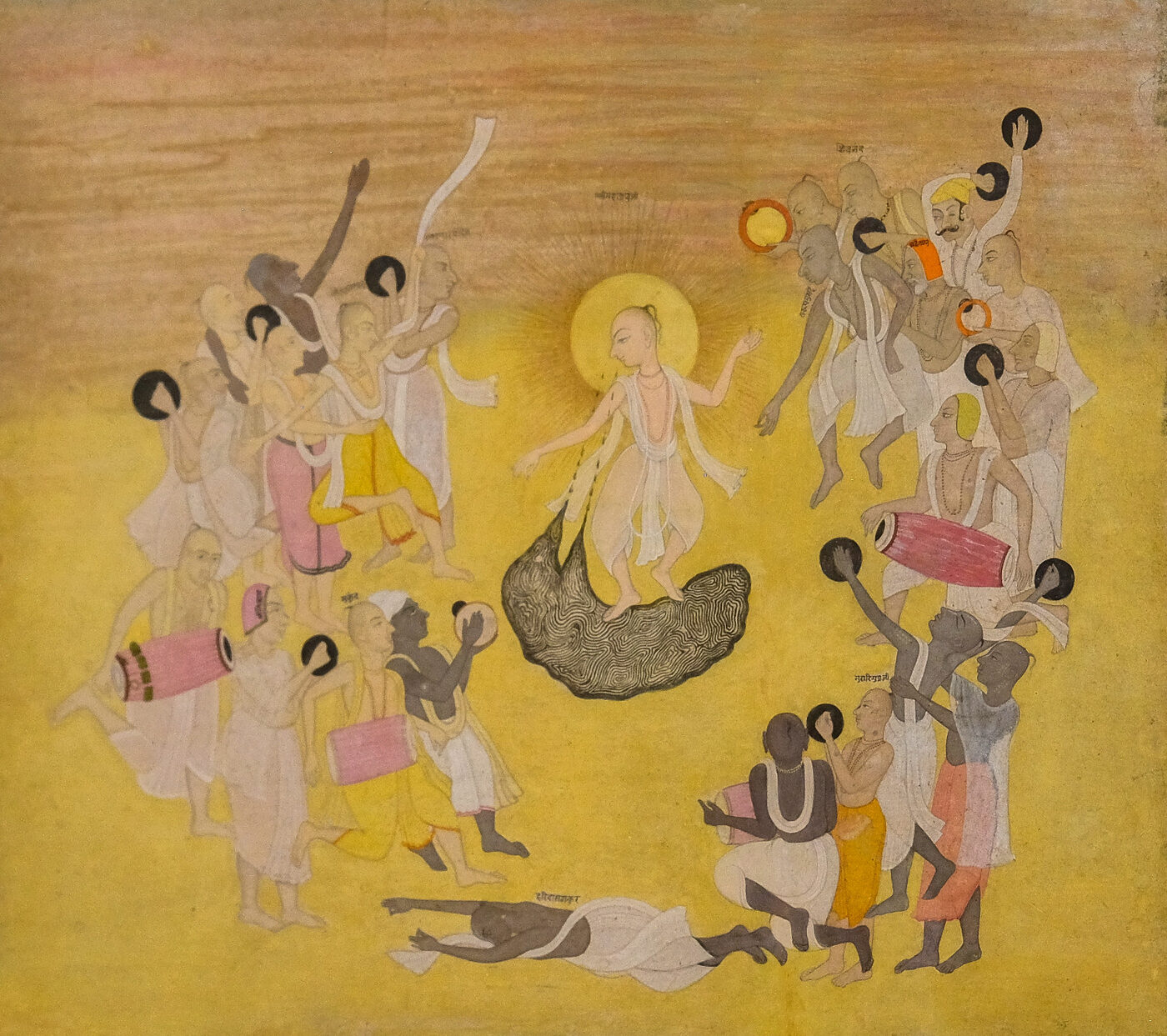
By about 1506, news reached Nityananda Prabhu in Vrindavana. It was the news he had been waiting twenty years to hear. Nimai Pandita of Nabadwip, the young logician whose reputation had filled Bengal, had gone to Gaya, received initiation from Ishvara Puri, and come back a different man. He wept at the name of Krishna, fell unconscious in the street, and had begun gathering a small circle of devotees in the courtyard of Srivasa Pandit to chant through the night. Nityananda left Vrindavana at once and walked to Nabadwip.
| Detail | Description |
|---|---|
| Year | About 1506 |
| Place | The house of Nandana Acharya, on the Ganges bank at Mayapur |
| Ages | Nityananda about thirty-two, Mahaprabhu about twenty |
| Sent to search | Srivasa Pandit and Haridasa Thakura |
| Forms revealed | Six-armed, four-armed and two-armed |
Hiding at the House of Nandana Acharya #
What Nityananda did when he arrived was typical of him, and it is the first thing the biographies stress. He announced himself to nobody. He went quietly to the house of a devotee named Nandana Acharya, on the Ganges bank at Mayapur, and stayed there without telling anyone who he was. Nandana Acharya did know. He felt his life was fulfilled, and he too said nothing. Nityananda had crossed the subcontinent to reach this town. Yet he chose to sit still in a stranger's house and wait to be found. That is not what one would expect. The tradition sees it as the proper behaviour of a servant, who does not put himself forward but waits to be called.
The Dream of the Palm Tree Chariot #
The next morning Chaitanya Mahaprabhu told the devotees about a dream. He had seen a chariot with a flag marked with a palm tree, which is Balarama's sign. On the chariot was an extraordinary person who was asking the way to the house of Nimai Pandita. That person, He said, had arrived in Nabadwip during the night, and they were to go and find Him. Srivasa Pandit and Haridasa Thakura were sent out. They went through the whole town, house by house and market by market, asking whether any remarkable visitor had come, and came back with nothing. Mahaprabhu, the accounts say, smiled at this, got up, and led the way Himself. The party walked to the house of Nandana Acharya.
The Meeting at the Door #
The Chaitanya-bhagavata describes the meeting as one of silence. Nityananda saw the shining light approaching and came to the door. The two of them stood looking at each other without speaking, unable to move. Then Nityananda fell to the ground. Mahaprabhu picked him up and embraced him, and both of them wept. Nityananda was then about thirty-two years old, and Mahaprabhu about twenty. By the normal rules of Bengali society, an older man from an unrelated family and a younger householder pandit had no special tie to each other at all.
The Reading From the Srimad Bhagavatam #
Vrindavana Dasa records that Mahaprabhu then asked Srivasa Pandit to read from the Srimad-Bhagavatam. He records that the passage read was the description of Krishna entering the forest of Vrindavana with the cowherd boys. Krishna wore yellow cloth and a peacock feather in His hair, and He filled His flute with the nectar of His lips. Nityananda lost consciousness before the reading was finished. This is a small but very deliberate detail in the story. Of all the verses that might have been chosen for the occasion, the one chosen describes the exact scene in which the two of them had walked side by side in a previous descent.
The Six Armed and Four Armed Forms #
Krishnadasa Kaviraja sums up what happened over the following days in a few verses of the Adi-lila. Chaitanya Mahaprabhu revealed to Nityananda Prabhu a six-armed form holding a conchshell, a disc, a club, a lotus, a bow and a flute. This one form shows the teaching of the whole meeting in a single picture. The conch, disc, club and lotus belong to Vishnu, the bow to Ramachandra and the flute to Krishna. Together the six items say that the young man of Nabadwip, who would soon take sannyasa, contains all three. The Lord then showed him a four-armed form, and finally the two-armed form of Krishna, the son of Nanda Maharaja, bluish, dressed in yellow and playing the flute. The tradition holds that very few people in Mahaprabhu's whole life were shown this sequence. It also holds that the order itself, from the combined form down to the original one, was a way of showing who He was.
The Vyasa Puja and the Musala #
Then came an exchange that the biographers clearly enjoyed. Nityananda arranged to perform Vyasa-puja, the formal worship offered to the spiritual master, and he made Chaitanya Mahaprabhu the one to be worshipped. Mahaprabhu accepted the worship. Then, in ecstasy, feeling Himself to be Nityananda, He took up the musala, the plough-like weapon of Balarama. In this way each of them was insisting, in the only way open to him, that the other was the master. Krishnadasa Kaviraja says elsewhere that this mixing of roles was permanent. Nityananda serves Chaitanya sometimes as His guru, sometimes as His friend and sometimes as His servant, just as Balarama did with Krishna in Vraja. Krishnadasa Kaviraja also says that although Nityananda's own incarnations are unlimited, He describes Himself as Chaitanya's servant. Shortly afterwards, the Adi-lila adds, Sachi Devi looked at the two of them in her own house and saw Krishna and Balarama.
The Two Biographies and Their Purposes #
Here it helps to be clear about the sources. The Chaitanya-charitamrita tells this whole episode in only six verses. This is because Krishnadasa Kaviraja was writing decades later, and he knew that Vrindavana Dasa Thakura had already covered it. The full story, with the dream, the failed search and the meeting at the door, is found in the Chaitanya-bhagavata. That book was written in Bengal while people who remembered the events were still alive, and it was written on Nityananda Prabhu's own instruction. A reader who wants the details has to go to this Bengali book. A reader who wants a short summary of the teaching will find it in the Charitamrita, with its many Sanskrit quotations. The two do not conflict, but they were written for different purposes.
The Second Pole of the Movement #
What did the two of them recognise in each other? The tradition gives a plain answer in the closing summary of the same chapter. The former son of Nanda Maharaja is now Chaitanya Mahaprabhu, and the former Baladeva, Krishna's brother, is now Nityananda Prabhu. But this recognition also had practical results, and they showed at once. From this point on, Nityananda is not just one follower among many. He becomes the second pole of the movement, alongside Mahaprabhu. In the Panca-tattva, the five features in which the Lord appears in order to distribute love of God, he stands next to Chaitanya Mahaprabhu and before Advaita Acharya, Gadadhara Pandit and Srivasa Thakura. When the sankirtana went out into the streets of Nabadwip, Mahaprabhu danced in one party and Nityananda moved with Him. When Mahaprabhu accepted sannyasa at Katwa in 1510, three men went with Him to make the arrangements, and Nityananda was one of them. Within a year or two of the meeting, the Lord wanted the holy name taken door to door through Nabadwip to people who had no interest in it at all. The man He sent was Nityananda. That task ended in blood, and the story is told here.
Concealment and the Reversal of Protocol #
Gaudiya Vaishnavas take two lessons from the episode. The first is the way he hid himself. Nityananda Prabhu had every reason to arrive in Nabadwip and announce himself, but he did the opposite. The tradition reads this as a lasting instruction about how a spiritual master behaves. He does not advertise himself, and the disciple must go looking for him. The second lesson is the reversal of roles at the Vyasa-puja. Their religious culture was carefully arranged around who must bow to whom. Yet the two central figures of the new movement spent their first weeks together each trying to give the other the higher seat. Whatever else the sankirtana movement was going to be, it was not going to be an institution built on rank.
Scriptural evidence for this chapter (9)
তবে নিত্যানন্দ–স্বরূপের আগমন ।
প্রভুকে মিলিয়া পাইল ষড়্ভুজ–দর্শন ॥ ১২ ॥
tabe nityānanda-svarūpera āgamana
prabhuke miliyā pāila ṣaḍ-bhuja-darśana
Word for word
tabe: thereafter; nityānanda-svarūpera: of the Personality of Godhead Nityānanda; āgamana: appearance; prabhuke: Lord Caitanya Mahāprabhu; miliyā: meeting; pāila: obtained; ṣaṭ-bhuja-darśana: a vision of the six-armed Śrī Caitanya Mahāprabhu.
After this function at the house of Śrīvāsa Ṭhākura, Nityānanda Prabhu appeared, and when He met with Lord Caitanya He got the opportunity to see Him in His six-armed form.
The arrival of Nityananda Prabhu at Nabadwip and His meeting with Chaitanya Mahaprabhu, at which He saw the six-armed form.
প্রথমে যড়্ভুজ তাঁরে দেখাইল ঈশ্বর ।
শঙ্খচক্রগদাপদ্ম–শার্ঙ্গবেণুধর ॥ ১৩ ॥
prathame ṣaḍ-bhuja tāṅre dekhāila īśvara
śaṅkha-cakra-gadā-padma-śārṅga-veṇu-dhara
Word for word
prathame: at first; ṣaṭ-bhuja: six-armed; tāṅre: unto Him; dekhāila: showed; īśvara: the Lord; śaṅkha: conchshell; cakra: disc; gadā: club; padma: lotus flower; śārṅga: bow; veṇu: flute; dhara: carrying.
One day Lord Caitanya Mahāprabhu exhibited to Lord Nityānanda Prabhu a six-armed form bearing a conchshell, disc, club, lotus flower, bow and flute.
The six-armed form itself, bearing conchshell, disc, club, lotus, bow and flute.
তবে ত’ দ্বিভুজ কেবল বংশীবদন ।
শ্যাম–অঙ্গ পীতবস্ত্র ব্রজেন্দ্রনন্দন ॥ ১৫ ॥
tabe ta’ dvi-bhuja kevala vaṁśī-vadana
śyāma-aṅga pīta-vastra vrajendra-nandana
Word for word
tabe: thereafter; ta’: certainly; dvi-bhuja: two-handed; kevala: only; vaṁśī: flute; vadana: on the mouth; śyāma: bluish; aṅga: body; pīta-vastra: yellow dress; vrajendra-nandana: the son of Nanda Mahārāja.
Finally the Lord showed Nityānanda Prabhu His two-armed form of Kṛṣṇa, the son of Mahārāja Nanda, simply playing on His flute, His bluish body dressed in yellow garments.
The final revelation of the two-armed form of Krishna, son of Nanda Maharaja, playing the flute.
তবে নিত্যানন্দ–গোসাঞির ব্যাস–পূজন ।
নিত্যানন্দাবেশে কৈল মুষল ধারণ ॥ ১৬ ॥
tabe nityānanda-gosāñira vyāsa-pūjana
nityānandāveśe kaila muṣala dhāraṇa
Word for word
tabe: thereafter; nityānanda: Nityānanda; gosāñira: of the Lord; vyāsa-pūjana: worshiping Vyāsadeva or the spiritual master; nityānanda-āveśe: in the ecstasy of becoming Nityānanda; kaila: did; muṣala dhāraṇa: carrying a plowlike weapon called a muṣala.
Nityānanda Prabhu then arranged to offer Vyāsa-pūjā, or worship of the spiritual master, to Lord Śrī Gaurasundara. But Lord Caitanya carried the plowlike weapon called muṣala in the ecstasy of being Nityānanda Prabhu.
Nityananda offers Vyasa-puja to Gaurasundara, and Mahaprabhu takes up the plough weapon in the ecstasy of being Nityananda.
তবে শচী দেখিল, রামকৃষ্ণ—দুই ভাই ।
তবে নিস্তারিল প্রভু জগাই–মাধাই ॥ ১৭ ॥
tabe śacī dekhila, rāma-kṛṣṇa — dui bhāi
tabe nistārila prabhu jagāi-mādhāi
Word for word
tabe: thereafter; śacī: mother Śacīdevī; dekhila: saw; rāma-kṛṣṇa: Lord Kṛṣṇa and Lord Balarāma; dui bhāi: two brothers; tabe: thereafter; nistārila: delivered; prabhu: the Lord; jagāi-mādhāi: the two brothers Jagāi and Mādhāi.
Thereafter mother Śacīdevī saw the brothers Kṛṣṇa and Balarāma in Their manifestation of Lord Caitanya and Nityānanda. Then the Lord delivered the two brothers Jagāi and Mādhāi.
Sachi Devi sees Krishna and Balarama in the two of them, and the deliverance of Jagai and Madhai follows.
बर्हापीडं नटवरवपु: कर्णयो: कर्णिकारं
बिभ्रद् वास: कनककपिशं वैजयन्तीं च मालाम् ।
रन्ध्रान् वेणोरधरसुधया पूरयन्गोपवृन्दै-
र्वृन्दारण्यं स्वपदरमणं प्राविशद् गीतकीर्ति: ॥ ५ ॥
barhāpīḍaṁ naṭa-vara-vapuḥ karṇayoḥ karṇikāraṁ
bibhrad vāsaḥ kanaka-kapiśaṁ vaijayantīṁ ca mālām
randhrān veṇor adhara-sudhayāpūrayan gopa-vṛndair
vṛndāraṇyaṁ sva-pada-ramaṇaṁ prāviśad gīta-kīrtiḥ
Word for word
barha: a peacock feather; āpīḍam: as the decoration of His head; naṭa-vara: of the best of dancers; vapuḥ: the transcendental body; karṇayoḥ: on the ears; karṇikāram: a particular kind of blue lotuslike flower; bibhrat: wearing; vāsaḥ: garments; kanaka: like gold; kapiśam: yellowish; vaijayantīm: named Vaijayantī; ca: and; mālām: the garland; randhrān: the holes; veṇoḥ: of His flute; adhara: of His lips; sudhayā: with the nectar; āpūrayan: filling up; gopa-vṛndaiḥ: by the cowherd boys; vṛndā-araṇyam: the forest of Vṛndāvana; sva-pada: because of the marks of His lotus feet; ramaṇam: enchanting; prāviśat: He entered; gīta: being sung; kīrtiḥ: His glories.
Wearing a peacock-feather ornament upon His head, blue karṇikāra flowers on His ears, a yellow garment as brilliant as gold, and the Vaijayantī garland, Lord Kṛṣṇa exhibited His transcendental form as the greatest of dancers as He entered the forest of Vṛndāvana, beautifying it with the marks of His footprints. He filled the holes of His flute with the nectar of His lips, and the cowherd boys sang His glories.
The verse describing Krishna entering the forest with the cowherd boys, read by Srivasa Pandit at the meeting according to the Chaitanya-bhagavata.
সেই নন্দসুত—ইহঁ চৈতন্য–গোসাঞি ।
সেই বলদেব— ইহঁ নিত্যানন্দ ভাই ॥ ২৯৫ ॥
sei nanda-suta — ihaṅ caitanya-gosāñi
sei baladeva — ihaṅ nityānanda bhāi
Word for word
sei nanda-suta: the same son of Nanda Mahārāja; ihaṅ: now; caitanya-gosāñi: Caitanya Mahāprabhu; sei baladeva: the selfsame Baladeva; ihaṅ: now; nityānanda bhāi: Nityānanda Prabhu, the brother of Śrī Caitanya Mahāprabhu.
The former son of Nanda Mahārāja is now Śrī Caitanya Mahāprabhu, and the former Baladeva, Kṛṣṇa’s brother, is now Nityānanda Prabhu, the brother of Lord Caitanya.
The identification stated in summary: the former son of Nanda is now Chaitanya, the former Baladeva is now Nityananda.
কভু গুরু, কভু সখা, কভু ভৃত্য–লীলা ।
পূর্বে যেন তিনভাবে ব্রজে কৈল খেলা ॥ ১৩৫ ॥
kabhu guru, kabhu sakhā, kabhu bhṛtya-līlā
pūrve yena tina-bhāve vraje kaila khelā
Word for word
kabhu: sometimes; guru: spiritual master; kabhu: sometimes; sakhā: friend; kabhu: sometimes; bhṛtya-līlā: pastimes as a servant; pūrve: formerly; yena: as; tina-bhāve: in three different moods; vraje: in Vṛndāvana; kaila khelā: plays with Kṛṣṇa.
Sometimes He serves Lord Caitanya as His guru, sometimes as His friend and sometimes as His servant, just as Lord Balarāma played with Lord Kṛṣṇa in these three different moods in Vraja.
Nityananda serves Chaitanya sometimes as guru, sometimes as friend and sometimes as servant, which is what the Vyasa-puja exchange enacted.
সঙ্গে নিত্যানন্দ, চন্দ্রশেখর আচার্য ।
মুকুন্দদত্ত,—এই তিন কৈল সর্ব কার্য ॥ ২৭৩ ৷৷
saṅge nityānanda, candraśekhara ācārya
mukunda-datta, — ei tina kaila sarva kārya
Word for word
saṅge: in His company; nityānanda: Nityānanda Prabhu; candraśekhara ācārya: Candraśekhara Ācārya; mukunda-datta: Mukunda Datta; ei tina: these three; kaila: performed; sarva: all; kārya: necessary activities.
When Śrī Caitanya Mahāprabhu accepted sannyāsa, three personalities were with Him to perform all the necessary activities. They were Nityānanda Prabhu, Candraśekhara Ācārya and Mukunda Datta.
Nityananda Prabhu as one of the three associates who accompanied the Lord when He accepted sannyasa.
Chapter 5
The Deliverance of Jagai and Madhai
What it cost the deliverer of the fallen to walk back a second time towards the two men nobody else in Nabadwip would approach
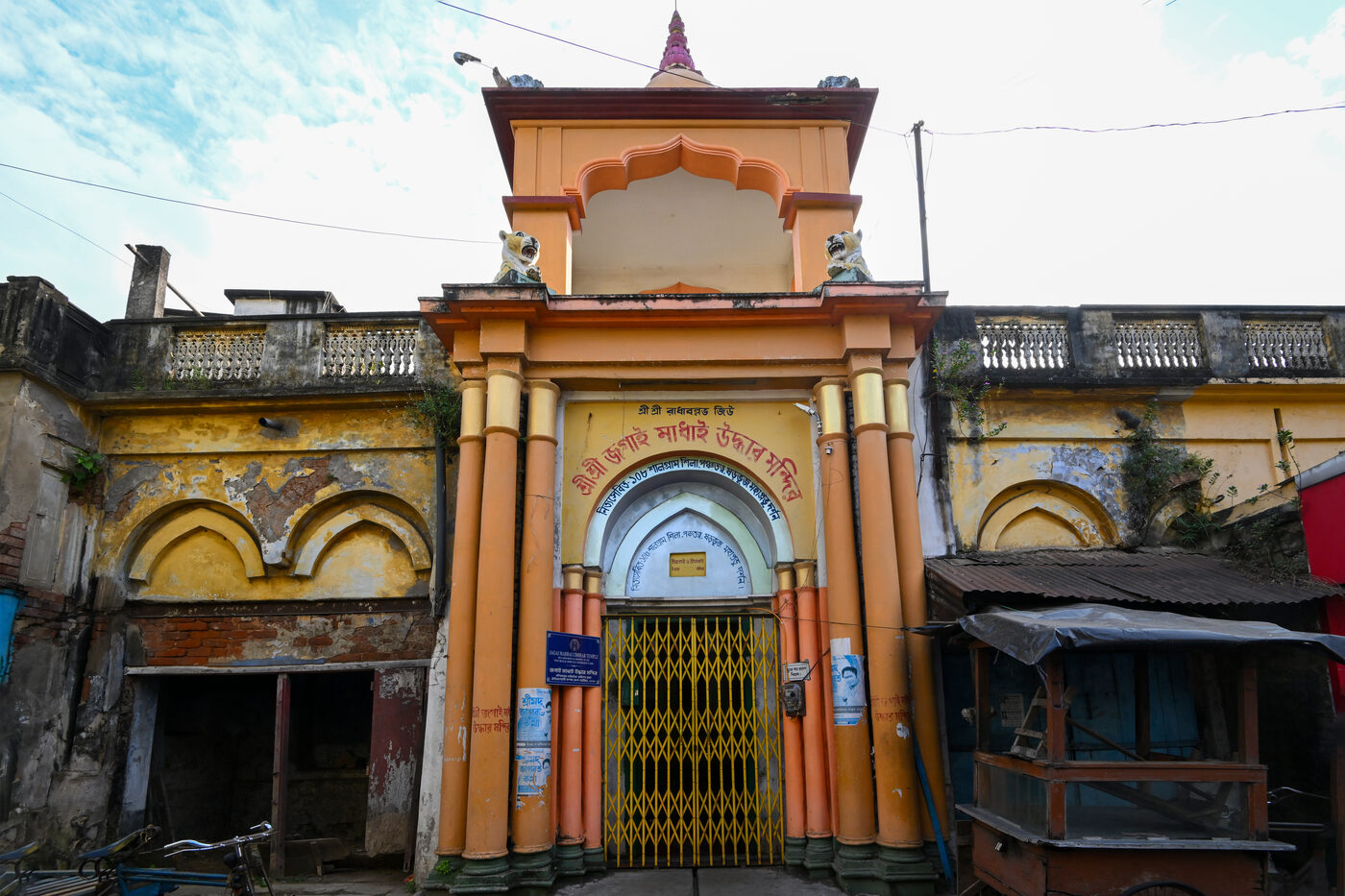
The episode of Jagai and Madhai is usually told as a story about Sri Chaitanya Mahaprabhu. Told that way, it is a story about anger and forgiveness. The Lord raises His disc against two criminals and then puts it down. Told from Nityananda Prabhu's side, it is a different story altogether, and a harder one. From his side, the interesting question is not why the Lord gave up His anger. It is why Nityananda went near the brothers in the first place, and then why, after being chased off once, he went back.
The Order to Beg Door to Door #
It all begins with an order that had no clear earlier example in the religious life of that time. Chaitanya Mahaprabhu instructed Nityananda Prabhu and Haridasa Thakura to go through Nabadwip door to door and beg. But they were not to beg for food. At every house they were to ask the householder to worship Krishna, chant Krishna's names and follow Krishna's instructions, and then move on. At the end of the day they were to report the results. The devotees who heard the instruction laughed at the idea of begging for such things. The two of them took it literally and went out.
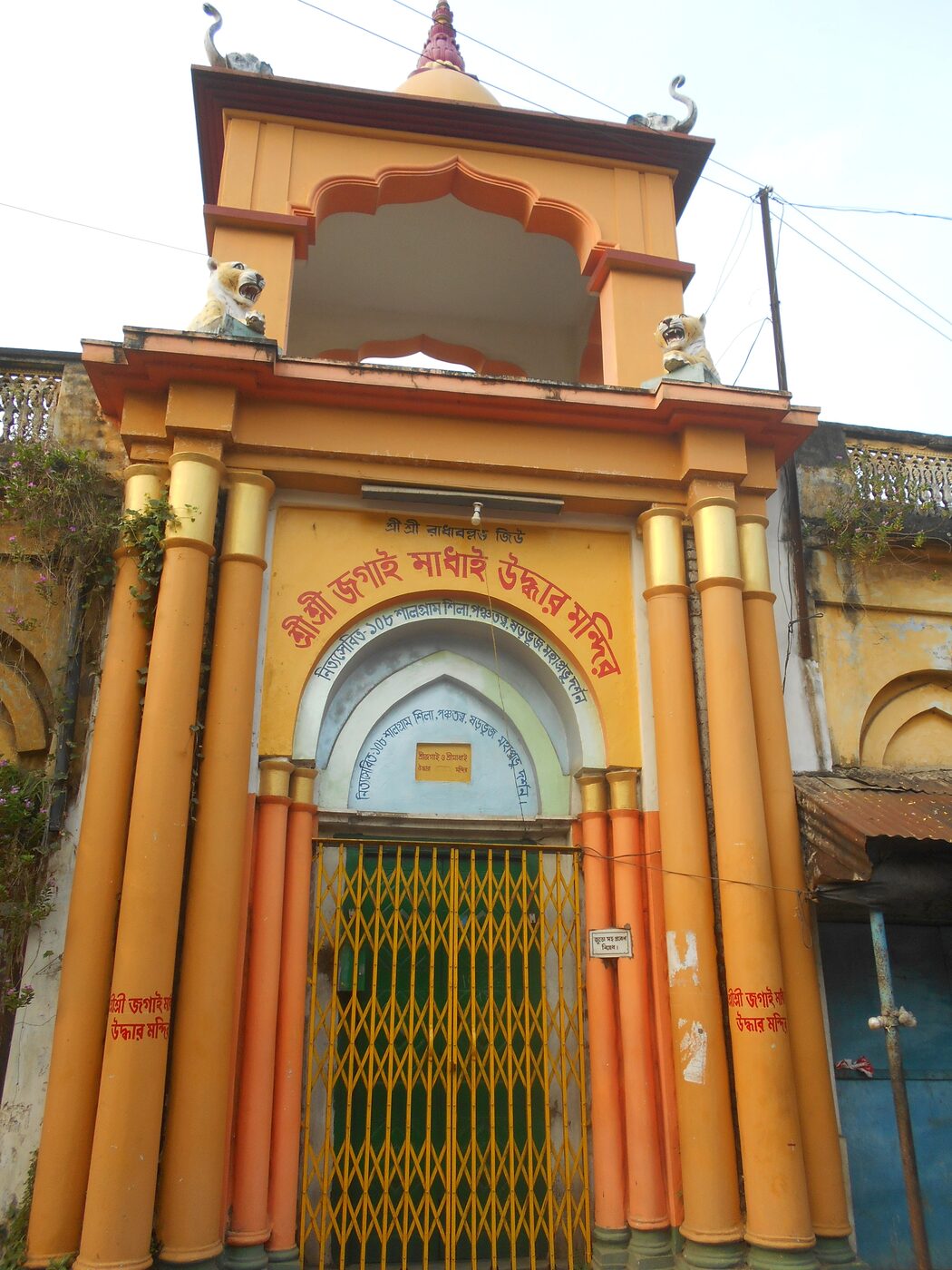
The Reception in Nabadwip #
The two preachers got a mixed reception, of a kind that anyone who has done this work since would recognise. Pious householders were delighted, invited them in and promised to do as they were asked. Others thought they were madmen, and said the same about the Lord who had sent them. Some people had been shut out of the nightly kirtana at Srivasa Pandit's house and resented it. They went further than words. The Chaitanya-bhagavata records that the two preachers were attacked and threatened with legal action by the local authority. Vrindavana Dasa comments that they were empowered by Chaitanya, so they paid no attention and carried on. Put simply, this was the first organised door-to-door preaching campaign in the history of the movement, and Nityananda Prabhu was one of the two men carrying it out. Everything he did for the next thirty years grew out of this assignment.
Meeting Jagai and Madhai in the Street #
At some point in that campaign the two of them came upon Jagai and Madhai in the street. The brothers were brahmanas of Nabadwip by birth, but they had given up every part of a brahmana's life. They were drunk more or less all the time. They ate meat, robbed people and set fires. They were so feared that the whole town arranged its life around them. Vrindavana Dasa does not describe what Nityananda and Haridasa felt on seeing them as pity in the ordinary sense. He says their hearts wept. The two talked it over. They decided that these brothers were the clearest possible example of what Mahaprabhu had come to do. They also decided to give them the Lord's message, even though they knew what was likely to follow. So they called out to them across the street to worship Krishna.
The First Attempt and the Chase #
The brothers took this as a disturbance of their afternoon and came after them, and the two preachers ran. That was the first attempt, and the biographies say plainly that they were chased off. They went to Chaitanya Mahaprabhu and described what they had seen. They asked Him to prove that He truly was Patita-pavana, the deliverer of the fallen, by delivering these two.
Advaita Acharya on Three Drunkards #
At this stage of the story Advaita Acharya makes a dry, humorous remark. Haridasa Thakura, still shaken, described how restless Nityananda had been and what it had nearly cost them both. Advaita Acharya replied that this was no surprise. Drunkards belong in the company of drunkards, he said, so it was quite fitting that three of them should be found together. Nityananda was intoxicated with love of Krishna, and the brothers with wine. Haridasa, who had taken vows, had no business there at all. Among the Nabadwip devotees, a remark like this counted as praise.
The Offence They Had Never Committed #
Vrindavana Dasa adds one remark that carries much of the teaching of the episode. For all their sins, Jagai and Madhai had never in their lives committed an offence against a Vaishnava. They had simply never had the chance. In Gaudiya theology, that makes the difference between a debt that the holy name can clear and a debt that it cannot. The biographer points it out because of what is about to happen.
The Brothers at the Ganges Ghat #
Some time afterwards the brothers camped on the bank of the Ganges at the ghat where Mahaprabhu bathed, and this frightened the neighbourhood very much. At night they heard the sound of the kirtana. In their drunken state they assumed it was being performed for the goddess Mangalachandi, and they danced to it. Then Nityananda Prabhu went to them again, at night, alone.
The Decision to Go Back Alone at Night #
The tradition sees this decision as the clearest statement of who Nityananda was, and it deserves a closer look. He had already been chased through the streets by these men. No new order made him go on this visit. The door-to-door assignment did not require a second try at a household that had thrown him out. There was no one watching. All the accounts agree that he knew fully what he was walking into. He went anyway. In his view, the fact that they were the worst men in Nabadwip was the reason to go, not the reason to stay away.
The Blow From the Broken Earthen Pot #
Madhai picked up a broken earthen pot and threw it. It struck Nityananda on the head and the blood ran down. His reply, as it is recorded, is the sentence for which Bengal has remembered him ever since. He said that Madhai might strike him again if he liked, so long as he would chant the name of Krishna. Jagai, drunk as he was, took hold of his brother and stopped him. He scolded Madhai for what he had done to a man who had come to them with nothing but good.
The Sudarshana Disc and the Plea for Jagai #
Chaitanya Mahaprabhu arrived with the devotees, saw the blood on Nityananda's body, and called for the Sudarshana disc. The Chaitanya-bhagavata says that the two brothers saw it with their own eyes. What Nityananda did at that moment is the second half of his part in the episode, and it is more than a simple plea for mercy. He told the Lord that Jagai had protected him. In this way he was pleading Jagai's case. With his own head still bleeding, he pointed the Lord to the one decent act done by either brother in years, and he built his whole case on it. Mahaprabhu accepted it and gave love of God to Jagai on the spot.
Madhai Sent to Nityananda for Forgiveness #
Madhai watched his brother receive what he himself had just lost the right to receive. He broke down and threw himself at Chaitanya Mahaprabhu's feet. The Lord refused him. This refusal was not revenge. It was exact according to the teaching. The offence had not been committed against Chaitanya Mahaprabhu, and He would not take it upon Himself to cancel a debt owed to somebody else. He sent Madhai to the feet of Nityananda Prabhu. Then He turned to Nityananda and said that since the man had fallen at his feet, it was proper for him to be merciful. According to the text, Nityananda answered by offering whatever spiritual credit he himself possessed in exchange for Madhai's forgiveness. Then, on the Lord's order, Nityananda took hold of the man who had cut his head open a few minutes earlier and embraced him. The Chaitanya-bhagavata says that Nityananda entered into Madhai's body and filled him with his own energies.
The Brothers Declared Maha Bhagavatas #
The rest followed quickly. Mahaprabhu forbade the brothers to sin again and accepted the burden of their past. He brought them into the house. When love of God had brought them both to rolling on the ground, He declared them maha-bhagavatas. He instructed the devotees to treat them as such, and He warned what would happen to anyone who did otherwise. The Vaishnavas blessed them. The text says, quite sternly, that the brothers' sinful reactions were transferred to those who speak ill of Vaishnavas. Local tradition at Nabadwip still points to a ghat on the Ganges as the place where Madhai did his penance by serving pilgrims.
Rupa and Sanatana at Ramakeli #
Krishnadasa Kaviraja gives the whole affair a single line in the Chaitanya-charitamrita, because Vrindavana Dasa had told it fully and there was no need to repeat him. But the episode appears again in his book at an important moment. Years later, at Ramakeli, two ministers of the Sultan of Bengal fell before Chaitanya Mahaprabhu. They told Him that delivering Jagai and Madhai had cost Him nothing. Those brothers, they said, were brahmanas of a holy town, and their only fault was addiction to sin. But the ministers themselves were servants of meat-eaters, and fallen millions of times further. Those two men became Rupa and Sanatana Goswami. What matters here is what their prayer takes for granted. By the 1510s, the deliverance of Jagai and Madhai had already become the standard, known to all, for how far the Lord's mercy would reach. Everyone else measured their own hopeless state against it. And it became that standard because one man had walked back down a dark street towards two drunks who had already chased him once.
Why the Episode Defines His Character #
That is why Gaudiya Vaishnavas see this episode as the one that defines Nityananda Prabhu's character, not just as one incident in it. The title Patita-pavana is not a compliment. It is a claim that needs proof, and proof of that kind can only come from somebody who is ready to be injured. Chaitanya Mahaprabhu had the disc; Nityananda had the wound. The way the story ends is important too. The Lord Himself will not forgive an offence committed against His servant, and He sends the offender back to that servant. This is the reason the tradition insists that the way to Chaitanya Mahaprabhu runs through Nityananda Prabhu and not around him. That doctrine is set out on the page on the mercy of Nitai, but its evidence is here, in a broken pot and a man who did not put his hand to his head.
Scriptural evidence for this chapter (8)
তবে শচী দেখিল, রামকৃষ্ণ—দুই ভাই ।
তবে নিস্তারিল প্রভু জগাই–মাধাই ॥ ১৭ ॥
tabe śacī dekhila, rāma-kṛṣṇa — dui bhāi
tabe nistārila prabhu jagāi-mādhāi
Word for word
tabe: thereafter; śacī: mother Śacīdevī; dekhila: saw; rāma-kṛṣṇa: Lord Kṛṣṇa and Lord Balarāma; dui bhāi: two brothers; tabe: thereafter; nistārila: delivered; prabhu: the Lord; jagāi-mādhāi: the two brothers Jagāi and Mādhāi.
Thereafter mother Śacīdevī saw the brothers Kṛṣṇa and Balarāma in Their manifestation of Lord Caitanya and Nityānanda. Then the Lord delivered the two brothers Jagāi and Mādhāi.
Krishnadasa Kaviraja's one-line notice of the deliverance of the two brothers, which he leaves to Vrindavana Dasa to narrate.
জগাই-মাধাই দুই করিলে উদ্ধার ।
তাহাঁ উদ্ধারিতে শ্রম নহিল তোমার ॥ ১৯২ ॥
jagāi-mādhāi dui karile uddhāra
tāhāṅ uddhārite śrama nahila tomāra
Word for word
jagāi-mādhāi: the two brothers Jagāi and Mādhāi; dui: two; karile: You did; uddhāra: deliverance; tāhāṅ: there; uddhārite: to deliver; śrama: exertion; nahila: there was not; tomāra: of You.
“You have delivered the two brothers Jagāi and Mādhāi, but to deliver them You did not have to exert Yourself very much.
Rupa and Sanatana at Ramakeli: You delivered Jagai and Madhai, but to do it You did not have to exert Yourself very much.
ব্রাহ্মণজাতি তারা, নবদ্বীপে ঘর ।
নীচ-সেবা নাহি করে, নহে নীচের কূর্পর ॥ ১৯৩ ॥
brāhmaṇa-jāti tārā, navadvīpe ghara
nīca-sevā nāhi kare, nahe nīcera kūrpara
Word for word
brāhmaṇa-jāti: born in a brāhmaṇa family; tārā: they; navadvīpe: the holy place of Navadvīpa-dhāma; ghara: their house; nīca-sevā: service to degraded persons; nāhi: not; kare: do; nahe: not; nīcera: of low persons; kūrpara: an instrument.
“The brothers Jagāi and Mādhāi belonged to the brāhmaṇa caste, and their residence was in the holy place of Navadvīpa. They never served low-class persons, nor were they instruments to abominable activities.
Their argument that the brothers were brahmanas of Nabadwip who never served low-class persons, establishing Jagai and Madhai as the tradition's benchmark of fallenness.
জগাই-মাধাই হৈতে কোটী কোটী গুণ ।
অধম পতিত পাপী আমি দুই জন ॥ ১৯৬ ॥
jagāi-mādhāi haite koṭī koṭī guṇa
adhama patita pāpī āmi dui jana
Word for word
jagāi-mādhāi: Jagāi and Mādhāi; haite: than; koṭī koṭī: millions and millions; guṇa: of times; adhama: degraded; patita: fallen; pāpī: sinful; āmi: we; dui: two; jana: persons.
“We two are millions and millions of times inferior to Jagāi and Mādhāi. We are more degraded, fallen and sinful than they.
The claim that follows from it: we two are millions of times more degraded than Jagai and Madhai.
জগাই মাধাই হৈতে মুঞি সে পাপিষ্ঠ ।
পুরীষের কীট হৈতে মুঞি সে লঘিষ্ঠ ॥ ২০৫ ॥
jagāi mādhāi haite muñi se pāpiṣṭha
purīṣera kīṭa haite muñi se laghiṣṭha
Word for word
jagāi mādhāi: the two brothers Jagāi and Mādhāi; haite: than; muñi: I; se: that; pāpiṣṭha: more sinful; purīṣera: in stool; kīṭa: the worms; haite: than; muñi: I am; se: that; laghiṣṭha: lower.
I am more sinful than Jagāi and Mādhāi and even lower than the worms in the stool.
Krishnadasa Kaviraja applies the same measure to himself: I am more sinful than Jagai and Madhai, and lower than the worms in stool.
প্রেমে মত্ত নিত্যানন্দ কৃপা–অবতার ।
উত্তম, অধম, কিছু না করে বিচার ॥ ২০৮ ॥
preme matta nityānanda kṛpā-avatāra
uttama, adhama, kichu nā kare vicāra
Word for word
preme: in ecstatic love; matta: mad; nityānanda: Lord Nityānanda; kṛpā: merciful; avatāra: incarnation; uttama: good; adhama: bad; kichu: any; nā: not; kare: makes; vicāra: consideration.
Because He is intoxicated by ecstatic love and is an incarnation of mercy, He does not distinguish between the good and the bad.
Because He is intoxicated by ecstatic love and is an incarnation of mercy, Nityananda does not distinguish between the good and the bad.
যে আগে পড়য়ে, তারে করয়ে নিস্তার ।
অতএব নিস্তারিলা মো–হেন দুরাচার ॥ ২০৯ ॥
ye āge paḍaye, tāre karaye nistāra
ataeva nistārilā mo-hena durācāra
Word for word
ye: whoever; āge: in front; paḍaye: falls down; tāre: unto him; karaye: does; nistāra: deliverance; ataeva: therefore; nistārilā: delivered; mo: as me; hena: such; durācāra: sinful and fallen person.
He delivers all those who fall down before Him. Therefore He has delivered such a sinful and fallen person as me.
He delivers all those who fall down before Him, which is precisely what happened when Madhai was sent to His feet.
প্রেমভক্তি দিয়া তেঁহো ভাসা’ল জগতে ।
তাঁর চরিত্র লোকে না পারে বুঝিতে ॥ ২৯৭ ॥
prema-bhakti diyā teṅho bhāsā’la jagate
tāṅra caritra loke nā pāre bujhite
Word for word
prema-bhakti: devotional service; diyā: giving; teṅho: Lord Nityānanda Prabhu; bhāsā’la: overflooded; jagate: in the world; tāṅra: His; caritra: character; loke: people; nā: not; pāre: able; bujhite: to understand.
Śrī Nityānanda Prabhu overflooded the entire world by distributing transcendental loving service. No one can understand His character and activities.
Nityananda Prabhu overflooded the entire world by distributing loving service, and no one can understand His character and activities.
Chapter 6
The Preaching Mission in Bengal
Left in charge of a province while the Lord stayed in Puri, and the reason Gaudiya Vaishnavism became a mass movement
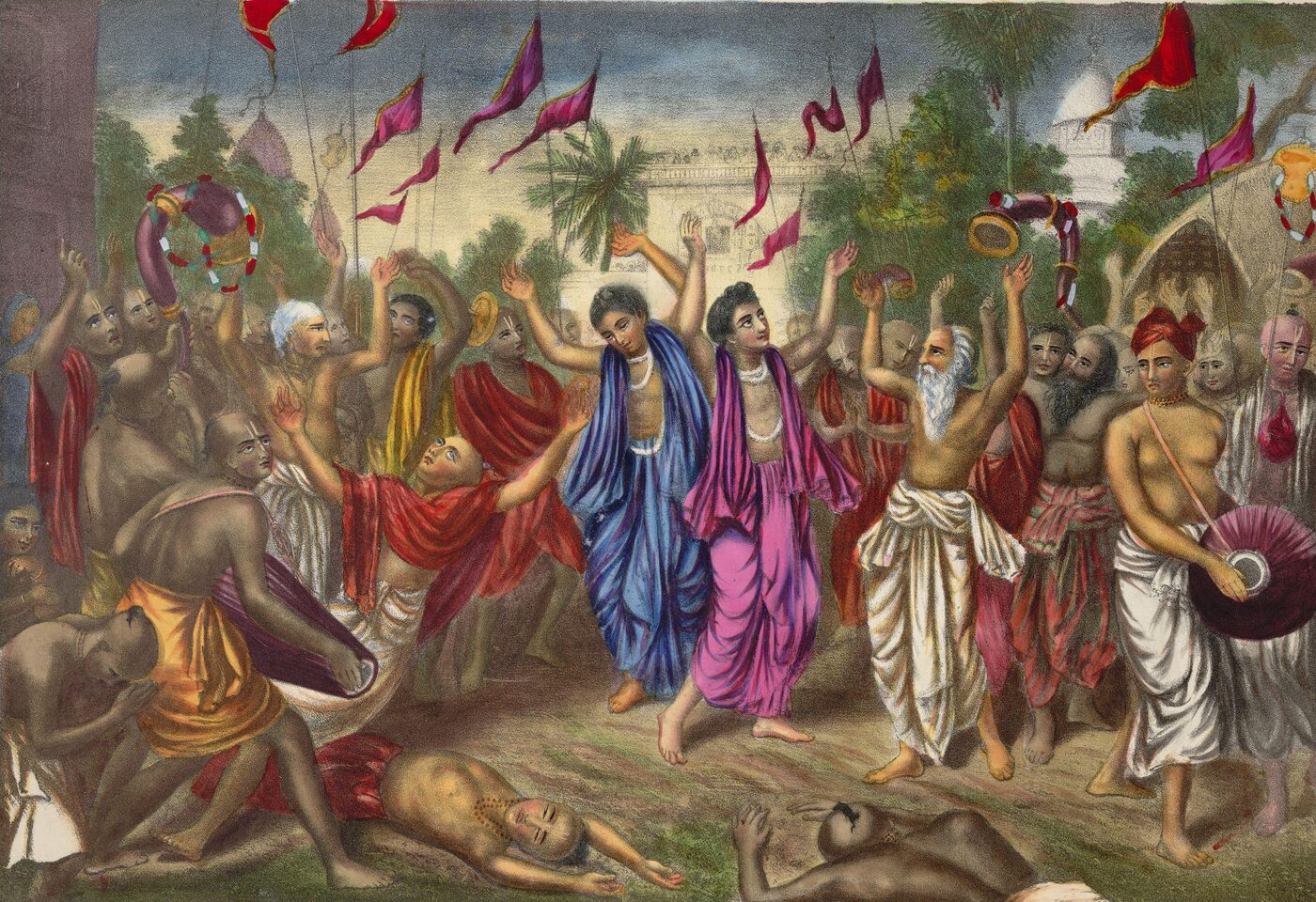
In January 1510 Chaitanya Mahaprabhu accepted sannyasa at Katwa. Three men went with Him to make the arrangements, and Nityananda Prabhu was one of them. Nityananda was also with Him on the road to Jagannatha Puri a few weeks later. On that road he did something that showed, more than any other single act, what kind of associate he was.
| Detail | Description |
|---|---|
| Appointment | Ordered by Chaitanya Mahaprabhu to preach throughout Bengal |
| Duration | Roughly thirty years |
| Headquarters | Khardaha, on the Ganges north of Calcutta |
| Centres | Nabadwip, Panihati, Saptagram, Ambika Kalna, Barahanagar, Naihati, Jhamatpura |
| Branch leaders | More than seventy-five, named in the eleventh chapter of the Adi-lila |
| Best known festival | The Danda Mahotsava at Panihati |
Breaking the Sannyasa Danda at Kamalapura #
At Kamalapura the Lord bathed in the Bhargi river and handed His sannyasa staff to Nityananda to hold. While He went on to the Siva temple at Kapotesvara, Nityananda broke the staff into three pieces and threw it into the water. A sannyasi's danda is not a walking stick. It is the visible sign of the sannyasa order. So destroying it looked, at first sight, like open disobedience by the man who had been given it to look after. When the Lord came back and asked for it, Nityananda said that He had fallen in ecstasy and that the two of them had come down on it together. Mahaprabhu was angry. Krishnadasa Kaviraja then records, with unusual honesty, that the devotees could not understand any of it. They could not understand why Nityananda broke the staff, or why the Lord allowed it, or why He was angry after allowing it. Nobody, he says, could understand the real purpose of the two Lords. Gaudiya commentators have offered explanations since. But for a biography of Nityananda the point is simpler. He was the one person in the movement who would do such a thing, and Chaitanya Mahaprabhu kept him anyway.
The Appointment to Preach in Bengal #
Not long afterwards, an arrangement was made that would shape the rest of both their lives. Chaitanya Mahaprabhu settled at Jagannatha Puri, and for the last eighteen years of His manifest life He practically never left it. He handed Bengal, the movement's home and all its people, to Nityananda. Krishnadasa Kaviraja mentions the appointment in a single clause, in the middle of a list of devotees, as a fact everybody already knew. He writes that when Nityananda Prabhu was ordered to go to Bengal to preach, two of Mahaprabhu's own men were told to go with Him. The Chaitanya-bhagavata describes the order more fully and more directly. There it is an instruction to deliver everyone, without asking who deserved it. For roughly thirty years, that is what he did.
The Geography of the Mission #
The places of the mission are worth listing, because they are not the stops of a pilgrimage. They are the towns of a whole province where he worked steadily. Nabadwip, where it had begun. Khardaha on the Ganges north of what is now Calcutta, where he eventually settled with his family. Panihati, a few miles further up the river. Saptagram on the Sarasvati in Hooghly, then a major inland port. Ambika Kalna, Barahanagar, Naihati, Jhamatpura, and back to the Birbhum country of his birth. He travelled with a large party of kirtana singers, servants and companions. Krishnadasa Kaviraja describes a scene at Panihati. He notes the crowd of devotees seated on the ground around Him, and the great influence of the man, which astonished a visitor who saw it for the first time.
The Seventy Five Branches of His Line #
The clearest evidence of what he actually built is a list. The eleventh chapter of the Adi-lila is given to listing the branches of Nityananda Prabhu's line. It names more than seventy-five individuals. It begins with his son Virabhadra Gosani and runs through Ramadasa, Gadadhara Dasa, Madhava Ghosh and Vasudeva Ghosh, Uddharana Datta, Gauridasa Pandita, Sundarananda, Kamalakara Pippalai, Mahesa Pandita, Dhananjaya Pandita, Parameshvara Dasa and Jagadisa Pandita. It also includes physicians, singers, dancers and a good many men of whom nothing is known except their names and the fact that they belonged to him. Twelve of them are identified as the twelve gopalas, the cowherd boys of Vraja who had come again. Krishnadasa Kaviraja ends the list by saying that these branches were loaded with ripe fruit and distributed it to everyone they met. He also says that each of them had the independent power to give Krishna to anybody. In the language of devotional biography, this describes a movement with many capable local leaders all across the province. No other associate of Chaitanya Mahaprabhu has a chapter like it.
Uddharana Datta and the Suvarna Vanik Community #
But the most important thing Nityananda did in Bengal was not to organise people. It was to change society, and it can be seen in the life of a single follower. Uddharana Datta Thakura of Saptagram was a suvarna-vanik, a member of the gold-merchant and banking community. For centuries that community had been formally shut out of respectable Hindu society in Bengal. The traditional explanation is a quarrel between the ruler Ballal Sena and the great banker Gauri Sena. The king had been borrowing huge sums from Gauri Sena, and in the end the banker stopped lending. The king's revenge was to have the whole caste shut out of society. Nityananda Prabhu came to Saptagram, stayed in Uddharana Datta's house, ate there, and made him one of the twelve gopalas. The Chaitanya-bhagavata states plainly that the entire suvarna-vanik community was purified through him. Srila Bhaktisiddhanta Sarasvati Thakura recorded the history in his commentary, and Srila Prabhupada, who came from that same community and whose family had visited Uddharana Datta's temple in his childhood, set it out in his purport. This is how the caste barrier was really broken in sixteenth-century Bengal. It was not broken by an argument. It was broken by a man of spotless brahmana birth who was also a recognised avadhuta. He sat down to eat in a house where such a man was not supposed to eat, and then he did it again in the next town.
Raghunatha Dasa Comes to Panihati #
The best-documented single event of the Bengal years is the festival at Panihati. It shows his whole method in one small scene. Raghunatha Dasa was the son of an extremely rich landholding family at Saptagram, and he had been trying for years to run away and join Chaitanya Mahaprabhu. His father kept having him brought back, and in the end guards were posted. One day he went instead to Nityananda Prabhu, who was at Panihati sitting under a tree on a rock by the Ganges with his party around him. Raghunatha offered his obeisances from a distance and would not come near. Nityananda called him. When Raghunatha still would not come, Nityananda caught hold of him and put his own feet on Raghunatha's head. Then, laughing, Nityananda announced the punishment. Raghunatha, he said, was a thief who tried to slip away without giving himself up, and he must be punished. He was to hold a festival and feed all the assembled devotees chipped rice and yogurt.
The Festival of Chipped Rice and Yogurt #
Raghunatha sent his men into the village to buy all the food they could find. The crowd grew so fast that he had to send to other villages. He bought four hundred large earthen pots, and then five or seven very large ones in which a brahmana soaked chipped rice in hot milk. Everyone present was given two pots, one of chipped rice with condensed milk and one with yogurt, sugar and bananas. Brahmanas who could not find a place on the platform went down to the bank of the Ganges, and those who could not find a place on the bank stood in the water and ate there. Shopkeepers from surrounding villages arrived to sell chipped rice, yogurt and bananas. Raghunatha bought their entire stock, paid them, and then fed them the food they had brought. Anyone who came to see what was going on was fed as well. Then, Krishnadasa Kaviraja says, Nityananda in meditation brought Chaitanya Mahaprabhu to the spot and stood up to receive Him. As a joke, he went from pot to pot pushing a morsel into His mouth, and then he sat the Lord down and ate beside Him. The comment that follows is the biographer's own: who can understand the influence of Nityananda Prabhu, who is so powerful that He induced Chaitanya Mahaprabhu to come and eat chipped rice on the bank of the Ganges? At the end of the festival, Nityananda had the whole assembly bless Raghunatha, and he put his own feet on the young man's head. Raghunatha Dasa left home shortly afterwards. He went to Puri and became one of the Six Goswamis of Vrindavana. The festival is still kept every year at Panihati as the Danda Mahotsava, the Festival of the Punishment.
The Punishment That Was a Picnic #
Notice what the punishment consisted of. It was a picnic. That was no accident. It was the whole preaching method. Nityananda Prabhu never asked anyone for a qualification before letting them in. The only doorway he set up was food, singing and company, all of it in the open air and free, so that nobody could fail to step through it. Then he left the rest to what happens when people have chanted and eaten together for a day. The householders of Bengal did not have to renounce anything, learn Sanskrit, or leave their trades. All they had to do was come.
How Bengal Became a Mass Movement #
That is why the tradition regards this appointment as the reason Gaudiya Vaishnavism became a mass movement, and not just a school of thought. Chaitanya Mahaprabhu's own preaching after 1510 was concentrated in Puri and in two long journeys. The Six Goswamis in Vrindavana produced the theology, and produced it magnificently. But they were six celibate scholars living under trees in another province, and they did not build congregations. The congregations were built in Bengal, by Nityananda Prabhu and the seventy-five men whose names Krishnadasa Kaviraja preserved, among ordinary householders in ordinary towns. Chaitanya Mahaprabhu disappeared in 1534, and the first generation of devotees began to leave this world after Him. What remained then was that Bengali householder community. Every later Gaudiya lineage, including the ones that eventually carried the movement out of India, grew from it.
Scriptural evidence for this chapter (10)
নিত্যানন্দে আজ্ঞা দিল যবে গৌড়ে যাইতে ।
মহাপ্রভু এই দুই দিলা তাঁর সাথে ॥ ১৪ ॥
অতএব দুইগণে দুঁহার গণন ।
মাধব–বাসুদেব ঘোষেরও এই বিবরণ ॥ ১৫ ॥
nityānande ājñā dila yabe gauḍe yāite
mahāprabhu ei dui dilā tāṅra sāthe
ataeva dui-gaṇe duṅhāra gaṇana
mādhava-vāsudeva ghoṣerao ei vivaraṇa
Word for word
nityānande: unto Lord Nityānanda; ājñā: order; dila: gave; yabe: when; gauḍe: to Bengal; yāite: to go; mahāprabhu: Śrī Caitanya Mahāprabhu; ei dui: these two; dilā: gave; tāṅra sāthe: with Him; ataeva: therefore; dui-gaṇe: in both the parties; duṅhāra: two of them; gaṇana: are counted; mādhava: Mādhava; vāsudeva: Vāsudeva; ghoṣerao: of the surname Ghoṣa; ei: this; vivaraṇa: description.
When Nityānanda Prabhu was ordered to go to Bengal to preach, these two devotees [Śrī Rāmadāsa and Gadādhara dāsa] were ordered to go with Him. Thus they are sometimes counted among the devotees of Lord Caitanya and sometimes among the devotees of Lord Nityānanda. Similarly, Mādhava Ghoṣa and Vāsudeva Ghoṣa belonged to both groups of devotees simultaneously.
The appointment itself, recorded in a single clause: when Nityananda Prabhu was ordered to go to Bengal to preach, two of the Lord's own men were sent with Him.
শ্রীনিত্যানন্দ–বৃক্ষের স্কন্ধ গুরুতর ।
তাহাতে জন্মিল শাখা–প্রশাখা বিস্তর ॥ ৫॥
śrī-nityānanda-vṛkṣera skandha gurutara
tāhāte janmila śākhā-praśākhā vistara
Word for word
śrī-nityānanda-vṛkṣera: of the tree known as Śrī Nityānanda; skandha: main branch; gurutara: extremely heavy; tāhāte: from that branch; janmila: grew; śākhā: branches; praśākhā: subbranches; vistara: expansively.
Śrī Nityānanda Prabhu is an extremely heavy branch of the Śrī Caitanya tree. From that branch grow many branches and subbranches.
Nityananda as an extremely heavy branch of the Chaitanya tree, from which many branches and sub-branches grow.
মহাভাগবত–শ্রেষ্ঠ দত্ত উদ্ধারণ ।
সর্বভাবে সেবে নিত্যানন্দের চরণ ॥ ৪১ ॥
mahā-bhāgavata-śreṣṭha datta uddhāraṇa
sarva-bhāve seve nityānandera caraṇa
Word for word
mahā-bhāgavata: great devotee; śreṣṭha: chief; datta: the surname Datta; uddhāraṇa: Uddhāraṇa; sarva-bhāve: in all respects; seve: worships; nityānandera: of Lord Nityānanda; caraṇa: lotus feet.
Uddhāraṇa Datta Ṭhākura, the eleventh among the twelve cowherd boys, was an exalted devotee of Lord Nityānanda Prabhu. He worshiped the lotus feet of Lord Nityānanda in all respects.
Uddharana Datta Thakura of Saptagram, the eleventh of the twelve cowherd boys; the purport records the restoration of the suvarna-vanik community.
এই সর্বশাখা পূর্ণ—পক্ক প্রেমফলে ।
যারে দেখে, তারে দিয়া ভাসাইল সকলে ॥ ৫৮ ॥
ei sarva-śākhā pūrṇa — pakva prema-phale
yāre dekhe, tāre diyā bhāsāila sakale
Word for word
ei: these; sarva-śākhā: all branches; pūrṇa: complete; pakva prema-phale: with ripened fruits of love of Godhead; yāre dekhe: whomever they see; tāre diyā: distributing to him; bhāsāila: overflooded; sakale: all of them.
All these branches, the devotees of Lord Nityānanda Prabhu, being full of ripened fruits of love of Kṛṣṇa, distributed these fruits to all they met, flooding them with love of Kṛṣṇa.
The branches of Nityananda's line, full of ripened fruit, distributing it to everyone they met and flooding them with love of Krishna.
অনর্গল প্রেম সবার, চেষ্টা অনর্গল ।
প্রেম দিতে, কৃষ্ণ দিতে ধরে মহাবল ॥ ৫৯ ॥
anargala prema sabāra, ceṣṭā anargala
prema dite, kṛṣṇa dite dhare mahābala
Word for word
anargala: unchecked; prema: love of Kṛṣṇa; sabāra: of everyone of them; ceṣṭā: activity; anargala: unchecked; prema dite: to give love of Kṛṣṇa; kṛṣṇa dite: to deliver Kṛṣṇa; dhare: they possess; mahābala: great strength.
All these devotees had unlimited strength to deliver unobstructed, unceasing love of Kṛṣṇa. By their own strength they could offer anyone Kṛṣṇa and love of Kṛṣṇa.
Each of these devotees had unlimited strength to give Krishna and love of Krishna to anyone, which is what a preaching network is.
পানিহাটি-গ্রামে পাইলা প্রভুর দরশন ।
কীর্তনীয়া সেবক সঙ্গে আর বহুজন ॥ ৪৩ ॥
pānihāṭi-grāme pāilā prabhura daraśana
kīrtanīyā sevaka saṅge āra bahu-jana
Word for word
pānihāṭi-grāme: in the village known as Pānihāṭi; pāilā: got; prabhura daraśana: the audience of Nityānanda Prabhu; kīrtanīyā sevaka: performers of saṅkīrtana and servants; saṅge: with; āra: and; bahu-jana: many other persons.
In the village of Pānihāṭi, Raghunātha dāsa obtained an interview with Nityānanda Prabhu, who was accompanied by many kīrtana performers, servants and others.
Raghunatha dasa's first sight of Nityananda Prabhu at Panihati, seated with kirtana performers and servants around Him.
দধি, চিড়া ভক্ষণ করাহ মোর গণে ।” শুনি’ আনন্দিত হৈল রঘুনাথ মনে ॥ ৫১ ॥
dadhi, ciḍā bhakṣaṇa karāha mora gaṇe”
śuni’ ānandita haila raghunātha mane
Word for word
dadhi: yogurt; ciḍā: chipped rice; bhakṣaṇa karāha: feed; mora gaṇe: My associates; śuni’: hearing; ānandita haila: became very happy; raghunātha: Raghunātha dāsa; mane: in the mind.
“Make a festival and feed all My associates yogurt and chipped rice.” Hearing this, Raghunātha dāsa was greatly pleased.
The sentence passed on Raghunatha dasa: make a festival and feed all My associates chipped rice and yogurt.
নিত্যানন্দ-প্রভাব-কৃপা জানিবে কোন্ জন ? মহাপ্রভু আনি’ করায় পুলিন-ভোজন ॥ ৮৯ ॥
nityānanda-prabhāva-kṛpā jānibe kon jana?
mahāprabhu āni’ karāya pulina-bhojana
Word for word
nityānanda: of Nityānanda Prabhu; prabhāva-kṛpā: influence and mercy; jānibe: can know; kon jana: who; mahāprabhu āni’: bringing Śrī Caitanya Mahāprabhu; karāya pulina-bhojana: induces Him to eat on the riverbank.
Who can understand the influence and mercy of Lord Nityānanda Prabhu? He is so powerful that He induced Lord Śrī Caitanya Mahāprabhu to come eat chipped rice on the bank of the Ganges.
Who can understand the influence of Nityananda Prabhu, who induced Chaitanya Mahaprabhu to come and eat chipped rice on the bank of the Ganges.
কপোতেশ্বর দেখিতে গেলা ভক্তগণ সঙ্গে ।
এথা নিত্যানন্দপ্রভু কৈল দণ্ড-ভঙ্গে ॥ ১৪২ ॥
তিন খণ্ড করি’ দণ্ড দিল ভাসাঞা ।
ভক্ত-সঙ্গে আইলা প্রভু মহেশ দেখিঞা ॥ ১৪৩ ॥
kapoteśvara dekhite gelā bhakta-gaṇa saṅge
ethā nityānanda-prabhu kaila daṇḍa-bhaṅge
tina khaṇḍa kari’ daṇḍa dila bhāsāñā
bhakta-saṅge āilā prabhu maheśa dekhiñā
Word for word
kapoteśvara: the Śiva temple of the name Kapoteśvara; dekhite: to see; gelā: went; bhakta-gaṇa saṅge: with the devotees; ethā: here; nityānanda-prabhu: Lord Nityānanda Prabhu; kaila: did; daṇḍa: of the sannyāsa staff; bhaṅge: breaking; tina khaṇḍa: three parts; kari’: making; daṇḍa: the staff; dila: threw in; bhāsāñā: washing away; bhakta-saṅge: with the devotees; āilā: returned; prabhu: Lord Caitanya Mahāprabhu; maheśa dekhiñā: having seen the temple of Lord Śiva.
When Lord Caitanya Mahāprabhu went to the temple of Lord Śiva known as Kapoteśvara, Nityānanda Prabhu, who was keeping His sannyāsa staff in custody, broke the staff in three parts and threw it into the river Bhārgīnadī. Later this river became known as Daṇḍa-bhāṅgā-nadī.
Nityananda breaks the Lord's sannyasa staff in three and throws it into the Bhargi river.
ইঁহো কেনে দণ্ড ভাঙ্গে, তেঁহো কেনে ভাঙ্গায় ।
ভাঙ্গাঞা ক্রোধে তেঁহো ইঁহাকে দোষায় ॥ ১৫৭ ॥
iṅho kene daṇḍa bhāṅge, teṅho kene bhāṅgāya
bhāṅgāñā krodhe teṅho iṅhāke doṣāya
Word for word
iṅho: Nityānanda; kene: why; daṇḍa: the staff; bhāṅge: breaks; teṅho: Śrī Caitanya Mahāprabhu; kene: why; bhāṅgāya: allows to break it; bhāṅgāñā: after allowing to break it; krodhe: in anger; teṅho: Śrī Caitanya Mahāprabhu; iṅhāke: Lord Nityānanda; doṣāya: accuses.
The devotees could not understand why Nityānanda Prabhu broke the staff, why Śrī Caitanya Mahāprabhu permitted Him to do so, or why, after permitting Him, Caitanya Mahāprabhu became angry.
Krishnadasa Kaviraja's admission that the devotees could understand neither the breaking of the staff, nor the Lord's permission, nor His anger.
Chapter 7
Marriage to Vasudha and Jahnava
An avadhuta married at the Lord's request, a son who became the movement's main pillar, and a woman who came to lead the tradition
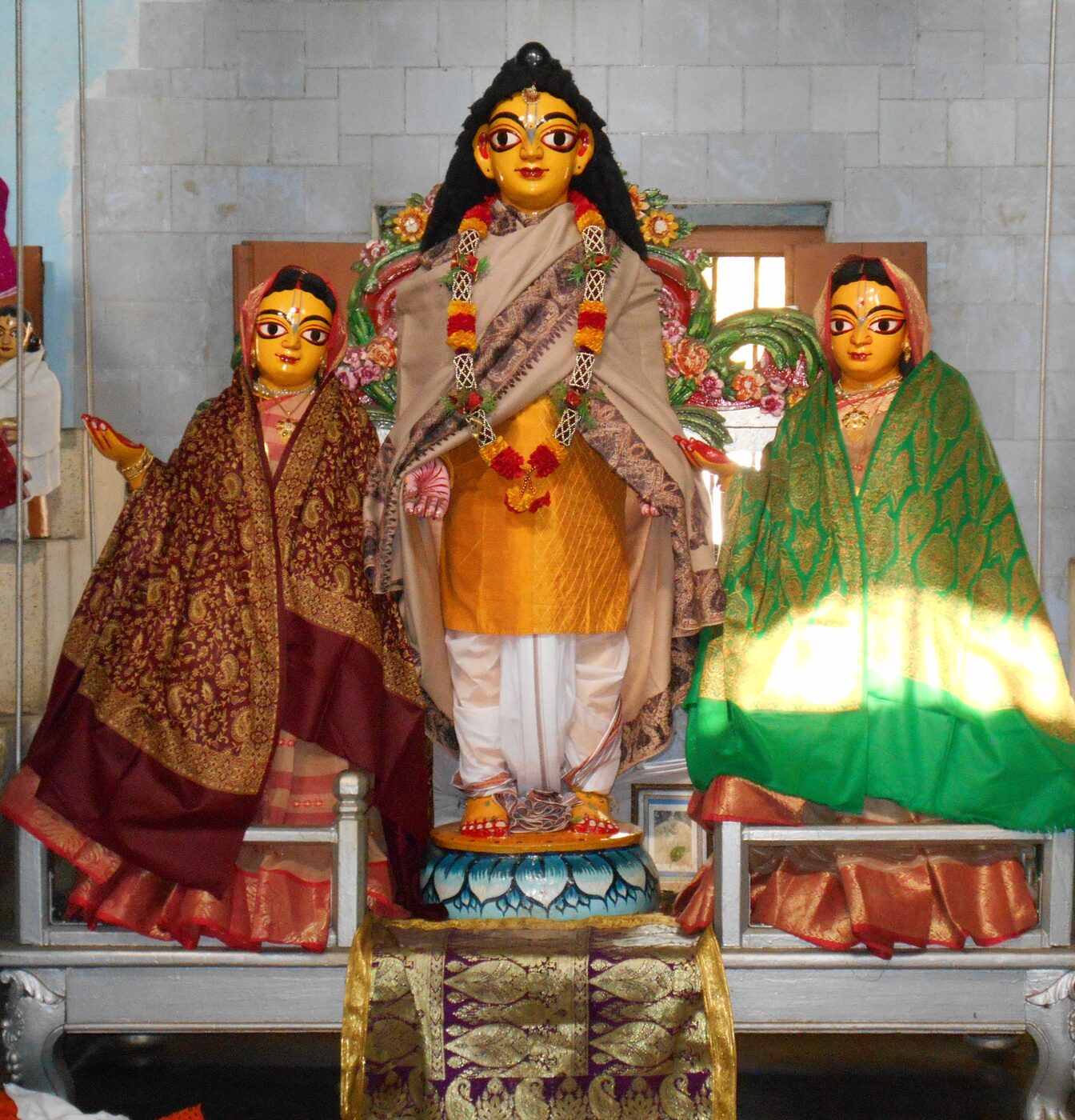
Nityananda Prabhu spent the first half of his life as an avadhuta. The word describes a renounced person who has gone beyond all rules, and it described him exactly. He had left home at twelve and wandered India for twenty years. He kept no fixed home and no fixed practice, and he regularly behaved in ways that shocked orthodox Bengal. He ended his life as a married householder at Khardaha, with two wives, a son and a daughter. This is one of the more surprising turns in Gaudiya history, and the tradition is quite clear about whose idea it was.
| Person | Relation |
|---|---|
| Suryadasa Sarakhela | Father of both wives, accountant to the ruler of Gauda |
| Gauridasa Pandita | Brother of Suryadasa, one of the twelve gopalas |
| Vasudha | The elder daughter, first wife |
| Jahnava | The younger daughter, second wife, known as Jahnava Mata |
| Virabhadra | Son of Vasudha, also called Virachandra |
| Ganga Devi | Daughter of Vasudha |
Why Mahaprabhu Told Him to Marry #
The later Bengali biographies record that Chaitanya Mahaprabhu took him aside and spoke to him plainly. If Nityananda also confined himself to the austerities of a renunciant, who would deliver the people sunk in material life, and how would the work continue? He should go back to Gauda, accept household life, and preach from inside it, so that ordinary people had an example they could actually copy. This is not recorded in the Chaitanya-charitamrita, and the reader should know that. It comes from the Bhakti-ratnakara, the Premavilasa and the many Bengali devotional biographies that grew up around the Nityananda line. But the reasoning behind it fits fully with everything else about the mission in Bengal, which was aimed at householders from beginning to end. An avadhuta cannot be imitated. A married man running a congregation can.
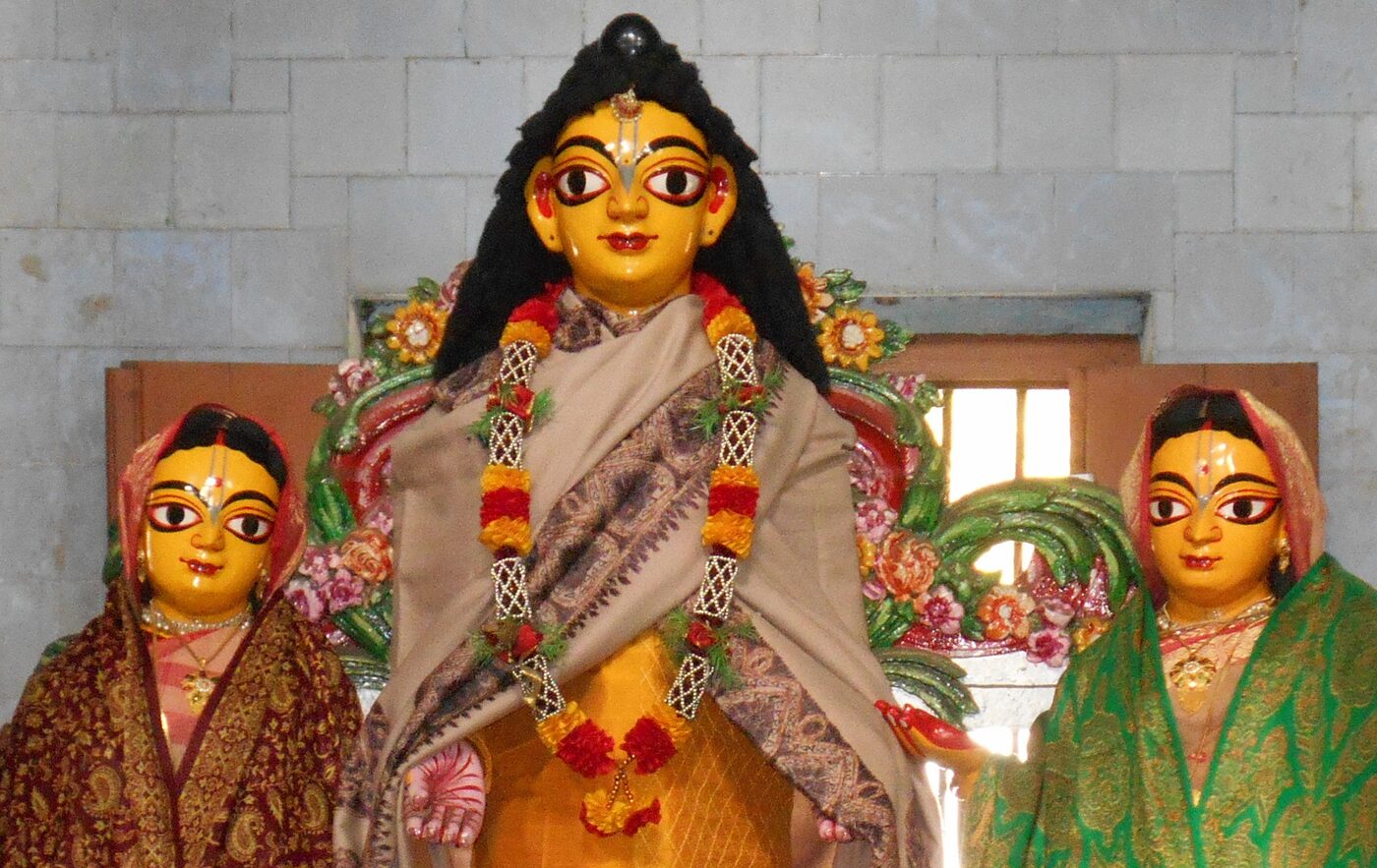
The Family of Suryadasa Sarakhela #
The family he married into was already inside the movement. Suryadasa Sarakhela lived at Saligrama. His title Sarakhela shows that he kept accounts for the ruler of Gauda. He had several brothers. One of them was Gauridasa Pandita, one of the twelve gopalas and among the most devoted of all Nityananda's followers. Another was Krishnadasa Sarakhela. The Chaitanya-charitamrita's list of Nityananda's devotees names him together with his brother, as a reservoir of love of God. Suryadasa had two daughters, Vasudha the elder and Jahnava the younger.
The Refusal and the Restoring of Vasudha #
The traditional account of the marriage is dramatic. It comes from the later biographies, not from the two great ones, so it should be read as what the tradition preserves, not as documented history. In that account Nityananda came to Suryadasa's house, accompanied by Uddharana Datta Thakura, and asked for Vasudha's hand. He was refused. Suryadasa could not bring himself to give his daughter to a man who had given up his caste position. Nityananda left. Vasudha had understood who had come for her, and she collapsed. Gauridasa Pandita came and fell at his elder brother's feet to beg him to change his mind. But by then Vasudha had already been carried to the Ganges for her last rites. Nityananda came to the riverside. Suryadasa fell at his feet and asked for his daughter's life. Nityananda answered that he would bring her back on condition that the marriage took place, and Suryadasa agreed. The accounts describe her waking and looking at him. Suryadasa then asked him to go through the customary purification rites and accept the sacred thread. Nityananda agreed without argument. He remarked that in this matter he was not the one in charge, and that the only master was Chaitanya. Some days later, while Jahnava was serving him his meal, her veil slipped. Nityananda understood that she too was his own energy, and he asked for her as well. Suryadasa answered that he had nothing left that he could refuse.
Marriage and Settling at Khardaha #
They were married and spent a few days at Saligrama. Then they went on the round of visits that any Bengali bridegroom makes. At Nabadwip, Sachi Devi received the two brides with great affection. At Advaita Acharya's house in Shantipur, Sita Thakurani took them into her lap and blessed them. Afterwards Nityananda settled at Khardaha, on the Ganges north of present-day Calcutta, and Khardaha became the headquarters of the Bengal mission.
The Children of Vasudha #
Vasudha bore eight sons and one daughter. Seven of the sons died in infancy. The two children who survived were the daughter Ganga Devi and the youngest son, Virabhadra, also called Virachandra. Vasudha herself died soon after their birth, and Jahnava, who had no children of her own, raised them. The accounts say that Virabhadra was her particular favourite, and it was Jahnava who eventually gave him initiation.
Virabhadra Gosani the Topmost Branch #
At the start of the eleventh chapter of the Adi-lila, Krishnadasa Kaviraja describes Virabhadra Gosani's place in the tradition in the strongest possible words. He calls him the greatest branch after Nityananda Prabhu himself. He describes him as the main pillar of the hall of devotional service built by Chaitanya Mahaprabhu. He says that it is by Virabhadra's mercy that people all over the world have the chance to chant the names of Chaitanya and Nityananda. And before beginning to write the Chaitanya-charitamrita, he takes shelter of Virabhadra's feet. A tradition preserved by the Nedadi sampradaya holds that Virabhadra brought twelve hundred Nedas, former Buddhist monks, into the Vaishnava community and set them to dig the great tank called Svetaganga at Ekachakra. He built the temple at Ekachakra that his father had never built. The villages of Viracandrapura and Virabhadrapura beside the birthplace carry his name.
Jahnava Mata and the Second Generation #
But it is the later life of Jahnava Devi, remembered throughout Bengal simply as Jahnava Mata, that makes her story so important. Chaitanya Mahaprabhu disappeared in 1534, and Nityananda Prabhu, Advaita Acharya and Srivasa Pandit followed within a few years. The movement was then left without any of the figures around whom it had been organised. The person who filled that gap was Nityananda Prabhu's widow.
She did it without any of the usual supports. She held no official post, and in sixteenth-century Bengal a widow was not expected to lead anything. The Vaishnavas of her time accepted her, and the records show no sign of any dispute about it. She gave initiation to her stepson Virabhadra and to a large number of other people. In other words, she served as a diksha-guru. Narottama Dasa Thakura, Srinivasa Acharya and Shyamananda Prabhu, the three men who carried the movement forward in its second generation, accepted her as the foremost Vaishnava in Bengal.
The Festival at Kheturi #
The clearest sign of this came at the festival at Kheturi. Narottama Dasa Thakura organised it, and it is generally regarded as the moment when the second generation of Gaudiya Vaishnavism became firmly established. It included the first recorded celebration of Chaitanya Mahaprabhu's appearance day after His disappearance, and six Deities were installed. Jahnava Mata was invited, given the highest honour, and asked on the opening day to take charge of the whole event. She did so. She directed the kirtana and oversaw the Deity worship. She told Srinivasa Acharya to distribute garlands and sandalwood paste, and she accepted them herself. During the kirtana the assembled devotees experienced what they took to be Mahaprabhu's presence. It was she who told them what had happened, that Mahaprabhu appears wherever the holy name is sung together. Then she instructed them to begin playing with the festival colours. The next morning she cooked the offering herself, distributed it, and ate only after everybody else had been fed.
Her Journeys to Vraja and Jahnava Radhika #
Afterwards she travelled to Vraja, as she had done at least once before. The accounts say that on an earlier visit Rupa Goswami himself had explained the literature to her. They also say that Raghunatha Dasa Goswami, well known as the strictest of the Six and the one who most kept away from company, spent a great deal of time showing her the area of Radha-kunda. More than any other single person, she is given credit for joining the Bengali wing of the movement and the Vrindavana wing into one body. This was at a time when the two might easily have drifted apart. In a vision she was told that the small Radha deity beside Gopinatha at Vrindavana should be replaced by a larger one. She had it made in Bengal and brought it there. The deity installed at Gopinatha's left is still called Jahnava Radhika, and the original went to Jaipur.
A Woman at the Head of the Movement #
Gaudiya Vaishnavas do not usually present her as a reformer, and she did not present herself that way. But it is worth naming what happened, because the tradition has never disowned it. In the middle of the sixteenth century a woman held the acknowledged spiritual leadership of a movement full of brahmana men, initiated disciples, presided over its central assembly, and negotiated its most important institutional relationship, and the sources treat this as unremarkable. That was possible because the movement's own logic had already made it possible: the qualification for teaching, in Chaitanya Mahaprabhu's stated position, is knowledge of Krishna and nothing else, neither birth nor status. Jahnava Mata is what that principle looks like when it is applied without flinching. She is worshipped today beside Nityananda Prabhu in temples throughout Bengal, and at Ekachakra she stands on the right-hand side of the Deity of Banka Raya.
The Nityananda Vamsa and Hereditary Succession #
The two marriages had one further result. Through Virabhadra and Ganga, Nityananda Prabhu's line became a family, and the hereditary Goswami households of the Nityananda-vamsa have carried the worship in Bengal ever since. Hereditary succession later became a disputed question in Gaudiya Vaishnavism. In the twentieth century, Srila Bhaktisiddhanta Sarasvati Thakura's reforms were aimed largely at its misuse. But in the decades just after 1534, every founder of the movement passed away within a few years of each other. In those years it was the family at Khardaha, and above all the woman at its head, that kept the movement standing.
Scriptural evidence for this chapter (8)
সূর্যদাস সরখেল, তাঁর ভাই কৃষ্ণদাস ।
নিত্যানন্দে দৃঢ় বিশ্বাস, প্রেমের নিবাস ॥ ২৫ ॥
sūryadāsa sarakhela, tāṅra bhāi kṛṣṇadāsa
nityānande dṛḍha viśvāsa, premera nivāsa
Word for word
sūryadāsa sarakhela: Sūryadāsa Sarakhela; tāṅra bhāi: his brother; kṛṣṇadāsa: Kṛṣṇadāsa; nityānande: unto Lord Nityānanda; dṛḍha viśvāsa: firm faith; premera nivāsa: the reservoir of all love of Godhead.
Sūryadāsa Sarakhela and his younger brother Kṛṣṇadāsa Sarakhela both possessed firm faith in Nityānanda Prabhu. They were a reservoir of love of Godhead.
Suryadasa Sarakhela and his younger brother Krishnadasa, both of firm faith in Nityananda Prabhu; the father of Vasudha and Jahnava.
গৌরীদাস পণ্ডিত যাঁর প্রেমোদ্দণ্ডভক্তি ।
কৃষ্ণপ্রেমা দিতে, নিতে, ধরে মহাশক্তি ॥ ২৬ ॥
gaurīdāsa paṇḍita yāṅra premoddaṇḍa-bhakti
kṛṣṇa-premā dite, nite, dhare mahāśakti
Word for word
gaurīdāsa paṇḍita: Gaurīdāsa Paṇḍita; yāṅra: whose; prema-uddaṇḍa-bhakti: the most elevated in love of Godhead and devotional service; kṛṣṇa-premā: love of Kṛṣṇa; dite: to deliver; nite: and to receive; dhare: empowered; mahāśakti: great potency.
Gaurīdāsa Paṇḍita, the emblem of the most elevated devotional service in love of Godhead, had the greatest potency to receive and deliver such love.
Gauridasa Pandita, Suryadasa's brother, who in the traditional account intervened to secure the marriage.
শ্ৰীবীরভদ্র গোসাঞি—স্কন্ধ–মহাশাখা ।
তাঁর উপশাখা যত, অসংখ্য তার লেখা ॥ ৮ ॥
śrī-vīrabhadra gosāñi — skandha-mahāśākhā
tāṅra upaśākhā yata, asaṅkhya tāra lekhā
Word for word
śrī-vīrabhadra gosāñi: Śrī Vīrabhadra Gosāñi; skandha: of the trunk; mahā-śākhā: the biggest branch; tāṅra: his; upaśākhā: subbranches; yata: all; asaṅkhya: innumerable; tāra: of that; lekhā: the description.
After Nityānanda Prabhu, the greatest branch is Vīrabhadra Gosāñi, who also has innumerable branches and subbranches. It is not possible to describe them all.
After Nityananda Prabhu the greatest branch is Virabhadra Gosani, whose own branches are beyond counting.
অন্তরে ঈশ্বর–চেষ্টা, বাহিরে নির্দম্ভ ।
চৈতন্যভক্তিমণ্ডপে তেঁহো মূলস্তম্ভ ॥ ১০ ॥
antare īśvara-ceṣṭā, bāhire nirdambha
caitanya-bhakti-maṇḍape teṅho mūla-stambha
Word for word
antare: within Himself; īśvara-ceṣṭā: the activities of the Supreme Personality of Godhead; bāhire: externally; nirdambha: without pride; caitanya-bhakti-maṇḍape: in the devotional hall of Śrī Caitanya Mahāprabhu; teṅho: He is; mūla-stambha: the main pillar.
He is the main pillar in the hall of devotional service erected by Śrī Caitanya Mahāprabhu. He knew within Himself that He acted as the Supreme Lord Viṣṇu, but externally He was prideless.
Virabhadra as the main pillar of the hall of devotional service erected by Chaitanya Mahaprabhu.
অদ্যাপি যাঁহার কৃপা–মহিমা হইতে ।
চৈতন্য–নিত্যানন্দ গায় সকল জগতে ॥ ১১ ॥
adyāpi yāṅhāra kṛpā-mahimā ha-ite
caitanya-nityānanda gāya sakala jagate
Word for word
adyāpi: until today; yāṅhāra: whose; kṛpā: mercy; mahimā: glorious; ha-ite: from; caitanya-nityānanda: Śrī Caitanya-Nityānanda; gāya: sing; sakala: all; jagate: in the world.
It is by the glorious mercy of Śrī Vīrabhadra Gosāñi that people all over the world now have the chance to chant the names of Caitanya and Nityānanda.
It is by Virabhadra Gosani's mercy that people all over the world can chant the names of Chaitanya and Nityananda.
সেই বীরভদ্র–গোসাঞির লইনু শরণ ।
যাঁহার প্রসাদে হয় অভীষ্ট–পূরণ ॥ ১২ ॥
sei vīrabhadra-gosāñira la-inu śaraṇa
yāṅhāra prasāde haya abhīṣṭa-pūraṇa
Word for word
sei: that; vīrabhadra-gosāñira: of Śrī Vīrabhadra Gosāñi; la-inu: I take; śaraṇa: shelter; yāṅhāra: whose; prasāde: by mercy; haya: it becomes so; abhīṣṭa-pūraṇa: fulfillment of desire.
I therefore take shelter of the lotus feet of Vīrabhadra Gosāñi, so that by His mercy my great desire to write Śrī Caitanya-caritāmṛta will be properly guided.
Krishnadasa Kaviraja takes shelter of Virabhadra's feet before beginning to write the Chaitanya-charitamrita.
সর্বশাখা–শ্রেষ্ঠ বীরভদ্র গোসাঞি ।
তাঁর উপশাখা যত, তার অন্ত নাই ॥ ৫৬ ॥
sarvaśākhā-śreṣṭha vīrabhadra gosāñi
tāṅra upaśākhā yata, tāra anta nāi
Word for word
sarva-śākhā-śreṣṭha: the best of all the branches; vīrabhadra gosāñi: Vīrabhadra Gosāñi; tāṅra upaśākhā: His subbranches; yata: all; tāra: of them; anta: limit; nāi: there is not.
Among all the branches of Śrī Nityānanda Prabhu, Vīrabhadra Gosāñi was the topmost. His subbranches were unlimited.
Among all the branches of Nityananda Prabhu, Virabhadra Gosani was the topmost, and his sub-branches unlimited.
মহাভাগবত–শ্রেষ্ঠ দত্ত উদ্ধারণ ।
সর্বভাবে সেবে নিত্যানন্দের চরণ ॥ ৪১ ॥
mahā-bhāgavata-śreṣṭha datta uddhāraṇa
sarva-bhāve seve nityānandera caraṇa
Word for word
mahā-bhāgavata: great devotee; śreṣṭha: chief; datta: the surname Datta; uddhāraṇa: Uddhāraṇa; sarva-bhāve: in all respects; seve: worships; nityānandera: of Lord Nityānanda; caraṇa: lotus feet.
Uddhāraṇa Datta Ṭhākura, the eleventh among the twelve cowherd boys, was an exalted devotee of Lord Nityānanda Prabhu. He worshiped the lotus feet of Lord Nityānanda in all respects.
Uddharana Datta Thakura, who in the traditional account accompanied Nityananda when he came to ask for Vasudha's hand.
Chapter 8
The Mercy of Nitai
Guru-tattva, patita-pavana, and why Gaudiya Vaishnavas approach Chaitanya Mahaprabhu through his servant rather than directly
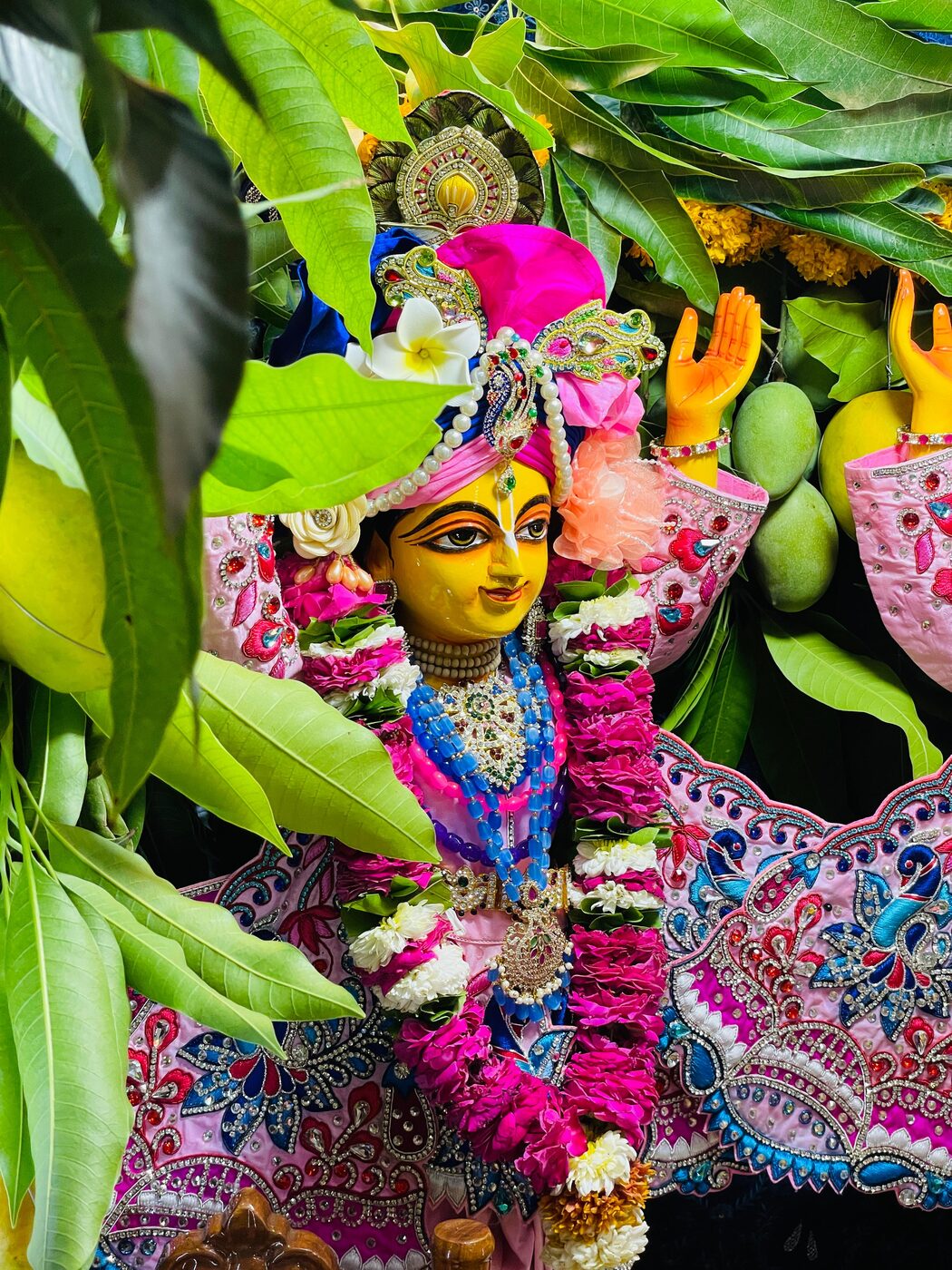
The clearest statement of what Gaudiya Vaishnavas mean by the mercy of Nityananda Prabhu is not a fixed formula of teaching. It is a personal confession by Krishnadasa Kaviraja about his own life. He placed it at the end of the fifth chapter of the Adi-lila of his own book. He warns that the matter is very private, and that he is revealing it only in order to make the mercy known.
Minaketana Ramadasa and the Offended Brahmana #
He begins with a servant of Nityananda named Minaketana Ramadasa, who came to his house in Bengal for a night of sankirtana. Ramadasa was almost always in a state of ecstasy. He wept all the time. Sometimes he climbed onto the shoulders of people offering him obeisances, or hit them lightly with his flute. He shouted the name of Nityananda in a way that disturbed everybody present. A respectable brahmana named Gunarnava Mishra, who was engaged in Deity worship at the time, did not stand up when Ramadasa entered the courtyard. Ramadasa noticed, and remarked that here was a second Romaharshana, the reciter of the Puranas who had failed to rise when Balarama came into the assembly. Then, at the end of the festival, he fell into a dispute with Krishnadasa Kaviraja's own brother, who had firm faith in Chaitanya Mahaprabhu and only a faint glimmer of it in Nityananda.
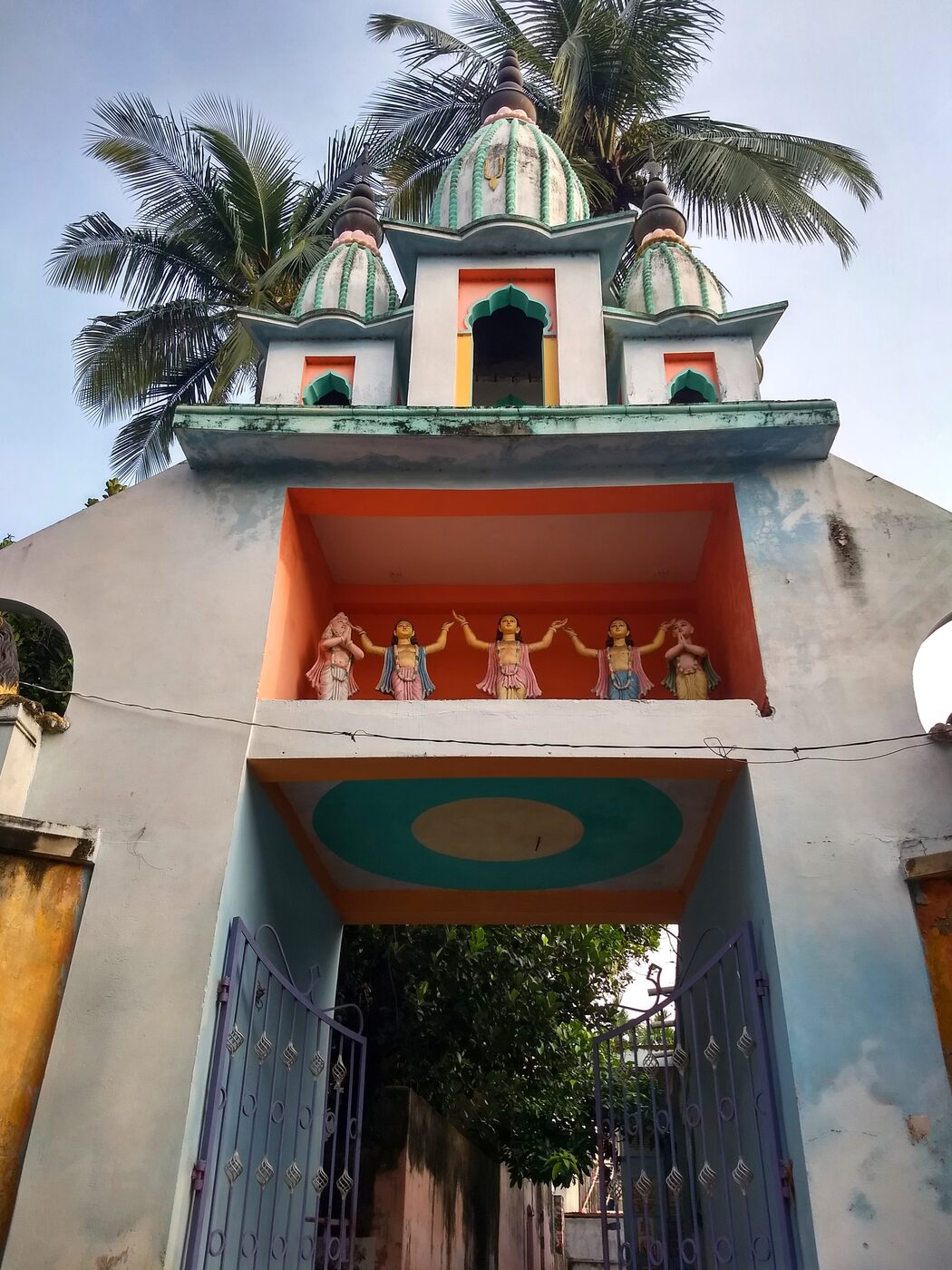
Half a Hen and the Dream at Jhamatpura #
Krishnadasa scolded his brother, and his words have become one of the tradition's best-known arguments. He told him that the two brothers, Chaitanya and Nityananda, are one body and one identity. To accept one and slight the other is the thinking of a man who wants to keep half a hen, keeping the half that lays eggs and cutting off the half that eats grain. It would be better to be an honest atheist and reject them both than to be a hypocrite who accepts one and speaks badly of the other. Ramadasa broke his flute and left in anger, and Krishnadasa's brother, the text says, fell down. That night, at the village of Jhamatpura near Naihati, Nityananda Prabhu appeared to Krishnadasa in a dream. Krishnadasa describes what he saw at length, and the tone of the description stands out. Nityananda was a tall, powerfully built figure of blackish complexion, in silk cloth and turban. He had gold at the ears and wrists, ankle bells, a garland and sandalwood paste. A red stick moved in His hand, and He moved like a maddened elephant. Around Him were devotees dressed as cowherd boys, chanting. He put His feet on Krishnadasa's head, told him repeatedly to get up, and then said one sentence: do not be afraid, go to Vrindavana, and there you will attain everything. Krishnadasa fainted and woke at daybreak. He understood that he had been ordered, and he left that very moment. The Chaitanya-charitamrita exists because of that dream.
What the Mercy Gave Krishnadasa Kaviraja #
The next part of the text is the reason this chapter is quoted more than almost any other in Gaudiya literature. Krishnadasa Kaviraja lists what Nityananda's mercy actually gave him. It gave him shelter in Vrindavana and the feet of Rupa and Sanatana Goswami. It gave him the shelter of Raghunatha Dasa Goswami and the refuge of Svarupa Damodara. It gave him the conclusions of devotional service from Sanatana and the taste of it from Rupa. And finally it gave him Radha and Govinda themselves. Then he speaks harshly about himself. He is more sinful than Jagai and Madhai, he says, and lower than the worms in stool, and anyone who hears his name loses the merit of his pious acts. Who in this world but Nityananda could have shown mercy to such a person? Then comes the sentence that carries the teaching: because He is intoxicated by ecstatic love and is an incarnation of mercy, He does not distinguish between the good and the bad; He delivers everyone who falls down before Him.
Mercy Without an Entrance Examination #
That last line is the whole teaching. It should be read carefully, because it is easily mistaken for mere sentiment. It does not say that conduct is unimportant. The same author is severe about offence and about the danger of hypocrisy. What it says is that there is no entrance examination. Every other path to the Absolute described in the Indian tradition first asks something of the seeker: learning, ritual purity, caste standing, celibacy, austerity, mental discipline, some measurable seriousness. The claim made about Nityananda Prabhu is that he gives his mercy before a person is qualified, and that the mercy itself then makes the person qualified. He does not sort out the seekers. He delivers the ones who fall at his feet, and falling at his feet is the only requirement.
Guru Tattva and Balarama as Adi Guru #
Behind that lies the doctrine of guru-tattva, and here the theology becomes exact. Balarama is Krishna's first expansion, and His whole nature is service. Gaudiya Vaishnavism identifies Him as the adi-guru, the original spiritual master. On this understanding, the function of the guru is not just one office among several that a great devotee might hold. It is Balarama's own function, embodied. Bhaktisiddhanta Sarasvati Thakura put it as briefly as anyone has: Nityananda alone possesses the distinctive function of the guru, and in Him that function is embodied; He is the servant-God. Krishnadasa Kaviraja states his own position in the very first chapter of his book. There he records that Nityananda Rama is the plenary manifestation of the Lord, and that Krishnadasa himself has been initiated by Him. Then he sets out the principle in general terms. Although he knows his spiritual master to be a servant of Chaitanya, he knows Him also as a plenary manifestation of the Lord. This is because, according to all the revealed scriptures, the spiritual master is nondifferent from Krishna, and Krishna in the form of the spiritual master delivers His devotees. In the fifth chapter he notes that Nityananda serves Chaitanya sometimes as guru, sometimes as friend and sometimes as servant, exactly as Balarama did in Vraja. All three roles are real, and the first of them, the guru, is the one addressed to us.
Why Vaishnavas Approach Through Nityananda #
Why, then, do Gaudiya Vaishnavas approach Chaitanya Mahaprabhu through Nityananda rather than directly? Three answers are given, and they are of different kinds.
Why the Lord Needs an Introducer #
The first answer comes from who Chaitanya Mahaprabhu is. Chaitanya Mahaprabhu is Krishna who has taken the mood and complexion of His own greatest devotee in order to taste love from the devotee's side. So He is not simply there to be approached directly. In that descent He is turned, so to speak, the other way, into the position of the devotee. Somebody has to make the introduction, and that work of introducing belongs to Balarama. To go to the Lord without a guru is to arrive unannounced. The tradition holds that this simply does not work. The reason is not a matter of formal rules. It is that the ability to recognise Him has to be given by someone who already has it.
The One Debt the Holy Name Cannot Clear #
The second answer is moral, and it is the one that matters most in practice. Gaudiya theology holds that the holy name will burn up any quantity of ordinary sin. But there is exactly one thing it will not remove by itself: an offence committed at the feet of a Vaishnava. That kind of debt is owed to a person, and only the person it is owed to can cancel it. In Nityananda Prabhu's case this is not just an idea. Madhai had cut Nityananda's head open with a broken pot. When Madhai threw himself before Chaitanya Mahaprabhu, the Lord refused him and sent him to Nityananda's feet, because the debt was not owed to Him. It was Nityananda who forgave, and who then offered his own spiritual credit in exchange for the forgiveness. The full episode is told here. The conclusion the tradition draws is practical, not sentimental. The safest door into the movement is the one man who, as the story shows, refused to take offence even when he was offended in the most direct way possible.
Everyone Has Claimed It Through Him #
The third answer comes from experience, as the tradition understands it. Everyone who has claimed the mercy has claimed it through him. Krishnadasa Kaviraja says this plainly about himself. By writing it into the fifth chapter of a book about somebody else, he made his own life the lasting example.
Patita Pavana as a Claim Requiring Proof #
The name that gathers all of this together is patita-pavana, the deliverer of the fallen. In Gaudiya literature this name is treated less as a title of honour than as a claim that needs proof. When Rupa and Sanatana Goswami first fell before Chaitanya Mahaprabhu at Ramakeli, they told Him that delivering Jagai and Madhai had cost Him very little. Those two, they said, were brahmanas of a holy town, and their only fault was addiction to sin. But if He would deliver two servants of meat-eaters, the name would be truly earned. They were not simply being humble. They were pointing out that a title of that kind has to be proved with the most fallen people, or it means nothing. Bengali Vaishnavism has always understood Nityananda Prabhu as the one who gave that proof, and gave it at his own cost.
The Song on the Lotus Feet of Nitai #
Two centuries of Bengali devotional song rest on this. Narottama Dasa Thakura, whose songs are sung daily in Gaudiya temples, wrote a short song on the lotus feet of Nitai, and it has become the standard statement of this teaching. The song says that those feet are the shelter of everyone who has no other shelter, and that they are cooling, like the shade of a tree. A man who does not want that shade is deliberately drinking poison. Nitai asks nothing of the sinner, and that is why the sinner has any hope at all. And, in the line everybody knows, when the mercy of Nitai is obtained one attains Radha and Krishna. That last line puts the entire doctrine into eight syllables of Bengali. The declared goal of Gaudiya Vaishnavism is the service of Radha and Krishna in Vrindavana. It is the highest goal the tradition can name, and the hardest to reach. Yet the path to it that the tradition actually recommends is not austerity or scholarship. It is the mercy of a man who never turned anyone away. Narottama then does what Krishnadasa Kaviraja did. He adds that he himself is the most fallen and the most degraded, and that he is singing this because he has nothing else to offer.
The Hard Edge of the Doctrine #
There is a hard side to this teaching, and it should be stated honestly. The same literature that praises Nityananda's mercy without limit is severe about the results of disrespecting him, and the passage about the half a hen is the mildest form of it. This is less a threat than a point that follows from the teaching itself. To reject the one who introduces you is to stay unintroduced. The tradition holds that a person who honours Chaitanya Mahaprabhu while dismissing His servant has misunderstood the nature of the One he honours. Nityananda Prabhu himself, as was his nature, never made this argument on his own behalf. It is made by his followers, and usually by followers who are painfully aware of their own past faults.
How the Doctrine Shows Itself in Practice #
In practice the doctrine shows itself in ordinary ways. His appearance day, Nityananda Trayodasi, is kept a few weeks before Gaura Purnima. In the Panca-tattva mantra his name is chanted immediately after Chaitanya Mahaprabhu's and before the other three. Bengali Vaishnavas greet each other with the two names paired, the servant's placed first. And in almost every Gaudiya temple in the world, the Deity of Chaitanya Mahaprabhu stands with Nityananda Prabhu beside Him, arms raised, and is not installed alone.
Scriptural evidence for this chapter (13)
Quoted in the text above:
- CC Ādi 5.208 Sri Chaitanya-charitamrita
Further verses:
দুই ভাই একতনু—সমান–প্রকাশ ।
নিত্যানন্দ না মান, তোমার হবে সর্বনাশ ॥ ১৭৫ ॥
dui bhāi eka-tanu — samāna-prakāśa
nityānanda nā māna, tomāra habe sarva-nāśa
Word for word
dui bhāi: two brothers; eka-tanu: one body; samāna-prakāśa: equal manifestation; nityānanda: Lord Nityānanda; nā māne: you do not believe; tomāra: your; habe: that will be; sarva-nāśa: downfall.
“These two brothers,” I told him, “are like one body; They are identical manifestations. If you do not believe in Lord Nityānanda, you will fall down.
The two brothers are one body and one identity; if you do not believe in Nityananda you will fall down.
একেতে বিশ্বাস, অন্যে না কর সম্মান ।
অর্ধকুক্কুটী–ন্যায়” তোমার প্রমাণ ॥ ১৭৬ ॥
ekete viśvāsa, anye nā kara sammāna
“ardha-kukkuṭī-nyāya” tomāra pramāṇa
Word for word
ekete viśvāsa: faith in one; anye: in the other; nā: not; kara: do; sammāna: respect; ardha-kukkuṭī-nyāya: the logic of accepting half of a hen; tomāra: your; pramāṇa: evidence.
“If you have faith in one but disrespect the other, your logic is like the logic of accepting half a hen.*
The logic of accepting half a hen: faith in one and disrespect to the other.
কিংবা, দোঁহা না মানিঞা হও ত’ পাষণ্ড ।
একে মানি’ আরে না মানি,—এইমত ভণ্ড ॥ ১৭৭ ॥
kiṁvā, doṅhā nā māniñā hao ta’ pāṣaṇḍa
eke māni’ āre nā māni, — ei-mata bhaṇḍa
Word for word
kiṁvā: otherwise; doṅhā: both of Them; nā: not; māniñā: accepting; hao: you become; ta’: certainly; pāṣaṇḍa: atheist; eke: one of Them; māni’: accepting; āre: the other; nā māni: not accepting; ei-mata: this kind of faith; bhaṇḍa: hypocrisy.
“It would be better to be an atheist by slighting both brothers than a hypocrite by believing in one and slighting the other.”
Better to be an atheist slighting both than a hypocrite believing in one and slighting the other.
আরে আরে কৃষ্ণদাস, না করহ ভয় ।
বৃন্দাবনে যাহ,—তাঁহা সর্ব লভ্য হয় ॥ ১৯৫ ॥
āre āre kṛṣṇadāsa, nā karaha bhaya
vṛndāvane yāha, — tāṅhā sarva labhya haya
Word for word
āre āre: O! O!; kṛṣṇa-dāsa: Kṛṣṇadāsa; nā: not; karaha: make; bhaya: fear; vṛndāvane yāha: go to Vṛndāvana; tāṅhā: there; sarva: everything; labhya: available; haya: is.
“O my dear Kṛṣṇadāsa, do not be afraid. Go to Vṛndāvana, for there you will attain all things.”
The one sentence spoken in the dream at Jhamatpura: do not be afraid, go to Vrindavana, and there you will attain all things.
জয় জয় নিত্যানন্দ–চরণারবিন্দ ।
যাঁহা হৈতে পাইনু শ্রীরাধাগোবিন্দ ॥ ২০৪ ॥
jaya jaya nityānanda-caraṇāravinda
yāṅhā haite pāinu śrī-rādhā-govinda
Word for word
jaya jaya: all glories to; nityānanda: of Lord Nityānanda; caraṇa-aravinda: the lotus feet; yāṅhā haite: from whom; pāinu: I got; śrī-rādhā-govinda: the shelter of Śrī Rādhā and Govinda.
All glory, all glory to the lotus feet of Lord Nityānanda, by whose mercy I have attained Śrī Rādhā-Govinda!
All glory to the lotus feet of Nityananda, by whose mercy I have attained Radha and Govinda.
এমন নির্ঘৃণ মোরে কেবা কৃপা করে ।
এক নিত্যানন্দ বিনু জগৎ ভিতরে ॥ ২০৭ ॥
emana nirghṛṇa more kebā kṛpā kare
eka nityānanda vinu jagat bhitare
Word for word
emana: such; nirghṛṇa: abominable; more: unto me; kebā: who; kṛpā: mercy; kare: shows; eka: one; nityānanda: Lord Nityānanda; vinu: but; jagat: world; bhitare: within.
Who in this world but Nityānanda could show His mercy to such an abominable person as me?
Who in this world but Nityananda could show mercy to such an abominable person as me.
যে আগে পড়য়ে, তারে করয়ে নিস্তার ।
অতএব নিস্তারিলা মো–হেন দুরাচার ॥ ২০৯ ॥
ye āge paḍaye, tāre karaye nistāra
ataeva nistārilā mo-hena durācāra
Word for word
ye: whoever; āge: in front; paḍaye: falls down; tāre: unto him; karaye: does; nistāra: deliverance; ataeva: therefore; nistārilā: delivered; mo: as me; hena: such; durācāra: sinful and fallen person.
He delivers all those who fall down before Him. Therefore He has delivered such a sinful and fallen person as me.
He delivers all those who fall down before Him, which is the whole of the entrance requirement.
নিত্যানন্দরায়—প্রভুর স্বরূপপ্রকাশ ।
তাঁর পাদপদ্ম বন্দো যাঁর মুঞি দাস ॥ ৪০ ॥
nityānanda-rāya — prabhura svarūpa-prakāśa
tāṅra pāda-padma vando yāṅra muñi dāsa
Word for word
nityānanda-rāya: Lord Nityānanda; prabhura: of the Supreme Lord; sva-rūpa-prakāśa: personal manifestation; tāṅra: of Him; pāda-padma: unto the lotus feet; vando: I offer respectful obeisances; yāṅra: of whom; muñi: I am; dāsa: the servant.
Śrīla Nityānanda Rāma is the plenary manifestation of the Lord, and I have been initiated by Him. I therefore offer my respectful obeisances unto His lotus feet.
Nityananda Rama is the plenary manifestation of the Lord, and Krishnadasa Kaviraja records that he was initiated by Him.
যদ্যপি আমার গুরু—চৈতন্যের দাস ।
তথাপি জানিয়ে আমি তাঁহার প্রকাশ ॥ ৪৪ ॥
yadyapi āmāra guru — caitanyera dāsa
tathāpi jāniye āmi tāṅhāra prakāśa
Word for word
yadyapi: even though; āmāra: my; guru: spiritual master; caitanyera: of Lord Caitanya Mahāprabhu; dāsa: the servitor; tathāpi: still; jāniye: know; āmi: I; tāṅhāra: of the Lord; prakāśa: direct manifestation.
Although I know that my spiritual master is a servitor of Śrī Caitanya, I know Him also as a plenary manifestation of the Lord.
Knowing the spiritual master to be a servant of Chaitanya and also a plenary manifestation of the Lord.
গুরু কৃষ্ণরূপ হন শাস্ত্রের প্রমাণে ।
গুরুরূপে কৃষ্ণ কৃপা করেন ভক্তগণে ॥ ৪৫ ॥
guru kṛṣṇa-rūpa hana śāstrera pramāṇe
guru-rūpe kṛṣṇa kṛpā karena bhakta-gaṇe
Word for word
guru: the spiritual master; kṛṣṇa-rūpa: as good as Kṛṣṇa; hana: is; śāstrera: of revealed scriptures; pramāṇe: by the evidence; guru-rūpe: in the form of the spiritual master; kṛṣṇa: Lord Śrī Kṛṣṇa; kṛpā: mercy; karena: distributes; bhakta-gaṇe: unto His devotees.
According to the deliberate opinion of all revealed scriptures, the spiritual master is nondifferent from Kṛṣṇa. Lord Kṛṣṇa in the form of the spiritual master delivers His devotees.
The spiritual master is nondifferent from Krishna, and Krishna in the form of the spiritual master delivers His devotees.
কভু গুরু, কভু সখা, কভু ভৃত্য–লীলা ।
পূর্বে যেন তিনভাবে ব্রজে কৈল খেলা ॥ ১৩৫ ॥
kabhu guru, kabhu sakhā, kabhu bhṛtya-līlā
pūrve yena tina-bhāve vraje kaila khelā
Word for word
kabhu: sometimes; guru: spiritual master; kabhu: sometimes; sakhā: friend; kabhu: sometimes; bhṛtya-līlā: pastimes as a servant; pūrve: formerly; yena: as; tina-bhāve: in three different moods; vraje: in Vṛndāvana; kaila khelā: plays with Kṛṣṇa.
Sometimes He serves Lord Caitanya as His guru, sometimes as His friend and sometimes as His servant, just as Lord Balarāma played with Lord Kṛṣṇa in these three different moods in Vraja.
Nityananda serves as guru, as friend and as servant by turns, of which the first role is the one addressed to us.
সবে এক দোষ তার, হয় পাপাচার ।
পাপরাশি দহে নামাভাসেই তোমার ॥ ১৯৪ ॥
sabe eka doṣa tāra, haya pāpācāra
pāpa-rāśi dahe nāmābhāsei tomāra
Word for word
sabe: in all; eka: one only; doṣa: fault; tāra: of them; haya: they are; pāpa-ācāra: attached to sinful activities; pāpa-rāśi: volumes of sinful activities; dahe: become burned; nāma-ābhāsei: simply by the dim reflection of chanting the holy name; tomāra: of Your Lordship.
“Jagāi and Mādhāi had but one fault — they were addicted to sinful activity. However, volumes of sinful activity can be burned to ashes simply by a dim reflection of the chanting of Your holy name.
The name Patita-pavana treated as a claim needing proof at the bottom of the scale, in Rupa and Sanatana's prayer at Ramakeli.
Chapter 9
The Disappearance of Sri Nityananda Prabhu
Around 1540, in ways the sources do not agree on, and what he left behind
Sri Chaitanya Mahaprabhu disappeared at Jagannatha Puri in June 1534. Within a few years Advaita Acharya, Srivasa Pandit and most of the first generation of the Nabadwip devotees had followed Him. Nityananda Prabhu had spent the last twenty or more years of the Lord's manifest life in Bengal, not in Puri. He lived only a little longer than all of them. Then he too departed, some time around 1540.
| Source | Date Given |
|---|---|
| Most modern accounts | About 1540 |
| Vaishnava-digdarsini | 1542, at the age of sixty-nine |
| Some sources | As late as 1544 |
| A few sources | As early as 1533 |
Why the Date Cannot Be Fixed #
The date cannot be fixed. We are not avoiding the question. The record simply does not give the date, and it helps to understand why. The two great biographies both leave us without an answer here, and for opposite reasons. Vrindavana Dasa Thakura's Chaitanya-bhagavata was written in Nityananda Prabhu's own lifetime and, according to Krishnadasa Kaviraja, by his order. So it has to end before his disappearance. Krishnadasa Kaviraja's Chaitanya-charitamrita was written half a century later, in Vrindavana, and it is a life of Chaitanya Mahaprabhu. It describes Nityananda's activities only where they are connected with the Lord's, and it simply does not describe his passing. No one ever wrote a detailed account of his disappearance like the Puri accounts of Mahaprabhu's own disappearance. What survives is temple tradition, later Bengali devotional biographies, and the family lineage records, and they do not agree.
The Dates Given by the Sources #
Most modern accounts settle on about 1540. The Vaishnava-digdarsini gives 1542, and says he was sixty-nine years old at the time, which fits an appearance in 1473. Some sources give a date as late as 1544. A few place it as early as 1533, which does not fit well with other events. A good deal of devotional writing about him was produced while people who knew him were still alive. Even so, the dates given for his disappearance cover a range of ten years. So the sensible course is simply to say around 1540.
Two Accounts of the Place and Manner #
The sources also disagree about the place and the manner of his departure, and in a more interesting way. Two quite different accounts have been handed down, and each is connected with a real place.
Merging Into Banka Raya at Ekachakra #
Most Gaudiya Vaishnavas follow the account that puts it at Ekachakra, and this is also the account connected with a place people still visit. In this version he travelled back to the village of his birth in Birbhum, and there he merged into the Deity of Banka Raya. Some tellings say he took Jahnava Devi with him to show her where he had come from. Banka Raya, also called Bankima Raya, is a form of Krishna. According to the priests of Ekachakra, Nityananda Prabhu had himself taken this Deity out of the water at the Kadamba-khandi ghat as a boy and installed Him in the village. The priests of the temple describe the disappearance in exactly those terms. They also add one detail that makes the account fit together. After this, the deity of Jahnava Mata was placed at Banka Raya's right-hand side, where she stands to this day. The Bhakti-ratnakara supports the Ekachakra version, and Srila Prabhupada records the temple tradition in his purport on Ekachakra in the Adi-lila.
The Khardaha Account and Its Difficulty #
The other account puts it at Khardaha, on the Ganges north of Calcutta, where he had lived for the last part of his life. It says that he disappeared during kirtana in the temple of Shyamasundara there. The objection to this version is about dates, not about devotion. The Shyamasundara Deity at Khardaha is generally held to have been installed later than 1540. So it is hard to accept the story exactly in that form. Some versions place the event at Khardaha without naming that Deity. Some traditions connect it with the death of Vasudha. Others simply record that he passed away at Khardaha and say nothing about the manner.
Why the Tradition Has Not Chosen #
Looking from the outside, there is no honest way to choose between the two accounts, and the tradition has not really tried. Differences like this are completely normal for that period and for such a subject. Every one of His biographers deliberately says very little about the disappearance of Chaitanya Mahaprabhu Himself. It is still one of the most discussed questions in Gaudiya history. The word used everywhere is disappearance, not death. The accounts that survive are statements about spiritual truth as much as statements about places. In the tradition's own way of speaking, to say that he merged into the Deity of Banka Raya tells us where he is now. It is not a report of what was done with a body. The claim is that he is present in that Deity, and that is why people go there. A reader who wants an official record of how Nityananda Prabhu died will not find one. The reason is that nobody who wrote about him was interested in producing such a record.
What He Left Behind #
But some things are clear, and the whole tradition agrees about them. These are the things he left behind, and he left a great deal.
Bengal Left Organised #
He left Bengal organised. The eleventh chapter of the Adi-lila names more than seventy-five branch leaders of his line. Twelve of them are identified as the cowherd boys of Vraja, who had come again. Krishnadasa Kaviraja sums up by saying that each of them had the independent strength to give love of Krishna to anyone they met. The householder congregations at Khardaha, Panihati, Saptagram, Ambika Kalna and across the Birbhum country were his work. So was the return of the suvarna-vanik community to respectable society. For centuries this community had been outside respectable Hindu society in Bengal, until he went and ate in Uddharana Datta Thakura's house at Saptagram.
Virabhadra and Jahnava Mata #
He left a family. Krishnadasa Kaviraja describes Virabhadra Gosani, his son by Vasudha, as the topmost branch of the line and the main pillar of the whole building of devotional service. It was Virabhadra who built the temple at Ekachakra, which his father had not built. And Nityananda Prabhu left behind Jahnava Mata. She guided the second generation, and her leadership reached its high point when she presided over the festival at Kheturi. All the founders of the movement died within a few years of each other. Her leadership is the single reason the movement did not come apart in those decades.
The Two Books Written on His Order #
In an indirect way, he also left both of the movement's main books. The Chaitanya-bhagavata was written by Vrindavana Dasa Thakura on his order, and Krishnadasa Kaviraja says so: by Nityananda Prabhu's order and strength, Vrindavana Dasa described elaborately everything that he himself had left out. And the Chaitanya-charitamrita exists because Nityananda Prabhu appeared in a dream to Krishnadasa Kaviraja at his home in Jhamatpura. He put His feet on Krishnadasa's head and told him to go to Vrindavana, where he would attain everything. He went, met Rupa Goswami's successors, and wrote the book. So Gaudiya Vaishnavism's two central biographies of its founder both come from him, in different ways.
Ekachakra and the Sites Shown Today #
Ekachakra today is called Birchandrapur, after his son, and lies in Birbhum district in West Bengal. The site of the birth, Garbhavasa, is still maintained. Half a mile away stands the Banka Raya temple, which was rebuilt after lightning struck it in 1924. In it Radharani stands on one side of the Deity and Jahnava Mata on the other. Visitors are also shown the ancient bakula tree, the tank at Hantugada, and the spot called Visramatala, where he is said to have acted out the Vraja pastimes with the village boys. Large fairs are still held there on his appearance day and at Goshthashtami.
Why the Disappearance Changed So Little #
Perhaps the most typical thing in the tradition's view of his disappearance is how little it is felt to have changed. Jahnava Mata is said to have continued receiving his guidance for the rest of her life. The teaching about his mercy, explained on the mercy of Nitai, has always been stated in the present tense. Krishnadasa Kaviraja wrote perhaps fifty years after the event. Yet he describes what Nityananda did for him personally as something still going on. In practice, too, the deities installed in Gaudiya temples show the same thing without any argument. Chaitanya Mahaprabhu is not installed alone. Nityananda Prabhu stands beside Him, arms raised, exactly as he did in the streets of Nabadwip. And Bengali Vaishnavas still put his name first when they greet each other.
Scriptural evidence for this chapter (9)
রাঢ়দেশে জন্মিলা ঠাকুর নিত্যানন্দ ।
গঙ্গাদাস পণ্ডিত, গুপ্ত মুরারি, মুকুন্দ ॥ ৬১ ॥
rāḍhadeśe janmilā ṭhākura nityānanda
gaṅgādāsa paṇḍita, gupta murāri, mukunda
Word for word
rāḍha-deśe: the place where there is no Ganges; janmilā: took birth; ṭhākura nityānanda: Nityānanda Prabhu; gaṅgādāsa paṇḍita: Gaṅgādāsa Paṇḍita; gupta murāri: Murāri Gupta; mukunda: Mukunda.
In Rāḍhadeśa, the part of Bengal where the Ganges is not visible, Nityānanda Prabhu, Gaṅgādāsa Paṇḍita, Murāri Gupta and Mukunda took birth.
The verse on Nityananda Prabhu's birth in Radhadesha, whose purport records the temple tradition that He entered the body of Banka Raya at Ekachakra.
বৃন্দাবনদাস ইহা ‘চৈতন্যমঙ্গলে’ ।
বিস্তারি’ বর্ণিলা নিত্যানন্দ–আজ্ঞা–বলে ॥ ৩৩০ ॥
vṛndāvana-dāsa ihā ‘caitanya-maṅgale’
vistāri’ varṇilā nityānanda-ājñā-bale
Word for word
vṛndāvana-dāsa: Ṭhākura Vṛndāvana dāsa; ihā: this; caitanya-maṅgale: in his book Caitanya-maṅgala; vistāri’: expanding; varṇilā: described; nityānanda: of Śrī Nityānanda Prabhu; ājñā: of the order; bale: on the strength.
By the order and strength of Śrī Nityānanda Prabhu, Śrīla Vṛndāvana dāsa Ṭhākura has elaborately described in his Caitanya-maṅgala all that I have not.
By the order and strength of Nityananda Prabhu, Vrindavana Dasa Thakura described everything Krishnadasa Kaviraja left out.
বৃন্দাবনদাস—নারায়ণীর নন্দন ।
চৈতন্য–মঙ্গল’ যেঁহো করিল রচন ॥ ৫৪ ॥
vṛndāvana-dāsa — nārāyaṇīra nandana
‘caitanya-maṅgala’ yeṅho karila racana
Word for word
vṛndāvana-dāsa: Śrīla Vṛndāvana dāsa Ṭhākura; nārāyaṇīra nandana: son of Nārāyaṇī; caitanya-maṅgala: the book of the name Caitanya-maṅgala; yeṅho: who; karila: did; racana: composition.
Vṛndāvana dāsa Ṭhākura, the son of Śrīmatī Nārāyaṇī, composed Śrī Caitanya-maṅgala [later known as Śrī Caitanya-bhāgavata].
Vrindavana Dasa Thakura, son of Narayani, the author of the Chaitanya-bhagavata, written under Nityananda's authority.
ভাগবতে কৃষ্ণলীলা বর্ণিলা বেদব্যাস ।
চৈতন্য–লীলাতে ব্যাস—বৃন্দাবন দাস ॥ ৫৫ ॥
bhāgavate kṛṣṇa-līlā varṇilā vedavyāsa
caitanya-līlāte vyāsa — vṛndāvana dāsa
Word for word
bhāgavate: in Śrīmad-Bhāgavatam; kṛṣṇa-līlā: the pastimes of Lord Kṛṣṇa; varṇilā: described; veda-vyāsa: Dvaipāyana Vyāsadeva; caitanya-līlāte: in the pastimes of Lord Caitanya; vyāsa: Vedavyāsa; vṛndāvana dāsa: Śrīla Vṛndāvana dāsa Ṭhākura.
Śrīla Vyāsadeva described the pastimes of Kṛṣṇa in Śrīmad-Bhāgavatam. The Vyāsa of the pastimes of Lord Caitanya Mahāprabhu was Vṛndāvana dāsa.
Vrindavana Dasa called the Vyasa of the pastimes of Chaitanya Mahaprabhu, which is the standing his commission from Nityananda gave him.
আরে আরে কৃষ্ণদাস, না করহ ভয় ।
বৃন্দাবনে যাহ,—তাঁহা সর্ব লভ্য হয় ॥ ১৯৫ ॥
āre āre kṛṣṇadāsa, nā karaha bhaya
vṛndāvane yāha, — tāṅhā sarva labhya haya
Word for word
āre āre: O! O!; kṛṣṇa-dāsa: Kṛṣṇadāsa; nā: not; karaha: make; bhaya: fear; vṛndāvane yāha: go to Vṛndāvana; tāṅhā: there; sarva: everything; labhya: available; haya: is.
“O my dear Kṛṣṇadāsa, do not be afraid. Go to Vṛndāvana, for there you will attain all things.”
The order given in the dream at Jhamatpura, without which the Chaitanya-charitamrita would not have been written.
সর্বশাখা–শ্রেষ্ঠ বীরভদ্র গোসাঞি ।
তাঁর উপশাখা যত, তার অন্ত নাই ॥ ৫৬ ॥
sarvaśākhā-śreṣṭha vīrabhadra gosāñi
tāṅra upaśākhā yata, tāra anta nāi
Word for word
sarva-śākhā-śreṣṭha: the best of all the branches; vīrabhadra gosāñi: Vīrabhadra Gosāñi; tāṅra upaśākhā: His subbranches; yata: all; tāra: of them; anta: limit; nāi: there is not.
Among all the branches of Śrī Nityānanda Prabhu, Vīrabhadra Gosāñi was the topmost. His subbranches were unlimited.
Virabhadra Gosani as the topmost of all the branches of Nityananda's line, the inheritor of the Bengal mission.
এই সর্বশাখা পূর্ণ—পক্ক প্রেমফলে ।
যারে দেখে, তারে দিয়া ভাসাইল সকলে ॥ ৫৮ ॥
ei sarva-śākhā pūrṇa — pakva prema-phale
yāre dekhe, tāre diyā bhāsāila sakale
Word for word
ei: these; sarva-śākhā: all branches; pūrṇa: complete; pakva prema-phale: with ripened fruits of love of Godhead; yāre dekhe: whomever they see; tāre diyā: distributing to him; bhāsāila: overflooded; sakale: all of them.
All these branches, the devotees of Lord Nityānanda Prabhu, being full of ripened fruits of love of Kṛṣṇa, distributed these fruits to all they met, flooding them with love of Kṛṣṇa.
The branches of Nityananda's line, loaded with ripe fruit, distributing it to everyone they met.
নিত্যানন্দ–প্রভুর গুণ–মহিমা অপার ।
সহস্রবদনে’ শেষ নাহি পায় যাঁর ॥ ২৩৪ ॥
nityānanda-prabhura guṇa-mahimā apāra
‘sahasra-vadane’ śeṣa nāhi pāya yāṅra
Word for word
nityānanda-prabhura: of Lord Nityānanda; guṇa-mahimā: glories of transcendental attributes; apāra: unfathomable; sahasra-vadane: in thousands of mouths; śeṣa: ultimate end; nāhi: does not; pāya: get; yāṅra: whose.
The glories of Lord Nityānanda’s transcendental attributes are unfathomable. Even Lord Śeṣa, with His thousands of mouths, cannot find their limit.
The glories of Nityananda's qualities are unfathomable, and even Sesa with His thousands of mouths cannot find their limit.
প্রেমভক্তি দিয়া তেঁহো ভাসা’ল জগতে ।
তাঁর চরিত্র লোকে না পারে বুঝিতে ॥ ২৯৭ ॥
prema-bhakti diyā teṅho bhāsā’la jagate
tāṅra caritra loke nā pāre bujhite
Word for word
prema-bhakti: devotional service; diyā: giving; teṅho: Lord Nityānanda Prabhu; bhāsā’la: overflooded; jagate: in the world; tāṅra: His; caritra: character; loke: people; nā: not; pāre: able; bujhite: to understand.
Śrī Nityānanda Prabhu overflooded the entire world by distributing transcendental loving service. No one can understand His character and activities.
Nityananda Prabhu overflooded the entire world by distributing loving service; no one can understand His character and activities.
Closing
Advent at Ekachakra #
He appeared around 1474 in the village of Ekachakra, in the Birbhum district of Bengal. This was some twelve years before Mahaprabhu. His parents were Hadai Ojha (Hadai Pandita) and Padmavati Devi. The biographies describe how, as a child, He acted out the pastimes of Krishna and Balarama with the other village boys. He would take sometimes one role and sometimes another. It is said that His play seemed so real that it made the adults watching it uneasy.
Leaving Home and Twenty Years of Pilgrimage #
When Nityananda was about twelve or thirteen, a travelling sannyasi named Lakshmipati Tirtha stopped at Hadai Pandita's house. The sannyasi asked for the boy as his companion. This was a guest's request, and it could not honourably be refused. Hadai Pandita gave his only son away and, the accounts say, collapsed. Nityananda left Ekachakra and did not return for some twenty years. He spent those years in continuous pilgrimage across the length of India. The Chaitanya-bhagavata records this journey at length. It covered Gaya, Kashi, Prayag, Mathura, Vrindavana, Dvaraka, Rameshvaram and the tirthas of the south.
The Meeting With Sri Chaitanya Mahaprabhu #
Nityananda came to Nabadwip around 1506. He was then in His early thirties, and Mahaprabhu had already begun the sankirtana movement. Their meeting is one of the best-loved episodes in Bengali Vaishnava literature. After arriving in the town, Nityananda hid Himself. Mahaprabhu knew very well who had come, and He sent devotees to find Nityananda. In the end Mahaprabhu revealed Himself in His four-armed and six-armed forms, and these forms made clear who both of them really were. From that point the two were inseparable, and Nityananda became the movement's most fearless preacher.
Kavi Karnapura's Gaura-ganoddesha-dipika (verse 11), explaining the Panca-tattva, says plainly who the two of Them are:
bhakta-rūpo gauracandro yato’sau nanda-nandanaḥ
bhakta-svarūpo nityānando vraje yaḥ śrī-halāyudhaḥ
"In this Panca-tattva, the bhakta-rupa (form of a devotee) is Lord Caitanya Mahaprabhu, who formerly appeared as Lord Krsna, the son of Nanda Maharaja. The bhakta-svarupa (devotional incarnation) is Lord Nityananda, who formerly appeared in Vrajabhumi as Lord Balarama." (Gaura-ganoddesha-dipika 11)
Chaitanya-charitamrita joins His identity and His mood of service in a single verse:
yadyapi āpani haye prabhu balarāma
tathāpi caitanyera kare dāsa-abhimāna
"Although Nityānanda Prabhu is none other than Balarāma Himself, He nonetheless always thinks of Himself as the eternal servant of Lord Śrī Caitanya Mahāprabhu." (Chaitanya-charitamrita Madhya 1.28)
The Deliverance of Jagai and Madhai #
His most famous act belongs to that period. Sent out with Haridasa Thakura to call every householder in Nabadwip to chant, He approached the two notorious brothers Jagai and Madhai and was struck on the head by Madhai with a broken earthen pot, so that blood ran down His face. When Mahaprabhu came in fury to punish them, it was the bleeding Nityananda who threw Himself between the Lord and the brothers and begged that they be forgiven. The episode fixed His reputation permanently as the most merciful of all the Lord's associates, the one who takes the blow and then pleads for the man who struck Him.
The Bengal Mission and Household Life #
When Mahaprabhu settled at Jagannatha Puri, He appointed Nityananda Prabhu to lead the mission throughout Bengal. Largely because of this, Gaudiya Vaishnavism became a mass movement and did not stay limited to Nabadwip. Nityananda preached across Bengal for decades, initiated thousands, and organised the householder communities that carried the tradition forward. At the request of the devotees He also married. His wives were Vasudha and Jahnava, daughters of Suryadasa Sarakhela. After Nityananda Prabhu's disappearance, Jahnava Mata became one of the most authoritative teachers in the entire tradition. The Gaudiya community accepted her leadership without dispute.
The Mercy of Nitai #
Gaudiya Vaishnavas hold that no one is qualified to approach Sri Chaitanya Mahaprabhu without first receiving the mercy of Nityananda Prabhu, and one certainly cannot approach Rādhā and Kṛṣṇa without His mercy. This teaching is expressed in the much-repeated line of Narottama Dasa Thakura that when Nitai's mercy comes, one attains Radha and Krishna. He is called patita-pavana, the deliverer of the fallen, and the tradition insists that His mercy asks nothing of anyone. The reason usually given is the Jagai and Madhai episode. Nityananda forgave even the man who struck Him and made Him bleed. In doing so He showed, in effect, the full extent of His mercy.
