Annakūṭa-kṣetra
अन्नकूट-क्षेत्र Hindi name proposed
In short
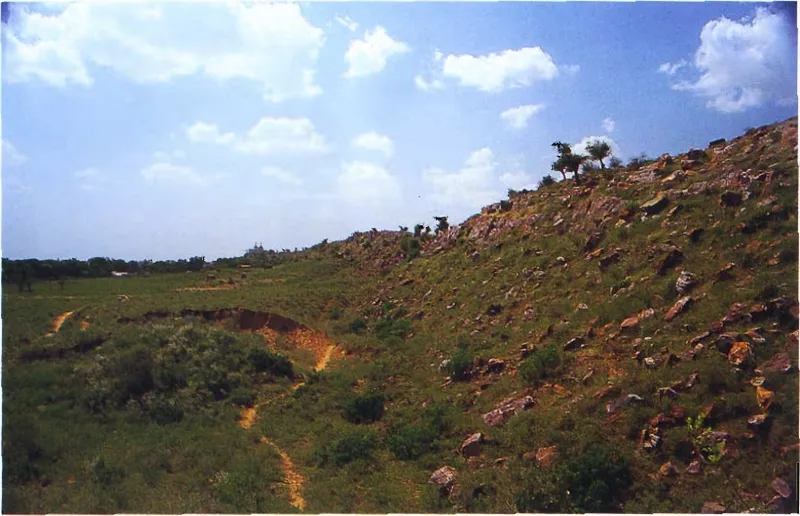
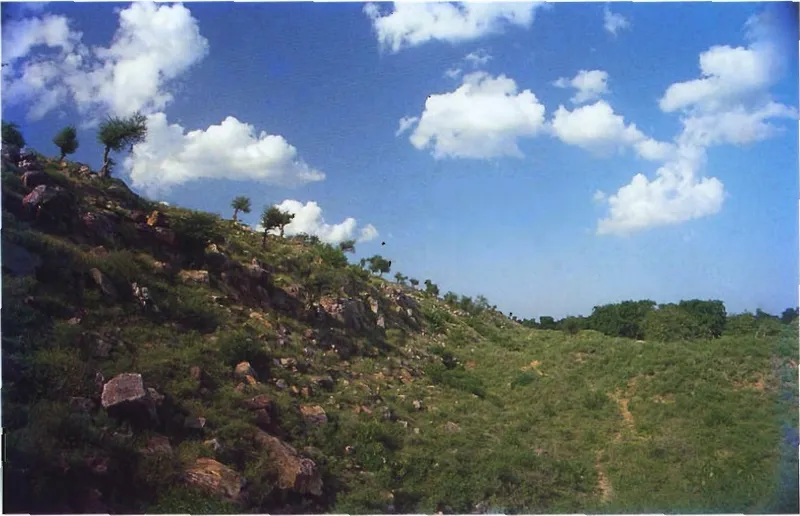
Annakūṭa-kṣetra, the field of the Annakūṭa, is the name that the guidebook Govardhana Hill (2001) gives to the stretch of Govardhana Hill from Dāna-nivartana-kuṇḍa up to the village of Aniyora. There, it says, the people of Vraja made a huge offering of food to the hill at the first Govardhana-pūjā.[1 +2] Śrīmad-Bhāgavatam tells how Kṛṣṇa then took a huge form, declared that He was the hill and ate the offerings, the first Annakūṭa (a hill of food), but it names no spot on the hill.[2 +8] The other sources place the Annakūṭa in different ways, and Śrīla Raghunātha dāsa Gosvāmī prays for shelter at the place known as Annakūṭa.[1 +9]
Key facts
| Kind | pastime site |
|---|---|
| Region · area | Govardhana |
| Ācāryas | Śrīla Raghunātha dāsa Gosvāmī, Śrīla Jīva Gosvāmī, Śrīla Narahari Cakravartī Ṭhākura, Śrīla Śrīnivāsa Ācārya, Śrīla Viśvanātha Cakravartī Ṭhākura |
Why it is glorified
Śrīla Raghunātha dāsa Gosvāmī's Vraja-vilāsa-stava prays for shelter at the place of the Annakūṭa.
Śrīla Raghunātha dāsa Gosvāmī's Vraja-vilāsa-stava prays for shelter at the place of the Annakūṭa. Govardhana Hill prints this verse at the head of its entry on Annakūṭa-kṣetra, though the verse gives the place no boundaries; Śrīla Prabhupāda translates it in his purport on Annakūṭa-grāma:[1 +4]
vrajendra-varyārpita-bhogam uccair
dhṛtvā bṛhat-kāyam aghārir utkaḥ
vareṇa rādhāṁ chalayan vibhuṅkte
yatrānna-kūṭaṁ tad ahaṁ prapadye
“When Nanda Mahārāja offered a large quantity of food to Govardhana Hill, Kṛṣṇa assumed a gigantic form and eagerly invited everyone to ask boons from Him. Then, deceiving even Śrīmatī Rādhārāṇī, He ate all the offered food. Let me take shelter of the place known as Annakūṭa, where Lord Kṛṣṇa enjoyed these pastimes.”
Translation: Śrīla A.C. Bhaktivedanta Swami PrabhupādaIn the Varāha Purāṇa, Annakūṭa is a name of the hill itself: the best of hills, held up to protect the cows from Indra's rain, is known as Annakūṭa, a tīrtha (holy bathing place) made by Indra lies near it, and walking around Annakūṭa is praised.[21] Śrīla Rūpa Gosvāmī also calls the hill Annakūṭa. His Mathurā-māhātmya quotes the Ādi-varāha that one who walks around Annakūṭa will not return to birth, and in his hymn on the lifting of the hill a gopī wonders how her beloved can bear the weight of Anna-kūṭa, which Śrīla Baladeva Vidyābhūṣaṇa explains as Govardhana, the hill that had eaten the heap of food.[22 +1]
Divine pastimes
The first Govardhana-pūjā in the Bhāgavatam
Kṛṣṇa asked the cowherds to use everything they had gathered for Indra's sacrifice in a sacrifice for the cows, the brāhmaṇas and the hill, and to cook many kinds of food:[4 +5]
pacyantāṃ vividhāḥ pākāḥ sūpāntāḥ pāyasādayaḥ / saṃyāvāpūpa-śaṣkulyaḥ sarva-dohaś ca gṛhyatām
Let many different kinds of food be cooked, from sweet rice to vegetable soups! Many kinds of fancy cakes, both baked and fried, should be prepared. And all the available milk products should be taken for this sacrifice.
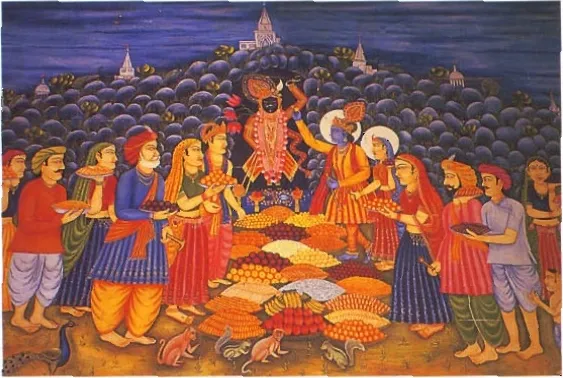
Translation: Śrīla Prabhupāda's disciples (BBT)The cowherds presented the offerings to the hill and the brāhmaṇas, gave grass to the cows and walked around the hill with the cows in front. Then Kṛṣṇa took another, huge form, declared that He was the hill and ate the offerings, and with the people of Vraja He bowed down to that form:[2 +8]
kṛṣṇas tv anyatamaṃ rūpaṃ gopa-viśrambhaṇaṃ gataḥ / śailo 'smīti bruvan bhūri balim ādad bṛhad-vapuḥ
Kṛṣṇa then assumed an unprecedented, huge form to instill faith in the cowherd men. Declaring “I am Govardhana Mountain!” He ate the abundant offerings.
Translation: Śrīla Prabhupāda's disciples (BBT)The Sanskrit of this chapter calls Govardhana only "the hill" and names no spot on it, no village and no area called Annakūṭa.[4 +5]
What the commentators add
The commentators on this verse place the huge form on the top of the hill (summarised here, not translated). Śrīla Sanātana Gosvāmī says that Kṛṣṇa Himself appeared separately on its summit, Śrīla Viśvanātha Cakravartī Ṭhākura that the form stood above Govardhana like a second mountain, and Śrīla Baladeva Vidyābhūṣaṇa that it rose above the hill. Śrīla Sanātana Gosvāmī and Śrīla Jīva Gosvāmī cite the Harivaṁśa, in which the cowherds see the mountain-like form standing on the summit. None of them names a village or an area called Annakūṭa.[24 +2]
They describe the form in different ways. Śrīla Viśvanātha Cakravartī Ṭhākura says that with thousands of millions of very long hands it took the offerings of the people of Vraja near and far, made in person or in meditation; Śrīla Baladeva Vidyābhūṣaṇa gives it a thousand arms; Śrīla Jīva Gosvāmī reads the verse to mean that many forms appeared then, unseen, to satisfy every group of cowherds.[24 +1] Śrīla Viśvanātha Cakravartī Ṭhākura and Śrīla Baladeva Vidyābhūṣaṇa explain the words "I am the hill" as the form announcing that it was the lord of this region, pleased with the cowherds' devotion, and inviting each of them to choose a boon.[7 +3]
The Gopāla-campū and other accounts
Śrīla Jīva Gosvāmī's Gopāla-campū tells the meal at length (summarised here, not translated). The cowherds bring the heaps of food near the hill; a huge form like Kṛṣṇa appears and says that it is the mountain; it eats the heaps and drinks from the ponds, kuṇḍas, lakes and rivers around, and the people run away like sparrows whenever it stretches out its hand.[28 +3]
The Garga-saṁhitā says that the huge form came out of the middle of the hill, and places the Annakūṭa at Govardhana's "mouth", below Śṛṅgāra-maṇḍala.[2 +6] The Viṣṇu Purāṇa puts the meal on the summit of the hill, the Harivaṁśa puts the form there when it laughs after the meal, and Śrīla Kavi-karṇapūra's Ānanda-vṛndāvana-campū says that Hari formed another body on top of the mountain.[26 +3] Read more: The first Govardhana-pūjā and the Annakūṭa →
Śrī Caitanya Mahāprabhu is shown the place
According to Śrīla Murāri Gupta's Kṛṣṇa-caitanya-caritāmṛta and Śrīla Locana dāsa Ṭhākura's Caitanya-maṅgala, on Śrī Caitanya Mahāprabhu's tour of Govardhana His guide pointed out the Annakūṭa place, where Kṛṣṇa stopped the worship of Indra. Neither book says where on the hill it is.[35 +1]
Traditional accounts
According to the Bhakti-ratnākara, the Annakūṭa place is the village of Aniyora, near the hill, where Kṛṣṇa in one form ate …
According to the Bhakti-ratnākara, the Annakūṭa place is the village of Aniyora, near the hill, where Kṛṣṇa in one form ate everything offered to Govardhana, and seeing it fulfils one's desires.[12 +3] The Caitanya-caritāmṛta speaks of a village called Annakūṭa on Govardhana Hill, where Gopāla stayed in Śrī Caitanya Mahāprabhu's time, and Śrīla Prabhupāda identifies it with Aniyora.[13 +1]
Śrīla Viśvanātha Cakravartī Ṭhākura's Vraja-rīti-cintāmaṇi places Nanda's great Annakūṭa festival at the pair of kuṇḍas (sacred ponds) Saṅkarṣaṇa and Dāna-nivartana, in the middle of the hill's chest, as the verse puts it. The verse is compressed: it may mean the ground between the two kuṇḍas or the part of the hill where they lie. It does not use the name Annakūṭa-kṣetra.[14 +2]
Govardhana Hill (2001) says that the food formed thousands of hills and filled an area almost two miles long; the figure is not certain, as the book names no source for it.[1 +1]
Śrīla Prabhupāda
Śrīla Prabhupāda's Kṛṣṇa book tells the pastime without naming any part of the hill (a general reference) …
Śrīla Prabhupāda's Kṛṣṇa book tells the pastime without naming any part of the hill (a general reference):[9 +1]
General teaching (does not name the place)“When everything was complete, Kṛṣṇa assumed a great transcendental form and declared to the inhabitants of Vṛndāvana that He was Himself Govardhana Hill in order to convince the devotees that Govardhana Hill and Kṛṣṇa Himself are identical.”
Śrīla Prabhupāda, Kṛṣṇa, the Supreme Personality of Godhead (Kṛṣṇa book), Chapter 24, Worshiping Govardhana Hill · vedabase.io
He writes that the form that ate the offerings was separately constituted, and that the Govardhana-pūjā begun that day is known as Annakūṭa:[9 +1]
General teaching (does not name the place)“From that day, Govardhana-pūjā has been going on and is known as Annakūṭa. In all the temples of Vṛndāvana or outside of Vṛndāvana, huge quantities of food are prepared in this ceremony and are very sumptuously distributed to the general population.”
Śrīla Prabhupāda, Kṛṣṇa, the Supreme Personality of Godhead (Kṛṣṇa book), Chapter 24, Worshiping Govardhana Hill · vedabase.io
Songs
In Śrīla Rūpa Gosvāmī's hymn on the lifting of the hill, one verse recalls that the Lord ate the offerings with a body as massive …
In Śrīla Rūpa Gosvāmī's hymn on the lifting of the hill, one verse recalls that the Lord ate the offerings with a body as massive as a mountain, and a later verse calls the lifted hill Anna-kūṭa.[39]
In his Dvitīya Govardhanāṣṭaka, Kṛṣṇa shows a huge body, clearly says "I am the hill" and Himself relishes the food that the cowherds offered.[40]
āviṣkṛtya prakaṭa-mukuṭāṭopam aṅgaṁ sthavīyaḥ
śailo 'smīti sphuṭam abhidadhat tuṣṭi-visphāra-dṛṣṭiḥ
yasmai kṛṣṇaḥ svayam arasayad ballavair dattam annaṁ
dhanyaḥ so 'yaṁ prathayatu sadā śarma govardhano naḥ
Location
| Where it is | 'from Dāna-Nirvartana-kuṇḍa up to the village of Aniyora'[41] |
|---|
Nearby places
Dāna-nivartana-kuṇḍa · Aniyora
Pictures
2 pictures
Where the sources differ
Accounts differ Where the Annakūṭa (the food offering and the hill-form's meal) took place
- Govardhana Hill: India's Most Sacred Mountain (2001)the whole area of the hill from Dāna-nirvartana-kuṇḍa up to Aniyora is Annakūṭa-kṣetra; the food filled an area almost two miles long
- Garga-saṁhitā 3.8.4at Govardhana's 'mouth', below Śṛṅgāra-maṇḍala
- Garga-saṁhitā 3.1.22 (Kṛṣṇa's instructions for the rite)the annakūṭa is to be made near the hill (tat-samīpe), after the ground below the hill is smeared with cow-dung
- Garga-saṁhitā 3.2.21the huge form came 'from the middle of the hill of Vraja'
Accounts differ What the hill-form looked like and did while eating (four arms or not, the left hand, the cry 'āniyora' / 'āno re')
- Govardhana Hill: India's Most Sacred Mountain (2001)eating with His right hand, Girirāja snapped the fingers of His left hand and said 'Aniyora, aniyora', which 'means "Bring more, bring more"'
- Bhakti-ratnākara, Fifth Wave (1912 ed. p. 201)in a voice deep as a cloud He called 'āniyora, āniyora' again and again; no gesture and no meaning of the word are given
- Gopāla-campū (Śrīla Jīva Gosvāmī) 1.18.35taking mouthful after mouthful with His right hand, He pointed at Indra with the index finger of His left hand and laughed; no call 'āniyora'
- Śrī Vraja-maṇḍala Parikramā (2007)Kṛṣṇa assumed a huge four-armed form, devoured the offerings with His long arms and called out 'Āno re, āno re! – Bring more, bring more!'; in that form He drank Mānasī-gaṅgā, Kusuma-sarovara and other ponds and said 'Tṛpto 'smi' (I am satisfied)
Accounts differ Which boon was asked or given at the Annakūṭa
- Śrī Vraja-maṇḍala Parikramā (2007)the four-armed Girirāja told the Vrajavāsīs to ask for a boon, and they asked only that their darling Kṛṣṇa may always remain happy and live long
- Garga-saṁhitā 3.2.22-24the gopas and gopīs asked that their relatives, friends and cows may prosper day after day; Govardhana said 'So be it'
- Vraja-vilāsa-stava 75 (Śrīla Raghunātha dāsa Gosvāmī), as translated in CC Madhya 18.26 purportKṛṣṇa in the gigantic form 'eagerly invited everyone to ask boons from Him' and deceived even Rādhārāṇī (vareṇa rādhāṁ chalayan)
- Viṣṇu Purāṇa 5.10.49when the form had vanished the cowherds, having obtained boons (labdhvā varān), returned to the settlement; the boons are not described (editorial reading of Viṣṇu Purāṇa, not quoted)
More on this place
The first Govardhana-pūjā and the Annakūṭa
References
41 references
- Govardhana Hill: India's Most Sacred Mountain (2001), Rajasekhara dasa Brahmacari, PDF p. 91
- Govardhana Hill: India's Most Sacred Mountain (2001), Rajasekhara dasa Brahmacari, PDF p. 92
- Govardhana Hill: India's Most Sacred Mountain (2001), Rajasekhara dasa Brahmacari, PDF p. 93
- Śrīmad-Bhāgavatam 10.24.25, GRETIL
- Śrīmad-Bhāgavatam 10.24.26, GRETIL
- Śrīmad-Bhāgavatam 10.24.32–33, GRETIL
- Śrīmad-Bhāgavatam 10.24.35, GRETIL
- Śrīmad-Bhāgavatam 10.24.36, GRETIL
- Śrīla Prabhupāda, Kṛṣṇa, the Supreme Personality of Godhead (Kṛṣṇa book), Chapter 24, Worshiping Govardhana Hill · vedabase.io
- Garga-saṁhitā, Girirāja-khaṇḍa (3), adhyāya 2, verse 21, Sanskrit Wikisource
- Govardhana Hill: India's Most Sacred Mountain (2001), Rajasekhara dasa Brahmacari, PDF p. 26
- Śrīla Narahari Cakravartī, Bhakti-ratnākara, Fifth Wave, 1912 ed. p. 201, 2nd ed., 1912
- Śrīla Prabhupāda, Śrī Caitanya-caritāmṛta, Madhya-līlā 18.26, purport (his translation of Bhakti-ratnākara, Fifth Wave) · vedabase.io
- Śrīla Viśvanātha Cakravartī Ṭhākura, Vraja-rīti-cintāmaṇi 3.20
- Śrīla Viśvanātha Cakravartī Ṭhākura, Vraja-rīti-cintāmaṇi, third sarga, v.18
- Garga-saṁhitā, Girirāja-khaṇḍa (3), adhyāya 8, verse 4, Sanskrit Wikisource
- Śrīla Raghunātha dāsa Gosvāmī, Vraja-vilāsa-stava 75
- Śrīla Raghunātha dāsa Gosvāmī, Vraja-vilāsa-stava 75, online edition · vedabase.io
- Śrīla Raghunātha dāsa Gosvāmī, Vraja-vilāsa-stava, as quoted in the Bhakti-ratnākara, Fifth Wave, 1912 ed. p. 201: 'tathāhi stavābalyāṁ brajabilāse | 75 ślokaḥ', 2nd ed., 1912
- Śrīla Prabhupāda, Śrī Caitanya-caritāmṛta, Madhya-līlā 18.26, purport (quoting Vraja-vilāsa-stava 75) · vedabase.io
Show all 41 references
- Varāha Purāṇa, adhyāya 164, verses 23b-26, Sanskrit Wikisource
- Śrīla Rūpa Gosvāmī, Mathurā-māhātmya, part 1, vv.400-403, in the Govardhana section ('atha śrī-govardhanasya, tatraiva', v.399, i.e. the Ādi-vārāha of v.397)
- Śrīla Rūpa Gosvāmī, Stava-mālā, Grantha Mandira text part 27, v.12 and the ṭīkā after it, after the edition of Bhakti Saranga Goswami and Purushottam Das, Vrindavan, 1959
- Śrīla Sanātana Gosvāmī: commentary on ŚB 10.24.35, Bhagavata Vidya Pith edition, ed. Bhagavata Rishi and Krishna Shankar Shastri, 1996
- Śrīla Sanātana Gosvāmī: commentary on ŚB 10.24.32–34, Bhagavata Vidya Pith edition, ed. Bhagavata Rishi and Krishna Shankar Shastri, 1996
- Harivaṁśa, 60.21 (critical edition), GRETIL
- Śrīla Prabhupāda, Kṛṣṇa, the Supreme Personality of Godhead (Kṛṣṇa book), Chapter 24, 'Worshiping Govardhana Hill' · vedabase.io
- Śrīla Jīva Gosvāmī, Gopāla-campū, Pūrva-campū 18, prose before verse 28, and verse 29, GRETIL
- Śrīla Jīva Gosvāmī, Gopāla-campū, Pūrva-campū 18, prose paragraphs [21]-[22] (between verses 31 and 32), GRETIL
- Śrīla Jīva Gosvāmī, Gopāla-campū, Pūrva-campū 18.33-35, GRETIL
- Śrīla Jīva Gosvāmī, Gopāla-campū, Pūrva-campū 18.19, GRETIL
- Viṣṇu Purāṇa, 5.10.47-48, GRETIL
- Harivaṁśa, 60.20 (critical edition), GRETIL
- Ānanda-vṛndāvana-campū, stavaka 15, prose after v.19 and v.21
- Kṛṣṇa-caitanya-caritāmṛta of Murāri Gupta, prakrama 4, sarga 8, v.12
- Caitanya-maṅgala, Śeṣa-khaṇḍa, 1903 ed. p. 174, right column
- Vṛndāvana-Dhāma Ki Jaya! (c. 1986), by Dhruva Mahārāja dāsa, PDF p. 43
- Śrīla Kṛṣṇadāsa Kavirāja Gosvāmī, Śrī Caitanya-caritāmṛta, CC Madhya-līlā 18.26, online edition · vedabase.io
- Jhamajjham Iti Varsati (Rūpa Gosvāmī (as the song book credits it)) · song book
- Nīla Skandhojjvala Ruci Bharair (Dvitīya Govardhanāṣṭakam) (Rūpa Gosvāmī (as the song book credits it)) · song book
- Govardhana Hill: India's Most Sacred Mountain (2001), Rajasekhara dasa Brahmacari, p. 77