Bhāṇḍīravaṭa (Bhāṇḍīravana)
भाण्डीरवट (भाण्डीरवन) Hindi name proposed
Also called Akshaya Vata
- What it is
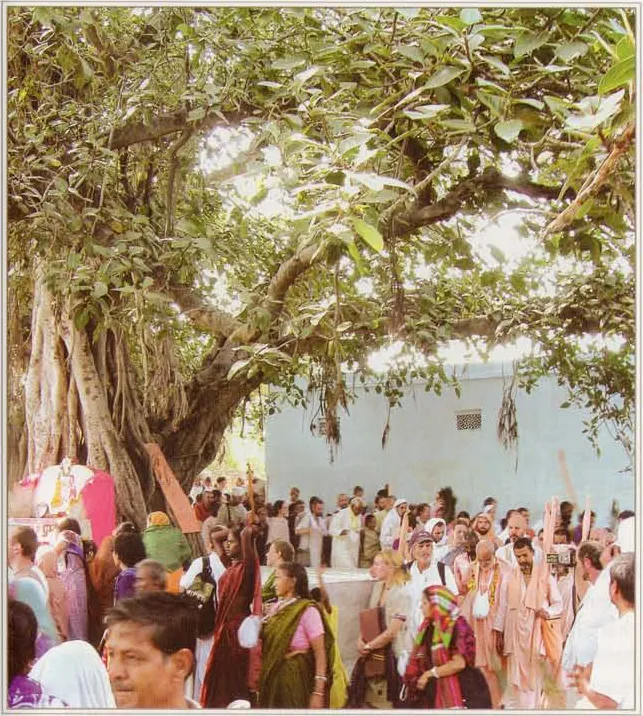
- Bhāṇḍīravaṭa is the banyan of Bhāṇḍīravana, across the Yamunā from Vṛndāvana.
- Visiting
- In 1883 the historian Growse described the sacred wood of Bhāṇḍīravana at the hamlet of Chhāhiri near Māṭ, with a small temple of Bihārī, a rest-house and a well, and just outside it an ancient …
- Places here
- Rādhā-Kṛṣṇa Marriage Place (Bhāṇḍīravaṭa)
In short
Bhāṇḍīravaṭa is the banyan of Bhāṇḍīravana, across the Yamunā from Vṛndāvana. The guidebook Śrī Vraja-maṇḍala Parikramā (2007) calls it the site of many pastimes of Rādhā and Kṛṣṇa and says that in Kṛṣṇa's time its branches spread so far that He, Baladeva and Their friends crossed the river on them.[1 +2] Śrīmad-Bhāgavatam names the Bhāṇḍīra banyan twice: as the goal of the game in which Balarāma killed the demon Pralamba, and as the tree beneath which the cowherd boys found themselves after Kṛṣṇa swallowed a forest fire.[4 +8] The sources differ on whether the Bhāṇḍīra of these pastimes is this tree or Akṣayavaṭa on the other bank.[13 +2] Śrīla Prabhupāda's Kṛṣṇa book tells the pastimes in the Bhāṇḍīra forest without saying on which bank the banyan stood, and Śrīla Sanātana Gosvāmī and Śrīla Jīva Gosvāmī place the banyan on the western bank.[4 +16]
Key facts
| Kind | tree |
|---|---|
| Region · area | Bhāṇḍīravana |
| Ācāryas | Śrīla Jīva Gosvāmī, Śrīla Sanātana Gosvāmī, Śrīla Baladeva Vidyābhūṣaṇa, Śrīla Rūpa Gosvāmī, Śrīla Raghunātha dāsa Gosvāmī |
Why it is glorified
The Harivaṁśa describes the Bhāṇḍīra as a banyan a yojana high, with great branches, standing like a dark cloud in the middle of …
The Harivaṁśa describes the Bhāṇḍīra as a banyan a yojana high, with great branches, standing like a dark cloud in the middle of Vṛndāvana, with the Kālindī flowing through the land. Kṛṣṇa chose it as His place by day after the move to Vṛndāvana and played there with the boys who herded the calves (summarised here, not translated).[22 +1] Śrīla Jīva Gosvāmī calls it a yojana high and as much across, and he and Śrīla Sanātana Gosvāmī say that its long branches reached across the Yamunā, so that the cowherds went to the near and far banks on them.[13 +9]
The Padma Purāṇa calls the Bhāṇḍīra the twelfth petal of the lotus of Vraja, a lovely forest where Kṛṣṇa plays surrounded by Śrīdāmā and the other boys.[26] The Brahma-vaivarta Purāṇa calls the banyan at the Bhāṇḍīra "imperishable": Uddhava, coming from Mathurā, saw it before him.[27] In Śrīla Rūpa Gosvāmī's Bhakti-rasāmṛta-sindhu, Nārada hears Kṛṣṇa's parrots debating Vedānta in the thicket of the Bhāṇḍīra and stands amazed. Śrīla Prabhupāda gives it in The Nectar of Devotion:[28 +1]
Names this place“When Nārada Muni was passing through Vṛndāvana, he came to the Bhāṇḍīra-vana forest and saw in one of the trees the famous parrot couple that always accompanies Lord Kṛṣṇa.”
Śrīla Prabhupāda, The Nectar of Devotion, Chapter 51, 'Mixing of Rasas' · vedabase.io
Śrīla Viśvanātha Cakravartī Ṭhākura, in his Vṛndāvanāṣṭaka, names the Bhāṇḍīra with Govardhana and the place of the rāsa dance as the three boundary marks of Vṛndāvana:[30]
bhāṇḍīra-govardhana-rāsa-pīṭhais
trī-sīmake yojana-pañcakena
mite vibhutvād amite pi cāsmin
mamāstu vṛndāvana eva vāsaḥ
Divine pastimes
The game with Pralamba
Śrīmad-Bhāgavatam (10.18) tells how the cowherd boys played a game in pairs, the losers carrying the winners, and went with Kṛṣṇa to the banyan called Bhāṇḍīraka. The demon Pralamba had joined them disguised as a cowherd boy. Kṛṣṇa, defeated, carried Śrīdāmā, and Pralamba carried Balarāma far beyond the agreed spot, where Balarāma killed him with His fist. The Bhāgavatam does not say on which bank the banyan stood.[4 +4]
vahanto vāhyamānāś ca cārayantaś ca go-dhanam / bhāṇḍīrakaṃ nāma vaṭaṃ jagmuḥ kṛṣṇa-purogamāḥ
Thus carrying and being carried by one another, and at the same time tending the cows, the boys followed Kṛṣṇa to a banyan tree known as Bhāṇḍīraka.
Translation: Śrīla Prabhupāda's disciples (BBT)Śrīla Prabhupāda's Kṛṣṇa book sets the game in the Bhāṇḍīravana forest:[4 +4]
Names this place“They began playing, and at the same time tended the cows as they proceeded through the Bhāṇḍīravana forest. The party of Balarāma, accompanied by Śrīdāmā and Vṛṣabha, came out victorious, and Kṛṣṇa’s party had to carry them on their backs through the Bhāṇḍīravana forest.”
Śrīla Prabhupāda, Kṛṣṇa, the Supreme Personality of Godhead (Kṛṣṇa book), Chapter 18, 'Killing the Demon Pralambāsura' · vedabase.io
The Viṣṇu Purāṇa and the Harivaṁśa say that Kṛṣṇa and Balarāma came to the Bhāṇḍīra banyan after killing Dhenuka and played and grazed the cows there before Pralamba came.[25 +1] In Śrīla Rūpa Gosvāmī's Chando'ṣṭādaśaka, Kṛṣṇa divides His friends into sides at the foot of the Bhāṇḍīra tree and knowingly accepts Pralamba in his disguise.[4 +2] Read more: The Bhāṇḍīra banyan →
The forest fire
Śrīmad-Bhāgavatam (10.19) tells that the cows strayed into the Muñja forest, a fire broke out, and Kṛṣṇa asked His friends to close their eyes and swallowed the fire. When they opened their eyes, they and the cows had been brought back to the Bhāṇḍīra tree.[9 +3]
tataś ca te 'kṣīṇy unmīlya punar bhāṇḍīram āpitāḥ / niśamya vismitā āsann ātmānaṃ gāś ca mocitāḥ
The cowherd boys opened their eyes and were amazed to find not only that they and the cows had been saved from the terrible fire but that they had all been brought back to the Bhāṇḍīra tree.
Translation: Śrīla Prabhupāda's disciples (BBT)Śrīla Prabhupāda's Kṛṣṇa book says that they found themselves "again in the Bhāṇḍīra forest".[9 +3] Śrīla Viśvanātha Cakravartī Ṭhākura explains that Kṛṣṇa had the boys close their eyes so that He could bring them unnoticed to the foot of the cool, shady Bhāṇḍīra tree, and Śrīla Kavi-karṇapūra's Ānanda-vṛndāvana-campū tells it in the same way (summarised here, not translated).[10 +3]
Brahmā's return
The Brahma-vaivarta Purāṇa tells that when Brahmā, after hiding the calves and boys for a year, came back ashamed, he found Kṛṣṇa at the foot of the Bhāṇḍīra banyan, surrounded by the cowherd boys. Śrīmad-Bhāgavatam tells Brahmā's return without naming the place, with Kṛṣṇa alone, searching for the calves and His friends.[36 +1]
Rādhā and Kṛṣṇa at the Bhāṇḍīra
The Gosvāmīs and the Purāṇas name the Bhāṇḍīra as a place of Śrī Rādhā and Kṛṣṇa's pastimes. Śrīla Raghunātha dāsa Gosvāmī prays to see Kṛṣṇa with His beloved in the shelter of the Bhāṇḍīra; Śrīla Rūpa Gosvāmī calls Śrī Rādhā the ornament of the Bhāṇḍīra; in Śrīla Jīva Gosvāmī's Gopāla-campū Kṛṣṇa names the Bhāṇḍīra to Her among the places of Their pastimes; and the Nārada Purāṇa calls Kṛṣṇa the one who dwells at the Bhāṇḍīravaṭa.[38 +5]
The wedding remembered at the banyan
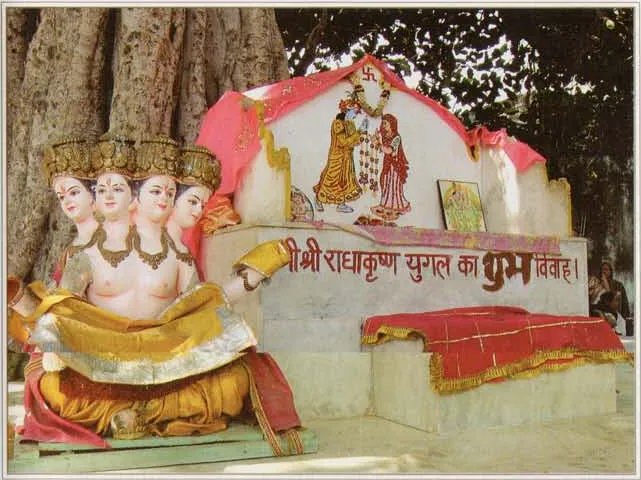
Pilgrims traditionally revere a spot beneath this banyan as the place of Śrī Rādhā and Kṛṣṇa's wedding.[44 +1] The account comes from two Purāṇas. According to the Garga-saṁhitā (Goloka-khaṇḍa, chapter 16), Brahmā performed Their wedding in the Bhāṇḍīra forest, as the sage Garga had foretold to Vṛṣabhānu (15.60–61); Brahmā says there that the two are already husband and wife and that he performs the rite to follow the custom of the world (16.29). The Brahma-vaivarta Purāṇa (Śrī-kṛṣṇa-janma-khaṇḍa, chapter 15) also tells of a wedding performed by Brahmā at the Bhāṇḍīra.[46 +10] Śrīmad-Bhāgavatam does not narrate this wedding.[57] The place has its own page, Rādhā-Kṛṣṇa Marriage Place.
The following are Śrīla Prabhupāda's general teachings; they do not name this place. In his purport to Caitanya-caritāmṛta Ādi 4.50 he explains that the conjugal relationship with Kṛṣṇa is of two kinds: svakīya, the relationship with Kṛṣṇa as a formally married husband, and parakīya, the relationship with Kṛṣṇa as a paramour.[58] There he also explains, following the six Gosvāmīs, that Kṛṣṇa's pastimes in Vraja are eternal and that parakīya-rasa, the gopīs' love for Kṛṣṇa beyond the bond of marriage, is ever present there.[58] In the Kṛṣṇa book (chapter 29) he writes:[59]
General teaching (does not name the place)“The gopīs wanted Kṛṣṇa to be their husband, but factually there was no possibility of His marrying all the gopīs. But because they had that natural tendency to accept Kṛṣṇa as their supreme husband, the relationship between the gopīs and Kṛṣṇa is called parakīya-rasa.”
Śrīla Prabhupāda, Kṛṣṇa, the Supreme Personality of Godhead (Kṛṣṇa book), Chapter 29, 'The Rāsa Dance: Introduction' · vedabase.io
In his purport to Caitanya-caritāmṛta Ādi 10.85 he explains why Śrīla Jīva Gosvāmī supported svakīya-rasa, love within marriage: some of Śrīla Jīva Gosvāmī's followers disliked the parakīya-rasa of the gopīs.[60]
General teaching (does not name the place)“Therefore Śrīla Jīva Gosvāmī, for their spiritual benefit, supported svakīya-rasa, for he could understand that sahajiyās would otherwise exploit the parakīya-rasa, as they are actually doing at the present time. … Śrīla Jīva Gosvāmī was never opposed to the transcendental parakīya-rasa, nor has any other Vaiṣṇava disapproved of it.”
Śrīla Prabhupāda, Śrī Caitanya-caritāmṛta, Ādi-līlā 10.85, purport · vedabase.io
Traditional accounts
According to Śrī Vraja-maṇḍala Parikramā (2007) and the undated parikramā notes Bhāṇḍīravana, a huge banyan stood here in Kṛṣṇa's …
According to Śrī Vraja-maṇḍala Parikramā (2007) and the undated parikramā notes Bhāṇḍīravana, a huge banyan stood here in Kṛṣṇa's manifest pastimes, its long branches spreading in all directions, with birds singing on them and animals resting in its shade.[1 +2] The two describe it as the place of the boys' picnics: the mothers sent lunch here, and after watering the cows and bathing in the Yamunā the boys ate in rows around Kṛṣṇa in the banyan's shade. The details are those of the forest lunch in Śrīmad-Bhāgavatam 10.13, which the Bhāgavatam sets on a sandy bank of the Yamunā.[1 +5] The guidebook adds that the cows strayed from here into the parched Muñja forest before the fire, and that afterwards the boys again joked and ate here; Śrīla Jīva Gosvāmī's Gopāla-campū gives the same outline, with the boys resting beneath the Bhāṇḍīra and the cows straying into the muñja forest by the Yamunā.[10 +5]
According to the Bhakti-ratnākara, Śrīla Rāghava Paṇḍita Gosvāmī, on the eastern side of the Yamunā, told Śrīla Śrīnivāsa Ācārya that after playing at the Bhāṇḍīra, Kṛṣṇa sat with His friends in the shade near Chāherī and ate many foods, and that the village is named after this shade (summarised here, not translated).[66]
Śrīla Nārāyaṇa Bhaṭṭa Gosvāmī's Vraja-bhakti-vilāsa counts the Bhāṇḍīra-vaṭa first among the eight banyans on the "northern bank" of the Yamunā, names Garuḍa-vāhana as its presiding deity, counts it in Lalitā's dominion, gives its circuit as half a krośa, and names a long temple as its sign.[67 +4]
Śrīla Jīva Gosvāmī writes in the Gopāla-campū that the Bhāṇḍīra, out of love for Kṛṣṇa, vanished when His pastimes became hidden.[16 +5]
Śrīla Prabhupāda
Śrīla Prabhupāda names the Bhāṇḍīra forest as the scene of the Pralamba game and the forest fire, as quoted above, but he does …
Śrīla Prabhupāda names the Bhāṇḍīra forest as the scene of the Pralamba game and the forest fire, as quoted above, but he does not name the banyan or its bank.[4 +8] In his purport to Caitanya-caritāmṛta Madhya 17.193 he counts Bhāṇḍīravana among the forests on the eastern side of the Yamunā:[72]
General teaching (does not name the place)“There are twelve such vanas in Vṛndāvana. Some are located on the western side of the Yamunā, and others are on the eastern side. The forests situated on the eastern side are Bhadravana, Bilvavana, Lauhavana, Bhāṇḍīravana and Mahāvana. On the western side are Madhuvana, Tālavana, Kumudavana, Bahulāvana, Kāmyavana, Khadiravana and Vṛndāvana. These are the twelve forests of the Vṛndāvana area.”
Śrīla Prabhupāda, Śrī Caitanya-caritāmṛta, Madhya-līlā 17.193, purport · vedabase.io
Visiting today
In 1883 the historian Growse described the sacred wood of Bhāṇḍīravana at the hamlet of Chhāhiri near Māṭ, with a small temple of Bihārī, a rest-house and a well, and just outside it an ancient banyan with a temple of Śrīdāmā under it. In 1966 Prabhudayāl Mītal named temples of Śrī Baladeva and Śrī Bihārī, the Bhāṇḍīra-vaṭa and the Bhāṇḍīra-kūpa. In 1987 A. W. Entwistle described two banyans, one near the well and another a few hundred metres to the south-west with the temple of Śrīdāmā. None of them gives a date or builder for the temples.[45 +2]
Śrī Vraja-maṇḍala Parikramā (2007) shows a shrine at the foot of the banyan, with a painting, in remembrance of the wedding.[44 +1] The nearby Baladeva Mandira and Śrīdāma Mandira have their own pages.
Location
| Where it is | Bhāṇḍīravana; the book distinguishes it from Akṣayavaṭa ('also called Bhāṇḍīravaṭa') across the Yamunā[77] |
|---|
Places at Bhāṇḍīravaṭa (Bhāṇḍīravana)
1 places
Nearby places
Yamunā · Akṣayavaṭa (near Rāma-ghāṭa)
Pictures
1 pictures
Where the sources differ
Which banyan is the Bhāṇḍīra of the Bhāgavatam. Śrīla Sanātana Gosvāmī, commenting on ŚB 10.19.13, places the well-known Bhāṇḍīra banyan on the western bank within Vṛndāvana, and Śrīla Jīva Gosvāmī places it on the southern bank, saying that he had seen it.[13 +7] Śrīla Baladeva Vidyābhūṣaṇa says that it stands on the far bank of the Kālindī, the bank of this tree, and the Vraja-bhakti-vilāsa lists it among the banyans of the northern bank.[15 +2] The guidebooks, which call both this tree and the Akṣayavaṭa near Rāma-ghāṭa "Bhāṇḍīravaṭa", say that they are different places.[1 +5] All the positions are set side by side on the Akṣayavaṭa page. Read more: The Bhāṇḍīra banyan →
Where Pralamba was killed. The Bhāgavatam says only that Pralamba carried Balarāma far beyond the agreed spot.[4 +4] The undated parikramā notes Bhāṇḍīravana set the killing at this banyan, which is not certain, while Śrī Vraja-maṇḍala Parikramā (2007) sets it at Akṣayavaṭa; the Garga-saṁhitā has Pralamba carry Balarāma from the Bhāṇḍīra to the Yamunā's shore, and Śrīla Jīva Gosvāmī has the boys leave the place where the body lay and settle beneath the Bhāṇḍīra.[6 +1] The accounts are shown on the Akṣayavaṭa page.
Accounts differ What became of the original Bhāṇḍīra banyan.
- the undated parikramā notes BhāṇḍīravanaThe original gigantic tree is not present now; it was cut down in the 17th century.
- Śrīla Jīva Gosvāmī, Gopāla-campū (Pūrva 1.13)The Bhāṇḍīra vanished when Kṛṣṇa's pastimes became hidden, out of love for Him.
- Śrī Vraja-maṇḍala Parikramā (2007)'At the time of Śrī Kṛṣṇa's manifest pastimes (prakaṭa-līlā), a huge banyan tree stood here' (no statement about its end).
- Bhakti-ratnākara, Thirteenth Wave (printed p.1025)At Vīracandra's visit to the (west-bank) place of the Bhāṇḍīravaṭa, he was told that Śrī Bhāṇḍīra-vaṭa had disappeared (antardhāna).
Accounts differ Which of the present banyans at Bhāṇḍīravana is the Bhāṇḍīravaṭa, which is the Vaṁśīvaṭa, and under which stands the temple of Śrīdāma.
- Śrī Vraja-maṇḍala Parikramā (2007) and the undated parikramā notes BhāṇḍīravanaBhāṇḍīravaṭa (the boys' picnics; the guidebook remembers Śrī Rādhā and Kṛṣṇa's wedding beneath it) and, a short distance from it, the Vaṁśīvaṭa, beneath which is the temple of Śrīdāma Bhaiyā; Chāherī-gaon lies between the two.
- F. S. Growse, Mathurá (1883), a historianGrowse places an ancient banyan, the Bhāṇḍīra-vaṭa, just outside the grove; the temple under it is Śrīdāmā's, the one in the grove Bihārī's.
- A. W. Entwistle (1987), a historianEntwistle says the banyan near the well is believed to be the place of Kṛṣṇa and Rādhā's wedding and is sometimes taken as the Bhāṇḍīra-vaṭa of the Pralamba story; another banyan a few hundred metres south-west, with Śrīdāmā's temple beside it, is called by some the Vaṁśī-vaṭa (in a wood called Śyāmavana), while others hold it to be the original banyan of the Pralamba game.
Accounts differ Where and how Brahmā found Kṛṣṇa at the end of the year after his theft of the calves and boys.
- Śrīmad-Bhāgavatam 10.13.57-64 (translation by Śrīla Prabhupāda)Brahmā saw Vṛndāvana and 'there' saw Kṛṣṇa alone, as before, with a morsel of food in His hand, searching for the calves and His friends; he fell at His feet. No Bhāṇḍīra is named.
- Brahma-vaivarta Purāṇa, Śrī-kṛṣṇa-janma-khaṇḍa 20.7-9Brahmā came to Hari's place at the foot of the Bhāṇḍīra banyan and saw Kṛṣṇa there surrounded by the cowherd boys, on a jewelled throne.
More on this place
The Bhāṇḍīra banyan
References
77 references
- Śrī Vraja-maṇḍala Parikramā (2007), PDF p. 252
- the undated parikramā notes Bhāṇḍīravana, ¶5
- the undated parikramā notes Akṣayavaṭa, ¶17
- Śrīmad-Bhāgavatam 10.18.22, GRETIL
- Śrīmad-Bhāgavatam 10.18.24, GRETIL
- Śrīmad-Bhāgavatam 10.18.28, GRETIL
- Śrīla Prabhupāda, Kṛṣṇa, the Supreme Personality of Godhead (Kṛṣṇa book), Chapter 18, 'Killing the Demon Pralambāsura' · vedabase.io
- Garga-saṁhitā, Mādhurya-khaṇḍa (4) 20.5, Sanskrit Wikisource
- Śrīmad-Bhāgavatam 10.19.12, GRETIL
- Śrīmad-Bhāgavatam 10.19.13, GRETIL
- Śrīla Prabhupāda, Kṛṣṇa, the Supreme Personality of Godhead (Kṛṣṇa book), Chapter 19, 'Devouring the Forest Fire' · vedabase.io
- Śrīla Prabhupāda, The Nectar of Devotion, Chapter 46, 'Astonishment and Chivalry' · vedabase.io
- Śrīmad-Bhāgavatam canto 10 with commentaries — Śrīla Sanātana Gosvāmī: commentary on ŚB 10.11.29, Bhagavata Vidya Pith edition, ed. Bhagavata Rishi and Krishna Shankar Shastri, 1996
- Śrīmad-Bhāgavatam canto 10 with commentaries — Śrīla Sanātana Gosvāmī: commentary on ŚB 10.19.13, Bhagavata Vidya Pith edition, ed. Bhagavata Rishi and Krishna Shankar Shastri, 1996
- Śrīla Rūpa Gosvāmī, Stava-mālā part 7, v.15 with the ṭīkā, after the edition of Bhakti Saranga Goswami and Purushottam Das, Vrindavan, 1959
- Gopāla-campū, Pūrva-campū (1), v.28
- Gopāla-campū, Pūrva-campū (1) prathama pūraṇa, v.29
- Gopāla-campū, Pūrva-campū (1) prathama pūraṇa, v.13
- Gopāla-campū, Pūrva-campū (16) ṣoḍaśa pūraṇa, v.18
- Gopāla-campū, (16) ṣoḍaśaṁ pūraṇam ¶[27]
Show all 77 references
- Gopāla-campū, Uttara-campū (37) saptatriṁśa pūraṇa
- Harivaṁśa, HV 52.25-27, GRETIL
- Harivaṁśa, HV 55.22-24, GRETIL
- Gopāla-campū, Uttara-campū (37) saptatriṁśa pūraṇa, vv.51-52
- Harivaṁśa 58.9-10, GRETIL
- Padma Purāṇa, Pātāla-khaṇḍa (5) 69.48 (= Vṛndāvana-māhātmya (1) v.48 in the Grantha Mandira text Vṛndāvana-māhātmya of the Padma Purāṇa), Sanskrit Wikisource
- Brahma-vaivarta Purāṇa, Kṛṣṇa-janma-khaṇḍa (4) 92.7-8, Sanskrit Wikisource
- Śrīla Rūpa Gosvāmī, Bhakti-rasāmṛta-sindhu, 4.9.35 (Uttara-vibhāga, ninth wave: anurasa, imitation of astonishment), GRETIL
- Śrīla Prabhupāda, The Nectar of Devotion, Chapter 51, 'Mixing of Rasas' · vedabase.io
- Na Yoga Siddhir Na Mamastu (Śrī Śrī Vṛndāvanāṣṭakam) (Viśvanātha Cakravartī Ṭhākura (as the song book credits it)) · song book
- Viṣṇu Purāṇa, 5.9.2-3, GRETIL
- Śrīla Rūpa Gosvāmī, Stava-mālā part 26 (Chando'ṣṭādaśaka), v.18 and the kalikā after it (section 'bhāṇḍīra-krīḍanādi'), after the edition of Bhakti Saranga Goswami and Purushottam Das, Vrindavan, 1959
- Śrīmad-Bhāgavatam canto 10 with commentaries — Śrīla Viśvanātha Cakravartī Ṭhākura: commentary on ŚB 10.19.11, Bhagavata Vidya Pith edition, ed. Bhagavata Rishi and Krishna Shankar Shastri, 1996
- Ānanda-vṛndāvana-campū, Stavaka 11 v.22
- Ānanda-vṛndāvana-campū, eleventh stavaka, v.1 (prose)
- Brahma-vaivarta Purāṇa, Kṛṣṇa-janma-khaṇḍa (4) 20.7-8, Sanskrit Wikisource
- Śrīmad-Bhāgavatam 10.13.61, GRETIL
- Śrīla Raghunātha dāsa Gosvāmī, Stavāvalī, Abhīṣṭa-prārthanāṣṭaka 6 (Stavāvalī text (27) v.6)
- Śrīla Rūpa Gosvāmī, Stava-mālā, part 17 v.24 with the ṭīkā, after the edition of Bhakti Saranga Goswami and Purushottam Das, Vrindavan, 1959
- Gopāla-campū, Uttara-campū (37) saptatriṁśa pūraṇa, v.117
- Garga-saṁhitā, Mathurā-khaṇḍa (5), adhyāya 4, verse 23, Sanskrit Wikisource
- Nārada Purāṇa, पूर्वार्धः/अध्यायः 82 v.82-120: Pūrva-bhāga, chapter 82 (rādhā-kṛṣṇa-sahasranāma-kathana), verse 120
- Nārada Purāṇa, Pūrva-bhāga 82.144
- Śrī Vraja-maṇḍala Parikramā (2007), PDF p. 253
- A. W. Entwistle, §8.64 'Bhandirban', printed p.399, Egbert Forsten, Groningen, 1987
- Garga-saṁhitā, Goloka-khaṇḍa (1) 15.60, Sanskrit Wikisource
- Garga-saṁhitā, Goloka-khaṇḍa (1) 15.61, Sanskrit Wikisource
- Garga-saṁhitā, Goloka-khaṇḍa (1) 16.1 (chapter heading 'Śrī-kṛṣṇa-rādhikā-vivāha-varṇanam'), Sanskrit Wikisource
- Garga-saṁhitā, Goloka-khaṇḍa (1) 16.8, Sanskrit Wikisource
- Garga-saṁhitā, Goloka-khaṇḍa (1) 16.11, Sanskrit Wikisource
- Garga-saṁhitā, Goloka-khaṇḍa (1) 16.20, Sanskrit Wikisource
- Brahma-vaivarta Purāṇa, Śrī-kṛṣṇa-janma-khaṇḍa (4) 15.1-2, Sanskrit Wikisource
- Brahma-vaivarta Purāṇa, Śrī-kṛṣṇa-janma-khaṇḍa (4) 15.120-121 (quoted) and 15.127-131 (summarised), Sanskrit Wikisource
- Brahma-vaivarta Purāṇa, Kṛṣṇa-janma-khaṇḍa (4) 111.55, Sanskrit Wikisource
- Garga-saṁhitā, Goloka-khaṇḍa (1) 16.29, Sanskrit Wikisource
- Garga muni performs Krsna’s Name giving ceremony. Description of Sri …, ¶47
- Śrīmad-Bhāgavatam ŚB 10.30.31, GRETIL
- Śrīla Prabhupāda, Śrī Caitanya-caritāmṛta, Ādi-līlā 4.50, purport · vedabase.io
- Śrīla Prabhupāda, Kṛṣṇa, the Supreme Personality of Godhead (Kṛṣṇa book), Chapter 29, 'The Rāsa Dance: Introduction' · vedabase.io
- Śrīla Prabhupāda, Śrī Caitanya-caritāmṛta, Ādi-līlā 10.85, purport · vedabase.io
- Śrīmad-Bhāgavatam 10.13.8, GRETIL
- Śrīmad-Bhāgavatam ŚB 10.13.11, GRETIL
- Śrīla Prabhupāda, Kṛṣṇa, the Supreme Personality of Godhead (Kṛṣṇa book), Chapter 13, 'Stealing the Boys and Calves by Brahmā' · vedabase.io
- Śrī Vraja-maṇḍala Parikramā (2007), PDF p. 254
- the undated parikramā notes Bhāṇḍīravana, ¶10
- Śrīla Narahari Cakravartī, Bhakti-ratnākara, Fifth Wave (pañcama taraṅga), printed p.275; Grantha Mandira text vv.1684-1685, 2nd ed., 1912
- Śrīla Nārāyaṇa Bhaṭṭa, Vraja-bhakti-vilāsa, chapter (2), v.20: the sixteen banyans, printed p.36, 1st ed., publ. Bābā Kṛṣṇadāsa, Kusuma-sarovara, Saṁvat 2008
- Śrīla Nārāyaṇa Bhaṭṭa, Vraja-bhakti-vilāsa, chapter (2), v.56: the sign-places of the sixteen banyans, printed p.53, 1st ed., publ. Bābā Kṛṣṇadāsa, Kusuma-sarovara, Saṁvat 2008
- Śrīla Nārāyaṇa Bhaṭṭa, Vraja-bhakti-vilāsa, chapter (2), v.17: the presiding deities of the sixteen banyans, printed p.34, 1st ed., publ. Bābā Kṛṣṇadāsa, Kusuma-sarovara, Saṁvat 2008
- Śrīla Nārāyaṇa Bhaṭṭa, Vraja-bhakti-vilāsa, chapter (2), v.22: Lalitā's dominion (citing the 'Nāradīya'), printed p.37, 1st ed., publ. Bābā Kṛṣṇadāsa, Kusuma-sarovara, Saṁvat 2008
- Śrīla Nārāyaṇa Bhaṭṭa, Vraja-bhakti-vilāsa, chapter (2), v.41: the circuits of the sixteen banyans (citing the 'Trailokya-sammohana-tantra'), printed p.42, 1st ed., publ. Bābā Kṛṣṇadāsa, Kusuma-sarovara, Saṁvat 2008
- Śrīla Prabhupāda, Śrī Caitanya-caritāmṛta, Madhya-līlā 17.193, purport · vedabase.io
- Mathurá (1883), F. S. Growse, B.C.S., M.A. Oxon., C.I.E. (as the title page gives him, p. 391
- Prabhudayāl Mītal, 'Braj-yātrā', first route across the Yamunā, entry 'भांडीर बन', printed p.129
- the undated parikramā notes Bhāṇḍīravana, ¶6
- Garga-saṁhitā, Mādhurya-khaṇḍa (4) 1.20, Sanskrit Wikisource
- Śrī Vraja-maṇḍala Parikramā (2007), p. 478-479