The Bhāṇḍīra banyan
Pralamba, the fire in the Muñja forest and the two banks of the Yamunā
In short
The Bhāṇḍīra is the great banyan of Kṛṣṇa's boyhood in Vraja. Śrīmad-Bhāgavatam names it twice. It is the goal of the carrying game in which Balarāma killed the demon Pralamba. It is also the tree where the boys found themselves after Kṛṣṇa swallowed a forest fire. The sources place it on two banks of the Yamunā.[1–9]
On this page
At a glance
- Śrīmad-Bhāgavatam 10.18 and 10.19 name the banyan Bhāṇḍīraka and Bhāṇḍīra, but they do not say on which bank of the river it stood.[1–6]
- Śrīla Prabhupāda's Kṛṣṇa book tells both pastimes in the Bhāṇḍīravana forest.[10–12]
- The Bhakti-ratnākara says that people now call the Bhāṇḍīra on the western route Akṣayavaṭa, the imperishable banyan.[7]
- Śrīla Sanātana Gosvāmī and Śrīla Jīva Gosvāmī place the banyan on the western bank, the Vṛndāvana side. Śrīla Jīva Gosvāmī says he saw it.[13]
- Śrīla Prabhupāda counts Bhāṇḍīravana among the five forests on the eastern bank. He locates the forest, but he does not say on which bank the banyan stood.[1 +7]
- Śrīla Jīva Gosvāmī writes that the old tree vanished when Kṛṣṇa's pastimes became hidden.[14]
What is the Bhāṇḍīra banyan?
The Purāṇas, the old scriptures, describe the tree (summarised here, not translated). The Harivaṁśa calls the Bhāṇḍīra a banyan like a mountain, a yojana high, standing in the middle of Vṛndāvana. (A yojana is an old, long measure of distance.) After the move to Vṛndāvana, it says, Kṛṣṇa chose the tree as His home by day. There He played with the boys who herded the calves.[15, 16]
Śrīmad-Bhāgavatam names the tree in two chapters of the Tenth Canto. It appears in the game that Pralamba joined, and in the return after the forest fire.[1–6] Śrīla Sanātana Gosvāmī comments on the first verse (summarised here, not translated). He says the tree is a banyan only in name: in truth it is the best of trees, a wish-fulfilling tree. Śrīla Viśvanātha Cakravartī Ṭhākura explains that it was the place fixed in the game for getting down.[17, 18]
The Gosvāmīs remember the tree's size. Śrīla Jīva Gosvāmī writes in the Gopāla-campū that the Bhāṇḍīra spread very wide. The cowherd boys went back and forth on its branches to the near and far banks of the Kālindī, the Yamunā.[19]
Śrīla Rūpa Gosvāmī counts it as the king of banyans among Śrī Kṛṣṇa's places. Śrīla Viśvanātha Cakravartī Ṭhākura names it as one of three boundary marks of Vṛndāvana, with Govardhana and the place of the rāsa dance.[20–26]
The carrying game and the killing of Pralamba
The pastime begins with the summer games. Śrīmad-Bhāgavatam tells that Balarāma, Kṛṣṇa and Their friends decorated themselves with leaves, peacock feathers and coloured minerals. Then they danced, wrestled and sang in the forest. In the BBT edition, the translation of these two chapters is by Śrīla Prabhupāda's disciples.[27]
Next they played a game in pairs, in which the losers carried the winners. Carrying one another, they followed Kṛṣṇa to the banyan called Bhāṇḍīraka. Kṛṣṇa lost and carried Śrīdāmā. Bhadrasena carried Vṛṣabha. And Pralamba, a demon who had joined the boys in the form of a cowherd, carried Balarāma.[1–3, 28]
vahanto vāhyamānāś ca cārayantaś ca go-dhanam / bhāṇḍīrakaṃ nāma vaṭaṃ jagmuḥ kṛṣṇa-purogamāḥ
Thus carrying and being carried by one another, and at the same time tending the cows, the boys followed Kṛṣṇa to a banyan tree known as Bhāṇḍīraka.
Translation: Śrīla Prabhupāda's disciples (BBT)Śrīla Prabhupāda sets the game in the forest itself, while the boys tended the cows:[10–12]
General teaching (does not name the place)“They began playing, and at the same time tended the cows as they proceeded through the Bhāṇḍīravana forest. The party of Balarāma, accompanied by Śrīdāmā and Vṛṣabha, came out victorious, and Kṛṣṇa’s party had to carry them on their backs through the Bhāṇḍīravana forest.”
Śrīla Prabhupāda, Kṛṣṇa, the Supreme Personality of Godhead (Kṛṣṇa book), Chapter 18, 'Killing the Demon Pralambāsura' · vedabase.io
Pralamba ran far beyond the spot where he should have put Balarāma down. He took his own huge form, and Balarāma killed him with one blow of His fist. The Bhāgavatam names no village for the killing.[3 +3] Śrīla Prabhupāda gives the demon's purpose in a few words:[3 +3]
General teaching (does not name the place)“In order to avoid the company of Kṛṣṇa, Pralambāsura carried Balarāma far away.”
Śrīla Prabhupāda, Kṛṣṇa, the Supreme Personality of Godhead (Kṛṣṇa book), chapter 18 · vedabase.io
athāgata-smṛtir abhayo ripuṃ balo vihāya sārtham iva harantam ātmanaḥ / ruṣāhanac chirasi dṛḍhena muṣṭinā surādhipo girim iva vajra-raṃhasā
Remembering the actual situation, the fearless Balarāma understood that the demon was tṛying to kidnap Him and take Him away from His companions. The Lord then became furious and struck the demon’s head with His hard fist, just as Indra, the king of the demigods, strikes a mountain with his thunderbolt weapon.
Translation: Śrīla Prabhupāda's disciples (BBT)The other Purāṇas tell the run differently. The Viṣṇu Purāṇa says that the demon lifted Saṅkarṣaṇa (Balarāma) on his shoulder and rose swiftly into the sky before he was struck down. The Garga-saṁhitā says that he carried Balarāma from the Bhāṇḍīra to the Yamunā's shore, heading for Mathurā.[32–35] In Śrīla Jīva Gosvāmī's Gopāla-campū, after Pralamba's death the boys sit in a circle at the foot of the Bhāṇḍīra, a yojana wide.[1 +4]
Śrīla Rūpa Gosvāmī retells the whole episode in his Chando'ṣṭādaśaka (summarised here, not translated). Kṛṣṇa divides His friends into sides at the foot of the Bhāṇḍīra tree. He knowingly lets in the demon chief disguised as a cowherd. He gives the victory to Balarāma's side and has Balarāma destroy Pralamba. Then He finds the cows in the reed forest and drinks the fire. The poet calls Him the one who sports at the Bhāṇḍīra.[38]
The Harivaṁśa and the Viṣṇu Purāṇa say instead that Kṛṣṇa defeated Śrīdāmā in that game.[39, 40]
Accounts differ In the game of the Pralamba pastime, did Kṛṣṇa lose to Śrīdāmā or defeat him?
- Śrīmad-Bhāgavatam 10.18.24Kṛṣṇa was defeated and carried Śrīdāmā.
- Śrīla Prabhupāda, Kṛṣṇa book ch. 18Kṛṣṇa, being defeated, carried Śrīdāmā.
- Śrī Vraja-maṇḍala Parikramā (2007)Kṛṣṇa was defeated by Śrīdāma (and the sakhīs later tease Him about it).
- Śrīla Rūpa Gosvāmī, Chando'ṣṭādaśaka (Stava-mālā)Kṛṣṇa made Balarāma's side the winner and did what pleased Śrīdāmā (Baladeva's ṭīkā: defeated by Śrīdāmā, He carried him).
The fire in the Muñja forest
On another day, the Bhāgavatam tells, the boys were lost in play and the cows strayed. They entered the Iṣīkāṭavī, also called the Muñjāṭavī, the forest of muñja reeds. A forest fire surrounded the boys and the cows. Kṛṣṇa told His friends to close their eyes, and He swallowed the fire. When they opened their eyes, they had been brought back to the Bhāṇḍīra.[4–6, 41] Śrīla Prabhupāda describes the forest that drew the animals in:[11]
Names this place“The goats, cows and buffalo traveled from one forest to another and entered the forest known as Īṣīkāṭavī. This forest was full of green grass, and therefore they were allured; but when they entered, they saw that there was a forest fire, and they began to cry.”
Śrīla Prabhupāda, Kṛṣṇa, the Supreme Personality of Godhead (Kṛṣṇa book), Chapter 19, 'Devouring the Forest Fire' · vedabase.io
Śrīla Śrīdhara Svāmī explains that the Muñjāṭavī is the same forest as the Iṣīkāṭavī, a forest of very tall, thick grass.[42] Śrīla Viśvanātha Cakravartī Ṭhākura explains why Kṛṣṇa asked the boys to close their eyes. It was so that He could bring them, unseen, to the foot of the cool, shady Bhāṇḍīra tree. Śrīla Kavi-karṇapūra's Ānanda-vṛndāvana-campū tells the end in the same way (both summarised here, not translated).[6 +2]
tataś ca te 'kṣīṇy unmīlya punar bhāṇḍīram āpitāḥ / niśamya vismitā āsann ātmānaṃ gāś ca mocitāḥ
The cowherd boys opened their eyes and were amazed to find not only that they and the cows had been saved from the terrible fire but that they had all been brought back to the Bhāṇḍīra tree.
Translation: Śrīla Prabhupāda's disciples (BBT)General teaching (does not name the place)“Out of fear, the boys were almost unconscious, but when they regained their consciousness and opened their eyes, they saw that they were again in the Bhāṇḍīra forest with Kṛṣṇa, Balarāma and the cows.”
Śrīla Prabhupāda, Kṛṣṇa, the Supreme Personality of Godhead (Kṛṣṇa book), Chapter 19, 'Devouring the Forest Fire' · vedabase.io
The boys were amazed to see the Bhāṇḍīra in front of them again. Śrīla Rūpa Gosvāmī takes their wonder as his example of astonishment known by inference. Śrīla Prabhupāda gives it in The Nectar of Devotion:[12, 44]
Names this place“Similarly, when there was a forest fire in the Bhāṇḍīra-vana, Kṛṣṇa instructed His friends to close their eyes tightly, and they all did this. Then when Kṛṣṇa had extinguished the fire, the cowherd boys opened their eyes and saw that they had been relieved from the danger and that their cows and calves were all safe.”
Śrīla Prabhupāda, The Nectar of Devotion, Chapter 46 (ecstatic love in wonder) · vedabase.io
The pastime stayed in Vraja's memory. In the rāsa dance, a gopī acts out Kṛṣṇa saving the boys from a fire. Śrīla Sanātana Gosvāmī and Śrīla Jīva Gosvāmī say that she recalls this fire in the Muñjāṭavī, as well as the fire near the Kāliya lake.[45, 46] That earlier fire, on the night after Kāliya was subdued, is told in its own article. Read more: Kṛṣṇa swallows the forest fire on the night after Kāliya →
Wrestling at the Bhāṇḍīra
Several texts make the Bhāṇḍīra a place of wrestling. The Harivaṁśa and the Viṣṇu Purāṇa say that after the Dhenuka pastime the two brothers came to the great banyan. There they exercised with swinging games, wrestling and stone-throwing.[47–49]
In the Bhaviṣya Purāṇa, Kṛṣṇa recalls that He lived at the Bhāṇḍīra banyan as an eight-year-old among the cowherds (summarised here, not translated). Strong wrestlers worshipped Him at its foot on a Dvādaśī, the twelfth day of the moon. So that day is called Malla-dvādaśī, the wrestlers' Dvādaśī.[50, 51]
Śrīla Jīva Gosvāmī links that story with the place he knew. The Deity worshipped there as Vāsudeva, he says, is Kṛṣṇa as the great wrestler of the Malla-dvādaśī.[13] In his Saṅkalpa-kalpadruma he tells how Kṛṣṇa's friends did the wrestlers' dance at the Bhāṇḍīra, while some girls of Vraja came to watch.[52]
Śrīla Raghunātha dāsa Gosvāmī, in his Vraja-vilāsa-stava (verse 93), honours the Bhāṇḍīraka as the place of Śrī Rādhā's playful wrestling with Kṛṣṇa. The Bhakti-ratnākara quotes that verse and says that in the match there was neither victory nor defeat.[53, 54] The guidebooks add a folk explanation of the name of the nearby village Kāśraṭa, from the Hindi word for physical exercise.[55, 56]
Two banyans called Bhāṇḍīra
The sources do not agree on which tree is the Bhāgavatam's Bhāṇḍīra, or on which bank of the Yamunā it stands. The Bhakti-ratnākara of Śrīla Narahari Cakravartī Ṭhākura links it with a living place. On the western route after Rāma-ghāṭa, Śrīla Rāghava Paṇḍita walks on the Bhāṇḍīra path, which, the book says, people now call Akṣayavaṭa. There he shows Śrīla Śrīnivāsa Ācārya the place of the Bhāṇḍīravaṭa, where Balarāma killed Pralamba.[7]
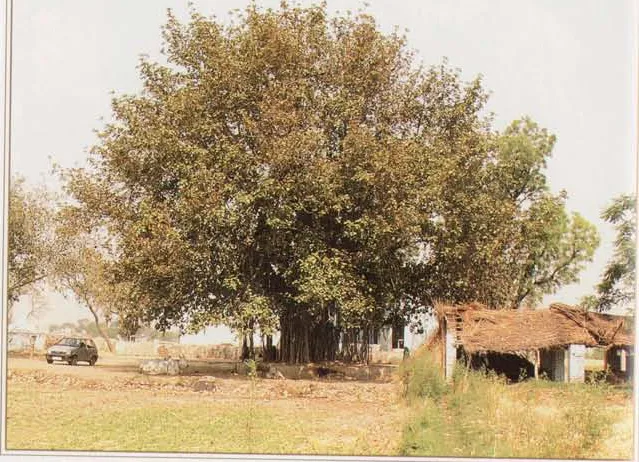
Later the same book describes Bhāṇḍīravana, across the river, as the eighth forest of the tour, after Bhadravana.[57–59]
Two Gosvāmīs place the Bhāṇḍīra of the pastimes on the Vṛndāvana side (summarised here, not translated). Śrīla Sanātana Gosvāmī puts the well-known banyan on the western bank, north-west of a Śiva temple, with the Muñja forest to its south. He gives two reasons. The Viṣṇu Purāṇa and the Harivaṁśa tell these games as one day's play. And the cowherds, with their countless cows, could not have crossed the river again and again.[13]
Śrīla Jīva Gosvāmī places the Bhāṇḍīra-vaṭa north-west of Syāro, a village with a well-known Śiva temple. He says that he has seen the place himself.[13] On an earlier verse, both Gosvāmīs add that the banyan's long branches reached even the northern bank.[60] Śrīla Viśvanātha Cakravartī Ṭhākura's Vraja-rīti-cintāmaṇi puts the tree and the Muñja forest in Khelā-vana, north-east of Nandīśvara, where the Yamunā winds (Khelanvana).[61]
Other texts point across the river. Śrīla Rūpa Gosvāmī calls Kṛṣṇa the dancer at the side of the Bhāṇḍīra. Explaining this name, Śrīla Baladeva Vidyābhūṣaṇa says that the banyan stands on the far bank of the Kālindī.[62] Śrīla Nārāyaṇa Bhaṭṭa Gosvāmī's Vraja-bhakti-vilāsa lists the Bhāṇḍīra-vaṭa first among the banyans of the northern bank. Yet its list of that bank's forests also holds places that lie near Akṣayavaṭa.[63] Śrīla Prabhupāda counts Bhāṇḍīravana among the forests of the eastern bank:[8, 9]
Names this place“The five forests situated on the eastern side of the river Yamunā are Bhadra, Bilva, Loha, Bhāṇḍīra and Mahāvana. The seven forests situated on the western side of the Yamunā are Madhu, Tāla, Kumuda, Bahulā, Kāmya, Khadira and Vṛndāvana.”
Śrīla Prabhupāda, Śrī Caitanya-caritāmṛta, Madhya-līlā 5.12, purport · vedabase.io
The Caitanya-caritāmṛta tells that Śrī Caitanya Mahāprabhu went to Bhāṇḍīravana after Khelā-tīrtha. Then He crossed the Yamunā to Bhadravana. The verse does not name Akṣayavaṭa.[64]
tabe ‘khelā-tīrtha’ dekhi’ ‘bhāṇḍīravana’ āilā
yamunā pāra hañā ‘bhadra-vana’ gelā
Afterwards, Śrī Caitanya Mahāprabhu saw Khelā-tīrtha and then went to Bhāṇḍīravana. After crossing the Yamunā River, He went to Bhadravana.
Translation: Śrīla A.C. Bhaktivedanta Swami PrabhupādaThis website does not decide between the two banks. All the positions are set side by side below.[7–9]
Accounts differ Which banyan is the Bhāṇḍīra(vaṭa) of the Pralamba and forest-fire pastimes, and on which bank of the Yamunā it stands: the Akṣayavaṭa near Rāma-ghāṭa (west bank) or the Bhāṇḍīravaṭa of Bhāṇḍīravana across the river.
- Bhakti-ratnākara, Fifth Wave (printed pp.267-268)On the west-bank route after Rāma-ghāṭa: the 'Bhāṇḍīra path', now people call it Akṣayavaṭa; the place of the Bhāṇḍīravaṭa, where Pralamba was killed. It describes Bhāṇḍīravana, the eighth forest, separately after the crossing.
- Bhakti-ratnākara, Thirteenth Wave (printed p.1025)Vīracandra saw the place of the Bhāṇḍīravaṭa after Rāma-ghāṭa and before Nanda-ghāṭa and Cīra-ghāṭa; later, after Bhadravana, he wandered in the Bhāṇḍīra forest.
- Śrīla Sanātana Gosvāmī, Bṛhad-vaiṣṇava-toṣaṇī on ŚB 10.19.13On the western bank within Vṛndāvana, north-west of the Śiva temple; the Varāha's Bhāṇḍa-hrada is on the eastern bank.
- Śrīla Jīva Gosvāmī, Laghu-vaiṣṇava-toṣaṇī on ŚB 10.19.13On the southern bank within Vṛndāvana, north-west of the Śiva-temple village Syāro, seen by us; the Bhāṇḍa-hrada on the northern bank.
The wording of these accounts is our summary of the sources, not a published translation.
Bhāṇḍīravana across the river
The forest on the eastern bank has its own banyan, the Bhāṇḍīravaṭa, and its own glories. The Varāha Purāṇa calls Bhāṇḍīra the best of forests, dear to the yogīs. It says that one who sees Vāsudeva there is not born again. Śrīla Rūpa Gosvāmī and the Bhakti-ratnākara quote these verses (summarised here, not translated).[57 +4] According to the Bhakti-ratnākara, after playing at the Bhāṇḍīra, Kṛṣṇa ate with His friends in the shade near the village of Chāherī. The village is named after that shade.[57–59]
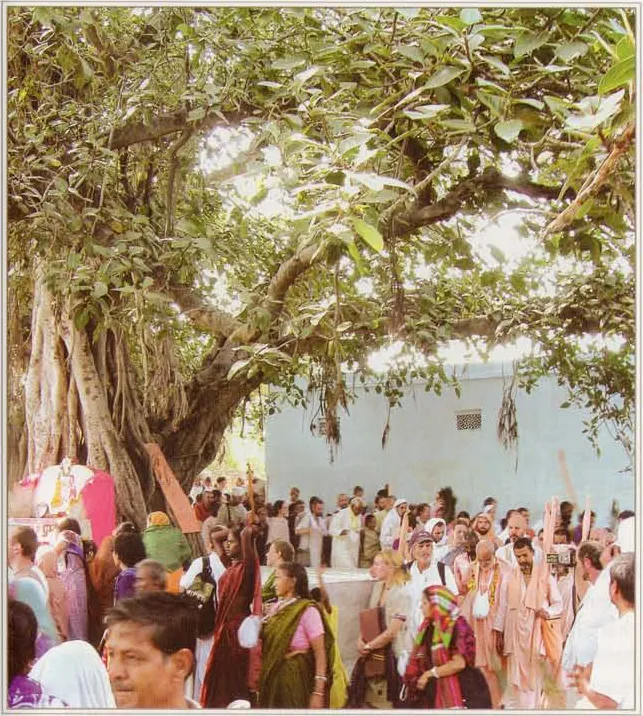
According to Śrīla Rūpa Gosvāmī's Bhakti-rasāmṛta-sindhu, Nārada heard Kṛṣṇa's parrots debating Vedānta in the thicket of the Bhāṇḍīra, and he stood amazed. Śrīla Prabhupāda renders the scene:[69, 70]
Names this place“When Nārada Muni was passing through Vṛndāvana, he came to the Bhāṇḍīra-vana forest and saw in one of the trees the famous parrot couple that always accompanies Lord Kṛṣṇa.”
Śrīla Prabhupāda, The Nectar of Devotion, Chapter 51, 'Mixing of Rasas' · vedabase.io
The Brahma-vaivarta Purāṇa sets more pastimes at the root of the Bhāṇḍīra banyan. Among them is Brahmā's return after the theft of the calves and boys. Another is the place where Rāma and Keśava waited while the boys went to ask the brāhmaṇas' wives for food. Śrīmad-Bhāgavatam tells both without naming the place.[71–76] Read more: Brahmā's theft of the calves and cowherd boys → “Kṛṣṇa and the wives of the brāhmaṇas: the pastime and its places” In the Garga-saṁhitā, the sage Durvāsā comes to Bhāṇḍīra, and the gopīs cross the Yamunā to feed him.[77, 78] Read more: The gopīs cross the Yamunā to feed Durvāsā →
Historians describe only the present site. In 1883 Growse described the sacred wood at the hamlet of Chhāhiri near Māṭ. It had a small temple of Bihārī and a well, and just outside stood an old banyan with a temple of Śrīdāmā. In 1987 A. W. Entwistle described two banyans there. None of these writers gives a date or builder for the temples.[79–81] According to Vṛndāvana-Dhāma Ki Jaya! (c. 1986), the water of the forest's well turns white like milk when the new moon falls on a Monday. The local people then hold a large festival.[82, 83]
The wedding remembered at Bhāṇḍīravana
Pilgrims traditionally revere a spot beneath the Bhāṇḍīravaṭa as the place of Śrī Rādhā and Kṛṣṇa's wedding, and a shrine with a painting there remembers it.[81, 84] The account comes from two Purāṇas. According to the Garga-saṁhitā (Goloka-khaṇḍa, chapter 16), Brahmā performed the wedding in the Bhāṇḍīra forest. The Brahma-vaivarta Purāṇa (Śrī-kṛṣṇa-janma-khaṇḍa, chapter 15) tells of a wedding performed by Brahmā in the Bhāṇḍīra grove.[85–93]
In the Garga-saṁhitā, Brahmā says that the two are already husband and wife. He performs the rite, he says, only to follow the ways of this world.[94, 95] Śrīmad-Bhāgavatam does not narrate this wedding.[96] The spot has its own page, Rādhā-Kṛṣṇa Marriage Place.
Śrīla Prabhupāda's teaching on the love of Vraja is general and does not name this place. He explains that the gopīs' relationship with Kṛṣṇa is parakīya-rasa, love beyond the bond of marriage, ever present in Goloka Vṛndāvana:[97, 98]
General teaching (does not name the place)“The gopīs wanted Kṛṣṇa to be their husband, but factually there was no possibility of His marrying all the gopīs. But because they had that natural tendency to accept Kṛṣṇa as their supreme husband, the relationship between the gopīs and Kṛṣṇa is called parakīya-rasa.”
Śrīla Prabhupāda, Kṛṣṇa, the Supreme Personality of Godhead (Kṛṣṇa book), Chapter 29, 'The Rāsa Dance: Introduction' · vedabase.io
He also explains why Śrīla Jīva Gosvāmī supported svakīya-rasa, love within marriage, for some of his followers, while never opposing the parakīya-rasa of Vraja:[97, 98]
General teaching (does not name the place)“Therefore Śrīla Jīva Gosvāmī, for their spiritual benefit, supported svakīya-rasa, for he could understand that sahajiyās would otherwise exploit the parakīya-rasa, as they are actually doing at the present time. … Śrīla Jīva Gosvāmī was never opposed to the transcendental parakīya-rasa, nor has any other Vaiṣṇava disapproved of it.”
Śrīla Prabhupāda, Śrī Caitanya-caritāmṛta, Ādi-līlā 10.85, purport · vedabase.io
What became of the old tree?
The Gosvāmīs say that the Bhāṇḍīra is no longer seen as it was. Śrīla Jīva Gosvāmī writes in the Gopāla-campū that, out of love for Hari, the banyan vanished completely when His pastimes became hidden (summarised here, not translated).[14]
According to the Bhakti-ratnākara, Śrīla Vīracandra Prabhu came to the place of the Bhāṇḍīravaṭa after Rāma-ghāṭa. There he was told that the banyan had disappeared. He sat alone and meditated there, and he saw Rāma and Kṛṣṇa playing with the cowherd boys.[99]
The guidebooks say that a new banyan was planted at Akṣayavaṭa when the old one disappeared. No source gives a date or a planter.[55, 56] The name itself has older roots. The Brahma-vaivarta Purāṇa calls the banyan at the Bhāṇḍīra imperishable, akṣaya, when Uddhava sees it on his way from Mathurā. The Nārada Purāṇa names an imperishable banyan in a list of the places of Vṛndāvana, separately from Bhāṇḍīra and without saying where it is.[75, 100] In 1987 A. W. Entwistle placed the Akṣayavaṭa of today near the village of Khajraut, with a Kṛṣṇa temple and a pond close by.[101]
Accounts differ What became of the original banyan.
- Śrīla Jīva Gosvāmī, Gopāla-campū (Pūrva 1.13)The Bhāṇḍīra vanished when Kṛṣṇa's pastimes became hidden, out of love for Him.
- Bhakti-ratnākara, Thirteenth Wave (printed p.1025)At Vīracandra's visit Vāsudeva said that Śrī Bhāṇḍīra-vaṭa had disappeared (antardhāna).
- Śrī Vraja-maṇḍala Parikramā (2007); the undated parikramā notes AkṣayavaṭaWhen the ancient banyan of Akṣayavaṭa disappeared, a new one was planted in its place.
- the undated parikramā notes BhāṇḍīravanaThe original gigantic tree (of the Bhāṇḍīravana banyan, 'presently known as Akshaya Vata also') was cut down in the 17th century.
Where the sources differ
The place of Pralamba's death is told in several ways. The Bhāgavatam says beyond the agreed spot, and the Garga-saṁhitā by the Yamunā's shore. The guidebook Śrī Vraja-maṇḍala Parikramā says at Akṣayavaṭa. Only the undated parikramā notes say at the village of Gandhibhima, so this is not certain. Other undated notes say at the banyan of Bhāṇḍīravana.[55 +5]
Accounts differ Where Pralamba was killed.
- Śrīmad-Bhāgavatam 10.18.22-25The game went to the banyan Bhāṇḍīraka; Pralamba carried Balarāma 'far beyond the spot where he was supposed to put his passenger down' before he was killed.
- Garga-saṁhitā, Mādhurya-khaṇḍa 20.8-11Pralamba carried Balarāma from the Bhāṇḍīra to the Yamunā's shore and, heading towards Mathurā, was struck dead by Balarāma's fist.
- Bhakti-ratnākara, Fifth WaveAt the place of the Bhāṇḍīravaṭa (now called Akṣayavaṭa), Balarāma playfully killed Pralamba.
- Śrī Vraja-maṇḍala Parikramā (2007); the undated parikramā notes AkṣayavaṭaBaladeva killed Pralambāsura at Akṣayavaṭa; Pralamba ran 'to a place that was deep and isolated'.
The wording of these accounts is our summary of the sources, not a published translation.
Where Kṛṣṇa brought the boys after the fire is also told in two ways. The Bhāgavatam says that they were back at the Bhāṇḍīra. The Garga-saṁhitā says that He took the cowherds and cows to an Aśoka forest on the bank of the Yamunā, where they asked for food.[6 +3] The Bhakti-ratnākara gives two answers for where the Muñja forest itself lay. One is Ārā-grāma, near the western Bhāṇḍīra. The other, as all the people say, is the village Bhāṇḍārī across the river.[108]
Accounts differ Where the Muñjāṭavī of the forest-fire pastime is, relative to the Bhāṇḍīra to which the boys were brought back.
- Bhakti-ratnākara, Fifth Wave (printed pp.268-269)Ārā-grāma near the Bhāṇḍīra is Muñjāṭavī; but all the people proclaim the village Bhāṇḍārī across the Yamunā to be Muñjāṭavī.
- Śrīla Sanātana Gosvāmī on ŚB 10.19.13Muñjāṭavī extends up to five krośas south of the west-bank Bhāṇḍīra.
- Śrīla Jīva Gosvāmī on ŚB 10.19.13Muñjāṭavī, up to five krośas south of the Bhāṇḍīra, at the edge of the village known as Agnivāra.
- Śrīla Viśvanātha Cakravartī, Vraja-rīti-cintāmaṇi 2.36Muñjāṭavī is among the forests of Khelā-vana.
The wording of these accounts is our summary of the sources, not a published translation.
For the close of Kṛṣṇa's pastimes, the Bhāgavatam comes first. It tells that the Lord left this world at Prabhāsa and entered His own abode. The Brahma-vaivarta Purāṇa gives its own, separate narration. In it, after His return to Gokula, Kṛṣṇa stays at the root of the Bhāṇḍīra banyan. Śrī Rādhā and the gopīs go to Goloka, and the gods come to the Bhāṇḍīra for His ascent. From then on, it says, His presence remains in Vṛndāvana. The two accounts are given side by side, not combined.[74 +3]
Accounts differ Where Kṛṣṇa's earthly pastimes ended.
- Śrīmad-Bhāgavatam 11.30-31 (disciples' translation)At Prabhāsa, after the Yadus went there; the Lord entered His own abode.
- Brahma-vaivarta Purāṇa, Kṛṣṇa-janma-khaṇḍa 128-129At the root of the Bhāṇḍīra banyan in Vraja: the instruction of Nanda, the gopīs' departure to Goloka, the gods' prayers at the Bhāṇḍīra and the ascent to Goloka.
Near the banyan of Bhāṇḍīravana the guidebooks also show Veṇu-kūpa, "the well of the flute". By local tradition they connect it with Kṛṣṇa's flute. No scripture, Gosvāmī's book or passage of the Bhakti-ratnākara is known to name this well.[82 +3]
Places in this article
Akṣayavaṭa (near Rāma-ghāṭa)
अक्षयवट (राम-घाट के पास)Akṣayavaṭa, "the imperishable banyan", stands near Rāma-ghāṭa on the Yamunā.
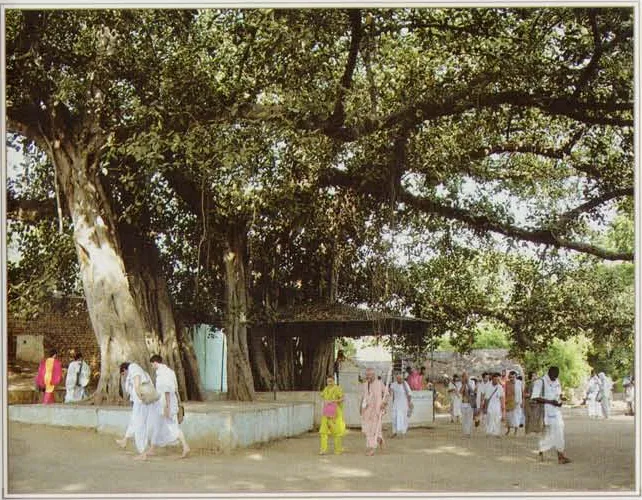
Bhāṇḍīravana
भाण्डीरवनBhāṇḍīravana, the forest of the Bhāṇḍīra banyan, is one of the twelve forests of Vraja, and Śrīla Prabhupāda counts it among the five forests on the eastern bank of the Y …
Bhāṇḍīravaṭa (Bhāṇḍīravana)
भाण्डीरवट (भाण्डीरवन)Bhāṇḍīravaṭa is the banyan of Bhāṇḍīravana, across the Yamunā from Vṛndāvana.
Muñjāṭavī
मुंजाटवीThe Muñjāṭavī, also called the Iṣīkāṭavī, is the forest of tall reeds where Kṛṣṇa swallowed a forest fire to save His cowherd friends and their cows.
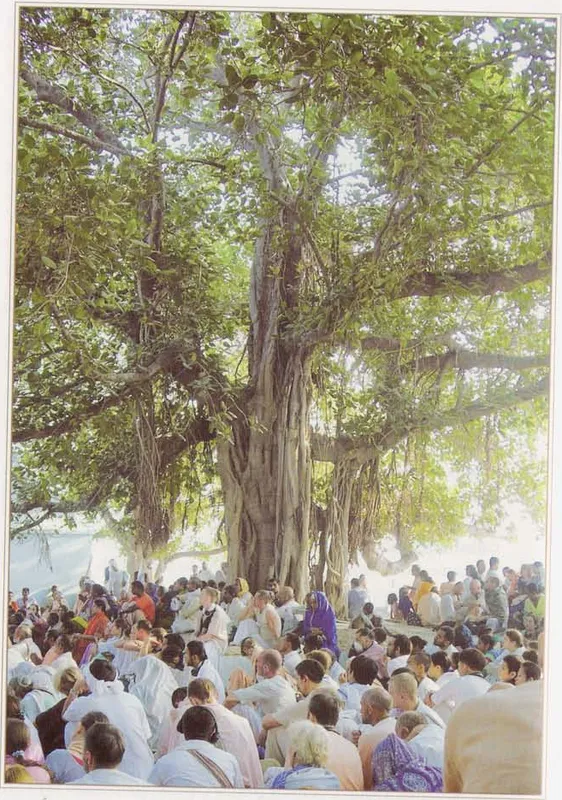
Rāma-ghāṭa
राम-घाटRāma-ghāṭa is a place on the Yamunā near Śergarh, honoured as the place of Balarāma's rāsa dance with the gopīs and of His dragging of the Yamunā with His plough, during …
Gandhibhima
गन्धिभिमKāśraṭa
काश्रटKāśraṭa is the village near Akṣayavaṭa.
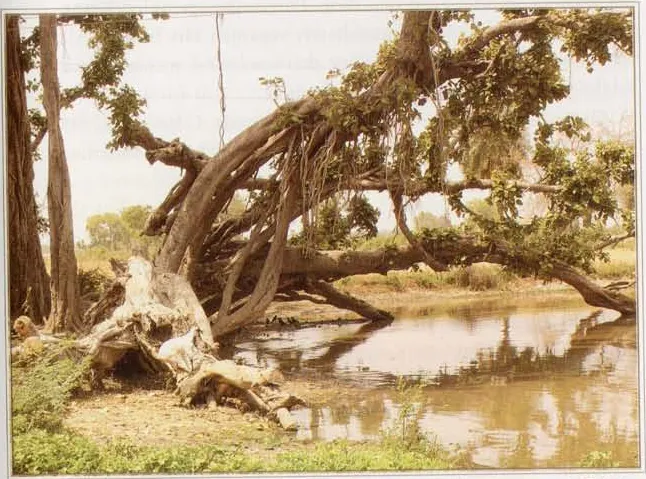
Khelanvana
खेलनवनKhelanvana, "the forest of play", lies at Śergarh on the Yamunā, two miles south-east of Ūjānī, according to Śrī Vraja-maṇḍala Parikramā (2007).
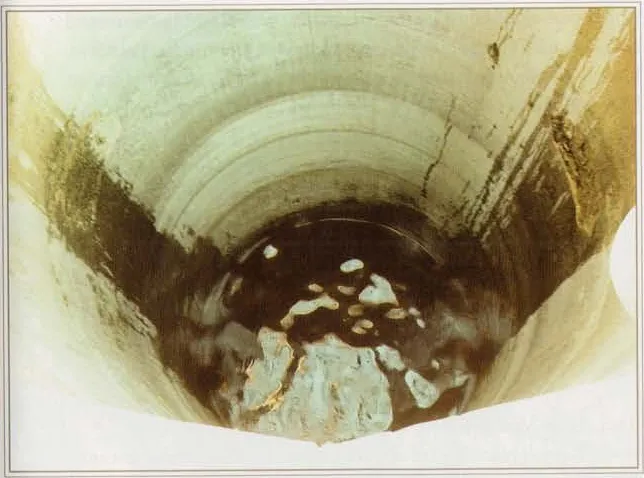
Veṇu-kūpa (Bhāṇḍīravana)
वेणु-कूप (भाण्डीरवन)Veṇu-kūpa, "the well of the flute", is a well near the Bhāṇḍīravaṭa in Bhāṇḍīravana.
Rādhā-Kṛṣṇa Marriage Place (Bhāṇḍīravaṭa)
राधा-कृष्ण विवाह-स्थल (भाण्डीरवट)This spot at the foot of the Bhāṇḍīravaṭa, the banyan of Bhāṇḍīravana, is traditionally revered by pilgrims as the place of Śrī Rādhā and Kṛṣṇa's wedding, and a shrine th …
Chāherī-gaon
छाहेरी-गाँवChāherī-gaon is a village near the Yamunā in Bhāṇḍīravana.
Questions and answers
The great banyan of Kṛṣṇa's boyhood in Vraja. The Harivaṁśa calls it a banyan like a mountain in the middle of Vṛndāvana. Śrīmad-Bhāgavatam names it in the Pralamba and forest-fire pastimes.[1 +7]
Śrīmad-Bhāgavatam says only that Pralamba carried Balarāma far beyond the agreed spot of the game before he was killed. It names no village. The Bhakti-ratnākara remembers the killing at the Bhāṇḍīravaṭa that people now call Akṣayavaṭa.[3 +4]
A game in pairs, in which the losers carried the winners. Kṛṣṇa lost and carried Śrīdāmā. Pralamba, disguised as a cowherd boy, carried Balarāma.[1–3, 28]
The cows strayed into the Muñjāṭavī, a forest of tall reeds, and a fire surrounded them and the boys. Kṛṣṇa asked His friends to close their eyes and swallowed the fire. Then they found themselves back at the Bhāṇḍīra.[4–6, 41]
The sources differ. Śrīla Sanātana Gosvāmī and Śrīla Jīva Gosvāmī place it on the western bank, the Vṛndāvana side. Śrīla Prabhupāda counts Bhāṇḍīravana among the forests of the eastern bank, but he does not say on which bank the banyan stood.[1 +8]
Pilgrims traditionally revere a spot beneath the Bhāṇḍīravaṭa as the wedding place. The account comes from the Garga-saṁhitā and the Brahma-vaivarta Purāṇa. Śrīmad-Bhāgavatam does not narrate it.[81 +8]
According to Śrīla Jīva Gosvāmī, the Bhāṇḍīra vanished when Kṛṣṇa's pastimes became hidden. The guidebooks say that a new banyan was planted at Akṣayavaṭa. No source gives the date.[14 +2]
Sources
- Śrīmad-Bhāgavatam 10.18.22, GRETIL
- Śrīmad-Bhāgavatam 10.18.24, GRETIL
- Śrīmad-Bhāgavatam 10.18.25, GRETIL
- Śrīmad-Bhāgavatam 10.19.5, GRETIL
- Śrīmad-Bhāgavatam 10.19.12, GRETIL
- Śrīmad-Bhāgavatam 10.19.13, GRETIL
- Śrīla Narahari Cakravartī, Bhakti-ratnākara, Fifth Wave (pañcama taraṅga), printed pp.267-268: the Bhāṇḍīra path 'now called Akṣayavaṭa', 2nd ed., 1912
- Śrīla Prabhupāda, Śrī Caitanya-caritāmṛta, Madhya-līlā 17.193, purport · vedabase.io
- Śrīla Prabhupāda, Śrīmad-Bhāgavatam, 4.8.42, purport · vedabase.io
- Śrīla Prabhupāda, Kṛṣṇa, the Supreme Personality of Godhead (Kṛṣṇa book), Chapter 18, 'Killing the Demon Pralambāsura' · vedabase.io
- Śrīla Prabhupāda, Kṛṣṇa, the Supreme Personality of Godhead (Kṛṣṇa book), Chapter 19, 'Devouring the Forest Fire' · vedabase.io
- Śrīla Prabhupāda, The Nectar of Devotion, Chapter 46, 'Astonishment and Chivalry' · vedabase.io
- Śrīmad-Bhāgavatam canto 10 with commentaries — Śrīla Sanātana Gosvāmī: commentary on ŚB 10.19.13, Bhagavata Vidya Pith edition, ed. Bhagavata Rishi and Krishna Shankar Shastri, 1996
- Gopāla-campū, Pūrva-campū (1) prathama pūraṇa, v.13
- Harivaṁśa, HV 52.25-27, GRETIL
- Harivaṁśa, HV 55.22-24, GRETIL
- Śrīla Sanātana Gosvāmī: commentary on ŚB 10.18.22, Bhagavata Vidya Pith edition, ed. Bhagavata Rishi and Krishna Shankar Shastri, 1996
- Śrīla Viśvanātha Cakravartī Ṭhākura: commentary on ŚB 10.19.1, Bhagavata Vidya Pith edition, ed. Bhagavata Rishi and Krishna Shankar Shastri, 1996
- Gopāla-campū, Pūrva-campū (1), v.28
- Śrīla Rūpa Gosvāmī, Rādhā-Kṛṣṇa-gaṇoddeśa-dīpikā, part 2, v.119, in the list of Śrī Kṛṣṇa's places
Show all 114 references
- Śrīla Rūpa Gosvāmī, Bhakti-rasāmṛta-sindhu, 4.2.11, GRETIL
- Śrīla Rūpa Gosvāmī, Bhakti-rasāmṛta-sindhu, 3.3.118, GRETIL
- Śrīla Rūpa Gosvāmī, Bhakti-rasāmṛta-sindhu, 4.9.35, GRETIL
- Śrīla Rūpa Gosvāmī, Stava-mālā, part 7 (Premendu-sāgara, the hundred and eight names of Kṛṣṇa) v.15 with the ṭīkā, after the edition of Bhakti Saranga Goswami and Purushottam Das, Vrindavan, 1959
- Śrīla Rūpa Gosvāmī, Stava-mālā, part 26 (Chando'ṣṭādaśaka) v.18 and the kalikā after it, section 'bhāṇḍīra-krīḍanādi', after the edition of Bhakti Saranga Goswami and Purushottam Das, Vrindavan, 1959
- Śrīla Viśvanātha Cakravartī Ṭhākura, Vṛndāvanāṣṭaka, Stavāmṛta-laharī part 24 (the Vṛndāvanāṣṭaka) v.5
- Śrīmad-Bhāgavatam ŚB 10.18.9, GRETIL
- Śrīmad-Bhāgavatam 10.18.28, GRETIL
- Śrīmad-Bhāgavatam ŚB 10.18.29, GRETIL
- Bhāvārtha-dīpikā (Śrīdhara Svāmī): commentary on ŚB 10.18.25, Bhagavata Vidya Pith edition, ed. Bhagavata Rishi and Krishna Shankar Shastri, 1996
- Śrīla Prabhupāda, Kṛṣṇa, the Supreme Personality of Godhead (Kṛṣṇa book), chapter 18 · vedabase.io
- Viṣṇu Purāṇa, 5.9.15-16, GRETIL
- Viṣṇu Purāṇa, 5.9.35-36, GRETIL
- Garga-saṁhitā, Mādhurya-khaṇḍa (4) 20.5, Sanskrit Wikisource
- Garga-saṁhitā, Mādhurya-khaṇḍa (4) 20.8-9, Sanskrit Wikisource
- Gopāla-campū, (16) ṣoḍaśaṁ pūraṇam ¶[27]
- Ānanda-vṛndāvana-campū, Stavaka 11 v.22
- Śrīla Rūpa Gosvāmī, Stava-mālā part 26 (Chando'ṣṭādaśaka), v.18 and the kalikā after it (section 'bhāṇḍīra-krīḍanādi'), after the edition of Bhakti Saranga Goswami and Purushottam Das, Vrindavan, 1959
- Harivaṁśa 58.21-22, GRETIL
- Viṣṇu Purāṇa 5.9.14-15, GRETIL
- Śrīmad-Bhāgavatam ŚB 10.19.2, GRETIL
- Śrīmad-Bhāgavatam canto 10 with commentaries — Śrīdhara Svāmī: commentary on ŚB 10.19.5, Bhagavata Vidya Pith edition, ed. Bhagavata Rishi and Krishna Shankar Shastri, 1996
- Śrīmad-Bhāgavatam canto 10 with commentaries — Śrīla Viśvanātha Cakravartī Ṭhākura: commentary on ŚB 10.19.11, Bhagavata Vidya Pith edition, ed. Bhagavata Rishi and Krishna Shankar Shastri, 1996
- Śrīla Rūpa Gosvāmī, Bhakti-rasāmṛta-sindhu, 4.2.11 (Uttara-vibhāga, second wave: astonishment), GRETIL
- Śrīmad-Bhāgavatam ŚB 10.30.22, GRETIL
- Śrīmad-Bhāgavatam canto 10 with commentaries — Śrīla Sanātana Gosvāmī: commentary on ŚB 10.30.22
- Harivaṁśa 58.9-10, GRETIL
- Viṣṇu Purāṇa 5.9.2, GRETIL
- Viṣṇu Purāṇa 5.9.8, GRETIL
- Bhaviṣya Purāṇa, Uttara-parva 73.2 (Malla-dvādaśī-vrata)
- Bhaviṣya Purāṇa, Uttara-parva 73.21 (Malla-dvādaśī-vrata)
- Śrīla Jīva Gosvāmī, Saṅkalpa-kalpadruma, vv.52-55, GRETIL
- Śrīla Raghunātha dāsa Gosvāmī, Stavāvalī, Vraja-vilāsa-stava 93
- Śrīla Narahari Cakravartī, Bhakti-ratnākara, Fifth Wave, printed p.268: Rādhā and Kṛṣṇa's wrestling at the Bhāṇḍīra, 2nd ed., 1912
- Śrī Vraja-maṇḍala Parikramā (2007), PDF p. 241
- the undated parikramā notes Akṣayavaṭa, ¶17
- Śrīla Narahari Cakravartī, Bhakti-ratnākara, Fifth Wave, printed pp. 274-275: the eighth forest, Bhāṇḍīravana, with the Ādi-vārāha verses and Chāherī, 2nd ed., 1912
- Śrīla Narahari Cakravartī, Bhakti-ratnākara, Fifth Wave, printed p. 285: the cowherds' move from Gokula to Vṛndāvana, 2nd ed., 1912
- Śrīla Narahari Cakravartī, Bhakti-ratnākara, Fifth Wave, printed p. 185: the twelve forests, with the Padma Purāṇa and Skanda verses, 2nd ed., 1912
- Śrīmad-Bhāgavatam canto 10 with commentaries — Śrīla Sanātana Gosvāmī: commentary on ŚB 10.11.29, Bhagavata Vidya Pith edition, ed. Bhagavata Rishi and Krishna Shankar Shastri, 1996
- Śrīla Viśvanātha Cakravartī, Vraja-rīti-cintāmaṇi, dvitīya sarga, vv.32 and 35-36
- Śrīla Rūpa Gosvāmī, Stava-mālā part 7, v.15 with the ṭīkā, after the edition of Bhakti Saranga Goswami and Purushottam Das, Vrindavan, 1959
- Śrīla Nārāyaṇa Bhaṭṭa, Vraja-bhakti-vilāsa, chapter (2), v.20: the sixteen banyans, printed p.36, 1st ed., publ. Bābā Kṛṣṇadāsa, Kusuma-sarovara, Saṁvat 2008
- Śrīla Kṛṣṇadāsa Kavirāja Gosvāmī, Śrī Caitanya-caritāmṛta, CC Madhya-līlā 18.66, online edition · vedabase.io
- Varāha Purāṇa, adhyāya 153, verses 45-47, Sanskrit Wikisource
- Varāha Purāṇa, adhyāya 156, verses 3-5, Sanskrit Wikisource
- Śrīla Rūpa Gosvāmī, Mathurā-māhātmya vv.354-356 ('of Bhāṇḍīra-vana'), quoting the Ādi-vārāha
- Padma Purāṇa, Vṛndāvana-māhātmya (1) v.48 (= Padma Pātāla-khaṇḍa 69.48)
- Śrīla Rūpa Gosvāmī, Bhakti-rasāmṛta-sindhu, 4.9.35 (Uttara-vibhāga, ninth wave: anurasa, imitation of astonishment), GRETIL
- Śrīla Prabhupāda, The Nectar of Devotion, Chapter 51, 'Mixing of Rasas' · vedabase.io
- Brahma-vaivarta Purāṇa, Kṛṣṇa-janma-khaṇḍa (4) 20.7-8, Sanskrit Wikisource
- Brahma-vaivarta Purāṇa, Kṛṣṇa-janma-khaṇḍa (4) 18.21-22, Sanskrit Wikisource
- Brahma-vaivarta Purāṇa, Kṛṣṇa-janma-khaṇḍa (4) 98.16-17, Sanskrit Wikisource
- Brahma-vaivarta Purāṇa, Kṛṣṇa-janma-khaṇḍa (4) 128.1-2, Sanskrit Wikisource
- Brahma-vaivarta Purāṇa, Kṛṣṇa-janma-khaṇḍa (4) 92.7-8, Sanskrit Wikisource
- Śrīmad-Bhāgavatam 10.13.61, GRETIL
- Garga-saṁhitā, Mādhurya-khaṇḍa (4), adhyāya 1, verse 12, Sanskrit Wikisource
- Garga-saṁhitā, Mādhurya-khaṇḍa (4), adhyāya 1, verses 26-27, Sanskrit Wikisource
- Mathurá (1883), F. S. Growse, B.C.S., M.A. Oxon., C.I.E. (as the title page gives him, p. 391
- Prabhudayāl Mītal, 'Braj-yātrā', first route across the Yamunā, entry 'भांडीर बन', printed p.129
- A. W. Entwistle, §8.64 'Bhandirban', printed p.399, Egbert Forsten, Groningen, 1987
- Vṛndāvana-Dhāma Ki Jaya! (c. 1986), by Dhruva Mahārāja dāsa, PDF p. 60
- Śrīla Nārāyaṇa Bhaṭṭa Gosvāmī, Vraja-bhakti-vilāsa, chapter 9, the Bhāṇḍīravana circuit: the Matsya-kūpa (quoted 'mātsye'), printed p. 205, 1st ed., publ. Bābā Kṛṣṇadāsa, Kusuma-sarovara, Saṁvat 2008
- Śrī Vraja-maṇḍala Parikramā (2007), PDF p. 253
- Garga-saṁhitā, Goloka-khaṇḍa (1) 15.60, Sanskrit Wikisource
- Garga-saṁhitā, Goloka-khaṇḍa (1) 15.61, Sanskrit Wikisource
- Garga-saṁhitā, Goloka-khaṇḍa (1) 16.1 (chapter heading 'Śrī-kṛṣṇa-rādhikā-vivāha-varṇanam'), Sanskrit Wikisource
- Garga-saṁhitā, Goloka-khaṇḍa (1) 16.8, Sanskrit Wikisource
- Garga-saṁhitā, Goloka-khaṇḍa (1) 16.11, Sanskrit Wikisource
- Garga-saṁhitā, Goloka-khaṇḍa (1) 16.20, Sanskrit Wikisource
- Brahma-vaivarta Purāṇa, Śrī-kṛṣṇa-janma-khaṇḍa (4) 15.1-2, Sanskrit Wikisource
- Brahma-vaivarta Purāṇa, Śrī-kṛṣṇa-janma-khaṇḍa (4) 15.120-121 (quoted) and 15.127-131 (summarised), Sanskrit Wikisource
- Brahma-vaivarta Purāṇa, Kṛṣṇa-janma-khaṇḍa (4) 111.55, Sanskrit Wikisource
- Garga-saṁhitā, Goloka-khaṇḍa (1) 16.29, Sanskrit Wikisource
- Garga muni performs Krsna’s Name giving ceremony. Description of Sri …, ¶47
- Śrīmad-Bhāgavatam ŚB 10.30.31, GRETIL
- Śrīla Prabhupāda, Kṛṣṇa, the Supreme Personality of Godhead (Kṛṣṇa book), Chapter 29, 'The Rāsa Dance: Introduction' · vedabase.io
- Śrīla Prabhupāda, Śrī Caitanya-caritāmṛta, Ādi-līlā 10.85, purport · vedabase.io
- Śrīla Narahari Cakravartī, Bhakti-ratnākara, Thirteenth Wave (trayodaśa taraṅga), printed p.1025: Vīracandra at the place of the Bhāṇḍīravaṭa, 2nd ed., 1912
- Nārada Purāṇa, उत्तरार्धः/अध्यायः 80 vv.80-75 to 80-77
- A. W. Entwistle, §8.59 'Akshay Bat', printed pp.392-393, Egbert Forsten, Groningen, 1987
- Śrī Vraja-maṇḍala Parikramā (2007), PDF p. 240
- the undated parikramā notes Akṣayavaṭa, ¶3
- the undated parikramā notes Akṣayavaṭa, ¶18
- the undated parikramā notes Bhāṇḍīravana, ¶6
- Garga-saṁhitā, Mādhurya-khaṇḍa (4) 21.6, Sanskrit Wikisource
- Garga-saṁhitā, Balabhadra-khaṇḍa (8), adhyāya 6, prose sections 10-13, Sanskrit Wikisource
- Śrīla Narahari Cakravartī, Bhakti-ratnākara, Fifth Wave, printed pp.268-269: Ārā-grāma and Muñjāṭavī near the Bhāṇḍīra, 2nd ed., 1912
- Brahma-vaivarta Purāṇa, Kṛṣṇa-janma-khaṇḍa (4) 129.2, Sanskrit Wikisource
- Brahma-vaivarta Purāṇa, Kṛṣṇa-janma-khaṇḍa (4) 129.7-8, Sanskrit Wikisource
- Śrīmad-Bhāgavatam 11.31.6, GRETIL
- Śrī Vraja-maṇḍala Parikramā (2007), PDF p. 254
- the undated parikramā notes Bhāṇḍīravana, ¶13
- the undated parikramā notes Bhāṇḍīravana, ¶14
Further sources
- Śrīmad-Bhāgavatam 10.18–19 (BBT; translation of these chapters by Śrīla Prabhupāda's disciples); Śrīla Prabhupāda, Kṛṣṇa book ch. 18–19, The Nectar of Devotion ch. 46 and 51, CC Madhya 5.12 purport.
- Commentaries of Śrīla Sanātana Gosvāmī, Śrīla Jīva Gosvāmī, Śrīla Viśvanātha Cakravartī Ṭhākura and Śrīla Śrīdhara Svāmī (Sanskrit): summarised, not translated.
- Bhakti-ratnākara, Fifth and Thirteenth Waves (1912 edition); Harivaṁśa, Viṣṇu, Bhaviṣya, Varāha, Brahma-vaivarta and Nārada Purāṇas, Garga-saṁhitā: summarised unless a published translation is shown.
- Historians (dated site descriptions only): F. S. Growse (1883), A. W. Entwistle (1987).