Caraṇa-pahāḍī (near Choṭī-baiṭhāna)
चरण-पहाड़ी (छोटी बठैन के पास)
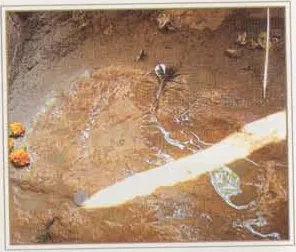
- What it is
- Caraṇa-pahāḍī, "the hill of the feet", is a small hill near Baiṭhāna; the guidebook Śrī Vraja-maṇḍala Parikramā (2007) places it one mile north of Choṭī-baiṭhāna.
- Visiting
- Śrī Vraja-maṇḍala Parikramā (2007) lists three hills called Caraṇa-pahāḍī among the hills of Vraja that pilgrims visit, this one as "Choṭī (small) Caraṇa-pahāḍī, near Baiṭhana".
In short
Caraṇa-pahāḍī, "the hill of the feet", is a small hill near Baiṭhāna; the guidebook Śrī Vraja-maṇḍala Parikramā (2007) places it one mile north of Choṭī-baiṭhāna.[1 +1] According to the Bhakti-ratnākara, Kṛṣṇa climbed this hill with His friends and played His flute. All who heard came running, the hill melted at the music, and the footprints of those who came, with Kṛṣṇa's own footprint, stayed in the rock and gave the hill its name.[3] The Garga-saṁhitā tells of a hill melting at Kṛṣṇa's flute, but in Kāmavana; Śrīmad-Bhāgavatam does not tell this pastime.[4 +1]
Key facts
| Kind | hill |
|---|---|
| Region · area | Jāvaṭa · Baḍokhora |
| Ācāryas | Śrīla Narahari Cakravartī Ṭhākura, Śrīla Rāghava Paṇḍita Gosvāmī of Govardhana, Śrīla Śrīnivāsa Ācārya |
Divine pastimes
The hill that melted at the flute
According to the Bhakti-ratnākara of Śrīla Narahari Cakravartī Ṭhākura, Śrīla Rāghava Paṇḍita Gosvāmī of Govardhana showed Śrīla Śrīnivāsa Ācārya this hill after Baiṭhāna and its kuṇḍas. While the cows grazed far off, Kṛṣṇa climbed the hill surrounded by His friends and looked all around. Flute in hand, He stood under a tree in His three-fold bending form and began to play. The whole world was enchanted, everyone came running and stood still, and the hill melted at the song. Śrīla Rāghava Paṇḍita told Śrīnivāsa to see on the rocks the footprints of all who came, and Kṛṣṇa's own footprint, which gave the hill its name (summarised here, not translated).[3]
চরণপাহাড়ি এই পর্ব্বতের নাম। এথা কৃষ্ণচন্দ্রের কৌতুক অনুপম ॥ সখা সুবেষ্টিত কৃষ্ণ চড়িয়া পর্ব্বতে। গো-গণ চরয়ে দূরে দেখে চারিভিতে ॥ ভুবনমোহন বেশে বংশী করে লৈয়া। দাঁড়াইলা বৃক্ষতলে ত্রিভঙ্গ হইয়া ॥ বংশীবাদ্যারম্ভ মাত্রে জগৎ মাতিল। যে যথা ছিলেন সবে ধাইয়া আইল ॥ বংশীগান শ্রবণে স্থগিত সবে হৈলা। তুলনা কি গানে এই পর্ব্বত দ্রবিলা ॥ বংশীধ্বনি শুনিয়া যে আইল এথায়। তা সবার পদচিহ্ন দেখহ শিলায় ॥ শ্রীকৃষ্ণের পাদপদ্ম চিহ্ন এ রহিল। এই হেতু চরণপাহাড়ি নাম হৈল ॥
caraṇapāhāṛi ei parbbatera nāma| ethā kṛṣṇacandrera kautuka anupama
sakhā subeṣṭita kṛṣṇa caṛiẏā parbbate| go-gaṇa caraẏe dūre dekhe cāribhite
bhubanamohana beśe baṁśī kare laiẏā| dām̐ṛāilā bṛkṣatale tribhaṅga haiẏā
baṁśībādyārambha mātre jagat mātila| ye yathā chilena sabe dhāiẏā āila
baṁśīgāna śrabaṇe sthagita sabe hailā| tulanā ki gāne ei parbbata drabilā
baṁśīdhbani śuniẏā ye āila ethāẏa| tā sabāra padacihna dekhaha śilāẏa
śrīkṛṣṇera pādapadma cihna e rahila| ei hetu caraṇapāhāṛi nāma haila ||
Śrīmad-Bhāgavatam does not tell of a hill melting at the flute. Commenting on the gopīs' song of the flute (ŚB 10.21.15), Śrīla Jīva Gosvāmī says in general that when Kṛṣṇa plays such a flute-song, dry branches sprout, stones melt and streams stand still; he names no place (summarised here, not translated).[7]
The Garga-saṁhitā tells that Kṛṣṇa, wandering with the women of Vraja, played His flute on a hill in Kāmavana; the hills melted at the music, and that hill came to bear His footprints, so that the sight of it brings one to the goal of life. It does not name this hill near Baiṭhāna. Kāmyavana has its own Caraṇa-pahāḍī, and a third is the Caraṇa-pahāḍī of Nandagrāma.[4 +3] Read more: The hills that melted at Kṛṣṇa's flute: the three Caraṇa-pahāḍīs →
Traditional accounts
The Bengali Bhaktamāla of Kṛṣṇadāsa Bābājī (1905) describes "another" Caraṇa-pahāḍī besides the one in Kāmyavana.
The Bengali Bhaktamāla of Kṛṣṇadāsa Bābājī (1905) describes "another" Caraṇa-pahāḍī besides the one in Kāmyavana. One day, it says, Kṛṣṇa and Balarāma were grazing the cows and buffaloes with Their friends; Kṛṣṇa playfully sounded His flute, the hill melted at the sweet sound, and the footprints of every friend, cow and buffalo were left in the rock, with Kṛṣṇa's and Balarāma's footprints in places and the marks of a friend who knelt there (summarised here, not translated).[10] The book gives no location for this hill; it places a Caraṇa-gaṅgā beside it, as the guidebook places Caraṇa-gaṅgā beside this one, but no source says that the two hills are the same.[10 +1]
The Bengali Vṛndāvana-kathā (1920) has a short entry "Caraṇa pāhāṛī": the hill melted at the sound of Śrī Kṛṣṇa's flute, and the footprints of the cowherd boys and cows that fell on it could still be seen in 1920. It does not say which Caraṇa-pahāḍī it means.[12]
According to Śrī Vraja-maṇḍala Parikramā (2007), the hill bears the footprints of Śrī Kṛṣṇa and Baladeva and the prints of cows and cowherd boys. When Kṛṣṇa played His flute standing under a tree on its top, the hill melted, and the cowherd boys, cows, deer, camels and other animals who came running left prints that all point one way, because the stones hardened again when the flute stopped. The book adds that Kṛṣṇa washed His feet at nearby Caraṇa-gaṅgā.[1 +1]
Visiting today
Śrī Vraja-maṇḍala Parikramā (2007) lists three hills called Caraṇa-pahāḍī among the hills of Vraja that pilgrims visit, this one as "Choṭī (small) Caraṇa-pahāḍī, near Baiṭhana". In its route list pilgrims go from Kokilāvana to Choṭī-baiṭhāna, Baḍī-baiṭhāna, Caraṇa-pahāḍī, Rasaulī and Koṭvana.[8 +1]
Caraṇa-gaṅgā
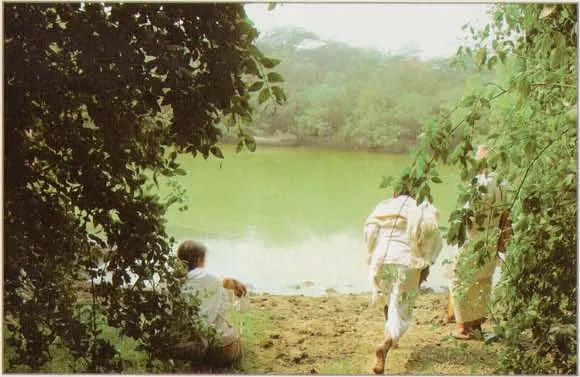
Caraṇa-gaṅgā is a pond near the hill. According to Śrī Vraja-maṇḍala Parikramā (2007), Kṛṣṇa washed His feet here; the book shows a photograph of the pond and, in another entry, says that Caraṇa-gaṅgā is located at Baḍokhora. Its statement that Kṛṣṇa washed His feet here has not been found in any older source.[2 +1] The only older book found that names the pond is the Bengali Bhaktamāla of Kṛṣṇadāsa Bābājī (1905). It counts two hills called Caraṇa-pahāḍī among the seven hills of Vraja, the footprint hill of Kāmyavana and "another" one (above), and says that beside this second hill is a Gaṅgā connected with Kṛṣṇa's footprint, known as Śrī Caraṇa-gaṅgā, the purifier of the world; one word of the line is broken in the print (summarised here, not translated).[10 +1]
চরণপাহাড়ি খ্যাত অন্য গিরিবর। কৃষ্ণ-বলরাম গো-মহিষ অনুচর ॥ সবাকার পদচিহ্ন অদ্যাপি প্রকাশ। কৃষ্ণপদচিহ্ন[…] গঙ্গা তাঁর পাশ ॥ শ্রীচরণগঙ্গা বলি তাঁহার খেয়াতি। ভুবনপাবনী তেঁহ সর্ব্বলোকগতি ॥ একদিন কৃষ্ণ-বলরাম সখা-সঙ্গে। গো-মহিষ চারণ করয়ে রসরঙ্গে ॥ কৌতুকী হইয়া কৃষ্ণ বংশীধ্বনি কৈল। মধুর ধ্বনিতে গিরি দ্রবীভূত হৈল ॥ যেখানে যে সখাগণ গো-মহিষ ছিল। সবাকার পদচিহ্ন পর্ব্বতে হইল ॥ কৃষ্ণ-বলরাম-পদচিহ্ন স্থানে স্থানে। হাঁটু গাড়ি বসি ছিল সখা কোনখানে ॥
caraṇapāhāṛi khyāta anya giribara| kṛṣṇa-balarāma go-mahiṣa anucara
sabākāra padacihna adyāpi prakāśa| kṛṣṇapadacihna[…] gaṅgā tām̐ra pāśa
śrīcaraṇagaṅgā bali tām̐hāra kheẏāti| bhubanapābanī tem̐ha sarbbalokagati
ekadina kṛṣṇa-balarāma sakhā-saṅge| go-mahiṣa cāraṇa karaẏe rasaraṅge
kautukī haiẏā kṛṣṇa baṁśīdhbani kaila| madhura dhbanite giri drabībhūta haila
yekhāne ye sakhāgaṇa go-mahiṣa chila| sabākāra padacihna parbbate haila
kṛṣṇa-balarāma-padacihna sthāne sthāne| hām̐ṭu gāṛi basi chila sakhā konakhāne ||
The book does not say where this second hill is. That it is this Caraṇa-pahāḍī, which also has a Caraṇa-gaṅgā beside it, is likely from the shared names but is stated by no source. The pond has not been found in any scripture, work of the Gosvāmīs or statement of Śrīla Prabhupāda.[2 +3]
Location
| Where it is | 1 mile north of Choṭī-baiṭhāna (also said to be at Baḍokhora)[16] near Baiṭhana[17] |
|---|
Places at Caraṇa-pahāḍī (near Choṭī-baiṭhāna)
1 places
Also described on this page
- Caraṇa-gaṅgā (Baḍokhora) kuṇḍa
Nearby places
Baiṭhāna · Koṭvana · Rasaulī
Pictures
1 pictures
History
The British district memoir of F. S. Growse (1883) reports a volume of Hindi poems recited on the morning of the Holaṅgā fair at Bathen (Baiṭhāna). Its colophon, dated Saṁvat 1852 (about 1795–96), says that Śrī Gopāl Dās wrote the book at Charan-Pahari for Śrī Sevā Dās of Baṛī Bathain. Growse adds that the Charan-Pahari is a small detached rock in the village of Little Bathen. The name was thus in use near Baiṭhāna by the end of the eighteenth century.[13]
Where the sources differ
Where the hill lies: the guidebook gives two positions, and the Bhakti-ratnākara only the order of the places.
Where the hill lies: the guidebook gives two positions, and the Bhakti-ratnākara only the order of the places.
Accounts differ Where Caraṇa-pahāḍī (and Caraṇa-gaṅgā) lies: Śrī Vraja-maṇḍala Parikramā (2007) gives two positions.
- Śrī Vraja-maṇḍala Parikramā (2007), Caraṇa-pahāḍī entry'This place is located one mile north of Choṭī-baiṭhāna'
- Śrī Vraja-maṇḍala Parikramā (2007), Baḍokhora entryBaḍokhora (Baindokhara) is 'situated west of Baiṭhāna'; 'Caraṇa-gaṅgā and Caraṇa-pahāḍī are located here'
- Śrī Vraja-maṇḍala Parikramā (2007), list of mountains'(23) Choṭī (small) Caraṇa-pahāḍī – near Baiṭhana' (and a separate '(17) Caraṇa-pahāḍī – Nandagaon')
- Bhakti-ratnākara, Fifth Waveno distance; lists the hill straight after Baiṭhāna's kuṇḍas and Beḍokhõr
Accounts differ Which hill melted at the sound of Kṛṣṇa's flute and kept the footprints.
- Garga-saṁhitā, Vṛndāvana-khaṇḍa 21.4-8a hill in Kāmavana; the mountains melted and that hill bears Kṛṣṇa's footprints
- Bhakti-ratnākara, Fifth Wave vv.1391-1397the hill Caraṇa-pāhāḍi after Beḍokhõr, near Baiṭhāna
- the Bengali Bhaktamāla of Kṛṣṇadāsa Bābājī (1905)both the Caraṇa-pāhāḍa of Kāmyavana (printed pp. 322-323) and 'another' Caraṇa-pāhāḍi with the Caraṇa-gaṅgā beside it (printed p. 323)
- Śrī Vraja-maṇḍala Parikramā (2007)three hills: Kāmyavana, Nandagaon and the hill one mile north of Choṭī-baiṭhāna
Accounts differ Whose footprints are on the hill.
- Bhakti-ratnākarathe footprints of all who came on hearing the flute, and Śrī Kṛṣṇa's own lotus-foot mark
- the Bengali Bhaktamāla of Kṛṣṇadāsa Bābājī (1905)Kṛṣṇa's and Balarāma's footprints in places, those of the friends, cows and buffaloes, and the knee-marks of a kneeling friend
- Śrī Vraja-maṇḍala Parikramā (2007)Kṛṣṇa and Baladeva's footprints, imprints of cows and gopas, and of deer, camels and other animals, all pointing in one direction
- Garga-saṁhitā 2.21.8 (for the Kāmavana hill)Kṛṣṇa's footprints only
Why the pond Caraṇa-gaṅgā is called so: the two books give different reasons. Where the pond and its hill lie is shown above, with the hill.[2 +1]
Accounts differ Why the pond is called Caraṇa-gaṅgā.
- Śrī Vraja-maṇḍala Parikramā (2007)'Nearby is Caraṇa-gaṅgā, where Kṛṣṇa washed His feet'
- the Bengali Bhaktamāla of Kṛṣṇadāsa Bābājī (1905)a Gaṅgā connected with Kṛṣṇa's footprint (the word after kṛṣṇa-pada-cihna is broken, possibly arisen from) beside the hill, famous as Śrī Caraṇa-gaṅgā; nothing about washing the feet
The wording of these accounts is our summary of the sources, not a published translation.
More on this place
The hills that melted at Kṛṣṇa's flute: the three Caraṇa-pahāḍīs
References
17 references
- Śrī Vraja-maṇḍala Parikramā (2007), PDF p. 233
- Śrī Vraja-maṇḍala Parikramā (2007), PDF p. 234
- Śrīla Narahari Cakravartī, Bhakti-ratnākara, Fifth Wave, printed pp. 255-256: the hill Caraṇa-pāhāḍi, after Beḍokhõr, 2nd ed., 1912
- Garga-saṁhitā, Vṛndāvana-khaṇḍa (2) 21.7, Sanskrit Wikisource
- Garga-saṁhitā, Vṛndāvana-khaṇḍa (2) 21.8, Sanskrit Wikisource
- Śrīla Narahari Cakravartī, Bhakti-ratnākara, Fifth Wave, printed pp. 255-256: the hill Caraṇa-pāhāḍi, after Beḍokhõr, 2nd ed., 1912
- Śrīla Jīva Gosvāmī: commentary on ŚB 10.21.15, Bhagavata Vidya Pith edition, ed. Bhagavata Rishi and Krishna Shankar Shastri, 1996
- Śrī Vraja-maṇḍala Parikramā (2007), PDF p. 26
- Śrī Vraja-maṇḍala Parikramā (2007), PDF p. 25
- Śrī Śrī Bhaktamāla grantha, ṣaḍviṁśa-mālā, the hills described one by one, printed p. 323, foot of the left column and top of the right column
- Śrī Śrī Bhaktamāla grantha, ṣaḍviṁśa-mālā, list of the seven hills of Vraja, printed p. 320, left column
- Vṛndāvana-kathā, ch. 8 (aṣṭama pariccheda), survey of the places of Vraja, entries 'ছত্রবনে', 'খদির বনে' and 'চরণ পাহাড়ী', printed p. 125
- Mathurá (1883), F. S. Growse, B.C.S., M.A. Oxon., C.I.E. (as the title page gives him, p. 99
- Śrī Vraja-maṇḍala Parikramā (2007), PDF p. 232
- Śrī Śrī Bhaktamāla grantha, ṣaḍviṁśa-mālā, the hills described one by one, printed p. 323, foot of the left column and top of the right column
- Śrī Vraja-maṇḍala Parikramā (2007), p. 440-441
- Śrī Vraja-maṇḍala Parikramā (2007), p. 26