The hills that melted at Kṛṣṇa's flute: the three Caraṇa-pahāḍīs
कृष्ण की बाँसुरी से पिघले पर्वत: तीन चरण-पहाड़ियाँ
In short
Caraṇa-pahāḍī, "the hill of the feet", is the name of three hills in Vraja: in Kāmyavana, west of Nandagrāma and near Choṭī-baiṭhāna. Each is said to have melted when Kṛṣṇa played His flute and to have kept His footprints. The Garga-saṁhitā and the Bhakti-ratnākara tell the pastime. The Bhāgavatam speaks of the flute's power without a melting hill.[1–5]
On this page
At a glance
- Scripture: Śrīmad-Bhāgavatam 10.21 tells that Kṛṣṇa's flute stuns moving beings and makes the trees tremble. It does not speak of melting stone.[4, 5]
- The ācāryas (the teachers of the tradition): Śrīla Jīva Gosvāmī, Śrīla Rūpa Gosvāmī and Śrīla Kṛṣṇadāsa Kavirāja Gosvāmī say that stones and mountains melt at the flute. They name no hill.[6–9]
- The Garga-saṁhitā tells of a hill in Kāmavana that melted at the flute and bears Kṛṣṇa's footprints.[1, 2]
- The Bhakti-ratnākara names a hill Caraṇa-pāhāḍi near Baiṭhāna and explains the name from Kṛṣṇa's footprint.[3]
- The 2007 guidebook Śrī Vraja-maṇḍala Parikramā tells the story of three hills: in Kāmyavana, at Nandagrāma and near Choṭī-baiṭhāna.[10–17]
- The historian Growse reports a copy of Hindi poems made in 1795–96. It was written at Charan-Pahari near Baṛī Bathain.[18]
What the Bhāgavatam says about the flute
The Tenth Canto gives a whole chapter to the gopīs' songs about Kṛṣṇa's flute. The gopīs, the cowherd girls of Vraja, sing them as He enters the forest with the cows. In one verse they describe the rivers.[4, 5]
When the rivers hear the flute-song of Kṛṣṇa, their minds begin to desire Him, and thus the flow of their currents is broken and their waters are agitated, moving around in whirlpools. Then with the arms of their waves the rivers embrace Murāri’s lotus feet and, holding on to them, present offerings of lotus flowers.
Translation: Śrīla Prabhupāda's disciples (BBT)In another they praise Govardhana Hill. It rejoices at the touch of the feet of Kṛṣṇa and Balarāma and serves Them, Their cows and Their friends. This is Śrīla Prabhupāda's translation, which he gives in the Caitanya-caritāmṛta:
Of all the devotees, this Govardhana Hill is the best! O my friends, this hill supplies Kṛṣṇa and Balarāma, as well as Their calves, cows and cowherd friends, with all kinds of necessities — water for drinking, very soft grass, caves, fruits, flowers and vegetables. In this way the hill offers respect to the Lord. Being touched by the lotus feet of Kṛṣṇa and Balarāma, Govardhana Hill appears very jubilant.
Translation: Śrīla A.C. Bhaktivedanta Swami PrabhupādaThe verse that follows tells the flute's power over moving and non-moving beings:
My dear friends, as Kṛṣṇa and Balarāma pass through the forest with Their cowherd friends, leading Their cows, They carry ropes to bind the cows’ rear legs at the time of milking. When Lord Kṛṣṇa plays on His flute, the sweet music causes the moving living entities to become stunned and the nonmoving trees to tremble with ecstasy. These things are certainly very wonderful.
Translation: Śrīla Prabhupāda's disciples (BBT)Śrīla Prabhupāda gives the same verse in his Kṛṣṇa book, his retelling of the Tenth Canto.[5]
General teaching (does not name the place)“When Kṛṣṇa and Balarāma play on Their transcendental flutes, the moving creatures become stunned and stop their activities, and the nonmoving living creatures, like trees and plants, begin to shiver with ecstasy.”
Śrīla Prabhupāda, Kṛṣṇa, the Supreme Personality of Godhead (Kṛṣṇa book), Chapter 21, The Gopīs Attracted by the Flute · vedabase.io
The Bhāgavatam itself does not speak of melting stone or of footprints left in rock.[4, 5]
What the ācāryas say: stones melt at the flute
The ācāryas go a step further, but they name no hill. Śrīla Jīva Gosvāmī comments on the verse of the rivers. He says that when Kṛṣṇa plays such a flute-song, dry branches sprout and stones melt. Flowing water stands still, and the swollen rivers rise even to the high place where He stands, to touch His feet. This is summarised here, not translated.[22]
Śrīla Viśvanātha Cakravartī Ṭhākura explains the joy of Govardhana in his note on that verse. At the touch of the feet of Rāma and Kṛṣṇa, its stones become like soft mud. So footprints marked with the flag, thunderbolt and goad are formed in them. He says this of Govardhana's stones in general.[6–9] Śrīla Sanātana Gosvāmī reads the same verse in his own way. Wherever Kṛṣṇa sets His lotus feet, Govardhana's stones at once become as soft as butter. They are cool in the hot season and warm in the cold. This is summarised here, not translated, and he too names no particular stone.[9]
Two other Gosvāmīs describe the same power in their own works. In Śrīla Rūpa Gosvāmī's play Vidagdha-mādhava, Balarāma marvels at the flute. When Kṛṣṇa kisses it, he says, the waters of the rivers become hard and the stones melt and become soft. In Śrīla Kṛṣṇadāsa Kavirāja Gosvāmī's Govinda-līlāmṛta, the motionless mountain peaks melt at the sound of the flute, and streams run in every direction.[6–9] None of them names a Caraṇa-pahāḍī.[6–9]
Śrīla Rūpa Gosvāmī also explains why pilgrims honour such marks. He counts the sight of Kṛṣṇa's footprint among the things that awaken love for Him. Śrīla Prabhupāda gives his example in The Nectar of Devotion. When Akrūra saw Kṛṣṇa's footprints on the land of Vṛndāvana, his love grew so much that the hairs on his body stood up.[23]
The hill of Kāmyavana
The oldest known text that ties the melting to a particular forest is the Garga-saṁhitā. It is summarised here, not translated. Wandering with the women of Vraja, Kṛṣṇa came to Kāmavana and played His flute on a hill there. At that music the moving and non-moving beings were bewildered. The rivers stood still and the mountains melted, and that hill in Kāmavana came to bear His footprints. Just by seeing it, the book says, one reaches the goal of life.[1 +2] The book does not give the hill a name.[1 +2]
The Bhakti-ratnākara of Śrīla Narahari Cakravartī Ṭhākura shows the marks of the holy feet on a hill of Kāmyavana. On Śrīla Śrīnivāsa Ācārya's tour, Śrīla Rāghava Paṇḍita points them out right after Dhyāna-kuṇḍa (a sacred pond), near the place of hide-and-seek. This book too does not name the hill. That it is today's Caraṇa-pahāḍī follows from the order of the places.[10–13] Read more: Kāmyavana parikramā: Vimala-kuṇḍa and the eighty-four tīrthas → The guidebooks name it Caraṇa-pahāḍī. The Bengali Bhaktamāla of Kṛṣṇadāsa Bābājī (1905) calls the hill of Kāmyavana that bears Kṛṣṇa's footprints Caraṇa-pāhāḍi, known in the three worlds.[10–13]
The Bhaktamāla also gives the occasion of its own telling, in a few words. Beside the hill is the Luk-lukī-kuṇḍa (the pond of hide-and-seek; the Bhaktamāla writes Lukāluki-kuṇḍa), where Kṛṣṇa played in the water with the gopīs. They could not find Him and grew upset. Then He played His flute from the top of the hill, the hill melted, and the mark of His lotus feet appeared on it.[25, 26] The 2007 guidebook places this hill two miles south-west of Kāmyavana, reached by the road from the Āmera Gate. It said then that Kṛṣṇa's footprints on it could still be seen very clearly.[10 +2]
The hill near Choṭī-baiṭhāna
The Bhakti-ratnākara gives the name Caraṇa-pāhāḍi to a different hill, after the village of Beḍokhõr near Baiṭhāna. It is summarised here, not translated. Śrīla Rāghava Paṇḍita tells Śrīla Śrīnivāsa Ācārya that Kṛṣṇa climbed this hill with His friends while the cows grazed far off. He stood under a tree in His three-fold bending form and played His flute. All who heard came running and stood still. The hill melted at the song, and their footprints were left on the rocks. Kṛṣṇa's own lotus-foot mark stayed there too, and so the hill is called Caraṇa-pāhāḍi.[3]
চরণপাহাড়ি এই পর্ব্বতের নাম। এথা কৃষ্ণচন্দ্রের কৌতুক অনুপম ॥ সখা সুবেষ্টিত কৃষ্ণ চড়িয়া পর্ব্বতে। গো-গণ চরয়ে দূরে দেখে চারিভিতে ॥ ভুবনমোহন বেশে বংশী করে লৈয়া। দাঁড়াইলা বৃক্ষতলে ত্রিভঙ্গ হইয়া ॥ বংশীবাদ্যারম্ভ মাত্রে জগৎ মাতিল। যে যথা ছিলেন সবে ধাইয়া আইল ॥ বংশীগান শ্রবণে স্থগিত সবে হৈলা। তুলনা কি গানে এই পর্ব্বত দ্রবিলা ॥ বংশীধ্বনি শুনিয়া যে আইল এথায়। তা সবার পদচিহ্ন দেখহ শিলায় ॥ শ্রীকৃষ্ণের পাদপদ্ম চিহ্ন এ রহিল। এই হেতু চরণপাহাড়ি নাম হৈল ॥
caraṇapāhāṛi ei parbbatera nāma| ethā kṛṣṇacandrera kautuka anupama
sakhā subeṣṭita kṛṣṇa caṛiẏā parbbate| go-gaṇa caraẏe dūre dekhe cāribhite
bhubanamohana beśe baṁśī kare laiẏā| dām̐ṛāilā bṛkṣatale tribhaṅga haiẏā
baṁśībādyārambha mātre jagat mātila| ye yathā chilena sabe dhāiẏā āila
baṁśīgāna śrabaṇe sthagita sabe hailā| tulanā ki gāne ei parbbata drabilā
baṁśīdhbani śuniẏā ye āila ethāẏa| tā sabāra padacihna dekhaha śilāẏa
śrīkṛṣṇera pādapadma cihna e rahila| ei hetu caraṇapāhāṛi nāma haila ||
The 2007 guidebook places this hill one mile north of Choṭī-baiṭhāna. It adds details that the Bhakti-ratnākara does not give. It speaks of the footprints of Kṛṣṇa and Baladeva and of the prints of cows, cowherd boys, deer and camels. They all point one way, because the stones hardened again when the flute stopped. Nearby, it says, is the Caraṇa-gaṅgā, where Kṛṣṇa washed His feet.[16, 17]
The Bengali Bhaktamāla counts a second Caraṇa-pāhāḍi besides the one of Kāmyavana, with the Caraṇa-gaṅgā beside it, but it does not give its place. There, it says, Kṛṣṇa and Balarāma were grazing cows and buffaloes with Their friends. Kṛṣṇa sounded His flute in play and the hill melted. The footprints of every friend, cow and buffalo were left on the rock. In places Kṛṣṇa's and Balarāma's own prints are there too, and the knee-marks of a friend who knelt there.[30]
The name near Baṛī Bathain is old. Growse (1883) reports a book of Hindi poems recited at the Holaṅgā fair there. Its colophon (the closing note of the book) is dated Saṁvat 1852 of the Indian Vikrama calendar, about 1795–96. It says the copy was written at Charan-Pahari for a resident of Baṛī Bathain. Growse describes Charan-Pahari as a small rock that crops up in the village of Little Bathen.[18]
The hill west of Nandagrāma
The third hill stands west of Nandagrāma. According to the 2007 guidebook, Kṛṣṇa played His flute there to call His cows. The rock melted at the sound and kept the prints of His feet.[14, 15] No older source is known to tell the flute story of this hill. The Bhakti-ratnākara shows footprints of Kṛṣṇa on the Nandīśvara hill, of whose power the elders speak, but without this name.[31] The guidebook connects this hill with Akrūra's sight of the footprints when he came to Vraja. That pastime is told in its own article.[32–35] Read more: Akrūra in Vraja: his arrival at Nandagrāma and Kṛṣṇa's departure →
The Vṛndāvana-kathā (1920) is a Bengali survey of the places of Vraja. It has an entry for a Caraṇa pāhāṛī without saying where it is. It says that at the sound of Kṛṣṇa's flute the hill melted, and the footprints of the cowherds and cows that fell on it could still be seen.[36]
Where the sources differ
The books do not agree on which hill melted. The Garga-saṁhitā names a hill in Kāmavana and the Bhakti-ratnākara the hill near Baiṭhāna. The Bengali Bhaktamāla names two hills and the 2007 guidebook three. The Bhāgavatam and its commentators name none.[1 +4]
Accounts differ Which hill melted at the sound of Kṛṣṇa's flute and kept the footprints.
- Garga-saṁhitā, Vṛndāvana-khaṇḍa 21.4-8a hill in Kāmavana; the mountains melted and that hill bears Kṛṣṇa's footprints
- Bhakti-ratnākara, Fifth Wave vv.1391-1397the hill Caraṇa-pāhāḍi after Beḍokhõr, near Baiṭhāna
- the Bengali Bhaktamāla of Kṛṣṇadāsa Bābājī (1905)both the Caraṇa-pāhāḍa of Kāmyavana (printed pp. 322-323) and 'another' Caraṇa-pāhāḍi with the Caraṇa-gaṅgā beside it (printed p. 323)
- Śrī Vraja-maṇḍala Parikramā (2007)three hills: Kāmyavana, Nandagaon and the hill one mile north of Choṭī-baiṭhāna
They also differ on whose footprints the rocks bear. The Garga-saṁhitā says they are Kṛṣṇa's alone. The Bhakti-ratnākara says they are Kṛṣṇa's and those of all who came. In the Bhaktamāla and the guidebook they are Kṛṣṇa's, Balarāma's, the friends' and the animals'.[3 +3]
Accounts differ Whose footprints are on the hill.
- Bhakti-ratnākarathe footprints of all who came on hearing the flute, and Śrī Kṛṣṇa's own lotus-foot mark
- the Bengali Bhaktamāla of Kṛṣṇadāsa Bābājī (1905)Kṛṣṇa's and Balarāma's footprints in places, those of the friends, cows and buffaloes, and the knee-marks of a kneeling friend
- Śrī Vraja-maṇḍala Parikramā (2007)Kṛṣṇa and Baladeva's footprints, imprints of cows and gopas, and of deer, camels and other animals, all pointing in one direction
- Garga-saṁhitā 2.21.8 (for the Kāmavana hill)Kṛṣṇa's footprints only
For the hill of Kāmyavana, the books also give different occasions for the flute. It is the rāsa pastimes (Kṛṣṇa's circle dance with the gopīs) in the Garga-saṁhitā, a game of hide-and-seek in the 2007 guidebook, and the water game at Lukāluki-kuṇḍa in the Bhaktamāla.[1 +6]
Accounts differ On what occasion Kṛṣṇa played the flute that melted the hill.
- Garga-saṁhitā, Vṛndāvana-khaṇḍa 21.4-8Wandering with the women of Vraja in the course of the rāsa pastimes, Kṛṣṇa came to Kāmavana and played the flute on a hill; the Vraja women fainted, the mountains melted.
- Śrī Vraja-maṇḍala Parikramā (2007)During hide-and-seek, after hiding in the cave Luk-luka-kandarā, Kṛṣṇa appeared on top of the hill and played the flute; it broke the sakhīs' meditation, they ran to Him, and the hill melted.
- the undated parikramā notes KāmyavanaKṛṣṇa played the flute here and the hill began to melt; hearing it, the gopīs, cowherd boys and cows climbed the hill.
- the Bengali Bhaktamāla of Kṛṣṇadāsa Bābājī (1905) (Bengali verse, Kolkata 1905; the Bengali Bhaktamāla of Kṛṣṇadāsa Bābājī (1905))During a water game with the gopīs in the Lukāluki-kuṇḍa beside the hill they held a diving contest; in the second round Kṛṣṇa stayed under, went away through the water and climbed the hill; seeing the gopīs searching and weeping, He played His flute from the summit; the stone melted and the mark of His lotus feet appeared on it.
The guidebook places the Baiṭhāna hill in two ways, and the Caraṇa-gaṅgā beside it has two explanations. So where the hill lies is not certain.[16 +2]
Accounts differ Where Caraṇa-pahāḍī (and Caraṇa-gaṅgā) lies: Śrī Vraja-maṇḍala Parikramā (2007) gives two positions.
- Śrī Vraja-maṇḍala Parikramā (2007), Caraṇa-pahāḍī entry'This place is located one mile north of Choṭī-baiṭhāna'
- Śrī Vraja-maṇḍala Parikramā (2007), Baḍokhora entryBaḍokhora (Baindokhara) is 'situated west of Baiṭhāna'; 'Caraṇa-gaṅgā and Caraṇa-pahāḍī are located here'
- Śrī Vraja-maṇḍala Parikramā (2007), list of mountains'(23) Choṭī (small) Caraṇa-pahāḍī – near Baiṭhana' (and a separate '(17) Caraṇa-pahāḍī – Nandagaon')
- Bhakti-ratnākara, Fifth Waveno distance; lists the hill straight after Baiṭhāna's kuṇḍas and Beḍokhõr
Places in this article
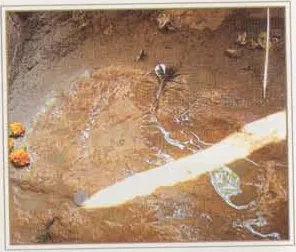
Caraṇa-pahāḍī (near Choṭī-baiṭhāna)
चरण-पहाड़ी (छोटी बठैन के पास)Caraṇa-pahāḍī, "the hill of the feet", is a small hill near Baiṭhāna; the guidebook Śrī Vraja-maṇḍala Parikramā (2007) places it one mile north of Choṭī-baiṭhāna.
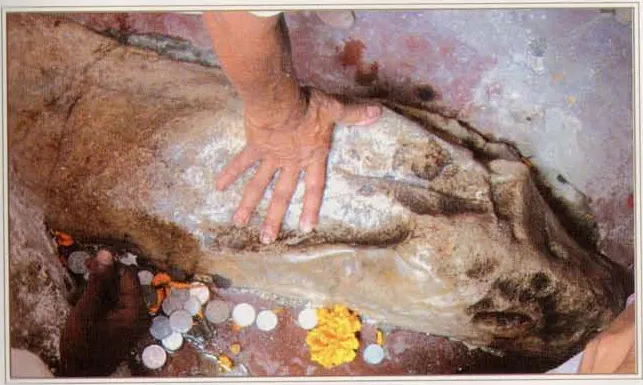
Caraṇa-pahāḍī (Kāmyavana)
चरण-पहाड़ी (काम्यवन)Caraṇa-pahāḍī, "the hill of the feet", is a hill outside the town of Kāmyavana.
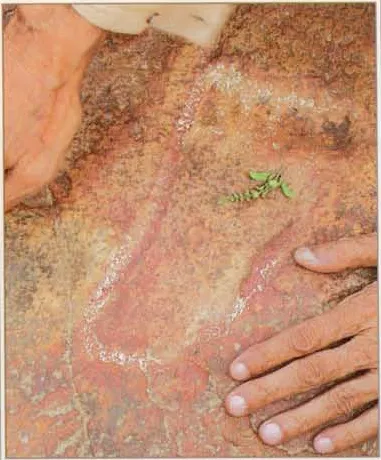
Caraṇa-pahāḍī (Nandagrāma)
चरण-पहाड़ी (नन्दग्राम)Caraṇa-pahāḍī, "the hill of the feet", is a hill west of Nandagrāma.
Caraṇa-gaṅgā (Baḍokhora)
चरण-गंगा (बड़ोखोर)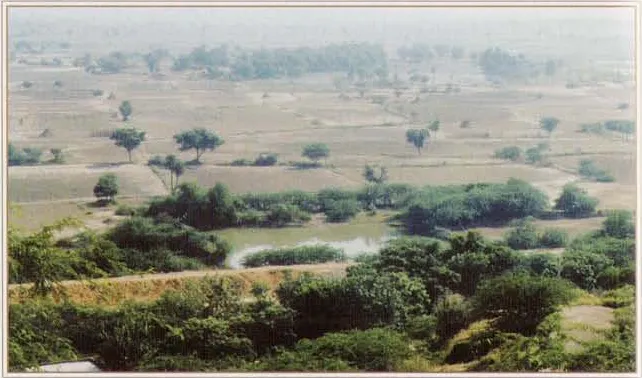
Luk-lukī-kuṇḍa
लुक-लुकी-कुण्डLuk-lukī-kuṇḍa, "the pond of hide-and-seek", is a kuṇḍa (sacred pond) of Kāmyavana.
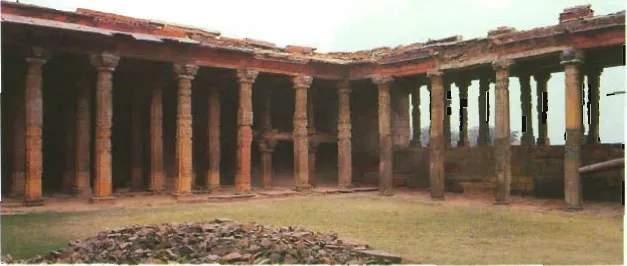
Kāmyavana
काम्यवनKāmyavana, also called Kāmavana, is one of the twelve forests of Vraja, around the town of Kāmā (Kāman).
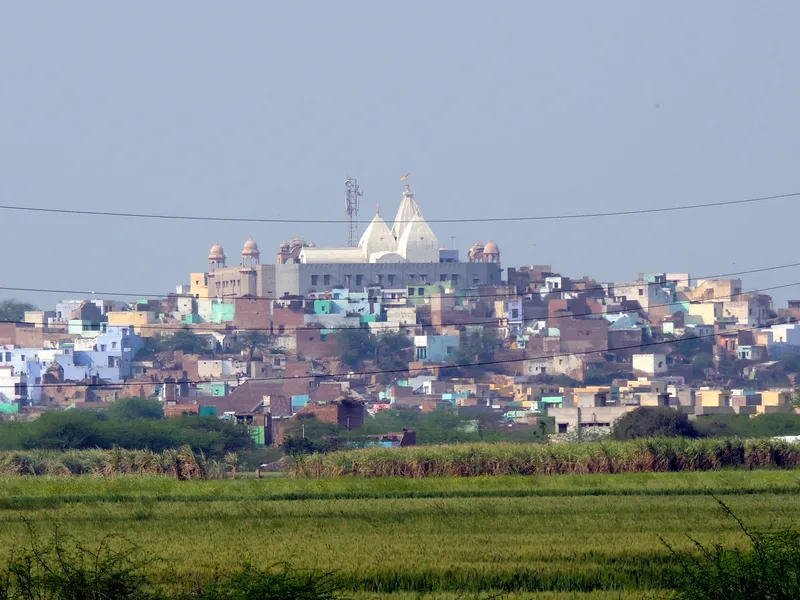
Nandagrāma
नन्दग्रामNandagrāma, today Nandagaon, is the village of Nanda Mahārāja, Kṛṣṇa's father in Vraja, on and around Nandīśvara Hill.
Questions and answers
The name means "the hill of the feet". It is a hill whose rock, according to the Garga-saṁhitā, the Bhakti-ratnākara and the guidebooks, melted at Kṛṣṇa's flute and kept His footprints. Three hills in Vraja bear the name.[1–3]
The books say that when Kṛṣṇa played His flute, the hill melted. The footprints of those standing on it, His own among them, stayed in the rock when it hardened again.[3 +2]
The 2007 guidebook names three: in Kāmyavana, west of Nandagrāma and near Choṭī-baiṭhāna. The Bengali Bhaktamāla counts two, and the older books one each.[10 +8]
No. Śrīmad-Bhāgavatam 10.21 says that the flute stuns moving beings and makes the trees tremble with ecstasy. Śrīla Jīva Gosvāmī and other ācāryas say that stones melt at the flute.[4–9]
The oldest known text to place it is the Garga-saṁhitā, which names a hill in Kāmavana. The Bhakti-ratnākara is the first known book to use the name Caraṇa-pāhāḍi, for the hill near Baiṭhāna.[1–3]
It is a pond beside the Caraṇa-pahāḍī near Baiṭhāna. The 2007 guidebook says Kṛṣṇa washed His feet there. The Bengali Bhaktamāla connects it with His footprint.[16 +2]
Sources
- Garga-saṁhitā, Vṛndāvana-khaṇḍa (2) 21.7, Sanskrit Wikisource
- Garga-saṁhitā, Vṛndāvana-khaṇḍa (2) 21.8, Sanskrit Wikisource
- Śrīla Narahari Cakravartī, Bhakti-ratnākara, Fifth Wave, printed pp. 255-256: the hill Caraṇa-pāhāḍi, after Beḍokhõr, 2nd ed., 1912
- Śrīmad-Bhāgavatam 10.21.19, Bhagavata Vidya Pith edition, ed. Bhagavata Rishi and Krishna Shankar Shastri, 1996
- Śrīla Prabhupāda, Kṛṣṇa, the Supreme Personality of Godhead (Kṛṣṇa book), Chapter 21, The Gopīs Attracted by the Flute · vedabase.io
- Śrīla Rūpa Gosvāmī, Vidagdha-mādhava 1.25 (Balarāma's speech)
- Śrīla Kṛṣṇadāsa Kavirāja Gosvāmī, Govinda-līlāmṛta 12.41, after the editions of Haridas Das and Haridas Shastri
- Śrīla Jīva Gosvāmī, Laghu-vaiṣṇava-toṣaṇī on Śrīmad-Bhāgavatam 10.21.15, Bhagavata Vidya Pith edition, ed. Bhagavata Rishi and Krishna Shankar Shastri, 1996
- Śrīla Viśvanātha Cakravartī Ṭhākura: commentary on ŚB 10.21.18, Bhagavata Vidya Pith edition, ed. Bhagavata Rishi and Krishna Shankar Shastri, 1996
- Śrī Vraja-maṇḍala Parikramā (2007), PDF p. 155
- the undated parikramā notes Kāmyavana, ¶14
- Vṛndāvana-Dhāma Ki Jaya! (c. 1986), by Dhruva Mahārāja dāsa, PDF p. 46
- Śrīla Narahari Cakravartī, Bhakti-ratnākara, Fifth Wave, 1912 ed. p. 216; Grantha Mandira text v.857 (first line), 2nd ed., 1912
- Śrī Vraja-maṇḍala Parikramā (2007), PDF p. 200
- Śrīla Rūpa Gosvāmī, Vidagdha-mādhava, Act 1 (veṇu-nāda-vilāsa), v.25
- Śrī Vraja-maṇḍala Parikramā (2007), PDF p. 233
- Śrī Vraja-maṇḍala Parikramā (2007), PDF p. 234
- Mathurá (1883), F. S. Growse, B.C.S., M.A. Oxon., C.I.E. (as the title page gives him, p. 99
- Śrīmad-Bhāgavatam 10.21.15, Bhagavata Vidya Pith edition, ed. Bhagavata Rishi and Krishna Shankar Shastri, 1996
- Śrīmad-Bhāgavatam 10.21.18, Bhagavata Vidya Pith edition, ed. Bhagavata Rishi and Krishna Shankar Shastri, 1996
Show all 36 references
- Śrīmad-Bhāgavatam 10.21.19, Bhagavata Vidya Pith edition, ed. Bhagavata Rishi and Krishna Shankar Shastri, 1996
- Śrīla Jīva Gosvāmī: commentary on ŚB 10.21.15, Bhagavata Vidya Pith edition, ed. Bhagavata Rishi and Krishna Shankar Shastri, 1996
- Śrīla Prabhupāda, The Nectar of Devotion, Chapter 26 · vedabase.io
- Garga-saṁhitā, Vṛndāvana-khaṇḍa (2) 21.4-5, Sanskrit Wikisource
- Śrī Śrī Bhaktamāla grantha, ṣaḍviṁśa-mālā, heading 'অথ কাম্যবনে চরণপাহাড়-মহিমাবর্ণন' and its first two couplets (printed p. 322, foot of the left column), then the last couplet of the right column
- Śrī Śrī Bhaktamāla grantha, ṣaḍviṁśa-mālā, the Kāmyavana Caraṇa-pāhāḍa section continued, printed p. 323, left column, couplets 1-3 and 8
- Śrī Vraja-maṇḍala Parikramā (2007), PDF p. 142
- Śrī Vraja-maṇḍala Parikramā (2007), PDF p. 160
- Śrīla Narahari Cakravartī, Bhakti-ratnākara, Fifth Wave, printed pp. 255-256: the hill Caraṇa-pāhāḍi, after Beḍokhõr, 2nd ed., 1912
- Śrī Śrī Bhaktamāla grantha, ṣaḍviṁśa-mālā, the hills described one by one, printed p. 323, foot of the left column and top of the right column
- Śrīla Narahari Cakravartī, Bhakti-ratnākara, Fifth Wave, 1912 ed. p. 228; Grantha Mandira text v.1014, 2nd ed., 1912
- Śrīmad-Bhāgavatam 10.38.24, Bhagavata Vidya Pith edition, ed. Bhagavata Rishi and Krishna Shankar Shastri, 1996
- Śrīmad-Bhāgavatam 10.38.25, Bhagavata Vidya Pith edition, ed. Bhagavata Rishi and Krishna Shankar Shastri, 1996
- Śrīmad-Bhāgavatam 10.38.26, Bhagavata Vidya Pith edition, ed. Bhagavata Rishi and Krishna Shankar Shastri, 1996
- Śrīla Prabhupāda, Kṛṣṇa, the Supreme Personality of Godhead, ch. 38 'Akrūra's Arrival in Vṛndāvana' · vedabase.io
- Vṛndāvana-kathā, ch. 8 (aṣṭama pariccheda), survey of the places of Vraja, entries 'ছত্রবনে', 'খদির বনে' and 'চরণ পাহাড়ী', printed p. 125
Further sources
- Śrīmad-Bhāgavatam, Tenth Canto, chapter 21 (translation by the disciples of Śrīla Prabhupāda; 10.21.18 in Śrīla Prabhupāda's translation from the Caitanya-caritāmṛta); Śrīla Prabhupāda, Kṛṣṇa, chapter 21.
- Garga-saṁhitā, Vṛndāvana-khaṇḍa 21; Bhakti-ratnākara, Fifth Wave; Bengali Bhaktamāla (1905); Vṛndāvana-kathā (1920): summarised here, not translated.