Kokilāvana
कोकिलावन Hindi name proposed
- What it is
- Kokilāvana, the forest of the cuckoo (kokila), lies west of Jāvaṭa.
- Visiting
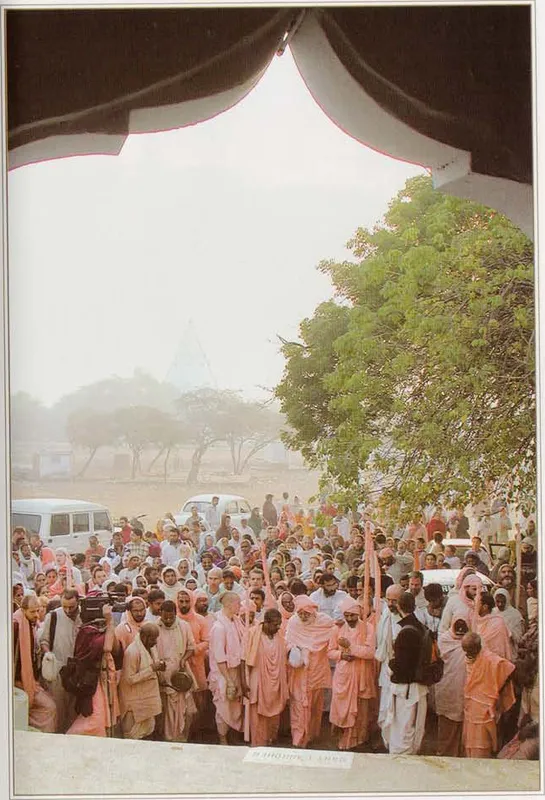
- Śrī Vraja-maṇḍala Parikramā (2007) prints a photograph of the entrance to a temple at Kokilāvana, crowded with pilgrims, but its text names no temple here.
- Places here
- Rāsa-maṇḍala (Kokilāvana), Ratnākara-sarovara (Kokilāvana), Rādhā-Kokilāvana-bihārī Mandira, Śanideva Mandira (Kokilāvana)
In short
Kokilāvana, the forest of the cuckoo (kokila), lies west of Jāvaṭa. According to the Bhakti-ratnākara, it takes its name from a pastime in which Kṛṣṇa called like a cuckoo so sweetly that Rādhā and Her sakhīs came into the forest, and so He met Her.[1 +4] Śrīla Viśvanātha Cakravartī Ṭhākura counts it among the twenty-four upavanas, the sub-forests of Vraja, where the cuckoo's call was an agreed signal.[6] The Garga-saṁhitā names it among the forests where Kṛṣṇa herded the cows.[7] Śrīla Nārāyaṇa Bhaṭṭa Gosvāmī's Vraja-bhakti-vilāsa classifies it differently, counting it among the twelve forests, and gives Naṭavara as its presiding Deity, with a pond called Ratnākara and a rāsa-maṇḍala as its signs.[2 +6]
Key facts
Why it is glorified
The Garga-saṁhitā (Vṛndāvana-khaṇḍa 10.17-21), describing how Kṛṣṇa wandered from forest to forest with the cows, names …
The Garga-saṁhitā (Vṛndāvana-khaṇḍa 10.17-21), describing how Kṛṣṇa wandered from forest to forest with the cows, names Kokilavana, loud with the calls of cuckoos, right after the hills of Bṛhatsānu and Nandīśvara. It tells no particular pastime there.[7]
The Nārada Purāṇa (Uttara-bhāga 80.75) names a Kokila forest, kokila-kānana, in a list of the holy places of Vṛndāvana, an area of five yojanas all round. It does not say where the forest is, so its identity with this Kokilāvana rests on the name alone.[14]
Divine pastimes
Kṛṣṇa's cuckoo call
Śrīmad-Bhāgavatam tells that while Kṛṣṇa herded the cows in the forest with Balarāma and the cowherd boys, He would sometimes answer a cuckoo by imitating its call. The Bhāgavatam tells this as play among the boys, not as a signal to Rādhā, and names no forest.[15 +1]
anujalpati jalpantaṃ kala-vākyaiḥ śukaṃ kvacit / kvacit sa-valgu kūjantam anukūjati kokilam … kvacic ca kāla-haṃsānām anukūjati kūjitam
Sometimes Lord Kṛṣṇa would imitate the chattering of a parrot, sometimes, with a sweet voice, the call of a cuckoo, and sometimes the cooing of swans.
Translation: Śrīla Prabhupāda's disciples (BBT)According to the Bhakti-ratnākara (Fifth Wave), Śrīla Rāghava Paṇḍita Gosvāmī told Śrīla Śrīnivāsa Ācārya and Śrīla Narottama dāsa Ṭhākura that Kṛṣṇa, who knows every language, is expert in the calls of the cuckoo and other birds, and used them as agreed signals to meet Rādhā. He then showed them this forest west of Yāvaṭa, full of cuckoos. One day Kṛṣṇa came here and made a cuckoo's call sweeter than any cuckoo's. Jaṭilā, who had never heard such a bird, let Viśākhā go with Rādhā and the sakhīs to see it, and so Kṛṣṇa met Rādhikā by the cuckoo's call; therefore, the book says, the place is called Kokilāvana (summarised here, not translated).[1 +4]
In his Vraja-rīti-cintāmaṇi (3.59), after the twelve principal forests, Śrīla Viśvanātha Cakravartī Ṭhākura names Hari's twenty-four sub-forests and among them Kokilā-kānana, where the cuckoo's call served as an agreed signal. He explains the name without telling the story.[6]
The rāsa-maṇḍala
Two guidebooks, the undated parikramā notes Kokilāvana and Śrī Vraja-maṇḍala Parikramā (2007), say that Kṛṣṇa danced the rāsa with the gopīs at the rāsa-maṇḍala of Kokilāvana, and the 2007 book adds that they then played in the water of the Ratnākara-sarovara. Neither names a source or says which rāsa this was.[17 +1] Śrīmad-Bhāgavatam sets the rāsa dance on the sandy bank of the Yamunā, and Kokilāvana is not on the Yamunā; the sources differ on where the rāsa and the water play after it took place.[19 +5] Read more: Where the autumn rāsa took place →
Accounts differ Where the rāsa dance and Kṛṣṇa's water play after it are set.
- Śrīmad-Bhāgavatam 10.29.45, 10.32.11-12, 10.33.2 (translation by Śrīla Prabhupāda's disciples)The rāsa takes place on the sandy bank of the Kālindī (Yamunā).
- Śrīmad-Bhāgavatam 10.33.22-24After the rāsa Kṛṣṇa entered 'the water' with the gopīs (in the translation, the Yamunā) and then strolled in a garden on the Yamunā's bank.
- Śrīla Sanātana Gosvāmī and the other commentators on ŚB 10.33.22The water of the Yamunā (Kālindī).
- Śrīla Prabhupāda, Kṛṣṇa book chs. 29 and 33The sandy bank of the Yamunā; the water of the Yamunā.
Traditional accounts
This website presents Kokilāvana as an upavana, a sub-forest of Vraja, following Śrīla Viśvanātha Cakravartī Ṭhākura, who counts …
An upavana, or one of the twelve forests
This website presents Kokilāvana as an upavana, a sub-forest of Vraja, following Śrīla Viśvanātha Cakravartī Ṭhākura, who counts it among the upavanas. The lists of the twelve forests in the Padma, Varāha and Nārada Purāṇas, in the Bhakti-ratnākara and in Śrīla Prabhupāda's purports do not include it; the sources differ.[6 +4] Read more: The twelve forests of Vraja: the lists side by side →
Śrīla Nārāyaṇa Bhaṭṭa Gosvāmī's Vraja-bhakti-vilāsa classifies it differently. It counts Kokilāvana among the twelve forests of Vraja twice: third in a list that it quotes from the "Pādma", and among the seven forests south of the Yamunā in a division that it quotes from the Ādi-varāha.[8 +5]
Accounts differ Whether Kokilāvana is one of the twelve forests of Vraja, or a sub-forest (upavana).
- Vraja-bhakti-vilāsa, list quoted 'pādme' (printed p. 2)Yes: the one called Kokilā is the third of the twelve forests.
- Vraja-bhakti-vilāsa, division of the twelve forests quoted 'ādivārāhe' (printed p. 12)Yes: the forest called Kokilā is one of the seven of the twelve forests on the southern bank of the Yamunā.
- Padma Purāṇa text, Pātāla-khaṇḍa 69.16-17Not in its list of twelve.
- Varāha Purāṇa 161.6-10Not in its list of twelve.
The wording of these accounts is our summary of the sources, not a published translation.
The Vraja-bhakti-vilāsa
The Vraja-bhakti-vilāsa gives Naṭavara, the best of dancers, as the Deity who presides over Kokilāvana, quoting the Bṛhan-nāradīya; that passage was not found in the available text of the Nārada Purāṇa.[10] It counts the forest among the nine forests that form the domain of Candrāvalī.[12] In a passage that it ascribes to the Viṣṇu-rahasya, describing Vraja as the Lord's own form, Bhāṇḍīra and Kokilā are His two feet; the edition's Hindi translation says His two hands.[11]
Quoting the Nārada-pañcarātra, the same book gives as the signs of Kokilāvana the Ratnākara pond and, beside it, the rāsa-maṇḍala.[2 +1] It sets the walk round the forest on Ṛṣi-pañcamī, the fifth day of the bright half of Bhādra, when it falls under the star Svāti. The pilgrim bows down six times with a prayer to the forest made by the cuckoo, which is said to give a voice like a cuckoo's; then bathes in the Ratnākara, prays at the rāsa-maṇḍala and walks round the forest, a circuit of one and three-quarter krośas (summarised here, not translated). The texts it quotes for this could not be checked.[28 +2]
Śrīla Prabhupāda
Śrīla Prabhupāda does not name Kokilāvana.
Śrīla Prabhupāda does not name Kokilāvana. In his Kṛṣṇa book, given here as a general account, he tells how Kṛṣṇa, Balarāma and the boys herded the cows and imitated the birds, the cuckoos among them:[15 +1]
General teaching (does not name the place)“Given charge of the cows, Kṛṣṇa and Balarāma traversed Vṛndāvana, purifying the land with Their lotus footprints. … They would all imitate the sound vibrations made by the different kinds of birds, especially the cakoras, peacocks, cuckoos and bhāradvājas.”
Śrīla Prabhupāda, Kṛṣṇa, the Supreme Personality of Godhead (Kṛṣṇa book), Chapter 15, 'The Killing of Dhenukāsura' · vedabase.io
Visiting today
Śrī Vraja-maṇḍala Parikramā (2007) prints a photograph of the entrance to a temple at Kokilāvana, crowded with pilgrims, but its text names no temple here. It may be the temple of Rādhā-Kokilāvana-bihārī, but no source says so, and none dates it.[3]
Location
| Where it is | Bhakti-ratnākara verse: 'jāvaṭera paścime e vana manohara'[34] Kokilāvana lies three miles north of Nandagaon and one mile west of Jāvaṭa.[33] |
|---|
Places at Kokilāvana
5 places
- 1Rāsa-maṇḍala (Kokilāvana)rāsa-sthalī›
- 2Ratnākara-sarovara (Kokilāvana)sarovara›
- 3Rādhā-Kokilāvana-bihārī Mandiratemple›
- 4Śanideva Mandira (Kokilāvana)shrine›
Also listed here
- Temple at Kokilāvana temple
Nearby places
Nandagrāma · Jāvaṭa · Baiṭhāna
History
In 1883 the British district officer F. S. Growse described Kokila-ban as a thickly wooded grove with a natural lake joined to a masonry tank, which he ascribed to Rūparāma Kaṭārā of Varṣāṇā, with shrines and pavilions on its margin. He recorded a pavilion built in 1870 by Nem Jī of Kosī with money left by his brother, a fair every Saturday and a larger one at every full moon, and some ten thousand pilgrims at the rāsa-līlā on the tenth day of the bright half of Bhādrapada. The resident ascetic then belonged to the Nimbārka line, and the grove measured 212 bighas.[31]
In 1966 the historian Prabhudayāl Mītal described a long unpaved kuṇḍa with some ghāṭas on one side, which he said Rājā Vīrasiṁha of Orchhā had built; he also recorded the rāsa-līlā on the same day, a sitting place (baiṭhaka) of Śrī Vallabhācārya and a temple.[32] The historians differ on who built the pond, and no source says whether it is the Ratnākara of the Vraja-bhakti-vilāsa.[31 +1]
Accounts differ Who built the masonry pond (kuṇḍa) at Kokilāvana.
- Growse (1883), Mathurá, p. 365A masonry tank 'also the work of Rúp Rám' (the Katārā of Barsana, p. 364), connected with the natural lake.
- Mītal (1966), Braj kā sāṁskṛtik itihās, vol. 1, p. 125The long unpaved kuṇḍa with some ghāṭas on one side was built by Rājā Vīrasiṁha of Orchhā.
- Entwistle (1987), Braj, p. 387Names the pond north of the Kokilabihārī temple Krishnakund and reports both: according to Growse its masonry facing by Rup Ram, according to Mital the steps at one end by Bir Singh Deo of Orchha.
Where the sources differ
Where the forest lies: the guidebooks give it three miles north of Nandagrāma and one mile west of Jāvaṭa, distances that do not …
Where the forest lies: the guidebooks give it three miles north of Nandagrāma and one mile west of Jāvaṭa, distances that do not agree with their own positions of Jāvaṭa.[1 +2]
Accounts differ Kokilāvana's position relative to Nandagaon and Jāvaṭa.
- Śrī Vraja-maṇḍala Parikramā (2007); the undated parikramā notes KokilāvanaThree miles north of Nandagaon and one mile west of Jāvaṭa.
- Bhakti-ratnākara, Fifth Wave (printed p. 241)West of Yāvaṭa (no distance).
- Śrī Vraja-maṇḍala Parikramā (2007)Jāvaṭa lies approximately two miles east of Nandagaon (with which 'one mile west of Jāvaṭa' would put Kokilāvana about a mile east of Nandagaon, not three miles north).
- the undated parikramā notes YāvaṭaYāvaṭa is 3 km north-east of Nandagaon.
Accounts differ Which limbs of the Lord Bhāṇḍīra and Kokilā are, in the Vraja-bhakti-vilāsa's Viṣṇu-rahasya list.
- Vraja-bhakti-vilāsa, Sanskrit (printed p. 14)'dvau pādau': the two feet.
- Vraja-bhakti-vilāsa, the edition's Hindi translation (same page)'भाण्डीर, कोकिल दोनों हस्त': both hands.
More on this place
The twelve forests of Vraja: the lists side by side · Where the autumn rāsa took place
References
34 references
- Śrīla Narahari Cakravartī, Bhakti-ratnākara, Fifth Wave (pañcama taraṅga), printed pp. 241-242: the cuckoo pastime that names Kokilāvana, 2nd ed., 1912
- Śrī Vraja-maṇḍala Parikramā (2007), PDF p. 222
- Śrī Vraja-maṇḍala Parikramā (2007), PDF p. 223
- the undated parikramā notes Kokilāvana, ¶31
- Padyāvalī (anthology compiled by Śrīla Rūpa Gosvāmī), verse 205, GRETIL
- Śrīla Viśvanātha Cakravartī Ṭhākura, Vraja-rīti-cintāmaṇi, tṛtīyaḥ sargaḥ v.59
- Garga-saṁhitā, Vṛndāvana-khaṇḍa (2) 10.17-19, Sanskrit Wikisource
- Śrīla Nārāyaṇa Bhaṭṭa Gosvāmī, Vraja-bhakti-vilāsa, chapter 1, list of the twelve forests quoted 'pādme', vv.13-14, printed p. 2, 1st ed., publ. Bābā Kṛṣṇadāsa, Kusuma-sarovara, Saṁvat 2008
- Śrīla Nārāyaṇa Bhaṭṭa Gosvāmī, Vraja-bhakti-vilāsa, chapter 1, the two divisions of the twelve forests by the Yamunā's banks, quoted 'ādivārāhe', printed p. 12, 1st ed., publ. Bābā Kṛṣṇadāsa, Kusuma-sarovara, Saṁvat 2008
- Śrīla Nārāyaṇa Bhaṭṭa Gosvāmī, Vraja-bhakti-vilāsa, chapter 1, the presiding Deities of the twelve forests quoted from the Bṛhan-nāradīya, no. 3, printed p. 5, 1st ed., publ. Bābā Kṛṣṇadāsa, Kusuma-sarovara, Saṁvat 2008
- Śrīla Nārāyaṇa Bhaṭṭa Gosvāmī, Vraja-bhakti-vilāsa, first chapter, v.93 (the print closes the passage '॥ ९३ ॥'): Vraja-maṇḍala and its forests as the limbs of the Lord, quoted under the label 'viṣṇu-rahasye'; printed p. 14, 1st ed., publ. Bābā Kṛṣṇadāsa, Kusuma-sarovara, Saṁvat 2008
- Śrīla Nārāyaṇa Bhaṭṭa Gosvāmī, Vraja-bhakti-vilāsa, chapter 2, the domain (adhikāra-rājya) of Candrāvalī, printed p. 38, 1st ed., publ. Bābā Kṛṣṇadāsa, Kusuma-sarovara, Saṁvat 2008
- Śrīla Nārāyaṇa Bhaṭṭa Gosvāmī, Vraja-bhakti-vilāsa, chapter 2, the signs (cihna) of the forests, Kokilāvana, quoted from the Nārada-pañcarātra, printed p. 50, 1st ed., publ. Bābā Kṛṣṇadāsa, Kusuma-sarovara, Saṁvat 2008
- Nārada Purāṇa, उत्तरार्धः/अध्यायः 80 vv.80-75 to 80-77
- Śrīmad-Bhāgavatam 10.15.11 (vedabase prints 10.15.10-12 together), GRETIL
- Śrīla Prabhupāda, Kṛṣṇa, the Supreme Personality of Godhead (Kṛṣṇa book), Chapter 15, 'The Killing of Dhenukāsura' · vedabase.io
- the undated parikramā notes Kokilāvana, ¶3
- Śrī Vraja-maṇḍala Parikramā (2007), PDF p. 225
- Śrīmad-Bhāgavatam 10.29.45, GRETIL
- Śrīmad-Bhāgavatam 10.32.11–12, GRETIL
Show all 34 references
- Śrīmad-Bhāgavatam 10.33.2, GRETIL
- Śrīmad-Bhāgavatam 10.33.3, GRETIL
- Śrīmad-Bhāgavatam 10.33.5, GRETIL
- Śrīla Prabhupāda, Kṛṣṇa, the Supreme Personality of Godhead (Kṛṣṇa book), Chapter 29, 'The Rāsa Dance: Introduction' · vedabase.io
- Padma Purāṇa, Vṛndāvana-māhātmya (1) vv.16-17 (= Padma Pātāla-khaṇḍa 69.16-17)
- Varāha Purāṇa, adhyāya 161, verses 6-10, Sanskrit Wikisource
- Śrīla Prabhupāda, Śrīmad-Bhāgavatam, 4.8.42, purport · vedabase.io
- Śrīla Nārāyaṇa Bhaṭṭa Gosvāmī, Vraja-bhakti-vilāsa, chapter 9, the circumambulation of Kokilāvana: the time (quoted 'ādivārāhe') and the prayer to the forest (quoted 'nāradapañcarātre'), printed p. 202, 1st ed., publ. Bābā Kṛṣṇadāsa, Kusuma-sarovara, Saṁvat 2008
- Śrīla Nārāyaṇa Bhaṭṭa Gosvāmī, Vraja-bhakti-vilāsa, chapter 9, the circumambulation of Kokilāvana: the prayer at the Ratnākara-sarovara, printed p. 203, 1st ed., publ. Bābā Kṛṣṇadāsa, Kusuma-sarovara, Saṁvat 2008
- Śrīla Nārāyaṇa Bhaṭṭa Gosvāmī, Vraja-bhakti-vilāsa, chapter 9, the circumambulation of Kokilāvana: the prayer at the rāsa-maṇḍala and the length of the circuit, printed p. 203, 1st ed., publ. Bābā Kṛṣṇadāsa, Kusuma-sarovara, Saṁvat 2008
- Mathurá (1883), F. S. Growse, B.C.S., M.A. Oxon., C.I.E. (as the title page gives him, p. 365
- Prabhudayāl Mītal, 'Kokilā ban', printed p. 125
- the undated parikramā notes Kokilāvana, ¶4
- Śrī Vraja-maṇḍala Parikramā (2007), p. 419