The four lanes by Sevā-kuñja
दान-गली Hindi name proposed
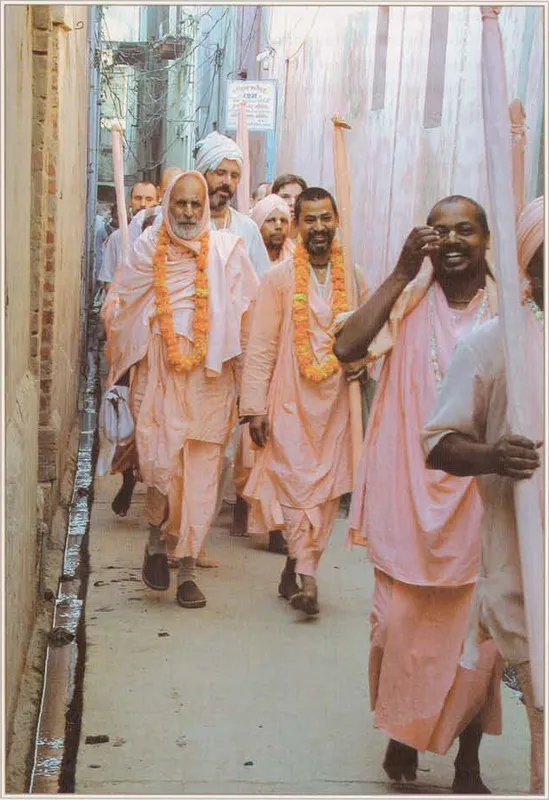
- What it is
- Four narrow lanes meet at one crossing near Sevā-kuñja in Vṛndāvana: Dāna-galī, Māna-galī, Gumāna-galī and Kuñja-galī, with the Deity Śrī Dāna-bihārī and the Śrī Rūpa-Sanātana Gauḍīya Maṭha where …
- Visiting
- Śrī Vraja-maṇḍala Parikramā (2007) places the four lanes, Dāna-galī, Māna-galī, Gumāna-galī and Kuñja-galī, just near Sevā-kuñja and photographs Dāna-galī.
In short
Four narrow lanes meet at one crossing near Sevā-kuñja in Vṛndāvana: Dāna-galī, Māna-galī, Gumāna-galī and Kuñja-galī, with the Deity Śrī Dāna-bihārī and the Śrī Rūpa-Sanātana Gauḍīya Maṭha where they cross.[1 +5] According to Śrī Vraja-maṇḍala Parikramā (2007), in Dāna-galī Kṛṣṇa and His friends asked the gopīs for a tax (dāna) of prema, pure love, and the gopīs asked the same of Him; so the lane is called Dāna-galī.[1 +1] The same book, the only one that names the lanes, gives each of the other three a local tradition of its own, and these traditions are not certain.[1 +2] The Bhāgavatam tells no toll pastime, and the commentators who read one into it name no place.[8 +4]
Key facts
| Kind | street/lane |
|---|---|
| Region · area | Vṛndāvana |
Divine pastimes
The toll pastime in the scriptures
Śrīmad-Bhāgavatam 10.18 lists the games that Kṛṣṇa, Balarāma and the cowherd boys played among the rivers, hills and groves of Vṛndāvana: games with fruits, touching and blindfold games, imitating animals and birds, jumping like frogs, swinging and imitating kings. It tells no toll pastime and names no single place, no lane, no toll and no refusal by Rādhā.[8 +3]
kvacid bilvaiḥ kvacit kumbhaiḥ kvacāmalaka-muṣṭibhiḥ / aspṛśya-netra-bandhādyaiḥ kvacin mṛga-khagehayā
Sometimes the cowherd boys would play with bilva or kumbha fruits, and sometimes with handfuls of āmalaka fruits. At other times they would play the games of trying to touch one another or of trying to identify somebody while one is blindfolded, and sometimes they would imitate animals and birds.
Translation: Śrīla Prabhupāda's disciples (BBT)Among these games, the Bhāgavatam says, the boys sometimes imitated kings:
kvacic ca dardura-plāvair vividhair upahāsakaiḥ / kadācit syandolikayā karhicin nṛpa-ceṣṭayā
They would sometimes jump around like frogs, sometimes play various jokes, sometimes ride in swings and sometimes imitate monarchs.
Translation: Śrīla Prabhupāda's disciples (BBT)Two commentators read the stopping of the gopīs into these verses (summarised here, not translated). Śrīla Sanātana Gosvāmī counts among the boys' "other games" blocking the way of the gopīs who passed at midday on the pretext of selling milk products, taking their yogurt, and ferrying by boat. Śrīla Viśvanātha Cakravartī Ṭhākura explains "imitating kings" as acting like a king at a toll place and stopping the girls of Vraja to take the toll; he does not say where the toll place was. Neither names a place, and neither tells of a tax of prema asked by both sides.[9 +3] Śrīla Jīva Gosvāmī and Śrīla Baladeva Vidyābhūṣaṇa explain the words instead as royal play, with a throne of hill-stone and an umbrella of flowers, and in the Kṛṣṇa book Śrīla Prabhupāda tells the same game as play "like a king and his subjects", without a toll. None of them names a place or tells of Rādhā refusing.[10 +2]
In a second reading of ŚB 10.35.14–15, the Bṛhat-krama-sandarbha, which its available text gives as Śrīla Jīva Gosvāmī's, and Śrīla Śrīnātha Cakravartī's commentary have the gopīs tell mother Yaśodā that her son, like a cowherd headman keeping a toll on the road, takes a toll on their milk products and torments them (summarised here, not translated). The verse itself and the Kṛṣṇa book speak only of His skill with the cows and the flute.[13 +3] Śrīla Sanātana Gosvāmī counts the toll pastimes told by Śrī Caṇḍīdāsa among those covered by the verse that closes the rāsa (ŚB 10.33.25). None of them names a place.[17 +1] Read more: Kṛṣṇa's toll pastime (dāna-līlā) at Govardhana and Varṣāṇā →
The Garga-saṁhitā names the dāna-līlā, the māna-līlā and the rāsa-līlā with the beauties of Vraja among the pastimes Kṛṣṇa performed in Vṛndāvana. It names no lane or temple.[19] According to the Bhakti-ratnākara, Kṛṣṇa performed the dāna-līlā on the hill at Varṣāṇā, where He also broke Rādhikā's māna, Her loving anger.[20]
Gumāna-galī
Śrī Vraja-maṇḍala Parikramā (2007), the only book that describes the lane, says that some call it Gumāna-galī after a local tradition that Śrī Rādhā showed pride (gumāna) here: Kṛṣṇa asked Śrīmatī Rādhikā for a toll (dāna) in this lane, and She, full of pride, refused to give it. No other source for this telling was found, so it is not certain. The book tells it beside its toll pastime of Dāna-galī, where the toll asked is "in the form of prema", and it cites no source for either story.[1 +1] No scripture or Gosvāmī work names the lane.[9 +1] The book is not consistent about the lane's name: its text calls it Prema-galī and adds that some also call it Gumāna-galī.[1 +1]
Māna-galī
Śrī Vraja-maṇḍala Parikramā (2007) records a local tradition that once, when Śrīmatī Rādhikā was in māna, loving anger, She made Her way to Māna-sarovara "via this very Māna-galī"; this is not certain. The book gives no occasion for the walk here, and it does not say in so many words that the lane is named after it. It is the only source that names the lane; no scripture or Gosvāmī work found names it.[1 +1]
Śrīmad-Bhāgavatam (10.29–10.30) tells that at the autumn rāsa the gopīs, honoured by Kṛṣṇa, grew proud, and that He disappeared to calm their pride. The searching gopīs then found that He had led one gopī away alone; proud, She asked Him to carry Her, and He disappeared from Her too. The verses name neither Rādhā nor any lane or lake; Śrīla Prabhupāda's Kṛṣṇa book names the gopī Rādhārāṇī.[21 +5]
ity evaṃ darśayantyas tāś cerur gopyo vicetasaḥ / yāṃ gopīm anayat kṛṣṇo vihāyānyāḥ striyo vane … sā ca mene tadātmānaṃ variṣṭhaṃ sarva-yoṣitām / hitvā gopīḥ kāma-yānā mām asau bhajate priyaḥ
As the gopīs wandered about, their minds completely bewildered, they pointed out various signs of Kṛṣṇa’s pastimes. The particular gopī whom Kṛṣṇa had led into a secluded forest when He had abandoned all the other young girls began to think Herself the best of women. “My beloved has rejected all the other gopīs,” She thought, “even though they are driven by Cupid himself. He has chosen to reciprocate with Me alone.”
Translation: Śrīla Prabhupāda's disciples (BBT)Śrīla Viśvanātha Cakravartī Ṭhākura and Śrīla Baladeva Vidyābhūṣaṇa explain the māna of that night as Rādhā's (summarised here, not translated): She was hurt because Kṛṣṇa treated all the gopīs alike, and He disappeared to pacify Her, taking Her with Him. Śrīla Jīva Gosvāmī also understands the disappearance as together with Śrī Rādhā. None of them names a lane or Māna-sarovara.[27] Read more: Śrī Rādhā's māna at the autumn rāsa and how it was broken →
The Caitanya-caritāmṛta (Madhya 8) gives two accounts of how Rādhā came to be apart from the other gopīs. Śrī Caitanya Mahāprabhu says that Kṛṣṇa stole Her away. Śrīla Rāmānanda Rāya says that She left the rāsa in anger and māna, and that Kṛṣṇa, not seeing Her, became anxious, left the circle of the dance and searched for Her. Neither says where She went.[28 +1]
ক্রোধ করি’ রাস ছাড়ি’ গেলা মান করি’ ।
তাঁরে না দেখিয়া ব্যাকুল হৈল শ্রীহরি ॥ ১১২ ॥
krodha kari’ rāsa chāḍi’ gelā māna kari’
tāṅre nā dekhiyā vyākula haila śrī-hari
“When Rādhārāṇī left the rāsa dance out of anger and resentment, Lord Śrī Kṛṣṇa became very anxious because He could not see Her.
Translation: Śrīla A.C. Bhaktivedanta Swami PrabhupādaŚrīla Prabhupāda translates māna as "jealous anger", of which the gopīs show many kinds (a general teaching; it names no place):[7]
General teaching (does not name the place)“It is not possible to give a complete statement about the different types of jealous anger manifest by the gopīs, but a few principles may serve as an indication.”
Śrīla Prabhupāda, Śrī Caitanya-caritāmṛta, Madhya-līlā 14.142, synonyms and translation · vedabase.io
Kuñja-galī
Kuñja-galī is the lane of the grove. According to the local tradition recorded in Śrī Vraja-maṇḍala Parikramā (2007), the only book that describes the lane, this is the lane by which the sakhīs, Śrī Rādhā's companions, would go to Sevā-kuñja, the place of Śrī Kṛṣṇa's loving service to Śrī Rādhā. The book gives no source, and no other source for this telling was found, so it is not certain.[1 +2] No scripture, Gosvāmī work or statement of Śrīla Prabhupāda that names the lane has been found in the works searched.[30 +3]
Śrīmad-Bhāgavatam does not tell the guidebook's pastime. Its nearest account is in the rāsa night: following Kṛṣṇa's footprints, the gopīs saw where the grass had hurt the soles of His beloved's feet and He had lifted her up, where He had picked flowers for her, and where He had sat with her and arranged her hair. It names no grove or lane; Śrīla Prabhupāda's Kṛṣṇa book names the beloved Rādhārāṇī.[30 +3]
tasyā amūni naḥ kṣobhaṃ kurvanty uccaiḥ padāni yat yaikāpahṛtya gopīnām raho bhunkte 'cyutādharam / na lakṣyante padāny atra tasyā nūnaṃ tṛṇāṅkuraiḥ khidyat-sujātāṅghri-talām unninye preyasīṃ priyaḥ
These footprints of that special gopī greatly disturb us. Of all the gopīs, She alone was taken away to a secluded place, where She is enjoying the lips of Kṛṣṇa. Look, we can’t see Her footprints over here! It’s obvious that the grass and sprouts were hurting the tender soles of Her feet, and so the lover lifted up His beloved.
Translation: Śrīla Prabhupāda's disciples (BBT)The commentators add to this (summarised here, not translated). Śrīla Viśvanātha Cakravartī Ṭhākura and Śrīla Baladeva Vidyābhūṣaṇa explain that Kṛṣṇa lifted her because, out of His great love, He could not bear her pain.[33 +1] Śrīla Jīva Gosvāmī and Śrīla Viśvanātha Cakravartī Ṭhākura name this beloved Rādhā. None of them names a place.[35] Śrīmad-Bhāgavatam (10.33.20) also tells that Kṛṣṇa wiped the faces of the gopīs when they were tired, and the commentators add that He fanned and served them.[36 +2]
The guidebook's list of the town's quarters also names a quarter called Kuñja-galī, between Sevā-kuñja and Vyāsa-gherā, and the quarter may take its name from the lane, but the book does not say so.[1 +4] Elsewhere the same book places the Rūpa-Sanātana Gauḍīya Maṭha in a "Sevā-kuñja-galī", which may be this lane, though the book does not say so.[2 +2]
Śrīla Prabhupāda
Śrīla Prabhupāda explains the dāna-keli-līlā, the pastime of the toll, at a crossing of the Yamunā.
Śrīla Prabhupāda explains the dāna-keli-līlā, the pastime of the toll, at a crossing of the Yamunā. He does not connect it with a lane in Vṛndāvana (a general explanation):[40]
General teaching (does not name the place)To cross the river, She has to pay the boatman, and the spot where the boatman collects his fares is called the dāna-ghāṭi. Lord Śrī Kṛṣṇa stops Her from going, telling Her, “First You have to pay the fee; then You will be allowed to go.” This pastime is called dāna-keli-līlā.
Śrīla Prabhupāda, Śrī Caitanya-caritāmṛta, Madhya-līlā 14.173, purport · vedabase.io
Visiting today
Śrī Vraja-maṇḍala Parikramā (2007) places the four lanes, Dāna-galī, Māna-galī, Gumāna-galī and Kuñja-galī, just near Sevā-kuñja and photographs Dāna-galī. The book puts the Deity Śrī Dāna-bihārī and the Śrī Rūpa-Sanātana Gauḍīya Maṭha where they cross.[1 +5] It gives no sign by which to tell the four lanes apart; it marks them together on its map beside Sevā-kuñja.[1 +3]
Śrī Dāna-bihārī
Śrī Dāna-bihārī is a Deity of Kṛṣṇa at the crossing of the four lanes. Śrī Vraja-maṇḍala Parikramā (2007) places Him there with the Śrī Rūpa-Sanātana Gauḍīya Maṭha and gives no description, history or date.[1 +1] The name recalls the dāna-līlā, Kṛṣṇa's pastime of asking the gopīs for a toll, told above. No scripture, Gosvāmī work or statement of Śrīla Prabhupāda found mentions this Deity.[9 +2] The book tells the toll pastime of Dāna-galī, the lane beside the Deity (see the summary above), but it does not say that the Deity's name comes from this pastime, so the connection is not certain.[1]
Location
| Where it is | near Sevā-kuñja; map key 4[45] |
|---|
Places at Dāna-galī
4 places
Also described on this page
- Dāna-bihārī (Vṛndāvana) temple
- Gumāna-galī street/lane
- Kuñja-galī street/lane
- Māna-galī street/lane
Nearby places
Sevā-kuñja · Rūpa-Sanātana Gauḍīya Maṭha
Where the sources differ
Accounts differ Where and how the toll (dāna) pastime is told.
- Śrīmad-Bhāgavatam 10.18.14–15no toll pastime; 'imitating kings' is one of the boys' games, with no place named
- Śrīla Sanātana Gosvāmī on 10.18.14at midday the boys block the way of the gopīs who go by on the pretext of selling milk products, take their yogurt, and ferry by boat; no place named
- Śrīla Viśvanātha Cakravartī (and Vaṁśīdhara) on 10.18.15'imitating kings': at the toll place (dāna-ghaṭṭa; ghaṭṭa can be a river landing or a toll post), like a king, stopping the girls of Vraja to take the toll; no river or other place named
- Śrīla Jīva Gosvāmī and Śrīla Baladeva Vidyābhūṣaṇa on 10.18.15'imitating kings': a rock for a throne, a parasol of flowers, cāmaras; no toll
The same question was recorded once more for Gumāna-galī; that record adds only the second reading of ŚB 10.35.14–15 in the Bṛhat-krama-sandarbha and Śrīla Śrīnātha Cakravartī's commentary and the guidebook's telling of Rādhā's refusal in that lane, both told above; the refusal is not certain.[1 +4]
Śrī Vraja-maṇḍala Parikramā also calls Gumāna-galī Prema-galī, the lane of love, after a local tradition it records that Rādhā and Kṛṣṇa first met there; no other source tells this, so it is not certain.[1] The same book places Their first meeting at Saṅketa as well, and Śrīla Prabhupāda reports a hearsay that They first met at Gāṅṭholī.[41]
Accounts differ Where Rādhā and Kṛṣṇa first met.
- Śrī Vraja-maṇḍala Parikramā (2007)'Prema-galī is where Kiśora-Kiśorījī's first meeting took place' (this lane in Vṛndāvana)
- Śrī Vraja-maṇḍala Parikramā (2007)at Saṅket, between Nandagaon and Varṣāṇā: 'The first meeting of Śrīmatī Rādhikā and Śrī Kṛṣṇa, after Their pūrva-rāga, took place here'
- Śrīla Prabhupāda, CC Madhya 18.37 purport'According to hearsay, Rādhā and Kṛṣṇa first met' at Gāṅṭhuli-grāma
How Rādhā came to be apart from the other gopīs at the rāsa, and where She went in Her māna: the guidebook's entry on Māna-sarovara says that She left the rāsa on Her own and crossed the Yamunā to that lake, which may not agree with the Bhāgavatam's order of events.[1 +2]
Accounts differ How Rādhā came to be apart from the other gopīs at the autumn rāsa, and where She went in Her māna: did She leave on Her own (to Māna-sarovara, according to Śrī Vraja-maṇḍala Parikramā (2007)'s Māna-sarovara entry; elsewhere the book says that 'once', in māna, She went to Māna-sarovara by this lane), or did Kṛṣṇa take Her away?
- Śrīmad-Bhāgavatam 10.29.47–48, 10.30.35–38Seeing the gopīs' pride and māna, Kṛṣṇa disappeared; the gopīs then find that He has led one gopī into a secluded forest, abandoning the others; when She, proud, asked to be carried, He disappeared from Her too and She felt great remorse; no gopī is named and no lane or lake.
- Śrīla Viśvanātha Cakravartī and Śrīla Baladeva Vidyābhūṣaṇa on ŚB 10.29.48 (Śrīla Jīva Gosvāmī and Vaṁśīdhara similar)The māna was Rādhā's, arising because He enjoyed with all alike; He disappeared to pacify Her, taking Her with Him.
- Kṛṣṇa book ch. 29–30 (Śrīla Prabhupāda)Kṛṣṇa disappeared to curb the gopīs' pride; the gopī He had taken away alone was Rādhārāṇī; the gopīs later found Her, left alone by Kṛṣṇa, lamenting
- Caitanya-caritāmṛta Madhya 8.102 (Śrī Caitanya Mahāprabhu speaking; Śrīla Prabhupāda's translation and purport)Kṛṣṇa stole Rādhā away, since in the presence of the other gopīs the intensity of Their love did not show (purport: out of fear of the other gopīs He took Her to a secluded place)
Where Kṛṣṇa served Śrī Rādhā in the rāsa night, and how: Śrīmad-Bhāgavatam names no place, a commentator places the arranging of Her hair at Śṛṅgāravaṭa, and the guidebooks set the service at Sevā-kuñja.[44]
Accounts differ Where Kṛṣṇa served Śrī Rādhā in the rāsa night, and how
- Śrīmad-Bhāgavatam 10.30.30–33Kṛṣṇa carried His beloved where the grass hurt Her feet, picked flowers for Her and arranged Her hair, making Her a crown; no place is named.
- Śrīla Viśvanātha Cakravartī and Śrīla Baladeva Vidyābhūṣaṇa on ŚB 10.30.30He carried Her because He could not bear the pain of the soles of Her feet; no place is named.
- Śrīmad-Bhāgavatam 10.33.20; Kṛṣṇa book ch. 33Seeing the gopīs tired from dancing, Kṛṣṇa lovingly wiped their faces with His hand; this is told of all the gopīs, and no place is named.
- Śrīla Viśvanātha Cakravartī and Śrīla Baladeva Vidyābhūṣaṇa on ŚB 10.33.20The word 'wiped' stands for more services: He also fanned the tired gopīs and offered them betel; no place is named.
More on this place
Kṛṣṇa's toll pastime (dāna-līlā) at Govardhana and Varṣāṇā · Śrī Rādhā's māna at the autumn rāsa and how it was broken
References
45 references
- Śrī Vraja-maṇḍala Parikramā (2007), PDF p. 302
- Śrī Vraja-maṇḍala Parikramā (2007), PDF p. 303
- Śrī Vraja-maṇḍala Parikramā (2007), PDF p. 305
- Śrī Vraja-maṇḍala Parikramā (2007), PDF p. 339
- Śrī Vraja-maṇḍala Parikramā (2007), PDF p. 341
- Śrī Vraja-maṇḍala Parikramā (2007), PDF p. 298
- Śrīla Prabhupāda, Śrī Caitanya-caritāmṛta, Madhya-līlā 14.142, synonyms and translation · vedabase.io
- Śrīmad-Bhāgavatam 10.18.14, GRETIL
- Śrīmad-Bhāgavatam 10.18.15, GRETIL
- Śrīla Prabhupāda, Kṛṣṇa, the Supreme Personality of Godhead (Kṛṣṇa book), Chapter 18, 'Killing the Demon Pralambāsura' · vedabase.io
- Śrīla Sanātana Gosvāmī: commentary on ŚB 10.18.14, Bhagavata Vidya Pith edition, ed. Bhagavata Rishi and Krishna Shankar Shastri, 1996
- Śrīla Viśvanātha Cakravartī Ṭhākura: commentary on ŚB 10.18.15, Bhagavata Vidya Pith edition, ed. Bhagavata Rishi and Krishna Shankar Shastri, 1996
- Śrīla Jīva Gosvāmī: commentary on ŚB 10.35.14-15, Bhagavata Vidya Pith edition, ed. Bhagavata Rishi and Krishna Shankar Shastri, 1996
- Śrīmad-Bhāgavatam 10.35.14–15, GRETIL
- Śrīla Prabhupāda, Kṛṣṇa, the Supreme Personality of Godhead (Kṛṣṇa book), Chapter 35, 'The Gopīs’ Feelings of Separation' · vedabase.io
- Śrīla Śrīnātha Cakravartī: commentary on ŚB 10.35.14, Bhagavata Vidya Pith edition, ed. Bhagavata Rishi and Krishna Shankar Shastri, 1996
- Śrīmad-Bhāgavatam 10.33.25, GRETIL
- Śrīla Sanātana Gosvāmī: commentary on ŚB 10.33.25
- Garga-saṁhitā, Viśvajit-khaṇḍa (7) 26.8, Sanskrit Wikisource
- Śrīla Narahari Cakravartī, Bhakti-ratnākara, Fifth Wave, printed p. 218 (1912 edition), 2nd ed., 1912
Show all 45 references
- Śrīmad-Bhāgavatam 10.29.48, GRETIL
- Śrīmad-Bhāgavatam 10.30.35–36, GRETIL
- Śrīmad-Bhāgavatam ŚB 10.30.37, GRETIL
- Śrīmad-Bhāgavatam ŚB 10.30.38, GRETIL
- Śrīla Prabhupāda, Kṛṣṇa, the Supreme Personality of Godhead, Chapter 29 (The Rāsa Dance: Introduction), last paragraph · vedabase.io
- Śrīla Prabhupāda, Kṛṣṇa, the Supreme Personality of Godhead, Chapter 30 (Kṛṣṇa’s Hiding from the Gopīs) · vedabase.io
- Śrīla Viśvanātha Cakravartī Ṭhākura: commentary on ŚB 10.29.48
- Śrīla Prabhupāda, Śrī Caitanya-caritāmṛta, Madhya-līlā 8.102, translation and purport · vedabase.io
- Śrīla Kṛṣṇadāsa Kavirāja Gosvāmī, Śrī Caitanya-caritāmṛta, Madhya-līlā 8.112 (Rāmānanda Rāya speaking), online edition · vedabase.io
- Śrīmad-Bhāgavatam 10.30.30, GRETIL
- Śrīmad-Bhāgavatam 10.30.32, GRETIL
- Śrīmad-Bhāgavatam 10.30.33, GRETIL
- Śrīla Prabhupāda, Kṛṣṇa, the Supreme Personality of Godhead (Kṛṣṇa book), Chapter 30, 'Kṛṣṇa’s Hiding from the Gopīs' · vedabase.io
- Śrīla Viśvanātha Cakravartī Ṭhākura: commentary on ŚB 10.30.30, second verse
- Śrīla Jīva Gosvāmī: commentary on ŚB 10.30.38
- Śrīmad-Bhāgavatam 10.33.20, GRETIL
- Śrīla Prabhupāda, Kṛṣṇa, the Supreme Personality of Godhead, Chapter 33, 'Description of the Rāsa Dance' · vedabase.io
- Śrīla Viśvanātha Cakravartī Ṭhākura: commentary on ŚB 10.33.20
- Śrī Vraja-maṇḍala Parikramā (2007), PDF p. 344
- Śrīla Prabhupāda, Śrī Caitanya-caritāmṛta, Madhya-līlā 14.173, purport · vedabase.io
- Śrīla Prabhupāda, Śrī Caitanya-caritāmṛta, Madhya-līlā 18.37, purport · vedabase.io
- Śrī Vraja-maṇḍala Parikramā (2007), PDF p. 258
- Śrī Vraja-maṇḍala Parikramā (2007), PDF p. 259
- Vaṁśīdhara: commentary on ŚB 10.30.33
- Śrī Vraja-maṇḍala Parikramā (2007), p. 578-579