Indra-kuṇḍa (Kadamba Vana)
इन्द्र-कुण्ड (कदम्ब वन) Hindi name proposed
Also called Indra-Kunda, Carana-kuṇḍa
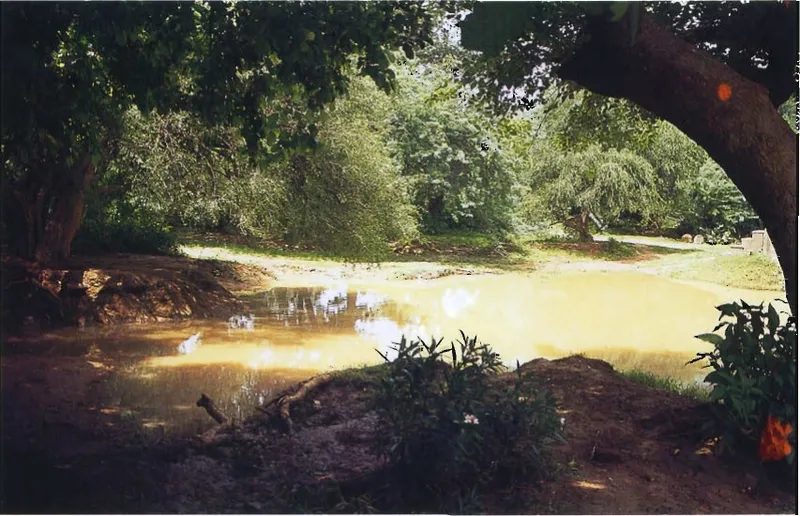
- What it is
- Indra-kuṇḍa is a kuṇḍa (pond) in Kadamba Vana at Govardhana, which the key to the numbered chart of the hill lists between Indra Pūjā and Surabhi-kuṇḍa.
- Visiting
- In 2001 Govardhana Hill described Indra-kuṇḍa as practically invisible unless heavy monsoon rains fill it.
In short
Indra-kuṇḍa is a kuṇḍa (pond) in Kadamba Vana at Govardhana, which the key to the numbered chart of the hill lists between Indra Pūjā and Surabhi-kuṇḍa.[1 +1] According to the local tradition recorded in the guidebook Govardhana Hill (2001), which also calls it Caraṇa-kuṇḍa, the kuṇḍa was formed by Indra's tears, which washed Kṛṣṇa's feet as Indra offered his prayers after the lifting of Govardhana; the book gives no source, so this is not certain.[1 +5] Śrīmad-Bhāgavatam and the Garga-saṁhitā tell how Indra bowed down to Kṛṣṇa in a solitary place, without tears or a kuṇḍa.[3 +2] Two Gauḍīya works, Śrīla Jīva Gosvāmī's Gopāla-campū and Śrīla Kavi-karṇapūra's Ānanda-vṛndāvana-campū, do tell of his tears at Kṛṣṇa's feet, but neither speaks of a kuṇḍa.[6 +2]
Key facts
| Kind | kuṇḍa |
|---|---|
| Region · area | Govardhana · Kadamba Vana (Govardhana) |
| Ācāryas | Śrī Caitanya Mahāprabhu |
Divine pastimes
Indra comes to Kṛṣṇa
Śrīmad-Bhāgavatam (10.27) tells that after Kṛṣṇa had held up Govardhana Hill and protected Vraja from the downpour, Surabhi, the mother of the cows, came to see Him, and Indra came with her. Ashamed of his offence, Indra approached Kṛṣṇa in a solitary place and touched His feet with his crown. Then, his pride gone, he joined his palms and began his prayers. None of these verses mentions tears or a kuṇḍa.[3 +3]
vivikta upasaṅgamya vrīḍītaḥ kṛta-helanaḥ / pasparśa pādayor enaṃ kirīṭenārka-varcasā
Indra was very ashamed of having offended the Lord. Approaching Him in a solitary place, Indra fell down and lay his helmet, whose effulgence was as brilliant as the sun, upon the Lord’s lotus feet.
Translation: Śrīla Prabhupāda's disciples (BBT)The Garga-saṁhitā tells it in the same way: Indra came with the demigods and bowed down to Kṛṣṇa in a secluded place on the hill.[3 +2]
The commentators on the Bhāgavatam set the solitary place on Govardhana (summarised here, not translated). They follow the Harivaṁśa, which says that Indra came down to earth riding his elephant Airāvata, saw Kṛṣṇa seated on a rock slab of Govardhana, gazed at Him with all his eyes and became ashamed.[11] Śrīla Jīva Gosvāmī, Śrīla Viśvanātha Cakravartī Ṭhākura and Śrīla Baladeva Vidyābhūṣaṇa put the meeting on that rock. Kṛṣṇa had gone there alone, they explain, to see how the hill's back had been battered by Indra's thunderbolts, and He had sent His friends away; prompted by Surabhi, Indra fell down in full prostration. Śrīla Sanātana Gosvāmī adds that out of shame and fear Indra bowed from a distance. None of them names a kuṇḍa or mentions tears.[3 +2]
Indra's tears
Two Gauḍīya works do tell of Indra's tears (both summarised here, not translated). In Śrīla Jīva Gosvāmī's Gopāla-campū, Indra, advised by Surabhi, comes secretly to Kṛṣṇa, who sits alone on a jewel-like rock of Govardhana, falls like a rod at His feet and weeps. Surabhi then says that Indra, gazing at His feet, is announcing His bathing ceremony with the thousand streams of his eyes.[6 +1] In Śrīla Kavi-karṇapūra's Ānanda-vṛndāvana-campū, water streams from Indra's thousand eyes as he clasps Kṛṣṇa's feet, as if washing them with the light of the jewels on his crown. Neither book says that a kuṇḍa was formed from the tears.[7]
Waters named after Indra
Other texts name waters after Indra at Govardhana, but none of them in Kadamba Vana. Explaining the verse on the singers who came to Kṛṣṇa's bathing ceremony (ŚB 10.27.24), Śrīla Jīva Gosvāmī places the gathering in the region of Govardhana known as Śakra-kuṇḍa, Indra's kuṇḍa, from the Varāha Purāṇa, and as Govinda-kuṇḍa from the Skanda Purāṇa (summarised here, not translated).[13] The Garga-saṁhitā calls a Śakra-sarovara, a lake of Indra, the hill's desire, without giving its position. The Varāha Purāṇa names a tīrtha made by Indra near Annakūṭa, where Kṛṣṇa stopped the sacrifice to Indra and a conversation with Indra himself took place.[14 +1]
Śrīla Rūpa Gosvāmī's Mathurā-māhātmya quotes that Varāha verse under the heading of Govinda-kuṇḍa, together with a verse saying that Govinda-kuṇḍa came into being where Indra bathed the Lord.[15 +2] In the Gopāla-campū, Surabhi fills a lake of Indra near the hill (sura-pati-sarasī) with her milk for that bath, while Airāvata brings water of the heavenly Gaṅgā; Śrīla Jīva Gosvāmī does not say where this lake is.[18] Read more: The lifting of Govardhana Hill, Indra's homage and the name Govinda →
Traditional accounts
According to the guidebook Govardhana Hill (2001), when Indra offered Kṛṣṇa his obeisances and prayers, torrents of tears from …
According to the guidebook Govardhana Hill (2001), when Indra offered Kṛṣṇa his obeisances and prayers, torrents of tears from his thousands of eyes washed the Lord's feet, and Indra-kuṇḍa was formed from them. The book also calls the kuṇḍa Caraṇa-kuṇḍa (caraṇa means foot) and cites no source for the story, so it is not certain.[1 +5]
According to the Bhakti-ratnākara, when Śrīla Śrīnivāsa Ācārya was shown the western stretch of the Govardhana circuit, his guide pointed out Airāvata's footprint and said that here Indra spoke of Kṛṣṇa's wonderful mercy; Rudra-kuṇḍa and Kadamba-khaṇḍī follow soon after. The book names no Indra-kuṇḍa and mentions no tears.[19]
Śrīla Prabhupāda
Śrīla Prabhupāda does not speak of this kuṇḍa by name.
Śrīla Prabhupāda does not speak of this kuṇḍa by name. His Kṛṣṇa book tells Indra's apology without tears and names the place only as a secluded place. This is a general description of the pastime:[5]
General teaching (does not name the place)“Indra, the king of heaven, was conscious of his offense before Kṛṣṇa; therefore he stealthily appeared before Him in a secluded place. He immediately fell down at the lotus feet of Kṛṣṇa, although his own crown was dazzling like sunshine.”
Śrīla Prabhupāda, Kṛṣṇa, the Supreme Personality of Godhead (Kṛṣṇa book), Chapter 27, 'Prayers by Indra, the King of Heaven' · vedabase.io
In a purport to the Caitanya-caritāmṛta, giving information from Śrīla Bhaktisiddhānta Sarasvatī Ṭhākura, he places Indra's prayers at Govinda-kuṇḍa:[20]
General teaching (does not name the place)“Govinda-kuṇḍa is exalted for its many spiritual activities. It was here that Indra, defeated by Lord Govinda, offered prayers to Him and bathed Him.”
Śrīla Prabhupāda, Śrī Caitanya-caritāmṛta, Madhya-līlā 18.37, purport · vedabase.io
Visiting today
In 2001 Govardhana Hill described Indra-kuṇḍa as practically invisible unless heavy monsoon rains fill it.[1 +1]
Where the sources differ
Accounts differ Where Indra offered his obeisances and prayers to Kṛṣṇa, and which water is connected with it
- Govardhana Hill: India's Most Sacred Mountain (2001)Indra's tears washed Kṛṣṇa's feet and formed Indra-kuṇḍa (Carana-kuṇḍa) in Kadamba Vana; Indra Pūjā, near Airāvata's footprint, is 'believed to be the spot' of his obeisances
- Śrīmad-Bhāgavatam 10.27.2; Garga-saṁhitā 3.4.1; Śrīla Prabhupāda, Kṛṣṇa book 27in a solitary or secluded place (Garga: on the hill); no tears and no kuṇḍa mentioned
- Varāha Purāṇa 164.23-24a tīrtha made by Śakra near Annakūṭa, where a conversation with Indra took place
- Garga-saṁhitā 3.8.11a Śakra-sarovara (Indra's lake) is the hill's desire; no position
Accounts differ Where Indra came before Kṛṣṇa after the lifting of Govardhana, and which kuṇḍa bears Indra's name: the Canto 10 commentators' and the Hari-vaṁśa's positions
- Śrīmad-Bhāgavatam 10.27.1-3in a solitary place (vivikte); not named
- Harivaṁśa 62.3-8 (critical edition)Kṛṣṇa was seated on a rock slab of Govardhana (62.3, 62.6); Indra left his elephant and approached Him, on the hill, in a solitary place (62.8)
- Śrīla Sanātana Gosvāmī (on 10.27.1-2), Śrīla Jīva Gosvāmī, Śrīla Viśvanātha Cakravartī and Śrīla Baladeva Vidyābhūṣaṇa (on 10.27.2)at Govardhana, on the rock slab of the Hari-vaṁśa, Kṛṣṇa having come alone; no kuṇḍa, no tears
- Śrīla Jīva Gosvāmī and Śrīla Sanātana Gosvāmī (and Vaṁśīdhara) on ŚB 10.27.24Jīva: the gathering at the bathing ceremony was in the region of Govardhana known as Śakra-kuṇḍa ('Indra's kuṇḍa') from the Varāha and as Govinda-kuṇḍa from the Skanda; Sanātana gives this as a second explanation (śatru-kuṇḍa, presumably Śakra-kuṇḍa, from the Skanda)
The wording of these accounts is our summary of the sources, not a published translation.
Whether Śrī Caitanya Mahāprabhu rested here on His walk around the hill. Govardhana Hill (2001) says that He is believed to have rested here, and Śrī Vraja-maṇḍala Parikramā (2007) names Gvāla-pokharā instead; the Caitanya-caritāmṛta names neither.
Accounts differ Where Śrī Caitanya Mahāprabhu rested during His Govardhana parikramā
- Govardhana Hill: India's Most Sacred Mountain (2001)'It is believed that Lord Caitanya rested here' at Indra-kuṇḍa (Carana-kuṇḍa)
- Śrī Vraja-maṇḍala Parikramā (2007)Mahāprabhu took rest for a short time at Gvāla-pokharā and remembered the pastimes there
- Caitanya-caritāmṛta, Madhya 18.17-38 (Śrīla Prabhupāda's translation)He came to Govardhana village, saw Harideva, took lunch at Brahma-kuṇḍa and stayed that night at the temple of Harideva (18.17-22); the next morning He bathed in Mānasa-gaṅgā, circumambulated Govardhana, danced, bathed at Govinda-kuṇḍa and went on to Gāṅṭhuli (18.32-36); no resting place on the circuit is named
More on this place
The lifting of Govardhana Hill, Indra's homage and the name Govinda
References
22 references
- Govardhana Hill: India's Most Sacred Mountain (2001), Rajasekhara dasa Brahmacari, PDF p. 131
- the key of the numbered Govardhana chart, ¶59
- Śrīmad-Bhāgavatam 10.27.2, GRETIL
- Garga-saṁhitā, Girirāja-khaṇḍa (3), adhyāya 4, verse 1, Sanskrit Wikisource
- Śrīla Prabhupāda, Kṛṣṇa, the Supreme Personality of Godhead (Kṛṣṇa book), Chapter 27, 'Prayers by Indra, the King of Heaven' · vedabase.io
- Jīva Gosvāmī, pūraṇa 19, v.27
- Kavi-karṇapūra, stavaka 15 ('Govardhanoddharaṇa'), prose after v.115
- Jīva Gosvāmī, pūraṇa 19 ('jambha-bhedi-surendratā-stambhana ...'), v.11
- Śrīmad-Bhāgavatam 10.27.1, GRETIL
- Śrīmad-Bhāgavatam 10.27.3, GRETIL
- Harivaṁśa, HV 62.2-6 (critical edition); HV 62.3 is the line the Canto 10 commentators cite as 'ha.vaṁ. 2.19.3', GRETIL
- Śrīla Sanātana Gosvāmī: commentary on ŚB 10.27.2, Bhagavata Vidya Pith edition, ed. Bhagavata Rishi and Krishna Shankar Shastri, 1996
- Śrīla Sanātana Gosvāmī: commentary on ŚB 10.27.24, Bhagavata Vidya Pith edition, ed. Bhagavata Rishi and Krishna Shankar Shastri, 1996
- Garga-saṁhitā, Girirāja-khaṇḍa (3), adhyāya 8, verse 11, Sanskrit Wikisource
- Varāha Purāṇa, adhyāya 164, verses 23b-25a, Sanskrit Wikisource
- Rūpa Gosvāmī, part 1 v.416-417, under the heading 'śrī-govinda-kuṇḍasya'; quoting the 'Mathurā-khaṇḍa' and the Ādi-varāha
- Śrīla Narahari Cakravartī, Bhakti-ratnākara, Fifth Wave, 1912 ed. p. 202, 2nd ed., 1912
- Jīva Gosvāmī, pūraṇa 19
- Śrīla Narahari Cakravartī, Bhakti-ratnākara, Fifth Wave, 1912 ed. p. 203, 2nd ed., 1912
- Śrīla Prabhupāda, Śrī Caitanya-caritāmṛta, Madhya-līlā 18.37, purport · vedabase.io
- Govardhana Hill: India's Most Sacred Mountain (2001), Rajasekhara dasa Brahmacari, p. 117
- Numbered list of the Govardhana sites (key of the Govardhana chart)