Surabhi-kuṇḍa (Govardhana)
सुरभि-कुण्ड (गोवर्धन) Hindi name proposed
Also called Surabhi Kunda
- What it is
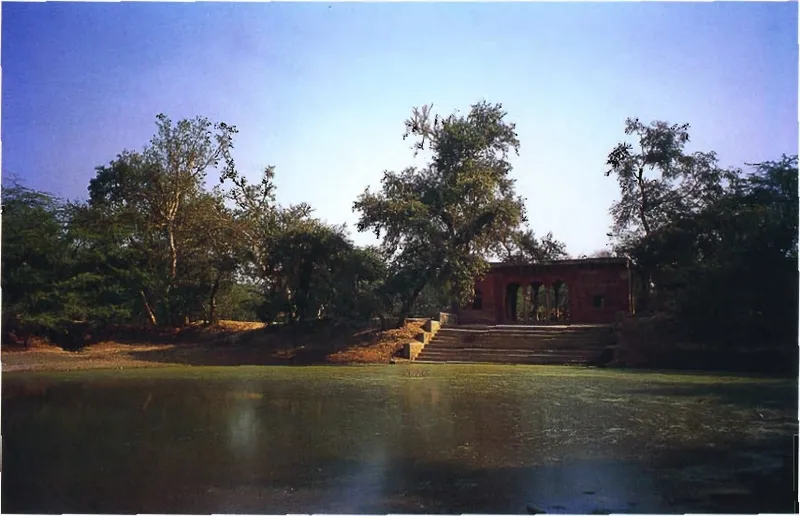
- Surabhi-kuṇḍa is a pond on the western side of the Govardhana circuit, in Kadamba-vana, and bears the name of Surabhi, the mother of the cows.
- Visiting
- The guidebooks place Surabhi-kuṇḍa in Kadamba-vana on the western side of the Govardhana parikramā, with Indra-kuṇḍa and Airāvata-kuṇḍa.
- Parikramā
- Govardhana parikramā, station 34
In short
Surabhi-kuṇḍa is a pond on the western side of the Govardhana circuit, in Kadamba-vana, and bears the name of Surabhi, the mother of the cows.[1 +4] Śrīmad-Bhāgavatam tells how Surabhi came to Kṛṣṇa with Indra after He had lifted Govardhana, prayed to Him and bathed Him with her milk, but it names no place on the hill.[6 +4] According to Śrī Vraja-maṇḍala Parikramā (2007), Surabhi bathed Kṛṣṇa at Govinda-kuṇḍa and then lived here for as long as His pastimes were manifest in Vraja; the book also says that Mahārāja Vajranābha made the kuṇḍa in her memory, which is not certain.[3 +2] None of the older texts found clearly names a Surabhi-kuṇḍa at Govardhana.[13 +4]
Key facts
| Kind | kuṇḍa |
|---|---|
| Region · area | Govardhana |
| Also part of | Kadamba Vana (Govardhana) |
| On the parikramā | Govardhana parikramā, station 34 · the route |
| Ācāryas | Śrīla Śrīnivāsa Ācārya, Śrīla Rāghava Paṇḍita Gosvāmī of Govardhana |
Why it is glorified
In its list of the holy places of Govardhana, the Garga-saṁhitā says that a sinner who bows down where the footprints of Airāvata …
In its list of the holy places of Govardhana, the Garga-saṁhitā says that a sinner who bows down where the footprints of Airāvata and Surabhi are goes to Vaikuṇṭha. It speaks of footprints, not of a kuṇḍa, and gives no place on the hill; no source connects the verse with this kuṇḍa, which shares only Surabhi's name.[13 +3]
According to Śrī Vraja-maṇḍala Parikramā (2007), bathing in the kuṇḍa and sipping its water dispel all sins, offences and anarthas (unwanted habits of the heart) and give vraja-prema, the love of the people of Vraja for Kṛṣṇa.[3 +1]
Divine pastimes
Surabhi comes to Kṛṣṇa
Śrīmad-Bhāgavatam (10.27) tells that after Kṛṣṇa had lifted Govardhana and protected Vraja from the rain, Surabhi came to Him from her planet, and Indra with her. The verse does not say where on the hill she met Him.[6 +4]
govardhane dhṛte śaile āsārād rakṣite vraje / go-lokād āvrajat kṛṣṇaṃ surabhiḥ śakra eva ca
Śukadeva Gosvāmī said: After Kṛṣṇa had lifted Govardhana Hill and thus protected the inhabitants of Vraja from the terrible rainfall, Surabhi, the mother of the cows, came from her planet to see Kṛṣṇa. She was accompanied by Indra.
Translation: Śrīla Prabhupāda's disciples (BBT)After Kṛṣṇa had spoken to Indra, Surabhi and her offspring, the cows, bowed down to Him. In her prayer she calls Him the cows' master and worshipable Deity, asks Him to become their Indra for the good of the cows, the brāhmaṇas, the demigods and all saintly people, and says that they will bathe Him as their Indra, as Brahmā has ordered. Her words contain no request to forgive Indra. Then she bathed Him with her own milk, and Indra bathed Him with water of the heavenly Gaṅgā and named Him Govinda.[6 +6]
evaṃ kṛṣṇam upāmantrya surabhiḥ payasātmanaḥ / jalair ākāśa-gaṅgāyā airāvata-karoddhṛtaiḥ
indraḥ surarṣibhiḥ sākaṃ codito deva-mātṛbhiḥ / abhyasiñcata dāśārhaṃ govinda iti cābhyadhāt
Śukadeva Gosvāmī said: Having thus appealed to Lord Kṛṣṇa, mother Surabhi performed His bathing ceremony with her own milk, and Indra, ordered by Aditi and other mothers of the demigods, anointed the Lord with heavenly Gaṅgā water from the trunk of Indra’s elephant carrier, Airāvata. Thus, in the company of the demigods and great sages, Indra coronated Lord Kṛṣṇa, the descendant of Daśārha, and gave Him the name Govinda.
Translation: Śrīla Prabhupāda's disciples (BBT)Śrīla Prabhupāda's Kṛṣṇa book tells her prayer in the same order, after Indra has been pardoned, and names no place:[10]
General teaching (does not name the place)“After this, the transcendental surabhi cow who had come with Indra to see Kṛṣṇa offered her respectful obeisances unto Him and worshiped Him. … O Supersoul of the universe, let us bathe You with our milk, for You are our Indra.”
Śrīla Prabhupāda, Kṛṣṇa, the Supreme Personality of Godhead (Kṛṣṇa book), Chapter 27, Prayers by Indra, the King of Heaven · vedabase.io
What the commentators and the Gopāla-campū add
The commentators on the chapter explain why Surabhi came (summarised here, not translated). Śrīla Jīva Gosvāmī understands from her words "urged by Brahmā" that Indra, in fear, had gone to Brahmā and on his order brought Surabhi. Śrīla Viśvanātha Cakravartī Ṭhākura and Śrīla Baladeva Vidyābhūṣaṇa say that Brahmā sent Surabhi to have Indra's offence forgiven and to bathe Kṛṣṇa as Indra of the cows, and in Śrīla Baladeva Vidyābhūṣaṇa's words Surabhi asks Kṛṣṇa to forgive Indra as a kindness to the cows.[20 +1] Śrīla Sanātana Gosvāmī says that Surabhi came in great joy to Śrī Govardhana, near Kṛṣṇa, because He had protected her offspring, and that Indra came with her, alone.[20]
Śrīla Jīva Gosvāmī's Gopāla-campū tells the whole story (summarised here, not translated). Back in heaven Indra was dejected; Bṛhaspati, the teacher of the gods, rebuked him and sent him to Brahmā. Brahmā said that he himself could not win forgiveness for Indra and told him to worship Surabhi, the mother of the cows, since Gopāla is pleased when the cows are pleased. Indra brought Surabhi to Brahmā, who sent her to Kṛṣṇa to calm Indra's fear.[2 +5] Surabhi pointed Kṛṣṇa out to Indra on Govardhana and advised him to approach Him quietly and bow down. When Kṛṣṇa had received Indra, she came with her offspring, and in her prayer she said that Kṛṣṇa's becoming Indra of the cows would also purify Indra. The text names no kuṇḍa.[25 +3] Read more: The lifting of Govardhana Hill, Indra's homage and the name Govinda →
Surabhi in other texts
The Garga-saṁhitā says that Surabhi bathed Kṛṣṇa with streams of her milk on Govardhana, that her hoofprints appeared there beside His footprints, and that her milk became Govinda-kuṇḍa.[13 +3] In the Viṣṇu Purāṇa and the Harivaṁśa it is the cows, not Surabhi by name, who send Indra or give their message through him and bathe Kṛṣṇa with their milk.[30 +3] Śrīla Raghunātha dāsa Gosvāmī connects Surabhi's part in the bath with Govinda-kuṇḍa, and the Gopāla-campū with a lake near the hill that Surabhi filled with her milk; neither names a Surabhi-kuṇḍa.[34 +1] The Bhakti-ratnākara sets Indra's coming before Kṛṣṇa with Surabhi's help at a village printed Reheja, beyond Gāṅṭholī, not at a kuṇḍa on the hill.[36]
Traditional accounts
The Vraja-bhakti-vilāsa ties Surabhi's name to a forest round Govinda-kuṇḍa instead.
The Vraja-bhakti-vilāsa ties Surabhi's name to a forest round Govinda-kuṇḍa instead. Its round of Surabhīvana, a forest that it praises as made delightful by Surabhi, takes in the bath at Govinda-kuṇḍa and the darśana of Govardhana-nātha, and it names no Surabhi-kuṇḍa at Govardhana.[17]
According to Śrī Vraja-maṇḍala Parikramā (2007), Surabhi bathed Śrī Govinda with her milk at Govinda-kuṇḍa at Indra's request, and later lived here for the whole of Kṛṣṇa's manifest pastimes, wishing to see Him herding the cows and the pastimes of the Divine Couple in the nikuñjas, the secluded groves.[3 +1] The book also says that Mahārāja Vajranābha made the kuṇḍa in Surabhi's memory, which is not certain, since it gives no evidence; the undated parikramā notes Govardhana repeat both statements.[3 +2]
The guidebooks do not agree on what happened here:
Accounts differ What happened at Surabhi-kuṇḍa, and which lake Surabhi's milk is connected with
- Govardhana Hill: India's Most Sacred Mountain (2001)Surabhi prayed here for Indra's forgiveness
- Śrī Vraja-maṇḍala Parikramā (2007)Surabhī bathed Govinda at Govinda-kuṇḍa, then lived here during Kṛṣṇa's manifest pastimes; Vajranābha established the kuṇḍa in her memory
- the undated parikramā notes Govardhanaboth: 'where Surabhi helped Indra be forgiven', then Śrī Vraja-maṇḍala Parikramā (2007)'s account word for word
- Garga-saṁhitā 3.4.14, 3.4.16Surabhi's hoofprints appeared at the place of the bath; her milk became Govinda-kuṇḍa
Visiting today
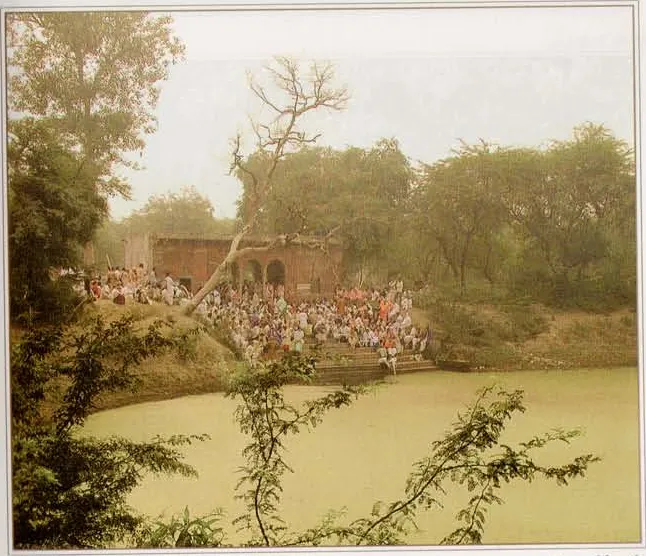
The guidebooks place Surabhi-kuṇḍa in Kadamba-vana on the western side of the Govardhana parikramā, with Indra-kuṇḍa and Airāvata-kuṇḍa. Śrī Vraja-maṇḍala Parikramā (2007) puts it on the right-hand side of the parikramā path, a little beyond Śrīla Rāghava Paṇḍita's cave, and says that it is filled with clean, sweet water.[1 +4]
Location
| Where it is | In Kadamba Vana[39] right-hand side of the parikramā path, somewhat further along than Rāghava Paṇḍita's cave[40] |
|---|---|
| On the numbered Govardhana chart | 57 (printed as “Surabhi Kunda”)[41] |
Nearby places
Rāghava Paṇḍita's cave · Govardhana parikramā path
Pictures
2 pictures
Where the sources differ
Why Surabhi came and what she asked of Kṛṣṇa, as the texts and the guidebooks tell it.[2 +2]
Accounts differ Why Surabhi came and what she asked of Kṛṣṇa
- Govardhana Hill: India's Most Sacred Mountain (2001)Bṛhaspati sent the dejected Indra to Brahmā, Brahmā sent him to Surabhi; Surabhi came with Indra to Govardhana and pleaded with Kṛṣṇa to forgive Indra, and He forgave him (at Surabhi-kuṇḍa)
- Śrīmad-Bhāgavatam 10.27.1, 18-21Surabhi came from her planet with Indra; after Kṛṣṇa had spoken to Indra she asked Him to become the cows' Indra, saying Brahmā had ordered them to bathe Him
- Śrīla Prabhupāda, Kṛṣṇa book 27the surabhi cow came with Indra; after Indra's pardon she prayed that Kṛṣṇa is their Indra and asked to bathe Him with milk; no plea for Indra
- Śrīla Jīva Gosvāmī, Gopāla-campū Pūrva 19Surabhi followed Indra, advised him to approach Kṛṣṇa privately and bow down; after Indra was received she came and, asking Kṛṣṇa to be Indra of the cows, said this was also Brahmā's view and would purify Indra, who had taken shelter of the cows
Where Surabhi came from, and whether she stayed in Vraja after the bath, as the commentators and a guidebook say.[3 +2]
Accounts differ Where Surabhi came from ('golokāt', ŚB 10.27.1) and whether she stayed in Vraja after the bath
- Śrīmad-Bhāgavatam 10.27.1, 10.27.28Surabhi came 'from Goloka' (vedabase: 'from her planet'); after the bath Indra returned to heaven surrounded by the demigods and others; whether Surabhi went is not said
- Śrīla Prabhupāda, Kṛṣṇa book 27'a surabhi cow from Goloka Vṛndāvana'
- Śrīla Sanātana Gosvāmī on 10.27.1Goloka is the world of the cows above Vaikuṇṭha; this Surabhi, root of the cows and chief of the Gokula in Goloka, is not Kaśyapa's wife, who lives in heaven
- Śrīla Jīva Gosvāmī (Laghu-toṣaṇī, Krama-sandarbha), Śrīla Viśvanātha Cakravartī and Śrīla Baladeva Vidyābhūṣaṇa on 10.27.1from the material Goloka, not the spiritual Goloka, since Indra could not have had the company of that Surabhi
The name of the kuṇḍa that the Bhakti-ratnākara shows after Airāvata's footprint, at the point of the circuit where the guidebooks put Surabhi-kuṇḍa.
Accounts differ The name of the kuṇḍa after Airāvata's footprint on the western circuit
- Bhakti-ratnākara, 1912 ed. p. 203a kuṇḍa printed সুরতিকুণ্ড (Surati-kuṇḍa), between Airāvata's footprint and Rudra-kuṇḍa
- Bhakti-ratnākara, second copy of the same editionalso prints সুরতিকুণ্ড
- Grantha Mandira text of the Bhakti-ratnākara, typed from this edition, pañcama taraṅga v.658dekhaha surabhikuṇḍa mahimā apāra: a modern editorial reading against the print
- Śrī Vraja-maṇḍala Parikramā (2007), Govardhana Hill: India's Most Sacred Mountain (2001), the undated parikramā notes Govardhana, the key of the numbered Govardhana chartSurabhi-kuṇḍa, with Airāvata-kuṇḍa and Rudra-kuṇḍa in Kadamba-vana
The wording of these accounts is our summary of the sources, not a published translation.
More on this place
The lifting of Govardhana Hill, Indra's homage and the name Govinda
References
41 references
- Govardhana Hill: India's Most Sacred Mountain (2001), Rajasekhara dasa Brahmacari, PDF p. 131
- Govardhana Hill: India's Most Sacred Mountain (2001), Rajasekhara dasa Brahmacari, PDF p. 133
- Śrī Vraja-maṇḍala Parikramā (2007), PDF p. 132
- the undated parikramā notes Govardhana, ¶142
- the key of the numbered Govardhana chart, ¶60
- Śrīmad-Bhāgavatam 10.27.1, GRETIL
- Śrīmad-Bhāgavatam 10.27.18, GRETIL
- Śrīmad-Bhāgavatam 10.27.21, GRETIL
- Śrīmad-Bhāgavatam 10.27.22-23, GRETIL
- Śrīla Prabhupāda, Kṛṣṇa, the Supreme Personality of Godhead (Kṛṣṇa book), Chapter 27, Prayers by Indra, the King of Heaven · vedabase.io
- the undated parikramā notes Govardhana, ¶145
- Skanda Purāṇa, Skanda version (śrīskānde māhātmyam), adhyāya 2, verses 4-5, Sanskrit Wikisource
- Garga-saṁhitā, Girirāja-khaṇḍa (3), adhyāya 4, verse 8, Sanskrit Wikisource
- Garga-saṁhitā, Girirāja-khaṇḍa (3), adhyāya 4, verse 14, Sanskrit Wikisource
- Garga-saṁhitā, Girirāja-khaṇḍa (3), adhyāya 4, verse 16, Sanskrit Wikisource
- Garga-saṁhitā, Girirāja-khaṇḍa (3), adhyāya 7, verse 38, Sanskrit Wikisource
- Śrīla Nārāyaṇa Bhaṭṭa, Vraja-bhakti-vilāsa, adhyāya 10, vv.51-54 ('the circumambulation of Surabhī-vana'), printed pp. 222-223, 1st ed., publ. Bābā Kṛṣṇadāsa, Kusuma-sarovara, Saṁvat 2008
- Śrīmad-Bhāgavatam 10.27.19, GRETIL
- Śrīmad-Bhāgavatam 10.27.20, GRETIL
- Śrīla Jīva Gosvāmī: commentary on ŚB 10.27.1, Bhagavata Vidya Pith edition, ed. Bhagavata Rishi and Krishna Shankar Shastri, 1996
Show all 41 references
- Śrīla Viśvanātha Cakravartī Ṭhākura: commentary on ŚB 10.27.21, Bhagavata Vidya Pith edition, ed. Bhagavata Rishi and Krishna Shankar Shastri, 1996
- Śrīla Jīva Gosvāmī, Gopāla-campū, Pūrva-campū 19, prose [14]-[15], GRETIL
- Śrīla Jīva Gosvāmī, Gopāla-campū, Pūrva-campū 19, prose [20]-[22], GRETIL
- Śrīla Jīva Gosvāmī, Gopāla-campū, Pūrva-campū 19, prose [23]-[26], GRETIL
- Śrīla Jīva Gosvāmī, Gopāla-campū, Pūrva-campū 19, verses 19.24-25 (in Surabhi's prayer), GRETIL
- Govardhana Hill: India's Most Sacred Mountain (2001), Rajasekhara dasa Brahmacari, PDF p. 134
- Śrīla Jīva Gosvāmī, Gopāla-campū, Pūrva-campū 19, prose [27] and verse 19.7, GRETIL
- Śrīla Jīva Gosvāmī, Gopāla-campū, Pūrva-campū 19, prose [30]-[31], GRETIL
- Śrīla Jīva Gosvāmī, Gopāla-campū, Pūrva-campū 19, prose [39], GRETIL
- Viṣṇu Purāṇa, 5.12.11-12, GRETIL
- Viṣṇu Purāṇa, 5.12.13-14, GRETIL
- Harivaṁśa, HV 62.37-38, GRETIL
- Harivaṁśa, HV 62.59, GRETIL
- Śrīla Raghunātha dāsa Gosvāmī, Govardhanāśraya-daśaka, verse 2
- Śrīla Jīva Gosvāmī, Gopāla-campū, Pūrva-campū 19, prose [48], GRETIL
- Śrīla Narahari Cakravartī, Bhakti-ratnākara, Fifth Wave, 1912 ed. p. 214, 2nd ed., 1912
- Śrīmad-Bhāgavatam 10.27.28, GRETIL
- Śrīla Sanātana Gosvāmī: commentary on ŚB 10.27.28, Bhagavata Vidya Pith edition, ed. Bhagavata Rishi and Krishna Shankar Shastri, 1996
- Govardhana Hill: India's Most Sacred Mountain (2001), Rajasekhara dasa Brahmacari, p. 119
- Śrī Vraja-maṇḍala Parikramā (2007), p. 238-239
- Numbered list of the Govardhana sites (key of the Govardhana chart)