Jñāna-gudri
ज्ञान-गुदड़ी Hindi name proposed
- What it is
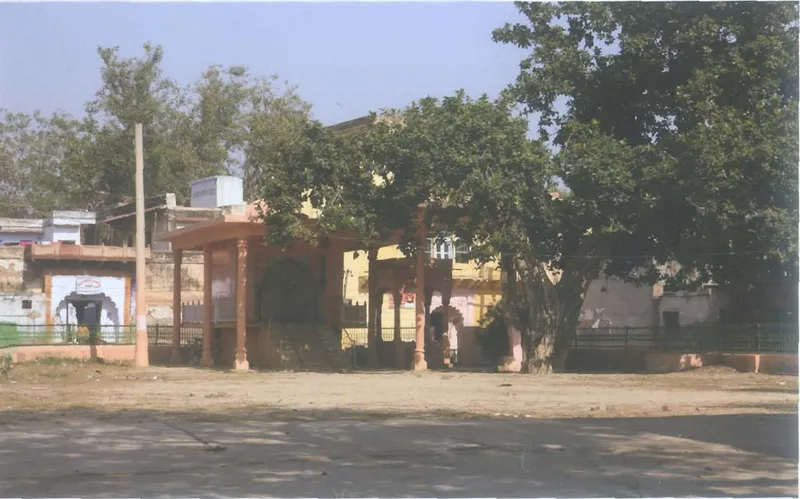
- Jñāna-gudri (Jñāna-gudaḍī) is an open ground with a large banyan tree on the Yamunā in Vṛndāvana, opposite the temple of Rādhā-Braja-mohana.
- Visiting
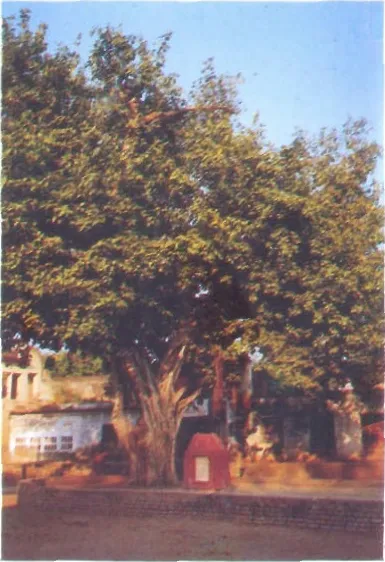
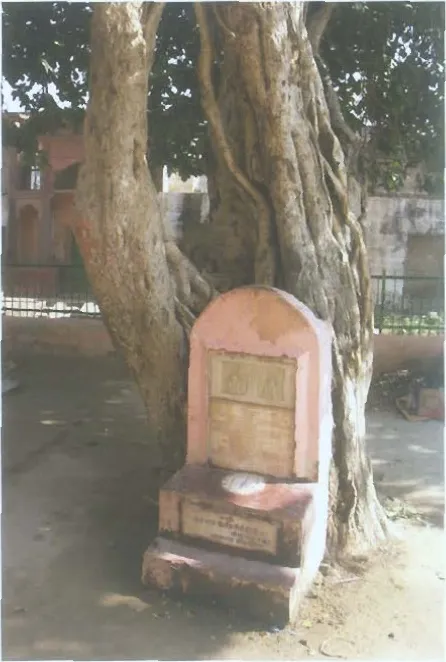
- Vṛndāvana, the Playground of God (2010) describes Jñāna-gudri as a one-acre open park; the photographs of 2000 and 2010 show the large banyan with a small whitewashed shrine or marker at its foot.
- Places here
- Gopa-kūpa (Vṛndāvana)
In short
Jñāna-gudri (Jñāna-gudaḍī) is an open ground with a large banyan tree on the Yamunā in Vṛndāvana, opposite the temple of Rādhā-Braja-mohana.[1 +4] The guidebooks connect it with Uddhava, who brought Kṛṣṇa's message from Mathurā to the gopīs: according to the local tradition recorded in Śrī Vraja-maṇḍala Parikramā (2007), the gopīs tore up His message of knowledge (jñāna) here like an old patched cloth (gudaḍī) and threw it into the river; the book cites no source, so this is not certain.[1] Śrīmad-Bhāgavatam tells Uddhava's mission without naming the place, and in it the gopīs welcome the message: the guidebook's story is not the Bhāgavatam's account.[6 +3]
Key facts
| Kind | pastime site |
|---|---|
| Region · area | Vṛndāvana |
| Also part of | Yamunā |
Divine pastimes
Uddhava's mission in the Bhāgavatam
Kṛṣṇa sent Uddhava to Vraja to please Nanda and Yaśodā and to relieve the gopīs' pain of separation with His messages. Uddhava took the message and went by chariot to Nanda's Gokula.[10 +1]
gacchoddhava vrajaṃ saumya pitror nau prītim āvaha / gopīnāṃ mad-viyogādhiṃ mat-sandeśair vimocaya
[Lord Kṛṣṇa said:] Dear gentle Uddhava, go to Vraja and give pleasure to Our parents. And also relieve the gopīs, suffering in separation from Me, by giving them My message.
Translation: Śrīla Prabhupāda's disciples (BBT)The gopīs recognised him as Kṛṣṇa's messenger and questioned him in a quiet, secluded place; neither the verse nor its commentators name that place.[8 +1] Kṛṣṇa's message told them that they are never really separated from Him, since He is the Soul of all.[9]
śrī-bhagavān uvāca bhavatīnāṃ viyogo me na hi sarvātmanā kvacit / yathā bhūtāni bhūteṣu khaṃ vāyv-agnir jalaṃ mahī / tathāhaṃ ca manaḥ-prāṇa- bhūtendriya-guṇāśrayaḥ
The Supreme Lord said: You are never actually separated from Me, for I am the Soul of all creation. Just as the elements of nature — ether, air, fire, water and earth — are present in every created thing, so I am present within everyone’s mind, life air and senses, and also within the physical elements and the modes of material nature.
Translation: Śrīla Prabhupāda's disciples (BBT)The gopīs were pleased to hear the message, which revived their remembrance of Him. His messages relieved their fever of separation, they worshipped Uddhava, and he stayed in Vraja for several months. The Bhāgavatam tells of no message torn up or thrown into the Yamunā.[6 +3]
śrī-śuka uvāca tatas tāḥ kṛṣṇa-sandeśair vyapeta-viraha-jvarāḥ / uddhavaṃ pūjayāṃ cakrur jñātvātmānam adhokṣajam
Śukadeva Gosvāmī continued: Lord Kṛṣṇa’s messages having relieved their fever of separation, the gopīs then worshiped Uddhava, recognizing him as nondifferent from their Lord, Kṛṣṇa.
Translation: Śrīla Prabhupāda's disciples (BBT)The message in the commentaries
Śrīla Sanātana Gosvāmī allows that the message was a letter in Kṛṣṇa's own hand, which Uddhava unsealed and read out himself, lest the gopīs be unable to read it in their distress or their tears wash the writing away (summarised, not translated). Śrīla Prabhupāda's Kṛṣṇa book also says that Uddhava read the written message to the gopīs instead of handing it over.[8 +2]
Śrīla Jīva Gosvāmī calls the message "full of knowledge", and reads the verse to say that even such a message did not take away the gopīs' loving remembrance of Kṛṣṇa. Śrīla Viśvanātha Cakravartī Ṭhākura says that no loving devotee, least of all the gopīs, ever liked the knowledge of oneness with the Supreme. Neither tells of a message torn up, and neither names a place (both summarised, not translated).[6 +2]
In Śrīla Jīva Gosvāmī's Gopāla-campū Uddhava meets the gopīs at a bathing place that Kṛṣṇa had named as their gathering place, without naming it, and reads out Kṛṣṇa's letters to them again and again until they are consoled; nothing is torn (summarised here, not translated).[17 +1] In the Garga-saṁhitā Uddhava gives written letters to Rādhā and the gopīs, and Rādhā places Hers on Her head, eyes and heart and reads it.[19 +1] Read more: Uddhava brings Kṛṣṇa's message to the gopīs →
Uddhava and Vidura
Vidura, on his travels, reached the Yamunā and met Uddhava there. They spent a night on its bank speaking of Kṛṣṇa, and Vidura wept to hear that Kṛṣṇa had remembered him. The Bhāgavatam does not name the spot.[21 +3]
tatas tv ativrajya surāṣṭram ṛddhaṃ sauvīra-matsyān kurujāṅgalāṃś ca / kālena tāvad yamunām upetya tatroddhavaṃ bhāgavataṃ dadarśa
Thereafter he passed through very wealthy provinces like Surat, Sauvīra and Matsya and through western India, known as Kurujāṅgala. At last he reached the bank of the Yamunā, where he happened to meet Uddhava, the great devotee of Lord Kṛṣṇa.
Translation: Śrīla A.C. Bhaktivedanta Swami PrabhupādaVṛndāvana, the Playground of God (2010) and The Color Guide to Vṛndāvana (2000) place this meeting at Jñāna-gudri, under the banyan tree; the first gives it only as a local saying, which is not certain.[4 +3]
Traditional accounts
According to Śrī Vraja-maṇḍala Parikramā, the gopīs tore up the message of philosophical knowledge (tattva-jñāna) that Uddhava …
The torn message
According to Śrī Vraja-maṇḍala Parikramā, the gopīs tore up the message of philosophical knowledge (tattva-jñāna) that Uddhava brought, so that it looked like a tattered cloth, and threw it into the Yamunā; the book adds that it floated to Prayāga and was lost in the ocean, and that the place was named for it. The book cites no source, so this is not certain.[1] Vṛndāvana, the Playground of God (2010) records a local tradition that Uddhava handed out Kṛṣṇa's letters written on cloth here, and that some Vrajavāsīs took the message that Kṛṣṇa is present everywhere as knowledge meant to keep them from Him, tore the letters into rags and threw them into the Yamunā.[4] Both stories differ from Śrīmad-Bhāgavatam, in which the gopīs were pleased to hear the message (see above).[6 +3]
Older explanations of the name
The Bengali Vṛndāvana-kathā (1920) reports a different explanation, from the Vrajavāsīs of its day: Uddhava, who came to instruct the gopīs, himself learned prema-bhakti (devotion in pure love) from them, and gained knowledge of the truth here.[26] The Bengali Bhaktamāla of Kṛṣṇadāsa Bābājī (1905) describes the great rāsa ground on the Yamunā sandbank, with its sādhus, kīrtana and Bhāgavatam readings, and says that some call it Jñānagudhari; it may mean the same place, but gives no reason for the name.[27]
Prayāga-rāja
According to the local tradition recorded in Vṛndāvana, the Playground of God and The Color Guide, Prayāga-rāja, the king of holy places, comes here as a black horse when the Yamunā floods up to Jñāna-gudri, and to come out of the water white, freed of the sins that pilgrims leave at Prayāga. No text found so far tells this, so it is not certain.[5 +1] The Garga-saṁhitā has a related story without the horse: the king of holy places, humbled when Hari told him that Mathurā-maṇḍala is His own home, came and worshipped Vraja-maṇḍala.[28]
Śrīla Prabhupāda
In the Kṛṣṇa book Śrīla Prabhupāda tells the delivery of the message without naming any place (a general account, not about this …
In the Kṛṣṇa book Śrīla Prabhupāda tells the delivery of the message without naming any place (a general account, not about this ground). In his telling the message itself tells the gopīs that they do not need knowledge of the Absolute, and Uddhava's words save them.[8 +2]
General teaching (does not name the place)“Transcendental knowledge of the Absolute is no longer necessary for you. You were accustomed to loving Me from the very beginning of your lives. … Uddhava’s messages and instructions saved the gopīs from immediate death, and the gopīs acknowledged the benediction from Uddhava.”
Śrīla Prabhupāda, Kṛṣṇa, the Supreme Personality of Godhead (Kṛṣṇa book), Chapter 47, 'Delivery of the Message of Kṛṣṇa to the Gopīs' · vedabase.io
Visiting today
Vṛndāvana, the Playground of God (2010) describes Jñāna-gudri as a one-acre open park; the photographs of 2000 and 2010 show the large banyan with a small whitewashed shrine or marker at its foot. The Color Guide (2000) says that Vrajavāsīs bathe here when the Yamunā floods in the monsoon.[4 +1] Brahma-kuṇḍa lies a little to the south-west, according to Śrī Vraja-maṇḍala Parikramā.[1 +4]
Gopa-kūpa
Śrī Vraja-maṇḍala Parikramā lists Gopa-kūpa, "the well of the cowherds", in Jñāna-gudri as one of four well-known wells of Vṛndāvana, with Veṇu-kūpa, Sapta-sāmudrika-kūpa and Rādhā-kūpa. It gives no story or description, and no other source names the well; whether it still exists is not certain.[31] The Gopa-kūpa of the Bhakti-ratnākara is a different well, at Gokula-Mahāvana.[31 +3]
Places at Jñāna-gudri
1 places
Nearby places
Rādhā-Braja-mohana Mandira · Brahma-kuṇḍa (Vṛndāvana) · Yamunā
Pictures
2 pictures
History
The historian F. S. Growse (1883) lists Jñāna-gudri as the first quarter of Vṛndāvana town, with a fair there on the full moon of Śrāvaṇa and a Dān Līlā, a play of the toll pastime, at the start of the bright half of Kuār.[29] The Vṛndāvana-kathā (1920) describes a small one-storey shrine by the Yamunā's sandbank, where Jagannātha, Baladeva and Subhadrā were worshipped.[26] In 1976 Śrīla Prabhupāda addressed a letter to Sri Triloki Natha Acarya at "Jnana, Gudadi (Gudri)" in Vṛndāvana, so the name was in use for a locality then.[30]
Where the sources differ
What the place is and why it is called Jñāna-gudri: the sources differ, and none of their explanations is certain; the torn …
What the place is and why it is called Jñāna-gudri: the sources differ, and none of their explanations is certain; the torn message rests on the guidebooks alone and is not certain.[1 +3]
Accounts differ What the place is and why it is called Jñāna-gudri (gudaḍī)
- Śrī Vraja-maṇḍala Parikramā (2007)the gopīs tore up Kṛṣṇa's message of tattva-jñāna 'so that it resembled a tattered garment (gudaḍī)' and threw it into the Yamunā
- Vṛndāvana, the Playground of God (2010)'It is said' some Vrajavāsīs tore Uddhava's cloth letters into rags; 'gudri' from 'gudadi', a bundle of rags
- Vṛndāvana-kathā (Pulinbihārī Datta, 1920), printed p. 208the Vrajavāsīs say that Uddhava, come to instruct the gopīs, himself learned prema-bhakti from them and gained tattva-jñāna here, hence the name; gudarī means a quilt or covering; a small Jagannātha shrine
- the Bengali Bhaktamāla of Kṛṣṇadāsa Bābājī (1905)the Mahā-rāsa-sthalī on the Yamunā sandbank, a place of sādhus, kīrtana and Bhāgavata readings, which some call 'Jñānagudhari'; no reason given
Accounts differ Whether Kṛṣṇa's message was a letter, and what became of it
- Śrīmad-Bhāgavatam 10.47.28–38, 10.47.53Uddhava speaks the message ('please hear'); the gopīs are pleased and their fever of separation is relieved; no letter is mentioned
- Śrīla Sanātana Gosvāmī on ŚB 10.46.7 and 10.47.28perhaps a letter in Kṛṣṇa's own hand; Uddhava showed it, broke its seal and read it out himself, lest the gopīs be unable to read it or their tears wash out the writing
- Kṛṣṇa book ch. 47 (Śrīla Prabhupāda)Uddhava had a message in writing, but he read it to the gopīs instead of handing it over
- Garga-saṁhitā 5.15–16Uddhava gives letters to Rādhā and the gopīs; Rādhā places Hers on Her head, eyes and heart and reads it
Accounts differ How the gopīs took the 'knowledge' in Kṛṣṇa's message
- Śrīmad-Bhāgavatam 10.47.38, 10.47.53they were pleased, the message revived their remembrance of Him, and His messages relieved their fever of separation
- Śrīla Sanātana Gosvāmī on ŚB 10.47.38 (one of his readings)read as a question: were they pleased? not at all; their grief did not cease, for they live only to see Him
- Śrīla Jīva Gosvāmī on ŚB 10.47.38the message was full of knowledge; in his first reading it brought them the remembrance of Him as the Supreme Self; read in a second sense at the same time, it did not take away their loving remembrance of Him
- Śrīla Viśvanātha Cakravartī on ŚB 10.47.53knowledge of oneness never pleased any loving devotee, least of all the gopīs; other, confidential messages relieved their fever
The wording of these accounts is our summary of the sources, not a published translation.
Where Uddhava met the gopīs: the guidebooks also set it at Uddhava-kyārī near Nandagrāma.[10 +2]
Accounts differ Where Uddhava met the gopīs and gave them Kṛṣṇa's message
- Śrīmad-Bhāgavatam 10.46.7–8, 10.46.47, 10.47.3Uddhava went to Nanda's Gokula; the gopīs saw his chariot at Nanda's door and questioned him in a secluded place; no place is named
- Vaṁśīdhara on ŚB 10.46.7; Sanātana and Śrīla Jīva Gosvāmī on ŚB 10.47.21Nanda's Gokula is Nandagrāma (Vaṁśīdhara); Nanda's houses are, in one of Śrīla Sanātana's and Śrīla Jīva's explanations of the plural, the palaces on the Nandīśvara hill
- Kṛṣṇa book ch. 47the gopīs called Uddhava to a secluded place; no name
- Śrīmad-Bhāgavatam 10.47.37 (Kṛṣṇa's message), with Śrīla Jīva Gosvāmī and Śrīla Viśvanātha Cakravartīthe message speaks of the rāsa forest as this forest (vane 'smin), glossed this Vṛndāvana; no spot is named
The wording of these accounts is our summary of the sources, not a published translation.
Accounts differ Prayāga-rāja (Tīrtharāja) and Vraja
- Vṛndāvana, the Playground of God (2010)Nārada tells Prayāga that Vṛndāvana never honours him; Kṛṣṇa, weeping, says Vṛndāvana is His home and lets Prayāga come when the Yamunā floods up to Jñāna Gudri, as a black horse that turns white
- The Color Guide to Vṛndāvana (2000)Prayāga came here as a black horse to bathe and was freed of pilgrims' sins, turning white
- Garga-saṁhitā 2.1.33–44Tīrtharāja complained to Hari in His abode; told that Mathurā-maṇḍala is Hari's home, he came, worshipped and circumambulated Vraja-maṇḍala and returned; no horse, no Jñāna-gudri
More on this place
Uddhava brings Kṛṣṇa's message to the gopīs
References
37 references
- Śrī Vraja-maṇḍala Parikramā (2007), PDF p. 321
- Śrī Vraja-maṇḍala Parikramā (2007), PDF p. 298
- Vṛndāvana, the Playground of God (2010), Bhakti Caitanya Svāmī, PDF p. 226
- Vṛndāvana, the Playground of God (2010), Bhakti Caitanya Svāmī, PDF p. 224
- The Color Guide to Vṛndāvana (2000), Written and Photographed by Rājaśekhara dāsa Brahmacārī, PDF p. 133
- Śrīmad-Bhāgavatam 10.47.38, GRETIL
- Śrīmad-Bhāgavatam 10.47.53, GRETIL
- Śrīla Prabhupāda, Kṛṣṇa, the Supreme Personality of Godhead (Kṛṣṇa book), Chapter 47, 'Delivery of the Message of Kṛṣṇa to the Gopīs' · vedabase.io
- Śrīmad-Bhāgavatam 10.47.29, GRETIL
- Śrīmad-Bhāgavatam 10.46.3, GRETIL
- Śrīla Prabhupāda, Kṛṣṇa, the Supreme Personality of Godhead (Kṛṣṇa book), Chapter 46, 'Uddhava Visits Vṛndāvana' · vedabase.io
- Śrīmad-Bhāgavatam 10.47.3, GRETIL
- Śrīla Sanātana Gosvāmī: commentary on ŚB 10.46.7, Bhagavata Vidya Pith edition, ed. Bhagavata Rishi and Krishna Shankar Shastri, 1996
- Śrīla Sanātana Gosvāmī: commentary on ŚB 10.47.28, Bhagavata Vidya Pith edition, ed. Bhagavata Rishi and Krishna Shankar Shastri, 1996
- Śrīla Jīva Gosvāmī: commentary on ŚB 10.47.38, Bhagavata Vidya Pith edition, ed. Bhagavata Rishi and Krishna Shankar Shastri, 1996
- Śrīla Viśvanātha Cakravartī Ṭhākura: commentary on ŚB 10.47.53, Bhagavata Vidya Pith edition, ed. Bhagavata Rishi and Krishna Shankar Shastri, 1996
- Śrīla Jīva Gosvāmī, Gopāla-campū, Uttara-campū 11, ¶[3] athaikādaśaṁ pūraṇam')
- Śrīla Jīva Gosvāmī, Gopāla-campū, Uttara-campū 12, ¶[11]–[13] dvādaśa pūraṇam')
- Garga-saṁhitā, Mathurā-khaṇḍa (5) 15.40–41, Sanskrit Wikisource
- Garga-saṁhitā, Mathurā-khaṇḍa (5) 16.1–2, Sanskrit Wikisource
Show all 37 references
- Śrīmad-Bhāgavatam 3.1.24, GRETIL
- Śrīmad-Bhāgavatam 3.4.27, GRETIL
- Śrīmad-Bhāgavatam 3.4.35, GRETIL
- Śrīla Prabhupāda, Śrīmad-Bhāgavatam, 3.1.24, purport · vedabase.io
- Vṛndāvana, the Playground of God (2010), Bhakti Caitanya Svāmī, PDF p. 225
- Vṛndāvana-kathā, ch. 18, printed pp. 208–209
- Śrī Śrī Bhaktamāla grantha, mālā 26 (Vṛndāvana-mahimā-varṇana), printed p. 349, right column
- Garga-saṁhitā, Vṛndāvana-khaṇḍa (2) 1.40–44, Sanskrit Wikisource
- Mathurá (1883), F. S. Growse, B.C.S., M.A. Oxon., C.I.E. (as the title page gives him, p. 268
- Śrīla Prabhupāda, Letter to: Sri Triloki Natha Acarya, letter 76-03-18, 18 March 1976 · vedabase.io
- Śrī Vraja-maṇḍala Parikramā (2007), PDF p. 345
- The Color Guide to Vṛndāvana (2000), Written and Photographed by Rājaśekhara dāsa Brahmacārī, PDF p. 136
- Śrī Vraja-maṇḍala Parikramā (2007), PDF p. 271
- Śrī Vraja-maṇḍala Parikramā (2007), PDF p. 272
- Śrī Vraja-maṇḍala Parikramā (2007), PDF p. 282
- Śrī Vraja-maṇḍala Parikramā (2007), p. 616-617
- Vṛndāvana, the Playground of God (2010), Bhakti Caitanya Svāmī, p. 224