Jugal-kuṇḍa
जुगल-कुण्ड Hindi name proposed
- What it is
- Jugal-kuṇḍa is a small kuṇḍa (sacred pond) on the parikramā, the walk around Govardhana Hill.
- Visiting
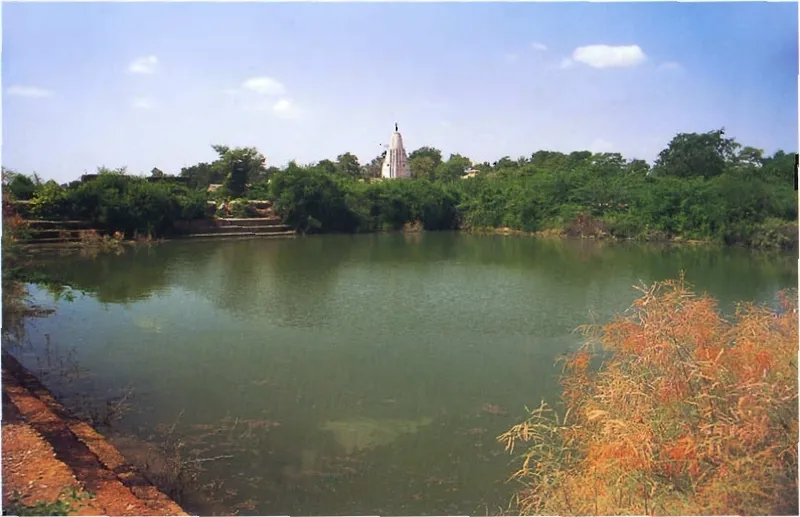
- The photograph in Govardhana Hill (2001) shows a broad pond with stepped stone banks and a white temple spire behind the trees.
In short
Jugal-kuṇḍa is a small kuṇḍa (sacred pond) on the parikramā, the walk around Govardhana Hill. The guide lists of the walk put it after Gvāla-pokharā and just before Killola-kuṇḍa.[1 +2] The guidebook Govardhana Hill (2001) calls it "this ancient kuṇḍa" and places it in the fields about twenty-five yards from the road, just before the toll gate.[4 +1] The same book says that Nanda Mahārāja and the cowherd men stayed here for a few days when they moved from Gokula to their new home at Nandagrāma. It names no source, and no scripture or Gosvāmī text names the kuṇḍa, so the story is not certain.[4 +2]
Key facts
| Kind | kuṇḍa |
|---|---|
| Region · area | Govardhana |
Divine pastimes
The Bhāgavatam (10.11) tells how the cowherds left Gokula for a new home. Upananda proposed a forest named Vṛndāvana, good for the cows, and they entered it and camped there with their bullock carts set in a half moon. The Bhāgavatam names no halt on the way and no kuṇḍa, and neither does Śrīla Prabhupāda's Kṛṣṇa book.[6 +4]
vṛndāvanaṃ govardhanaṃ yamunā-pulināni ca / vīkṣyāsīd uttamā prītī rāma-mādhavayor nṛpa
O King Parīkṣit, when Rāma and Kṛṣṇa saw Vṛndāvana, Govardhana and the banks of the river Yamunā, They both enjoyed great pleasure.
Translation: Śrīla A.C. Bhaktivedanta Swami PrabhupādaThe commentators on these verses describe the new settlement in different ways (summarised here, not translated). Śrīla Viśvanātha Cakravartī Ṭhākura says that the cowherds chose a place between Nandīśvara and Mahāvana. Śrīla Sanātana Gosvāmī says that they crossed the Yamunā and camped on its bank on the first day. Śrīla Jīva Gosvāmī says that the settlement was two yojanas long (a yojana is an old measure of distance), with Govardhana in front, and that Nanda's home at Nandīśvara came later. Śrīla Baladeva Vidyābhūṣaṇa says that it reached from Kāliya-hrada to the slopes of Govardhana. None of them names a halt at a kuṇḍa.[11 +1]
Visiting today
The photograph in Govardhana Hill (2001) shows a broad pond with stepped stone banks and a white temple spire behind the trees.[4 +1] The guidebook Śrī Vraja-maṇḍala Parikramā (2007) spells the name Yugala-kuṇḍa and gives it only in its list of the places on the way.[1 +2]
Location
| Where it is | 'in the middle of the fields about twenty-five yards away from the road just before the toll gate'[13] |
|---|---|
| On the numbered Govardhana chart | 15 (printed as “Jugal Kunda”)[14] |
Pictures
1 pictures
Where the sources differ
Accounts differ Where the Vrajavāsīs went when they left Gokula, and where they halted
- Śrīmad-Bhāgavatam 10.11.28, 35, 36 (Śrīla Prabhupāda's translation)to a forest named Vṛndāvana ('between Nandeśvara and Mahāvana' in the translation); they camped with their carts in a half moon; Kṛṣṇa and Balarāma rejoiced to see Vṛndāvana, Govardhana and the Yamunā; no halt is named
- Śrīla Viśvanātha Cakravartī, Sārārtha-darśinī on 10.11.28they could not go to Nandīśvara, their old capital, where the danger they had fled was still present; so they chose a place between Nandīśvara and Mahāvana
- Śrīla Sanātana Gosvāmī, Bṛhad-vaiṣṇava-toṣaṇī on 10.11.35they crossed the Yamunā above Kāliya-hrada and camped on its bank the first day; Vraja stretched two yojanas from a krośa south of Kāliya-hrada; Nanda's main residence was mostly beside Nandīśvara hill; the cows' station moved from place to place
- Śrīla Jīva Gosvāmī, Laghu-vaiṣṇava-toṣaṇī and Krama-sandarbha on 10.11.35the settlement was two yojanas long and included Saṭṭīkarā, a krośa south-west of Kāliya-hrada, with Govardhana in front; Nanda's residence around Nandīśvara came later
References
14 references
- Govardhana Hill: India's Most Sacred Mountain (2001), Rajasekhara dasa Brahmacari, PDF p. 11
- the key of the numbered Govardhana chart, ¶17
- Śrī Vraja-maṇḍala Parikramā (2007), PDF p. 24
- Govardhana Hill: India's Most Sacred Mountain (2001), Rajasekhara dasa Brahmacari, PDF p. 64
- Govardhana Hill: India's Most Sacred Mountain (2001), Rajasekhara dasa Brahmacari, PDF p. 65
- Śrīmad-Bhāgavatam 10.11.35, GRETIL
- Śrīla Prabhupāda, Śrīmad-Bhāgavatam, Canto 10, Chapter 11, verse 35, translation · vedabase.io
- Śrīmad-Bhāgavatam 10.11.28, GRETIL
- Śrīmad-Bhāgavatam 10.11.36, GRETIL
- Śrīla Prabhupāda, Kṛṣṇa, the Supreme Personality of Godhead (Kṛṣṇa book), Chapter 11, 'Killing the Demons Vatsāsura and Bakāsura' · vedabase.io
- Śrīla Viśvanātha Cakravartī Ṭhākura: commentary on ŚB 10.11.28, Bhagavata Vidya Pith edition, ed. Bhagavata Rishi and Krishna Shankar Shastri, 1996
- Śrīla Sanātana Gosvāmī: commentary on ŚB 10.11.35, Bhagavata Vidya Pith edition, ed. Bhagavata Rishi and Krishna Shankar Shastri, 1996
- Govardhana Hill: India's Most Sacred Mountain (2001), Rajasekhara dasa Brahmacari, p. 50
- Numbered list of the Govardhana sites (key of the Govardhana chart)