Nandīśvara Hill
नन्दीश्वर पर्वत Hindi name proposed
Also called Rudra-parvata
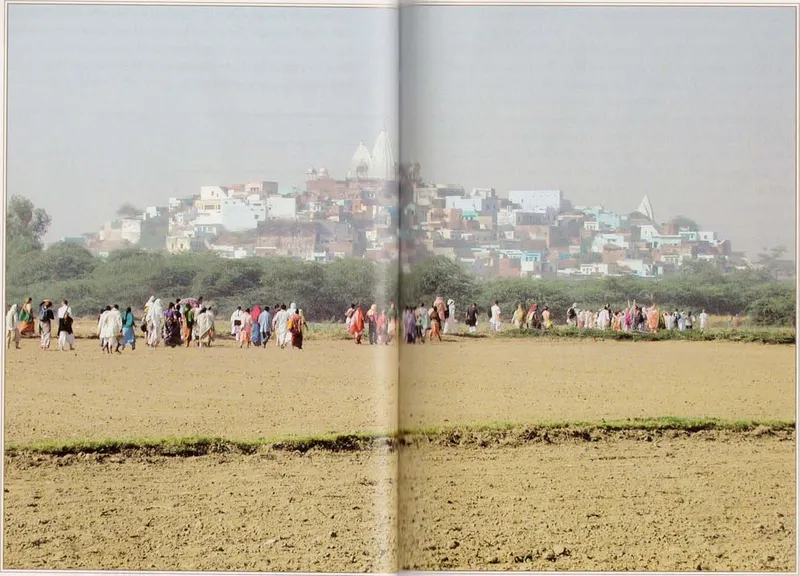
- What it is
- Nandīśvara is the hill of Nandagrāma, also called Rudra-parvata, "Rudra's hill".
- Visiting
- The guidebook Vṛndāvana-Dhāma Ki Jaya! (c. 1986) describes a temple on the summit with Deities of Kṛṣṇa, Balarāma, Nanda, Yaśodā, Rādhārāṇī and two cowherd friends; the undated parikramā notes …
- Places here
- Nanda-bhavana (Nandagrāma), Nanda-bhavan Mandira (Nandagrāma), Sanātana Gosvāmī's temple on Nandīśvara Hill (historical), Cave on Nandīśvara Hill
In short
Nandīśvara is the hill of Nandagrāma, also called Rudra-parvata, "Rudra's hill". The Padma Purāṇa names the forest of Nandīśvara as the place of Nanda's abode, and the Gosvāmīs describe the hill as the home and capital of Nanda, the king of Vraja.[1 +7] Śrīla Rūpa Gosvāmī gives a verse of Śrīmad-Bhāgavatam as its glory and wrote his Dāna-keli-kaumudī while living here.[9 +4] Śrī Caitanya Mahāprabhu climbed the hill, saw the Deities of Nanda, Yaśodā and Kṛṣṇa in a cave and danced here every day.[14 +5] The sources differ on how the hill came to be and on its relation to Śiva, and on when Nanda's people settled here.
Key facts
| Kind | hill |
|---|---|
| Region · area | Nandagrāma |
| Ācāryas | Śrīla Rūpa Gosvāmī, Śrīla Sanātana Gosvāmī, Śrīla Raghunātha dāsa Gosvāmī |
Why it is glorified
In his Mathurā-māhātmya, under the heading of the glory of Nandīśvara, Śrīla Rūpa Gosvāmī quotes the verse in which the women of …
The lands of Vraja
In his Mathurā-māhātmya, under the heading of the glory of Nandīśvara, Śrīla Rūpa Gosvāmī quotes the verse in which the women of Mathurā praise the lands of Vraja, where the Lord, hidden in human form, tends the cows with Balarāma and plays His flute. The verse speaks of Vraja as a whole; applying it to Nandīśvara is Śrīla Rūpa Gosvāmī's own choice, and the Bhakti-ratnākara quotes it here too.[3 +7]
puṇyā bata vraja-bhuvo yad ayaṁ nṛ-liṅga- gūḍhaḥ purāṇa-puruṣo vana-citra-mālyaḥ
gāḥ pālayan saha-balaḥ kvaṇayaṁś ca veṇuṁ vikrīḍayāñcati giritra-ramārcitāṅghriḥ ||
How pious are the tracts of land in Vraja, for there the primeval Personality of Godhead, disguising Himself with human traits, wanders about, enacting His many pastimes! Adorned with wonderfully variegated forest garlands, He whose feet are worshiped by Lord Śiva and goddess Ramā vibrates His flute as He tends the cows in the company of Balarāma.
Translation: Śrīla Prabhupāda's disciples (BBT)He also gives the verse that whoever bathes in the Pāvana lake and sees Kṛṣṇa on Nandīśvara Hill with Nanda and Yaśodā attains every desire; Śrīla Prabhupāda quotes and translates it (see Pāvana-sarovara).[23 +2]
Nanda's capital
The Padma Purāṇa lists Nandīśvara among the groves of Vraja, and the Garga-saṁhitā names it as a hill of Vṛndāvana beside the hill Bṛhatsānu, where Kṛṣṇa was seen with the cows.[1 +6]
बृहत्सानुगिरेः पार्श्वे गिरेर्नन्दीश्वरस्य च । सुंदरे कोकिलवने कोकिलध्वनिसंकुले
bṛhatsānugireḥ pārśve girernandīśvarasya ca
suṁdare kokilavane kokiladhvanisaṁkule
Śrīla Rūpa Gosvāmī calls the hill Kṛṣṇa's home and, among Kṛṣṇa's names, "He who found joy at Nandīśvara"; in his Haṁsadūta Kṛṣṇa always delights in play near the hill.[3 +5] Śrīla Raghunātha dāsa Gosvāmī worships Nandīśvara as the crown of the cowherd settlements, and Śrīla Baladeva Vidyābhūṣaṇa calls it the capital of the lord of Vraja, its ridges bright with jewels and its slopes full of streams, trees and creepers.[3 +10] Śrīla Viśvanātha Cakravartī Ṭhākura gives the whole first canto of his Vraja-rīti-cintāmaṇi to Nandīśvara. He calls it the crown of the villages and forests of Vraja and places the city of King Nanda, the most ancient of cities, on its ridge (all summarised here, not translated).[3 +9] Read more: The morning in Nanda's house at Nandīśvara →
Divine pastimes
Parjanya and his five sons
Śrīla Rūpa Gosvāmī tells that Parjanya, Kṛṣṇa's grandfather, worshipped the husband of Lakṣmī at Nandīśvara on the order of Nārada, wishing for excellent children. A voice from the sky promised him five sons, the middle one named Nanda. He lived here until, afraid of the demon Keśī, he went with his family to Bṛhadvana (summarised here, not translated).[3 +6]
According to the Bhakti-ratnākara, Nārada gave Parjanya the Lakṣmī-Nārāyaṇa mantra at Nandīśvara, and Parjanya performed austerities at Taḍāga-tīrtha until five sons were born.[41] Read more: Nanda's family at Nandagrāma →
Nanda's people come to Nandīśvara
Śrīmad-Bhāgavatam (10.11) tells how the cowherds left Mahāvana for the forest of Vṛndāvana and camped there with their carts drawn up in a half-moon; it does not name Nandīśvara.[42 +2] Śrīla Prabhupāda writes that Nandīśvara is the house of Mahārāja Nanda, and that the Vṛndāvana to which the cowherds moved from Mahāvana lies between Nandeśvara and Mahāvana.[42 +2] In his purport to the opening of the Tenth Canto and in talks he describes the move as one from Gokula to Nanda-grāma, the whole village carried by bullock carts, and in 1971 he said that Kṛṣṇa was brought to Nanda-grāma when He was three or four years old.[47 +4]
In Śrīla Murāri Gupta's and Śrīla Locana dāsa Ṭhākura's accounts of Śrī Caitanya Mahāprabhu's tour of Vraja, His guide says that Nanda, out of fear of Kaṁsa, made his home on Nandīśvara Hill with all of Vraja (summarised here, not translated).[52 +5] According to the Bhakti-ratnākara, Nanda camped at Ḍerāvalī on his way to Nandīśvara.[58 +1] When the family settled here, the Gosvāmīs and later writers tell differently, as shown below; Śrīla Viśvanātha Cakravartī Ṭhākura and Śrīla Baladeva Vidyābhūṣaṇa call the hill the cowherds' ancient capital.[6 +9] Read more: Nanda's family at Nandagrāma →
Śrīla Sanātana Gosvāmī explains the lake where Kṛṣṇa killed the demon Baka as the great lake east of Nandīśvara Hill known as Baka-sthala. The killing of Baka is told on the page of Baktharā.[60 +4]
Rādhā and Kṛṣṇa on the hill
Śrīla Raghunātha dāsa Gosvāmī, and Śrīla Viśvanātha Cakravartī Ṭhākura in his Kṛṣṇa-bhāvanāmṛta, also set pastimes of Rādhā and Kṛṣṇa on the hill, in a grove and in a cave, with the help of Dhaniṣṭhā of Nanda's household; the commentator on the Kṛṣṇa-bhāvanāmṛta names the hill as Nandīśvara (summarised here, not translated).[31 +1]
According to the Bhakti-ratnākara, Kṛṣṇa's footprints are on Nandīśvara Hill, and the elders say that seeing them has great power.[66]
Śrī Caitanya Mahāprabhu at Nandīśvara
The Caitanya-caritāmṛta (Madhya 18) tells that after Kāmyavana Śrī Caitanya Mahāprabhu came to Nandīśvara, overwhelmed with ecstatic love. He bathed in all the lakes, beginning with Pāvana, climbed the hill and asked whether there were Deities on it. Told that they were in a cave, He opened it, saw Nanda, Yaśodā and Kṛṣṇa, honoured Nanda and Yaśodā and touched Kṛṣṇa's body in love.[14 +6]
tāhāṅ līlā-sthalī dekhi’ gelā ‘nandīśvara’
‘nandīśvara’ dekhi’ preme ha-ilā vihvala
After visiting the places of Kṛṣṇa’s pastimes at Kāmyavana, Śrī Caitanya Mahāprabhu went to Nandīśvara. While there, He was overwhelmed with ecstatic love.
Translation: Śrīla A.C. Bhaktivedanta Swami Prabhupādasaba dina premāveśe nṛtya-gīta kailā
tāhāṅ haite mahāprabhu ‘khadira-vana’ āilā
Every day the Lord chanted and danced in ecstatic love. Finally He went to Khadiravana.
Translation: Śrīla A.C. Bhaktivedanta Swami PrabhupādaThe Bhakti-ratnākara adds that He entered the cave and danced and sang there in love.[67] Where the Deities went later is told on the page of the temple on the summit. Read more: Śrīla Sanātana Gosvāmī at Nandagrāma →
Traditional accounts
According to Śrīla Nārāyaṇa Bhaṭṭa Gosvāmī's Vraja-bhakti-vilāsa, Yaśodā installed a Rudra named Nandīśvara for her family's …
Śiva and the hill
According to Śrīla Nārāyaṇa Bhaṭṭa Gosvāmī's Vraja-bhakti-vilāsa, Yaśodā installed a Rudra named Nandīśvara for her family's welfare, and Rudra, pleased, asked that where he became a hill, she and Nanda should live on top of him; the book calls the hill Rudra's hill, with Nanda's temple on top.[68 +1] The guidebook Śrī Vraja-maṇḍala Parikramā (2007) says instead that Śiva asked Kṛṣṇa for the boon of seeing His childhood pastimes and was told to stand at Nandagaon as a hill; Vṛndāvana-Dhāma Ki Jaya! (c. 1986) calls the hill an incarnation of Śiva.[70 +2] Śrīla Kavi-karṇapūra likens the hill to "a second Nandīśvara", that is, to Śiva, and his commentator explains its white colour as Śiva's.[73 +2] The Śiva of the village has his own page, Nandīśvara Mahādeva.
Worship of the hill
The Sādhana-dīpikā asks the worshipper of Rādhā and Kṛṣṇa to worship Nandī-śaila, "Nandī's hill", and Nandagrāma, together with Saṅketa, Vṛṣabhānupura and Varasānu; it does not say where Nandī-śaila is. It names Nandagrāma among the places for the offering of lamps (summarised here, not translated).[76 +2]
In the Bhakti-ratnākara
In the Fifth Wave of the Bhakti-ratnākara, Śrīla Rāghava Paṇḍita shows Śrīla Śrīnivāsa Ācārya Nandīśvara, Nanda's home, with its cave, ponds and forests and the places of Parjanya, Akrūra and Uddhava. He then brings him to the Pāvana lake and to Śrīla Sanātana Gosvāmī's hut.[11 +6]
দেখ নন্দীশ্বর চতুর্দ্দিকে কুণ্ডবন। কৃষ্ণবিলাসের স্থান ভুবনপাবন ॥ পর্ব্বত উপরে দেখ পুত্রের সহিতে। শ্রীনন্দ-যশোদা শোভে অপূর্ব্ব গোফাতে ॥ অহে শ্রীনিবাস এথা শ্রীচৈতন্যরায়। করিতে দর্শন গিয়া প্রবেশে গোফায় ॥ শ্রীনন্দ যশোদা দুই দিকে দুই জন। মধ্যে কৃষ্ণচন্দ্রে দেখি প্রফুল্লনয়ন ॥ শ্রীনন্দ শ্রীযশোদার চরণ বন্দিয়া। কৃষ্ণের সর্ব্বাঙ্গ স্পর্শে উল্লাসিত হৈয়া ॥ প্রেমের আবেশে নৃত্য গীত আরম্ভিল। দেখিয়া সকল লোক বিস্ময় হইল ॥
dekha nandīśbara caturddike kuṇḍabana| kṛṣṇabilāsera sthāna bhubanapābana
parbbata upare dekha putrera sahite| śrīnanda-yaśodā śobhe apūrbba gophāte
ahe śrīnibāsa ethā śrīcaitanyarāẏa| karite darśana giẏā prabeśe gophāẏa
śrīnanda yaśodā dui dike dui jana| madhye kṛṣṇacandre dekhi praphullanaẏana
śrīnanda śrīyaśodāra caraṇa bandiẏā| kṛṣṇera sarbbāṅga sparśe ullāsita haiẏā
premera ābeśe nṛtya gīta ārambhila| dekhiẏā sakala loka bismaẏa haila ||
The Gosvāmīs and ācāryas
Śrīla Rūpa Gosvāmī says in the closing verse of his play Dāna-keli-kaumudī that he wrote it while living at Nandīśvara; the …
Śrīla Rūpa Gosvāmī says in the closing verse of his play Dāna-keli-kaumudī that he wrote it while living at Nandīśvara; the editor of a 1976 edition reads the date as śaka 1471 (1549). In the prologue the play is first presented to an assembly of saints at the foot of Nandīśvara Hill.[12 +1]
Śrīla Prabhupāda
Śrīla Prabhupāda's purport to Upananda's proposal in the Bhāgavatam names the hill as one end of the land to which the cowherds …
Śrīla Prabhupāda's purport to Upananda's proposal in the Bhāgavatam names the hill as one end of the land to which the cowherds moved:[42 +2]
Names this place“Vṛndāvana is situated between Nandeśvara and Mahāvana. Formerly the cowherd men had shifted to Mahāvana, but still there were disturbances. Therefore the cowherd men selected Vṛndāvana, which was between the two villages, and decided to go there.”
Śrīla Prabhupāda, Śrīmad-Bhāgavatam, Canto 10, chapter 11, verse 28, purport · vedabase.io
On 28 November 1971 he came with his disciples to the temple on the hill; see Nanda-bhavan Mandira.[48]
Songs
Every verse of Śrīla Viśvanātha Cakravartī Ṭhākura's Nandīśvarāṣṭaka ends with the prayer that Nandīśvara may give him boundless …
Every verse of Śrīla Viśvanātha Cakravartī Ṭhākura's Nandīśvarāṣṭaka ends with the prayer that Nandīśvara may give him boundless joy, and one says that even Meru cannot equal its fortune, for Nanda lives here with his son and wife (summarised here, not translated).[3 +9]
Visiting today
The guidebook Vṛndāvana-Dhāma Ki Jaya! (c. 1986) describes a temple on the summit with Deities of Kṛṣṇa, Balarāma, Nanda, Yaśodā, Rādhārāṇī and two cowherd friends; the undated parikramā notes Nandagrāma speak of a three-domed temple on the site of Nanda's palace; and Śrī Vraja-maṇḍala Parikramā (2007) mentions a few ruins of the staircase of Nanda-bhavana south of the hill.[72 +3] The sources describe the altar differently at different dates; see Nanda-bhavan Mandira.
Places at Nandīśvara Hill
4 places
Nearby places
Pāvana-sarovara · Vṛndā-kuṇḍa (Nandagrāma)
Where the sources differ
Accounts differ How Nandīśvara hill came to be, and its relation to Śiva (Rudra, Nandīśvara).
- Vraja-bhakti-vilāsa ch. 4 vv.25–26 (Śrīla Nārāyaṇa Bhaṭṭa)Yaśodā installed a Rudra named Nandīśvara for the welfare of her family; pleased, Rudra gave her a boon and asked one for himself: that where he became a hill, she and Nanda would shine on top of him.
- Vraja-bhakti-vilāsa ch. 2 v.44A great image of Rudra named Nandīśvara stands inside the village beside the place of churning; Nanda's temple is on top of Rudra's hill (rudra-parvata).
- Śrī Vraja-maṇḍala Parikramā (2007)Śiva asked Kṛṣṇa for the boon of seeing His childhood pastimes; Kṛṣṇa ordered him to stand in Nandagaon as a hill, and he became Nandīśvara Hill.
- Vṛndāvana-Dhāma Ki Jaya! (c. 1986)The hill is 'considered to be an incarnation of Lord Śiva'.
Accounts differ Where the cowherds settled after leaving Gokula-Mahāvana, and when Nandīśvara (Nandagrāma) became Nanda's residence.
- Śrīmad-Bhāgavatam 10.11.28, 10.11.35Upananda proposes the forest named Vṛndāvana; they enter Vṛndāvana and camp with the carts in a half-moon. No Nandīśvara or Nandagrāma is named.
- Śrīla Prabhupāda, ŚB 10.11.28 translation and purport'Between Nandeśvara and Mahāvana is a place named Vṛndāvana'; the cowherds chose Vṛndāvana, between the two villages.
- Śrīla Prabhupāda, ŚB 10.1.9 purport, transcripts 1971, 1974, 1976After some days in Gokula Kṛṣṇa moved with His family to 'Nanda-grāma, Vṛndāvana'; the village was moved by bullock carts from Gokula to Nandagrāma; 'when He was three, four years old, then He was brought to Nanda-grāma'; at the Nandagrāma temple in 1971: 'Nanda Mahārāja left Gokula and came here'.
- Śrīla Viśvanātha Cakravartī on ŚB 10.11.28They could not go to Nandīśvara, 'our ancient capital', because the danger they had fled from was still there; so they chose a place between Nandīśvara and Mahāvana.
The wording of these accounts is our summary of the sources, not a published translation.
Accounts differ How Parjanya, Kṛṣṇa's grandfather, obtained his five sons at Nandīśvara.
- Rādhā-Kṛṣṇa-gaṇoddeśa-dīpikā (Śrīla Rūpa Gosvāmī) part 1 vv.16–21By the order of the sage of the gods he worshipped Lakṣmī's husband formerly at Nandīśvara, wishing for excellent children; a voice from the sky promised five sons; he lived there until Keśī came.
- Bhakti-ratnākara, Fifth WaveNārada came to Nandīśvara and gave Parjanya the Lakṣmī-Nārāyaṇa mantra; Parjanya performed austerities at Taḍāga-tīrtha and five sons were born.
- Śrī Vraja-maṇḍala Parikramā (2007)Nārada initiated him in the Lakṣmī-Nārāyaṇa mantra; he bathed daily in Taḍāga-tīrtha and worshipped until a divine voice promised five sons.
- Śrī Vraja-maṇḍala Parikramā (2007)'Some Vrajavāsīs also say' that Parjanya had his five sons by the blessings of Āśīṣeśvara Mahādeva, whom he worshipped.
The wording of these accounts is our summary of the sources, not a published translation.
Accounts differ How the Deities of Nanda, Yaśodā and Kṛṣṇa on Nandīśvara hill were found and who brought them out of the cave.
- Śrī Caitanya-caritāmṛta, Madhya 18.59–62The local people told Śrī Caitanya that the Deities were inside a cave; He saw them after opening (ughāḍiyā; Śrīla Prabhupāda: 'excavating') the cave and touched Kṛṣṇa's body in love.
- Bhakti-ratnākara, Fifth WaveNanda and Yaśodā with their son are in a wonderful cave on the hill; Śrī Caitanya entered the cave to see them.
- the undated parikramā notes NandagrāmaThe three Deities were hidden in a cave; Kṛṣṇa revealed their place to Śrīla Sanātana Gosvāmī, then living at Pāvana-sarovara, who unearthed them and built them a temple on top of the hill; 'it seems' Lord Caitanya had seen them earlier in the cave.
- Vṛndāvana-Dhāma Ki Jaya! (c. 1986)When Lord Caitanya visited, the Deities were kept in a cave; later the temple was built and they were moved inside (no name given).
More on this place
Nanda's family at Nandagrāma · Śrīla Sanātana Gosvāmī at Nandagrāma · The morning in Nanda's house at Nandīśvara
References
87 references
- Padma Purāṇa, Pātāla-khaṇḍa (5) 69.19, Sanskrit Wikisource
- Padma Purāṇa, Pātāla-khaṇḍa (5) 69.41–43, Sanskrit Wikisource
- Śrīla Rūpa Gosvāmī, Rādhā-Kṛṣṇa-gaṇoddeśa-dīpikā, part 2, vv.116–117 (sthāna-vivaraṇa)
- Śrīla Raghunātha dāsa Gosvāmī, Vraja-vilāsa-stava, Stavāvalī (9) Vraja-vilāsa-stava 8
- Śrīla Raghunātha dāsa Gosvāmī, Vraja-vilāsa-stava, Stavāvalī (9) Vraja-vilāsa-stava 62
- Śrīla Viśvanātha Cakravartī, Vraja-rīti-cintāmaṇi 1.15–16
- Śrīla Viśvanātha Cakravartī, Vraja-rīti-cintāmaṇi 1.19–22
- Śrīla Rūpa Gosvāmī, Stava-mālā, part 7 (Kṛṣṇa's names) v.15 with ṭīkā, after the edition of Bhakti Saranga Goswami and Purushottam Das, Vrindavan, 1959
- Śrīla Rūpa Gosvāmī, Mathurā-māhātmya v.432
- Śrīmad-Bhāgavatam 10.44.13, Bhagavata Vidya Pith edition, ed. Bhagavata Rishi and Krishna Shankar Shastri, 1996
- Śrīla Narahari Cakravartī, Bhakti-ratnākara, Fifth Wave, 1912 ed. p. 221; Grantha Mandira text v.931–934, 2nd ed., 1912
- Śrīla Rūpa Gosvāmī, Dāna-keli-kaumudī, closing verse (v.101), after the undated edition published by Krishna Das of Kusum Sarovar
- Śrīla Rūpa Gosvāmī, Dāna-keli-kaumudī, prologue (after v.2), after the undated edition published by Krishna Das of Kusum Sarovar
- Śrīla Kṛṣṇadāsa Kavirāja Gosvāmī, Śrī Caitanya-caritāmṛta, CC Madhya-līlā 18.57, online edition · vedabase.io
- Śrīla Kṛṣṇadāsa Kavirāja Gosvāmī, Śrī Caitanya-caritāmṛta, CC Madhya-līlā 18.58, online edition · vedabase.io
- Śrīla Kṛṣṇadāsa Kavirāja Gosvāmī, Śrī Caitanya-caritāmṛta, CC Madhya-līlā 18.59, online edition · vedabase.io
- Śrīla Kṛṣṇadāsa Kavirāja Gosvāmī, Śrī Caitanya-caritāmṛta, CC Madhya-līlā 18.61, online edition · vedabase.io
- Śrīla Kṛṣṇadāsa Kavirāja Gosvāmī, Śrī Caitanya-caritāmṛta, CC Madhya-līlā 18.62, online edition · vedabase.io
- Śrīla Kṛṣṇadāsa Kavirāja Gosvāmī, Śrī Caitanya-caritāmṛta, CC Madhya-līlā 18.63, online edition · vedabase.io
- Śrīla Rūpa Gosvāmī, Rādhā-Kṛṣṇa-gaṇoddeśa-dīpikā, part 1, vv.16–19
Show all 87 references
- Śrīla Rūpa Gosvāmī, Rādhā-Kṛṣṇa-gaṇoddeśa-dīpikā, part 1, vv.20–21
- Śrīla Rūpa Gosvāmī, Haṁsadūta 83, GRETIL
- Śrīla Rūpa Gosvāmī, Mathurā-māhātmya v.433
- Śrīla Narahari Cakravartī, Bhakti-ratnākara, Fifth Wave, 1912 ed. p. 221; Grantha Mandira text v.935–938, 2nd ed., 1912
- Śrīla Prabhupāda, Śrī Caitanya-caritāmṛta, Madhya-līlā 18.58, purport · vedabase.io
- Garga-saṁhitā, Vṛndāvana-khaṇḍa (2) 1.17, Sanskrit Wikisource
- Garga-saṁhitā, Vṛndāvana-khaṇḍa (2) 10.19, Sanskrit Wikisource
- Garga-saṁhitā, Vṛndāvana-khaṇḍa (2) 18.17, Sanskrit Wikisource
- Garga-saṁhitā, Vṛndāvana-khaṇḍa (2) 21.10 in the Wikisource text (= 2.21.9-10 in the Danavir Goswami edition), Sanskrit Wikisource
- Garga-saṁhitā, Aśvamedha-khaṇḍa (10) 44.29, Sanskrit Wikisource
- Śrīla Raghunātha dāsa Gosvāmī, Vraja-vilāsa-stava, Stavāvalī (9) Vraja-vilāsa-stava 33
- Śrīla Raghunātha dāsa Gosvāmī, Vilāpa-kusumāñjali, Stavāvalī (8) Vilāpa-kusumāñjali 61
- Baladeva Vidyābhūṣaṇa: commentary v.10.11.28, baladeva-vidyabhūṣaṇaḥ (vaiṣṇavānandinī), Bhagavata Vidya Pith edition, ed. Bhagavata Rishi and Krishna Shankar Shastri, 1996
- Baladeva Vidyābhūṣaṇa: commentary v.10.11.34 [vedabase 10.11.35], baladeva-vidyabhūṣaṇaḥ (vaiṣṇavānandinī), Bhagavata Vidya Pith edition, ed. Bhagavata Rishi and Krishna Shankar Shastri, 1996
- Baladeva Vidyābhūṣaṇa: commentary on ŚB 10.24.38, Bhagavata Vidya Pith edition, ed. Bhagavata Rishi and Krishna Shankar Shastri, 1996
- Śrīla Viśvanātha Cakravartī, Vraja-rīti-cintāmaṇi 1.80, 1.82, 1.83
- Śrīla Viśvanātha Cakravartī, Vraja-rīti-cintāmaṇi 1.87 (colophon of the first canto)
- Śrīla Viśvanātha Cakravartī Ṭhākura: commentary on ŚB 10.11.28, Bhagavata Vidya Pith edition, ed. Bhagavata Rishi and Krishna Shankar Shastri, 1996
- Śrīla Viśvanātha Cakravartī: commentary v.10.38.11, viśvanātha-cakravartī (sārārtha-darśiṇī), Bhagavata Vidya Pith edition, ed. Bhagavata Rishi and Krishna Shankar Shastri, 1996
- Ānanda-vṛndāvana-campū, part 4, ṭīkā on v.4
- Śrīla Narahari Cakravartī, Bhakti-ratnākara, Fifth Wave, 1912 ed. pp. 222–223; Grantha Mandira text v.955–957, 2nd ed., 1912
- Śrīmad-Bhāgavatam 10.11.28, Bhagavata Vidya Pith edition, ed. Bhagavata Rishi and Krishna Shankar Shastri, 1996
- Śrīmad-Bhāgavatam 10.11.35, GRETIL
- Śrīla Prabhupāda, Kṛṣṇa, the Supreme Personality of Godhead, ch. 11 'Killing the Demons Vatsāsura and Bakāsura' · vedabase.io
- Śrīla Prabhupāda, Śrī Caitanya-caritāmṛta, Madhya-līlā 18.57, purport · vedabase.io
- Śrīla Prabhupāda, Śrīmad-Bhāgavatam, Canto 10, chapter 11, verse 28, purport · vedabase.io
- Śrīla Prabhupāda, Śrīmad-Bhāgavatam, Canto 10, chapter 1, verse 9, purport · vedabase.io
- Śrīla Prabhupāda, Parikramā on the Way to Gokula, Vṛndāvana, 28 November 1971 · vedabase.io
- Śrīla Prabhupāda, Parikramā on the Way to Gokula, Vṛndāvana, 28 November 1971 · vedabase.io
- Śrīla Prabhupāda, Morning Walk, Rome, 27 May 1974 · vedabase.io
- Śrīla Prabhupāda, Śrīmad-Bhāgavatam 5.5.10–13 lecture, Vṛndāvana, 1 November 1976 · vedabase.io
- Kṛṣṇa-caitanya-caritāmṛta of Śrīla Murāri Gupta, prakrama 4, sarga 8, v.1
- Kṛṣṇa-caitanya-caritāmṛta of Śrīla Murāri Gupta, prakrama 4, sarga 12, v.10
- Śrīla Locana dāsa Ṭhākura, Caitanya-maṅgala, Śeṣa-khaṇḍa, 1903 ed. p. 174, left column, lines 1-2
- Śrīla Locana dāsa Ṭhākura, Caitanya-maṅgala, Śeṣa-khaṇḍa, 1903 ed. p. 177, right column, lines 7-8
- Kṛṣṇa-caitanya-caritāmṛta of Śrīla Murāri Gupta, prakrama 4, sarga 10, vv.15-16
- Śrīla Locana dāsa Ṭhākura, Caitanya-maṅgala, Śeṣa-khaṇḍa, 1903 ed. p. 177, right column, lines 11-12
- Śrīla Narahari Cakravartī, Bhakti-ratnākara, Fifth Wave, 1912 ed. pp. 211-212, 2nd ed., 1912
- Śrī Vraja-maṇḍala Parikramā (2007), PDF p. 135
- Śrīla Sanātana Gosvāmī: commentary v.10.11.46, sanātana-gosvāmī (bṛhad-vaiṣṇava-toṣaṇī), Bhagavata Vidya Pith edition, ed. Bhagavata Rishi and Krishna Shankar Shastri, 1996
- Bṛhad-vaiṣṇava-toṣaṇī on Śrīmad-Bhāgavatam 10.11.35 (Śrīla Sanātana Gosvāmī): commentary on ŚB 10.11.35 (Bṛhad-vaiṣṇava-toṣaṇī), Bhagavata Vidya Pith edition, ed. Bhagavata Rishi and Krishna Shankar Shastri, 1996
- Śrīla Sanātana Gosvāmī: commentary on ŚB 10.17.20, Bhagavata Vidya Pith edition, ed. Bhagavata Rishi and Krishna Shankar Shastri, 1996
- Śrīla Sanātana Gosvāmī: commentary on ŚB 10.38.24, Bhagavata Vidya Pith edition, ed. Bhagavata Rishi and Krishna Shankar Shastri, 1996
- Śrīla Sanātana Gosvāmī: commentary v.10.47.21, sanātana-gosvāmī (bṛhad-vaiṣṇava-toṣaṇī), Bhagavata Vidya Pith edition, ed. Bhagavata Rishi and Krishna Shankar Shastri, 1996
- Śrīla Viśvanātha Cakravartī, Kṛṣṇa-bhāvanāmṛta, sarga 6 (ṣaṣṭhaḥ sargaḥ, bhojana-kautukānumodana; text section (6), which the index labels 'pañcamaḥ sargaḥ') v.116 with the ṭīkā on vv.115–116, after the edition of Radhikanath Goswami, Vrindavan, 1906
- Śrīla Narahari Cakravartī, Bhakti-ratnākara, Fifth Wave, 1912 ed. p. 228; Grantha Mandira text v.1014, 2nd ed., 1912
- Śrīla Narahari Cakravartī, Bhakti-ratnākara, Fifth Wave, 1912 ed. p. 222; Grantha Mandira text v.940–945, 2nd ed., 1912
- Śrīla Nārāyaṇa Bhaṭṭa, Vraja-bhakti-vilāsa, ch. 4 vv.25–26; printed p. 91, 1st ed., publ. Bābā Kṛṣṇadāsa, Kusuma-sarovara, Saṁvat 2008
- Śrīla Nārāyaṇa Bhaṭṭa, Vraja-bhakti-vilāsa, ch. 2 v.44; printed p. 45, 1st ed., publ. Bābā Kṛṣṇadāsa, Kusuma-sarovara, Saṁvat 2008
- Śrī Vraja-maṇḍala Parikramā (2007), PDF p. 191
- Śrī Vraja-maṇḍala Parikramā (2007), PDF p. 192
- Vṛndāvana-Dhāma Ki Jaya! (c. 1986), by Dhruva Mahārāja dāsa, PDF p. 51
- Ānanda-vṛndāvana-campū, part 3, prose after v.49 and ṭīkā on v.50
- Ānanda-vṛndāvana-campū, opening verse of the seventh stavaka, with ṭīkā
- Ānanda-vṛndāvana-campū, part 7, v.2 with ṭīkā
- Śrīla Rādhā-kṛṣṇa Gosvāmī, Sādhana-dīpikā (4) part 6 vv.26–27
- Śrīla Rādhākṛṣṇa Gosvāmī, Sādhana-dīpikā, (4) part 10 v.4
- Śrīla Rādhākṛṣṇa Gosvāmī, Sādhana-dīpikā, (4) part 10 v.10
- Śrīla Narahari Cakravartī, Bhakti-ratnākara, Fifth Wave (pañcama taraṅga), printed p. 229 (1912 edition), 2nd ed., 1912
- Śrīla Narahari Cakravartī, Bhakti-ratnākara, Fifth Wave, 1912 ed. p. 230; Grantha Mandira text v.1041–1042, 2nd ed., 1912
- Śrīla Narahari Cakravartī, Bhakti-ratnākara, Fifth Wave, 1912 ed. p. 250; Grantha Mandira text v.1297–1302, 2nd ed., 1912
- Śrīla Narahari Cakravartī, Bhakti-ratnākara, Fifth Wave, 1912 ed. p. 222; Grantha Mandira text v.940–945, 2nd ed., 1912
- the undated parikramā notes Nandagrāma, ¶7
- the undated parikramā notes Nandagrāma, ¶10
- Śrī Vraja-maṇḍala Parikramā (2007), PDF p. 195
- Vṛndāvana-Dhāma Ki Jaya! (c. 1986), by Dhruva Mahārāja dāsa, p. 33
- Vṛndāvana, the Playground of God (2010), Bhakti Caitanya Svāmī, p. 178