Kadamba tree at Kāliya-ghāṭa
कालिय-घाट का कदम्ब वृक्ष Hindi name proposed
Also called Keli-kadamba
- What it is
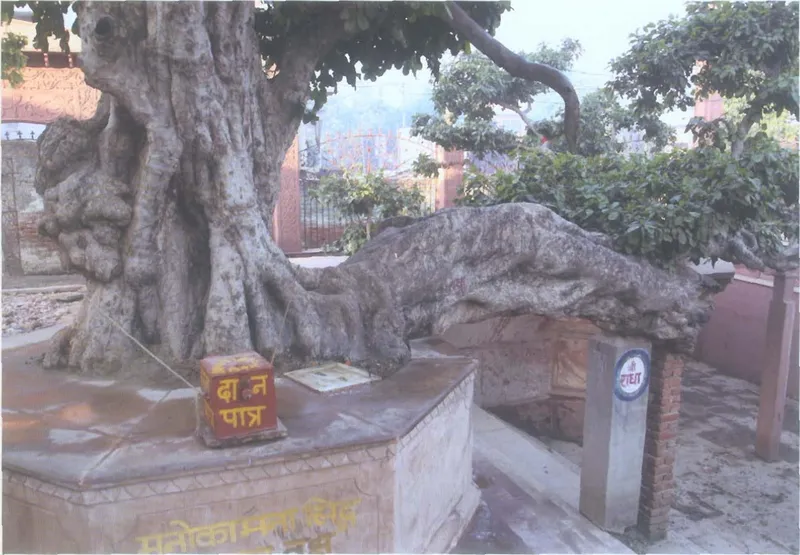
- An old kadamba tree stands at Kāliya-ghāṭa in Vṛndāvana, by the old bank of the Yamunā.
- Visiting
- The Color Guide to Vṛndāvana (2000) says that the Yamunā no longer flows past the ghāṭa except in the rainy-season floods.
In short
An old kadamba tree stands at Kāliya-ghāṭa in Vṛndāvana, by the old bank of the Yamunā. The guidebooks present it as the tree that Kṛṣṇa climbed before He jumped into the poisoned lake of the serpent Kāliya; the Bhakti-ratnākara calls that tree the keli-kadamba, the kadamba of His play.[1 +6] Śrīmad-Bhāgavatam and four other Purāṇic texts tell of the kadamba, and the ācāryas explain why it alone lived when the poison had dried up everything around.[8 +6] Śrīla Rūpa Gosvāmī and Śrīla Jīva Gosvāmī quote a verse on a holy kadamba east of the lake that blossoms all year. That the present tree is the tree of the pastime is the pilgrims' tradition.[1 +7]
Key facts
| Kind | tree |
|---|---|
| Region · area | Vṛndāvana · Kāliya-ghāṭa |
| Also part of | Kāliya-damanavana |
| Ācāryas | Śrīla Jīva Gosvāmī, Śrīla Prabodhānanda Sarasvatī |
Why it is glorified
Śrīla Jīva Gosvāmī teaches that Vṛndāvana is the Lord's eternal abode, and that its divine trees, such as the kadamba and the …
Śrīla Jīva Gosvāmī teaches that Vṛndāvana is the Lord's eternal abode, and that its divine trees, such as the kadamba and the aśoka, are seen even now by great devotees. As an example he quotes a verse that he gives as the Varāha Purāṇa's: east of Kāliya-hrada, Kāliya's lake, stands a great and holy kadamba, hundred-branched and fragrant, which blossoms in all twelve months and lights up the ten directions.[16 +2] He quotes it again in his commentary on the Bhāgavatam, as an example of the eternally perfect trees of this forest, which mundane senses do not touch (summarised here, not translated).[19] Śrīla Rūpa Gosvāmī quotes the same verse in his Mathurā-māhātmya. The verse speaks of a tree east of the lake; it does not say that it is the tree Kṛṣṇa climbed.[15] The Bhakti-ratnākara quotes it for that tree.[16 +2]
In Śrīla Rūpa Gosvāmī's poem Haṁsadūta, Lalitā sends a swan to Kṛṣṇa in Mathurā and tells it to drink the sweet water of holy Kāliya-hrada, fragrant with the pollen of kadamba flowers (summarised here, not translated).[20]
Divine pastimes
The jump from the kadamba
Śrīmad-Bhāgavatam (10.16) tells that Kṛṣṇa saw how Kāliya had poisoned the Yamunā. To subdue the serpent He climbed a very tall kadamba tree on the bank, tightened His belt, slapped His arms and jumped into the lake. The Viṣṇu Purāṇa, the Harivaṁśa, the Brahma-vaivarta Purāṇa and the Garga-saṁhitā also tell of the kadamba; in the Garga-saṁhitā He ties His yellow cloth at His waist before He dives.[8 +4]
taṃ caṇḍa-vega-viṣa-vīryam avekṣya tena
duṣṭāṃ nadīṃ ca khala-saṃyamanāvatāraḥ … kṛṣṇaḥ kadambam adhiruhya tato 'ti-tuṅgam
āsphoṭya gāḍha-raśano nyapatad viṣode
Lord Kṛṣṇa saw how the Kāliya serpent had polluted the Yamunā River with his terribly powerful poison. Since Kṛṣṇa had descended from the spiritual world specifically to subdue envious demons, the Lord immediately climbed to the top of a very high kadamba tree and prepared Himself for battle. He tightened His belt, slapped His arms and then jumped into the poisonous water.
Translation: Śrīla Prabhupāda's disciples (BBT)Why the tree lived
Śrīla Prabhupāda writes in his Kṛṣṇa book that this kadamba was the only tree there that was not dead, and he gives two explanations:[14]
Names this place“The kadamba tree from which Kṛṣṇa jumped was the only tree there which was not dead. Some commentators say that due to being touched by the lotus feet of Kṛṣṇa, the tree immediately became alive. In some other Purāṇas it is stated that Garuḍa … put some nectar on this tree to preserve it.”
Śrīla Prabhupāda, Kṛṣṇa, the Supreme Personality of Godhead, Chapter 16 (Subduing Kāliya) · vedabase.io
The commentators on the Bhāgavatam give these and other reasons (summarised here, not translated). Śrīla Śrīdhara Svāmī, followed by Śrīla Viśvanātha Cakravartī Ṭhākura and Śrīla Baladeva Vidyābhūṣaṇa, says that the tree did not dry up because of the good fortune of the touch of Kṛṣṇa's feet that was to come, or, according to another Purāṇa, because Garuḍa had stepped on it while carrying the nectar of immortality. Śrīla Jīva Gosvāmī says that it was Kṛṣṇa's own tree, kept by Him for His pastime, and quotes a saying that the kadamba near Kāliya's lake is Kṛṣṇa's tree.[13 +1] In his Gopāla-campū Śrīla Jīva Gosvāmī has Kṛṣṇa show His friends the one kadamba that held firm against the flames of the poison because Garuḍa had sprinkled nectar on it, and then climb it.[16 +1]
On a later verse, Śrīla Viśvanātha Cakravartī Ṭhākura and Śrīla Jīva Gosvāmī say that no trees grew on the bank or near the lake at all.[22] Lines found in some manuscripts of the Harivaṁśa have Kṛṣṇa say that the touch of His soles will make the kadamba long-lived, flowering and worthy of worship by His dear ones, and add that its top still shines with the beauty of that touch.[10] Read more: How Kṛṣṇa subdued the serpent Kāliya →
Traditional accounts
According to the Bhakti-ratnākara, Śrīla Śrīnivāsa Ācārya's guide showed him Kāliya-hrada and told how Kṛṣṇa climbed the …
According to the Bhakti-ratnākara, Śrīla Śrīnivāsa Ācārya's guide showed him Kāliya-hrada and told how Kṛṣṇa climbed the keli-kadamba on the bank, jumped in, subdued Kāliya, danced on his hoods and sent him to Ramaṇaka island. Whoever bathes here, the guide said, is freed from all sins.[5 +1] The guidebook Śrī Vraja-maṇḍala Parikramā (2007) explains the name keli-kadamba as the kadamba of Kṛṣṇa's play, and lists it among the kadamba trees of Vṛndāvana.[5 +2]
Śrīla Locana dāsa Ṭhākura's Caitanya-maṅgala tells that when Śrī Caitanya Mahāprabhu came to Vṛndāvana, His guide showed Him Kāliya's lake and said that Kṛṣṇa had climbed the kadamba here; Śrīla Murāri Gupta tells the same visit without the tree. Both are read from worn or faulty prints and still need checking against printed editions.[23 +2]
The guidebooks present the tree now standing as the tree Kṛṣṇa climbed. Vṛndāvana, the Playground of God (2010) calls it the five-thousand-year-old kadamba, and The Color Guide to Vṛndāvana (2000) records a local tradition that it is the same tree. No historical record of its age was found, so this is not certain.[1 +3]
Songs
The Śrī Govinda-dāmodara-stotra, which the song book credits to Śrīla Bilvamaṅgala Ṭhākura, tells how Kṛṣṇa fell from the kadamba …
The Śrī Govinda-dāmodara-stotra, which the song book credits to Śrīla Bilvamaṅgala Ṭhākura, tells how Kṛṣṇa fell from the kadamba into the lake to subdue Kāliya, and how the gopīs and gopas came running and cried out His names.[27]
Visiting today
The Color Guide to Vṛndāvana (2000) says that the Yamunā no longer flows past the ghāṭa except in the rainy-season floods.[1 +5] Directly behind the tree, according to Vṛndāvana, the Playground of God (2010), is the samādhi of Śrīla Prabodhānanda Sarasvatī; the other guidebooks put it within about twenty metres of the ghāṭa.[3 +5]
The guidebooks list near the ghāṭa the Kāliya-mardana Mandira, Dvādaśāditya-ṭīlā and, according to Śrī Vraja-maṇḍala Parikramā, Śrīla Bilvamaṅgala Ṭhākura's place of bhajana.[6 +4]
Nearby places
Prabodhānanda Sarasvatī's samādhi
History
The Bengali Vṛndāvana-kathā (1920) lists Kāliya-damanavana among the old gardens of Vṛndāvana and places a Deity of Kṛṣṇa subduing Kāliya a little to the north of this kadamba. It names no temple and does not say whether this is the Deity of today's Kāliya-mardana Mandira.[26]
Where the sources differ
Why the kadamba survived Kāliya's poison: the texts give different reasons, and two guidebooks add details of their own.
Why the kadamba survived Kāliya's poison: the texts give different reasons, and two guidebooks add details of their own.
Accounts differ Why the kadamba tree survived Kāliya's poison.
- HarivaṁśaThe constituted text does not say that the tree survived the poison (it describes both banks as overgrown with trees, shrubs and creepers, 55.51-53); in the star passage Kṛṣṇa says the touch of His soles will make this kadamba long-lived, and the text adds that it still shines by that touch.
- Gopāla-campū, Pūrva 13.19 (Śrīla Jīva Gosvāmī)Garuḍa had sprinkled nectar on it, so it alone held firm against the poison-fire.
- Kṛṣṇa book ch. 16 (Śrīla Prabhupāda)Some commentators: revived by the touch of Kṛṣṇa's lotus feet; some other Purāṇas: Garuḍa, knowing the future, put nectar on it.
- Śrī Vraja-maṇḍala Parikramā (2007)Garuḍa rested on it while carrying nectar for Vinatā; the nectar's fragrance or a spilled drop saved it.
The same question with the Canto 10 commentators, who also say that no trees grew near the lake.
Accounts differ Why the kadamba survived Kāliya's poison.
- Śrīla Śrīdhara Svāmī on ŚB 10.16.6 (quoted by Śrīla Viśvanātha Cakravartī; Śrīla Baladeva Vidyābhūṣaṇa the same)by the good fortune of the touch of Kṛṣṇa's feet that was to come; or, according to another Purāṇa, because Garuḍa, carrying the nectar, had stepped (Baladeva: sat) on it
- Śrīla Jīva Gosvāmī, Laghu-vaiṣṇava-toṣaṇī on ŚB 10.16.6because it is Kṛṣṇa's own tree, kept by Him for His pastime (a saying: 'the kadamba near Kāliya-hrada is Kṛṣṇa's tree'); the trees near it did not die either
- Śrīla Jīva Gosvāmī, Gopāla-campū, Pūrva 13.19Garuḍa had sprinkled nectar on it
- Śrīla Viśvanātha Cakravartī and Śrīla Jīva Gosvāmī on ŚB 10.17.15no trees grew on the bank or near the lake
The wording of these accounts is our summary of the sources, not a published translation.
More on this place
How Kṛṣṇa subdued the serpent Kāliya
References
38 references
- Vṛndāvana, the Playground of God (2010), Bhakti Caitanya Svāmī, PDF p. 124
- The Color Guide to Vṛndāvana (2000), Written and Photographed by Rājaśekhara dāsa Brahmacārī, PDF p. 54
- Vṛndāvana-Dhāma Ki Jaya! (c. 1986), by Dhruva Mahārāja dāsa, PDF p. 63
- the undated parikramā notes Vṛndāvana, ¶32
- Śrīla Narahari Cakravartī, Bhakti-ratnākara, Fifth Wave (pañcama taraṅga), 1912 ed. p. 301, 2nd ed., 1912
- Śrī Vraja-maṇḍala Parikramā (2007), PDF p. 341
- Śrī Vraja-maṇḍala Parikramā (2007), PDF p. 346
- Śrīmad-Bhāgavatam 10.16.6, GRETIL
- Garga-saṁhitā, Vṛndāvana-khaṇḍa 12.4, Sanskrit Wikisource
- Harivaṁśa, 55.57 and 56.1 (constituted text), with the star passage that the text prints between them (lines marked '|', in segment HV_56.1), GRETIL
- Viṣṇu Purāṇa, 5.7.10-11, GRETIL
- Brahma-vaivarta Purāṇa, Śrī-kṛṣṇa-janma-khaṇḍa 19.8-9, Sanskrit Wikisource
- Śrīdhara Svāmī: commentary on ŚB 10.16.6, Bhagavata Vidya Pith edition, ed. Bhagavata Rishi and Krishna Shankar Shastri, 1996
- Śrīla Prabhupāda, Kṛṣṇa, the Supreme Personality of Godhead, Chapter 16 (Subduing Kāliya) · vedabase.io
- Śrīla Rūpa Gosvāmī, Mathurā-māhātmya, v.390–391
- Śrīla Jīva Gosvāmī, Kṛṣṇa-sandarbha, anuccheda 106, GRETIL
- Śrīla Jīva Gosvāmī, Gopāla-campū, Uttara-campū, pūraṇa 29, prose 88, GRETIL
- Śrīla Narahari Cakravartī, Bhakti-ratnākara, Fifth Wave (pañcama taraṅga), 1912 ed. p. 302, 2nd ed., 1912
- Śrīla Jīva Gosvāmī: commentary on ŚB 10.28.17, Bhagavata Vidya Pith edition, ed. Bhagavata Rishi and Krishna Shankar Shastri, 1996
- Śrīla Rūpa Gosvāmī, Haṁsadūta 29-30, GRETIL
Show all 38 references
- Śrīla Jīva Gosvāmī, Gopāla-campū, Pūrva-campū 13, prose 19-20, GRETIL
- Śrīla Viśvanātha Cakravartī Ṭhākura: commentary on ŚB 10.17.15, Bhagavata Vidya Pith edition, ed. Bhagavata Rishi and Krishna Shankar Shastri, 1996
- Kṛṣṇa-caitanya-caritāmṛta, prakrama 4, sarga 7, verse 8
- Kṛṣṇa-caitanya-caritāmṛta, prakrama 4, sarga 7, verses 9–10 (4.7.9–10), PDF page 569
- Śrīla Locana dāsa Ṭhākura, Caitanya-maṅgala, Śeṣa-khaṇḍa, 1903 ed. p. 173: left column, last line; right column, lines 1–6
- Pulinbihārī Datta, chapter 17, section 2 ('udyāna'), printed p. 195
- Agre Kurunam Atha (Śrī Govinda-dāmodara-stotram) (Bilvamaṅgala Ṭhākura (as the song book credits it)) · song book
- Vṛndāvana, the Playground of God (2010), Bhakti Caitanya Svāmī, PDF p. 18
- Śrī Vraja-maṇḍala Parikramā (2007), PDF p. 342
- Śrī Vraja-maṇḍala Parikramā (2007), PDF p. 299
- Pulinbihārī Datta, chapter 23 ('upasaṁhāra'), printed p. 274
- Vṛndāvana, the Playground of God (2010), Bhakti Caitanya Svāmī, PDF p. 126
- The Color Guide to Vṛndāvana (2000), Written and Photographed by Rājaśekhara dāsa Brahmacārī, PDF p. 55
- the undated parikramā notes Vṛndāvana, ¶43
- Śrī Vraja-maṇḍala Parikramā (2007), PDF p. 345
- The Color Guide to Vṛndāvana (2000), Written and Photographed by Rājaśekhara dāsa Brahmacārī, PDF p. 56
- Vṛndāvana, the Playground of God (2010), Bhakti Caitanya Svāmī, p. 124
- The Color Guide to Vṛndāvana (2000), Written and Photographed by Rājaśekhara dāsa Brahmacārī, p. 40