Pañca-tīrtha-kuṇḍa
पंच-तीर्थ-कुण्ड Hindi name proposed
- What it is
- Pañca-tīrtha-kuṇḍa, the kuṇḍa (sacred pond) of the five holy waters, lies at the entrance of Govardhana town, beside the palace that the guidebook Govardhana Hill (2001) credits to the kings of …
- Visiting
- In 2001 Govardhana Hill reported that the kuṇḍa was generally not open to the public, though ISKCON sometimes held its yearly boat festival there; this has not been checked since.
In short
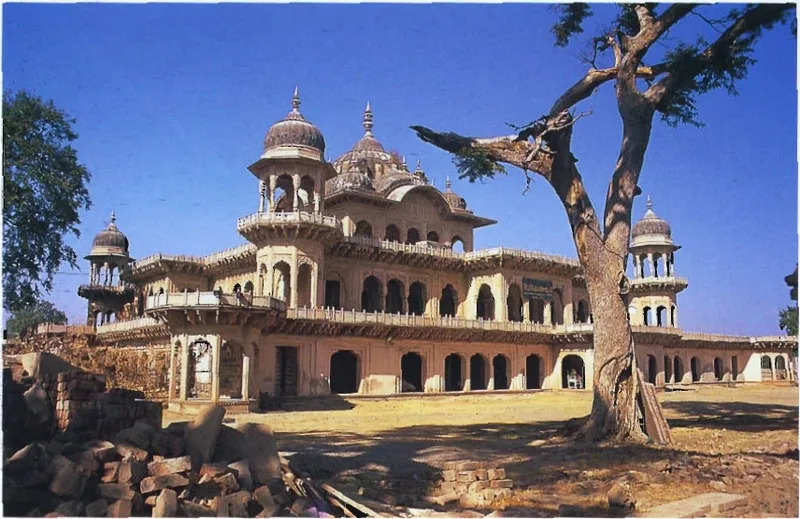
Pañca-tīrtha-kuṇḍa, the kuṇḍa (sacred pond) of the five holy waters, lies at the entrance of Govardhana town, beside the palace that the guidebook Govardhana Hill (2001) credits to the kings of Bhāratapura (Bharatpur).[1] The same book says that it holds the water of five holy rivers.[1 +1] Two older texts name a kuṇḍa called Pañca-tīrtha at Govardhana: the Varāha Purāṇa, which ends the walk around the hill with a bath in it, and Śrīla Nārāyaṇa Bhaṭṭa Gosvāmī's Vraja-bhakti-vilāsa. Neither says that its kuṇḍa is this one.[2 +2]
Key facts
| Kind | kuṇḍa |
|---|---|
| Region · area | Govardhana · Govardhana (town) |
| Ācāryas | Śrīla Nārāyaṇa Bhaṭṭa Gosvāmī |
Why it is glorified
The Varāha Purāṇa closes its account of the walk around Govardhana with a bath "at Cakra-tīrtha, in the kuṇḍa called …
The Varāha Purāṇa closes its account of the walk around Govardhana with a bath "at Cakra-tīrtha, in the kuṇḍa called Pañca-tīrtha", followed by a night vigil at Govardhana (summarised here, not translated). The verse does not say where this kuṇḍa lies.[3]
According to the Vraja-bhakti-vilāsa, the kuṇḍa called Pañca-tīrtha lies in the middle of Indradhvaja-vana, a forest that the book lists after Cakra-tīrtha and the image of Cakreśvara Mahādeva. There all the demigods brought the five tīrthas, the holy waters, and made a kuṇḍa for the gopīs' play and bathing. The book says that the kuṇḍa destroys five kinds of sin of killing and that a gift of five grains is given to five brāhmaṇas there. Its prayer for bathing calls on the rivers Narmadā, Sarayū, Kāñcī, Gomatī and Vetrikā, gathered for the abhiṣeka (ceremonial bath) of Kṛṣṇa, without saying which bath it means (summarised here, not translated).[2 +1]
Divine pastimes
Śrīmad-Bhāgavatam tells of a bath of Kṛṣṇa at Govardhana: after Indra's prayers, Surabhi, the mother of the cows, bathed Him with her milk, and Indra, with the demigods and sages, bathed Him with water of the heavenly Gaṅgā and named Him Govinda. It names no kuṇḍa for this bath and no five rivers, and no source says that the abhiṣeka of the Vraja-bhakti-vilāsa's prayer is this bath, so the verses are not quoted here as being about this kuṇḍa.[5 +1]
Explaining the next verse, Śrīla Jīva Gosvāmī and the commentator Vaṁśīdhara set that bath at the place on Govardhana known as Śakra-kuṇḍa and as Govinda-kuṇḍa (summarised here, not translated); none of the commentators speaks of a Pañca-tīrtha.[7 +1] Read more: The lifting of Govardhana Hill, Indra's homage and the name Govinda →
Traditional accounts
Govardhana Hill (2001) says that the kuṇḍa beside the palace holds the water of five holy rivers, the Narmadā, Gomatī, Sarayū …
Govardhana Hill (2001) says that the kuṇḍa beside the palace holds the water of five holy rivers, the Narmadā, Gomatī, Sarayū, Kanchī and Vetrī. These are the five that the Vraja-bhakti-vilāsa's prayer names, but the guidebook does not say where it learned this.[1 +1]
Śrīla Prabhupāda
Śrīla Prabhupāda does not speak of this kuṇḍa by name; his Kṛṣṇa book tells the same bath of Kṛṣṇa without naming a place.
Śrīla Prabhupāda does not speak of this kuṇḍa by name; his Kṛṣṇa book tells the same bath of Kṛṣṇa without naming a place.[6]
Visiting today
In 2001 Govardhana Hill reported that the kuṇḍa was generally not open to the public, though ISKCON sometimes held its yearly boat festival there; this has not been checked since.[1 +1]
The book's same remark is also recorded for the palace: the place was generally not open to the public, though ISKCON sometimes held its yearly boat festival there. The sentence follows the book's description of the kuṇḍa, so it may refer to the kuṇḍa rather than to the palace.[1]
Location
| Where it is | 'Just as one enters the town of Govardhana, on the right side of the road', beside the palace[12] |
|---|---|
| On the numbered Govardhana chart | 17 (printed as “Pancha Tirtha Kunda”)[13] |
Places at Pañca-tīrtha-kuṇḍa
1 places
Also described on this page
Pictures
1 pictures
History
Govardhana Hill places the kuṇḍa on the right of the road as one enters Govardhana town, beside a palace built by the kings of Bhāratapura. It gives no date or builder's name, and no inscription is recorded.[1]
The palace at Pañca-tīrtha-kuṇḍa
The palace at Pañca-tīrtha-kuṇḍa stands at the entrance of Govardhana town, on the right of the road as one comes in, with the kuṇḍa beside it. The guidebook Govardhana Hill (2001), the only source that describes it, says that the kings of Bhāratapura (Bharatpur) built it. It names no king and gives no date, so the attribution is not certain.[1]
Beyond the guidebook's word that the kings of Bhāratapura built it, no record of the palace has been found: no builder's name, no date and no inscription, so the attribution is not certain.[1] Govardhana Hill prints on the same page a verse of Śrīla Raghunātha dāsa Gosvāmī's Vraja-vilāsa-stava, but the verse tells of Mānasī-gaṅgā and of Rādhā and Kṛṣṇa's boat pastimes on it, and belongs to the book's entry on the lake, not to the palace.[1 +2]
More on this place
The lifting of Govardhana Hill, Indra's homage and the name Govinda
References
13 references
- Govardhana Hill: India's Most Sacred Mountain (2001), Rajasekhara dasa Brahmacari, PDF p. 70
- Śrīla Nārāyaṇa Bhaṭṭa, Vraja-bhakti-vilāsa, Govardhana section, Pañca-tīrtha-kuṇḍa (§ 13), printed p. 115, 1st ed., publ. Bābā Kṛṣṇadāsa, Kusuma-sarovara, Saṁvat 2008
- Varāha Purāṇa, adhyāya 164, verses 41-44 and 49, Sanskrit Wikisource
- Śrīla Nārāyaṇa Bhaṭṭa, Vraja-bhakti-vilāsa, Govardhana-liṅga (list of Govardhana's sites), § 50, printed p. 47, 1st ed., publ. Bābā Kṛṣṇadāsa, Kusuma-sarovara, Saṁvat 2008
- Śrīmad-Bhāgavatam 10.27.22-23, GRETIL
- Śrīla Prabhupāda, Kṛṣṇa, the Supreme Personality of Godhead (Kṛṣṇa book), Chapter 27, 'Prayers by Indra, the King of Heaven' · vedabase.io
- Śrīmad-Bhāgavatam 10.27.24, GRETIL
- Vaṁśīdhara, Śrīla Sanātana Gosvāmī, Śrīla Jīva Gosvāmī: commentary on ŚB 10.27.24, Bhagavata Vidya Pith edition, ed. Bhagavata Rishi and Krishna Shankar Shastri, 1996
- Śrīla Narahari Cakravartī, Bhakti-ratnākara, Fifth Wave, 1912 ed. p. 204-205, 2nd ed., 1912
- Śrīla Raghunātha dāsa Gosvāmī, Vraja-vilāsa-stava, Stavāvalī section (9) Vraja-vilāsa-stava, v.64
- the key of the numbered Govardhana chart, ¶19
- Govardhana Hill: India's Most Sacred Mountain (2001), Rajasekhara dasa Brahmacari, p. 56
- Numbered list of the Govardhana sites (key of the Govardhana chart)