Saṅkarṣaṇa-kuṇḍa (Bahulāvana)
संकर्षण-कुण्ड (बहुलावन) Hindi name proposed
Also called Sankarṣana kuṇḍa
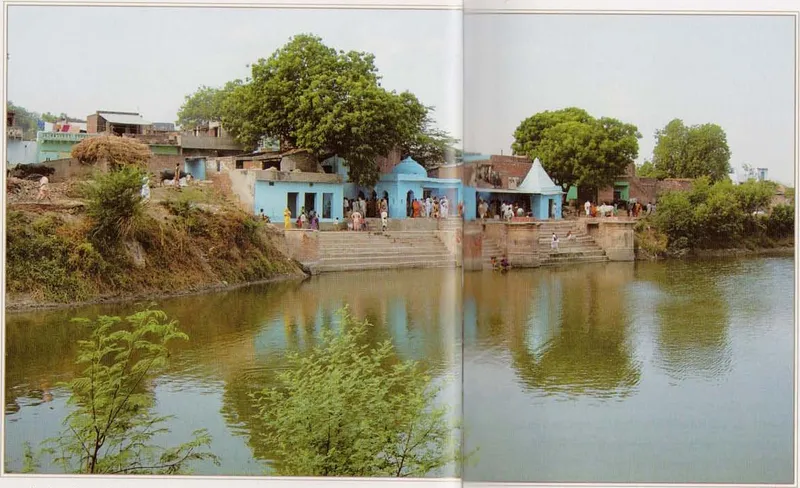
- What it is
- Saṅkarṣaṇa-kuṇḍa is a pond of Bahulāvana, one of the forests of Vraja, whose site is now the village of Bāṭī.
- Visiting
- Two historians described the ponds of Bāṭī: Prabhudayāl Mītal in 1966 and A.
- Places here
- Bahulādevī Mandira
In short
Saṅkarṣaṇa-kuṇḍa is a pond of Bahulāvana, one of the forests of Vraja, whose site is now the village of Bāṭī. Saṅkarṣaṇa is a name of Balarāma. The Skanda Purāṇa, in verses that Śrīla Rūpa Gosvāmī and the Bhakti-ratnākara quote, names Saṅkarṣaṇa-kuṇḍa and Māna-saras in Bahulāvana and says that whoever bathes there in the month of Madhu sees Hari with Lakṣmī.[1 +1] Śrīla Nārāyaṇa Bhaṭṭa Gosvāmī's Vraja-bhakti-vilāsa gives a prayer for bathing in it that calls it the king of holy waters, arisen from the bath of the elder brother, Balarāma.[3 +1] The sources do not agree on how many ponds Bāṭī has, or on which of them the shrine of the cow Bahulā stands.[5 +2]
Key facts
Why it is glorified
The Skanda Purāṇa's Mathurā-khaṇḍa survives only in quotation.
The Skanda Purāṇa's Mathurā-khaṇḍa survives only in quotation. As Śrīla Rūpa Gosvāmī quotes it in his Mathurā-māhātmya, it says that Viṣṇu always sports with Lakṣmī in Bahulāvana, that Saṅkarṣaṇa-kuṇḍa and Māna-saras are there, and that one who bathes there in the month of Madhu (Caitra) sees Hari with Lakṣmī (summarised here, not translated). The Bhakti-ratnākara quotes the same verses.[1 +1] The undated parikramā notes Bahulāvana recommend bathing here in Caitra for the darśana of Lakṣmī and Nārāyaṇa, which is the promise of the same verse.[1 +3]
The Varāha Purāṇa promises Viṣṇu's own world to one who bathes on the twelfth day of the bright fortnight of Caitra in a great holy place in a forest it calls Bahula. It names no kuṇḍa, and no source says that this forest is the Bahulāvana of Bāṭī.[9] According to Śrī Vraja-maṇḍala Parikramā (2007), it is popularly believed that any desire of one who bathes here will be fulfilled; the book does not say which of the ponds it means.[4 +1]
Traditional accounts
Śrīla Nārāyaṇa Bhaṭṭa Gosvāmī's Vraja-bhakti-vilāsa lists Saṅkarṣaṇa-kuṇḍa in Bahulāvana and, near it, a Kṛṣṇa-kuṇḍa. On the pilgrims' walk round the forest it gives a prayer for each. Saṅkarṣaṇa-kuṇḍa is addressed as arisen from the bath of the elder brother, to be said ten times with immersions, and Kṛṣṇa-kuṇḍa as born of Kṛṣṇa's bath; the walk round the forest measures two krośas (summarised here, not translated).[3 +1] No other source found tells of such a bath, and the book speaks of many kuṇḍas in the same way.[3 +1] That this Kṛṣṇa-kuṇḍa is today's Māna-sarovara rests on one source, the undated notes Bahulāvana.[3 +1]
The Gosvāmīs and ācāryas
According to the Bhakti-ratnākara of Śrīla Narahari Cakravartī Ṭhākura (Fifth Wave), Śrīla Rāghava Paṇḍita Gosvāmī of Govardhana …
According to the Bhakti-ratnākara of Śrīla Narahari Cakravartī Ṭhākura (Fifth Wave), Śrīla Rāghava Paṇḍita Gosvāmī of Govardhana showed Śrīla Śrīnivāsa Ācārya and Śrīla Narottama dāsa Ṭhākura the kuṇḍas of Bahulāvana: a wonderful kuṇḍa with a lotus forest, the incomparable Saṅkarṣaṇa-kuṇḍa and the charming Māna-sarasī. Seeing them and bathing in them, he said, brings much fruit, and the Purāṇas say that one sees Kṛṣṇa with Lakṣmī here (summarised here, not translated).[2]
Śrīla Prabhupāda
The Caitanya-caritāmṛta says that Śrī Caitanya Mahāprabhu visited Bahulāvana and bathed wherever He went, without naming the …
The Caitanya-caritāmṛta says that Śrī Caitanya Mahāprabhu visited Bahulāvana and bathed wherever He went, without naming the kuṇḍa (a general reference):[11]
General teaching (does not name the place)“Śrī Caitanya Mahāprabhu visited the different forests, including Madhuvana, Tālavana, Kumudavana and Bahulāvana. Wherever He went, He took His bath with great ecstatic love.”
Śrīla Prabhupāda, Śrī Caitanya-caritāmṛta, Madhya-līlā 17.193, translation · vedabase.io
Visiting today
Two historians described the ponds of Bāṭī: Prabhudayāl Mītal in 1966 and A. W. Entwistle in 1987. Both name three: Saṅkarṣaṇa-kuṇḍa, which they also call Balarāma-kuṇḍa, on the east side of the village, Māna-sarovara on the south, and a Kṛṣṇa-kuṇḍa beside which the shrine of the cow Bahulā stands. These are their observations of those years, not a report of the site today.[5 +2] The guidebooks instead put the cow's shrine on the bank of Saṅkarṣaṇa-kuṇḍa, and the undated notes Bahulāvana say that Saṅkarṣaṇa-kuṇḍa and Māna-sarovara have been joined into one pond. These questions are shown on the pages of the Bahulādevī Mandira and of Māna-sarovara.[5 +2]
Location
| Where it is | In Bahulāvana[12] |
|---|
Places at Saṅkarṣaṇa-kuṇḍa (Bahulāvana)
1 places
Nearby places
Māna-sarovara (Bahulāvana)
References
- Śrīla Rūpa Gosvāmī, Mathurā-māhātmya vv.342-344, quoting the Skanda Purāṇa, Mathurā-khaṇḍa
- Śrīla Narahari Cakravartī, Bhakti-ratnākara, Fifth Wave (pañcama taraṅga), printed p. 189 (1912 ed.), 2nd ed., 1912
- Śrīla Nārāyaṇa Bhaṭṭa Gosvāmī, Vraja-bhakti-vilāsa, second adhyāya, list of the forests and their sacred sites (finding aid Vraja-bhakti-vilāsa: (2) part 13 v.54), printed p. 51, 1st ed., publ. Bābā Kṛṣṇadāsa, Kusuma-sarovara, Saṁvat 2008
- Śrīla Nārāyaṇa Bhaṭṭa Gosvāmī, Vraja-bhakti-vilāsa, tenth adhyāya, circuit of Bahulāvana, verses numbered 15-16 (finding aid Vraja-bhakti-vilāsa: (10) vv.15-16), printed p. 213, 1st ed., publ. Bābā Kṛṣṇadāsa, Kusuma-sarovara, Saṁvat 2008
- Prabhudayāl Mītal, 'Braj-yātrā', 3 Bahulāvana, printed p. 103
- Prabhudayāl Mītal, 'Braj-yātrā', 3 Bahulāvana (the third halt, Āśvin kṛ. 1-2), printed p. 102
- A. W. Entwistle, ch. 8 §7 'Bahulaban (Bati)', printed p. 336, Egbert Forsten, Groningen, 1987
- the undated parikramā notes Bahulāvana, ¶19
- Varāha Purāṇa 157.8-10, Sanskrit Wikisource
- Śrī Vraja-maṇḍala Parikramā (2007), PDF p. 75
- Śrīla Prabhupāda, Śrī Caitanya-caritāmṛta, Madhya-līlā 17.193, translation · vedabase.io
- Śrī Vraja-maṇḍala Parikramā (2007), p. 125