Rāval
रावल
In short
Rāval (Rāvala) is a village of the Mahāvana region, across the Yamunā from Mathurā. Śrīla Raghunātha dāsa Gosvāmī calls it Rāvala, the town of Vṛṣabhānu, where Śrī Rādhā was born from the womb of Kīrtidā, and the Bhakti-ratnākara shows it as Vṛṣabhānu's residence, where She appeared.[1 +3] Another tradition gives Varṣāṇā as Her birthplace, and on his parikramā of 1971, at the stop that is taken to be Varṣāṇā, Śrīla Prabhupāda said that She was born at that spot; this page gives both traditions side by side, each with its source.[5] According to the Bhakti-ratnākara, Śrī Caitanya Mahāprabhu stayed at Rāval on His way from Gokula to Mathurā.[6]
Key facts
| Kind | village |
|---|---|
| Region · area | Mahāvana |
| Ācāryas | Śrīla Raghunātha dāsa Gosvāmī, Śrīla Rāghava Paṇḍita Gosvāmī of Govardhana, Śrīla Śrīnivāsa Ācārya, Śrīla Narottama dāsa Ṭhākura, Vīracandra Prabhu |
Why it is glorified
In his Vraja-vilāsa-stava (verse 90) Śrīla Raghunātha dāsa Gosvāmī prays that his love may rest on Rāvala, the town of Vṛṣabhānu …
In his Vraja-vilāsa-stava (verse 90) Śrīla Raghunātha dāsa Gosvāmī prays that his love may rest on Rāvala, the town of Vṛṣabhānu, filled with gopīs, gopas and herds of cows. There, he writes, the jewel of Gāndharvā's birth came forth from the jewel-mine of Kīrtidā's womb; Gāndharvā is Śrī Rādhā, and Kīrtidā is Her mother.[1 +1]
The Bhakti-ratnākara quotes this verse at Rāval, and after it a Bengali song on Rādhikā's birth in Vṛṣabhānu's mansion from the womb of Kīrtidā, whom the song calls Kṛttikā.[2 +2]
Śrīla Nārāyaṇa Bhaṭṭa Gosvāmī's Vraja-bhakti-vilāsa counts Rāvala-vana as the sixth of the twelve siddha-vanas (forests of perfection), in a list it gives as from the Viṣṇu Purāṇa, and names its presiding Deity Śrīnivāsa. It does not mention Rādhā's birth there.[7 +1]
Divine pastimes
Śrī Rādhā's appearance at Rāval
In the Fifth Wave of the Bhakti-ratnākara, Śrīla Rāghava Paṇḍita Gosvāmī of Govardhana guides Śrīla Śrīnivāsa Ācārya through Vraja. At Rāval he tells him to see this village, the matchless residence of Vṛṣabhānu, where Śrī Rādhikā appeared, and says that Her appearance spread happiness through the world (summarised here, not translated).[2 +2]
অহে শ্রীনিবাস দেখ এ রাবল গ্রাম। এথা বৃষভানুর বসতি অনুপম ॥ শ্রীরাধিকা প্রকট হইলা এই খানে। যাহার প্রকটে সুখ ব্যাপিল ভুবনে ॥
ahe śrīnibāsa dekha e rābala grāma| ethā bṛṣabhānura basati anupama
śrīrādhikā prakaṭa hailā ei khāne| yāhāra prakaṭe sukha byāpila bhubane ||
The Thirteenth Wave of the same book tells that Śrīla Vīracandra Prabhu, touring Vraja with his party, saw Kṛṣṇa's birthplace at Gokula-Mahāvana, then Śrī Rādhikā's birthplace at Rāval, and then bathed at Viśrāma-ghāṭa in Mathurā.[10]
The Aiśvarya-kādambinī, attributed to Śrīla Baladeva Vidyābhūṣaṇa, does not name Rāval. It places the palace of King Vṛṣabhānu, where Rādhikā appeared, near the city of Nanda in Bṛhadvana (Mahāvana), where Kṛṣṇa was born, and says that the city of the king of Vraja was later at Nandīśvara Hill.[11] The Garga-saṁhitā names no village either: Śrī Rādhā appears in a palace in a garden by the Yamunā, and Vṛṣabhānu's town of that time stands on the bank of the Kālindī, the Yamunā.[12 +1]
अथैव राधां वृषभानुपत्न्या- मावेश्य रूपं महसः पराख्यम् । कलिन्दजाकूलनिकुञ्जदेशे सुमन्दिरे सावततार राजन्
athaiva rādhāṁ vṛṣabhānupatnyā- māveśya rūpaṁ mahasaḥ parākhyam
kalindajākūlanikuñjadeśe sumandire sāvatatāra rājan
The tradition of Varṣāṇā
Other sources connect Her appearance with Varṣāṇā. On his parikramā of Vraja on 28 November 1971, at the stop that is taken to be the hill temple of Varṣāṇā (the recording itself names neither the temple nor the spot), Śrīla Prabhupāda said of a spot there that this was where Rādhārāṇī was born. He added that by Rādhāṣṭamī, Her appearance day, She is fifteen days younger than Kṛṣṇa.[5]
General teaching (does not name the place)“This is the spot… …where Rādhārāṇī was born. … Rādhāṣṭamī. Fifteen days younger than Kṛṣṇa.”
Śrīla Prabhupāda, Parikramā on the Way to Gokula, Vṛndāvana, 28 November 1971 · vedabase.io
The guidebook Śrī Vraja-maṇḍala Parikramā (2007) and the undated parikramā notes Mahāvana give both places: Vṛṣabhānu found the newborn Rādhikā on a lotus in the Yamunā at Rāval, and in other eras on a lotus in Vṛṣabhānu-kuṇḍa at Varṣāṇā.[14 +4] Two Purāṇas name neither village. The Brahma-vaivarta Purāṇa says that Rādhā took birth in Vṛṣabhānu's house in Gokula, and the Padma Purāṇa (Brahma-khaṇḍa) that She appeared by day on Vṛṣabhānu's sacrificial ground and was seen when it was being cleared.[19 +1] Read more: The appearance of Śrī Rādhā: the traditions of Rāvala and Varṣāṇā →
The sources differ on where Śrī Rādhā was born. They are set side by side here, each with its source, and this page does not decide between them.
Accounts differ Where Śrī Rādhā was born.
- Śrīla Raghunātha dāsa Gosvāmī, Vraja-vilāsa-stava 90At Rāvala, Vṛṣabhānu's town, from Kīrtidā's womb.
- Bhakti-ratnākara, Fifth and Thirteenth WavesAt Rāval, in Vṛṣabhānu's residence; Vīracandra saw Her birthplace at Rāval.
- Aiśvarya-kādambinī 4.2In Vṛṣabhānu's palace near Nanda's city in Bṛhadvana (Rāval not named).
- Garga-saṁhitā 1.8.6, 1.15.40In a palace in a grove on the Yamunā's bank; Vṛṣabhānupura on the Kālindī (no village named).
Traditional accounts
According to Śrī Vraja-maṇḍala Parikramā and the notes Mahāvana, Vṛṣabhānu found the newborn Rādhikā early in the morning on a …
The lotus in the Yamunā
According to Śrī Vraja-maṇḍala Parikramā and the notes Mahāvana, Vṛṣabhānu found the newborn Rādhikā early in the morning on a hundred-petalled lotus in the Yamunā at Rāval. The notes, citing "the Purāṇas" without naming one, and the guidebook Vṛndāvana-Dhāma Ki Jaya! (c. 1986) tell instead of a golden lotus at noon and of Brahmā giving Her to Vṛṣabhānu. No scripture or Gosvāmī text that tells the lotus story has been found.[14 +4] Śrīla Raghunātha dāsa Gosvāmī and the song in the Bhakti-ratnākara speak of Her birth from Kīrtidā's womb, and the accounts of how She appeared differ.[1 +3]
Accounts differ How Śrī Rādhā appeared to Vṛṣabhānu and Kīrtidā.
- Śrī Vraja-maṇḍala Parikramā (2007); the undated parikramā notes MahāvanaVṛṣabhānu found Her early in the morning on a hundred-petalled lotus in the Yamunā at Rāval (in other eras on a lotus in Vṛṣabhānu-kuṇḍa at Varṣāṇā).
- the undated parikramā notes Mahāvana ("the Purāṇas"); Vṛndāvana-Dhāma Ki Jaya! (c. 1986)A golden lotus at noon; Brahmā appeared and entrusted Her to Vṛṣabhānu.
- Vraja-vilāsa-stava 90; the Bengali song quoted by the Bhakti-ratnākaraBorn from Kīrtidā's (Kṛttikā's) womb.
- Garga-saṁhitā 1.8.6Rādhā placed Her form in Vṛṣabhānu's wife and appeared in the palace.
Nārada's visit
The same two guidebooks tell that the sage Nārada came to Rāval and asked to see Vṛṣabhānu's daughter. He sent Vṛṣabhānu away to fetch things for a blessing and prayed to Her alone, and Rādhā, with Lalitā, Viśākhā and Her other sakhīs (girl companions), showed him Her youthful form.[15 +3]
The Padma Purāṇa (Pātāla-khaṇḍa 71) tells a similar visit but sets it in Nanda's Gokula. Nārada enters the house of the cowherd Bhānu, Nanda's friend, whose little daughter seems dull, blind and deaf. Alone with Her, he praises Her, and She takes a divine form of fourteen years, surrounded by girls of Vraja. It does not name Rāval.[24 +3]
The prayer that the guidebooks put in Nārada's mouth is the refrain of the Rādhā-kṛpā-kaṭākṣa-stava-rāja, which the Sādhana-dīpikā quotes as from the Ūrdhvāmnāya; our song book has this hymn as Munīndra-vṛnda-vandite and credits it to Lord Śiva. Where Nārada came and what he prayed are told differently.[21 +1]
Accounts differ Nārada's visit to the infant Rādhā: where, and what he prayed.
- Padma Purāṇa, Pātāla-khaṇḍa 71.17-69In the house of the cowherd Bhānu in Nanda's Gokula; the girl seemed dull, blind and deaf; Nārada sends Bhānu away, praises Her as mistress of Yoga-māyā, and She shows a divine form of fourteen years among girls of Vraja; his prayers do not include the line below.
- Śrī Vraja-maṇḍala Parikramā (2007); the undated parikramā notes MahāvanaAt Rāval: Nārada sends Vṛṣabhānu to fetch things, prays "kadā kariṣyasīha māṁ kṛpā-kaṭākṣa-bhājanam", and Rādhā with Lalitā, Viśākhā and other sakhīs shows him Her youthful form.
- Sādhana-dīpikā (quoting the Ūrdhvāmnāya)That line is the refrain of the Rādhā-kṛpā-kaṭākṣa-stava-rāja; the song book credits the stava to Lord Śiva.
- the undated parikramā notes Mahāvana; Vṛndāvana-Dhāma Ki Jaya! (c. 1986)Nārada advised the parents of the blind baby to go on with the birth feast.
The birth feast and the name
Vṛndāvana-Dhāma Ki Jaya! and the notes Mahāvana record a local tradition, which is not certain, that the baby Rādhā was thought blind. On Nārada's advice a birth feast was held, to which Nanda, Yaśodā and their children came, and She opened Her eyes for the first time when the crawling Kṛṣṇa came near. No older text has been found that tells this feast.[18 +2] Śrīla Prabhupāda said that by Rādhāṣṭamī She is fifteen days younger than Kṛṣṇa (above); the notes' story has Kṛṣṇa already past His first birthday.[5]
Accounts differ How much younger Śrī Rādhā is than Kṛṣṇa (bearing on the birth-feast story told at Rāval).
- Śrīla Prabhupāda, 28 November 1971"Rādhāṣṭamī. Fifteen days younger than Kṛṣṇa."
- the undated parikramā notes MahāvanaAt Her birth feast Kṛṣṇa "had just passed His first birthday" and was crawling.
- Vṛndāvana-Dhāma Ki Jaya! (c. 1986)At the feast Kṛṣṇa crawled near Her (no age given).
Śrī Vraja-maṇḍala Parikramā and the notes Mahāvana say that rāvala means an influential landlord and that the village may be named after Vṛṣabhānu; they give no source for this.[14 +1] The same guidebook prints at Rāval, without naming its source, a couplet from Śrīla Rūpa Gosvāmī's song Jaya jaya rādhe mādhava-dayite, which praises Rādhā as the new crescent moon risen from the ocean of Vṛṣabhānu; the song does not name Rāval.[14 +1]
The Gosvāmīs and ācāryas
According to the Bhakti-ratnākara, Śrī Caitanya Mahāprabhu came with His companions from Gokula and stayed at Rāval, so absorbed …
Śrī Caitanya Mahāprabhu
According to the Bhakti-ratnākara, Śrī Caitanya Mahāprabhu came with His companions from Gokula and stayed at Rāval, so absorbed in love that, as Śrīla Rāghava Paṇḍita tells Śrīla Śrīnivāsa Ācārya, even Śeṣa could not describe it. People ran from all sides calling the name of Hari, and from here He went on to Mathurā with the Sanoḍiyā brāhmaṇa. Śrīla Rāghava Paṇḍita also calls Rāval a secluded place of Śrī Rādhā's childhood pastimes.[6]
অহে শ্রীনিবাস গৌরচন্দ্র গণসনে। গোকুল হইতে আসি রহে এই খানে ॥ দেখিয়া রায়লগ্রাম যৈছে ভাবাবেশ। আনের কা কথা তা বর্ণিতে নারে শেষ ॥ … অলৌকিক লীলা প্রভু প্রকাশি এখানে। মথুরা গেলেন সেই সনৌড়িয়া সনে ॥ অহে শ্রীনিবাস এই পরম নির্জ্জন। এথা রাধিকার বাল্যলীলা মনোরম ॥
ahe śrīnibāsa gauracandra gaṇasane| gokula haite āsi rahe ei khāne
dekhiẏā rāẏalagrāma yaiche bhābābeśa| ānera kā kathā tā barṇite nāre śeṣa
… alaukika līlā prabhu prakāśi ekhāne| mathurā gelena sei sanauṛiẏā sane
ahe śrīnibāsa ei parama nirjjana| ethā rādhikāra bālyalīlā manorama ||
The Caitanya-caritāmṛta does not mention Rāval: it takes Mahāprabhu from Mahāvana and Gokula to Mathurā. The sources differ on when, and how many times, He came to Gokula-Mahāvana; the accounts are set side by side on the page of the Mahāvana area.[6] Read more: Śrī Caitanya Mahāprabhu in Gokula-Mahāvana →
Śrīla Rāghava Paṇḍita Gosvāmī of Govardhana, Śrīla Śrīnivāsa Ācārya and Śrīla Narottama dāsa Ṭhākura
In the Bhakti-ratnākara's Fifth Wave, Śrīla Rāghava Paṇḍita brings Śrīla Śrīnivāsa Ācārya and Śrīla Narottama dāsa Ṭhākura to Rāval and shows them Vṛṣabhānu's residence. They spend the night there, absorbed in love, and in the morning cross the Yamunā to Mathurā.[2 +2] Earlier on the same tour, at Gokula-Mahāvana, Śrīla Rāghava Paṇḍita says that the cowherds of Gokula, Rāval and other places left for Vṛndāvana by this path, crossing the Yamunā beside Bhāṇḍīravana.[38] Śrīmad-Bhāgavatam (10.11) tells the cowherds' move from Bṛhadvana to Vṛndāvana but names no other village.[39 +1]
Śrīla Prabhupāda
No statement of Śrīla Prabhupāda about Rāval itself has been found; his words on Śrī Rādhā's birthplace were spoken at Varṣāṇā …
No statement of Śrīla Prabhupāda about Rāval itself has been found; his words on Śrī Rādhā's birthplace were spoken at Varṣāṇā and are given above. Vṛndāvana-Dhāma Ki Jaya! quotes at Rāval his purports to the Caitanya-caritāmṛta on Śrī Rādhā's nature. These are general teachings, not words about the village:[18 +2]
General teaching (does not name the place)“The unadulterated action of the hlādinī-śakti is displayed in the dealings of the damsels of Vraja and Śrīmatī Rādhārāṇī, who is the topmost participant in that transcendental group.”
Śrīla Prabhupāda, Śrī Caitanya-caritāmṛta, Ādi-līlā 4.69, purport · vedabase.io
Location
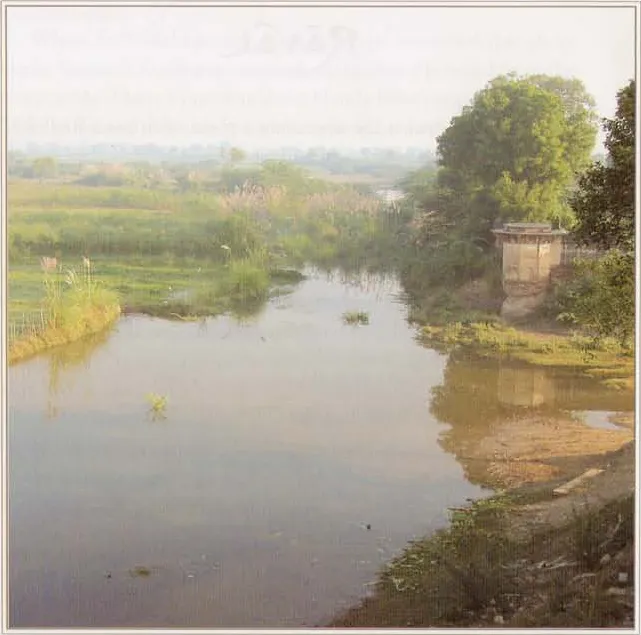
| Where it is | on the Yamunā (photo 'The Yamunā at Rāval'); no distance given[43] |
|---|
Nearby places
Yamunā
Pictures
3 pictures
History
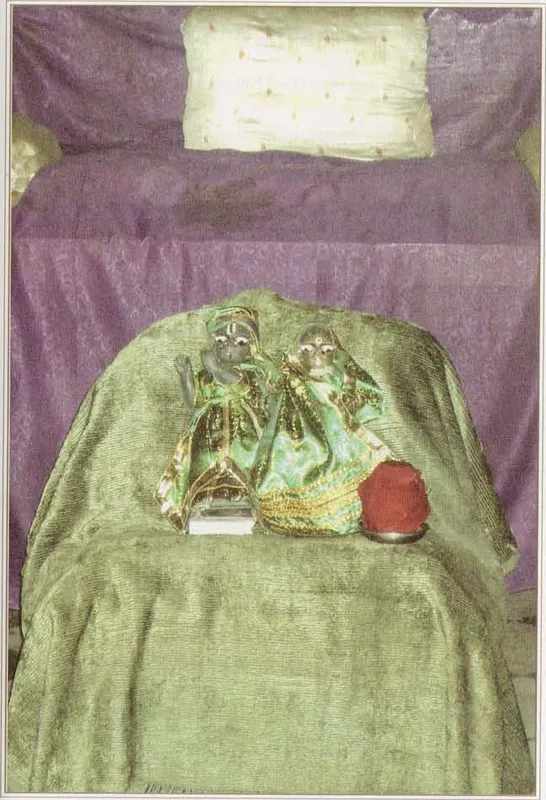
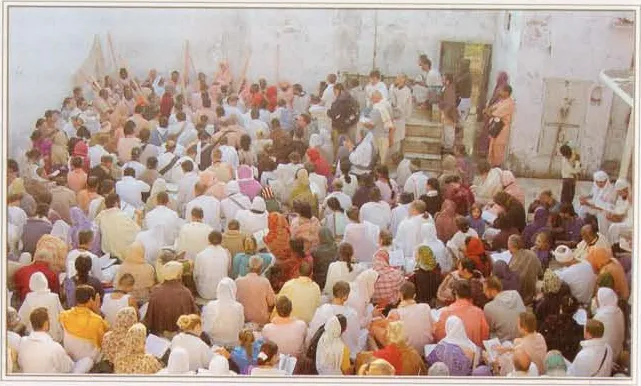
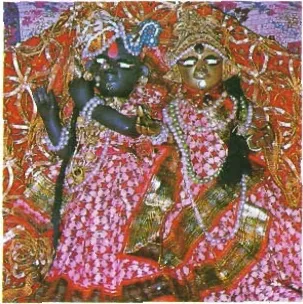
Three historians tell the story of the temple differently, and none cites a document. Prabhudayāl Mītal (1966) writes that before the temple of Śrī Lāḍilī jī at Varṣāṇā was built, the temple of Rāval was of great importance; in the seventeenth century a Yamunā flood badly damaged it, and the ancient image of Śrī Rādhā was moved to Varṣāṇā; he gives no year and does not say which era his century counts by.[33] A. W. Entwistle (1987) writes that the temple of Rādhā (Lāḍilījī) that he saw at Rāval was built by Kushal Seth early in the nineteenth century, in place of an earlier one that the Yamunā had washed away.[34 +1] F. S. Growse (1883) placed the move of Rādhā's chief shrine to Varṣāṇā in the fifteenth or sixteenth century; he gives no record, and his date may rest only on his estimate of the age of a temple at Varṣāṇā.[36] The three accounts differ on the dates:
Accounts differ When Śrī Rādhā's chief image or shrine was moved from Rāval to Barsānā.
- Mītal (1966, p. 148)In the seventeenth century, after a Yamunā flood damaged the old Rāval temple; he gives no year and does not say which era his century counts by.
- Growse (1883, p. 325)"In the 15th or 16th century A.D." (an inference about the date of the Mān Mandir).
- Entwistle (1987, pp. 427-428)The present temple of Rādhā (Lāḍilījī) at Rāval was built by Kushal Seth in the early nineteenth century, replacing an earlier one washed away by the Yamunā (no date for the earlier temple or for any move of the image).
Growse also reports that the pujārī (priest) of the temple in his day, Chhote Lāl, held a sanad, a written grant, of the twentieth year of the emperor Muhammad Shah (1739). By it the minister Karm-ud-dīn Khān assigned the pujārī of that time, Rūp Chand, one rupee a day from the revenue of the Mahāvana tahsil. Mītal repeats this from Growse with the date Saṁvat 1798 (1741/42). The sanad itself could not be checked.[33 +1] The two dates differ:
Accounts differ The date of the Rāval temple's sanad.
- Growse (1883, p. 89, footnote)The 20th year of Muhammad Shah (1739 A.D.).
- Prabhudayāl Mītal (1966), a historian, citing GrowseMītal, citing Growse, dates it to the time of Muhammad Shah, Saṁvat 1798 (1741/42).
Where the sources differ
Where the cowherds went when they left Mahāvana, by what way, and why, the sources tell differently; the accounts are set side by …
Where the cowherds went when they left Mahāvana, by what way, and why, the sources tell differently; the accounts are set side by side on the page of the Mahāvana area.[38]
More on this place
The appearance of Śrī Rādhā: the traditions of Rāvala and Varṣāṇā · Śrī Caitanya Mahāprabhu in Gokula-Mahāvana
References
43 references
- Śrīla Raghunātha dāsa Gosvāmī, Vraja-vilāsa-stava, Stavāvalī (9) Vraja-vilāsa-stava v.90
- Śrīla Narahari Cakravartī, Bhakti-ratnākara, Fifth Wave, 1912 ed. pp. 285-286; Grantha Mandira text v.1811-1812, 2nd ed., 1912
- Śrīla Narahari Cakravartī, Bhakti-ratnākara, Fifth Wave, 1912 ed. p. 285; Grantha Mandira text v.1809–1810, 2nd ed., 1912
- Śrīla Narahari Cakravartī, Bhakti-ratnākara, Fifth Wave (pañcama taraṅga), printed p. 287 (1912 ed.), 2nd ed., 1912
- Śrīla Prabhupāda, Parikramā on the Way to Gokula, Vṛndāvana, 28 November 1971 · vedabase.io
- Śrīla Narahari Cakravartī, Bhakti-ratnākara, Fifth Wave (pañcama taraṅga), 1912 ed. printed p. 287) vv.1828-1829, 1835-1836, 2nd ed., 1912
- Śrīla Nārāyaṇa Bhaṭṭa Gosvāmī, Vraja-bhakti-vilāsa, chapter 2 v.6, printed p. 31; Grantha Mandira text (2) v.6, 1st ed., publ. Bābā Kṛṣṇadāsa, Kusuma-sarovara, Saṁvat 2008
- Śrīla Nārāyaṇa Bhaṭṭa Gosvāmī, Vraja-bhakti-vilāsa, chapter 2 v.14, printed p. 34; Grantha Mandira text (2) v.14, 1st ed., publ. Bābā Kṛṣṇadāsa, Kusuma-sarovara, Saṁvat 2008
- Śrīla Narahari Cakravartī, Bhakti-ratnākara, Fifth Wave, 1912 ed. p. 285; Grantha Mandira text v.1809–1810, 2nd ed., 1912
- Śrīla Narahari Cakravartī, Bhakti-ratnākara, Thirteenth Wave (trayodaśa taraṅga), 1912 ed. p. 1025; verses 381-384 in the Grantha Mandira text numbering, 2nd ed., 1912
- Aiśvarya-kādambinī, Fourth Shower (caturthī vṛṣṭiḥ) vv.1-3, after Haridas Shastri's undated edition
- Garga-saṁhitā, Goloka-khaṇḍa (1) 8.6, Sanskrit Wikisource
- Garga-saṁhitā, Goloka-khaṇḍa (1) 15.40, Sanskrit Wikisource
- Śrī Vraja-maṇḍala Parikramā (2007), PDF p. 280
- Śrī Vraja-maṇḍala Parikramā (2007), PDF p. 281
- the undated parikramā notes Mahāvana, ¶106
- the undated parikramā notes Mahāvana, ¶118
- Vṛndāvana-Dhāma Ki Jaya! (c. 1986), by Dhruva Mahārāja dāsa, PDF p. 88
- Brahma-vaivarta Purāṇa, Kṛṣṇa-janma-khaṇḍa (4) 3.116, Sanskrit Wikisource
- Padma Purāṇa, Brahma-khaṇḍa 7.40–42, Sanskrit Wikisource
Show all 43 references
- Śrī Vraja-maṇḍala Parikramā (2007), PDF p. 282
- the undated parikramā notes Mahāvana, ¶113
- the undated parikramā notes Mahāvana, ¶114
- Padma Purāṇa, Vṛndāvana-māhātmya (3) vv.17-21 = Padma Pātāla-khaṇḍa 71.17-21
- Padma Purāṇa, Vṛndāvana-māhātmya (3) vv.29-30 = Padma Pātāla-khaṇḍa 71.29-30
- Padma Purāṇa, Vṛndāvana-māhātmya (3) vv.46b-47 = Padma Pātāla-khaṇḍa 71.46b-47
- Padma Purāṇa, Vṛndāvana-māhātmya (3) vv.67-69 = Padma Pātāla-khaṇḍa 71.67-69
- Śrīla Rādhā-kṛṣṇa Gosvāmī, Sādhana-dīpikā (4) [part 11] v.1
- the undated parikramā notes Mahāvana, ¶120
- the undated parikramā notes Mahāvana, ¶121
- the undated parikramā notes Mahāvana, ¶105
- Śrīla Rūpa Gosvāmī, Gītāvalī, Stava-mālā, Gītāvalī: song "jaya jaya rādhe mādhava-dayite" v.1, after the edition of Bhakti Saranga Goswami and Purushottam Das, Vrindavan, 1959
- Prabhudayāl Mītal, 'Rāvala', printed p. 148
- A. W. Entwistle, §73 "Rawal", printed pp. 427-428, Egbert Forsten, Groningen, 1987
- Mathurá (1883), F. S. Growse, B.C.S., M.A. Oxon., C.I.E. (as the title page gives him, p. 89
- Mathurá (1883), F. S. Growse, B.C.S., M.A. Oxon., C.I.E. (as the title page gives him, p. 325
- Śrīla Narahari Cakravartī, Bhakti-ratnākara, Fifth Wave (pañcama taraṅga), 1912 ed. printed p. 287) vv.1828-1829, 1835-1836, 2nd ed., 1912
- Śrīla Narahari Cakravartī, Bhakti-ratnākara, Fifth Wave, printed p. 285: the cowherds' move from Gokula to Vṛndāvana, 2nd ed., 1912
- Śrīmad-Bhāgavatam 10.11.35, GRETIL
- Śrīla Prabhupāda, Kṛṣṇa, the Supreme Personality of Godhead (Kṛṣṇa book), Chapter 11, 'Killing the Demons Vatsāsura and Bakāsura' · vedabase.io
- Śrīla Prabhupāda, Śrī Caitanya-caritāmṛta, Ādi-līlā 4.69, purport · vedabase.io
- Vṛndāvana-Dhāma Ki Jaya! (c. 1986), by Dhruva Mahārāja dāsa, PDF p. 89
- Śrī Vraja-maṇḍala Parikramā (2007), p. 534-535