Nanda-bhavan Mandira (Nandagrāma)
नन्द-भवन मन्दिर (नन्दग्राम) Hindi name proposed
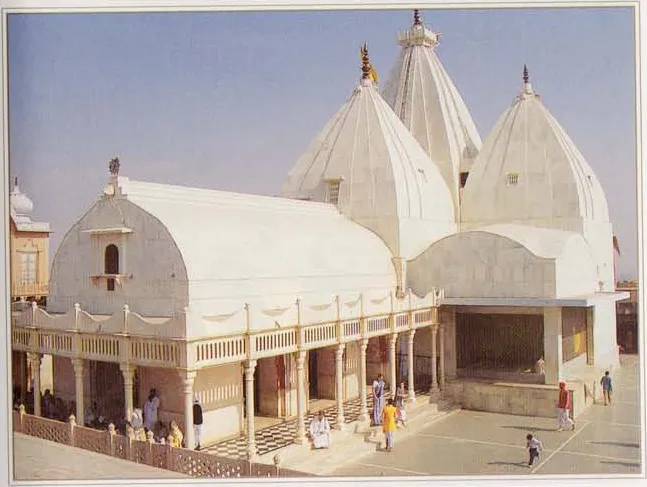
- What it is
- The temple of Nanda-rāya, known as Nanda-bhavan, is the large temple on the summit of Nandīśvara Hill at Nandagrāma.
- Visiting
- According to Mītal (1966), at the Holī festival of Nandagrāma a samāj, a gathering for song, is held in this temple, where the Gosvāmīs of Nandagrāma and Varṣāṇā sing Holī songs and rasiyā.
- Places here
- Nandīśvara Mahādeva
In short
The temple of Nanda-rāya, known as Nanda-bhavan, is the large temple on the summit of Nandīśvara Hill at Nandagrāma. The undated parikramā notes Nandagrāma say that it stands where Nanda Mahārāja's palace once stood, and the historian Prabhudayāl Mītal (1966) records the same belief and the names Nandālaya and Nanda-mahal.[1 +4] Śrīla Nārāyaṇa Bhaṭṭa Gosvāmī's Vraja-bhakti-vilāsa already names a temple of Nanda-rāya on top of "Rudra's hill", where Nanda, Yaśodā, Kṛṣṇa and Balarāma are seen.[6 +1] Śrīla Prabhupāda took darśana here with his disciples on 28 November 1971.[8 +1] The sources differ on the Deities and on when the present building was raised.
Key facts
| Kind | temple |
|---|---|
| Region · area | Nandagrāma · Nanda-bhavana (Nandagrāma) |
| Also part of | Nandīśvara Hill |
| Ācāryas | Śrīla Sanātana Gosvāmī, Śrīla Nārāyaṇa Bhaṭṭa Gosvāmī, Śrīla A.C. Bhaktivedanta Swami Prabhupāda |
Why it is glorified
Śrīla Rūpa Gosvāmī's Mathurā-māhātmya gives a verse that says that whoever bathes in the Pāvana lake and sees Kṛṣṇa on Nandīśvara …
Śrīla Rūpa Gosvāmī's Mathurā-māhātmya gives a verse that says that whoever bathes in the Pāvana lake and sees Kṛṣṇa on Nandīśvara Hill, with Nanda and Yaśodā, attains every desire. Śrīla Prabhupāda quotes and translates it in his purport to the Caitanya-caritāmṛta. The verse names the hill, not a temple.[10 +2]
pāvane sarasi snātvā kṛṣṇaṁ nandīśvare girau
dṛṣṭvā nandaṁ yaśodāñ ca sarvābhīṣṭam avāpnuyāt
One who bathes in Pāvana Lake by Nandīśvara Hill will see Kṛṣṇa there along with Nanda and Yaśodā and will fufill all his desires.
Translation: Śrīla A.C. Bhaktivedanta Swami PrabhupādaAbout this place: Śrīla Rūpa Gosvāmī gives this verse with the words 'and so they recite': whoever bathes in the Pāvana lake and sees Kṛṣṇa, Nanda and Yaśodā on Nandīśvara Hill attains every desire. It names the hill, not a temple; Śrīla Prabhupāda quotes and translates it in his purport to Caitanya-caritāmṛta, Madhya 18.58.
The guidebook Śrī Vraja-maṇḍala Parikramā (2007) says that the custom is to bathe in Pāvana-sarovara before the darśana of Nanda, Yaśodā and the others on the crest of the hill.[10 +2]
Divine pastimes
Nanda's move from Gokula
Śrīmad-Bhāgavatam (10.11) tells how the elder cowherds under Nanda, troubled by the demons at Mahāvana, decided on Upananda's advice to move to "the forest named Vṛndāvana". The Sanskrit names neither Nandīśvara nor Nandagrāma, while Śrīla Prabhupāda's translation places that Vṛndāvana between Nandeśvara (Nandīśvara) and Mahāvana.[13 +3]
vanaṃ vṛndāvanaṃ nāma paśavyaṃ nava-kānanam / gopa-gopī-gavāṃ sevyaṃ puṇyādri-tṛṇa-vīrudham
Between Nandeśvara and Mahāvana is a place named Vṛndāvana. This place is very suitable because it is lush with grass, plants and creepers for the cows and other animals. It has nice gardens and tall mountains and is full of facilities for the happiness of all the gopas and gopīs and our animals.
Translation: Śrīla A.C. Bhaktivedanta Swami PrabhupādaOn the walk up to this temple in 1971 Śrīla Prabhupāda said that Nanda came "here" from Gokula because of the demons, as told below. When Nanda's household came to live at Nandīśvara is told differently in the sources; see Nandīśvara Hill.[8 +1] Read more: Nanda's family at Nandagrāma →
The Deities in the cave
The Caitanya-caritāmṛta (Madhya 18) tells that Śrī Caitanya Mahāprabhu climbed Nandīśvara Hill and asked whether there were Deities on top of it. The people said that the Deities were in a cave; He opened the cave and saw three Deities, Nanda, Yaśodā and Kṛṣṇa.[17 +3]
vrajendra-vrajeśvarīra kaila caraṇa vandana
premāveśe kṛṣṇera kaila sarvāṅga-sparśana
Śrī Caitanya Mahāprabhu offered His respects to Nanda Mahārāja and mother Yaśodā, and with great ecstatic love He touched the body of Lord Kṛṣṇa.
Translation: Śrīla A.C. Bhaktivedanta Swami PrabhupādaAccording to the Bhakti-ratnākara, Śrīla Rāghava Paṇḍita later showed Śrīla Śrīnivāsa Ācārya Nanda and Yaśodā with their son "in a wonderful cave" on the hill.[21] How the Deities came out of the cave, and whether into this temple, the later accounts tell differently (below). Read more: Śrīla Sanātana Gosvāmī at Nandagrāma →
Traditional accounts
Śrīla Nārāyaṇa Bhaṭṭa Gosvāmī lists "the temple of Nanda-rāya" on Rudra's hill among the holy places of Nandagrāma, and in his …
Śrīla Nārāyaṇa Bhaṭṭa Gosvāmī lists "the temple of Nanda-rāya" on Rudra's hill among the holy places of Nandagrāma, and in his order of pilgrimage gives a prayer to be said "in the temple of Nanda's abode". It bows to Nanda, to Yaśodā, to the child Kṛṣṇa and to Balabhadra (Balarāma) (summarised here, not translated). He ascribes the prayer to the Brahma-vaivarta Purāṇa, where it has not been found.[6 +1]
ततो नन्दधाममन्दिरे नन्दयशोदाकृष्ण बलभद्रप्रार्थनमन्त्रः । ब्रह्मवैवर्त्ते— … नन्दधात नमस्तुभ्यं यशोदायै नमो नमः । नमः कृष्णाय बालाय बलभद्राय ते नमः ॥
tato nandadhāmamandire nandayaśodākṛṣṇa balabhadraprārthanamantraḥ
brahmavaivartte— … nandadhāta namastubhyaṁ yaśodāyai namo namaḥ
namaḥ kṛṣṇāya bālāya balabhadrāya te namaḥ ||
The Bengali Vṛndāvana-kathā (1920), citing temple manuscripts of Vanamālī Gosvāmī that are not available today, says that in saṁvat 1595 (1538, the author's conversion) Śrīla Sanātana Gosvāmī brought to light at Nandagrāma four images, Nanda, Yaśodā, Balabhadra and Kṛṣṇa. It says that their abhiṣeka (the bath of installation) was held on the sixth day of the bright fortnight of Māgha and that a man named Haridāsa was made their pūjārī. It mentions no cave and no temple building. As its manuscripts cannot be checked, the account is not certain.[23 +1]
Śrīla Prabhupāda
On 28 November 1971, on a parikramā of Vraja with his disciples, Śrīla Prabhupāda took darśana of the Deities of this temple, had …
On 28 November 1971, on a parikramā of Vraja with his disciples, Śrīla Prabhupāda took darśana of the Deities of this temple, had a rupee offered and had the prasāda distributed. The transcript does not name the temple; the Deities described at the stop identify it.[8 +1] On the walk up he said:[8 +1]
Names this place“Nanda, Nanda Mahārāja left Gokula and came here because the demons were disturbing Kṛṣṇa. They decided to change.”
Śrīla Prabhupāda, Parikramā on the Way to Gokula, Vṛndāvana, 28 November 1971 · vedabase.io
Songs
In his Nandīśvarāṣṭaka, Śrīla Viśvanātha Cakravartī Ṭhākura pictures the palaces of the city of the king of Vraja on Nandīśvara …
In his Nandīśvarāṣṭaka, Śrīla Viśvanātha Cakravartī Ṭhākura pictures the palaces of the city of the king of Vraja on Nandīśvara, with a peacock dancing on their pinnacles like the emblem on a victory flag (summarised here, not translated). The verse describes Nanda's eternal palace, not the present building.[30]
Visiting today
According to Mītal (1966), at the Holī festival of Nandagrāma a samāj, a gathering for song, is held in this temple, where the Gosvāmīs of Nandagrāma and Varṣāṇā sing Holī songs and rasiyā. The two parties then play Holī in the temple courtyard before the laṭhmār Holī, the Holī of sticks, in the ground below. That is a description of 1966.[31]
Places at Nanda-bhavan Mandira (Nandagrāma)
2 places
Also described on this page
History
The historians Prabhudayāl Mītal (1966) and A. W. Entwistle (1987) record the custodians' tradition that the four images were installed by the poet Ānandaghana, whose descendants are the temple's Gosvāmīs. Mītal adds that these Gosvāmīs follow the Nimbārka sampradāya, and Entwistle places a poet Ghanānanda, also called Ānandghan, in the eighteenth century. The sources behind this tradition are not available, so it is not certain.[3 +3]
In 1883 Growse's British district memoir recorded a flight of 114 steps of Bharatpur stone, built in 1818 at the cost of Bābū Gaur Prasād of Calcutta, leading from the plain up to the street that ended at the temple's main gate. It also recorded a range of stone buildings for traders and pilgrims in the square at the foot of the hill, built by Rānī Kiśorī, the wife of Sūraj Mal.[28]
Śrīla Sanātana Gosvāmī's temple on Nandīśvara Hill
According to the undated parikramā notes Nandagrāma, Śrīla Sanātana Gosvāmī built a temple on top of Nandīśvara Hill for the Deities that he brought out of a cave on the hill.[23 +1] No source from the Gosvāmīs' time for such a building has been found, and the notes do not say whether it survives or how it relates to the temple that stands on the hill today.[23 +1] The Bengali Vṛndāvana-kathā (1920), citing the Sevā-prākaṭya o Iṣṭalābher dina-nirṇaya of Vanamālī Gosvāmī, tells how Śrīla Sanātana Gosvāmī brought the four images to light (above), but it mentions no temple building, so the account is not certain.[23 +2] Read more: Śrīla Sanātana Gosvāmī at Nandagrāma → How the Deities came into worship, and whether a temple stood on the hill in the sixteenth century, the sources tell differently: the Caitanya-caritāmṛta has Śrī Caitanya see the Deities in a cave (see below).[23 +1]
Where the sources differ
How the Deities of Nanda, Yaśodā and Kṛṣṇa on Nandīśvara hill came out of the cave into worship, and who brought or installed …
Accounts differ How the Deities of Nanda, Yaśodā and Kṛṣṇa on Nandīśvara hill came out of the cave into worship, and who brought or installed them.
- Śrī Caitanya-caritāmṛta, Madhya 18.59–62The local people told Śrī Caitanya that the Deities were inside a cave; He saw the three after opening ('excavating', Śrīla Prabhupāda) the cave. No later history is told.
- Bhakti-ratnākara, Fifth WaveRāghava Paṇḍita shows Śrīnivāsa Nanda and Yaśodā with their son shining in a wonderful cave on the hill (present tense); Śrī Caitanya entered the cave.
- the undated parikramā notes NandagrāmaKṛṣṇa revealed the hidden Deities to Śrīla Sanātana Gosvāmī, then living at Pāvana-sarovara; he unearthed them and built them a temple on top of the hill; 'it seems' Śrī Caitanya saw them earlier in the cave.
- Vṛndāvana-Dhāma Ki Jaya! (c. 1986)When Lord Caitanya visited, the Deities were kept in a cave; later the temple was built and the Deities moved inside (no name given).
The wording of these accounts is our summary of the sources, not a published translation.
Accounts differ How many Deities there are on the hill and who they are (the cave, the old temple and the present altar).
- Śrī Caitanya-caritāmṛta, Madhya 18.60–62Three Deities in the cave: a father and a mother with a three-fold-bending child between them (Nanda, Yaśodā, Kṛṣṇa); no Balarāma.
- Vraja-bhakti-vilāsa 2.44 and 4.26In the temple of Nanda-rāya on Rudra's hill: Nanda-rāya, Yaśodā, Kṛṣṇa and Balabhadra; the prayer there addresses all four.
- Vṛndāvana-kathā (1920), citing the Sevā-prākaṭyaŚrīla Sanātana Gosvāmī brought to light four images: Nanda, Yaśodā, Balabhadra and Kṛṣṇa.
- Mītal (1966), pp. 122–123Four images: Śrī Kṛṣṇa, Baladeva, Nanda-rāya and Yaśodā.
Accounts differ When and by whom the present temple on Nandīśvara hill was built.
- F. S. Growse, Mathurá (1883), a historianGrowse thought the temple of Nanda-rāya dated only from the middle of the eighteenth century; its founder is said to have been Rūp Singh, a Sinsinwār Jāṭ.
- Mītal (1966), printed p. 123The present temple was built by a Jāṭ chief named Rūpasiṁha in saṁvat 1907; when the temple was first built is not recorded.
- the undated parikramā notes NandagrāmaThe three-domed structure was built in the nineteenth century on the site of Nanda's palace.
- Entwistle (1987), p. 379Repeats Growse: built in the mid-eighteenth century by Rup Singh, a Sinsinwar Jat (no independent evidence).
Accounts differ Whether there was a temple on the hill in the sixteenth century.
- Mītal (1966), p. 123From the Caitanya-caritāmṛta he concludes that in the sixteenth century there was no temple at Nandagrāma, the three Deities being seen in a cave of the hill; when the temple was first built is not recorded.
- Vraja-bhakti-vilāsa 2.44 (Śrīla Nārāyaṇa Bhaṭṭa)'On top of Rudra's hill, the mandira of Nanda-rāya', where Nanda-rāya, Yaśodā, Kṛṣṇa and Balabhadra are seen (the edition's Hindi: a temple, 'मन्दिर', with their darśana).
- the undated parikramā notes NandagrāmaŚrīla Sanātana Gosvāmī built a temple on top of the hill for the Deities he unearthed.
- A. W. Entwistle (1987), a historianEntwistle takes the references of Śrīla Rūpa Gosvāmī, Śrīla Kṛṣṇadāsa Kavirāja Gosvāmī and Nārāyaṇa Bhaṭṭa to be, presumably, to an older form of the temple that now stands on the hill.
More on this place
Śrīla Sanātana Gosvāmī at Nandagrāma · Nanda's family at Nandagrāma
References
33 references
- the undated parikramā notes Nandagrāma, ¶7
- the undated parikramā notes Nandagrāma, ¶8
- Prabhudayāl Mītal, printed p. 122, section '१२–नदगाँव'
- Śrī Vraja-maṇḍala Parikramā (2007), PDF p. 194
- Śrī Vraja-maṇḍala Parikramā (2007), PDF p. 195
- Śrīla Nārāyaṇa Bhaṭṭa, Vraja-bhakti-vilāsa, ch. 2 v.44; printed p. 45, 1st ed., publ. Bābā Kṛṣṇadāsa, Kusuma-sarovara, Saṁvat 2008
- Śrīla Nārāyaṇa Bhaṭṭa, Vraja-bhakti-vilāsa, ch. 4 v.26; printed pp. 91–92, 1st ed., publ. Bābā Kṛṣṇadāsa, Kusuma-sarovara, Saṁvat 2008
- Śrīla Prabhupāda, Parikramā on the Way to Gokula, Vṛndāvana, 28 November 1971 · vedabase.io
- Śrīla Prabhupāda, Parikramā on the Way to Gokula, Vṛndāvana, 28 November 1971 · vedabase.io
- Rūpa Gosvāmī, Mathurā-māhātmya v.433 (after v.432 headed "atha nāndīśvarasya")
- Śrīla Prabhupāda, Śrī Caitanya-caritāmṛta, Madhya-līlā 18.58, purport · vedabase.io
- Śrī Vraja-maṇḍala Parikramā (2007), PDF p. 201
- Śrīmad-Bhāgavatam ŚB 10.11.21, GRETIL
- Śrīmad-Bhāgavatam 10.11.28, GRETIL
- Śrīla Prabhupāda, Śrīmad-Bhāgavatam, Canto 10, chapter 11, verse 28, purport · vedabase.io
- Śrīla Prabhupāda, Kṛṣṇa, the Supreme Personality of Godhead, ch. 11 'Killing the Demons Vatsāsura and Bakāsura' · vedabase.io
- Śrīla Kṛṣṇadāsa Kavirāja Gosvāmī, Śrī Caitanya-caritāmṛta, CC Madhya-līlā 18.59, online edition · vedabase.io
- Śrīla Kṛṣṇadāsa Kavirāja Gosvāmī, Śrī Caitanya-caritāmṛta, CC Madhya-līlā 18.61, online edition · vedabase.io
- Śrīla Kṛṣṇadāsa Kavirāja Gosvāmī, Śrī Caitanya-caritāmṛta, CC Madhya-līlā 18.62, online edition · vedabase.io
- Śrīla Prabhupāda, Śrī Caitanya-caritāmṛta, Madhya-līlā 18.61, translation · vedabase.io
Show all 33 references
- Śrīla Narahari Cakravartī, Bhakti-ratnākara, Fifth Wave, 1912 ed. p. 222; Grantha Mandira text v.940–945, 2nd ed., 1912
- Śrīla Nārāyaṇa Bhaṭṭa, Vraja-bhakti-vilāsa, ch. 4 v.26; printed pp. 91–92, 1st ed., publ. Bābā Kṛṣṇadāsa, Kusuma-sarovara, Saṁvat 2008
- Pulinbihārī Datta, account of Sanātana Gosvāmī, printed p. 68
- Pulinbihārī Datta, eighth chapter, entry 'নন্দীশ্বর বা নন্দগ্রাম' (continued), printed p. 125
- Prabhudayāl Mītal, printed p. 123, section 'नदगाँव'
- A. W. Entwistle, §40 'Nandgaon', part 1 'Nand Bhavan/Nandarayji ka Mandir', printed p. 379, Egbert Forsten, Groningen, 1987
- A. W. Entwistle, printed p. 212, on the eighteenth-century poets of Vrindaban, Egbert Forsten, Groningen, 1987
- Mathurá (1883), F. S. Growse, B.C.S., M.A. Oxon., C.I.E. (as the title page gives him, p. 315
- the undated parikramā notes Nandagrāma, ¶12
- Śrī Nandīśvarāṣṭaka of Śrīla Viśvanātha Cakravartī Ṭhākura, Nandīśvarāṣṭaka v.4
- Prabhudayāl Mītal, printed p. 236, chapter on Braj festivals, the Holī of Nandagrāma
- Śrī Vraja-maṇḍala Parikramā (2007), p. 362-363
- Vṛndāvana-Dhāma Ki Jaya! (c. 1986), by Dhruva Mahārāja dāsa, p. 33