Sūrya-tīrtha (Mathurā)
सूर्य-तीर्थ (मथुरा) Hindi name proposed
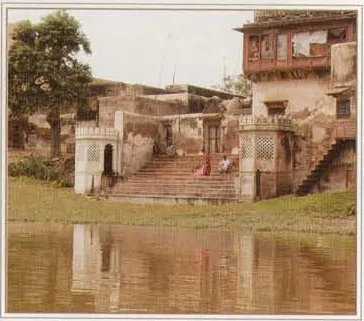
- What it is
- Sūrya-tīrtha is a bathing place on the Yamunā at Mathurā, the sixth of the twelve tīrthas (holy bathing places) south of Viśrāma-ghāṭa in the Bhakti-ratnākara.
- Visiting
- Śrī Vraja-maṇḍala Parikramā (2007) says that a Deity of Bali Mahārāja, with his worshipful Deity Śrī Vāmanadeva, stays in a temple near Sūrya-tīrtha (Bali Mahārāja and Vāmanadeva Mandira), and it …
In short
Sūrya-tīrtha is a bathing place on the Yamunā at Mathurā, the sixth of the twelve tīrthas (holy bathing places) south of Viśrāma-ghāṭa in the Bhakti-ratnākara.[1 +1] The Varāha Purāṇa tells that Bali, the son of Virocana, worshipped the sun-god here for a full year and received from him the cintāmaṇi jewel. It says that a bath here frees one from all sins, and that a bath on a Sunday, at a saṅkrānti (the sun's entry into a new sign) or at an eclipse brings the result of a rājasūya sacrifice.[1 +4] Śrīla Prabhupāda names Sūrya-tīrtha among the twenty-four ghāṭas in which Śrī Caitanya Mahāprabhu bathed.[7 +2]
Key facts
| Kind | ghāṭa |
|---|---|
| Region · area | Mathurā |
| Also part of | Yamunā |
| Ācāryas | Śrī Caitanya Mahāprabhu, Śrīla Rūpa Gosvāmī, Śrīla Narahari Cakravartī Ṭhākura, Śrīla Rāghava Paṇḍita Gosvāmī of Govardhana, Śrīla Śrīnivāsa Ācārya |
Why it is glorified
The Varāha Purāṇa names Sūrya-tīrtha after Tinduka and tells its story (summarised here, not translated).
Bali's worship of the sun
The Varāha Purāṇa names Sūrya-tīrtha after Tinduka and tells its story (summarised here, not translated). Bali, the son of Virocana, had lost his kingdom and lived in Pātāla. Wanting wealth to support his family, he stood here with his arms raised and without food for a full year. Pleased, the sun-god asked him why he did such austerity, then gave him the cintāmaṇi jewel from his own crown, and with it Bali went back to Pātāla.[3 +1]
मुकुटात्तस्य वै सूर्यो ददौ चिन्तामणिं ततः ।। चिन्तामणिं समासाद्य पातालमगमद्बलिः ॥ 56 ॥ तस्मिंस्तीर्थे नरः स्नातः सर्वपापैः प्रमुच्यते ।। तत्राथ मुञ्चते प्राणान्मम लोकं स गच्छति ॥ 57 ॥ आदित्याहनि संक्रान्तौ ग्रहणे चन्द्रसूर्ययोः ।। तस्मिन्स्नातो नरो देवि राजसूयफलं लभेत् ॥ 58 ॥
mukuṭāttasya vai sūryo dadau cintāmaṇiṁ tataḥ
cintāmaṇiṁ samāsādya pātālamagamadbaliḥ
tasmiṁstīrthe naraḥ snātaḥ sarvapāpaiḥ pramucyate
tatrātha muñcate prāṇānmama lokaṁ sa gacchati
ādityāhani saṁkrāntau grahaṇe candrasūryayoḥ
tasminsnāto naro devi rājasūyaphalaṁ labhet
What a bath here gives
The same verses say that one who bathes here is freed from all sins and one who gives up his life here goes to the Lord's world. One who bathes here on a Sunday, at a saṅkrānti or at an eclipse of the moon or the sun gains the result of a rājasūya.[1 +3] Śrīla Rūpa Gosvāmī quotes these verses from the Ādi-varāha in his Mathurā-māhātmya, with Bali's worship but without the story of the jewel.[5 +1]
The Nārada Purāṇa has no Sūrya-tīrtha by name. After Tinduka it names a Paṭusvāmi-tīrtha dear to the Sun, where one bathes, sees the Sun and goes to heaven; it does not say whether this is Sūrya-tīrtha or Vaṭa-svāmī-tīrtha.[11]
Traditional accounts
The guidebook Śrī Vraja-maṇḍala Parikramā (2007) says that at Sūrya-tīrtha the sun-god, with his twelve aspects, is always absorbed in serving Śrī Kṛṣṇa, and that this is why Bali Mahārāja worshipped him here. No older text found so far says this of the tīrtha.[6] As a general teaching, Śrīla Prabhupāda writes that Vaiṣṇavas honour the demigods only on the principles of the Brahma-saṁhitā, as servants of Kṛṣṇa:[12]
General teaching (does not name the place)“Vaiṣṇavas can also worship all these demigods, but only on the principles of the Brahma-saṁhitā, which is recommended by Śrī Caitanya Mahāprabhu. … All the demigods are servants of Kṛṣṇa; they are not equal with Kṛṣṇa.”
Śrīla Prabhupāda, Śrī Caitanya-caritāmṛta, Ādi-līlā 7.157, purport · vedabase.io
The Gosvāmīs and ācāryas
According to the Bhakti-ratnākara of Śrīla Narahari Cakravartī Ṭhākura, Śrīla Rāghava Paṇḍita Gosvāmī of Govardhana took Śrīla …
According to the Bhakti-ratnākara of Śrīla Narahari Cakravartī Ṭhākura, Śrīla Rāghava Paṇḍita Gosvāmī of Govardhana took Śrīla Śrīnivāsa Ācārya and Śrīla Narottama dāsa Ṭhākura round Mathurā and showed them the twenty-four Yamunā tīrthas, which, he said, lie in a half-moon. At Sūrya-tīrtha he told Śrīla Śrīnivāsa Ācārya that it destroys all sins, that Bali performed austerity here, and that a bath here at an eclipse, at a saṅkrānti or on a Sunday gives the result of a rājasūya; then he recited the Ādi-varāha verses (summarised here, not translated).[1 +5]
এই সূর্য্যতীর্থ পাপ নাশয়ে সকলি। এথা তপ কৈলা বিরোচনপুত্র বলি ॥ চন্দ্র সূর্য্যগ্রহণ সংক্রান্তি রবিবারে। রাজসূয় ফল লভে স্নান যেই করে ॥ তথাহি আদিবারাহে ॥ ততঃ পরং সূর্য্যতীর্থং সর্ব্বপাপপ্রমোচনং। বৈরোচনেন বলিনা সূর্য্যস্ত্বারাধিতঃ পুরা ॥ আদিত্যোঽহনি সংক্রান্তৌ গ্রহণে চন্দ্রসূর্য্যয়োঃ। তস্মিন্ স্নাতো নরো দেবি রাজসূয়ফলং লভেৎ
ei sūryyatīrtha pāpa nāśaẏe sakali| ethā tapa kailā birocanaputra bali
candra sūryyagrahaṇa saṁkrānti rabibāre| rājasūẏa phala labhe snāna yei kare
tathāhi ādibārāhe
tataḥ paraṁ sūryyatīrthaṁ sarbbapāpapramocanaṁ| bairocanena balinā sūryyastbārādhitaḥ purā
ādityo'hani saṁkrāntau grahaṇe candrasūryyaẏoḥ| tasmin snāto naro debi rājasūẏaphalaṁ labhet
The Caitanya-caritāmṛta (Madhya 17.190) says that Śrī Caitanya Mahāprabhu bathed in the twenty-four ghāṭas of the Yamunā at Mathurā, without naming them. At the end of the tour Śrīla Rāghava Paṇḍita tells Śrīla Śrīnivāsa Ācārya that Mahāprabhu bathed in these twenty-four with great joy.[7 +3] Read more: The twenty-four ghāṭas of Mathurā →
Śrīla Prabhupāda
In his purport to that verse Śrīla Prabhupāda lists the twenty-four ghāṭas and gives Sūrya-tīrtha as the seventh; his purport to …
In his purport to that verse Śrīla Prabhupāda lists the twenty-four ghāṭas and gives Sūrya-tīrtha as the seventh; his purport to Śrīmad-Bhāgavatam 4.8.42 gives the same list. He says nothing more about the place.[7 +2]
Visiting today
Śrī Vraja-maṇḍala Parikramā (2007) says that a Deity of Bali Mahārāja, with his worshipful Deity Śrī Vāmanadeva, stays in a temple near Sūrya-tīrtha (Bali Mahārāja and Vāmanadeva Mandira), and it lists the Bali Mahārāja-ṭīlā, where Bali worshipped Vāmanadeva, on the walk round Mathurā. The same book also lists a Sūrya-ghāṭa on that walk but does not say whether it is this tīrtha.[6 +1]
Location
| Where it is | southern side[18] |
|---|
Nearby places
Bali Mahārāja and Vāmanadeva Mandira (Sūrya-tīrtha)
Where the sources differ
The lists of Mathurā's twelve southern ghāṭas differ; the accounts are set side by side on the page of Viśrāma-ghāṭa.[2 +4]
More on this place
The twenty-four ghāṭas of Mathurā
References
18 references
- Śrīla Narahari Cakravartī, Bhakti-ratnākara, Fifth Wave, printed pp. 172-173 (1912 ed.), 2nd ed., 1912
- Śrīla Narahari Cakravartī, Bhakti-ratnākara, Fifth Wave, printed p. 175 (1912 ed.), 2nd ed., 1912
- Varāha Purāṇa, 152.51b-55, Sanskrit Wikisource
- Varāha Purāṇa, adhyāya 152, vv. 56-58, Sanskrit Wikisource
- Śrīla Rūpa Gosvāmī, Mathurā-māhātmya vv. 247-248, quoting the Ādi-varāha
- Śrī Vraja-maṇḍala Parikramā (2007), PDF p. 38
- Śrīla Prabhupāda, Śrī Caitanya-caritāmṛta, Madhya-līlā 17.190, purport · vedabase.io
- Śrīla Prabhupāda, Śrīmad-Bhāgavatam, 4.8.42, purport · vedabase.io
- Śrīla Prabhupāda, Śrīmad-Bhāgavatam 4.8.42, purport (the list, as reprinted with numbers)
- Śrīla Rūpa Gosvāmī, Mathurā-māhātmya v.239
- Nārada Purāṇa, उत्तरार्धः/अध्यायः 79 v.79-29
- Śrīla Prabhupāda, Śrī Caitanya-caritāmṛta, Ādi-līlā 7.157, purport · vedabase.io
- Śrīla Narahari Cakravartī, Bhakti-ratnākara, Fifth Wave (pañcama taraṅga), 1912 ed. p. 171, 2nd ed., 1912
- Śrīla Rūpa Gosvāmī, Mathurā-māhātmya, v.274 (Rūpa Gosvāmī's note on the Mathurā-khaṇḍa's count)
- Śrīla Narahari Cakravartī, Bhakti-ratnākara, Fifth Wave (pañcama taraṅga), 1912 ed. p. 178, 2nd ed., 1912
- Śrīla Kṛṣṇadāsa Kavirāja Gosvāmī, Śrī Caitanya-caritāmṛta, Madhya-līlā 17.190, online edition · vedabase.io
- Śrī Vraja-maṇḍala Parikramā (2007), PDF p. 43
- Śrī Vraja-maṇḍala Parikramā (2007), p. 50-51