Tamāla-talā
तमाल-तला Hindi name proposed
Also called Caitanya Baiṭhāka, Lord Caitanya's Baiṭhāka, Mahāprabhu's Baiṭhāka
- What it is
- Tamāla-talā, "the foot of the tamāla tree", is the place on the bank of Śyāma-kuṇḍa that the guidebooks give as the spot where Śrī Caitanya Mahāprabhu sat under a tamāla tree when He found the lost …
- Visiting
- The guidebooks of 1999 to 2007 place Tamāla-talā on the southern bank of Śyāma-kuṇḍa, at its south corner, with the Tamāla-talā-ghāṭa beside it.
- Places here
- Impression of Caitanya's footprints (Tamāla-talā), Tamāla tree (Tamāla-talā)
In short
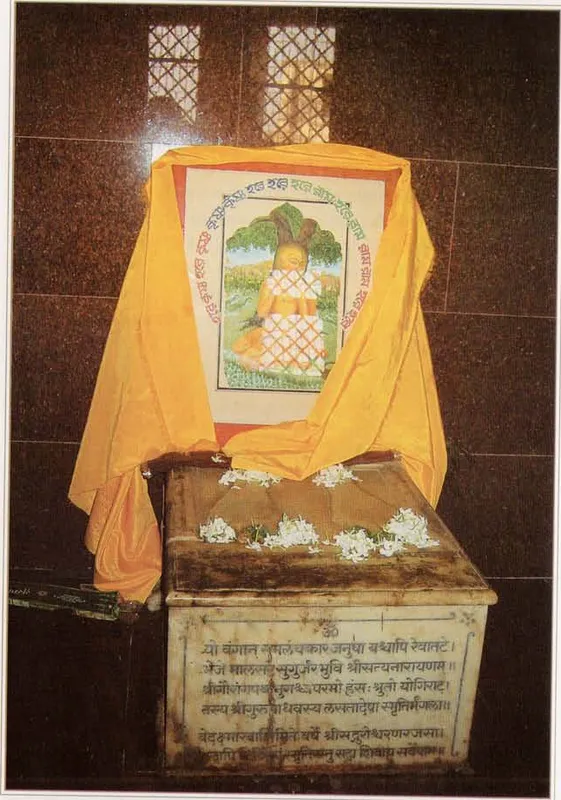
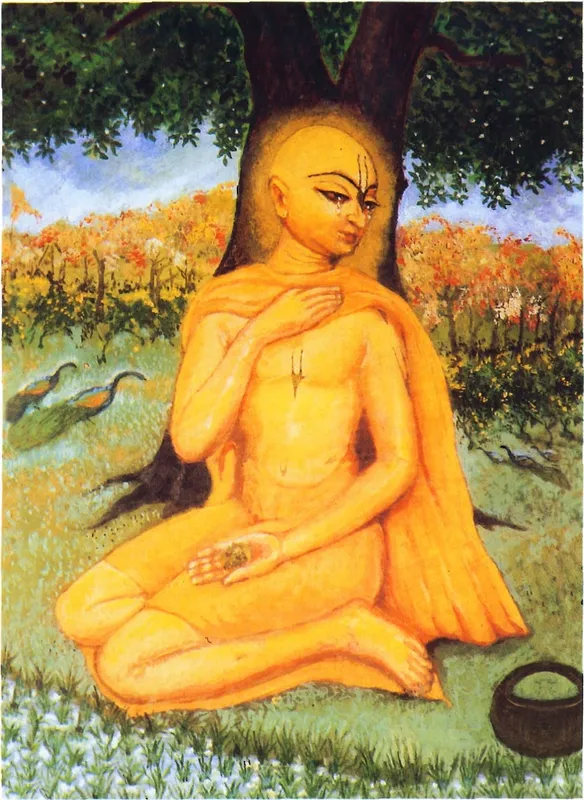
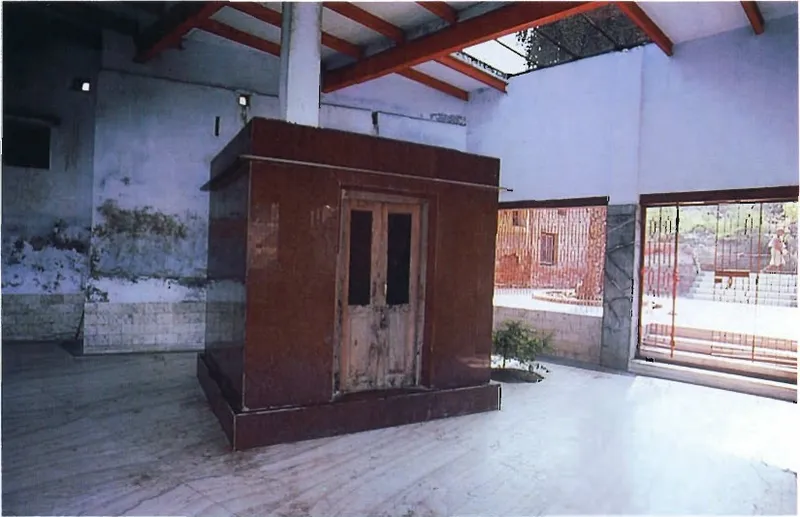
Tamāla-talā, "the foot of the tamāla tree", is the place on the bank of Śyāma-kuṇḍa that the guidebooks give as the spot where Śrī Caitanya Mahāprabhu sat under a tamāla tree when He found the lost Rādhā-kuṇḍa and Śyāma-kuṇḍa. It is also called Mahāprabhu's baiṭhaka, His sitting-place.[1 +10] The Caitanya-caritāmṛta tells how He found the two kuṇḍas in two paddy fields but names no tree.[9 +5] The Bhakti-ratnākara is the oldest source found for the tree: it says that He came and sat under "this tamāla" at the kuṇḍas, and that Śrīla Vīracandra Prabhu was later overwhelmed with love at the same tree.[7 +1] Today a small shrine stands here with a stone carved with footprints.[1 +7]
Key facts
| Kind | baiṭhaka |
|---|---|
| Region · area | Rādhā-kuṇḍa |
| Also part of | Śyāma-kuṇḍa (Rādhā-kuṇḍa), Rādhā-kuṇḍa (village) |
| Ācāryas | Śrī Caitanya Mahāprabhu, Śrī Vīracandra Prabhu, Śrīla Bhaktisiddhānta Sarasvatī Ṭhākura, Śrīla Śrīnivāsa Ācārya, Śrīla Rāghava Paṇḍita Gosvāmī of Govardhana |
Divine pastimes
Śrī Caitanya Mahāprabhu finds the kuṇḍas
The Caitanya-caritāmṛta (Madhya 18) tells how Śrī Caitanya Mahāprabhu, dancing in ecstasy on His way through Vraja, came back to outer awareness at Āriṭ-grāma, the village of the two kuṇḍas. He asked where Rādhā-kuṇḍa was. No one knew, not even the brāhmaṇa travelling with Him.[9 +5]
āriṭe rādhā-kuṇḍa-vārtā puche loka-sthāne
keha nāhi kahe, saṅgera brāhmaṇa nā jāne
Śrī Caitanya Mahāprabhu asked the local people, “Where is Rādhā-kuṇḍa?” No one could inform Him, and the brāhmaṇa accompanying Him did not know either.
Translation: Śrīla A.C. Bhaktivedanta Swami PrabhupādaKnowing that the holy place had been lost to sight, the Lord bathed in the little water of two paddy fields and so found Rādhā-kuṇḍa and Śyāma-kuṇḍa.[9 +5] The villagers were astonished. He prayed to Rādhā-kuṇḍa, danced on its bank remembering Kṛṣṇa's pastimes there, marked His body with tilaka from its mud and, with Balabhadra Bhaṭṭācārya's help, took some of the mud with Him.[19 +2] The Caitanya-caritāmṛta does not say where He sat or where He was when He asked.[9 +5] Śrīla Prabhupāda explains the event in his purport, here as a general teaching on the discovery:[9 +5]
General teaching (does not name the place)“He therefore discovered Rādhā-kuṇḍa and Śyāma-kuṇḍa, which were two reservoirs of water in two paddy fields. Although there was very little water, Śrī Caitanya Mahāprabhu was omniscient and could understand that formerly these two ponds were called Śrī Rādhā-kuṇḍa and Śyāma-kuṇḍa.”
Śrīla Prabhupāda, Śrī Caitanya-caritāmṛta, Madhya-līlā 18.3, purport · vedabase.io
The tamāla in the Bhakti-ratnākara
According to the Bhakti-ratnākara, Śrīla Rāghava Paṇḍita, showing the two kuṇḍas to Śrīla Śrīnivāsa Ācārya, pointed to "this tamāla". Śrī Kṛṣṇa-Caitanya, he said, had come here after wandering through the forests, sat under it, and then asked the people of Ariṣṭa-grāma about the kuṇḍas. When no one could tell Him, He saw that the hidden holy places had become two paddy fields, bathed in their little water, praised the kuṇḍa and made tilaka with its clay (summarised here, not translated).[7 +1] The villagers then said that they had called these fields Kālī and Gaurī, and that by His mercy they now knew them as the two kuṇḍas.[3 +3] The book does not say on which bank the tamāla stood.[7] Read more: How Rādhā-kuṇḍa was found and dug out again →
The Gosvāmīs and ācāryas
The Bhakti-ratnākara (Thirteenth Wave) tells that Śrīla Vīracandra Prabhu came to Rādhā-kuṇḍa with many Vaiṣṇavas.
The Bhakti-ratnākara (Thirteenth Wave) tells that Śrīla Vīracandra Prabhu came to Rādhā-kuṇḍa with many Vaiṣṇavas. He went to the tamāla under which Lord Gauracandra had sat during His forest wanderings, and was so overwhelmed with love there that everyone was amazed. After a while he became steady, rejoiced at the sight of the two kuṇḍas, and danced in saṅkīrtana at Rādhā-kuṇḍa, Śyāma-kuṇḍa and Govardhana.[8 +1]
Śrīla Prabhupāda
Śrīla Prabhupāda writes of the discovery in other places too, in general terms: in The Nectar of Instruction he says that …
Śrīla Prabhupāda writes of the discovery in other places too, in general terms: in The Nectar of Instruction he says that Mahāprabhu found the spot, bathed in the small pond there and told His devotees that the real Rādhā-kuṇḍa was there, and that the pond was later dug out by His devotees headed by the Six Gosvāmīs.[14 +1]
Visiting today
The shrine and the footprints
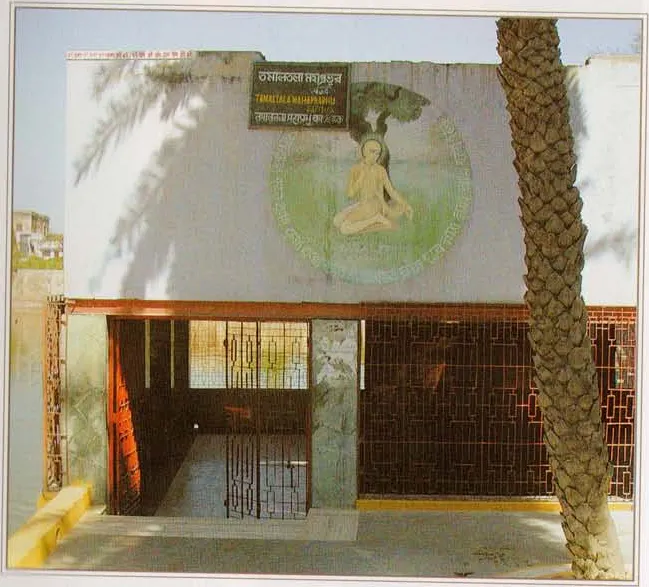
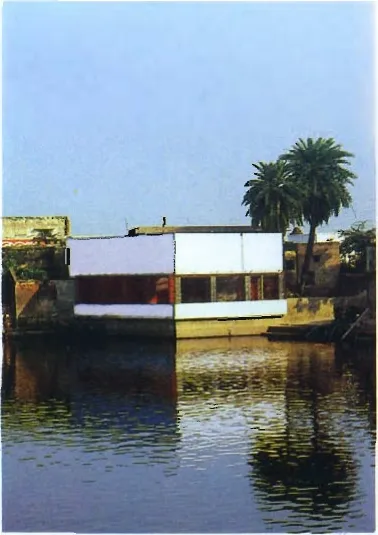
The guidebooks of 1999 to 2007 place Tamāla-talā on the southern bank of Śyāma-kuṇḍa, at its south corner, with the Tamāla-talā-ghāṭa beside it. Śrī Vraja-maṇḍala Parikramā (2007) lists Aṣṭa-sakhī-ghāṭa between Gayā-ghāṭa and Tamāla-talā, and Vallabha-ghāṭa west of it. The Colour Guide to Rādhā-kuṇḍa (1999) calls the shrine at the water's edge newly built; a guide of 2001 calls it the red granite shrine.[2 +5]
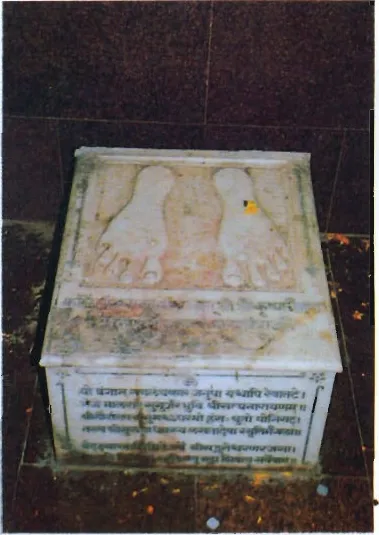
Inside the shrine is a stone carved with footprints. The Colour Guide (1999) and two other guides, of about 1986 and of 2001, call them the lotus footprints of Śrī Caitanya Mahāprabhu; Śrī Vraja-maṇḍala Parikramā (2007) photographs the stone only as His sitting-place.[1 +3] Who set up the stone, and whose footprints these are, is not certain (see below).[1 +1]
The tamāla tree
Two books of 1999 and 2001, by the same author, say that the tamāla tree growing here now is an offshoot of the tree under which Mahāprabhu sat, and that the place is named after it. They give no evidence, so this is not certain.[1 +1] This tree should not be confused with the old tamāla that, according to the local tradition recorded in Śrī Vraja-maṇḍala Parikramā (2007), stood at Saṅgama-ghāṭa.[2 +3] Śrīla Prabhupāda explains in general why the tamāla is dear in Vraja: its colour is Kṛṣṇa's, and Śrīmatī Rādhārāṇī would rest under it when She felt separation from Him.[27]
Location
| Where it is | On the southern bank of Śyāma-kuṇḍa; map key 17 at the south corner of Śyāma-kuṇḍa[28] On the banks of Śyāma-kuṇḍa, with a view of both kuṇḍas.[29] |
|---|---|
| On the numbered Govardhana chart | 4 (printed as “Lord Caitanya’s Sitting Place”)[30] |
Places at Tamāla-talā
2 places
Nearby places
Tamāla-talā-ghāṭa · Aṣṭa-sakhī-ghāṭa · Vallabha-ghāṭa (Rādhā-kuṇḍa) · Rādhā-kuṇḍa
Pictures
5 pictures
Where the sources differ
Accounts differ When Mahāprabhu sat at Tamāla-talā: before asking about the kuṇḍas, or after bathing in them
- Bhakti-ratnākara (Fifth Wave, 1912 ed. p. 194)After wandering in the forests He came and sat under this tamāla, then asked the villagers, then found and bathed in the kuṇḍas.
- The Colour Guide to Rādhā-kuṇḍa (1999)He first asked the local people where the kuṇḍas were; no one knew; then, on the outskirts of the village, He sat in deep contemplation under a tamāla, His glance fell on two paddy fields, and He ran into them and bathed; repeats 'just before discovering'.
- Govardhana Hill: India's Most Sacred Mountain (2001)He sat in contemplation under the tamāla 'just before discovering' the kuṇḍas (no order relative to the inquiry is given).
- Śrī Vraja-maṇḍala Parikramā (2007), ghāṭa listHe sat under a tamāla here and inquired about the kuṇḍas from the villagers, then declared the fields to be the kuṇḍas and bathed.
Whether Śrī Caitanya found the lost kuṇḍas Himself or was shown them is told differently; the accounts are set side by side on the Rādhā-kuṇḍa page.[9 +5]
Whose footprints are carved on the stone in the shrine, and who set it up: a guidebook's report and the stone's own inscription, read only in part from photographs, do not agree.[1 +1]
Accounts differ Whose footprints are carved on the stone at Tamāla-talā, and who set it up?
- The Colour Guide to Rādhā-kuṇḍa (1999)Lord Caitanya's lotus footprints, 'believed to have been established by Śrīla Bhakti-siddhānta Sarasvatī'.
- Vṛndāvana-Dhāma Ki Jaya! (c. 1986); Govardhana Hill: India's Most Sacred Mountain (2001)His (Mahāprabhu's) lotus footprints are in the shrine; no installer named.
- Inscription on the stoneAn auspicious memorial (smṛti) of a guru whose name ends in '-dhava', a Bengal-born paramahaṁsa and follower of Śrī Gaurāṅga's feet; no legible word names Śrīla Bhaktisiddhānta Sarasvatī or Mahāprabhu's footprints.
More on this place
How Rādhā-kuṇḍa was found and dug out again
References
30 references
- Govardhana Hill: India's Most Sacred Mountain (2001), Rajasekhara dasa Brahmacari, PDF p. 157
- The Colour Guide to Rādhā-kuṇḍa (1999), Rājaśekhara dāsa Brahmacārī, PDF p. 147
- Śrī Vraja-maṇḍala Parikramā (2007), PDF p. 85
- Śrī Vraja-maṇḍala Parikramā (2007), PDF p. 98
- the undated parikramā notes Rādhā-kuṇḍa, ¶114
- Vṛndāvana-Dhāma Ki Jaya! (c. 1986), by Dhruva Mahārāja dāsa, PDF p. 31
- Śrīla Narahari Cakravartī, Bhakti-ratnākara, Pañcama-taraṅga (5th wave), printed page 194, 2nd ed., 1912
- Śrīla Narahari Cakravartī, Bhakti-ratnākara, Thirteenth Wave, 1912 ed. p. 1022, 2nd ed., 1912
- Śrīla Kṛṣṇadāsa Kavirāja Gosvāmī, Śrī Caitanya-caritāmṛta, CC Madhya-līlā 18.3, online edition · vedabase.io
- Śrīla Kṛṣṇadāsa Kavirāja Gosvāmī, Śrī Caitanya-caritāmṛta, CC Madhya-līlā 18.4, online edition · vedabase.io
- Śrīla Kṛṣṇadāsa Kavirāja Gosvāmī, Śrī Caitanya-caritāmṛta, Madhya-līlā 18.5, online edition · vedabase.io
- Śrīla Prabhupāda, Śrī Caitanya-caritāmṛta, Madhya-līlā 18.3, purport · vedabase.io
- Śrīla Prabhupāda, Śrī Caitanya-caritāmṛta, Ādi-līlā 10.90, purport · vedabase.io
- Śrīla Prabhupāda, The Nectar of Instruction (Śrī Upadeśāmṛta), Text 9, purport · vedabase.io
- Śrī Vraja-maṇḍala Parikramā (2007), PDF p. 99
- Śrī Vraja-maṇḍala Parikramā (2007), PDF p. 101
- The Colour Guide to Rādhā-kuṇḍa (1999), Rājaśekhara dāsa Brahmacārī, PDF p. 149
- The Colour Guide to Rādhā-kuṇḍa (1999), Rājaśekhara dāsa Brahmacārī, PDF p. 150
- Śrīla Kṛṣṇadāsa Kavirāja Gosvāmī, Śrī Caitanya-caritāmṛta, CC Madhya-līlā 18.6, online edition · vedabase.io
- Śrīla Kṛṣṇadāsa Kavirāja Gosvāmī, Śrī Caitanya-caritāmṛta, Madhya-līlā 18.13, online edition · vedabase.io
Show all 30 references
- Śrīla Kṛṣṇadāsa Kavirāja Gosvāmī, Śrī Caitanya-caritāmṛta, Madhya-līlā 18.14, online edition · vedabase.io
- Śrīla Narahari Cakravartī, Bhakti-ratnākara, Fifth Wave, 1912 ed. p. 195, lines 4-5, 2nd ed., 1912
- The Colour Guide to Rādhā-kuṇḍa (1999), Rājaśekhara dāsa Brahmacārī, PDF p. 37
- Śrīla Narahari Cakravartī, Bhakti-ratnākara, Thirteenth Wave (trayodaśa taraṅga), 1912 ed. p. 1022, 2nd ed., 1912
- Śrīla Prabhupāda, Lecture, San Francisco, 28 June 1971 · vedabase.io
- The Colour Guide to Rādhā-kuṇḍa (1999), Rājaśekhara dāsa Brahmacārī, PDF p. 126
- Śrīla Prabhupāda, Letter to Tamala Krsna, letter 70-05-01, 1 May 1970 · vedabase.io
- Śrī Vraja-maṇḍala Parikramā (2007), p. 144-145
- The Colour Guide to Rādhā-kuṇḍa (1999), Rājaśekhara dāsa Brahmacārī, p. 143
- Numbered list of the Govardhana sites (key of the Govardhana chart)