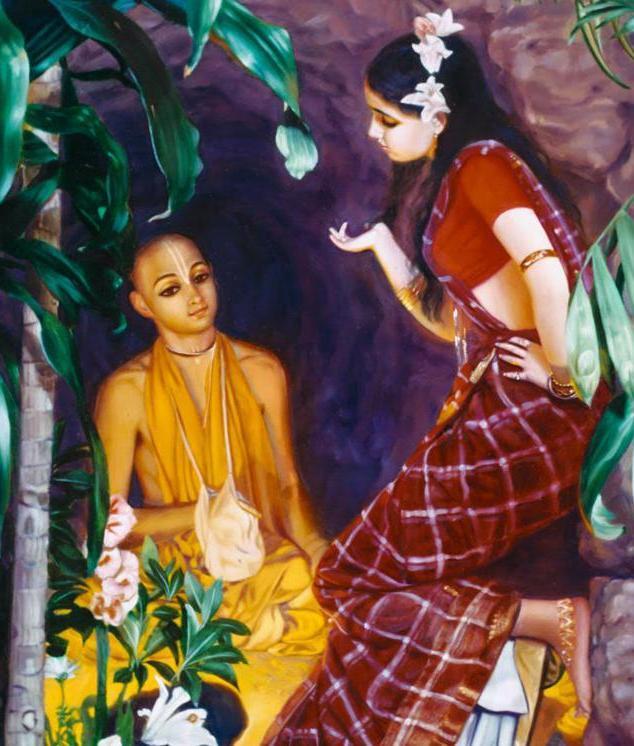
When Krishnadasa Kaviraja Goswami reached the third chapter of the Antya-lila, the last part of his book, he asked the devotees to hear about the qualities of Srila Haridasa Thakura (Haridāsa Ṭhākura) "that Śrīla Vṛndāvana dāsa Ṭhākura has not described in detail" (Chaitanya-charitamrita Antya 3.98). So the stories below come to us from Chaitanya-charitamrita. They are part of what Vrindavana Dasa Thakura had left untold, and they begin in the forest of Benapola, where Haridasa stayed for some time after leaving home (Chaitanya-charitamrita Antya 3.99). Srila Prabhupada places Benapola in the district of Jessore, near Bangaon, on the border of today's Bangladesh (purport to Antya 3.100). Chaitanya-bhagavata, however, begins the story of his early life at Phuliya, and the account of his birth and early life follows that order.
In that forest he built himself a small hut and planted a tulasi (tulasī) plant, the sacred plant served by Vaishnavas, in front of it. He begged a little food from a brahmana's house and chanted the holy name day and night:
nirjana-vane kuṭira kari’ tulasī sevana
rātri-dine tina lakṣa nāma-saṅkīrtana
"Haridāsa Ṭhākura constructed a cottage in a solitary forest. There he planted a tulasī plant, and in front of the tulasī he would chant the holy name of the Lord 300,000 times daily. He chanted throughout the entire day and night." (Sri Chaitanya-charitamrita Antya 3.100)
brāhmaṇera ghare kare bhikṣā nirvāhaṇa
prabhāve sakala loka karaye pūjana
"For his bodily maintenance he would go to a brāhmaṇa’s house and beg some food. He was spiritually so influential that all the neighboring people worshiped him." (Sri Chaitanya-charitamrita Antya 3.101)
In his purport Srila Prabhupada explains: "From his personal example we can understand that chanting the Hare Kṛṣṇa mantra and becoming highly elevated in Kṛṣṇa consciousness is very simple."
A Zamindar Who Could Not Bear His Fame #
But one powerful man could not bear the love that the villagers showed this poor hermit:
sei deśādhyakṣa nāma — rāmacandra khāṅna
vaiṣṇava-vidveṣī sei pāṣaṇḍa-pradhāna
"A landholder named Rāmacandra Khān was the zamindar of that district. He was envious of Vaiṣṇavas and was therefore a great atheist." (Sri Chaitanya-charitamrita Antya 3.102)
He tried in many ways to disgrace Haridasa. But he could find no fault in the Thakura's life, so he decided to create one. He called together the prostitutes of the area and asked them to make this vairagi, a renounced holy man, break his vows (Chaitanya-charitamrita Antya 3.103-105). Srila Prabhupada saw the same spirit in critics of his own day, who searched for faults "exactly like the old rascal Rāmacandra Khān, who opposed Haridāsa Ṭhākura" (purport to Antya 3.104). One young and beautiful girl promised to capture Haridasa's mind within three days. The zamindar wanted his constable to go with her and arrest Haridasa on the spot. But she asked him to wait. First she would be with Haridasa once, she said, and the second time she would bring the constable (Chaitanya-charitamrita Antya 3.106-108).
The First Night #
That night she dressed with great care and went happily to the cottage. Strangely, for someone on such an errand, she first bowed down to the tulasi plant and then to Haridasa (Chaitanya-charitamrita Antya 3.109-110). She sat at the door and uncovered part of her body. Then she praised his beauty and his youth, which, in her words, "is just beginning," and said that she could not live without him (Chaitanya-charitamrita Antya 3.111-113). Haridasa showed no anger and gave her no lecture. On the surface, his reply even sounded like a promise:
haridāsa kahe, — “tomā karimu aṅgīkāra
saṅkhyā-nāma-samāpti yāvat nā haya āmāra
tāvat tumi vasi’ śuna nāma-saṅkīrtana
nāma-samāpti haile karimu ye tomāra mana”
"Haridāsa Ṭhākura replied, ‘I shall accept you without fail, but you will have to wait until I have finished chanting my regular rounds on my beads. Until that time, please sit and listen to the chanting of the holy name. As soon as I am finished, I shall fulfill your desire.’" (Sri Chaitanya-charitamrita Antya 3.114-115)
So she sat and listened, and he chanted until the first light of morning. Then she went back to Ramachandra Khan and told him that Haridasa had given his word, and that tomorrow she would surely succeed (Chaitanya-charitamrita Antya 3.116-118).
The Second Night #
The next night Haridasa welcomed her and again gave her many assurances. He even asked her to forgive him for disappointing her the night before. Then he asked her once more to sit and hear the maha-mantra until he had finished his fixed number of names (Chaitanya-charitamrita Antya 3.119-121). Then something happened that neither she nor the zamindar had planned:
tulasīre tāṅke veśyā namaskāra kari’
dvāre vasi’ nāma śune bale ‘hari’ ‘hari’
"After offering her obeisances to the tulasī plant and Haridāsa Ṭhākura, she sat down at the door. Hearing Haridāsa Ṭhākura chanting the Hare Kṛṣṇa mantra, she also chanted, ‘O my Lord Hari, O my Lord Hari.’" (Sri Chaitanya-charitamrita Antya 3.122)
In his purport Srila Prabhupada explains: "The prostitute came to pollute Haridāsa Ṭhākura, but he took it as his duty to deliver the prostitute."
Toward dawn she grew restless. Haridasa explained that he had vowed to chant ten million names in one month. The vow was almost over, and he had chanted the whole night hoping to finish it, but it was still not done. Tomorrow, he said, he would be free (Chaitanya-charitamrita Antya 3.123-126). A reader may be puzzled by these promises, but Srila Prabhupada answers plainly: "Haridāsa Ṭhākura never wanted to enjoy the prostitute, but he tricked her to deliver her by giving her a chance to hear the holy name of the Lord while he chanted" (purport to Antya 3.126).
The Third Night: A Heart Turned Around #
On the third day she came early, as soon as evening fell. Again she bowed to tulasi and to the Thakura and sat at the door. She listened and chanted "Hari, Hari" herself, and Haridasa told her that tonight his chanting would surely end (Chaitanya-charitamrita Antya 3.127-129). Like the two nights before it, this night passed in kirtana, the chanting of the holy name. But by the end of it, Krishnadasa Kaviraja Goswami tells us, "by his association the mind of the prostitute had changed" (Chaitanya-charitamrita Antya 3.130).
She fell flat at his feet, confessed Ramachandra Khan's plot, and begged: "My lord, be merciful to me. Deliver my fallen soul" (Chaitanya-charitamrita Antya 3.131-132). But nothing had been hidden from Haridasa. He had known about the plot all along. He called the zamindar "an ignorant fool" and said that his schemes did not make him unhappy (Chaitanya-charitamrita Antya 3.133). Then he told her why he had not simply walked away:
sei-dina yāitāma e-sthāna chāḍiyā
tina dina rahilāṅa tomā nistāra lāgiyā
"On the very day Rāmacandra Khān was planning his intrigue against me, I would have left this place immediately, but because you came to me I stayed here for three days to deliver you." (Sri Chaitanya-charitamrita Antya 3.134)
The three nights had never been a danger to him. They were his mercy to her.
"Kindly Act as My Spiritual Master" #
The woman who had come to bring him down now asked to be lifted up: "Kindly act as my spiritual master. Instruct me in my duty, by which I can get relief from material existence" (Chaitanya-charitamrita Antya 3.135). His instruction was short and complete. She should give her property to the brahmanas, and then come back to that very room and live there for good (Chaitanya-charitamrita Antya 3.136). And then: "Chant the Hare Kṛṣṇa mantra continuously and render service to the tulasī plant by watering her and offering prayers to her. In this way you will very soon get the opportunity to be sheltered at the lotus feet of Kṛṣṇa" (Chaitanya-charitamrita Antya 3.137). In his purport Srila Prabhupada points out the heart of this instruction: "Haridāsa Ṭhākura says, nirantara nāma lao: 'Chant the Hare Kṛṣṇa mantra without stopping.'"
After teaching her how to chant, Haridasa stood up and walked away, chanting "Hari, Hari" as he went (Chaitanya-charitamrita Antya 3.138). He left her his cottage, his tulasi and his way of life, and took nothing with him but the holy name.
Why the Wealth Went to the Brahmanas #
She obeyed at once and gave the brahmanas everything in her house, "following the order of her spiritual master" (Chaitanya-charitamrita Antya 3.139). Haridasa, who begged his own meals, kept none of it. Srila Prabhupada draws the lesson in his purport: "A Vaiṣṇava guru is never dependent on the contributions of his disciples. Following the instructions of Haridāsa Ṭhākura, a pure Vaiṣṇava does not personally take even a single paisa from anyone, but he induces his followers to spend for the service of the Lord whatever possessions they have."
A Celebrated Vaishnavi #
She shaved her head, kept only one cloth to wear and stayed on in that room. There she chanted three hundred thousand names day and night, "following in the footsteps of her spiritual master" (Chaitanya-charitamrita Antya 3.140). She served the tulasi plant. She ate whatever came to her as alms, and when nothing came, she fasted. As her senses came under control, the signs of love for Krishna began to appear in her (Chaitanya-charitamrita Antya 3.141).
prasiddhā vaiṣṇavī haila parama-mahāntī
baḍa baḍa vaiṣṇava tāṅra darśanete yānti
"Thus the prostitute became a celebrated devotee. She became very advanced in spiritual life, and many stalwart Vaiṣṇavas would come to see her." (Sri Chaitanya-charitamrita Antya 3.142)
In his purport Srila Prabhupada explains: "Anyone can be turned into a Vaiṣṇava if he or she follows the Vaiṣṇava principles." Those who saw her new life were amazed, and they bowed to Haridasa and spoke of his glory (Chaitanya-charitamrita Antya 3.143).
Chaitanya-charitamrita does not give her name. But local tradition at Benapola remembers her as Hira Bai, and pilgrims there are still shown her bhajana-kutir, the hut where she worshipped. Later she chanted lakhs, or hundreds of thousands, of holy names every day, so she came to be called Laksha-Hira (Lakshahira). The forest where this happened later came to be known as Hira Veshya's Jungle, the forest of Hira the courtesan. Some later retellings stretch the test over many more nights. But Chaitanya-charitamrita gives three, and Haridasa himself counts them (Antya 3.134).
The Seed of Offense: Ramachandra Khan's Fate #
Haridasa held nothing against the man who had tried to ruin him. But the Lord does not overlook an offense against His devotee:
rāmacandra khāṅna aparādha-bīja kaila
sei bīja vṛkṣa hañā āgete phalila
"By inducing a prostitute to disturb Haridāsa Ṭhākura, Rāmacandra Khān caused a seed of offense at his lotus feet to germinate. This seed later became a tree, and when it fructified, Rāmacandra Khān ate its fruits." (Sri Chaitanya-charitamrita Antya 3.144)
Ramachandra Khan was no devotee to begin with, and through this offense he became like a demon. In time his long contempt for the Vaishnavas bore its fruit (Chaitanya-charitamrita Antya 3.146-147). Once Nityananda Prabhu was touring Bengal to spread love of Godhead and to subdue the atheists. He came to Ramachandra Khan's house on purpose and sat down in its Durga-mandapa, the hall kept for the yearly worship of the goddess Durga (Chaitanya-charitamrita Antya 3.148-150). The zamindar did not come out. Instead he sent a servant to say that there was no room for so many people, and that a milkman's large cowshed would suit them better (Chaitanya-charitamrita Antya 3.151-153). Nityananda Prabhu became angry and came out. Laughing loudly, He said: "Rāmacandra Khān has spoken rightly. This place is unfit for Me. It is fit for cow-killing meat-eaters." He left at once and would not stay even in that village (Chaitanya-charitamrita Antya 3.154-156). Ramachandra Khan had the earth dug up where the Lord had sat, and he had the hall smeared with cow-dung water. Still, his mind found no peace (Chaitanya-charitamrita Antya 3.157-158).
Nityananda Prabhu's words soon came true. Ramachandra Khan had been avoiding payment of the government's revenue. So the angry Muslim minister came and made his camp in that same Durga-mandapa, and there he killed a cow and cooked its meat (Chaitanya-charitamrita Antya 3.159-160). He arrested Ramachandra Khan with his wife and sons, plundered the house and village for three days, and "took away Rāmacandra Khān’s position, wealth and followers. For many days the village remained deserted" (Chaitanya-charitamrita Antya 3.161-163). Krishnadasa Kaviraja Goswami draws the lesson for everyone: "Wherever an advanced devotee is insulted, for one man’s fault the entire town or place is afflicted" (Chaitanya-charitamrita Antya 3.164). Srila Prabhupada gives the reason in his purport to a later verse of the same chapter: "Kṛṣṇa, however, cannot tolerate any insults or blasphemy against a Vaiṣṇava" (Chaitanya-charitamrita Antya 3.213, purport).
By this time Haridasa had long since walked on to Chandapura, to the house of Balarama Acharya (Chaitanya-charitamrita Antya 3.165). There a brahmana named Gopala Chakravarti would soon commit a similar offense. That story is told in the debate at Chandapura.
A Second Test, at the Ganges #
This was not the last time Haridasa was tested in this way. Later he lived in a cave on the bank of the Ganges near Shantipura. There Maya Devi herself, the Lord's illusory energy, came to him at night for three nights. She too heard nothing from him but the holy name, and in the end she begged to receive it (Chaitanya-charitamrita Antya 3.228-266). That story is told in full in Maya Devi Tests Haridasa Thakura.
