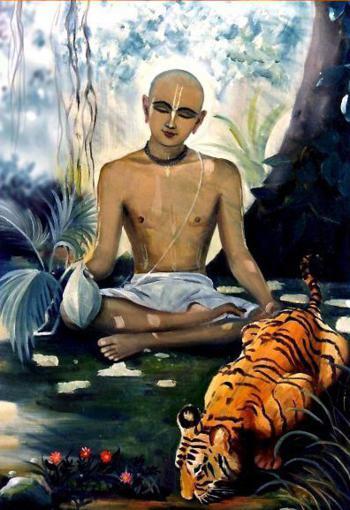
Srila Haridasa Thakura (Haridāsa Ṭhākura) appeared in a Muslim family in the village of Budhana in Bengal, many years before Sri Chaitanya Mahaprabhu began His sankirtana movement (Chaitanya-bhagavata Adi 16.18). The Advaita-vilasa gives the year as 1451, so he was about thirty-five years older than the Lord. Nothing in his background pointed to the life that was coming. Yet from his early years Krishna's names were always on his lips, and the great devotees of Bengal soon accepted him as one of their own. Here is the story of those first years, as Chaitanya-bhagavata, Sri Chaitanya-charitamrita and Srila Prabhupada's purports tell it. It ends at the time when he and Advaita Acharya together called the Lord to come into this world.
| Detail | Description |
|---|---|
| Born | c. 1451, village of Budhan/Buron, Bengal Sultanate (today Satkhira District, Bangladesh) |
| Family | Muslim by birth |
| Chief early influence | Advaita Acharya, met on the banks of the Ganges near Phuliya |
| Practice from youth | Loud chanting of the Hare Krishna maha-mantra, reportedly 300,000 times daily |
| Sources | Chaitanya-bhagavata (Adi-khanda), Sri Chaitanya-caritamrta (Antya 3), later devotional biographies |
Why He Took Birth in a Muslim Family #
Why would such a great soul appear among people who did not worship Krishna? The tradition gives more than one answer, and the answers agree with each other. Kavi Karnapura's Gaura-ganoddesha-dipika says that he is Lord Brahma, who appeared together with Prahlada Maharaja. Following Murari Gupta, it also tells an old story. As Brahma Mahatapa, a son of Rcika Muni, he once brought his father a tulasi leaf without washing it first. His father cursed him for this, and because of that curse he took birth among yavanas (Gaura-ganoddesha-dipika 93-95; the verses are quoted in the life of Srila Haridasa Thakura). Later, Sri Chaitanya Mahaprabhu Himself spoke to Haridasa about his avatara, his incarnation in this world (Chaitanya-charitamrita Antya 11.25). Srila Prabhupada explains in his purport: "By using the words tomāra avatāra (“your incarnation”), Śrī Caitanya Mahāprabhu confirms that Haridāsa Ṭhākura is the incarnation of Lord Brahmā."
Bhaktivinoda Thakura tells the deeper story in his Navadvipa-dhama-mahatmya. At the end of Dvapara-yuga, Brahma had stolen Krishna's calves and cowherd boys, and Krishna had forgiven him. Yet Brahma still felt sad. He thought: "Because of my wrong mentality, I am devoid of divine love for Kṛṣṇa and deprived of relishing the rasa of Pastimes in Vraja." His pride in being Brahma, the creator, had kept him out. So he went to Antardvipa, the central island of Navadvipa, and did austerities there for a long time, hoping for Gauranga's mercy. When Gauranga appeared before him, Brahma prayed for one thing: "May I attain a birth in which my mentality of being Brahmā leaves me, and I live in Your company, chanting Your glories." The Lord said, "So be it," and told him how his next birth would be (Navadvipa-dhama-mahatmya 5.124-144):
ye samaya mama līlā prakaṭa ha-ibe
yavanera gṛhe tumi janama labhibe
āpanāke hīna bali’ ha-ibe geyāna
haridāsa habe tumi śūnya abhimāna
tina-lakṣa hari-nāma jihvāgre nāchibe
niryāṇa-samaye tumi āmāke dekhibe
"When My Pastimes manifest, you will be born in a home of uncivilised people. You will consider yourself lowly. You will be known as Haridāsa, and you will be free from pride. The Name will dance on the tip of your tongue three hundred thousand times a day, and you will see Me at the time of your passing away." (Sri Navadvipa-dhama-mahatmya 5.145-147, translated by the Bhaktivinoda Institute)
Every part of this promise came true. Haridasa always thought of himself as low, he chanted three hundred thousand names a day, and he left this world with his eyes on the Lord's face, as the last chapter of this biography tells. The Advaita-vilasa gives the same reason for his low birth.
Vrindavana Dasa Thakura gives the reason in the simplest words. Haridasa was born in a low family by the Lord's own order, so that his life would prove what the scriptures say: a devotee of Vishnu is worthy of worship by all, even if he is born in a low family, and a high birth is useless to one who does not worship Krishna (Chaitanya-bhagavata Adi 16.237-240). Sri Chaitanya-charitamrita puts the same truth in one verse:
haridāsa-dvārā nāma-māhātmya-prakāśa
sanātana-dvārā bhakti-siddhānta-vilāsa
"Śrī Caitanya Mahāprabhu exhibited the glories of the holy name of the Lord through Haridāsa Ṭhākura, who was born in a Muslim family. Similarly, He exhibited the essence of devotional service through Sanātana Gosvāmī, who had almost been converted into a Muslim." (Sri Chaitanya-charitamrita Antya 5.86)
The next verse compares him to Prahlada, who was born among demons, and to Hanuman, who was born as a monkey. In each case the low birth was only an outer covering (Chaitanya-bhagavata Adi 16.241). In Chaitanya-bhagavata these words come from a most unusual speaker: the king of serpents, speaking through a snake-charmer. That story is told further below (Chaitanya-bhagavata Adi 16.222-248).
Srimad-Bhagavatam taught the same truth long before, and Sri Chaitanya Mahaprabhu recited this very verse about Haridasa when He embraced him at Puri (Chaitanya-charitamrita Madhya 11.192):
aho bata śva-paco ’to garīyān
yaj-jihvāgre vartate nāma tubhyam
tepus tapas te juhuvuḥ sasnur āryā
brahmānūcur nāma gṛṇanti ye te
"Oh, how glorious are they whose tongues are chanting Your holy name! Even if born in the families of dog-eaters, such persons are worshipable. Persons who chant the holy name of Your Lordship must have executed all kinds of austerities and fire sacrifices and achieved all the good manners of the Āryans. To be chanting the holy name of Your Lordship, they must have bathed at holy places of pilgrimage, studied the Vedas and fulfilled everything required." (Srimad-Bhagavatam 3.33.7)
In his purport Srila Prabhupada names Haridasa directly: "He was apparently born in a family of Muhammadans, but because he was chanting the holy name of the Supreme Lord offenselessly, Lord Caitanya empowered him to become the authority, or ācārya, of spreading the name."
Budhana: His Birthplace and Family #
Chaitanya-bhagavata names his village as Budhana, and it says that because he appeared there, the whole district became filled with kirtana (Chaitanya-bhagavata Adi 16.18). Srila Prabhupada repeats this, but he is careful about the exact place: "It is not definitely certain whether Śrī Haridāsa Ṭhākura appeared in the village named Buḍhana that is in the district of Khulnā" (Chaitanya-charitamrita Adi 10.43, purport). The area called Budhana is now in Satkhira, in Bangladesh.
The accounts do not agree about his parents, and neither Chaitanya-bhagavata nor Chaitanya-charitamrita names them. One tradition says he was born to brahmana parents named Sumati and Gauri. They died while he was still small, and a Muslim family in the nearby village of Halimpur brought him up. The Advaita-vilasa gives a different account. It names his father as Khan Ullah Kazi and makes him about thirty-five years older than Sri Chaitanya Mahaprabhu (The Gaudiya Treasures of Bengal). The same book places his birth in the month of Agrahayana in Shaka 1372 (1451), and it too says that he lost his parents when he was young. The two main biographies simply say that he was born a Muslim, and Srila Prabhupada states it plainly: "Haridāsa Ṭhākura was born in a Muslim family and was later recognized as a great Vaiṣṇava, but nevertheless the brāhmaṇas were very critical of him" (Chaitanya-charitamrita Antya 3.220, purport).
The Holy Name From His Early Years #
The early books do not tell us how the boy first came to love the holy name. Srila Prabhupada notes only this: "From the very beginning of his life he was never trained in the karma-kāṇḍa system, but because he was always chanting the holy name of the Lord, Śrī Caitanya Mahāprabhu accepted him as nāmācārya" (Srimad-Bhagavatam 5.9.4, purport). When Krishnadasa Kaviraja Goswami lists the branches of the Chaitanya tree, he describes the life that grew from it:
haridāsa-ṭhākura śākhāra adbhuta carita
tina lakṣa nāma teṅho layena apatita
"The twentieth branch of the Caitanya tree was Haridāsa Ṭhākura. His character was wonderful. He used to chant the holy name of Kṛṣṇa 300,000 times a day without fail." (Sri Chaitanya-charitamrita Adi 10.43)
In his purport Srila Prabhupada writes: "Certainly the chanting of 300,000 holy names of the Lord is wonderful. No ordinary person can chant so many names, nor should one artificially imitate Haridāsa Ṭhākura’s behavior." He then gives the practical lesson for his own followers: "Therefore we have prescribed in our Society that all our students must chant at least sixteen rounds daily." In the same purport he also gives the outline of these years: "It is stated in the Caitanya-bhāgavata, Ādi-khaṇḍa, chapter two, that Haridāsa Ṭhākura was born in a village known as Buḍhana but after some time came to live on the bank of the Ganges at Phuliyā, near Śāntipura."
On the Bank of the Ganges at Phuliya #
After some years Haridasa left Budhana. He settled on the bank of the Ganges at Phuliya, a village near Shantipura in today's Nadia district (Chaitanya-bhagavata Adi 16.19). Advaita Acharya was so happy to have his company that He roared aloud with joy, and the two of them floated together in the ocean of Krishna's sweetness (Chaitanya-bhagavata Adi 16.20-21). Day after day Haridasa walked along the riverbank calling out Krishna's names. Sometimes he danced, wept, laughed or fell unconscious in ecstasy (Chaitanya-bhagavata Adi 16.22-29). The brahmanas of Phuliya saw that his tears and trembling were real, so they began to honor this son of a Muslim family as a devotee of the first rank.
Sri Chaitanya-charitamrita tells these years in a different order. After he left home, it first shows him living for some time in the forest of Benapola (Antya 3.99). Then he stays at Chandapura, and only after that does he come to Advaita Acharya at Shantipura (Antya 3.214). The two books differ on the order, but they fully agree on how he lived:
nirjana-vane kuṭira kari’ tulasī sevana
rātri-dine tina lakṣa nāma-saṅkīrtana
"Haridāsa Ṭhākura constructed a cottage in a solitary forest. There he planted a tulasī plant, and in front of the tulasī he would chant the holy name of the Lord 300,000 times daily. He chanted throughout the entire day and night." (Sri Chaitanya-charitamrita Antya 3.100)
In his purport Srila Prabhupada finds hope in this simple picture: "From his personal example we can understand that chanting the Hare Kṛṣṇa mantra and becoming highly elevated in Kṛṣṇa consciousness is very simple." The story of Benapola is told in the prostitute's test, and the debate at Chandapura is told in Teachings on the Holy Name.
Advaita Acharya's Shelter and the Shraddha-patra #
When Haridasa came to Shantipura, he bowed down to Advaita Acharya. Advaita Acharya embraced him and honored him in return (Chaitanya-charitamrita Antya 3.214-215). Then the Acharya gave him a quiet place to chant, and also the best teaching:
gaṅgā-tīre goṅphā kari’ nirjane tāṅre dilā
bhāgavata-gītāra bhakti-artha śunāilā
"On the bank of the Ganges, in a solitary place, Advaita Ācārya made a cavelike home for Haridāsa Ṭhākura and spoke to him about the real meaning of Śrīmad-Bhāgavatam and the Bhagavad-gītā in terms of devotional service." (Sri Chaitanya-charitamrita Antya 3.216)
Every day Haridasa ate at Advaita Acharya's house, and the two of them enjoyed talking about Krishna together (Chaitanya-charitamrita Antya 3.217). But this daily kindness troubled Haridasa's humble heart. Shantipura was full of proud brahmana families, and he was afraid that the Acharya's open love for a man of his birth would bring Him trouble. So he spoke to Him openly:
mahā-mahā-vipra ethā kulīna-samāja
nīce ādara kara, nā vāsaha bhaya lāja!!
"Sir, You are living within a society of great, great brāhmaṇas and aristocrats, but without fear or shame You adore a lower-class man like me." (Sri Chaitanya-charitamrita Antya 3.219)
Srila Prabhupada explains this worry in his purport: "Thus Haridāsa Ṭhākura was afraid that Advaita Ācārya would be put into some difficulty because of His familiarity with Haridāsa Ṭhākura" (Chaitanya-charitamrita Antya 3.220, purport). But Advaita Acharya did not care for social custom, and He replied: "My dear Haridāsa, do not be afraid. I shall behave strictly according to the principles of the revealed scriptures." (Chaitanya-charitamrita Antya 3.221) Srila Prabhupada comments: "As stated in the śāstric injunctions, which are the true medium of evidence or proof, anyone can go back to Godhead, even if born of a low family." Srimad-Bhagavatam gives the same rule for judging a person: "If one shows the symptoms of being a brāhmaṇa, kṣatriya, vaiśya or śūdra, as described above, even if he has appeared in a different class, he should be accepted according to those symptoms of classification" (Srimad-Bhagavatam 7.11.35).
Then Advaita Acharya showed in practice what the scriptures mean. At the shraddha ceremony for His departed father, the plate of honor was meant for the most respected brahmana present, but He placed it before Haridasa:
tumi khāile haya koṭi-brāhmaṇa-bhojana”
eta bali, śrāddha-pātra karāilā bhojana
“Feeding you is equal to feeding ten million brāhmaṇas,” Advaita Ācārya said. “Therefore, accept this śrāddha-pātra.” Thus Advaita Ācārya made him eat. (Sri Chaitanya-charitamrita Antya 3.222)
In his purport Srila Prabhupada explains: "Instead of offering the śrāddha-pātra to any other brāhmaṇa, Advaita Ācārya offered it to Haridāsa Ṭhākura, considering him greater than any of the foremost brāhmaṇas." Krishnadasa Kaviraja thought this honor was so important that he also mentions it when he lists Haridasa among the branches of the Chaitanya tree (Chaitanya-charitamrita Adi 10.44). Some later biographies, such as the Advaita-prakasha, say that Advaita Acharya also gave him his name and his first instruction in chanting. Chaitanya-charitamrita and Chaitanya-bhagavata do not describe such a ceremony.
The Serpent in the Cave #
Chaitanya-bhagavata tells the next story after Haridasa's trial before the qazi, which is told in Persecution in Twenty-Two Marketplaces. Back at Phuliya he lived alone in a cave on the bank of the Ganges. He remembered Krishna day and night and chanted 300,000 names daily, so the cave became like Vaikuntha (Chaitanya-bhagavata Adi 16.172-173). But a great poisonous snake also lived in that cave. Visitors who came to speak with Haridasa felt a burning heat from its poison and could not stay for more than a few moments, while Haridasa himself felt nothing at all (Chaitanya-bhagavata Adi 16.174-176).
Some doctors of Phuliya who knew about snakes found the cause, and together with the local brahmanas they begged him to move (Chaitanya-bhagavata Adi 16.177-184). Haridasa said that he had never felt any burning there. But since his visitors were suffering, he would leave the next day if the snake did not. Then they all sat together in kirtana, and just as evening fell, the great snake came out of its hole before everyone's eyes and went away for good (Chaitanya-bhagavata Adi 16.185-194). After this the brahmanas' faith in Haridasa became even deeper, because even a snake had left its home at a word from him (Chaitanya-bhagavata Adi 16.195-197).
Srila Prabhupada tells this story while explaining a verse about how a renounced devotee depends fully on the Lord:
cīrāṇi kiṁ pathi na santi diśanti bhikṣāṁ
naivāṅghripāḥ para-bhṛtaḥ sarito ’py aśuṣyan
ruddhā guhāḥ kim ajito ’vati nopasannān
kasmād bhajanti kavayo dhana-durmadāndhān
"Are there no torn clothes lying on the common road? Do the trees, which exist for maintaining others, no longer give alms in charity? Do the rivers, being dried up, no longer supply water to the thirsty? Are the caves of the mountains now closed? Or above all, does the Almighty Lord not protect the fully surrendered souls? Why then do the learned sages go to flatter those who are intoxicated by hard-earned wealth?" (Srimad-Bhagavatam 2.2.5)
In his purport he concludes: "By the dictation of the Lord, who lived also within the heart of the snake, the snake gave preference to Haridāsa and decided to leave the place and not disturb him. So this is a tangible example of how the Lord gives protection to a bona fide devotee like Ṭhākura Haridāsa."
The Snake-Charmer and the Envious Brahmana #
Chaitanya-bhagavata follows with a second story about a snake. One day a snake-charmer was performing in a rich man's courtyard. He danced and sang about Krishna's dance on the hoods of the serpent Kaliya, while his companions played music and sang around him. Haridasa happened to come there, and when he heard the pastimes of his Lord, he fell to the ground unconscious. Then he rose with a loud roar and danced, weeping and trembling, while the snake-charmer stepped aside and stood with folded hands. The people there smeared the dust from Haridasa's footprints on their bodies (Chaitanya-bhagavata Adi 16.198-212).
A brahmana in the crowd wanted the same honor for himself. When the singing began again, he threw himself on the ground and lay there as if lost in ecstasy. At once the snake-charmer attacked him with a cane and beat him about the head and body until he ran away screaming (Chaitanya-bhagavata Adi 16.213-219). The people asked why he had honored one man and beaten the other. Then the king of serpents, who had entered the snake-charmer's body by the power of his mantra, answered through his mouth. He said that the brahmana's show came from envy and a wish to be thought great, and that only a person free from pretense can reach Krishna. But whoever sees Haridasa dance becomes free from all bondage, and even Brahma and Shiva long for the company of such a devotee (Chaitanya-bhagavata Adi 16.220-236). In this same speech the serpent explains why Haridasa took a low birth.
Srila Prabhupada gives every devotee the lesson of this story. Speaking of the bodily signs of ecstasy seen in great devotees, he writes: "Ṭhākura Haridāsa also exhibited them, and there are many pure devotees who manifested such bodily symptoms. They are not to be imitated, but when one is actually advanced, these symptoms are exhibited" (Srimad-Bhagavatam 4.12.18, purport). His warning in the purport to Adi 10.43, quoted above, points the same way. Haridasa's ecstasy is to be honored, not copied.
Two Devotees Calling the Lord #
All this happened when Bengal still knew almost nothing of sankirtana. Chaitanya-bhagavata describes how people mocked the few devotees who chanted aloud. Haridasa was sad to see this, but he kept on chanting the holy name as loudly as he could (Chaitanya-bhagavata Adi 16.251-265). His debate on this very point with a brahmana from Harinadi is told in Teachings on the Holy Name.
Sri Chaitanya-charitamrita shows what was happening beneath these quiet years at Shantipura. Advaita Acharya was always thinking about how the whole world, so empty of devotion, could be saved. So He made a vow to bring Krishna down, and He began to worship Him with Ganges water and tulasi leaves (Chaitanya-charitamrita Antya 3.223-224). In his cave by the river, Haridasa chanted with exactly the same longing (Chaitanya-charitamrita Antya 3.225). Krishnadasa Kaviraja Goswami tells us the result:
dui-janera bhaktye caitanya kailā avatāra
nāma-prema pracāri’ kailā jagat uddhāra
"Because of the devotional service of these two persons, Lord Śrī Caitanya Mahāprabhu descended as an incarnation. Thus He preached the holy name of the Lord and ecstatic love of Kṛṣṇa to deliver the entire world." (Sri Chaitanya-charitamrita Antya 3.226)
In this way the boy from Budhana, born where no one expected a Vaishnava, became one of the two devotees whose prayers brought Sri Chaitanya Mahaprabhu into the world. The next part of his life, when he refused to give up the holy name even under a death sentence, is told in Persecution in Twenty-Two Marketplaces.
