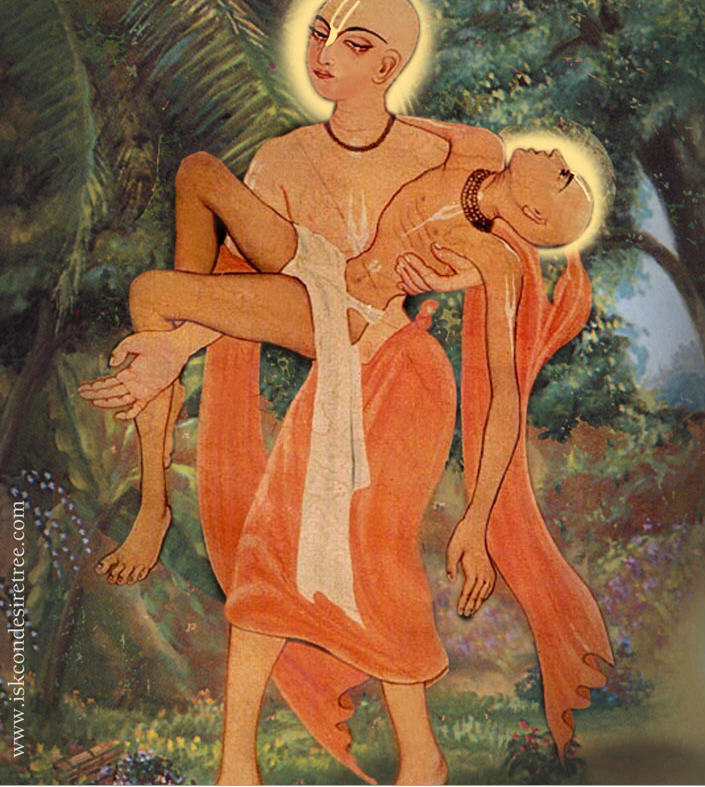
Krishnadasa Kaviraja Goswami gives a whole chapter of Sri Chaitanya-charitamrita to the last days of Srila Haridasa Thakura (Haridāsa Ṭhākura). It is the eleventh chapter of the Antya-lila, called "The Passing of Haridāsa Ṭhākura". He tells it slowly, almost hour by hour, because here the love of Sri Chaitanya Mahaprabhu for His devotee is seen in full. The chapter's very first verse already holds the whole story:
namāmi haridāsaṁ taṁ
caitanyaṁ taṁ ca tat-prabhum
saṁsthitām api yan-mūrtiṁ
svāṅke kṛtvā nanarta yaḥ
"Let me offer my respectful obeisances unto Haridāsa Ṭhākura and his master, Śrī Caitanya Mahāprabhu, who danced with the body of Haridāsa Ṭhākura on His lap." (Sri Chaitanya-charitamrita Antya 11.1)
A few verses later the author glorifies the Lord in the same spirit: "All glories to the master of Haridāsa Ṭhākura!" (Chaitanya-charitamrita Antya 11.3). Haridasa had no shelter other than this master, and the chapter shows how the master answered him.
A Little Prasadam, Honoured #
By this time Sri Chaitanya Mahaprabhu's feelings of separation from Krishna were growing stronger day by day, and Svarupa Damodara Goswami and Ramananda Raya stayed with Him day and night (Antya 11.13-15). Haridasa was living at Siddha Bakula, as told in Life With Sri Chaitanya Mahaprabhu at Puri. One day Govinda, the Lord's servant, happily came to bring him Lord Jagannatha's prasadam. He found Haridasa lying on his back, chanting his rounds very slowly (Antya 11.16-17). "Please rise and take your mahā-prasādam," Govinda said. Haridasa replied that he would fast that day, because his chanting was not complete. Then he added: "But you have brought mahā-prasādam, and how can I neglect it?" He offered prayers to the prasadam, took a tiny portion and ate it (Chaitanya-charitamrita Antya 11.18-20). In his purport Srila Prabhupada explains: "Mahā-prasādam is nondifferent from Kṛṣṇa. Therefore, instead of eating mahā-prasādam, one should honor it."
"My Disease Is That I Cannot Complete My Rounds" #
The next day the Lord Himself came and asked, "Haridāsa, are you well?" Haridasa bowed and said, "My body is all right, but my mind and intelligence are not well." When the Lord asked what his disease was, he answered, "My disease is that I cannot complete my rounds" (Chaitanya-charitamrita Antya 11.21-23). Srila Prabhupada draws the lesson for every devotee: "If one cannot complete the fixed number of rounds he is assigned, he should be considered to be in a diseased condition of spiritual life" (Antya 11.23, purport).
The Lord lovingly told him that he was old and already liberated, so he could chant fewer names (Antya 11.24). Then He added: "Your role in this incarnation is to deliver the people in general. You have sufficiently preached the glories of the holy name in this world" (Chaitanya-charitamrita Antya 11.25). In his purport Srila Prabhupada notes: "By using the words tomāra avatāra (“your incarnation”), Śrī Caitanya Mahāprabhu confirms that Haridāsa Ṭhākura is the incarnation of Lord Brahmā." (On this identity, see Namacharya, the Teacher of the Holy Name.)
The Request #
Haridasa did not argue about his rounds. He answered with a prayer he had carried in his heart for a long time. First he spoke of his own lowliness and the Lord's kindness: he was born in a low family and was "unseeable and untouchable", yet the Lord had accepted him as His servant and lifted him from hell to Vaikuntha, the spiritual world. The Lord had made him dance in many ways, even letting him eat the shraddha-patra meant for the best brahmanas (Antya 11.27-30). Then he made his request. He felt that the Lord would soon end His pastimes in this world, and he could not bear to see that (Antya 11.31):
sei līlā prabhu more kabhu nā dekhāibā
āpanāra āge mora śarīra pāḍibā
“I wish that You not show me this closing chapter of Your pastimes. Before that time comes, kindly let my body fall down in Your presence.” (Sri Chaitanya-charitamrita Antya 11.32)
He knew exactly how he wished to go. He wanted to hold the Lord's lotus feet on his heart, to look at His moonlike face, and to chant with his tongue the Lord's own name, "Śrī Kṛṣṇa Caitanya!" (Antya 11.33-34). He begged, "Let this lowborn body fall down before You." (Antya 11.36)
"Whatever Happiness Is Mine" #
The Lord could not refuse him, but His heart was heavy. He said, "My dear Haridāsa, Kṛṣṇa is so merciful that He must execute whatever you want." (Chaitanya-charitamrita Antya 11.37) Then He opened His heart:
kintu āmāra ye kichu sukha, saba tomā lañā
tomāra yogya nahe, — yābe āmāre chāḍiyā”
“But whatever happiness is Mine is all due to your association. It is not fitting for you to go away and leave Me behind.” (Sri Chaitanya-charitamrita Antya 11.38)
Haridasa caught the Lord's feet. "My Lord, do not create an illusion!" he said. "Although I am so fallen, You must certainly show me this mercy!" (Antya 11.39). He said that the Lord had millions of devotees. All of them were fit to be placed on his head, and all of them were helping in His pastimes (Antya 11.40). What would the world lose by his going?
āmā-hena yadi eka kīṭa mari’ gela
eka pipīlikā maile pṛthvīra kāhāṅ hāni haila?
“My Lord, if an insignificant insect like me dies, what is the loss? If an ant dies, where is the loss to the material world?” (Sri Chaitanya-charitamrita Antya 11.41)
"I am just an imitation devotee," he ended, "but nevertheless I wish that You fulfill my desire" (Antya 11.42). The Lord embraced him and went to the sea for His noon duties. It was settled that He would come back the next morning after seeing Lord Jagannatha (Antya 11.43-44).
The Last Morning #
Early next morning, after visiting the temple, the Lord hurried to Haridasa with all His devotees. Haridasa bowed to the feet of the Lord and of every Vaishnava. "My dear Haridāsa, what is the news?" the Lord asked, and Haridasa answered, "My Lord, whatever mercy You can bestow upon me" (Chaitanya-charitamrita Antya 11.45-47).
At once the Lord began a great sankirtana (saṅkīrtana), congregational chanting of the holy name, in the courtyard. Vakreshvara Pandita was the chief dancer, and the devotees led by Svarupa Damodara surrounded Haridasa and chanted (Antya 11.48-49). Then, in front of Ramananda Raya, Sarvabhauma Bhattacharya and all the others, the Lord began to describe Haridasa's qualities. He spoke as if He had five mouths, and the more He described, the happier He became. The devotees were struck with wonder and all bowed down at Haridasa's feet (Antya 11.50-52).
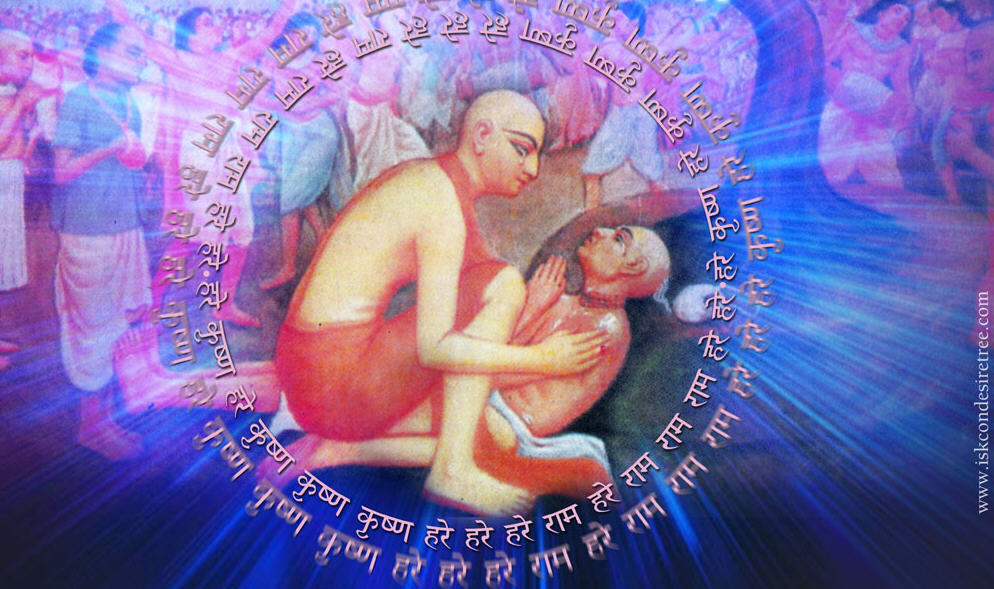
Haridasa had the Lord sit down in front of him and fixed his eyes, like two bumblebees, on the Lord's lotus face. He held the Lord's feet on his heart and put the dust of all the devotees' feet on his head. Again and again he chanted "Śrī Kṛṣṇa Caitanya", drinking in the sweetness of the Lord's face while tears poured from his eyes (Antya 11.53-55). And so his wish was granted:
‘śrī-kṛṣṇa-caitanya’ śabda karite uccāraṇa
nāmera sahita prāṇa kaila utkrāmaṇa
"While chanting the holy name of Śrī Kṛṣṇa Caitanya, he gave up his air of life and left his body." (Sri Chaitanya-charitamrita Antya 11.56)
He was not carried off by sickness. He left when he chose to leave, and the devotees who watched remembered Bhishma, the grandsire of the Mahabharata: "Seeing the wonderful death of Haridāsa Ṭhākura by his own will, which was just like a great mystic yogī’s, everyone remembered the passing away of Bhīṣma" (Chaitanya-charitamrita Antya 11.57).
The Lord Dances With His Body #
The courtyard rang with the names of Hari and Krishna, and Sri Chaitanya Mahaprabhu was overwhelmed with love. He lifted Haridasa's body, placed it on His lap and began to dance in the courtyard. Seeing Him, the devotees too lost all control and danced and chanted with Him (Antya 11.58-60). Only after some time did Svarupa Damodara remind the Lord of the rites still to be done (Antya 11.61).
The body was placed on a carrier like a small airship and taken to the sea with kirtana. The Lord danced at the front of the procession, and Vakreshvara Pandita and the devotees danced behind Him (Chaitanya-charitamrita Antya 11.62-63).
Laid to Rest by the Sea #
At the shore the Lord bathed the body Himself:
haridāse samudra-jale snāna karāilā
prabhu kahe, — “samudra ei ‘mahā-tīrtha’ ha-ilā”
"Śrī Caitanya Mahāprabhu bathed the body of Haridāsa Ṭhākura in the sea and then declared, “From this day on, this sea has become a great pilgrimage site.”" (Sri Chaitanya-charitamrita Antya 11.64)
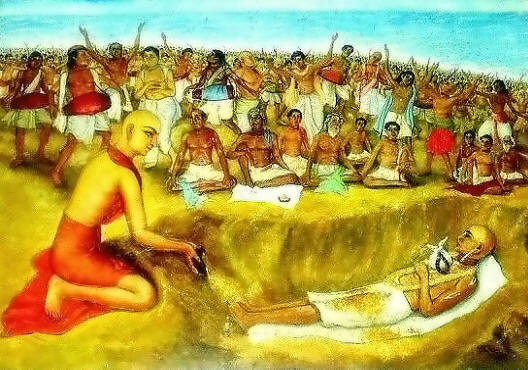
The devotees drank the water that had washed Haridasa's feet and smeared his body with Lord Jagannatha's sandalwood pulp. A grave was dug in the sand, and the body was laid in it with Jagannatha's remnants: His silken ropes, sandalwood, food and cloth (Antya 11.65-66). Vakreshvara danced while the devotees chanted all around. Then the Lord, "chanting “Haribol! Haribol!”", covered the body with sand with His own hands (Chaitanya-charitamrita Antya 11.67-68). A platform was built over the grave and fenced on every side, and the Lord danced and chanted around it until the whole world seemed full of the name of Hari. Afterwards He bathed in the sea with His devotees (Antya 11.69-71).
Begging at the Lion Gate #
Then the Lord walked around the tomb and went straight to the Simha-dvara, the Lion Gate of the Jagannatha temple, while the whole city rang with kirtana. There He spread out His cloth before the shopkeepers who sold prasadam and asked them for alms: "I am begging prasādam for a festival honoring the passing away of Haridāsa Ṭhākura," the Lord said. "Please give Me alms" (Chaitanya-charitamrita Antya 11.72-74).
The shopkeepers jumped up joyfully with whole baskets of prasadam. Svarupa Damodara stopped them and sent the Lord back to His residence. Svarupa kept four Vaishnavas and four porters with him and asked each shop for four palmfuls of every item, until the porters were fully loaded. Vaninatha Pattanayaka and Kashi Mishra also sent large quantities (Antya 11.75-80).
The Feast #
The Lord seated the devotees in rows and began to serve them Himself. His hand could not give a little, so He put enough for five men on every plate, until Svarupa Damodara begged Him to sit and watch while others served (Antya 11.81-83). Svarupa, Jagadananda Pandita, Kashishvara Pandit and Shankara Pandita served without stopping. No one would eat before the Lord, so Kashi Mishra brought Him prasadam and fed Him with great care, and He ate with Paramananda Puri and Brahmananda Bharati (Antya 11.84-87). Then all the Vaishnavas ate. They were filled up to the neck, because the Lord kept calling to the servers, "Give them more! Give them more!" Afterwards He decorated each devotee with a flower garland and sandalwood pulp (Antya 11.88-89).
The Benediction #
Overwhelmed with love, the Lord then gave a blessing that reaches everyone who took part in that day (Antya 11.90):
“haridāsera vijayotsava ye kaila darśana
ye ihāṅ nṛtya kaila, ye kaila kīrtana
ye tāṅre vālukā dite karila gamana
tāra madhye mahotsave ye kaila bhojana
acire ha-ibe tā-sabāra ‘kṛṣṇa-prāpti’
haridāsa-daraśane haya aiche ‘śakti’
Śrī Caitanya Mahāprabhu gave this benediction: “Anyone who has seen the festival of Śrī Haridāsa Ṭhākura’s passing away, anyone who has chanted and danced here, anyone who has offered sand on the body of Haridāsa Ṭhākura, and anyone who has joined this festival to partake of the prasādam will achieve the favor of Kṛṣṇa very soon. There is such wonderful power in seeing Haridāsa Ṭhākura.” (Sri Chaitanya-charitamrita Antya 11.91-93)
Then the Lord spoke of His own loss: "Being merciful upon Me, Kṛṣṇa gave Me the association of Haridāsa Ṭhākura. Being independent in His desires, He has now broken that association." And again: "When Haridāsa Ṭhākura wanted to leave this material world, it was not within My power to detain him." (Chaitanya-charitamrita Antya 11.94-95) He too thought of Bhishma:
icchā-mātre kailā nija-prāṇa niṣkrāmaṇa
pūrve yena śuniyāchi bhīṣmera maraṇa
“Simply by his will, Haridāsa Ṭhākura could give up his life and go away, exactly like Bhīṣma, who previously died simply by his own desire, as we have heard from śāstra.” (Sri Chaitanya-charitamrita Antya 11.96)
Then the Lord said, "Haridāsa Ṭhākura was the crown jewel on the head of this world; without him, this world is now bereft of its valuable jewel." (Chaitanya-charitamrita Antya 11.97) He told everyone to call out "All glories to Haridāsa Ṭhākura!" and began to dance, and all the devotees sang, "All glories to Haridāsa Ṭhākura, who revealed the importance of chanting the holy name of the Lord!" (Antya 11.98-99). Then He sent the devotees home and rested, "with mixed feelings of happiness and distress" (Antya 11.100).
A Victory, Not a Defeat #
Krishnadasa Kaviraja does not call this a death. He calls it Haridasa's vijaya, his victory, and he promises a blessing to every listener:
ei ta’ kahiluṅ haridāsera vijaya
yāhāra śravaṇe kṛṣṇe dṛḍha-bhakti haya
"Thus I have spoken about the victorious passing away of Haridāsa Ṭhākura. Anyone who hears this narration will certainly fix his mind firmly in devotional service to Kṛṣṇa." (Sri Chaitanya-charitamrita Antya 11.101)
He sees in it, above all, the Lord's love for His devotees: "Although He is the topmost of all sannyāsīs, He fully satisfied the desire of Haridāsa Ṭhākura" (Chaitanya-charitamrita Antya 11.102). The Lord gave Haridasa His company and His touch at the end, danced with his body, covered it with sand with His own hand, begged the food for his festival and held the festival Himself (Antya 11.103-104). And he counts Haridasa's early departure as good fortune: "It was his great fortune that he passed away before Śrī Caitanya Mahāprabhu" (Chaitanya-charitamrita Antya 11.105). In the same verse Haridasa is called "parama-vidvān", the most learned. In his purport Srila Prabhupada explains why: "Actually, the most important science to know is the science of getting out of the clutches of material existence. Anyone who knows this science must be considered the greatest learned person."
His Samadhi at Puri #
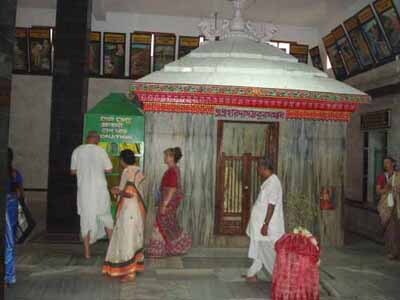
The grave by the sea is still honoured. In his purport to Antya 11.101 Srila Prabhupada writes: "If one goes from there to the sea, he can discover the tomb of Haridāsa Ṭhākura still existing. Every year on the date of Ananta-caturdaśī there is a festival to commemorate the passing away of Haridāsa Ṭhākura." He is speaking of the walk from the temple of Tota-gopinatha down to the sea.
The same purport adds that Bhaktivinoda Thakura built a small house called the Bhakti-kuti near the tomb, and that in 1922 the Purushottama Math, a branch of the Gaudiya Math, was established there. It also quotes the Bhakti-ratnakara, which tells how Srinivasa Acharya ran to the shore and fell before Haridasa's samadhi, almost fainting. Pilgrims still come today to that shore, where the Lord Himself declared the sea a great place of pilgrimage because Haridasa's body had touched it.
