Srila Haridasa Thakura
Namacharya: The Teacher of the Holy Name
The complete life, on one page: The main biography and every pastime page, in order, in one place
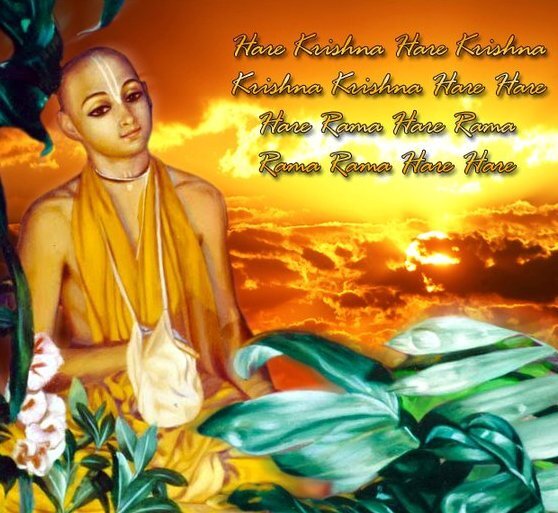
Introduction
Srila Haridasa Thakura (Haridāsa Ṭhākura) is remembered across Gaudiya Vaishnavism as Namacharya (Nāmācārya), the teacher of the holy name. The Gaura-ganoddesha-dipika (verses 93-95) names him as Brahma, the great ascetic son of Rcika Muni, appearing together with Prahlada. Srila Prabhupada calls him the incarnation of Lord Brahma (Antya 11.25 purport). His whole life shows what the chanting of Krishna's names can do. He was born to Muslim parents around 1451 in the village of Budhan (some sources say Buron) in rural Bengal. From his youth until his last days, he chanted 300,000 names of Krishna every day. He survived a public beating that was meant to kill him, and by his mercy a prostitute who was sent to seduce him became one of the most respected Vaishnavas of her time. He grew so dear to Sri Chaitanya Mahaprabhu that the Lord came to see him every day during his last years at Puri, and when he left this world the Lord buried him with His own hands.
| Detail | Description |
|---|---|
| Born | c. 1451, village of Budhan/Buron, Bengal Sultanate (today Satkhira District, Bangladesh) |
| Disappeared | Ananta Chaturdashi (Ananta Caturdaśī) day, at Jagannatha Puri, in Sri Chaitanya Mahaprabhu's presence (the exact year is not clear from the sources checked) |
| Family background | Muslim by birth |
| Identity | Incarnation of Lord Brahma (Chaitanya-charitamrita Antya 11.25 purport); Brahma Mahatapa, son of Rcika Muni, combined with Prahlada (Gaura-ganoddesha-dipika 93-95) |
| Title | Namacharya, "teacher of the holy name" (Srila Prabhupada's translation of Sri Chaitanya-caritamrta, Antya 3.55) |
| Daily practice | 300,000 names of Krishna chanted aloud, roughly 175 rounds of japa |
| Guru | Not named in Sri Chaitanya-caritamrta or Chaitanya-bhagavata; later devotional biographies (Advaita-prakasha, Prema-vilasa) name Advaita Acharya |
| Best-known episodes | The prostitute's test at Benapola; beaten in twenty-two marketplaces; daily visits from Mahaprabhu at Puri |
Scriptural evidence for the introduction (12)
ऋचीकस्य मुनेः पुत्रो नाम्ना ब्रह्मा महातपाः ।
प्रह्लादेन समं जातो हरिदासाख्यकोऽपि सन् ॥९३॥
ṛcīkasya muneḥ putro nāmnā brahmā mahātapāḥ
prahlādena samaṁ jāto haridāsākhyako'pi san
Rcika Muni's son Brahma Mahatapah, and Prahlada Maharaja combined to appear as Haridasa Thakur in Lord Caitanya's pastimes.
Kavi Karnapura names Haridasa Thakura as Brahma, the great ascetic son of Rcika Muni, appearing together with Prahlada Maharaja. Sanskrit: diacritic edition of the Gaura-ganoddesha-dipika; English translation as published at bvmlu.org.
मुरारिगुप्तचरणैश्चैतन्यचरितामृते ।
उक्तो मुनिसुतः प्रातस्तुलसीपात्रमाहरन् ॥९४॥
अधौतमभिषप्तस्तं पिता यावनतां गतः ।
स एव हरिदासः सन्जातः परम भक्तिमान् ॥९५॥
murāri-gupta-caraṇaiś caitanya-caritāmṛte
ukto muni-sutaḥ prātas tulasī-pātram āharan
adhautam abhiṣaptas taṁ pitā yāvanatāṁ gataḥ
sa eva haridāsaḥ san jātaḥ parama bhaktimān
In the book Caitanya-carita, Murari Gupta explains that one morning Mahatapah gave an unwashed tulasi leaf to his father, who became so angry at him for this that he cursed him. Because of this Mahatapah took birth in a yavana family as the great devotee Haridasa Thakura.
Following Murari Gupta, Kavi Karnapura explains why Haridasa was born in a yavana (Muslim) family: his father cursed him for offering an unwashed tulasi leaf. Sanskrit: diacritic edition of the Gaura-ganoddesha-dipika; English translation as published at bvmlu.org.
লোক নিস্তারিতে এই তোমার ‘অবতার’ ।
নামের মহিমা লোকে করিলা প্রচার ॥
loka nistārite ei tomāra ‘avatāra’
nāmera mahimā loke karilā pracāra
“Your role in this incarnation is to deliver the people in general. You have sufficiently preached the glories of the holy name in this world.”
From the purport: By using the words tomāra avatāra (“your incarnation”), Śrī Caitanya Mahāprabhu confirms that Haridāsa Ṭhākura is the incarnation of Lord Brahmā. ... Haridāsa Ṭhākura is thus the incarnation of Lord Brahmā, and other devotees are likewise incarnations who help in the prosecution of the Lord’s mission. (Srila Prabhupada, purport purport)
Sri Chaitanya Mahaprabhu speaks of Haridasa's "incarnation" (tomara avatara); Srila Prabhupada's purport takes this as confirming that Haridasa Thakura is the incarnation of Lord Brahma. Verse text, translation and purport: Srila Prabhupada, Sri Chaitanya-charitamrita (vedabase.io).
प्रसिद्धा वैष्णवी हैल परम-महान्ती ।
बड बड वैष्णव ताँर दर्शनेते यान्ति ॥
prasiddhā vaiṣṇavī haila parama-mahāntī
baḍa baḍa vaiṣṇava tāṅra darśanete yānti
Thus the prostitute became a celebrated devotee. She became very advanced in spiritual life, and many stalwart Vaiṣṇavas would come to see her.
From the purport: Anyone can be turned into a Vaiṣṇava if he or she follows the Vaiṣṇava principles. (Srila Prabhupada, Chaitanya-charitamrita Antya 3.142 purport)
Shows in full the verse the biography cites for the prostitute becoming "a celebrated devotee" after Haridasa's mercy.
यद्यपि अन्य सङ्केते अन्य हय नामाभास ।
तथापि नामेर तेज ना हय विनाश ॥
yadyapi anya saṅkete anya haya nāmābhāsa
tathāpi nāmera teja nā haya vināśa
Nāmācārya Haridāsa Ṭhākura, the authority on the chanting of the holy name, said, “The chanting of the Lord’s holy name to indicate something other than the Lord is an instance of nāmābhāsa. Even when the holy name is chanted in this way, its transcendental power is not destroyed.
Haridasa's teaching to Sri Chaitanya Mahaprabhu that even nāmābhāsa keeps the power of the holy name; Srila Prabhupada's translation of this verse is where the title Namacharya appears.
मन्दिरेर चक्र देखि' करिह प्रणाम ।
एइ ठाञि तोमार आसिबे प्रसादान्न ॥
mandirera cakra dekhi’ kariha praṇāma
ei ṭhāñi tomāra āsibe prasādānna
“Remain here peacefully and look at the cakra on the top of the temple and offer obeisances. As far as your prasādam is concerned, I shall arrange to have that sent here.”
From the purport: This means that if one is not allowed to enter the temple, or if he thinks himself unfit to enter the temple, he can look at the wheel from outside the temple, and that is as good as seeing the Deity within. (Srila Prabhupada, Chaitanya-charitamrita Madhya 11.195 purport)
The Lord's instruction to Haridasa at Puri: bow to the temple's cakra from outside, and prasadam will be sent to him.
हरिदास आछिल पृथिवीर ‘शिरोमणि’ ।
ताहा विना रत्न-शून्या ह-इल मेदिनी ॥
haridāsa āchila pṛthivīra ‘śiromaṇi’
tāhā vinā ratna-śūnyā ha-ila medinī
“Haridāsa Ṭhākura was the crown jewel on the head of this world; without him, this world is now bereft of its valuable jewel.”
Sri Chaitanya Mahaprabhu's own words about Haridasa at the festival after his passing, quoted in the biography as "the crown jewel on the head of this world."
तुमि खाइले हय कोटि-ब्राह्मण-भोजन ।
एत बलि, श्राद्ध-पात्र कराइला भोजन ॥
tumi khāile haya koṭi-brāhmaṇa-bhojana”
eta bali, śrāddha-pātra karāilā bhojana
“Feeding you is equal to feeding ten million brāhmaṇas,” Advaita Ācārya said. “Therefore, accept this śrāddha-pātra.” Thus Advaita Ācārya made him eat.
From the purport: Instead of offering the śrāddha-pātra to any other brāhmaṇa, Advaita Ācārya offered it to Haridāsa Ṭhākura, considering him greater than any of the foremost brāhmaṇas. (Srila Prabhupada, Chaitanya-charitamrita Antya 3.222 purport)
Advaita Acharya gives Haridasa the first plate of His father's shraddha ceremony, honouring him above the foremost brahmanas.
ऐछे नामोदयारम्भे पाप-आदिर क्षय ।
उदय कैले कृष्ण-पदे हय प्रेमोदय ॥
aiche nāmodayārambhe pāpa-ādira kṣaya
udaya kaile kṛṣṇa-pade haya premodaya
“Similarly, the first hint that offenseless chanting of the Lord’s holy name has awakened dissipates the reactions of sinful life immediately. And when one chants the holy name offenselessly, one awakens to service in ecstatic love at the lotus feet of Kṛṣṇa.
Haridasa's teaching in the Majumadaras' assembly at Chandapura: freedom from sin comes at the first glimpse of the name; its real fruit is love for Krishna.
प्रभु कहे, — तोमा स्पर्शि पवित्र ह-इते ।
तोमार पवित्र धर्म नाहिक आमाते ॥
prabhu kahe, — tomā sparśi pavitra ha-ite
tomāra pavitra dharma nāhika āmāte
The Lord said, “I wish to touch you just to be purified, for your purified activities do not exist in Me.”
From the purport: This is an example of the reciprocation of feelings between master and servant. (Srila Prabhupada, Chaitanya-charitamrita Madhya 11.189 purport)
At Puri Haridasa begs the Lord not to touch him; Mahaprabhu embraces him and says He touches him to be purified.
‘श्री-कृष्ण-चैतन्य’ शब्द करिते उच्चारण ।
नामेर सहित प्राण कैल उत्क्रामण ॥
‘śrī-kṛṣṇa-caitanya’ śabda karite uccāraṇa
nāmera sahita prāṇa kaila utkrāmaṇa
While chanting the holy name of Śrī Kṛṣṇa Caitanya, he gave up his air of life and left his body.
Haridasa's departure in the Lord's presence, chanting "Sri Krishna Chaitanya" with the Lord's feet on his heart.
निर्जन-वने कुटिर करि’ तुलसी सेवन ।
रात्रि-दिने तिन लक्ष नाम-सङ्कीर्तन ॥
nirjana-vane kuṭira kari’ tulasī sevana
rātri-dine tina lakṣa nāma-saṅkīrtana
Haridāsa Ṭhākura constructed a cottage in a solitary forest. There he planted a tulasī plant, and in front of the tulasī he would chant the holy name of the Lord 300,000 times daily. He chanted throughout the entire day and night.
From the purport: We can follow his example, however, by chanting sixteen rounds of the Hare Kṛṣṇa mahā-mantra on beads every day and offering respect to the tulasī plant. (Srila Prabhupada, Chaitanya-charitamrita Antya 3.100 purport)
Haridasa's life at Benapola, which Srila Prabhupada set as the model for every devotee: a fixed vow of chanting and respect for tulasi.
Chapter 1
Birth and Early Life
A boy born to Muslim parents in rural Bengal grows into one of the most single-minded chanters of the holy name Gaudiya Vaishnavism has ever known.
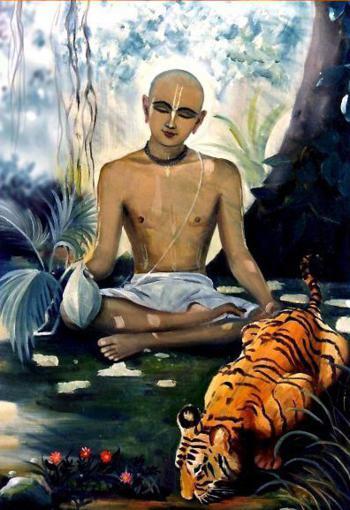
Srila Haridasa Thakura (Haridāsa Ṭhākura) appeared in a Muslim family in the village of Budhana in Bengal, many years before Sri Chaitanya Mahaprabhu began His sankirtana movement (Chaitanya-bhagavata Adi 16.18). The Advaita-vilasa gives the year as 1451, so he was about thirty-five years older than the Lord. Nothing in his background pointed to the life that was coming. Yet from his early years Krishna's names were always on his lips, and the great devotees of Bengal soon accepted him as one of their own. Here is the story of those first years, as Chaitanya-bhagavata, Sri Chaitanya-charitamrita and Srila Prabhupada's purports tell it. It ends at the time when he and Advaita Acharya together called the Lord to come into this world.
| Detail | Description |
|---|---|
| Born | c. 1451, village of Budhan/Buron, Bengal Sultanate (today Satkhira District, Bangladesh) |
| Family | Muslim by birth |
| Chief early influence | Advaita Acharya, met on the banks of the Ganges near Phuliya |
| Practice from youth | Loud chanting of the Hare Krishna maha-mantra, reportedly 300,000 times daily |
| Sources | Chaitanya-bhagavata (Adi-khanda), Sri Chaitanya-caritamrta (Antya 3), later devotional biographies |
Why He Took Birth in a Muslim Family #
Why would such a great soul appear among people who did not worship Krishna? The tradition gives more than one answer, and the answers agree with each other. Kavi Karnapura's Gaura-ganoddesha-dipika says that he is Lord Brahma, who appeared together with Prahlada Maharaja. Following Murari Gupta, it also tells an old story. As Brahma Mahatapa, a son of Rcika Muni, he once brought his father a tulasi leaf without washing it first. His father cursed him for this, and because of that curse he took birth among yavanas (Gaura-ganoddesha-dipika 93-95; the verses are quoted in the life of Srila Haridasa Thakura). Later, Sri Chaitanya Mahaprabhu Himself spoke to Haridasa about his avatara, his incarnation in this world (Chaitanya-charitamrita Antya 11.25). Srila Prabhupada explains in his purport: "By using the words tomāra avatāra (“your incarnation”), Śrī Caitanya Mahāprabhu confirms that Haridāsa Ṭhākura is the incarnation of Lord Brahmā."
Bhaktivinoda Thakura tells the deeper story in his Navadvipa-dhama-mahatmya. In Dvapara-yuga, Brahma once hid Krishna's calves and cowherd friends to test Him. When he saw the Lord's power, he fell at His feet and begged forgiveness. Later Brahma became afraid that he might offend the Lord again when Krishna came as Gauranga. So he went to Antardvipa, the central island of Navadvipa, and sat down to meditate, and Gauranga appeared before him and gave him his mission:
"During my incarnation as Gaura, you will be born in a family of mlecchas and will preach the glories of the Holy Name and bring auspiciousness to all the living beings." (Bhaktivinoda Thakura's Navadvipa-dhama-mahatmya, as retold in Srila Bhakti Ballabh Tirtha Maharaj's Sri Chaitanya: His Life and Associates)
Tirtha Maharaj adds that Brahma prayed for a low birth so that false pride could not touch him in Gaura-lila. He says the Advaita-vilasa holds the same view.
Vrindavana Dasa Thakura gives the reason in the simplest words. Haridasa was born in a low family by the Lord's own order, so that his life would prove what the scriptures say about birth and devotion:
"Hari Das Thakur was born in a low-caste family on the Lord’s order in order to show that caste and class have no importance at all. All the scriptures say that a Devotee of Vishnu, though born in a lowly family, is still worshipable by all. What will one’s caste do for one is born in a high caste but does not worship Krishna? He will go to hell in spite of his high birth. Hari Das took a low birth just to bear witness to these scriptural statements." (Chaitanya-bhagavata Adi 16.237-240, as translated in Srila Bhakti Ballabh Tirtha Maharaj's Sri Chaitanya: His Life and Associates)
The next verse compares him to Prahlada, who was born among demons, and to Hanuman, who was born as a monkey. In each case the low birth was only an outer covering (Chaitanya-bhagavata Adi 16.241). In Chaitanya-bhagavata these words come from a most unusual speaker: the king of serpents, speaking through a snake-charmer. That story is told further below (Chaitanya-bhagavata Adi 16.222-248).
Srimad-Bhagavatam taught the same truth long before, and Sri Chaitanya Mahaprabhu recited this very verse about Haridasa when He embraced him at Puri (Chaitanya-charitamrita Madhya 11.192):
aho bata śva-paco ’to garīyān
yaj-jihvāgre vartate nāma tubhyam
tepus tapas te juhuvuḥ sasnur āryā
brahmānūcur nāma gṛṇanti ye te
"Oh, how glorious are they whose tongues are chanting Your holy name! Even if born in the families of dog-eaters, such persons are worshipable. Persons who chant the holy name of Your Lordship must have executed all kinds of austerities and fire sacrifices and achieved all the good manners of the Āryans. To be chanting the holy name of Your Lordship, they must have bathed at holy places of pilgrimage, studied the Vedas and fulfilled everything required." (Srimad-Bhagavatam 3.33.7)
In his purport Srila Prabhupada names Haridasa directly: "He was apparently born in a family of Muhammadans, but because he was chanting the holy name of the Supreme Lord offenselessly, Lord Caitanya empowered him to become the authority, or ācārya, of spreading the name."
Budhana: His Birthplace and Family #
Chaitanya-bhagavata names his village as Budhana, and it says that because he appeared there, the whole district became filled with kirtana (Chaitanya-bhagavata Adi 16.18). Srila Prabhupada repeats this, but he is careful about the exact place: "It is not definitely certain whether Śrī Haridāsa Ṭhākura appeared in the village named Buḍhana that is in the district of Khulnā" (Chaitanya-charitamrita Adi 10.43, purport). The area called Budhana is now in Satkhira, in Bangladesh. Tirtha Maharaj spells the name Burihana, and other writers give Buron.
The accounts do not agree about his parents, and neither Chaitanya-bhagavata nor Chaitanya-charitamrita names them. One tradition says he was born to brahmana parents named Sumati and Gauri. They died while he was still small, and a Muslim family in the nearby village of Halimpur brought him up. The Advaita-vilasa gives a different account. It names his father as Khanaulla Kazi, places his birth in the month of Agrahayana in Shaka 1372 (1451), and also says that he lost his parents when he was young. The two main biographies simply say that he was born a Muslim, and Srila Prabhupada states it plainly: "Haridāsa Ṭhākura was born in a Muslim family and was later recognized as a great Vaiṣṇava, but nevertheless the brāhmaṇas were very critical of him" (Chaitanya-charitamrita Antya 3.220, purport).
The Holy Name From His Early Years #
The early books do not tell us how the boy first came to love the holy name. Tirtha Maharaj only says that this love showed itself at a very young age. When Krishnadasa Kaviraja Goswami lists the branches of the Chaitanya tree, he describes the life that grew from it:
haridāsa-ṭhākura śākhāra adbhuta carita
tina lakṣa nāma teṅho layena apatita
"The twentieth branch of the Caitanya tree was Haridāsa Ṭhākura. His character was wonderful. He used to chant the holy name of Kṛṣṇa 300,000 times a day without fail." (Sri Chaitanya-charitamrita Adi 10.43)
In his purport Srila Prabhupada writes: "Certainly the chanting of 300,000 holy names of the Lord is wonderful. No ordinary person can chant so many names, nor should one artificially imitate Haridāsa Ṭhākura’s behavior." He then gives the practical lesson for his own followers: "Therefore we have prescribed in our Society that all our students must chant at least sixteen rounds daily." In the same purport he also gives the outline of these years: "It is stated in the Caitanya-bhāgavata, Ādi-khaṇḍa, chapter two, that Haridāsa Ṭhākura was born in a village known as Buḍhana but after some time came to live on the bank of the Ganges at Phuliyā, near Śāntipura."
On the Bank of the Ganges at Phuliya #
After some years Haridasa left Budhana. He settled on the bank of the Ganges at Phuliya, a village near Shantipura in today's Nadia district (Chaitanya-bhagavata Adi 16.19). Advaita Acharya was so happy to have his company that He roared aloud with joy, and the two of them floated together in the ocean of Krishna's sweetness (Chaitanya-bhagavata Adi 16.20-21). Day after day Haridasa walked along the riverbank calling out Krishna's names. Sometimes he danced, wept, laughed or fell unconscious in ecstasy (Chaitanya-bhagavata Adi 16.22-29). The brahmanas of Phuliya saw that his tears and trembling were real, so they began to honor this son of a Muslim family as a devotee of the first rank.
Sri Chaitanya-charitamrita tells these years in a different order. After he left home, it first shows him living for some time in the forest of Benapola (Antya 3.99). Then he stays at Chandapura, and only after that does he come to Advaita Acharya at Shantipura (Antya 3.214). The two books differ on the order, but they fully agree on how he lived:
nirjana-vane kuṭira kari’ tulasī sevana
rātri-dine tina lakṣa nāma-saṅkīrtana
"Haridāsa Ṭhākura constructed a cottage in a solitary forest. There he planted a tulasī plant, and in front of the tulasī he would chant the holy name of the Lord 300,000 times daily. He chanted throughout the entire day and night." (Sri Chaitanya-charitamrita Antya 3.100)
In his purport Srila Prabhupada finds hope in this simple picture: "From his personal example we can understand that chanting the Hare Kṛṣṇa mantra and becoming highly elevated in Kṛṣṇa consciousness is very simple." The story of Benapola is told in the prostitute's test, and the debate at Chandapura is told in Teachings on the Holy Name.
Advaita Acharya's Shelter and the Shraddha-patra #
When Haridasa came to Shantipura, he bowed down to Advaita Acharya. Advaita Acharya embraced him and honored him in return (Chaitanya-charitamrita Antya 3.214-215). Then the Acharya gave him a quiet place to chant, and also the best teaching:
gaṅgā-tīre goṅphā kari’ nirjane tāṅre dilā
bhāgavata-gītāra bhakti-artha śunāilā
"On the bank of the Ganges, in a solitary place, Advaita Ācārya made a cavelike home for Haridāsa Ṭhākura and spoke to him about the real meaning of Śrīmad-Bhāgavatam and the Bhagavad-gītā in terms of devotional service." (Sri Chaitanya-charitamrita Antya 3.216)
Every day Haridasa ate at Advaita Acharya's house, and the two of them enjoyed talking about Krishna together (Chaitanya-charitamrita Antya 3.217). But this daily kindness troubled Haridasa's humble heart. Shantipura was full of proud brahmana families, and he was afraid that the Acharya's open love for a man of his birth would bring Him trouble. So he spoke to Him openly:
mahā-mahā-vipra ethā kulīna-samāja
nīce ādara kara, nā vāsaha bhaya lāja!!
"Sir, You are living within a society of great, great brāhmaṇas and aristocrats, but without fear or shame You adore a lower-class man like me." (Sri Chaitanya-charitamrita Antya 3.219)
Srila Prabhupada explains this worry in his purport: "Thus Haridāsa Ṭhākura was afraid that Advaita Ācārya would be put into some difficulty because of His familiarity with Haridāsa Ṭhākura" (Chaitanya-charitamrita Antya 3.220, purport). But Advaita Acharya did not care for social custom, and He replied: "My dear Haridāsa, do not be afraid. I shall behave strictly according to the principles of the revealed scriptures." (Chaitanya-charitamrita Antya 3.221) Srila Prabhupada comments: "As stated in the śāstric injunctions, which are the true medium of evidence or proof, anyone can go back to Godhead, even if born of a low family." Srimad-Bhagavatam gives the same rule for judging a person: "If one shows the symptoms of being a brāhmaṇa, kṣatriya, vaiśya or śūdra, as described above, even if he has appeared in a different class, he should be accepted according to those symptoms of classification" (Srimad-Bhagavatam 7.11.35).
Then Advaita Acharya showed in practice what the scriptures mean. At the shraddha ceremony for His departed father, the plate of honor was meant for the most respected brahmana present, but He placed it before Haridasa:
tumi khāile haya koṭi-brāhmaṇa-bhojana”
eta bali, śrāddha-pātra karāilā bhojana
“Feeding you is equal to feeding ten million brāhmaṇas,” Advaita Ācārya said. “Therefore, accept this śrāddha-pātra.” Thus Advaita Ācārya made him eat. (Sri Chaitanya-charitamrita Antya 3.222)
In his purport Srila Prabhupada explains: "Instead of offering the śrāddha-pātra to any other brāhmaṇa, Advaita Ācārya offered it to Haridāsa Ṭhākura, considering him greater than any of the foremost brāhmaṇas." Krishnadasa Kaviraja thought this honor was so important that he also mentions it when he lists Haridasa among the branches of the Chaitanya tree (Chaitanya-charitamrita Adi 10.44). Some later biographies, such as the Advaita-prakasha, say that Advaita Acharya also gave him his name and his first instruction in chanting. Chaitanya-charitamrita and Chaitanya-bhagavata do not describe such a ceremony.
The Serpent in the Cave #
Chaitanya-bhagavata tells the next story after Haridasa's trial before the qazi, which is told in Persecution in Twenty-Two Marketplaces. Back at Phuliya he lived alone in a cave on the bank of the Ganges. He remembered Krishna day and night and chanted 300,000 names daily, so the cave became like Vaikuntha (Chaitanya-bhagavata Adi 16.172-173). But a great poisonous snake also lived in that cave. Visitors who came to speak with Haridasa felt a burning heat from its poison and could not stay for more than a few moments, while Haridasa himself felt nothing at all (Chaitanya-bhagavata Adi 16.174-176).
Some doctors of Phuliya who knew about snakes found the cause, and together with the local brahmanas they begged him to move (Chaitanya-bhagavata Adi 16.177-184). Haridasa said that he had never felt any burning there. But since his visitors were suffering, he would leave the next day if the snake did not. Then they all sat together in kirtana, and just as evening fell, the great snake came out of its hole before everyone's eyes and went away for good (Chaitanya-bhagavata Adi 16.185-194). After this the brahmanas' faith in Haridasa became even deeper, because even a snake had left its home at a word from him (Chaitanya-bhagavata Adi 16.195-197).
Srila Prabhupada tells this story while explaining a verse about how a renounced devotee depends fully on the Lord:
cīrāṇi kiṁ pathi na santi diśanti bhikṣāṁ
naivāṅghripāḥ para-bhṛtaḥ sarito ’py aśuṣyan
ruddhā guhāḥ kim ajito ’vati nopasannān
kasmād bhajanti kavayo dhana-durmadāndhān
"Are there no torn clothes lying on the common road? Do the trees, which exist for maintaining others, no longer give alms in charity? Do the rivers, being dried up, no longer supply water to the thirsty? Are the caves of the mountains now closed? Or above all, does the Almighty Lord not protect the fully surrendered souls? Why then do the learned sages go to flatter those who are intoxicated by hard-earned wealth?" (Srimad-Bhagavatam 2.2.5)
In his purport he concludes: "By the dictation of the Lord, who lived also within the heart of the snake, the snake gave preference to Haridāsa and decided to leave the place and not disturb him. So this is a tangible example of how the Lord gives protection to a bona fide devotee like Ṭhākura Haridāsa."
The Snake-Charmer and the Envious Brahmana #
Chaitanya-bhagavata follows with a second story about a snake. One day a snake-charmer was performing in a rich man's courtyard. He danced and sang about Krishna's dance on the hoods of the serpent Kaliya, while his companions played music and sang around him. Haridasa happened to come there, and when he heard the pastimes of his Lord, he fell to the ground unconscious. Then he rose with a loud roar and danced, weeping and trembling, while the snake-charmer stepped aside and stood with folded hands. The people there smeared the dust from Haridasa's footprints on their bodies (Chaitanya-bhagavata Adi 16.198-212).
A brahmana in the crowd wanted the same honor for himself. When the singing began again, he threw himself on the ground and lay there as if lost in ecstasy. At once the snake-charmer attacked him with a cane and beat him about the head and body until he ran away screaming (Chaitanya-bhagavata Adi 16.213-219). The people asked why he had honored one man and beaten the other. Then the king of serpents, who had entered the snake-charmer's body by the power of his mantra, answered through his mouth. He said that the brahmana's show came from envy and a wish to be thought great, and that only a person free from pretense can reach Krishna. But whoever sees Haridasa dance becomes free from all bondage, and even Brahma and Shiva long for the company of such a devotee (Chaitanya-bhagavata Adi 16.220-236). In this same speech the serpent explains why Haridasa took a low birth.
Tirtha Maharaj draws a lesson from this for every devotee: showing off devotion to win respect does great harm to one's own devotional life. Srila Prabhupada's warning in his purport to Adi 10.43, quoted above, points the same way. Haridasa's ecstasy is to be honored, not copied.
Two Devotees Calling the Lord #
All this happened when Bengal still knew almost nothing of sankirtana. Chaitanya-bhagavata describes how people mocked the few devotees who chanted aloud. Haridasa was sad to see this, but he kept on chanting the holy name as loudly as he could (Chaitanya-bhagavata Adi 16.251-265). His debate on this very point with a brahmana from Harinadi is told in Teachings on the Holy Name.
Sri Chaitanya-charitamrita shows what was happening beneath these quiet years at Shantipura. Advaita Acharya was always thinking about how the whole world, so empty of devotion, could be saved. So He made a vow to bring Krishna down, and He began to worship Him with Ganges water and tulasi leaves (Chaitanya-charitamrita Antya 3.223-224). In his cave by the river, Haridasa chanted with exactly the same longing (Chaitanya-charitamrita Antya 3.225). Krishnadasa Kaviraja Goswami tells us the result:
dui-janera bhaktye caitanya kailā avatāra
nāma-prema pracāri’ kailā jagat uddhāra
"Because of the devotional service of these two persons, Lord Śrī Caitanya Mahāprabhu descended as an incarnation. Thus He preached the holy name of the Lord and ecstatic love of Kṛṣṇa to deliver the entire world." (Sri Chaitanya-charitamrita Antya 3.226)
In this way the boy from Budhana, born where no one expected a Vaishnava, became one of the two devotees whose prayers brought Sri Chaitanya Mahaprabhu into the world. The next part of his life, when he refused to give up the holy name even under a death sentence, is told in Persecution in Twenty-Two Marketplaces.
Scriptural evidence for this chapter (12)
Quoted in the text above:
- SB 3.33.7 Srimad-Bhagavatam quoted above ↑
- Antya 3.100 Sri Chaitanya-charitamrita quoted above ↑
- Antya 3.222 Sri Chaitanya-charitamrita quoted above ↑
- Adi 10.43 Sri Chaitanya-charitamrita quoted above ↑
- Antya 3.216 Sri Chaitanya-charitamrita quoted above ↑
- Antya 3.219 Sri Chaitanya-charitamrita quoted above ↑
- Antya 3.226 Sri Chaitanya-charitamrita quoted above ↑
- SB 2.2.5 Srimad-Bhagavatam quoted above ↑
Further verses:
yasya yal lakṣaṇaṁ proktaṁ
puṁso varṇābhivyañjakam
yad anyatrāpi dṛśyeta
tat tenaiva vinirdiśet
If one shows the symptoms of being a brahmana, kshatriya, vaishya or shudra, as described above, even if he has appeared in a different class, he should be accepted according to those symptoms of classification.
Supports the page's account of Advaita Acharya's own reasoning for befriending and defending Haridasa: a soul's devotion to Krishna, not the family it is born into, is what actually qualifies it. Narada Muni states this same principle to Maharaja Yudhishthira. Same verse reused on this acharya's Life at Puri page, where Bhaktisiddhanta Sarasvati Thakura's commentary on the shraddha-patra episode makes the identical point.
अलौकिक आचार तोमार कहिते पाइ भय
सेइ कृपा करिबा, — याते मोर रक्षा हय”
alaukika ācāra tomāra kahite pāi bhaya
sei kṛpā karibā, — yāte mora rakṣā haya”
“My dear Sir, Your behavior is uncommon. Indeed, sometimes I am afraid to speak to You. But please favor me by protecting me from the behavior of society.”
From the purport: Haridāsa Ṭhākura was born in a Muslim family and was later recognized as a great Vaiṣṇava, but nevertheless the brāhmaṇas were very critical of him. Thus Haridāsa Ṭhākura was afraid that Advaita Ācārya would be put into some difficulty because of His familiarity with Haridāsa Ṭhākura. (Srila Prabhupada, Chaitanya-charitamrita Antya 3.220 purport)
Srila Prabhupada states plainly that Haridasa was born in a Muslim family and explains why he feared for Advaita Acharya's reputation.
आचार्य कहेन, — “तुमि ना करिह भय
सेइ आचरिब, येइ शास्त्र-मत हय
ācārya kahena, — “tumi nā kariha bhaya
sei ācariba, yei śāstra-mata haya
Advaita Ācārya replied, “My dear Haridāsa, do not be afraid. I shall behave strictly according to the principles of the revealed scriptures.
From the purport: As stated in the śāstric injunctions, which are the true medium of evidence or proof, anyone can go back to Godhead, even if born of a low family. (Srila Prabhupada, Chaitanya-charitamrita Antya 3.221 purport)
Advaita Acharya's answer: He would act by scripture, not by social custom, in honoring Haridasa.
लोक निस्तारिते एइ तोमार ‘अवतार’
नामेर महिमा लोके करिला प्रचार
loka nistārite ei tomāra ‘avatāra’
nāmera mahimā loke karilā pracāra
“Your role in this incarnation is to deliver the people in general. You have sufficiently preached the glories of the holy name in this world.”
From the purport: By using the words tomāra avatāra (“your incarnation”), Śrī Caitanya Mahāprabhu confirms that Haridāsa Ṭhākura is the incarnation of Lord Brahmā. (Srila Prabhupada, Chaitanya-charitamrita Antya 11.25 purport)
Sri Chaitanya Mahaprabhu speaks of Haridasa's incarnation; the purport identifies him as Lord Brahma, one of the answers to why he took birth in a Muslim family.
Chapter 2
Persecution in Twenty-Two Marketplaces
Ordered beaten from market to market for refusing to abandon the holy name, Haridasa Thakura endured without complaint and prayed only for his persecutors.
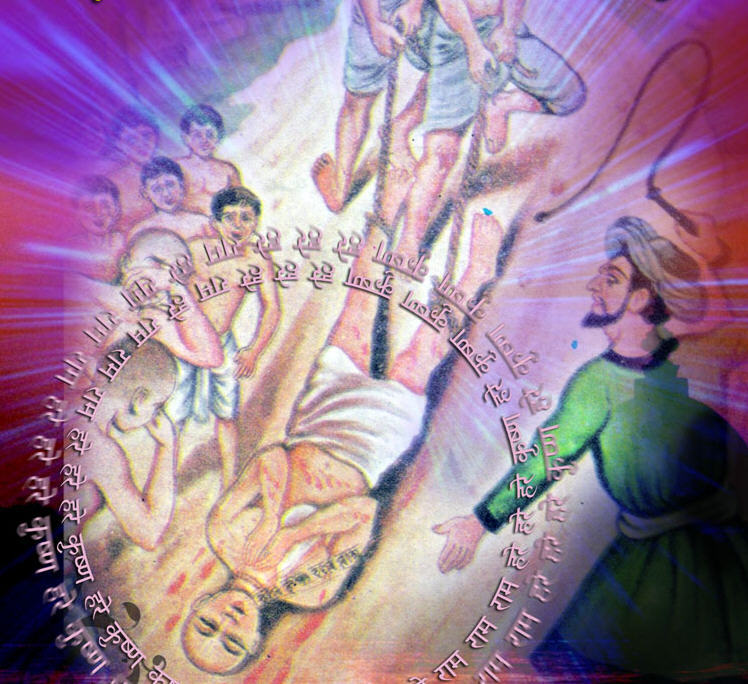
Long before he met Sri Chaitanya Mahaprabhu, Srila Haridasa Thakura (Haridāsa Ṭhākura) was put on trial for chanting the names of Krishna. He had been born a Muslim, so the qazi of his district reported him to the ruler. When he refused to give up the holy name, he was sentenced to be caned in twenty-two marketplaces until he died. But he survived, he prayed for the very men who beat him, and in the end even his judges bowed to him. Vrindavana Dasa Thakura tells the full story in the sixteenth chapter of the Adi-khanda of Chaitanya-bhagavata, and Krishnadasa Kaviraja Goswami leaves these pastimes to him (Chaitanya-charitamrita Adi 10.47). Srila Prabhupada sends every reader to that chapter: "From the description of his chastisement by a Muslim magistrate, which is found in the sixteenth chapter of the Ādi-khaṇḍa of Caitanya-bhāgavata, we can understand how humble and meek Haridāsa Ṭhākura was and how he achieved the causeless mercy of the Lord" (Chaitanya-charitamrita Adi 10.43, purport).
Why the Qazi Brought a Complaint #
At Phuliya, Haridasa bathed in the Ganges every day. Then he would walk about, calling out the names of Hari in a loud voice (Chaitanya-bhagavata Adi 16.35). The local qazi, a Muslim judge, could not bear to see a man from his own community following the ways of another faith, and he was afraid that others would follow him. So he went to the ruler of the district and asked that Haridasa be judged, and the ruler had him brought at once (Chaitanya-bhagavata Adi 16.36-38). Srila Prabhupada sums up the charge in one line: "Haridāsa Ṭhākura, a Muhammadan by birth, was a very great devotee and was always chanting Hare Kṛṣṇa. That was his only fault." (Teachings of Lord Kapila 11)
By Krishna's mercy Haridasa had no fear of rulers, or even of death. He set off at once, chanting "Krishna, Krishna." The good people of the place were happy to see his courage, but they were also afraid for his life (Chaitanya-bhagavata Adi 16.39-41). The accounts differ a little about who did what. Tirtha Maharaj calls the ruler the Nawab. Srila Prabhupada, telling the story briefly, gives both the questioning and the sentence to the qazi. In Chaitanya-bhagavata the ruler questions Haridasa, and the qazi proposes the punishment.
A Blessing for the Prisoners #
Before he was taken to the ruler, Haridasa was brought among the men held in the ruler's jail. Some of them were men of good family. When they heard that he had come, they were glad, because they hoped that seeing such a great Vaishnava would end their suffering. They persuaded the guards to let them see him, and they bowed down at his feet (Chaitanya-bhagavata Adi 16.42-48). Haridasa smiled at them kindly and blessed them to stay just as they were. The prisoners were very upset, because they thought he meant they should stay in chains. So he explained (Chaitanya-bhagavata Adi 16.49-62):
"I don’t mean to say that you should remain prisoners, but that you forget sense gratification and that you chant Hare Krishna. This was the meaning of my blessing; please don’t be sad for a moment on that account." (Chaitanya-bhagavata Adi 16.63-64, as translated in Srila Bhakti Ballabh Tirtha Maharaj's Sri Chaitanya: His Life and Associates)
He told them that in jail, away from business and family, their minds had turned to Krishna, but outside, their old attachments would soon pull them back. He also promised them that they would be set free within two or three days (Chaitanya-bhagavata Adi 16.55-67). Even on the way to his own trial, he was thinking about the good of others.
Before the Ruler: "God Is One" #
The ruler saw the bright glow on Haridasa's face, so he offered him a seat and questioned him almost gently. He said that Haridasa had been born a Muslim by great good fortune, so why was he lowering himself by following the customs of another faith? If he recited the kalima, whatever wrong he had done in ignorance would be wiped away (Chaitanya-bhagavata Adi 16.69-74). Haridasa laughed softly at the power of illusion, and then he answered very sweetly (Chaitanya-bhagavata Adi 16.75-76). In Tirtha Maharaj's rendering he said: "God is one. The same God is present in every religion; He is the non-dual absolute truth."
Haridasa explained that the difference lies only in the names by which people call Him: "The same God sits in the heart of every single living being and he engages each one of them in His service in different ways. One worships in the way one is made to worship by Him." He pointed out that some men born as brahmanas take up Islam. In the same way he, though born a Muslim, had been engaged by the Lord in chanting Krishna's names. He ended humbly, without any defiance: "The living being has no independence in such matters. If this is a fault, then please punish me." (Chaitanya-bhagavata Adi 16.76-85)
His words about the Lord in the heart are what Krishna Himself teaches in Bhagavad-gita:
īśvaraḥ sarva-bhūtānāṁ
hṛd-deśe ’rjuna tiṣṭhati
bhrāmayan sarva-bhūtāni
yantrārūḍhāni māyayā
"The Supreme Lord is situated in everyone’s heart, O Arjuna, and is directing the wanderings of all living entities, who are seated as on a machine, made of the material energy." (Bhagavad-gita 18.61)
"I Will Never Abandon the Holy Name" #
The Muslims present were satisfied with this answer, but the qazi was not. He pressed the ruler to punish Haridasa as a warning to others, or at least to force him to recite the confession of faith. Otherwise, he said, Haridasa would lead others away (Chaitanya-bhagavata Adi 16.86-89). So Haridasa was told to chant only the names of his own religion or face a terrible punishment. His reply has been dear to devotees ever since:
"You may cut my body to pieces, and the life may leave it. But I will never abandon the Holy Name which my tongue will ever continue to chant." (Chaitanya-bhagavata Adi 16.91, as translated in Srila Bhakti Ballabh Tirtha Maharaj's Sri Chaitanya: His Life and Associates; verse 16.94 in some other editions)
Krishnadasa Kaviraja Goswami gives the whole trial just one line in his list of the Lord's associates, and that line shows Haridasa's state of mind:
prahlāda-samāna tāṅra guṇera taraṅga
yavana-tāḍaneo yāṅra nāhika bhrū-bhaṅga
"The waves of his good qualities were like those of Prahlāda Mahārāja. He did not even slightly raise an eyebrow when persecuted by the Muslim ruler." (Sri Chaitanya-charitamrita Adi 10.45)
The Sentence of Twenty-Two Marketplaces #
The ruler turned to the qazi and asked what should be done. The qazi's answer was really a death sentence, though he called it a test. As Tirtha Maharaj renders it: "He should be flogged publicly in 22 market places until he is dead. If after being beaten in 22 market places he is still alive, then we will know that he really has some kind of spiritual power and that he has been telling the truth!" (Chaitanya-bhagavata Adi 16.95-97). The qazi told the guards to beat him until he died, and the ruler gave the order (Chaitanya-bhagavata Adi 16.98-100).
Srila Prabhupada explains what this sentence meant: "The Kazi became very angry and ordered Haridāsa Ṭhākura to be whipped in twenty-two bazaars. This essentially meant that he was to be beaten to death, but because he was such a great devotee he did not actually feel the pain." (Teachings of Lord Kapila 11) In one lecture at Vrindavana in 1976 he said "twenty-one bazaars" in passing (lecture on Srimad-Bhagavatam, 19 November 1976). Chaitanya-bhagavata and his books give the number as twenty-two.
Beaten From Market to Market #
The guards dragged Haridasa from one marketplace to the next and beat him with all their strength. But he simply kept remembering Krishna's name. The joy of the name kept him from feeling the blows, just as Prahlada Maharaja had felt no pain when the demons beat him (Chaitanya-bhagavata Adi 16.101-110). Good people who saw this were horrified. Some cried out that the whole kingdom would be ruined for treating a saint like this. Some cursed the ruler and the qazi, and some were ready to fight. Others fell at the guards' feet and offered them money to strike more lightly, but the guards showed no mercy (Chaitanya-bhagavata Adi 16.103-107).
Srila Prabhupada saw in Haridasa's calm the sign of a pure devotee, who is not disturbed by the ups and downs of this world:
dehināṁ deha-saṁyogād
dvandvānīśvara-līlayā
sukhaṁ duḥkhaṁ mṛtir janma
śāpo ’nugraha eva ca
"Because of the actions of the Supreme Lord’s external energy, the living entities are conditioned in contact with material bodies. The dualities of happiness and distress, birth and death, curses and favors, are natural by-products of this contact in the material world." (Srimad-Bhagavatam 6.17.29)
In his purport he writes: "For example, Haridāsa Ṭhākura was beaten with cane in twenty-two bazaars, but he was never disturbed; instead, he smilingly tolerated the beating."
A Prayer for the Men Who Beat Him #
What hurt Haridasa was not his own pain but the fate of the men who were beating him. Even as the cane came down, he prayed for them:
"Be merciful to all these poor souls, O Lord! Though they treat me like an enemy, do not consider this to be an offense." (Chaitanya-bhagavata Adi 16.110, as translated in Srila Bhakti Ballabh Tirtha Maharaj's Sri Chaitanya: His Life and Associates; verse 16.113 in some other editions)
Years later Sri Chaitanya Mahaprabhu asked this same tolerance of everyone who chants the holy name:
tṛṇād api su-nīcena
taror iva sahiṣṇunā
amāninā māna-dena
kīrtanīyaḥ sadā hariḥ
"One who thinks himself lower than the grass, who is more tolerant than a tree, and who does not expect personal honor yet is always prepared to give all respect to others can very easily always chant the holy name of the Lord." (Sri Chaitanya-charitamrita Adi 17.31)
Srila Prabhupada names Haridasa as the best example of this tolerance: "Haridāsa Ṭhākura is exceptional for his forbearance because although he was beaten with canes in twenty-two marketplaces, he was nevertheless tolerant." (Chaitanya-charitamrita Adi 10.84, purport)
Given to the Ganges #
After twenty-two marketplaces Haridasa was still alive and even smiling. The men beating him began to wonder whether he was a pir, a Muslim saint (Chaitanya-bhagavata Adi 16.114-118). They also became afraid for themselves, because if he lived, the qazi would surely have them killed (Chaitanya-bhagavata Adi 16.119-120). Srila Prabhupada once described the scene: "So they began to flatter him, 'Sir, unless you die, we'll be dead. Our life is in great danger.' So Haridāsa Ṭhākura made a show of death, and he was brought before the Kazi" (lecture on Srimad-Bhagavatam, 19 November 1976). Out of kindness to them, Haridasa went into deep meditation on Krishna, and his breathing stopped (Chaitanya-bhagavata Adi 16.121-123).
They carried his still body to the ruler, who ordered it to be buried. But the qazi objected. He said that burial would give such a man a good destination after death, so the body must be thrown into the Ganges instead (Chaitanya-bhagavata Adi 16.124-128). Chaitanya-bhagavata adds that for some time even the strongest guards could not move him, because the Lord Himself had entered his body (Chaitanya-bhagavata Adi 16.129-132). In the river Haridasa floated along, so absorbed in Krishna that he did not know whether he was in the sky, on land or in water. After some time he came back to outer awareness. He climbed out on the bank and set off for Phuliya, chanting Krishna's names aloud (Chaitanya-bhagavata Adi 16.133-145). Vrindavana Dasa compares him to Hanuman, who allowed himself to be bound by the brahmastra weapon out of respect for Brahma. In the same way, with Govinda as his protector no one could have harmed Haridasa, and he accepted the beating only to teach the world (Chaitanya-bhagavata Adi 16.137-140).
The Ruler Asks Forgiveness #
When the Muslims saw his power, they forgot their hatred. They bowed to him as a pir and were freed from their sins (Chaitanya-bhagavata Adi 16.146-147). The ruler himself came to him with folded hands. He said that now he knew Haridasa was a true saint, fixed in the knowledge that God is one. He begged Haridasa to forgive all his offenses, and he told him he was free to go wherever he wished and to live in a cave by the Ganges or anywhere else (Chaitanya-bhagavata Adi 16.148-155). The man who had ordered his death now held his feet (Chaitanya-bhagavata Adi 16.157). Tirtha Maharaj adds that the qazi also bowed down, and that the ruler gave Haridasa formal permission to chant the holy name wherever he went.
Only a Small Punishment #
The brahmanas of Phuliya had been heartbroken by the news of the beating. When Haridasa came back among them chanting, they were overjoyed. They sang the names of Hari around him, and he danced in ecstasy (Chaitanya-bhagavata Adi 16.159-164). Then he asked them not to feel sorry for him. He said that with his own ears he had heard much blasphemy of the Lord, and hearing blasphemy of Vishnu is a great sin. The Lord had removed that great offense with only a small punishment (Chaitanya-bhagavata Adi 16.165-169). Where everyone else saw cruelty, Haridasa saw only the Lord's kindness. Vrindavana Dasa adds that the men who had beaten him were destroyed, with their families, within a few days (Chaitanya-bhagavata Adi 16.171).
Srila Prabhupada teaches the same way of seeing suffering when he explains Brahma's words to the frightened demigods:
viśvasya yaḥ sthiti-layodbhava-hetur ādyo
yogeśvarair api duratyaya-yogamāyaḥ
kṣemaṁ vidhāsyati sa no bhagavāṁs tryadhīśas
tatrāsmadīya-vimṛśena kiyān ihārthaḥ
"My dear sons, the Lord is the controller of the three modes of nature and is responsible for the creation, preservation and dissolution of the universe. His wonderful creative power, yoga-māyā, cannot be easily understood even by the masters of yoga. That most ancient person, the Personality of Godhead, will alone come to our rescue. What purpose can we serve on His behalf by deliberating on the subject?" (Srimad-Bhagavatam 3.16.37)
In his purport he writes: "When something is arranged by the Supreme Personality of Godhead, one should not be disturbed by it, even if it appears to be a reverse according to one’s calculations." He gives Haridasa as one of his examples: "But Haridāsa was punished at the hands of the Kazi by being beaten in twenty-two marketplaces." And he says of such a devotee: "He accepts even reverse conditions as the grace of the Lord."
The Lord Who Took the Blows #
Years later the Lord Himself revealed who had really suffered those blows. In Navadvipa, when He showed His divine glory in the house of Srivasa Thakura, Sri Chaitanya Mahaprabhu called Haridasa forward. He said that when the guards were beating Haridasa from village to village, He had come down with His disc to cut them to pieces. But Haridasa was praying for their good, so the disc could do nothing. Then the Lord covered Haridasa's back with His own body and took the blows Himself, and He showed Haridasa the marks (Chaitanya-bhagavata Madhya 10.35-44). When Haridasa heard this, he fell unconscious in love (Chaitanya-bhagavata Madhya 10.52-56). That moment, and the Lord's loving words to him, are told in Life With Sri Chaitanya Mahaprabhu at Puri.
What Srila Prabhupada Teaches From It #
Srila Prabhupada spoke about this episode again and again. He used it to show that sincere preaching will meet opposition, and that a sadhu answers that opposition with mercy. Explaining the qualities of a sadhu, he writes (Srimad-Bhagavatam 3.25.21, purport): "Sometimes devotees are personally attacked with violence. Lord Jesus Christ was crucified, Haridāsa Ṭhākura was caned in twenty-two marketplaces, and Lord Caitanya’s principal assistant, Nityānanda, was violently attacked by Jagāi and Mādhāi. But still they were tolerant because their mission was to deliver the fallen souls." The verse he was explaining describes the sadhu this way:
titikṣavaḥ kāruṇikāḥ
suhṛdaḥ sarva-dehinām
ajāta-śatravaḥ śāntāḥ
sādhavaḥ sādhu-bhūṣaṇāḥ
"The symptoms of a sādhu are that he is tolerant, merciful and friendly to all living entities. He has no enemies, he is peaceful, he abides by the scriptures, and all his characteristics are sublime." (Srimad-Bhagavatam 3.25.21)
In Teachings of Lord Kapila, speaking on the same verse, he adds: "Although a devotee may sometimes have to suffer, he tolerates the suffering. At the same time, he is very kind to conditioned souls and tries to elevate them to Kṛṣṇa consciousness." (Teachings of Lord Kapila 11) Nityananda Prabhu showed the same mercy to Jagai and Madhai. Haridasa's tolerance and mercy shine just as brightly in another story, at Benapola, where Ramachandra Khan sent a prostitute to his cottage: see the prostitute's test.
Scriptural evidence for this chapter (8)
Quoted in the text above:
- SB 3.25.21 Srimad-Bhagavatam quoted above ↑
- BG 18.61 Bhagavad-gita quoted above ↑
- Adi 17.31 Sri Chaitanya-charitamrita quoted above ↑
- Adi 10.45 Sri Chaitanya-charitamrita quoted above ↑
- SB 6.17.29 Srimad-Bhagavatam quoted above ↑
- SB 3.16.37 Srimad-Bhagavatam quoted above ↑
Further verses:
अनुपम-वल्लभ, श्री-रूप, सनातन
एइ तिन शाखा वृक्षेर पश्चिमे सर्वोत्तम
anupama-vallabha, śrī-rūpa, sanātana
ei tina śākhā vṛkṣera paścime sarvottama
On the western side were the forty-third, forty-fourth and forty-fifth branches — Śrī Sanātana, Śrī Rūpa and Anupama. They were the best of all.
From the purport: Haridāsa Ṭhākura is exceptional for his forbearance because although he was beaten with canes in twenty-two marketplaces, he was nevertheless tolerant. (Srila Prabhupada, Chaitanya-charitamrita Adi 10.84 purport)
Cited for the purport only: Srila Prabhupada names Haridasa as exceptional for his forbearance under the beating in twenty-two marketplaces. The verse itself is about Rupa, Sanatana and Anupama.
हरिदास-ठाकुर शाखार अद्भुत चरित
तिन लक्ष नाम तेँहो लयेन अपतित
haridāsa-ṭhākura śākhāra adbhuta carita
tina lakṣa nāma teṅho layena apatita
The twentieth branch of the Caitanya tree was Haridāsa Ṭhākura. His character was wonderful. He used to chant the holy name of Kṛṣṇa 300,000 times a day without fail.
From the purport: From the description of his chastisement by a Muslim magistrate, which is found in the sixteenth chapter of the Ādi-khaṇḍa of Caitanya-bhāgavata, we can understand how humble and meek Haridāsa Ṭhākura was and how he achieved the causeless mercy of the Lord. (Srila Prabhupada, Chaitanya-charitamrita Adi 10.43 purport)
Srila Prabhupada directs readers to Chaitanya-bhagavata Adi 16 for the account of Haridasa's trial and beating.
Chapter 3
The Vow of Chanting and the Prostitute's Test
A jealous zamindar sent a hired prostitute to break Haridasa Thakura's vow of chanting; three nights later, she was the one who had been transformed.
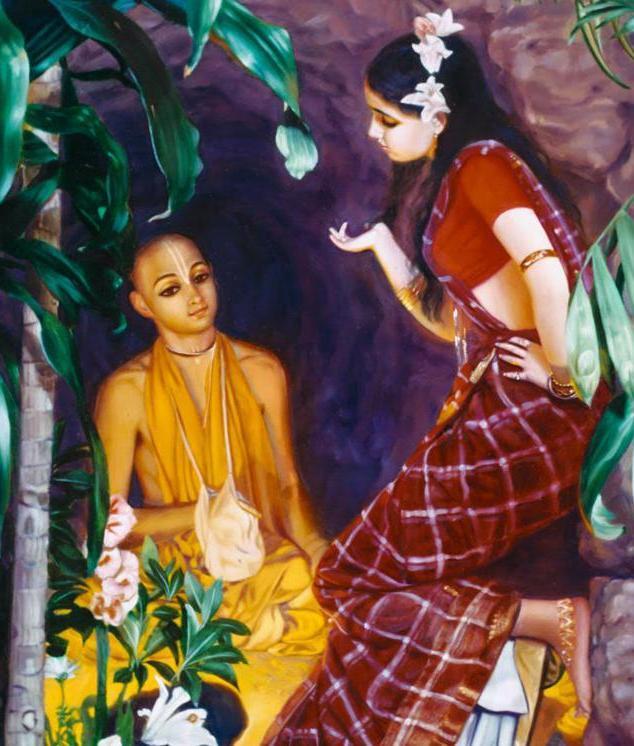
When Krishnadasa Kaviraja Goswami reached the third chapter of the Antya-lila, the last part of his book, he asked the devotees to hear about the qualities of Srila Haridasa Thakura (Haridāsa Ṭhākura) "that Śrīla Vṛndāvana dāsa Ṭhākura has not described in detail" (Chaitanya-charitamrita Antya 3.98). So the stories below come to us from Chaitanya-charitamrita. They are part of what Vrindavana Dasa Thakura had left untold, and they begin in the forest of Benapola, where Haridasa stayed for some time after leaving home (Chaitanya-charitamrita Antya 3.99). Srila Prabhupada places Benapola in the district of Jessore, near Bangaon, on the border of today's Bangladesh (purport to Antya 3.100). Chaitanya-bhagavata, however, begins the story of his early life at Phuliya, and the account of his birth and early life follows that order.
In that forest he built himself a small hut and planted a tulasi (tulasī) plant, the sacred plant served by Vaishnavas, in front of it. He begged a little food from a brahmana's house and chanted the holy name day and night:
nirjana-vane kuṭira kari’ tulasī sevana
rātri-dine tina lakṣa nāma-saṅkīrtana
"Haridāsa Ṭhākura constructed a cottage in a solitary forest. There he planted a tulasī plant, and in front of the tulasī he would chant the holy name of the Lord 300,000 times daily. He chanted throughout the entire day and night." (Sri Chaitanya-charitamrita Antya 3.100)
brāhmaṇera ghare kare bhikṣā nirvāhaṇa
prabhāve sakala loka karaye pūjana
"For his bodily maintenance he would go to a brāhmaṇa’s house and beg some food. He was spiritually so influential that all the neighboring people worshiped him." (Sri Chaitanya-charitamrita Antya 3.101)
In his purport Srila Prabhupada explains: "From his personal example we can understand that chanting the Hare Kṛṣṇa mantra and becoming highly elevated in Kṛṣṇa consciousness is very simple."
A Zamindar Who Could Not Bear His Fame #
But one powerful man could not bear the love that the villagers showed this poor hermit:
sei deśādhyakṣa nāma — rāmacandra khāṅna
vaiṣṇava-vidveṣī sei pāṣaṇḍa-pradhāna
"A landholder named Rāmacandra Khān was the zamindar of that district. He was envious of Vaiṣṇavas and was therefore a great atheist." (Sri Chaitanya-charitamrita Antya 3.102)
He tried in many ways to disgrace Haridasa. But he could find no fault in the Thakura's life, so he decided to create one. He called together the prostitutes of the area and asked them to make this vairagi, a renounced holy man, break his vows (Chaitanya-charitamrita Antya 3.103-105). Srila Prabhupada saw the same spirit in critics of his own day, who searched for faults "exactly like the old rascal Rāmacandra Khān, who opposed Haridāsa Ṭhākura" (purport to Antya 3.104). One young and beautiful girl promised to capture Haridasa's mind within three days. The zamindar wanted his constable to go with her and arrest Haridasa on the spot. But she asked him to wait. First she would be with Haridasa once, she said, and the second time she would bring the constable (Chaitanya-charitamrita Antya 3.106-108).
The First Night #
That night she dressed with great care and went happily to the cottage. Strangely, for someone on such an errand, she first bowed down to the tulasi plant and then to Haridasa (Chaitanya-charitamrita Antya 3.109-110). She sat at the door and uncovered part of her body. Then she praised his beauty and his youth, which, in her words, "is just beginning," and said that she could not live without him (Chaitanya-charitamrita Antya 3.111-113). Haridasa showed no anger and gave her no lecture. On the surface, his reply even sounded like a promise:
haridāsa kahe, — “tomā karimu aṅgīkāra
saṅkhyā-nāma-samāpti yāvat nā haya āmāra
tāvat tumi vasi’ śuna nāma-saṅkīrtana
nāma-samāpti haile karimu ye tomāra mana”
"Haridāsa Ṭhākura replied, ‘I shall accept you without fail, but you will have to wait until I have finished chanting my regular rounds on my beads. Until that time, please sit and listen to the chanting of the holy name. As soon as I am finished, I shall fulfill your desire.’" (Sri Chaitanya-charitamrita Antya 3.114-115)
So she sat and listened, and he chanted until the first light of morning. Then she went back to Ramachandra Khan and told him that Haridasa had given his word, and that tomorrow she would surely succeed (Chaitanya-charitamrita Antya 3.116-118).
The Second Night #
The next night Haridasa welcomed her and again gave her many assurances. He even asked her to forgive him for disappointing her the night before. Then he asked her once more to sit and hear the maha-mantra until he had finished his fixed number of names (Chaitanya-charitamrita Antya 3.119-121). Then something happened that neither she nor the zamindar had planned:
tulasīre tāṅke veśyā namaskāra kari’
dvāre vasi’ nāma śune bale ‘hari’ ‘hari’
"After offering her obeisances to the tulasī plant and Haridāsa Ṭhākura, she sat down at the door. Hearing Haridāsa Ṭhākura chanting the Hare Kṛṣṇa mantra, she also chanted, ‘O my Lord Hari, O my Lord Hari.’" (Sri Chaitanya-charitamrita Antya 3.122)
In his purport Srila Prabhupada explains: "The prostitute came to pollute Haridāsa Ṭhākura, but he took it as his duty to deliver the prostitute."
Toward dawn she grew restless. Haridasa explained that he had vowed to chant ten million names in one month. The vow was almost over, and he had chanted the whole night hoping to finish it, but it was still not done. Tomorrow, he said, he would be free (Chaitanya-charitamrita Antya 3.123-126). A reader may be puzzled by these promises, but Srila Prabhupada answers plainly: "Haridāsa Ṭhākura never wanted to enjoy the prostitute, but he tricked her to deliver her by giving her a chance to hear the holy name of the Lord while he chanted" (purport to Antya 3.126).
The Third Night: A Heart Turned Around #
On the third day she came early, as soon as evening fell. Again she bowed to tulasi and to the Thakura and sat at the door. She listened and chanted "Hari, Hari" herself, and Haridasa told her that tonight his chanting would surely end (Chaitanya-charitamrita Antya 3.127-129). Like the two nights before it, this night passed in kirtana, the chanting of the holy name. But by the end of it, Krishnadasa Kaviraja Goswami tells us, "by his association the mind of the prostitute had changed" (Chaitanya-charitamrita Antya 3.130).
She fell flat at his feet, confessed Ramachandra Khan's plot, and begged: "My lord, be merciful to me. Deliver my fallen soul" (Chaitanya-charitamrita Antya 3.131-132). But nothing had been hidden from Haridasa. He had known about the plot all along. He called the zamindar "an ignorant fool" and said that his schemes did not make him unhappy (Chaitanya-charitamrita Antya 3.133). Then he told her why he had not simply walked away:
sei-dina yāitāma e-sthāna chāḍiyā
tina dina rahilāṅa tomā nistāra lāgiyā
"On the very day Rāmacandra Khān was planning his intrigue against me, I would have left this place immediately, but because you came to me I stayed here for three days to deliver you." (Sri Chaitanya-charitamrita Antya 3.134)
The three nights had never been a danger to him. They were his mercy to her.
"Kindly Act as My Spiritual Master" #
The woman who had come to bring him down now asked to be lifted up: "Kindly act as my spiritual master. Instruct me in my duty, by which I can get relief from material existence" (Chaitanya-charitamrita Antya 3.135). His instruction was short and complete. She should give her property to the brahmanas, and then come back to that very room and live there for good (Chaitanya-charitamrita Antya 3.136). And then: "Chant the Hare Kṛṣṇa mantra continuously and render service to the tulasī plant by watering her and offering prayers to her. In this way you will very soon get the opportunity to be sheltered at the lotus feet of Kṛṣṇa" (Chaitanya-charitamrita Antya 3.137). In his purport Srila Prabhupada points out the heart of this instruction: "Haridāsa Ṭhākura says, nirantara nāma lao: 'Chant the Hare Kṛṣṇa mantra without stopping.'"
After teaching her how to chant, Haridasa stood up and walked away, chanting "Hari, Hari" as he went (Chaitanya-charitamrita Antya 3.138). He left her his cottage, his tulasi and his way of life, and took nothing with him but the holy name.
Why the Wealth Went to the Brahmanas #
She obeyed at once and gave the brahmanas everything in her house, "following the order of her spiritual master" (Chaitanya-charitamrita Antya 3.139). Haridasa, who begged his own meals, kept none of it. Srila Prabhupada draws the lesson in his purport: "A Vaiṣṇava guru is never dependent on the contributions of his disciples. Following the instructions of Haridāsa Ṭhākura, a pure Vaiṣṇava does not personally take even a single paisa from anyone, but he induces his followers to spend for the service of the Lord whatever possessions they have."
Bhaktisiddhanta Sarasvati Thakura makes the same point in his Anubhashya commentary on this verse. Srila Prabhupada's purport does not quote this comment, so it is given here in the English translation found in Srila Bhakti Ballabh Tirtha Maharaj's book:
"Even though the guru has a legitimate claim on all of his disciple’s worldly possessions, he does not ask for them for his own use. ... By not accepting his disciple’s possessions, which are after all intended for sense gratification, the Vaishnava guru remains independent of his disciple and does not compromise his integrity. ... Hari Das Thakur’s teaching here is that the guru’s duty is to rid his disciple of his mundane pride and not to himself accept the material possessions which the disciple has renounced." (Srila Bhaktisiddhanta Sarasvati Thakura, Anubhashya on Chaitanya-charitamrita Antya 3.139, as translated in Srila Bhakti Ballabh Tirtha Maharaj's Sri Chaitanya: His Life and Associates)
A Celebrated Vaishnavi #
She shaved her head, kept only one cloth to wear and stayed on in that room. There she chanted three hundred thousand names day and night, "following in the footsteps of her spiritual master" (Chaitanya-charitamrita Antya 3.140). She served the tulasi plant. She ate whatever came to her as alms, and when nothing came, she fasted. As her senses came under control, the signs of love for Krishna began to appear in her (Chaitanya-charitamrita Antya 3.141).
prasiddhā vaiṣṇavī haila parama-mahāntī
baḍa baḍa vaiṣṇava tāṅra darśanete yānti
"Thus the prostitute became a celebrated devotee. She became very advanced in spiritual life, and many stalwart Vaiṣṇavas would come to see her." (Sri Chaitanya-charitamrita Antya 3.142)
In his purport Srila Prabhupada explains: "Anyone can be turned into a Vaiṣṇava if he or she follows the Vaiṣṇava principles." Those who saw her new life were amazed, and they bowed to Haridasa and spoke of his glory (Chaitanya-charitamrita Antya 3.143).
Chaitanya-charitamrita does not give her name. But local tradition at Benapola remembers her as Hira, and pilgrims there are still shown her bhajana-kutir, the hut where she worshipped. She was later called Laksha-Hira (Lakshahira) because she chanted lakhs, or hundreds of thousands, of holy names every day. Srila Bhakti Ballabh Tirtha Maharaj's book calls her Lakshahira throughout, and it adds that the forest later came to be known as Hira Veshya's Jungle. Some later retellings stretch the test over many more nights. But Chaitanya-charitamrita gives three, and Haridasa himself counts them (Antya 3.134).
The Seed of Offense: Ramachandra Khan's Fate #
Haridasa held nothing against the man who had tried to ruin him. But the Lord does not overlook an offense against His devotee:
rāmacandra khāṅna aparādha-bīja kaila
sei bīja vṛkṣa hañā āgete phalila
"By inducing a prostitute to disturb Haridāsa Ṭhākura, Rāmacandra Khān caused a seed of offense at his lotus feet to germinate. This seed later became a tree, and when it fructified, Rāmacandra Khān ate its fruits." (Sri Chaitanya-charitamrita Antya 3.144)
Ramachandra Khan was no devotee to begin with, and through this offense he became like a demon. In time his long contempt for the Vaishnavas bore its fruit (Chaitanya-charitamrita Antya 3.146-147). Once Nityananda Prabhu was touring Bengal to spread love of Godhead and to subdue the atheists. He came to Ramachandra Khan's house on purpose and sat down in its Durga-mandapa, the hall kept for the yearly worship of the goddess Durga (Chaitanya-charitamrita Antya 3.148-150). The zamindar did not come out. Instead he sent a servant to say that there was no room for so many people, and that a milkman's large cowshed would suit them better (Chaitanya-charitamrita Antya 3.151-153). Nityananda Prabhu became angry and came out. Laughing loudly, He said: "Rāmacandra Khān has spoken rightly. This place is unfit for Me. It is fit for cow-killing meat-eaters." He left at once and would not stay even in that village (Chaitanya-charitamrita Antya 3.154-156). Ramachandra Khan had the earth dug up where the Lord had sat, and he had the hall smeared with cow-dung water. Still, his mind found no peace (Chaitanya-charitamrita Antya 3.157-158).
Nityananda Prabhu's words soon came true. Ramachandra Khan had been avoiding payment of the government's revenue. So the angry Muslim minister came and made his camp in that same Durga-mandapa, and there he killed a cow and cooked its meat (Chaitanya-charitamrita Antya 3.159-160). He arrested Ramachandra Khan with his wife and sons, plundered the house and village for three days, and "took away Rāmacandra Khān’s position, wealth and followers. For many days the village remained deserted" (Chaitanya-charitamrita Antya 3.161-163). Krishnadasa Kaviraja Goswami draws the lesson for everyone: "Wherever an advanced devotee is insulted, for one man’s fault the entire town or place is afflicted" (Chaitanya-charitamrita Antya 3.164). As Srila Bhakti Ballabh Tirtha Maharaj writes in his book, "The results of such offenses may come immediately or they may be delayed, but they are inevitable."
By this time Haridasa had long since walked on to Chandapura, to the house of Balarama Acharya (Chaitanya-charitamrita Antya 3.165). There a brahmana named Gopala Chakravarti would soon commit a similar offense. That story is told in the debate at Chandapura.
A Second Test, at the Ganges #
This was not the last time Haridasa was tested in this way. Later he lived in a cave on the bank of the Ganges near Shantipura. There Maya Devi herself, the Lord's illusory energy, came to him at night for three nights. She too heard nothing from him but the holy name, and in the end she begged to receive it (Chaitanya-charitamrita Antya 3.228-266). That story is told in full in Maya Devi Tests Haridasa Thakura.
Scriptural evidence for this chapter (14)
Quoted in the text above:
- Antya 3.144 Sri Chaitanya-caritamrta quoted above ↑
- Antya 3.100 Sri Chaitanya-charitamrita quoted above ↑
- Antya 3.101 Sri Chaitanya-charitamrita quoted above ↑
- Antya 3.102 Sri Chaitanya-charitamrita quoted above ↑
- Antya 3.114-115 Sri Chaitanya-charitamrita quoted above ↑
- Antya 3.122 Sri Chaitanya-charitamrita quoted above ↑
- Antya 3.134 Sri Chaitanya-charitamrita quoted above ↑
- Antya 3.142 Sri Chaitanya-charitamrita quoted above ↑
- Antya 3.137 Sri Chaitanya-charitamrita quoted above ↑
- Antya 3.155 Sri Chaitanya-charitamrita
- Antya 3.164 Sri Chaitanya-charitamrita quoted above ↑
Further verses:
वेश्या कहे, — “कृपा करि' करह उपदेश
कि मोर कर्तव्य, याते याय भव-क्लेश”
veśyā kahe, — “kṛpā kari’ karaha upadeśa
ki mora kartavya, yāte yāya bhava-kleśa”
The prostitute said, “Kindly act as my spiritual master. Instruct me in my duty, by which I can get relief from material existence.”
Her plea after the third night: "Kindly act as my spiritual master." Prabhupada's translation is the basis for calling Haridasa her spiritual master.
तबे सेइ वेश्या गुरुर आज्ञा ल-इल
गृह-वित्त येबा छिल, ब्राह्मणेरे दिल
tabe sei veśyā gurura ājñā la-ila
gṛha-vitta yebā chila, brāhmaṇere dila
Thereafter, the prostitute distributed to the brāhmaṇas whatever household possessions she had, following the order of her spiritual master.
From the purport: A Vaiṣṇava guru is never dependent on the contributions of his disciples. Following the instructions of Haridāsa Ṭhākura, a pure Vaiṣṇava does not personally take even a single paisa from anyone, but he induces his followers to spend for the service of the Lord whatever possessions they have.
She gives all her possessions to the brahmanas; Haridasa keeps nothing. Bhaktisiddhanta Sarasvati Thakura's Anubhashya on this verse is quoted on the page from B.B. Tirtha Maharaj's book (not quoted in Prabhupada's purport).
जाति-धन-जन खानेर सकल ल-इल
बहु-दिन पर्यन्त ग्राम उजाड रहिल
jāti-dhana-jana khānera sakala la-ila
bahu-dina paryanta grāma ujāḍa rahila
The Muslim minister took away Rāmacandra Khān’s position, wealth and followers. For many days the village remained deserted.
The end of Ramachandra Khan: position, wealth and followers taken; the village deserted.
Chapter 4
Maya Devi Tests Haridasa Thakura
In a cave by the Ganges, the Lord's own illusory energy came to him for three nights, and went away begging for the holy name.
After the events at Benapola and Chandapura, Srila Haridasa Thakura (Haridāsa Ṭhākura) went to live near Advaita Acharya at Shantipura. There, in a cave on the bank of the Ganges, he faced the strangest test of his life. This time the tester was not a woman sent by an envious man, as at Benapola, but Maya Devi herself, the illusory energy who keeps the whole world bound. Krishnadasa Kaviraja Goswami tells the story in Sri Chaitanya-charitamrita, Antya-lila, chapter three. The earlier test, by the prostitute whom Ramachandra Khan sent, is told in The Vow of Chanting and the Prostitute's Test.
Maya Devi Herself Comes to Test Him #
From Chandapura, Haridasa went to Advaita Acharya at Shantipura, and Advaita made him a cave-like home in a lonely spot on the bank of the Ganges (Chaitanya-charitamrita Antya 3.214-216). Krishnadasa Kaviraja Goswami tells one more story about that cave, but first he asks his readers to hear it with faith: "Hear about such incidents without putting forth dry arguments, for these incidents are beyond our material reasoning. One must believe in them with faith" (Chaitanya-charitamrita Antya 3.228).
It was a bright moonlit night. The Ganges sparkled, the tulasi stood on her clean altar at the cave door, and Haridasa sat inside chanting the holy name aloud (Chaitanya-charitamrita Antya 3.229-231). Then a woman appeared in the courtyard. The glow of her body turned the whole place yellow, her fragrance filled every direction, and her ornaments tinkled (Chaitanya-charitamrita Antya 3.232-233). Like the woman of Benapola, she bowed to tulasi first. Then she walked around the plant and, with folded hands, bowed at Haridasa's feet. She called him "the friend of the entire world," said she had come only for him, and reminded him that saints are kind to the poor. Then she showed herself in ways that would shake the patience of even a great sage (Chaitanya-charitamrita Antya 3.234-238).
"Haridāsa Ṭhākura was immovable, for he was deeply determined." Still, he answered her, "being very merciful toward her" (Chaitanya-charitamrita Antya 3.239). It was the same answer he had given at Benapola. He told her that chanting his fixed number of names every day was a great sacrifice he had vowed to perform. So she should sit at the door and hear the chanting, and when it was finished he would please her (Chaitanya-charitamrita Antya 3.240-242). For three nights she came back, with charms that could bewilder even Lord Brahma. But Haridasa's mind was fixed on Krishna's name, and all her display was "just like crying in the forest" (Chaitanya-charitamrita Antya 3.243-246). At the end of the third night she complained that he had cheated her, because his chanting never ended, day or night. He said only: "My dear friend, what can I do? I have made a vow. How, then, can I give it up?" (Chaitanya-charitamrita Antya 3.247-249). Then she bowed and told him who she was:
tabe nārī kahe tāṅre kari’ namaskāra
‘āmi — māyā’ karite āilāṅa parīkṣā tomāra
"After offering obeisances to Haridāsa Ṭhākura, the woman said, ‘I am the illusory energy of the Supreme Personality of Godhead. I came here to test you." (Sri Chaitanya-charitamrita Antya 3.250)
brahmādi jīva, āmi sabāre mohiluṅ
ekelā tomāre āmi mohite nāriluṅ
"‘I have previously captivated the mind of even Brahmā, what to speak of others. Your mind alone have I failed to attract." (Sri Chaitanya-charitamrita Antya 3.251)
In his purport, Srila Prabhupada links this to Lord Krishna's promise in Bhagavad-gita 7.14 that a surrendered soul can cross over His illusory energy. Then he explains how Haridasa did it: "It was because Haridāsa Ṭhākura, fully surrendered to the lotus feet of Kṛṣṇa, was always absorbed in thoughts of Kṛṣṇa by chanting the holy names of the Lord 300,000 times daily as a vow."
The Name That Maya Begged For #
Now the tester became a beggar. She said that seeing him and hearing him chant had purified her heart, and now she wanted to chant too (Chaitanya-charitamrita Antya 3.252-253). She spoke of the flood of love of Godhead that Sri Chaitanya Mahaprabhu had released by His appearance (Chaitanya-charitamrita Antya 3.254-255). Long ago she had received Lord Rama's name from Lord Shiva. Now she longed for Krishna's name, because "the holy name of Kṛṣṇa transports one to the other side of the ocean of nescience and at last gives one ecstatic love of Kṛṣṇa" (Chaitanya-charitamrita Antya 3.256-258).
eta bali’ vandilā haridāsera caraṇa
haridāsa kahe, — “kara kṛṣṇa-saṅkīrtana”
"After speaking in this way, Māyā worshiped the lotus feet of Haridāsa Ṭhākura, who initiated her by saying, ‘Just perform chanting of the Hare Kṛṣṇa mahā-mantra.’" (Sri Chaitanya-charitamrita Antya 3.259)
In his purport, Srila Prabhupada writes: "Now even Māyā wanted to be favored by Haridāsa Ṭhākura. Therefore Haridāsa Ṭhākura formally initiated her by asking her to chant the Hare Kṛṣṇa mahā-mantra."
Maya went away full of joy (Chaitanya-charitamrita Antya 3.260). Some readers may doubt this story, so Krishnadasa Kaviraja Goswami explains why it should not surprise us. In Sri Chaitanya Mahaprabhu's time, Lord Brahma, Lord Shiva, the four Kumaras, Narada Muni, Prahlada and the goddess of fortune all took human birth because they were greedy for love of Krishna (Chaitanya-charitamrita Antya 3.261-265). So why should anyone be surprised if Maya, the Lord's maidservant, also begs for that love? "Without the mercy of a devotee and without the chanting of the holy name of the Lord, love of Godhead cannot be possible" (Chaitanya-charitamrita Antya 3.266).
Two Tests, One Answer #
Both women came by night and bowed to tulasi before they spoke. Both heard the same reply, and both went away chanting Krishna's name. One was a bound soul hired by an envious man, and the other was the energy that binds the whole world. Yet Haridasa treated them both in the same way: he let them sit, let them hear, and gave them the holy name. Srila Prabhupada calls his victory "practical proof of the strength of devotional service" (purport to Antya 3.251). Srila Bhakti Ballabh Tirtha Maharaj turns the same lesson into a warning: "If one sees someone who is apparently taking shelter of the Holy Name, but at the same time succumbs to the temptations of women, wealth and power, it can be understood that he is not truly surrendered to the Name."
Krishnadasa Kaviraja Goswami ends by saying that he has told "but a fragment of the glories of Haridāsa Ṭhākura" (Chaitanya-charitamrita Antya 3.271). The same steadiness carried him through the qazi's canes in the twenty-two marketplaces, and it is the reason he is honored as the teacher of the holy name.
Scriptural evidence for this chapter (7)
Quoted in the text above:
- Antya 3.228 Sri Chaitanya-charitamrita quoted above ↑
- Antya 3.250 Sri Chaitanya-charitamrita quoted above ↑
- Antya 3.251 Sri Chaitanya-charitamrita quoted above ↑
- Antya 3.259 Sri Chaitanya-charitamrita quoted above ↑
Further verses:
हरिदास ठाकुर कहेन, — “आमि कि करिमु?
नियम करियाछि, ताहा केमने छाडिमु?”
haridāsa ṭhākura kahena, — “āmi ki karimu?
niyama kariyāchi, tāhā kemane chāḍimu?”
Haridāsa Ṭhākura said, “My dear friend, what can I do? I have made a vow. How, then, can I give it up?”
Haridasa's whole answer to Maya Devi at the end of the third night.
मुक्ति-हेतुक तारक हय ‘राम-नाम’
‘कृष्ण-नाम’ पारक हञा करे प्रेम-दान
mukti-hetuka tāraka haya ‘rāma-nāma’
‘kṛṣṇa-nāma’ pāraka hañā kare prema-dāna
“The holy name of Lord Rāma certainly gives liberation, but the holy name of Kṛṣṇa transports one to the other side of the ocean of nescience and at last gives one ecstatic love of Kṛṣṇa.
From the purport: The Hare Kṛṣṇa mahā-mantra, however, gives liberation and at the same time offers shelter at the lotus feet of Kṛṣṇa.
Maya explains why she wants Krishna's name after receiving Rama's name from Lord Shiva.
माया-दासी ‘प्रेम’ मागे, — इथे कि विस्मय?
‘साधु-कृपा’-‘नाम’ विना ‘प्रेम’ ना जन्मय
māyā-dāsī ‘prema’ māge, — ithe ki vismaya?
‘sādhu-kṛpā’-‘nāma’ vinā ‘prema’ nā janmaya
What is the wonder if the maidservant of Kṛṣṇa, His external energy, begs for love of Godhead? Without the mercy of a devotee and without the chanting of the holy name of the Lord, love of Godhead cannot be possible.
Krishnadasa Kaviraja Goswami's conclusion to the Maya Devi episode: love of Godhead comes only by a devotee's mercy and the holy name.
Chapter 5
Teachings on the Holy Name
At Chandapura and later at Puri, Haridasa Thakura carefully explained exactly why chanting the holy name works, and what keeps it from bearing its full fruit.
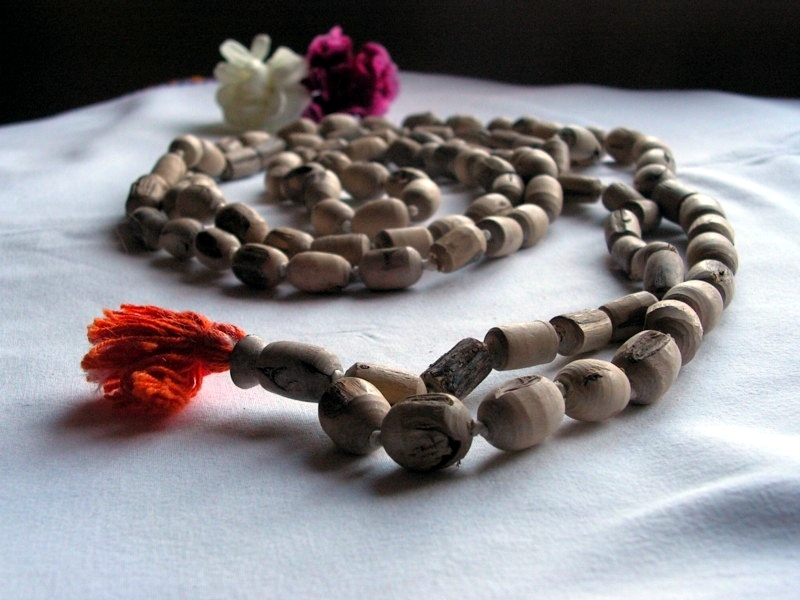
Srila Haridasa Thakura (Haridāsa Ṭhākura) taught the holy name mostly by chanting it himself, three hundred thousand times every day. He only rarely taught by argument. But when he was asked what the name really does, his answers became the clearest teaching in the Gaudiya Vaishnava tradition on three kinds of chanting: chanting with offenses, namabhasa (nāmābhāsa, the first faint glimmer of the name), and pure chanting. Three such conversations are recorded. Two come from Krishnadasa Kaviraja Goswami's Sri Chaitanya-charitamrita: a public discussion in the assembly of the Majumadara brothers at Chandapura, and a private talk with Sri Chaitanya Mahaprabhu at Puri. The third, a debate at Harinadi about chanting aloud, comes from Vrindavana Dasa Thakura's Chaitanya-bhagavata. The two biographers tell his early years in different orders, so we cannot be sure whether Chandapura or Harinadi came first.
A Quiet Cottage at Chandapura #
After the events at Benapola, told in the vow of chanting and the prostitute's test, Haridasa walked to the village of Chandapura and stayed in the home of Balarama Acharya (Chaitanya-charitamrita Antya 3.165). Srila Prabhupada's purport places Chandapura near Saptagrama in the Hugli district, and adds that, according to Srila Bhaktisiddhanta Sarasvati Thakura, the village was later renamed Krishnapura (Antya 3.165, purport). Two brothers, Hiranya and Govardhana Majumadara, were the government treasurers of that region, and Balarama Acharya was their family priest (Antya 3.166).
Balarama had received Haridasa's mercy and was deeply attached to him. He gave the Thakura a thatched cottage in a quiet, lonely place, where he could chant the Hare Krishna mahā-mantra without disturbance, and Haridasa took his meals at Balarama's house (Antya 3.167-168). A schoolboy came to see him every day. This was Raghunatha, Govardhana's son, who would one day become Raghunatha Dasa Goswami (Antya 3.169). Krishnadasa Kaviraja Goswami traces the boy's whole future to those visits:
haridāsa kṛpā kare tāṅhāra upare
sei kṛpā ‘kāraṇa’ haila caitanya pāibāre
"Naturally Haridāsa Ṭhākura was merciful toward him, and because of the merciful benediction of this Vaiṣṇava, he later attained the shelter of Śrī Caitanya Mahāprabhu’s lotus feet." (Chaitanya-charitamrita Antya 3.170)
The Assembly of the Majumadaras #
One day Balarama Acharya humbly begged Haridasa to come with him to the brothers' assembly. As soon as Hiranya and Govardhana saw the Thakura, they stood up, fell at his feet and seated him with great respect (Antya 3.172-173). The hall was full of learned scholars, brahmanas and respectable men, and the two brothers were learned themselves (Antya 3.174). Everyone began to speak of Haridasa's qualities "as if they had five mouths," and the brothers were delighted to hear it (Antya 3.175).
When someone mentioned that he chanted three hundred thousand names every day, the pandits, the learned scholars, turned the discussion to the glories of the name itself (Antya 3.176). One group said that chanting frees a person from the reactions of sin. Another said that chanting gives liberation from material bondage (Antya 3.177). Both answers fell far short.
The Real Fruit of the Name #
Haridasa set both answers aside and named what the holy name really gives:
haridāsa kahena, — “nāmera ei dui phala naya
nāmera phale kṛṣṇa-pade prema upajaya
"Haridāsa Ṭhākura protested, “These two benedictions are not the true result of chanting the holy name. Actually, by chanting the holy name without offenses, one awakens his ecstatic love for the lotus feet of Kṛṣṇa." (Chaitanya-charitamrita Antya 3.178)
He supported this with a verse from the Bhagavatam. It describes a devotee who loves the name: he sings it loudly, laughs, weeps and dances like a madman, and does not care what outsiders think (Antya 3.179, quoting Srimad-Bhagavatam 11.2.40). Freedom from sin and liberation, he said, are only by-products (Antya 3.180). Then he recited a verse from Srila Rupa Goswami's Padyavali that compares the name to the rising sun. When the scholars asked him to explain it, he explained it himself (Antya 3.181-182).
Even before the sun rises above the horizon, Haridasa said, its first light begins to remove the darkness of night. At once people stop fearing thieves, ghosts and demons. And when the sun is fully up, everyone begins his religious duties (Antya 3.183-184). The holy name works in the same two stages:
aiche nāmodayārambhe pāpa-ādira kṣaya
udaya kaile kṛṣṇa-pade haya premodaya
"Similarly, the first hint that offenseless chanting of the Lord’s holy name has awakened dissipates the reactions of sinful life immediately. And when one chants the holy name offenselessly, one awakens to service in ecstatic love at the lotus feet of Kṛṣṇa." (Chaitanya-charitamrita Antya 3.185)
So liberation, he concluded, is "the insignificant result derived from a glimpse of the awakening of offenseless chanting of the holy name." Ajamila was the proof. At the time of death he only meant to call his son, whose name was Narayana, yet he reached the spiritual world. Krishna gives liberation away so easily, but His pure devotees refuse it, because they want only to serve Him (Antya 3.186-189, quoting Srimad-Bhagavatam 6.2.49 and 3.29.13). Srila Prabhupada connects this very assembly with the Bhagavatam's account of Ajamila: "In the assembly of Raghunātha dāsa Gosvāmī’s father, Haridāsa Ṭhākura confirmed that simply by chanting the holy name of the Lord one is liberated, even if he does not chant completely inoffensively." (Srimad-Bhagavatam 6.3.24, purport)
Gopala Chakravarti's Challenge #
Among those present was Gopala Chakravarti. He was the chief tax collector working for the Majumadaras, and his duty was to collect 1,200,000 coins for the emperor's treasury (Antya 3.190-191). Gopala was young, handsome and learned, but he could not bear to hear that a mere glimpse of the name gives liberation (Antya 3.192). Srila Prabhupada explains the root of his anger: "Māyāvādīs cannot tolerate the statements of the śāstras about how easily liberation can be achieved." (Antya 3.192, purport)
Angrily, Gopala turned to the assembly: "O assembly of learned scholars ... just hear the conclusion of the emotional devotee." Even after millions of births of perfect knowledge, he said, a person may not be liberated, and yet this man claims that a glimpse of the name is enough (Antya 3.193-194). Haridasa answered calmly: "Why are you doubtful? The revealed scriptures say that one can attain liberation simply by a glimpse of offenseless chanting of the holy name." (Antya 3.195) Compared with the happiness of devotional service, he went on, liberation is so small that pure devotees never want it. As the Hari-bhakti-sudhodaya says, next to the ocean of joy in seeing the Lord, even the bliss of the impersonal Brahman is like the water in a calf's hoofprint (Antya 3.196-197).
Then Gopala turned it into a wager. "If one is not liberated by nāmābhāsa," he said, "then you may be certain that I shall cut off your nose." (Antya 3.198) Haridasa accepted the challenge at once and put up his own nose as the stake. "If by nāmābhāsa liberation is not available," he said, "certainly I shall cut off my nose." (Antya 3.199)
Forgiveness, and Krishna's Justice #
The whole assembly was in an uproar, and both Majumadaras scolded the brahmana (Antya 3.200). Balarama Acharya spoke even more strongly. "You are a foolish logician," he said. "What do you know about the devotional service of the Lord?" You have insulted Haridasa Thakura, he warned, and nothing auspicious will come to you (Antya 3.201-202). Haridasa stood up to leave, and the brothers dismissed Gopala from their service on the spot. Then the brothers and everyone in the hall fell at Haridasa's feet (Antya 3.203-204).
Haridasa was smiling. In a sweet voice he told them that none of them was at fault, not even the brahmana, because his mind had been trained only in dry argument. "One cannot understand the glories of the holy name simply by logic and argument," he said. Then he sent them home with a blessing and asked only that no one should feel sorry about the insult to him (Antya 3.205-207). Srila Prabhupada writes: "From this statement by Haridāsa Ṭhākura, it is understood that a pure Vaiṣṇava never takes anyone’s insults seriously." (Antya 3.207, purport)
Hiranya Majumadara, however, barred Gopala from his house (Antya 3.208). Within three days the brahmana was struck by leprosy. His high nose melted and fell off, and his fingers and toes, once as lovely as golden campaka buds, withered away (Antya 3.209-210). Everyone who saw this was astonished. They praised Haridasa's power and bowed down to him (Antya 3.211). Haridasa had forgiven the man, yet the man still suffered. Krishnadasa Kaviraja Goswami explains how both can be true at once:
bhakta-svabhāva, — ajña-doṣa kṣamā kare
kṛṣṇa-svabhāva, — bhakta-nindā sahite nā pāre
"A characteristic of a pure devotee is that he excuses any offense by an ignorant rascal. A characteristic of Kṛṣṇa, however, is that He cannot tolerate blasphemy of His devotees." (Chaitanya-charitamrita Antya 3.213)
In his purport Srila Prabhupada explains: "Although Śrīla Haridāsa Ṭhākura tolerated the insult by Gopāla Cakravartī, Kṛṣṇa could not. The Lord immediately punished Gopāla Cakravartī by making him suffer from leprosy." Haridasa himself took no pleasure in it. When he heard about the brahmana's disease, he was unhappy. After informing Balarama Acharya, he left for Shantipura, the home of Advaita Acharya (Antya 3.214).
Chanting Aloud: The Debate at Harinadi #
Haridasa did not chant softly under his breath. Chaitanya-charitamrita describes him sitting in his cave "reciting the holy name of the Lord very loudly" (Antya 3.229). In the years before Mahaprabhu began His sankirtana, the congregational chanting of the holy name, not everyone liked this habit. Srila Bhakti Ballabh Tirtha Maharaj describes how scoffers mocked Haridasa and Advaita Acharya for calling out loudly to the Lord. They said that this loud calling would disturb the Lord's rest during the rainy season and bring famine on the land (Sri Chaitanya: His Life and Associates). The mockery hurt Haridasa, but he never lowered his voice.
At a village named Harinadi, a brahmana challenged him openly. The names of the Lord, he argued, should be meditated on in silence. He demanded to know which scripture tells anyone to chant them aloud. Haridasa answered by describing the glories of the name at length (Chaitanya-bhagavata Adi 16). In Vrindavana Dasa Thakura's verses, he explained:
"Animals, birds, insects and other creatures are unable to speak, but if they just hear the Holy Name, they can all cross over. If you chant the Holy Names silently, then you yourself will be saved, but if you chant aloud, then you will benefit others. Therefore, all the scriptures state that by the loud chanting of the Name, a hundred times greater result can be obtained." (Chaitanya-bhagavata Adi 16.280-282, as translated in Srila Bhakti Ballabh Tirtha Maharaj's Sri Chaitanya: His Life and Associates)
Next to these verses Tirtha Maharaj places a statement from the Naradiya Purana that makes the same point:
"Someone who chants the Holy Names aloud is a hundred times better than one who performs japa, because ... the person who chants japa aloud not only does good for himself, but for all those who hear him as well." (Naradiya Purana, as translated in Srila Bhakti Ballabh Tirtha Maharaj's Sri Chaitanya: His Life and Associates)
The brahmana was not convinced. He grew angry and insulted Haridasa for the family he was born in. Then he threatened that if these glories of the name were not found in scripture, he would cut off Haridasa's nose and ears in public. According to the Chaitanya-bhagavata, as Tirtha Maharaj retells it, the brahmana was soon struck by smallpox and lost his own nose and ear (Chaitanya-bhagavata Adi 16). It is the same lesson as at Chandapura: the Vaishnava forgives, but Krishna does not overlook an offense to His devotee.
Centuries later Srila Prabhupada met the same objection. A guest in Bombay told him that the mantra should be chanted secretly. Prabhupada answered that "in the Kali-yuga it should be openly chanted, and we have to follow our predecessor, Haridāsa Ṭhākura, nāmācārya." Then he settled the matter: "Haridāsa Ṭhākura, he was chanting very loudly; Caitanya Mahāprabhu chanted very loudly. So what more evidence you want? My Guru Mahārāja chanted loudly; we are chanting loudly." (Srila Prabhupada, lecture on Srimad-Bhagavatam 6.1.14, Bombay, 10 November 1970)
At Puri: "How Will These Yavanas Be Delivered?" #
Many years later Haridasa was living near Mahaprabhu at Puri (life with Sri Chaitanya Mahaprabhu at Puri). One day the Lord met him as usual and asked him about something that was troubling Him (Antya 3.49). In this Age of Kali, He said, most people are without Vedic culture. They are called yavanas, and they harm cows and brahminical culture. "How will these yavanas be delivered? To My great unhappiness, I do not see any way." (Antya 3.50-51) Long before, the Bhagavatam had declared that yavanas and others "addicted to sinful acts can be purified by taking shelter of the devotees of the Lord" (Srimad-Bhagavatam 2.4.18). Now the Lord was asking one of those devotees how it would happen.
Haridasa first comforted Him: "My dear Lord, do not be in anxiety." (Antya 3.52) Srila Prabhupada comments: "When the Lord is unhappy because of the condition of the fallen souls, the devotee consoles Him, saying, “My dear Lord, do not be in anxiety.” This is service." (Antya 3.52, purport) Then Haridasa explained. The yavanas often say "hā rāma, hā rāma" as an expression of disgust, while a devotee cries out the same words in ecstatic love. So without knowing it, the yavanas are taking the Lord's name, and by this namabhasa they will easily be delivered (Antya 3.53-54). Even when the name is spoken to mean something else, Haridasa said, its power is not destroyed. In this verse Srila Prabhupada's translation calls him "Nāmācārya Haridāsa Ṭhākura, the authority on the chanting of the holy name" (Antya 3.55). The title is explained in Namacharya, the Teacher of the Holy Name. Haridasa's evidence was a verse from the Nrisimha Purana:
daṁṣṭri-daṁṣṭrāhato mleccho
hā rāmeti punaḥ punaḥ
uktvāpi muktim āpnoti
kiṁ punaḥ śraddhayā gṛṇan
"Even a mleccha who is being killed by the tusk of a boar and who cries in distress again and again, “hā rāma, hā rāma” attains liberation. What then to speak of those who chant the holy name with veneration and faith?" (Chaitanya-charitamrita Antya 3.56)
Srila Prabhupada explains: "Nevertheless, because the words hā rāma are the spiritual summum bonum, the fact is the same, whether they are uttered by yavanas or by great devotees, just as fire is the same both for a child and for an elderly man." (Antya 3.54, purport)
Haridasa reminded the Lord of Ajamila, who was freed from the messengers of Yamaraja, the lord of death, because he called his son Narayana at the time of death. He added that the letters of the name keep their power even when they are spoken imperfectly (Antya 3.57-59). But he was careful that namabhasa should not be mistaken for the goal. He quoted a verse from the Padma Purana that praises the name's power and also warns against chanting for wrong motives:
nāmaikaṁ yasya vāci smaraṇa-patha-gataṁ śrotra-mūlaṁ gataṁ vā
śuddhaṁ vāśuddha-varṇaṁ vyavahita-rahitaṁ tārayaty eva satyam
tac ced deha-draviṇa-janatā-lobha-pāṣaṇḍa-madhye
nikṣiptaṁ syān na phala-janakaṁ śīghram evātra vipra
"If a devotee once utters the holy name of the Lord, or if it penetrates his mind or enters his ear, which is the channel of aural reception, that holy name will certainly deliver him from material bondage, whether vibrated properly or improperly, with correct or incorrect grammar, or properly joined or vibrated in separate parts. O brāhmaṇa, the potency of the holy name is therefore certainly great. However, if one uses the vibration of the holy name for the benefit of the material body, for material wealth and followers, or under the influence of greed or atheism — in other words, if one utters the name with offenses — such chanting will not produce the desired result very soon. Therefore one should diligently avoid offenses in chanting the holy name of the Lord." (Chaitanya-charitamrita Antya 3.60)
"If one offenselessly utters the holy name even imperfectly," Haridasa continued, "one can be freed from all the results of sinful life." He quoted Srila Rupa Goswami's Bhakti-rasamrita-sindhu, which compares the name to the sun, and ended with these words: "The evidence appears in the story of Ajāmila in Śrīmad-Bhāgavatam." (Antya 3.61-65) The Bhagavatam itself says: "Even if one chants the holy name of the Lord with improper pronunciation, he will achieve relief from material bondage if he chants without offenses." (Srimad-Bhagavatam 6.3.24)
Even the Trees Can Be Delivered #
Mahaprabhu's happiness grew as He listened, but He asked one more question. What about the trees, plants and insects, the moving and the nonmoving beings? "How will they be delivered from material bondage?" (Antya 3.66-67) Haridasa answered that their deliverance depends only on the Lord's mercy, and that He had already given it (Antya 3.68). "You have loudly chanted the Hare Kṛṣṇa mantra, and everyone, moving or not moving, has benefited by hearing it." The moving creatures who heard it were freed, and when the trees heard it, the sound came back from them like an echo (Antya 3.69-70). But it was not really an echo:
‘pratidhvani’ nahe, sei karaye ‘kīrtana’
tomāra kṛpāra ei akathya kathana
"Actually, however, it is not an echo: it is the kīrtana of the nonmoving living entities. All this, although inconceivable, is possible by Your mercy." (Chaitanya-charitamrita Antya 3.71)
Then Haridasa looked ahead to the future: "When loud chanting of the Hare Kṛṣṇa mantra is performed all over the world by those who follow in Your footsteps, all living entities, moving and nonmoving, dance in ecstatic devotional love." (Antya 3.72) He recalled the Lord's journey through the Jharikhanda forest and Vasudeva Datta's prayer for the deliverance of all living beings (Antya 3.73-74). Then he said: "You have preached the loud chanting of the Hare Kṛṣṇa mahā-mantra and in this way freed all moving and nonmoving living entities from material bondage." (Antya 3.76)
The Lord objected that the universe would then be left empty. Haridasa answered that the Lord would awaken souls who were not yet developed and fill it again (Antya 3.77-80). He ended with complete humility: "My dear Lord, Your pastimes are just like an ocean of nectar. It is not possible for me to conceive how great that ocean is or even to understand a drop of it." (Antya 3.88)
The Lord's Delight #
Mahaprabhu was astonished. "These are actually My confidential pastimes," He thought. "How could Haridāsa have understood them?" (Antya 3.89) He was greatly pleased and embraced Haridasa, though outwardly He avoided the subject. The Lord may wish to hide His glories, but He cannot hide them from His devotees (Antya 3.90-91). Then He went to His own devotees and began describing Haridasa's qualities "as if He had hundreds of mouths" (Antya 3.93). Krishnadasa Kaviraja Goswami adds that the Lord takes great pleasure in praising His devotees, "and among the devotees, Haridāsa Ṭhākura is the foremost." (Antya 3.94)
Three Stages of Chanting #
Taken together, Haridasa's teachings describe three stages. Chanting with offenses brings results only slowly. Namabhasa, the first glimmer of the pure name, already destroys sin and gives liberation. And pure chanting awakens love for Krishna, the only fruit Haridasa cared about. Srila Prabhupada summed it up in a class: "Offensive chanting may give you material pains and pleasure, and almost offenseless will give you liberation, will place you in the transcendental platform. And when it is offenseless, then immediately you'll invoke love of God, kṛṣṇa-prema." In the same class he also drew a lesson from Haridasa's answer about the trees: "This is the recommendation of Haridāsa Ṭhākura, that if we chant loudly, the trees will hear, the birds will hear, the insect will hear, and they will be liberated. That is the statement of Nāmācārya Haridāsa Ṭhākura." (Srila Prabhupada, lecture on The Nectar of Devotion, Vrindavana, 8 November 1972)
For the meaning of his title and the example Srila Prabhupada asks his followers to take from it, see Namacharya, the Teacher of the Holy Name.
Scriptural evidence for this chapter (15)
Quoted in the text above:
- Antya 3.60 Sri Chaitanya-caritamrta quoted above ↑
- Antya 3.185 Sri Chaitanya-charitamrita quoted above ↑
- Antya 3.213 Sri Chaitanya-charitamrita quoted above ↑
- Antya 3.56 Sri Chaitanya-charitamrita quoted above ↑
- Antya 3.71 Sri Chaitanya-charitamrita quoted above ↑
- Antya 3.170 Sri Chaitanya-charitamrita quoted above ↑
- Antya 3.178 Sri Chaitanya-charitamrita quoted above ↑
- Antya 3.72 Sri Chaitanya-charitamrita quoted above ↑
Further verses:
kirāta-hūṇāndhra-pulinda-pulkaśā
ābhīra-śumbhā yavanāḥ khasādayaḥ
ye 'nye ca pāpā yad-apāśrayāśrayāḥ
śudhyanti tasmai prabhaviṣṇave namaḥ
Kirāta, Hūṇa, Āndhra, Pulinda, Pulkaśa, Ābhīra, Śumbha, Yavana, members of the Khasa races and even others addicted to sinful acts can be purified by taking shelter of the devotees of the Lord, due to His being the supreme power. I beg to offer my respectful obeisances unto Him.
Supports the page's account of Sri Chaitanya Mahaprabhu's question to Haridasa about how the yavanas of Kali-yuga would be delivered. Sukadeva Goswami's own verse to Maharaja Parikshit already answers the question in principle, naming yavanas explicitly among those purified by taking shelter of the Lord's devotees, before Haridasa's own answer explains exactly how.
etāvatālam agha-nirharaṇāya puṁsāṁ
saṅkīrtanaṁ bhagavato guṇa-karma-nāmnāṁ
vikruśya putram aghavān yad ajāmilo 'pi
nārāyaṇeti mriyamāṇa iyāya muktim
Therefore it should be understood that one is easily relieved from all sinful reactions by chanting the holy name of the Lord and chanting of His qualities and activities. This is the only process recommended for relief from sinful reactions. Even if one chants the holy name of the Lord with improper pronunciation, he will achieve relief from material bondage if he chants without offenses. Ajāmila, for example, was extremely sinful, but while dying he merely chanted the holy name, and although calling his son, he achieved complete liberation because he remembered the name of Nārāyaṇa.
The verse behind the Ajamila story Haridasa cites as evidence that even an unconscious utterance of the Lord's name delivers the chanter. Ajamila, a lifelong sinner, called out 'Narayana' only to summon his son, yet attained liberation at the moment of death by that sound alone.
‘मुक्ति’ तुच्छ-फल हय नामाभास हैते
‘mukti’ tuccha-phala haya nāmābhāsa haite
“Liberation is the insignificant result derived from a glimpse of the awakening of offenseless chanting of the holy name.
Haridasa calls liberation an insignificant result that comes from only a glimpse of offenseless chanting (namabhasa).
हरिदास कहेन, — “यदि नामाभासे ‘मुक्ति’ नय
तबे आमार नाक काटिमु, — एइ सुनिश्चय”
haridāsa kahena, — “yadi nāmābhāse ‘mukti’ naya
tabe āmāra nāka kāṭimu, — ei suniścaya”
Then Haridāsa Ṭhākura accepted the challenge offered by Gopāla Cakravartī. “If by nāmābhāsa liberation is not available,” he said, “certainly I shall cut off my nose.”
Haridasa accepts Gopala Chakravarti's challenge and stakes his own nose; in the previous verse (3.198) Gopala had threatened to cut off Haridasa's nose.
तर्केर गोचर नहे नामेर महत्त्व
कोथा हैते जानिबे से एइ सब तत्त्व?
tarkera gocara nahe nāmera mahattva
kothā haite jānibe se ei saba tattva?
“One cannot understand the glories of the holy name simply by logic and argument. Therefore this man cannot possibly understand the glories of the holy name.
Haridasa forgives Gopala Chakravarti in the assembly, explaining that the glories of the holy name cannot be reached by logic and argument.
हरिदास कहे, — “प्रभु, चिन्ता ना करिह
यवनेर संसार देखि' दुःख ना भाविह
haridāsa kahe, — “prabhu, cintā nā kariha
yavanera saṁsāra dekhi’ duḥkha nā bhāviha
Haridāsa Ṭhākura replied, “My dear Lord, do not be in anxiety. Do not be unhappy to see the condition of the yavanas in material existence.
From the purport: When the Lord is unhappy because of the condition of the fallen souls, the devotee consoles Him, saying, “My dear Lord, do not be in anxiety.” This is service.
Haridasa's first reply at Puri when Sri Chaitanya Mahaprabhu worried about the deliverance of the yavanas.
भक्तेर गुण कहिते प्रभुर बाडये उल्लास
भक्त-गण-श्रेष्ठ ताते श्री-हरिदास
bhaktera guṇa kahite prabhura bāḍaye ullāsa
bhakta-gaṇa-śreṣṭha tāte śrī-haridāsa
Śrī Caitanya Mahāprabhu derives great pleasure from glorifying His devotees, and among the devotees, Haridāsa Ṭhākura is the foremost.
After the Puri conversation Sri Chaitanya Mahaprabhu praised Haridasa to His devotees; Krishnadasa Kaviraja Goswami calls him the foremost of the devotees.
Chapter 6
Namacharya, the Teacher of the Holy Name
Three hundred thousand names a day, and a title Srila Prabhupada's translation of Sri Chaitanya-caritamrta gives to him alone: how Haridasa Thakura came to be called Namacharya.
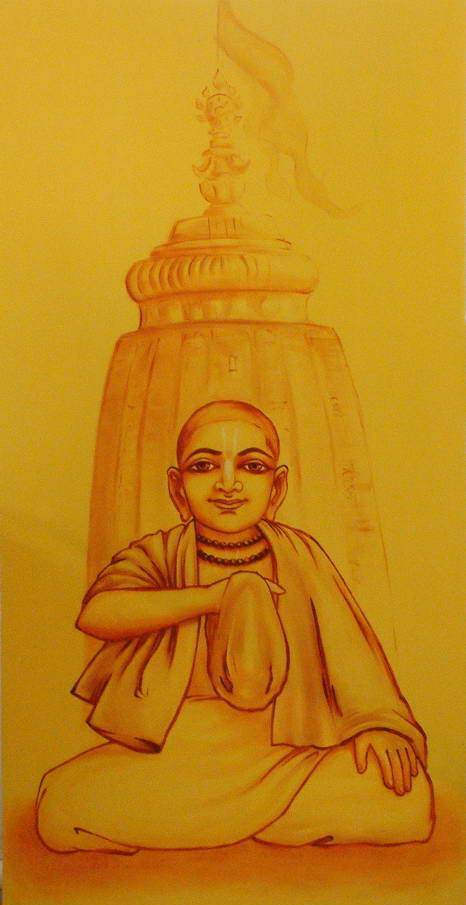
An acharya is a teacher who teaches by his own example as much as by his words. When Krishna decided to come into this world as Sri Chaitanya Mahaprabhu, He set this standard: "Unless one practices devotional service himself, he cannot teach it to others." (Chaitanya-charitamrita Adi 3.21). The title Namacharya (Nāmācārya) points to one subject only: the holy name of Krishna, how it is chanted, and what chanting can and cannot do. Srila Haridasa Thakura (Haridāsa Ṭhākura) is given this title in Srila Prabhupada's translation of Sri Chaitanya-charitamrita, in the very sentence where he explains namabhasa, a dim reflection of the holy name, to Mahaprabhu: "Nāmācārya Haridāsa Ṭhākura, the authority on the chanting of the holy name, said..." (Antya 3.55), and again a few verses later (Antya 3.61). Since then, Gaudiya Vaishnavas have honored this title as his alone.
| Detail | Description |
|---|---|
| Title | Namacharya, "teacher of the holy name" |
| Where the title appears | Srila Prabhupada's translation of Sri Chaitanya-caritamrta, Antya-lila 3.55 and 3.61 |
| Daily chanting | 300,000 names of Krishna, roughly 175 rounds of japa |
| Also called | Brahma Haridasa (regarded as connected to Brahma) |
| Best-known teaching | The distinction between namabhasa, a dim reflection of the name, and pure, offenseless chanting |
Where the Title Comes From #
The word Namacharya is not in the Bengali verses of Chaitanya-charitamrita. It comes from Srila Prabhupada's English translation of the verse in which Haridasa answers the Lord's question about the yavanas, people born outside Vedic culture:
yadyapi anya saṅkete anya haya nāmābhāsa
tathāpi nāmera teja nā haya vināśa
"Nāmācārya Haridāsa Ṭhākura, the authority on the chanting of the holy name, said, “The chanting of the Lord’s holy name to indicate something other than the Lord is an instance of nāmābhāsa. Even when the holy name is chanted in this way, its transcendental power is not destroyed." (Chaitanya-charitamrita Antya 3.55)
Six verses later the translation opens the same way: "Nāmācārya Haridāsa Ṭhākura continued..." (Antya 3.61). Srila Prabhupada uses the title again in his purports and explains it each time. On the verse about Benapola he writes: "Haridāsa Ṭhākura, being the ācārya of chanting the Hare Kṛṣṇa mahā-mantra, is called Nāmācārya Haridāsa Ṭhākura." (Antya 3.100, purport). About the prostitute who was sent to test him, he says that Haridasa, "although born in a mleccha or yavana family, became Nāmācārya Haridāsa Ṭhākura because he performed the nāma-yajña a minimum of 300,000 times every day." (Antya 3.124, purport). At Puri, where temple custom kept him outside the Jagannatha temple, Prabhupada notes: "Nonetheless, he was recognized by Śrī Caitanya Mahāprabhu as Nāmācārya Haridāsa Ṭhākura." (Madhya 11.195, purport). Even the Lord's own praise of Haridasa to Vallabha Bhatta is translated "Haridāsa Ṭhākura, the teacher of the holy name..." (Antya 7.48).
In his lectures Srila Prabhupada stressed that the title came from the Lord's own choice, not from Haridasa's birth: "This Haridāsa Ṭhākura was born in a Muhammadan family. And Caitanya Mahāprabhu made him Nāmācārya Śrīla Haridāsa Ṭhākura." He also said: "Caitanya Mahāprabhu Himself came to broadcast the glory of Hare Kṛṣṇa mahā-mantra. So instead of becoming Himself the ācārya, He designated Haridāsa Ṭhākura as ācārya." (Srila Prabhupada, lecture on Bhagavad-gita 2.26, Hyderabad, 30 November 1972)
Brahma Haridasa #
The tradition also gives him a second name. The summary of the third chapter of Antya-lila, written by Srila Bhaktivinoda Thakura and translated by Srila Prabhupada, speaks of "Haridāsa Ṭhākura, who was known as Brahma Haridāsa" (Chaitanya-charitamrita Antya 3, chapter summary). When a disciple asked about it, Prabhupada replied: "Yes, Srivas Acarya is incarnation of Narada Muni and Haridasa Thakura is incarnation of Lord Brahma, therefore sometimes Haridasa Thakura is called Brahma Haridasa." (Srila Prabhupada, letter to Jayapataka, 17 April 1970). Near the end of Haridasa's life Mahaprabhu Himself spoke of "this incarnation" of his:
loka nistārite ei tomāra ‘avatāra’
nāmera mahimā loke karilā pracāra
"Your role in this incarnation is to deliver the people in general. You have sufficiently preached the glories of the holy name in this world." (Chaitanya-charitamrita Antya 11.25)
Srila Prabhupada's purport joins the two names together: "Haridāsa Ṭhākura is known as nāmācārya because it is he who preached the glories of chanting hari-nāma, the holy name of God. By using the words tomāra avatāra (“your incarnation”), Śrī Caitanya Mahāprabhu confirms that Haridāsa Ṭhākura is the incarnation of Lord Brahmā." (Antya 11.25, purport). The Gaura-ganoddesha-dipika (93-95) describes him as Brahma Mahatapa, the son of Richika Muni, who appeared together with Prahlada Maharaja. This identity is explained in Srila Haridasa Thakura's biography. Srila Bhakti Ballabh Tirtha Maharaj adds an account from Bhaktivinoda Thakura's Navadvipa-dhama-mahatmya. In this account, Lord Brahma remembered how he had once stolen Krishna's calves and cowherd friends in Vraja. So he feared that he might offend the Lord again when He came as Gauranga. He was then told that he would be born among mlecchas, people outside Vedic culture, and would preach the glories of the holy name (Sri Chaitanya: His Life and Associates).
Three Hundred Thousand Names a Day #
About Haridasa's daily life, every source agrees on one thing: the number of names he chanted. When Krishnadasa Kaviraja Goswami lists him among the branches of the Chaitanya tree, this is what he records:
haridāsa-ṭhākura śākhāra adbhuta carita
tina lakṣa nāma teṅho layena apatita
"The twentieth branch of the Caitanya tree was Haridāsa Ṭhākura. His character was wonderful. He used to chant the holy name of Kṛṣṇa 300,000 times a day without fail." (Chaitanya-charitamrita Adi 10.43)
This number appears again and again, through every stage of his life. In the forest at Benapola he chanted it before his tulasi plant, "throughout the entire day and night" (Antya 3.100). When a prostitute was sent to test him, he told her of his vow to chant ten million names in a month (Antya 3.124). Srila Prabhupada works out that this means 333,333 names a day for thirty days, plus ten more (Antya 3.124, purport). In the assembly of the Majumadaras at Chandapura, it was the mention of his three hundred thousand names that started the famous discussion on the holy name (Antya 3.176). That story is told in Teachings on the Holy Name. And at Puri, Mahaprabhu Himself gave the same figure (Antya 7.48).
Srila Prabhupada once did the arithmetic for a disciple: "Haridasa Thakura chanted 3 lakhs of names each day, that means 16 names in the mantra, 108x16 or 1,728 names in each round of mala, dividing 300,000 by 1,728 comes to roundabout 175 rounds on beads daily. And for us it is even difficult to chant 16 rounds! That is why Haridasa Thakura is 'namacarya.'" (Srila Prabhupada, letter to Yajnesvara, 2 January 1972)
The Lord's Own Praise #
Sri Chaitanya Mahaprabhu never hid His high regard for Haridasa. After their conversation at Puri about the yavanas and the trees, He went to His devotees and described Haridasa's qualities "as if He had hundreds of mouths," and Krishnadasa Kaviraja Goswami adds that among all the devotees, "Haridāsa Ṭhākura is the foremost." (Antya 3.93-94). When Haridasa begged the Lord not to touch him, calling himself "most fallen and untouchable," Mahaprabhu answered: "I wish to touch you just to be purified, for your purified activities do not exist in Me." He added that Haridasa was "far better than any brāhmaṇa or sannyāsī" (Madhya 11.188-191). That meeting is told in full in life with Sri Chaitanya Mahaprabhu at Puri.
The clearest praise came when the learned Vallabha Bhatta visited Puri and glorified Mahaprabhu for spreading the holy name. But the Lord saw that the scholar's heart was full of pride. So He turned the praise to His associates and named what He had learned from each of them (Antya 7.16-53). Of Haridasa He said:
haridāsa-ṭhākura — mahā-bhāgavata-pradhāna
prati dina laya teṅha tina-lakṣa nāma
"Haridāsa Ṭhākura, the teacher of the holy name, is the most exalted of all pure devotees. Every day he chants 300,000 holy names of the Lord." (Chaitanya-charitamrita Antya 7.48)
Then the Lord, whose own mission was to give the holy name to the world, said that He had learned its glories from Haridasa:
nāmera mahimā āmi tāṅra ṭhāñi śikhiluṅ
tāṅra prasāde nāmera mahimā jāniluṅ
"I have learned about the glories of the Lord’s holy name from Haridāsa Ṭhākura, and by his mercy I have understood these glories." (Chaitanya-charitamrita Antya 7.49)
On the day Haridasa left this world, Mahaprabhu gave His last and highest praise: "Haridāsa Ṭhākura was the crown jewel on the head of this world; without him, this world is now bereft of its valuable jewel." (Antya 11.97). That day is told in disappearance in the Lord's embrace.
What Srila Prabhupada Teaches From His Example #
Srila Prabhupada drew one practical lesson from Haridasa's life again and again: do not imitate his number, but do keep a fixed vow. Explaining the verse on the three hundred thousand names, he writes: "No ordinary person can chant so many names, nor should one artificially imitate Haridāsa Ṭhākura’s behavior. It is essential, however, that everyone fulfill a specific vow to chant the Hare Kṛṣṇa mantra. Therefore we have prescribed in our Society that all our students must chant at least sixteen rounds daily. Such chanting must be offenseless in order to be of high quality." (Adi 10.43, purport)
He gives the same instruction at the verse that describes Haridasa's cottage at Benapola:
nirjana-vane kuṭira kari’ tulasī sevana
rātri-dine tina lakṣa nāma-saṅkīrtana
"Haridāsa Ṭhākura constructed a cottage in a solitary forest. There he planted a tulasī plant, and in front of the tulasī he would chant the holy name of the Lord 300,000 times daily. He chanted throughout the entire day and night." (Chaitanya-charitamrita Antya 3.100)
In his purport Srila Prabhupada writes: "We can follow his example, however, by chanting sixteen rounds of the Hare Kṛṣṇa mahā-mantra on beads every day and offering respect to the tulasī plant." He says this practice is simple yet of "immense spiritual potency," and urges his followers "to follow Haridāsa Ṭhākura’s example rigidly." (Antya 3.100, purport). At the verse where Haridasa tells the prostitute to chant constantly and serve tulasi, Prabhupada adds that even those not used to it "are advised to chant at least sixteen rounds on their beads so that they may be trained." (Antya 3.137, purport)
The vow mattered to Haridasa to the very end. In his last illness at Puri, his rounds were not finished, so he took only a tiny bit of the prasada that Govinda brought, and he took even that only out of respect for it (Antya 11.17-20). When the Lord asked what his disease was, he named it plainly:
prabhu kahe, — ‘kon vyādhi, kaha ta’ nirṇaya?’
teṅho kahe, — ‘saṅkhyā-kīrtana nā pūraya’
"Śrī Caitanya Mahāprabhu further inquired from Haridāsa, “Can you ascertain what your disease is?” Haridāsa Ṭhākura replied, “My disease is that I cannot complete my rounds.”" (Chaitanya-charitamrita Antya 11.23)
Srila Prabhupada draws the lesson for every devotee: "If one cannot complete the fixed number of rounds he is assigned, he should be considered to be in a diseased condition of spiritual life. Śrīla Haridāsa Ṭhākura is called nāmācārya. Of course, we cannot imitate Haridāsa Ṭhākura, but everyone must chant a prescribed number of rounds." He adds that the sixteen rounds "must be chanted, and chanted loudly, so that one can hear himself and others." (Antya 11.23, purport). In the next verse the Lord, out of love, told the aging Haridasa that he could chant fewer names, since he was already liberated. Here Prabhupada notes that "Ṭhākura Haridāsa was the living example of how to follow the regulative principles." (Antya 11.24, purport)
Prabhupada also warned against copying Haridasa's solitary life. Mahaprabhu gave different orders to different devotees: Nityananda Prabhu to preach in Bengal, Rupa and Sanatana to uncover the holy places of Vrindavana, and Haridasa to stay at Puri and chant. "Consequently one should not try to imitate the behavior of Haridāsa Ṭhākura without being ordered by Śrī Caitanya Mahāprabhu or His representative." (Madhya 11.195, purport). In the same purport he quotes Srila Bhaktisiddhanta Sarasvati Thakura's song against the imitator who sits alone to chant: "pratiṣṭhāra tare, nirjanera ghare, tava hari-nāma kevala kaitava." In Prabhupada's translation, what such a person wants is "cheap popularity and not the actual qualifications of Haridāsa Ṭhākura." Prabhupada explains that a beginner should first work and preach under the direction of the spiritual master, and that "one should not try to imitate Haridāsa Ṭhākura at the beginning of one’s transcendental life." (Madhya 11.176, purport)
Not to Be Confused With Other Devotees Named Haridasa #
Sri Chaitanya Mahaprabhu's circle included other devotees named Haridasa, and the tradition is careful to keep them apart.
- Chota Haridasa (Junior Haridasa) was a devotee in the renounced order of life who used to sing for Mahaprabhu at Puri (Antya 2.102). At Bhagavan Acharya's request he begged fine rice from Madhavi-devi, the elderly and saintly sister of Shikhi Mahiti (Antya 2.103-107). For this, the Lord would no longer allow him to come before Him, saying: "I cannot tolerate seeing the face of a person who has accepted the renounced order of life but who still talks intimately with a woman." (Antya 2.113-117). His story fills Antya-lila chapter two, "The Chastisement of Junior Haridāsa," just before the chapter on Haridasa Thakura's glories (Antya 2).
- Dvija Haridasa is named as the seventy-second branch of Mahaprabhu's own tree (Adi 10.112). From Bhaktisiddhanta Sarasvati Thakura's Anubhashya, quoted in the purport, we learn that "He had two sons, named Śrīdāma and Gokulānanda, who were disciples of Śrī Advaita Ācārya," and that it is uncertain whether he wrote the Ashtottara-shata-nama (Adi 10.112, purport).
- Namacharya Haridasa Thakura is the devotee of Benapola, Chandapura, Phuliya and Siddha Bakula, the teacher of the holy name.
Wherever the name Haridasa appears in Gaudiya literature, the title Namacharya points to the one devotee from whom Mahaprabhu said He had learned the glories of the holy name.
Scriptural evidence for this chapter (10)
Quoted in the text above:
- Antya 3.55 Sri Chaitanya-caritamrta quoted above ↑
- Adi 10.43 Sri Chaitanya-charitamrita quoted above ↑
- Antya 7.48 Sri Chaitanya-charitamrita quoted above ↑
- Antya 7.49 Sri Chaitanya-charitamrita quoted above ↑
- Antya 11.23 Sri Chaitanya-charitamrita quoted above ↑
- Antya 11.25 Sri Chaitanya-charitamrita quoted above ↑
- Antya 3.100 Sri Chaitanya-charitamrita quoted above ↑
Further verses:
“कोटि-नाम-ग्रहण-यज्ञ करि एक-मासे
एइ दीक्षा करियाछि, हैल आसि' शेषे
“koṭi-nāma-grahaṇa-yajña kari eka-māse
ei dīkṣā kariyāchi, haila āsi’ śeṣe
“I have vowed to chant ten million names in a month. I have taken this vow, but now it is nearing its end.
From the purport: On the other hand, we find that Haridāsa Ṭhākura, although born in a mleccha or yavana family, became Nāmācārya Haridāsa Ṭhākura because he performed the nāma-yajña a minimum of 300,000 times every day.
Haridasa's vow of ten million names in a month (333,333 a day, per the purport). Prabhupada explains that by this nāma-yajña Haridasa, though born in a yavana family, became Nāmācārya.
प्रभु कहे, — “वृद्ध ह-इला ‘सङ्ख्या' अल्प कर
सिद्ध-देह तुमि, साधने आग्रह केने कर?
prabhu kahe, — “vṛddha ha-ilā ‘saṅkhyā’ alpa kara
siddha-deha tumi, sādhane āgraha kene kara?
“Now that you have become old,” the Lord said, “you may reduce the number of rounds you chant daily. You are already liberated, and therefore you need not follow the regulative principles very strictly.
From the purport: Unless one has come to the platform of spontaneous love of God, he must follow the regulative principles. Ṭhākura Haridāsa was the living example of how to follow the regulative principles.
Mahaprabhu, out of affection, allows the aged Haridasa to reduce his rounds; Prabhupada calls Haridasa the living example of following the regulative principles.
मन्दिरेर चक्र देखि' करिह प्रणाम
एइ ठाञि तोमार आसिबे प्रसादान्न
mandirera cakra dekhi’ kariha praṇāma
ei ṭhāñi tomāra āsibe prasādānna
“Remain here peacefully and look at the cakra on the top of the temple and offer obeisances. As far as your prasādam is concerned, I shall arrange to have that sent here.”
From the purport: Consequently one should not try to imitate the behavior of Haridāsa Ṭhākura without being ordered by Śrī Caitanya Mahāprabhu or His representative.
The Lord's arrangement for Haridasa at Siddha Bakula. The purport notes that Mahaprabhu recognized him as Nāmācārya though temple custom kept him outside, and warns against imitating his solitary chanting without the order of the Lord or His representative.
Chapter 8
Life With Sri Chaitanya Mahaprabhu at Puri
Barred from the Jagannatha temple by birth, Haridasa Thakura lived in a small garden hut at Puri where the Lord Himself came to see him every day.
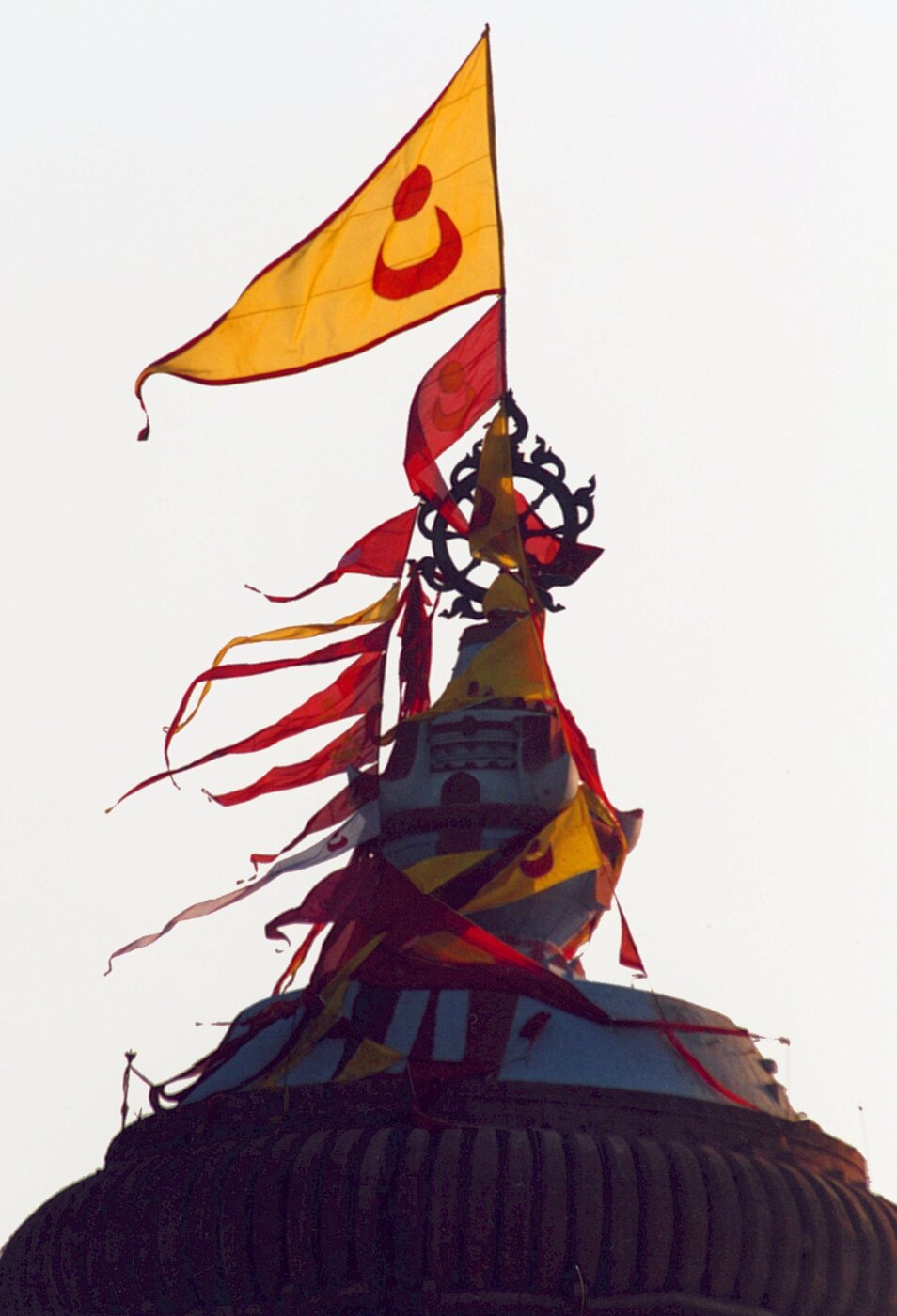
Srila Haridasa Thakura (Haridāsa Ṭhākura) spent his last years at Jagannatha Puri, in one small room in a flower garden. He never entered the great temple, yet Sri Chaitanya Mahaprabhu Himself came to him there every day. The years before this, when he sang, danced and preached at the Lord's side in Navadvipa, are told in With Sri Chaitanya Mahaprabhu in Navadvipa. Here the story begins when the Lord took sannyasa and set out for Puri.
"What Will Be My Destination?" #
Tirtha Maharaj records that Haridasa was staying in the Lord's house on the night before He left Navadvipa to take sannyasa. Afterwards, at Advaita Acharya's house in Shantipur, the Lord asked the devotees to go home and chant the holy name together (Chaitanya-charitamrita Madhya 3.188-192). As He prepared to leave for Puri, Haridasa wept:
nīlācale yābe tumi, mora kon gati
nīlācale yāite mora nāhika śakati
Haridāsa Ṭhākura said, “You are going to Jagannātha Purī, and that is all right, but what will be my destination? I am not able to go to Jagannātha Purī. (Sri Chaitanya-charitamrita Madhya 3.194)
In his purport Srila Prabhupada explains: "Although Śrīla Haridāsa Ṭhākura was born in a Muslim family, he was accepted as a properly initiated brāhmaṇa. As such, he had every right to enter the temple of Jagannātha Purī, but ... Haridāsa Ṭhākura, out of his great humility, did not want to violate these existing rules."
Haridasa felt that if the Lord lived in the temple, a man who could not enter it would never see Him again (Madhya 3.194, purport). The Lord answered, "Please check your humility. Just the sight of your humility very much agitates My mind." He promised that He would make a request to Lord Jagannatha and take Haridasa to Puri Himself (Chaitanya-charitamrita Madhya 3.196-197).
Arrival at Puri and the Temple Rule #
The promise was kept. Some years later, after the Lord's tour of South India, the devotees of Bengal came to Puri for the Ratha-yatra, and Haridasa came with them. The Lord greeted each one, then asked, "Where is Haridāsa?" Haridasa was lying flat at the edge of the public road far away, offering obeisances from a distance (Chaitanya-charitamrita Madhya 11.161-163). The devotees ran to call him, and he answered:
haridāsa kahe, — muñi nīca-jāti chāra
mandira-nikaṭe yāite mora nāhi ādhikāra
Haridāsa Ṭhākura replied, “I cannot go near the temple because I am a low-caste, abominable person. I have no authority to go there.” (Sri Chaitanya-charitamrita Madhya 11.165)
In his purport Srila Prabhupada explains: "This is a long-standing regulation, and thus Haridāsa Ṭhākura, although certainly competent and qualified to enter the temple, did not want even to go near it."
He asked only for a lonely place near the temple, where he would not touch any servant of Lord Jagannatha (Madhya 11.166-167). The Lord was delighted to hear it (Madhya 11.168). Sri Chaitanya-charitamrita records no complaint from Haridasa about the rule.
A Room in the Flower Garden #
When Kashi Mishra came to arrange places for the devotees to stay, the Lord asked him for a single solitary room in a flower garden near His own residence: "Indeed, I shall remember the lotus feet of the Lord sitting in that solitary place" (Chaitanya-charitamrita Madhya 11.175-176). Srila Prabhupada notes that the Lord wanted it "either for Himself or Haridāsa Ṭhākura". He also warns that beginners should not imitate such solitary chanting (Madhya 11.176, purport).
Then the Lord went to Haridasa, who fell flat before Him like a stick. The Lord lifted him up and embraced him, and both began to cry (Madhya 11.185-187). "My dear Lord, please do not touch me," Haridasa pleaded, "for I am most fallen and untouchable and am the lowest among men." The Lord replied, "I wish to touch you just to be purified, for your purified activities do not exist in Me" (Chaitanya-charitamrita Madhya 11.188-189). He said that Haridasa was bathing in every holy place at every moment and was far better than any brahmana or sannyasi (Madhya 11.190-192). Then He led him into the garden and showed him his room:
mandirera cakra dekhi’ kariha praṇāma
ei ṭhāñi tomāra āsibe prasādānna
“Remain here peacefully and look at the cakra on the top of the temple and offer obeisances. As far as your prasādam is concerned, I shall arrange to have that sent here.” (Sri Chaitanya-charitamrita Madhya 11.195)
In his purport Srila Prabhupada explains: "This means that if one is not allowed to enter the temple, or if he thinks himself unfit to enter the temple, he can look at the wheel from outside the temple, and that is as good as seeing the Deity within."
That same day the Lord carefully sent prasadam to Haridasa through His servant Govinda (Madhya 11.206). From then on Haridasa remained at Puri, among the Lord's own Puri devotees (Chaitanya-charitamrita Adi 10.124-126).
Siddha Bakula and the Bakula Tree #
The garden where Haridasa lived is known today as Siddha Bakula. Srila Prabhupada writes: "A monastery has now been erected there, known as Siddhabakula Maṭha" (Chaitanya-charitamrita Madhya 3.194, purport). Tirtha Maharaj adds that the place was earlier called Mudra Math.
The name comes from a bakula tree. Sri Chaitanya-charitamrita does not mention it. The story is a local Puri tradition recorded by Tirtha Maharaj. It is said that the temple priests sometimes gave the twig used to clean Lord Jagannatha's teeth (danta-kashtha) as prasadam to a special person. Once such a bakula twig was given to Sri Chaitanya Mahaprabhu. He planted it at the place where Haridasa chanted, and it grew into a great tree. The tradition says the planting took place on Mahavishuva Sankranti, the day the sun enters Aries. According to the same account, a Danta-kashtha-ropana festival, the festival of planting the tooth-cleaning twig, is held on that day every year.
The Lord's Daily Visits #
Every morning the Lord went to the temple to see the upala-bhoga offering, and on His way home He stopped to see Haridasa. When Rupa Goswami and Sanatana Goswami came to Puri, they too kept away from the temple and stayed with Haridasa, and the Lord visited whichever of them was there (Chaitanya-charitamrita Madhya 1.63-65; Antya 1.45; Antya 4.13-16). In his purport Srila Prabhupada draws the lesson: "Kṛṣṇa Himself associates with devotees who are chanting His holy name, and there is no need to be unhappy over not being able to enter a certain temple." The Lord's affection for Haridasa and Sanatana was open and tender. He told them, "I think of you as My little boys, to be maintained by Me." (Chaitanya-charitamrita Antya 4.184)
There, in Haridasa's room, Sanatana spoke the praise that has defined Haridasa ever since:
‘ācāra’, ‘pracāra’, — nāmera karaha ‘dui’ kārya
tumi — sarva-guru, tumi jagatera ārya
“You simultaneously perform both duties in relation to the holy name by your personal behavior and by your preaching. Therefore you are the spiritual master of the entire world, for you are the most advanced devotee in the world.” (Sri Chaitanya-charitamrita Antya 4.103)
In his purport Srila Prabhupada explains: "The qualifications expressed in this connection are that one must act according to the scriptural injunctions and at the same time preach."
On festival days Haridasa came out to dance. At the Ratha-yatra, in the party led by Mukunda Datta, "the senior Haridāsa [Haridāsa Ṭhākura] was the dancer" (Chaitanya-charitamrita Madhya 13.40-41).
In these years the Lord felt the deepest separation from Krishna, and He spent His nights with Ramananda Raya and Svarupa Damodara Goswami (Antya 11.11-15). His visit to Haridasa belonged to the daytime. It was a fixed hour of quiet friendship.
dine nṛtya-kīrtana, īśvara-daraśana
rātrye rāya-svarūpa-sane rasa-āsvādana
"In the daytime Śrī Caitanya Mahāprabhu engaged in dancing and chanting and in seeing the temple of Lord Jagannātha. At night, in the company of His most confidential devotees, such as Rāmānanda Rāya and Svarūpa Dāmodara Gosvāmī, He tasted the nectar of the transcendental mellows of Lord Śrī Kṛṣṇa’s pastimes." (Sri Chaitanya-charitamrita Antya 11.12)
Honoured Above His Birth #
Years before, at Shantipur, Advaita Acharya had offered him the shraddha-patra, the plate of food from the memorial rite for Advaita's father, which custom kept for the best brahmanas (Chaitanya-charitamrita Adi 10.44). Near the end of his life, Haridasa himself remembered this honour as he spoke to the Lord:
aneka nācāilā more prasāda kariyā
viprera śrāddha-pātra khāinu ‘mleccha’ hañā
“My dear Lord, by Your mercy You have made me dance in many ways. For example, I was offered the śrāddha-pātra, which should have been offered to first-class brāhmaṇas. I ate from it even though I was born in a family of meat-eaters.” (Sri Chaitanya-charitamrita Antya 11.30)
In his purport Srila Prabhupada explains: "Although Haridāsa Ṭhākura was born in the family of meat-eaters, because he was an advanced devotee he was shown more respect than a first-class brāhmaṇa."
In the same purport Srila Prabhupada cites Bhaktisiddhanta Sarasvati Thakura's Anubhashya, which says that a person born a brahmana who does not live like a brahmana should not receive the shraddha-patra. Srimad-Bhagavatam gives the rule: "If one shows the symptoms of being a brāhmaṇa, kṣatriya, vaiśya or śūdra, as described above, even if he has appeared in a different class, he should be accepted according to those symptoms of classification" (Srimad-Bhagavatam 7.11.35). The temple rule stayed, and Haridasa honoured it, but Srila Prabhupada is clear about what the Lord thought of it: "Such dogmatic prohibitions were not approved by Lord Caitanya Mahāprabhu" (Madhya 1.63, purport).
The Last Years at Siddha Bakula #
Haridasa grew old in that garden, still chanting three hundred thousand names a day. One day Govinda found him lying down and chanting slowly. Haridasa ate only a little of the prasadam, saying, "But you have brought mahā-prasādam, and how can I neglect it?" (Chaitanya-charitamrita Antya 11.16-20). The next day he told the Lord that his only disease was that he could not complete his rounds (Antya 11.21-23), and the Lord made a loving suggestion:
prabhu kahe, — “vṛddha ha-ilā ‘saṅkhyā’ alpa kara
siddha-deha tumi, sādhane āgraha kene kara?
“Now that you have become old,” the Lord said, “you may reduce the number of rounds you chant daily. You are already liberated, and therefore you need not follow the regulative principles very strictly.” (Sri Chaitanya-charitamrita Antya 11.24)
In his purport Srila Prabhupada explains: "Ṭhākura Haridāsa was the living example of how to follow the regulative principles."
Haridasa did not take the rest that was offered. Instead he asked the Lord for one last mercy, told in Disappearance in the Lord's Embrace.
Scriptural evidence for this chapter (9)
Quoted in the text above:
- Antya 11.30 Sri Chaitanya-caritamrta quoted above ↑
- Madhya 11.165 Sri Chaitanya-charitamrita quoted above ↑
- Madhya 11.195 Sri Chaitanya-charitamrita quoted above ↑
- Antya 11.12 Sri Chaitanya-charitamrita quoted above ↑
- Antya 11.24 Sri Chaitanya-charitamrita quoted above ↑
- Madhya 3.194 Sri Chaitanya-charitamrita quoted above ↑
- Antya 4.103 Sri Chaitanya-charitamrita quoted above ↑
Further verses:
yasya yal lakṣaṇaṁ proktaṁ
puṁso varṇābhivyañjakam
yad anyatrāpi dṛśyeta
tat tenaiva vinirdiśet
If one shows the symptoms of being a brahmana, kshatriya, vaishya or shudra, as described above, even if he has appeared in a different class, he should be accepted according to those symptoms of classification.
Supports Bhaktisiddhanta Sarasvati Thakura's commentary, quoted above, that a person born in a brahmana family who does not act like one should not receive a brahmana's honors, while a devotee of Haridasa's caliber deserves them regardless of birth. The same verse is used on the Birth and Early Life page for Advaita Acharya's identical reasoning.
प्रभु कहे, — तोमा स्पर्शि पवित्र ह-इते
तोमार पवित्र धर्म नाहिक आमाते
prabhu kahe, — tomā sparśi pavitra ha-ite
tomāra pavitra dharma nāhika āmāte
The Lord said, “I wish to touch you just to be purified, for your purified activities do not exist in Me.”
From the purport: This is an example of the reciprocation of feelings between master and servant. (Srila Prabhupada, Chaitanya-charitamrita Madhya 11.189 purport)
The Lord's reply when Haridasa, newly arrived at Puri, begged Him not to touch him.
Chapter 9
Disappearance in the Lord's Embrace
Haridasa Thakura chose the day of his own passing, chanted through a final kirtana that Sri Chaitanya Mahaprabhu held in his presence, and disappeared with the Lord's feet against his heart.
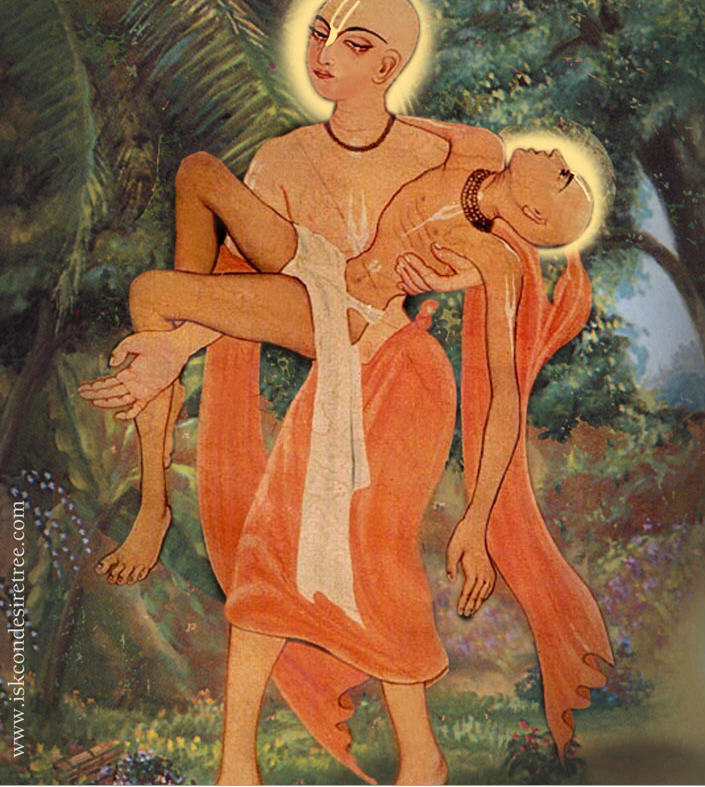
Krishnadasa Kaviraja Goswami gives a whole chapter of Sri Chaitanya-charitamrita to the last days of Srila Haridasa Thakura (Haridāsa Ṭhākura). It is the eleventh chapter of the Antya-lila, called "The Passing of Haridāsa Ṭhākura". He tells it slowly, almost hour by hour, because here the love of Sri Chaitanya Mahaprabhu for His devotee is seen in full. The chapter's very first verse already holds the whole story:
namāmi haridāsaṁ taṁ
caitanyaṁ taṁ ca tat-prabhum
saṁsthitām api yan-mūrtiṁ
svāṅke kṛtvā nanarta yaḥ
"Let me offer my respectful obeisances unto Haridāsa Ṭhākura and his master, Śrī Caitanya Mahāprabhu, who danced with the body of Haridāsa Ṭhākura on His lap." (Sri Chaitanya-charitamrita Antya 11.1)
A few verses later the author glorifies the Lord in the same spirit: "All glories to the master of Haridāsa Ṭhākura!" (Chaitanya-charitamrita Antya 11.3). Haridasa had no shelter other than this master, and the chapter shows how the master answered him.
A Little Prasadam, Honoured #
By this time Sri Chaitanya Mahaprabhu's feelings of separation from Krishna were growing stronger day by day, and Svarupa Damodara Goswami and Ramananda Raya stayed with Him day and night (Antya 11.13-15). Haridasa was living at Siddha Bakula, as told in Life With Sri Chaitanya Mahaprabhu at Puri. One day Govinda, the Lord's servant, happily came to bring him Lord Jagannatha's prasadam. He found Haridasa lying on his back, chanting his rounds very slowly (Antya 11.16-17). "Please rise and take your mahā-prasādam," Govinda said. Haridasa replied that he would fast that day, because his chanting was not complete. Then he added: "But you have brought mahā-prasādam, and how can I neglect it?" He offered prayers to the prasadam, took a tiny portion and ate it (Chaitanya-charitamrita Antya 11.18-20). In his purport Srila Prabhupada explains: "Mahā-prasādam is nondifferent from Kṛṣṇa. Therefore, instead of eating mahā-prasādam, one should honor it."
"My Disease Is That I Cannot Complete My Rounds" #
The next day the Lord Himself came and asked, "Haridāsa, are you well?" Haridasa bowed and said, "My body is all right, but my mind and intelligence are not well." When the Lord asked what his disease was, he answered, "My disease is that I cannot complete my rounds" (Chaitanya-charitamrita Antya 11.21-23). Srila Prabhupada draws the lesson for every devotee: "If one cannot complete the fixed number of rounds he is assigned, he should be considered to be in a diseased condition of spiritual life" (Antya 11.23, purport).
The Lord lovingly told him that he was old and already liberated, so he could chant fewer names (Antya 11.24). Then He added: "Your role in this incarnation is to deliver the people in general. You have sufficiently preached the glories of the holy name in this world" (Chaitanya-charitamrita Antya 11.25). In his purport Srila Prabhupada notes: "By using the words tomāra avatāra (“your incarnation”), Śrī Caitanya Mahāprabhu confirms that Haridāsa Ṭhākura is the incarnation of Lord Brahmā." (On this identity, see Namacharya, the Teacher of the Holy Name.)
The Request #
Haridasa did not argue about his rounds. He answered with a prayer he had carried in his heart for a long time. First he spoke of his own lowliness and the Lord's kindness: he was born in a low family and was "unseeable and untouchable", yet the Lord had accepted him as His servant and lifted him from hell to Vaikuntha, the spiritual world. The Lord had made him dance in many ways, even letting him eat the shraddha-patra meant for the best brahmanas (Antya 11.27-30). Then he made his request. He felt that the Lord would soon end His pastimes in this world, and he could not bear to see that (Antya 11.31):
sei līlā prabhu more kabhu nā dekhāibā
āpanāra āge mora śarīra pāḍibā
“I wish that You not show me this closing chapter of Your pastimes. Before that time comes, kindly let my body fall down in Your presence.” (Sri Chaitanya-charitamrita Antya 11.32)
He knew exactly how he wished to go. He wanted to hold the Lord's lotus feet on his heart, to look at His moonlike face, and to chant with his tongue the Lord's own name, "Śrī Kṛṣṇa Caitanya!" (Antya 11.33-34). He begged, "Let this lowborn body fall down before You." (Antya 11.36)
"Whatever Happiness Is Mine" #
The Lord could not refuse him, but His heart was heavy. He said, "My dear Haridāsa, Kṛṣṇa is so merciful that He must execute whatever you want." (Chaitanya-charitamrita Antya 11.37) Then He opened His heart:
kintu āmāra ye kichu sukha, saba tomā lañā
tomāra yogya nahe, — yābe āmāre chāḍiyā”
“But whatever happiness is Mine is all due to your association. It is not fitting for you to go away and leave Me behind.” (Sri Chaitanya-charitamrita Antya 11.38)
Haridasa caught the Lord's feet. "My Lord, do not create an illusion!" he said. "Although I am so fallen, You must certainly show me this mercy!" (Antya 11.39). He said that the Lord had millions of devotees. All of them were fit to be placed on his head, and all of them were helping in His pastimes (Antya 11.40). What would the world lose by his going?
āmā-hena yadi eka kīṭa mari’ gela
eka pipīlikā maile pṛthvīra kāhāṅ hāni haila?
“My Lord, if an insignificant insect like me dies, what is the loss? If an ant dies, where is the loss to the material world?” (Sri Chaitanya-charitamrita Antya 11.41)
"I am just an imitation devotee," he ended, "but nevertheless I wish that You fulfill my desire" (Antya 11.42). The Lord embraced him and went to the sea for His noon duties. It was settled that He would come back the next morning after seeing Lord Jagannatha (Antya 11.43-44).
The Last Morning #
Early next morning, after visiting the temple, the Lord hurried to Haridasa with all His devotees. Haridasa bowed to the feet of the Lord and of every Vaishnava. "My dear Haridāsa, what is the news?" the Lord asked, and Haridasa answered, "My Lord, whatever mercy You can bestow upon me" (Chaitanya-charitamrita Antya 11.45-47).
At once the Lord began a great sankirtana (saṅkīrtana), congregational chanting of the holy name, in the courtyard. Vakreshvara Pandita was the chief dancer, and the devotees led by Svarupa Damodara surrounded Haridasa and chanted (Antya 11.48-49). Then, in front of Ramananda Raya, Sarvabhauma Bhattacharya and all the others, the Lord began to describe Haridasa's qualities. He spoke as if He had five mouths, and the more He described, the happier He became. The devotees were struck with wonder and all bowed down at Haridasa's feet (Antya 11.50-52).
Haridasa had the Lord sit down in front of him and fixed his eyes, like two bumblebees, on the Lord's lotus face. He held the Lord's feet on his heart and put the dust of all the devotees' feet on his head. Again and again he chanted "Śrī Kṛṣṇa Caitanya", drinking in the sweetness of the Lord's face while tears poured from his eyes (Antya 11.53-55). And so his wish was granted:
‘śrī-kṛṣṇa-caitanya’ śabda karite uccāraṇa
nāmera sahita prāṇa kaila utkrāmaṇa
"While chanting the holy name of Śrī Kṛṣṇa Caitanya, he gave up his air of life and left his body." (Sri Chaitanya-charitamrita Antya 11.56)
He was not carried off by sickness. He left when he chose to leave, and the devotees who watched remembered Bhishma, the grandsire of the Mahabharata: "Seeing the wonderful death of Haridāsa Ṭhākura by his own will, which was just like a great mystic yogī’s, everyone remembered the passing away of Bhīṣma" (Chaitanya-charitamrita Antya 11.57).
The Lord Dances With His Body #
The courtyard rang with the names of Hari and Krishna, and Sri Chaitanya Mahaprabhu was overwhelmed with love. He lifted Haridasa's body, placed it on His lap and began to dance in the courtyard. Seeing Him, the devotees too lost all control and danced and chanted with Him (Antya 11.58-60). Only after some time did Svarupa Damodara remind the Lord of the rites still to be done (Antya 11.61).
The body was placed on a carrier like a small airship and taken to the sea with kirtana. The Lord danced at the front of the procession, and Vakreshvara Pandita and the devotees danced behind Him (Chaitanya-charitamrita Antya 11.62-63).
Laid to Rest by the Sea #
At the shore the Lord bathed the body Himself:
haridāse samudra-jale snāna karāilā
prabhu kahe, — “samudra ei ‘mahā-tīrtha’ ha-ilā”
"Śrī Caitanya Mahāprabhu bathed the body of Haridāsa Ṭhākura in the sea and then declared, “From this day on, this sea has become a great pilgrimage site.”" (Sri Chaitanya-charitamrita Antya 11.64)
The devotees drank the water that had washed Haridasa's feet and smeared his body with Lord Jagannatha's sandalwood pulp. A grave was dug in the sand, and the body was laid in it with Jagannatha's remnants: His silken ropes, sandalwood, food and cloth (Antya 11.65-66). Vakreshvara danced while the devotees chanted all around. Then the Lord, "chanting “Haribol! Haribol!”", covered the body with sand with His own hands (Chaitanya-charitamrita Antya 11.67-68). A platform was built over the grave and fenced on every side, and the Lord danced and chanted around it until the whole world seemed full of the name of Hari. Afterwards He bathed in the sea with His devotees (Antya 11.69-71).
Begging at the Lion Gate #
Then the Lord walked around the tomb and went straight to the Simha-dvara, the Lion Gate of the Jagannatha temple, while the whole city rang with kirtana. There He spread out His cloth before the shopkeepers who sold prasadam and asked them for alms: "I am begging prasādam for a festival honoring the passing away of Haridāsa Ṭhākura," the Lord said. "Please give Me alms" (Chaitanya-charitamrita Antya 11.72-74).
The shopkeepers jumped up joyfully with whole baskets of prasadam. Svarupa Damodara stopped them and sent the Lord back to His residence. Svarupa kept four Vaishnavas and four porters with him and asked each shop for four palmfuls of every item, until the porters were fully loaded. Vaninatha Pattanayaka and Kashi Mishra also sent large quantities (Antya 11.75-80).
The Feast #
The Lord seated the devotees in rows and began to serve them Himself. His hand could not give a little, so He put enough for five men on every plate, until Svarupa Damodara begged Him to sit and watch while others served (Antya 11.81-83). Svarupa, Jagadananda Pandita, Kashishvara Pandit and Shankara Pandita served without stopping. No one would eat before the Lord, so Kashi Mishra brought Him prasadam and fed Him with great care, and He ate with Paramananda Puri and Brahmananda Bharati (Antya 11.84-87). Then all the Vaishnavas ate. They were filled up to the neck, because the Lord kept calling to the servers, "Give them more! Give them more!" Afterwards He decorated each devotee with a flower garland and sandalwood pulp (Antya 11.88-89).
The Benediction #
Overwhelmed with love, the Lord then gave a blessing that reaches everyone who took part in that day (Antya 11.90):
“haridāsera vijayotsava ye kaila darśana
ye ihāṅ nṛtya kaila, ye kaila kīrtana
ye tāṅre vālukā dite karila gamana
tāra madhye mahotsave ye kaila bhojana
acire ha-ibe tā-sabāra ‘kṛṣṇa-prāpti’
haridāsa-daraśane haya aiche ‘śakti’
Śrī Caitanya Mahāprabhu gave this benediction: “Anyone who has seen the festival of Śrī Haridāsa Ṭhākura’s passing away, anyone who has chanted and danced here, anyone who has offered sand on the body of Haridāsa Ṭhākura, and anyone who has joined this festival to partake of the prasādam will achieve the favor of Kṛṣṇa very soon. There is such wonderful power in seeing Haridāsa Ṭhākura.” (Sri Chaitanya-charitamrita Antya 11.91-93)
Then the Lord spoke of His own loss: "Being merciful upon Me, Kṛṣṇa gave Me the association of Haridāsa Ṭhākura. Being independent in His desires, He has now broken that association." And again: "When Haridāsa Ṭhākura wanted to leave this material world, it was not within My power to detain him." (Chaitanya-charitamrita Antya 11.94-95) He too thought of Bhishma:
icchā-mātre kailā nija-prāṇa niṣkrāmaṇa
pūrve yena śuniyāchi bhīṣmera maraṇa
“Simply by his will, Haridāsa Ṭhākura could give up his life and go away, exactly like Bhīṣma, who previously died simply by his own desire, as we have heard from śāstra.” (Sri Chaitanya-charitamrita Antya 11.96)
Then the Lord said, "Haridāsa Ṭhākura was the crown jewel on the head of this world; without him, this world is now bereft of its valuable jewel." (Chaitanya-charitamrita Antya 11.97) He told everyone to call out "All glories to Haridāsa Ṭhākura!" and began to dance, and all the devotees sang, "All glories to Haridāsa Ṭhākura, who revealed the importance of chanting the holy name of the Lord!" (Antya 11.98-99). Then He sent the devotees home and rested, "with mixed feelings of happiness and distress" (Antya 11.100).
A Victory, Not a Defeat #
Krishnadasa Kaviraja does not call this a death. He calls it Haridasa's vijaya, his victory, and he promises a blessing to every listener:
ei ta’ kahiluṅ haridāsera vijaya
yāhāra śravaṇe kṛṣṇe dṛḍha-bhakti haya
"Thus I have spoken about the victorious passing away of Haridāsa Ṭhākura. Anyone who hears this narration will certainly fix his mind firmly in devotional service to Kṛṣṇa." (Sri Chaitanya-charitamrita Antya 11.101)
He sees in it, above all, the Lord's love for His devotees: "Although He is the topmost of all sannyāsīs, He fully satisfied the desire of Haridāsa Ṭhākura" (Chaitanya-charitamrita Antya 11.102). The Lord gave Haridasa His company and His touch at the end, danced with his body, covered it with sand with His own hand, begged the food for his festival and held the festival Himself (Antya 11.103-104). And he counts Haridasa's early departure as good fortune: "It was his great fortune that he passed away before Śrī Caitanya Mahāprabhu" (Chaitanya-charitamrita Antya 11.105). In the same verse Haridasa is called "parama-vidvān", the most learned. In his purport Srila Prabhupada explains why: "Actually, the most important science to know is the science of getting out of the clutches of material existence. Anyone who knows this science must be considered the greatest learned person."
His Samadhi at Puri #
The grave by the sea is still honoured. In his purport to Antya 11.101 Srila Prabhupada writes: "If one goes from there to the sea, he can discover the tomb of Haridāsa Ṭhākura still existing. Every year on the date of Ananta-caturdaśī there is a festival to commemorate the passing away of Haridāsa Ṭhākura." He is speaking of the walk from the temple of Tota-gopinatha down to the sea. Tirtha Maharaj likewise gives the day of his passing as the fourteenth day of the bright fortnight of Bhadra, which is Ananta-chaturdashi.
The same purport adds that Bhaktivinoda Thakura built a small house called the Bhakti-kuti near the tomb, and that in 1922 the Purushottama Math, a branch of the Gaudiya Math, was established there. It also quotes the Bhakti-ratnakara, which tells how Srinivasa Acharya ran to the shore and fell before Haridasa's samadhi, almost fainting. Pilgrims still come today to that shore, where the Lord Himself declared the sea a great place of pilgrimage because Haridasa's body had touched it.
Scriptural evidence for this chapter (14)
Quoted in the text above:
- Antya 11.1 Sri Chaitanya-caritamrta quoted above ↑
- Antya 11.32 Sri Chaitanya-charitamrita quoted above ↑
- Antya 11.56 Sri Chaitanya-charitamrita quoted above ↑
- Antya 11.91-93 Sri Chaitanya-charitamrita quoted above ↑
- Antya 11.96 Sri Chaitanya-charitamrita quoted above ↑
- Antya 11.25 Sri Chaitanya-charitamrita quoted above ↑
- Antya 11.38 Sri Chaitanya-charitamrita quoted above ↑
- Antya 11.41 Sri Chaitanya-charitamrita quoted above ↑
- Antya 11.57 Sri Chaitanya-charitamrita quoted above ↑
- Antya 11.64 Sri Chaitanya-charitamrita quoted above ↑
- Antya 11.74 Sri Chaitanya-charitamrita quoted above ↑
- Antya 11.101 Sri Chaitanya-charitamrita quoted above ↑
Further verses:
হরিদাস আছিল পৃথিবীর ‘শিরোমণি’। তাহা বিনা রত্ন-শূন্যা হইল মেদিনী॥
haridāsa āchila pṛthivīra 'śiromaṇi'
tāhā vinā ratna-śūnyā ha-ila medinī
Word for word
haridāsa āchila: Haridasa Thakura was; pṛthivīra: of this world; śiromaṇi: the crown jewel; tāhā vinā: without him; ratna-śūnyā: without the valuable jewel; ha-ila medinī: this world becomes.
"Haridasa Thakura was the crown jewel on the head of this world; without him, this world is now bereft of its valuable jewel."
Part of Sri Chaitanya Mahaprabhu's own benediction spoken to the assembled devotees on the day of Haridasa's passing.
महा-भागवत हरिदास — परम-विद्वान्
ए सौभाग्य लागि' आगे करिला प्रयाण
mahā-bhāgavata haridāsa — parama-vidvān
e saubhāgya lāgi’ āge karilā prayāṇa
Haridāsa Ṭhākura was not only the topmost devotee of the Lord but also a great and learned scholar. It was his great fortune that he passed away before Śrī Caitanya Mahāprabhu.
From the purport: Actually, the most important science to know is the science of getting out of the clutches of material existence. Anyone who knows this science must be considered the greatest learned person. (Srila Prabhupada, Chaitanya-charitamrita Antya 11.105 purport)
Haridasa is called parama-vidvan, the most learned, and his passing before the Lord is counted his great fortune.
Closing
Lord Brahma in the Pastimes of Sri Chaitanya #
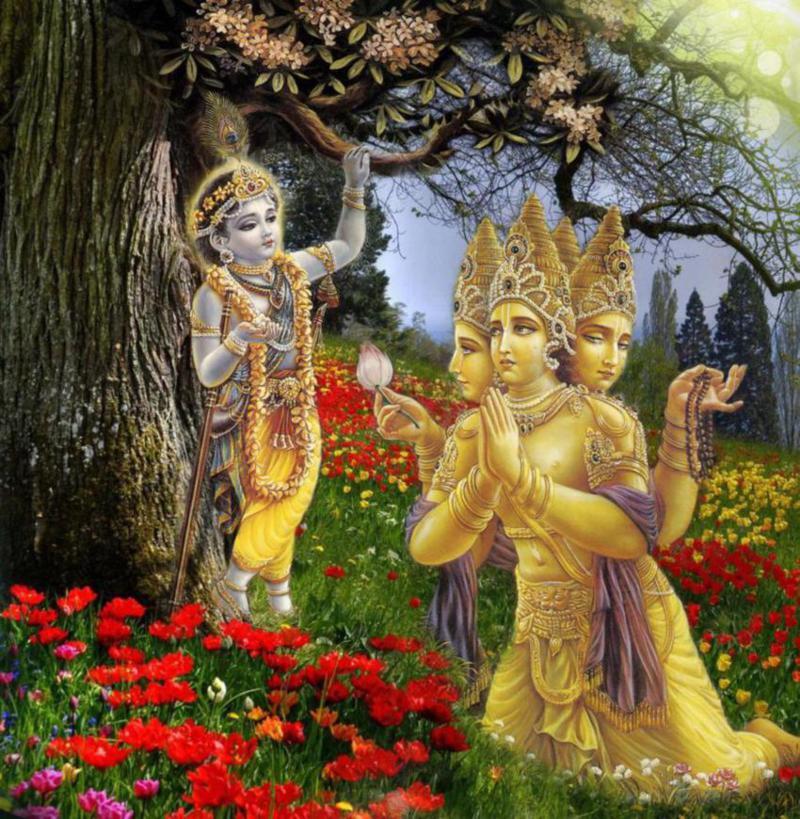
Gaudiya Vaishnavas have never seen Haridasa's birth in a Muslim home as a mere accident. Kavi Karnapura's Gaura-ganoddesha-dipika (verse 93) names him as Brahma, a great ascetic (mahatapa) and the son of Rcika Muni, who appeared together with Prahlada Maharaja. Verses 94-95 follow the account of Murari Gupta and tell why he was born in a yavana (Muslim) family:
ṛcīkasya muneḥ putro nāmnā brahmā mahātapāḥ
prahlādena samaṁ jāto haridāsākhyako'pi san
murāri-gupta-caraṇaiś caitanya-caritāmṛte
ukto muni-sutaḥ prātas tulasī-pātram āharan
adhautam abhiṣaptas taṁ pitā yāvanatāṁ gataḥ
sa eva haridāsaḥ san jātaḥ parama bhaktimān
"Rcika Muni's son Brahma Mahatapah, and Prahlada Maharaja combined to appear as Haridasa Thakur in Lord Caitanya's pastimes. ... In the book Caitanya-carita, Murari Gupta explains that one morning Mahatapah gave an unwashed tulasi leaf to his father, who became so angry at him for this that he cursed him. Because of this Mahatapah took birth in a yavana family as the great devotee Haridasa Thakura." (Gaura-ganoddesha-dipika 93-95)
In Sri Chaitanya-charitamrita (Antya 11.25), Sri Chaitanya Mahaprabhu Himself tells Haridasa: "Your role in this incarnation is to deliver the people in general. You have sufficiently preached the glories of the holy name in this world." Srila Prabhupada explains in his purport to Chaitanya-charitamrita Antya 11.25: "By using the words tomāra avatāra (“your incarnation”), Śrī Caitanya Mahāprabhu confirms that Haridāsa Ṭhākura is the incarnation of Lord Brahmā. ... Haridāsa Ṭhākura is thus the incarnation of Lord Brahmā, and other devotees are likewise incarnations who help in the prosecution of the Lord’s mission."
What Srila Prabhupada Teaches From His Life #
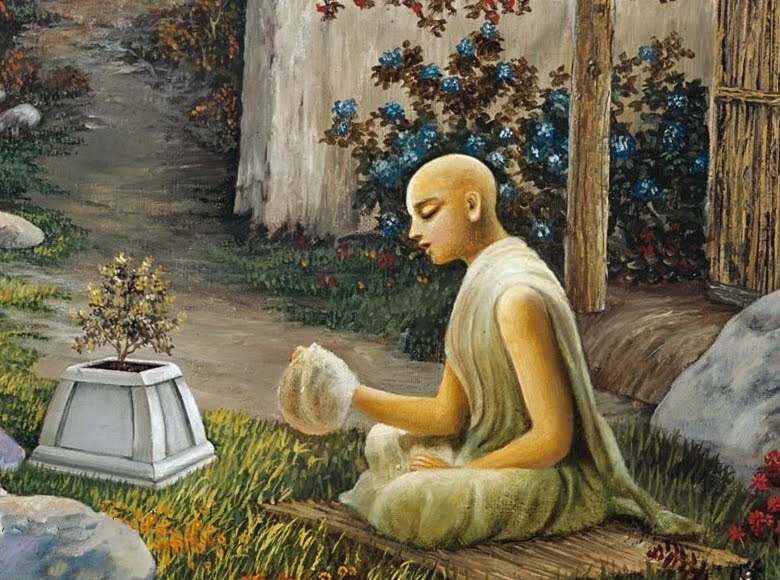
Srila Prabhupada returned to Haridasa Thakura's example again and again, but he never asked anyone to copy the number 300,000. "No ordinary person can chant so many names, nor should one artificially imitate Haridāsa Ṭhākura’s behavior. It is essential, however, that everyone fulfill a specific vow to chant the Hare Kṛṣṇa mantra" (Chaitanya-charitamrita Adi 10.43, purport). The simple life at Benapola became his model for every devotee:
nirjana-vane kuṭira kari’ tulasī sevana
rātri-dine tina lakṣa nāma-saṅkīrtana
"Haridāsa Ṭhākura constructed a cottage in a solitary forest. There he planted a tulasī plant, and in front of the tulasī he would chant the holy name of the Lord 300,000 times daily. He chanted throughout the entire day and night." (Sri Chaitanya-charitamrita Antya 3.100)
In his purport he writes: "We can follow his example, however, by chanting sixteen rounds of the Hare Kṛṣṇa mahā-mantra on beads every day and offering respect to the tulasī plant." He saw in Haridasa the proof that birth decides nothing: "He was apparently born in a family of Muhammadans, but because he was chanting the holy name of the Supreme Lord offenselessly, Lord Caitanya empowered him to become the authority, or ācārya, of spreading the name" (Srimad-Bhagavatam 3.33.7, purport). From the way Haridasa guided the woman he saved, Prabhupada drew a rule for every teacher: "Following the instructions of Haridāsa Ṭhākura, a pure Vaiṣṇava does not personally take even a single paisa from anyone" (Chaitanya-charitamrita Antya 3.139, purport). And from Haridasa's last illness he drew a gentle warning for all of us: "If one cannot complete the fixed number of rounds he is assigned, he should be considered to be in a diseased condition of spiritual life" (Chaitanya-charitamrita Antya 11.23, purport).
