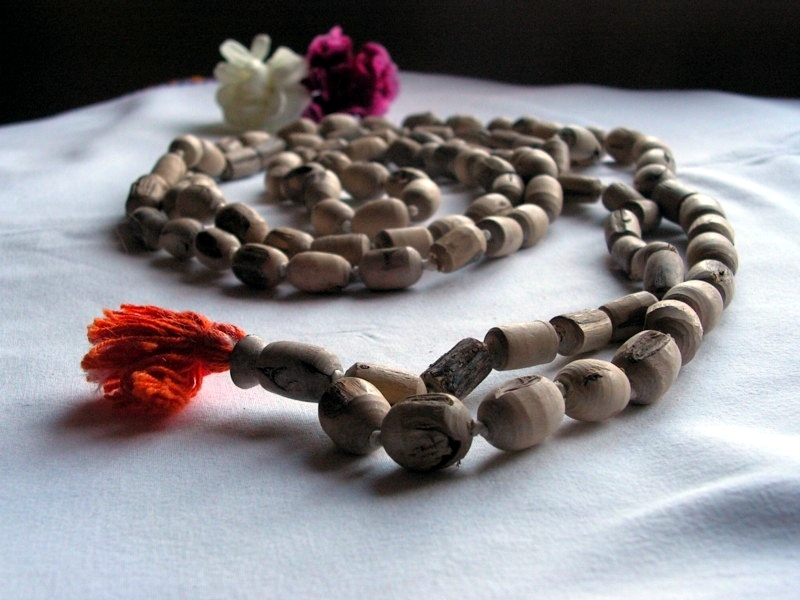
Srila Haridasa Thakura (Haridāsa Ṭhākura) taught the holy name mostly by chanting it himself, three hundred thousand times every day. He only rarely taught by argument. But when he was asked what the name really does, his answers became the clearest teaching in the Gaudiya Vaishnava tradition on three kinds of chanting: chanting with offenses, namabhasa (nāmābhāsa, the first faint glimmer of the name), and pure chanting. Three such conversations are recorded. Two come from Krishnadasa Kaviraja Goswami's Sri Chaitanya-charitamrita: a public discussion in the assembly of the Majumadara brothers at Chandapura, and a private talk with Sri Chaitanya Mahaprabhu at Puri. The third, a debate at Harinadi about chanting aloud, comes from Vrindavana Dasa Thakura's Chaitanya-bhagavata. The two biographers tell his early years in different orders, so we cannot be sure whether Chandapura or Harinadi came first.
A Quiet Cottage at Chandapura #
After the events at Benapola, told in the vow of chanting and the prostitute's test, Haridasa walked to the village of Chandapura and stayed in the home of Balarama Acharya (Chaitanya-charitamrita Antya 3.165). Srila Prabhupada's purport places Chandapura near Saptagrama in the Hugli district, and adds that, according to Srila Bhaktisiddhanta Sarasvati Thakura, the village was later renamed Krishnapura (Antya 3.165, purport). Two brothers, Hiranya and Govardhana Majumadara, were the government treasurers of that region, and Balarama Acharya was their family priest (Antya 3.166).
Balarama had received Haridasa's mercy and was deeply attached to him. He gave the Thakura a thatched cottage in a quiet, lonely place, where he could chant the Hare Krishna mahā-mantra without disturbance, and Haridasa took his meals at Balarama's house (Antya 3.167-168). A schoolboy came to see him every day. This was Raghunatha, Govardhana's son, who would one day become Raghunatha Dasa Goswami (Antya 3.169). Krishnadasa Kaviraja Goswami traces the boy's whole future to those visits:
haridāsa kṛpā kare tāṅhāra upare
sei kṛpā ‘kāraṇa’ haila caitanya pāibāre
"Naturally Haridāsa Ṭhākura was merciful toward him, and because of the merciful benediction of this Vaiṣṇava, he later attained the shelter of Śrī Caitanya Mahāprabhu’s lotus feet." (Chaitanya-charitamrita Antya 3.170)
The Assembly of the Majumadaras #
One day Balarama Acharya humbly begged Haridasa to come with him to the brothers' assembly. As soon as Hiranya and Govardhana saw the Thakura, they stood up, fell at his feet and seated him with great respect (Antya 3.172-173). The hall was full of learned scholars, brahmanas and respectable men, and the two brothers were learned themselves (Antya 3.174). Everyone began to speak of Haridasa's qualities "as if they had five mouths," and the brothers were delighted to hear it (Antya 3.175).
When someone mentioned that he chanted three hundred thousand names every day, the pandits, the learned scholars, turned the discussion to the glories of the name itself (Antya 3.176). One group said that chanting frees a person from the reactions of sin. Another said that chanting gives liberation from material bondage (Antya 3.177). Both answers fell far short.
The Real Fruit of the Name #
Haridasa set both answers aside and named what the holy name really gives:
haridāsa kahena, — “nāmera ei dui phala naya
nāmera phale kṛṣṇa-pade prema upajaya
"Haridāsa Ṭhākura protested, “These two benedictions are not the true result of chanting the holy name. Actually, by chanting the holy name without offenses, one awakens his ecstatic love for the lotus feet of Kṛṣṇa." (Chaitanya-charitamrita Antya 3.178)
He supported this with a verse from the Bhagavatam. It describes a devotee who loves the name: he sings it loudly, laughs, weeps and dances like a madman, and does not care what outsiders think (Antya 3.179, quoting Srimad-Bhagavatam 11.2.40). Freedom from sin and liberation, he said, are only by-products (Antya 3.180). Then he recited a verse from Srila Rupa Goswami's Padyavali that compares the name to the rising sun. When the scholars asked him to explain it, he explained it himself (Antya 3.181-182).
Even before the sun rises above the horizon, Haridasa said, its first light begins to remove the darkness of night. At once people stop fearing thieves, ghosts and demons. And when the sun is fully up, everyone begins his religious duties (Antya 3.183-184). The holy name works in the same two stages:
aiche nāmodayārambhe pāpa-ādira kṣaya
udaya kaile kṛṣṇa-pade haya premodaya
"Similarly, the first hint that offenseless chanting of the Lord’s holy name has awakened dissipates the reactions of sinful life immediately. And when one chants the holy name offenselessly, one awakens to service in ecstatic love at the lotus feet of Kṛṣṇa." (Chaitanya-charitamrita Antya 3.185)
So liberation, he concluded, is "the insignificant result derived from a glimpse of the awakening of offenseless chanting of the holy name." Ajamila was the proof. At the time of death he only meant to call his son, whose name was Narayana, yet he reached the spiritual world. Krishna gives liberation away so easily, but His pure devotees refuse it, because they want only to serve Him (Antya 3.186-189, quoting Srimad-Bhagavatam 6.2.49 and 3.29.13). Srila Prabhupada connects this very assembly with the Bhagavatam's account of Ajamila: "In the assembly of Raghunātha dāsa Gosvāmī’s father, Haridāsa Ṭhākura confirmed that simply by chanting the holy name of the Lord one is liberated, even if he does not chant completely inoffensively." (Srimad-Bhagavatam 6.3.24, purport)
Gopala Chakravarti's Challenge #
Among those present was Gopala Chakravarti. He was the chief tax collector working for the Majumadaras, and his duty was to collect 1,200,000 coins for the emperor's treasury (Antya 3.190-191). Gopala was young, handsome and learned, but he could not bear to hear that a mere glimpse of the name gives liberation (Antya 3.192). Srila Prabhupada explains the root of his anger: "Māyāvādīs cannot tolerate the statements of the śāstras about how easily liberation can be achieved." (Antya 3.192, purport)
Angrily, Gopala turned to the assembly: "O assembly of learned scholars ... just hear the conclusion of the emotional devotee." Even after millions of births of perfect knowledge, he said, a person may not be liberated, and yet this man claims that a glimpse of the name is enough (Antya 3.193-194). Haridasa answered calmly: "Why are you doubtful? The revealed scriptures say that one can attain liberation simply by a glimpse of offenseless chanting of the holy name." (Antya 3.195) Compared with the happiness of devotional service, he went on, liberation is so small that pure devotees never want it. As the Hari-bhakti-sudhodaya says, next to the ocean of joy in seeing the Lord, even the bliss of the impersonal Brahman is like the water in a calf's hoofprint (Antya 3.196-197).
Then Gopala turned it into a wager. "If one is not liberated by nāmābhāsa," he said, "then you may be certain that I shall cut off your nose." (Antya 3.198) Haridasa accepted the challenge at once and put up his own nose as the stake. "If by nāmābhāsa liberation is not available," he said, "certainly I shall cut off my nose." (Antya 3.199)
Forgiveness, and Krishna's Justice #
The whole assembly was in an uproar, and both Majumadaras scolded the brahmana (Antya 3.200). Balarama Acharya spoke even more strongly. "You are a foolish logician," he said. "What do you know about the devotional service of the Lord?" You have insulted Haridasa Thakura, he warned, and nothing auspicious will come to you (Antya 3.201-202). Haridasa stood up to leave, and the brothers dismissed Gopala from their service on the spot. Then the brothers and everyone in the hall fell at Haridasa's feet (Antya 3.203-204).
Haridasa was smiling. In a sweet voice he told them that none of them was at fault, not even the brahmana, because his mind had been trained only in dry argument. "One cannot understand the glories of the holy name simply by logic and argument," he said. Then he sent them home with a blessing and asked only that no one should feel sorry about the insult to him (Antya 3.205-207). Srila Prabhupada writes: "From this statement by Haridāsa Ṭhākura, it is understood that a pure Vaiṣṇava never takes anyone’s insults seriously." (Antya 3.207, purport)
Hiranya Majumadara, however, barred Gopala from his house (Antya 3.208). Within three days the brahmana was struck by leprosy. His high nose melted and fell off, and his fingers and toes, once as lovely as golden campaka buds, withered away (Antya 3.209-210). Everyone who saw this was astonished. They praised Haridasa's power and bowed down to him (Antya 3.211). Haridasa had forgiven the man, yet the man still suffered. Krishnadasa Kaviraja Goswami explains how both can be true at once:
bhakta-svabhāva, — ajña-doṣa kṣamā kare
kṛṣṇa-svabhāva, — bhakta-nindā sahite nā pāre
"A characteristic of a pure devotee is that he excuses any offense by an ignorant rascal. A characteristic of Kṛṣṇa, however, is that He cannot tolerate blasphemy of His devotees." (Chaitanya-charitamrita Antya 3.213)
In his purport Srila Prabhupada explains: "Although Śrīla Haridāsa Ṭhākura tolerated the insult by Gopāla Cakravartī, Kṛṣṇa could not. The Lord immediately punished Gopāla Cakravartī by making him suffer from leprosy." Haridasa himself took no pleasure in it. When he heard about the brahmana's disease, he was unhappy. After informing Balarama Acharya, he left for Shantipura, the home of Advaita Acharya (Antya 3.214).
Chanting Aloud: The Debate at Harinadi #
Haridasa did not chant softly under his breath. Chaitanya-charitamrita describes him sitting in his cave "reciting the holy name of the Lord very loudly" (Antya 3.229). In the years before Mahaprabhu began His sankirtana, the congregational chanting of the holy name, not everyone liked this habit. Chaitanya-bhagavata tells how scoffers laughed at the few devotees who called out loudly to the Lord. They said that these brahmanas would ruin the country and bring famine on it (Chaitanya-bhagavata Adi 16.256). They even gave a reason: "The Lord takes rest for four months during the rainy season, but these brāhmaṇas loudly call Him even at that time. Is this proper?" (Chaitanya-bhagavata Adi 16.258, translated by Bhumipati Dasa) The mockery hurt Haridasa, but he never lowered his voice.
At a village named Harinadi, a brahmana challenged him openly. The names of the Lord, he argued, should be meditated on in silence. He demanded to know which scripture tells anyone to chant them aloud. Haridasa answered by describing the glories of the name at length (Chaitanya-bhagavata Adi 16). He said that animals, birds and insects cannot speak, yet they are delivered just by hearing the holy name. One who chants silently saves himself, but one who chants aloud helps everyone who hears (Chaitanya-bhagavata Adi 16.280-282). Srila Prabhupada explains this same teaching of Haridasa:
"Śrī Caitanya Mahāprabhu once asked Haridāsa Ṭhākura how trees and plants could be delivered, and Haridāsa Ṭhākura replied that the loud chanting of the Hare Kṛṣṇa mahā-mantra would benefit not only trees and plants but insects and all other living beings. One should therefore not be disturbed by the loud chanting of Hare Kṛṣṇa, for it is beneficial not only to the chanter but to everyone who gets an opportunity to hear." (Chaitanya-charitamrita Madhya 17.45, purport)
Then Haridasa quoted a verse that Prahlada Maharaja spoke in the Naradiya Purana, as Srila Bhaktisiddhanta Sarasvati Thakura notes in his commentary:
japato hari-nāmāni sthāne śata-guṇādhikaḥ
ātmānaṃ ca punāty uccair japan śrotṛn punāti ca
"One who loudly chants the holy names of the Lord is a hundred times greater than one who silently chants, because those who chant silently purify only themselves, while those who chant loudly purify themselves as well as those who hear them." (Chaitanya-bhagavata Adi 16.283, translated by Bhumipati Dasa)
The brahmana was not convinced. He grew angry and insulted Haridasa for the family he was born in. Then he threatened that if these glories of the name were not found in scripture, he would cut off Haridasa's nose and ears in public. Haridasa only smiled, chanted the name of Hari and walked away (Chaitanya-bhagavata Adi 16.296-297). Then Chaitanya-bhagavata says: "Within a few days, that wretched brāhmaṇa was attacked by smallpox and as a result his nose melted away and fell off." (Chaitanya-bhagavata Adi 16.306, translated by Bhumipati Dasa) It is the same lesson as at Chandapura: the Vaishnava forgives, but Krishna does not overlook an offense to His devotee.
Centuries later Srila Prabhupada met the same objection. A guest in Bombay told him that the mantra should be chanted secretly. Prabhupada answered that "in the Kali-yuga it should be openly chanted, and we have to follow our predecessor, Haridāsa Ṭhākura, nāmācārya." Then he settled the matter: "Haridāsa Ṭhākura, he was chanting very loudly; Caitanya Mahāprabhu chanted very loudly. So what more evidence you want? My Guru Mahārāja chanted loudly; we are chanting loudly." (Srila Prabhupada, lecture on Srimad-Bhagavatam 6.1.14, Bombay, 10 November 1970)
At Puri: "How Will These Yavanas Be Delivered?" #
Many years later Haridasa was living near Mahaprabhu at Puri (life with Sri Chaitanya Mahaprabhu at Puri). One day the Lord met him as usual and asked him about something that was troubling Him (Antya 3.49). In this Age of Kali, He said, most people are without Vedic culture. They are called yavanas, and they harm cows and brahminical culture. "How will these yavanas be delivered? To My great unhappiness, I do not see any way." (Antya 3.50-51) Long before, the Bhagavatam had declared that yavanas and others "addicted to sinful acts can be purified by taking shelter of the devotees of the Lord" (Srimad-Bhagavatam 2.4.18). Now the Lord was asking one of those devotees how it would happen.
Haridasa first comforted Him: "My dear Lord, do not be in anxiety." (Antya 3.52) Srila Prabhupada comments: "When the Lord is unhappy because of the condition of the fallen souls, the devotee consoles Him, saying, “My dear Lord, do not be in anxiety.” This is service." (Antya 3.52, purport) Then Haridasa explained. The yavanas often say "hā rāma, hā rāma" as an expression of disgust, while a devotee cries out the same words in ecstatic love. So without knowing it, the yavanas are taking the Lord's name, and by this namabhasa they will easily be delivered (Antya 3.53-54). Even when the name is spoken to mean something else, Haridasa said, its power is not destroyed. In this verse Srila Prabhupada's translation calls him "Nāmācārya Haridāsa Ṭhākura, the authority on the chanting of the holy name" (Antya 3.55). The title is explained in Namacharya, the Teacher of the Holy Name. Haridasa's evidence was a verse from the Nrisimha Purana:
daṁṣṭri-daṁṣṭrāhato mleccho
hā rāmeti punaḥ punaḥ
uktvāpi muktim āpnoti
kiṁ punaḥ śraddhayā gṛṇan
"Even a mleccha who is being killed by the tusk of a boar and who cries in distress again and again, “hā rāma, hā rāma” attains liberation. What then to speak of those who chant the holy name with veneration and faith?" (Chaitanya-charitamrita Antya 3.56)
Srila Prabhupada explains: "Nevertheless, because the words hā rāma are the spiritual summum bonum, the fact is the same, whether they are uttered by yavanas or by great devotees, just as fire is the same both for a child and for an elderly man." (Antya 3.54, purport)
Haridasa reminded the Lord of Ajamila, who was freed from the messengers of Yamaraja, the lord of death, because he called his son Narayana at the time of death. He added that the letters of the name keep their power even when they are spoken imperfectly (Antya 3.57-59). But he was careful that namabhasa should not be mistaken for the goal. He quoted a verse from the Padma Purana that praises the name's power and also warns against chanting for wrong motives:
nāmaikaṁ yasya vāci smaraṇa-patha-gataṁ śrotra-mūlaṁ gataṁ vā
śuddhaṁ vāśuddha-varṇaṁ vyavahita-rahitaṁ tārayaty eva satyam
tac ced deha-draviṇa-janatā-lobha-pāṣaṇḍa-madhye
nikṣiptaṁ syān na phala-janakaṁ śīghram evātra vipra
"If a devotee once utters the holy name of the Lord, or if it penetrates his mind or enters his ear, which is the channel of aural reception, that holy name will certainly deliver him from material bondage, whether vibrated properly or improperly, with correct or incorrect grammar, or properly joined or vibrated in separate parts. O brāhmaṇa, the potency of the holy name is therefore certainly great. However, if one uses the vibration of the holy name for the benefit of the material body, for material wealth and followers, or under the influence of greed or atheism — in other words, if one utters the name with offenses — such chanting will not produce the desired result very soon. Therefore one should diligently avoid offenses in chanting the holy name of the Lord." (Chaitanya-charitamrita Antya 3.60)
"If one offenselessly utters the holy name even imperfectly," Haridasa continued, "one can be freed from all the results of sinful life." He quoted Srila Rupa Goswami's Bhakti-rasamrita-sindhu, which compares the name to the sun, and ended with these words: "The evidence appears in the story of Ajāmila in Śrīmad-Bhāgavatam." (Antya 3.61-65) The Bhagavatam itself says: "Even if one chants the holy name of the Lord with improper pronunciation, he will achieve relief from material bondage if he chants without offenses." (Srimad-Bhagavatam 6.3.24)
Even the Trees Can Be Delivered #
Mahaprabhu's happiness grew as He listened, but He asked one more question. What about the trees, plants and insects, the moving and the nonmoving beings? "How will they be delivered from material bondage?" (Antya 3.66-67) Haridasa answered that their deliverance depends only on the Lord's mercy, and that He had already given it (Antya 3.68). "You have loudly chanted the Hare Kṛṣṇa mantra, and everyone, moving or not moving, has benefited by hearing it." The moving creatures who heard it were freed, and when the trees heard it, the sound came back from them like an echo (Antya 3.69-70). But it was not really an echo:
‘pratidhvani’ nahe, sei karaye ‘kīrtana’
tomāra kṛpāra ei akathya kathana
"Actually, however, it is not an echo: it is the kīrtana of the nonmoving living entities. All this, although inconceivable, is possible by Your mercy." (Chaitanya-charitamrita Antya 3.71)
Then Haridasa looked ahead to the future: "When loud chanting of the Hare Kṛṣṇa mantra is performed all over the world by those who follow in Your footsteps, all living entities, moving and nonmoving, dance in ecstatic devotional love." (Antya 3.72) He recalled the Lord's journey through the Jharikhanda forest and Vasudeva Datta's prayer for the deliverance of all living beings (Antya 3.73-74). Then he said: "You have preached the loud chanting of the Hare Kṛṣṇa mahā-mantra and in this way freed all moving and nonmoving living entities from material bondage." (Antya 3.76)
The Lord objected that the universe would then be left empty. Haridasa answered that the Lord would awaken souls who were not yet developed and fill it again (Antya 3.77-80). He ended with complete humility: "My dear Lord, Your pastimes are just like an ocean of nectar. It is not possible for me to conceive how great that ocean is or even to understand a drop of it." (Antya 3.88)
The Lord's Delight #
Mahaprabhu was astonished. "These are actually My confidential pastimes," He thought. "How could Haridāsa have understood them?" (Antya 3.89) He was greatly pleased and embraced Haridasa, though outwardly He avoided the subject. The Lord may wish to hide His glories, but He cannot hide them from His devotees (Antya 3.90-91). Then He went to His own devotees and began describing Haridasa's qualities "as if He had hundreds of mouths" (Antya 3.93). Krishnadasa Kaviraja Goswami adds that the Lord takes great pleasure in praising His devotees, "and among the devotees, Haridāsa Ṭhākura is the foremost." (Antya 3.94)
Three Stages of Chanting #
Taken together, Haridasa's teachings describe three stages. Chanting with offenses brings results only slowly. Namabhasa, the first glimmer of the pure name, already destroys sin and gives liberation. And pure chanting awakens love for Krishna, the only fruit Haridasa cared about. Srila Prabhupada summed it up in a class: "Offensive chanting may give you material pains and pleasure, and almost offenseless will give you liberation, will place you in the transcendental platform. And when it is offenseless, then immediately you'll invoke love of God, kṛṣṇa-prema." In the same class he also drew a lesson from Haridasa's answer about the trees: "This is the recommendation of Haridāsa Ṭhākura, that if we chant loudly, the trees will hear, the birds will hear, the insect will hear, and they will be liberated. That is the statement of Nāmācārya Haridāsa Ṭhākura." (Srila Prabhupada, lecture on The Nectar of Devotion, Vrindavana, 8 November 1972)
For the meaning of his title and the example Srila Prabhupada asks his followers to take from it, see Namacharya, the Teacher of the Holy Name.
