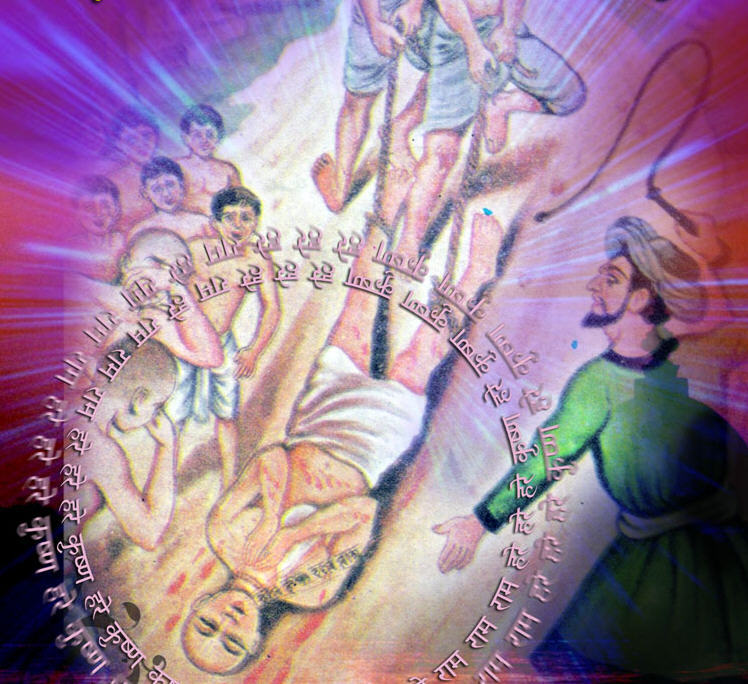
Long before he met Sri Chaitanya Mahaprabhu, Srila Haridasa Thakura (Haridāsa Ṭhākura) was put on trial for chanting the names of Krishna. He had been born a Muslim, so the qazi of his district reported him to the ruler. When he refused to give up the holy name, he was sentenced to be caned in twenty-two marketplaces until he died. But he survived, he prayed for the very men who beat him, and in the end even his judges bowed to him. Vrindavana Dasa Thakura tells the full story in the sixteenth chapter of the Adi-khanda of Chaitanya-bhagavata, and Krishnadasa Kaviraja Goswami leaves these pastimes to him (Chaitanya-charitamrita Adi 10.47). Srila Prabhupada sends every reader to that chapter: "From the description of his chastisement by a Muslim magistrate, which is found in the sixteenth chapter of the Ādi-khaṇḍa of Caitanya-bhāgavata, we can understand how humble and meek Haridāsa Ṭhākura was and how he achieved the causeless mercy of the Lord" (Chaitanya-charitamrita Adi 10.43, purport).
Why the Qazi Brought a Complaint #
At Phuliya, Haridasa bathed in the Ganges every day. Then he would walk about, calling out the names of Hari in a loud voice (Chaitanya-bhagavata Adi 16.35). The local qazi, a Muslim judge, could not bear to see a man from his own community following the ways of another faith, and he was afraid that others would follow him. So he went to the ruler of the district and asked that Haridasa be judged, and the ruler had him brought at once (Chaitanya-bhagavata Adi 16.36-38). Srila Prabhupada sums up the charge in one line: "Haridāsa Ṭhākura, a Muhammadan by birth, was a very great devotee and was always chanting Hare Kṛṣṇa. That was his only fault." (Teachings of Lord Kapila 11)
By Krishna's mercy Haridasa had no fear of rulers, or even of death. He set off at once, chanting "Krishna, Krishna." The good people of the place were happy to see his courage, but they were also afraid for his life (Chaitanya-bhagavata Adi 16.39-41). The accounts differ a little about who did what. Chaitanya-bhagavata calls the ruler the king of Bengal (Chaitanya-bhagavata Adi 16.36, translated by Bhumipati Dasa). Srila Prabhupada, telling the story briefly, gives both the questioning and the sentence to the qazi. In Chaitanya-bhagavata the ruler questions Haridasa, and the qazi proposes the punishment.
A Blessing for the Prisoners #
Before he was taken to the ruler, Haridasa was brought among the men held in the ruler's jail. Some of them were men of good family. When they heard that he had come, they were glad, because they hoped that seeing such a great Vaishnava would end their suffering. They persuaded the guards to let them see him, and they bowed down at his feet (Chaitanya-bhagavata Adi 16.42-48). Haridasa smiled at them kindly and blessed them to stay just as they were. The prisoners were very upset, because they thought he meant they should stay in chains. So he explained what he meant (Chaitanya-bhagavata Adi 16.49-64). Srila Prabhupada tells this part of the story in a letter to a disciple:
"Haridasa Thakura was taken to the jail and he told the prisoners there, oh, you are so fortunate to have this opportunity to sit and chant the Holy Names without the Maya distractions of the outer world! So you should think like that, and use your time in the prison house to the greatest advantage for spiritual advancement." (Srila Prabhupada, letter to Upendra, 5 February 1968)
He told them that in jail, away from business and family, their minds had turned to Krishna, but outside, their old attachments would soon pull them back. He also promised them that they would be set free within two or three days (Chaitanya-bhagavata Adi 16.55-67). Even on the way to his own trial, he was thinking about the good of others. On a morning walk Srila Prabhupada drew one more lesson from the blessing. The prisoners had bowed to a Vaishnava, and "'Stay in this condition' means your attitude to offer respect to a Vaiṣṇava. That was the intent ... not that 'You stay in the prison house'" (Srila Prabhupada, morning walk, Los Angeles, 10 June 1976).
Before the Ruler: "God Is One" #
The ruler saw the bright glow on Haridasa's face, so he offered him a seat and questioned him almost gently. He said that Haridasa had been born a Muslim by great good fortune, so why was he lowering himself by following the customs of another faith? If he recited the kalima, whatever wrong he had done in ignorance would be wiped away (Chaitanya-bhagavata Adi 16.69-74). Haridasa laughed softly at the power of illusion, and then he answered very sweetly (Chaitanya-bhagavata Adi 16.75-76). He told the ruler that the Supreme Lord of all is one without a second, and that people only call Him by different names (Chaitanya-bhagavata Adi 16.76-77). Then he said: "The pure, eternal, nondual, inexhaustible Lord sits in the heart of everyone. That Lord induces everyone to work in a particular way, and everyone in the entire world acts accordingly." (Chaitanya-bhagavata Adi 16.78-79, translated by Bhumipati Dasa)
Haridasa explained that the difference lies only in the names by which people call Him: "The same God sits in the heart of every single living being and he engages each one of them in His service in different ways. One worships in the way one is made to worship by Him." He pointed out that some men born as brahmanas take up Islam. In the same way he, though born a Muslim, had been engaged by the Lord in chanting Krishna's names. He ended humbly, without any defiance: "The living being has no independence in such matters. If this is a fault, then please punish me." (Chaitanya-bhagavata Adi 16.76-85)
His words about the Lord in the heart are what Krishna Himself teaches in Bhagavad-gita:
īśvaraḥ sarva-bhūtānāṁ
hṛd-deśe ’rjuna tiṣṭhati
bhrāmayan sarva-bhūtāni
yantrārūḍhāni māyayā
"The Supreme Lord is situated in everyone’s heart, O Arjuna, and is directing the wanderings of all living entities, who are seated as on a machine, made of the material energy." (Bhagavad-gita 18.61)
"I Will Never Abandon the Holy Name" #
The Muslims present were satisfied with this answer, but the qazi was not. He pressed the ruler to punish Haridasa as a warning to others, or at least to force him to recite the confession of faith. Otherwise, he said, Haridasa would lead others away (Chaitanya-bhagavata Adi 16.86-89). So Haridasa was told to chant only the names of his own religion or face a terrible punishment. His reply has been dear to devotees ever since:
khaṇḍa khaṇḍa hai deha yāya yadi prāṇa
tabu āmi vadane nā chāḍi hari-nāma
"Even if my body is cut into pieces and I give up my life, I will never give up chanting the Lord’s holy name." (Chaitanya-bhagavata Adi 16.94; verse 16.91 in some other editions, translated by Bhumipati Dasa)
Krishnadasa Kaviraja Goswami gives the whole trial just one line in his list of the Lord's associates, and that line shows Haridasa's state of mind:
prahlāda-samāna tāṅra guṇera taraṅga
yavana-tāḍaneo yāṅra nāhika bhrū-bhaṅga
"The waves of his good qualities were like those of Prahlāda Mahārāja. He did not even slightly raise an eyebrow when persecuted by the Muslim ruler." (Sri Chaitanya-charitamrita Adi 10.45)
The Sentence of Twenty-Two Marketplaces #
The ruler turned to the qazi and asked what should be done. The qazi's answer was really a death sentence, though he called it a test. He said that Haridasa should be beaten in twenty-two marketplaces. If he was still alive after that, it would prove that he had spoken the truth (Chaitanya-bhagavata Adi 16.95-97). The qazi told the guards to beat him until he died, and the ruler gave the order (Chaitanya-bhagavata Adi 16.98-100).
Srila Prabhupada explains what this sentence meant: "The Kazi became very angry and ordered Haridāsa Ṭhākura to be whipped in twenty-two bazaars. This essentially meant that he was to be beaten to death, but because he was such a great devotee he did not actually feel the pain." (Teachings of Lord Kapila 11) Telling the story in a lecture at Vrindavana in 1976, he said it in plain words: "So Haridāsa Ṭhākura was beaten in public market. The idea was that beating, he would die. But he did not die." In that lecture he said "twenty-one bazaars" in passing (Srila Prabhupada, lecture on Srimad-Bhagavatam 5.5.32, Vrindavana, 19 November 1976). Chaitanya-bhagavata and his books give the number as twenty-two.
Beaten From Market to Market #
The guards dragged Haridasa from one marketplace to the next and beat him with all their strength. But he simply kept remembering Krishna's name. The joy of the name kept him from feeling the blows, just as Prahlada Maharaja had felt no pain when the demons beat him (Chaitanya-bhagavata Adi 16.101-110). Good people who saw this were horrified. Some cried out that the whole kingdom would be ruined for treating a saint like this. Some cursed the ruler and the qazi, and some were ready to fight. Others fell at the guards' feet and offered them money to strike more lightly, but the guards showed no mercy (Chaitanya-bhagavata Adi 16.103-107).
Srila Prabhupada saw in Haridasa's calm the sign of a pure devotee, who is not disturbed by the ups and downs of this world:
dehināṁ deha-saṁyogād
dvandvānīśvara-līlayā
sukhaṁ duḥkhaṁ mṛtir janma
śāpo ’nugraha eva ca
"Because of the actions of the Supreme Lord’s external energy, the living entities are conditioned in contact with material bodies. The dualities of happiness and distress, birth and death, curses and favors, are natural by-products of this contact in the material world." (Srimad-Bhagavatam 6.17.29)
In his purport he writes: "For example, Haridāsa Ṭhākura was beaten with cane in twenty-two bazaars, but he was never disturbed; instead, he smilingly tolerated the beating."
A Prayer for the Men Who Beat Him #
What hurt Haridasa was not his own pain but the fate of the men who were beating him. Even as the cane came down, he prayed for them (Chaitanya-bhagavata Adi 16.110; 16.113 in some editions). Srila Prabhupada explains why a pure devotee prays like this:
"For this reason alone, pure devotees never feel offended. ... Haridāsa Ṭhākura was severely lashed in twenty-two marketplaces by the Muslim Kazi's sentries. Still he prayed to the Lord not to punish his tormentors. ... Such is the profound compassion of the pure devotees." (Srila Prabhupada, Renunciation Through Wisdom 2.3)
Years later Sri Chaitanya Mahaprabhu asked this same tolerance of everyone who chants the holy name:
tṛṇād api su-nīcena
taror iva sahiṣṇunā
amāninā māna-dena
kīrtanīyaḥ sadā hariḥ
"One who thinks himself lower than the grass, who is more tolerant than a tree, and who does not expect personal honor yet is always prepared to give all respect to others can very easily always chant the holy name of the Lord." (Sri Chaitanya-charitamrita Adi 17.31)
Srila Prabhupada names Haridasa as the best example of this tolerance: "Haridāsa Ṭhākura is exceptional for his forbearance because although he was beaten with canes in twenty-two marketplaces, he was nevertheless tolerant." (Chaitanya-charitamrita Adi 10.84, purport)
Given to the Ganges #
After twenty-two marketplaces Haridasa was still alive and even smiling. The men beating him began to wonder whether he was a pir, a Muslim saint (Chaitanya-bhagavata Adi 16.114-118). They also became afraid for themselves, because if he lived, the qazi would surely have them killed (Chaitanya-bhagavata Adi 16.119-120). Srila Prabhupada once described the scene: "So they began to flatter him, 'Sir, unless you die, we'll be dead. Our life is in great danger.' So Haridāsa Ṭhākura made a show of death, and he was brought before the Kazi" (lecture on Srimad-Bhagavatam, 19 November 1976). Out of kindness to them, Haridasa went into deep meditation on Krishna, and his breathing stopped (Chaitanya-bhagavata Adi 16.121-123).
They carried his still body to the ruler, who ordered it to be buried. But the qazi objected. He said that burial would give such a man a good destination after death, so the body must be thrown into the Ganges instead (Chaitanya-bhagavata Adi 16.124-128). Chaitanya-bhagavata adds that for some time even the strongest guards could not move him, because the Lord Himself had entered his body (Chaitanya-bhagavata Adi 16.129-132). In the river Haridasa floated along, so absorbed in Krishna that he did not know whether he was in the sky, on land or in water. After some time he came back to outer awareness. He climbed out on the bank and set off for Phuliya, chanting Krishna's names aloud (Chaitanya-bhagavata Adi 16.133-145). Vrindavana Dasa compares him to Hanuman, who allowed himself to be bound by the brahmastra weapon out of respect for Brahma. In the same way, with Govinda as his protector no one could have harmed Haridasa, and he accepted the beating only to teach the world (Chaitanya-bhagavata Adi 16.137-140).
The Ruler Asks Forgiveness #
When the Muslims saw his power, they forgot their hatred. They bowed to him as a pir and were freed from their sins (Chaitanya-bhagavata Adi 16.146-147). The ruler himself came to him with folded hands. He said that now he knew Haridasa was a true saint, fixed in the knowledge that God is one. He begged Haridasa to forgive all his offenses, and he told him he was free to go wherever he wished and to live in a cave by the Ganges or anywhere else (Chaitanya-bhagavata Adi 16.148-155). The man who had ordered his death now held his feet (Chaitanya-bhagavata Adi 16.157). The ruler's last words to him were: "Now you may stay wherever you like and do whatever you please." (Chaitanya-bhagavata Adi 16.155, translated by Bhumipati Dasa) Even the qazi who had demanded his death was humbled. He came to Haridasa with the others and begged pardon for his offenses, and Haridasa forgave them all.
Only a Small Punishment #
The brahmanas of Phuliya had been heartbroken by the news of the beating. When Haridasa came back among them chanting, they were overjoyed. They sang the names of Hari around him, and he danced in ecstasy (Chaitanya-bhagavata Adi 16.159-164). Then he asked them not to feel sorry for him. He said that with his own ears he had heard much blasphemy of the Lord, and hearing blasphemy of Vishnu is a great sin. The Lord had removed that great offense with only a small punishment (Chaitanya-bhagavata Adi 16.165-169). Where everyone else saw cruelty, Haridasa saw only the Lord's kindness. Vrindavana Dasa adds that the men who had beaten him were destroyed, with their families, within a few days (Chaitanya-bhagavata Adi 16.171).
Srila Prabhupada teaches the same way of seeing suffering when he explains Brahma's words to the frightened demigods:
viśvasya yaḥ sthiti-layodbhava-hetur ādyo
yogeśvarair api duratyaya-yogamāyaḥ
kṣemaṁ vidhāsyati sa no bhagavāṁs tryadhīśas
tatrāsmadīya-vimṛśena kiyān ihārthaḥ
"My dear sons, the Lord is the controller of the three modes of nature and is responsible for the creation, preservation and dissolution of the universe. His wonderful creative power, yoga-māyā, cannot be easily understood even by the masters of yoga. That most ancient person, the Personality of Godhead, will alone come to our rescue. What purpose can we serve on His behalf by deliberating on the subject?" (Srimad-Bhagavatam 3.16.37)
In his purport he writes: "When something is arranged by the Supreme Personality of Godhead, one should not be disturbed by it, even if it appears to be a reverse according to one’s calculations." He gives Haridasa as one of his examples: "But Haridāsa was punished at the hands of the Kazi by being beaten in twenty-two marketplaces." And he says of such a devotee: "He accepts even reverse conditions as the grace of the Lord."
The Lord Who Took the Blows #
Years later the Lord Himself revealed who had really suffered those blows. In Navadvipa, when He showed His divine glory in the house of Srivasa Thakura, Sri Chaitanya Mahaprabhu called Haridasa forward. He said that when the guards were beating Haridasa from village to village, He had come down with His disc to cut them to pieces. But Haridasa was praying for their good, so the disc could do nothing. Then the Lord covered Haridasa's back with His own body and took the blows Himself, and He showed Haridasa the marks (Chaitanya-bhagavata Madhya 10.35-44). When Haridasa heard this, he fell unconscious in love (Chaitanya-bhagavata Madhya 10.52-56). That moment, and the Lord's loving words to him, are told in Life With Sri Chaitanya Mahaprabhu at Puri.
What Srila Prabhupada Teaches From It #
Srila Prabhupada spoke about this episode again and again. He used it to show that sincere preaching will meet opposition, and that a sadhu answers that opposition with mercy. Explaining the qualities of a sadhu, he writes (Srimad-Bhagavatam 3.25.21, purport): "Sometimes devotees are personally attacked with violence. Lord Jesus Christ was crucified, Haridāsa Ṭhākura was caned in twenty-two marketplaces, and Lord Caitanya’s principal assistant, Nityānanda, was violently attacked by Jagāi and Mādhāi. But still they were tolerant because their mission was to deliver the fallen souls." The verse he was explaining describes the sadhu this way:
titikṣavaḥ kāruṇikāḥ
suhṛdaḥ sarva-dehinām
ajāta-śatravaḥ śāntāḥ
sādhavaḥ sādhu-bhūṣaṇāḥ
"The symptoms of a sādhu are that he is tolerant, merciful and friendly to all living entities. He has no enemies, he is peaceful, he abides by the scriptures, and all his characteristics are sublime." (Srimad-Bhagavatam 3.25.21)
In Teachings of Lord Kapila, speaking on the same verse, he adds: "Although a devotee may sometimes have to suffer, he tolerates the suffering. At the same time, he is very kind to conditioned souls and tries to elevate them to Kṛṣṇa consciousness." (Teachings of Lord Kapila 11) Nityananda Prabhu showed the same mercy to Jagai and Madhai. Haridasa's tolerance and mercy shine just as brightly in another story, at Benapola, where Ramachandra Khan sent a prostitute to his cottage: see the prostitute's test.
