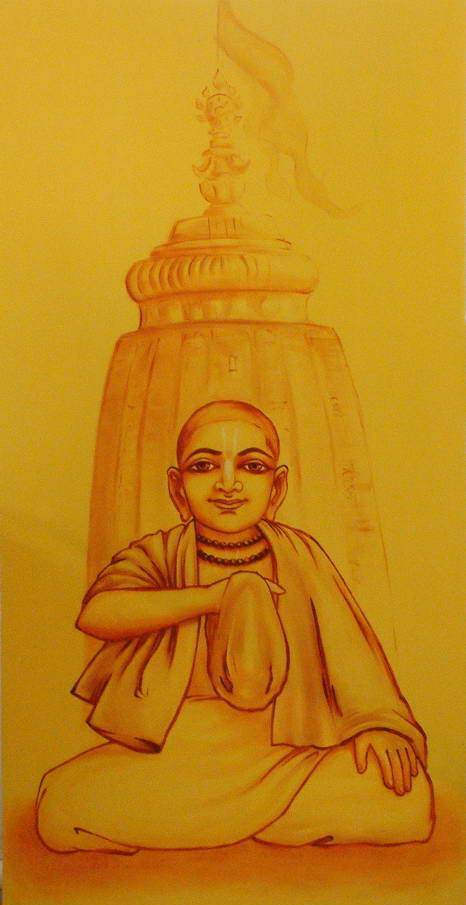
An acharya is a teacher who teaches by his own example as much as by his words. When Krishna decided to come into this world as Sri Chaitanya Mahaprabhu, He set this standard: "Unless one practices devotional service himself, he cannot teach it to others." (Chaitanya-charitamrita Adi 3.21). The title Namacharya (Nāmācārya) points to one subject only: the holy name of Krishna, how it is chanted, and what chanting can and cannot do. Srila Haridasa Thakura (Haridāsa Ṭhākura) is given this title in Srila Prabhupada's translation of Sri Chaitanya-charitamrita, in the very sentence where he explains namabhasa, a dim reflection of the holy name, to Mahaprabhu: "Nāmācārya Haridāsa Ṭhākura, the authority on the chanting of the holy name, said..." (Antya 3.55), and again a few verses later (Antya 3.61). Since then, Gaudiya Vaishnavas have honored this title as his alone.
| Detail | Description |
|---|---|
| Title | Namacharya, "teacher of the holy name" |
| Where the title appears | Srila Prabhupada's translation of Sri Chaitanya-caritamrta, Antya-lila 3.55 and 3.61 |
| Daily chanting | 300,000 names of Krishna, roughly 175 rounds of japa |
| Also called | Brahma Haridasa (regarded as connected to Brahma) |
| Best-known teaching | The distinction between namabhasa, a dim reflection of the name, and pure, offenseless chanting |
Where the Title Comes From #
The word Namacharya is not in the Bengali verses of Chaitanya-charitamrita. It comes from Srila Prabhupada's English translation of the verse in which Haridasa answers the Lord's question about the yavanas, people born outside Vedic culture:
yadyapi anya saṅkete anya haya nāmābhāsa
tathāpi nāmera teja nā haya vināśa
"Nāmācārya Haridāsa Ṭhākura, the authority on the chanting of the holy name, said, “The chanting of the Lord’s holy name to indicate something other than the Lord is an instance of nāmābhāsa. Even when the holy name is chanted in this way, its transcendental power is not destroyed." (Chaitanya-charitamrita Antya 3.55)
Six verses later the translation opens the same way: "Nāmācārya Haridāsa Ṭhākura continued..." (Antya 3.61). Srila Prabhupada uses the title again in his purports and explains it each time. On the verse about Benapola he writes: "Haridāsa Ṭhākura, being the ācārya of chanting the Hare Kṛṣṇa mahā-mantra, is called Nāmācārya Haridāsa Ṭhākura." (Antya 3.100, purport). About the prostitute who was sent to test him, he says that Haridasa, "although born in a mleccha or yavana family, became Nāmācārya Haridāsa Ṭhākura because he performed the nāma-yajña a minimum of 300,000 times every day." (Antya 3.124, purport). At Puri, where temple custom kept him outside the Jagannatha temple, Prabhupada notes: "Nonetheless, he was recognized by Śrī Caitanya Mahāprabhu as Nāmācārya Haridāsa Ṭhākura." (Madhya 11.195, purport). Even the Lord's own praise of Haridasa to Vallabha Bhatta is translated "Haridāsa Ṭhākura, the teacher of the holy name..." (Antya 7.48).
In his lectures Srila Prabhupada stressed that the title came from the Lord's own choice, not from Haridasa's birth: "This Haridāsa Ṭhākura was born in a Muhammadan family. And Caitanya Mahāprabhu made him Nāmācārya Śrīla Haridāsa Ṭhākura." He also said: "Caitanya Mahāprabhu Himself came to broadcast the glory of Hare Kṛṣṇa mahā-mantra. So instead of becoming Himself the ācārya, He designated Haridāsa Ṭhākura as ācārya." (Srila Prabhupada, lecture on Bhagavad-gita 2.26, Hyderabad, 30 November 1972)
Brahma Haridasa #
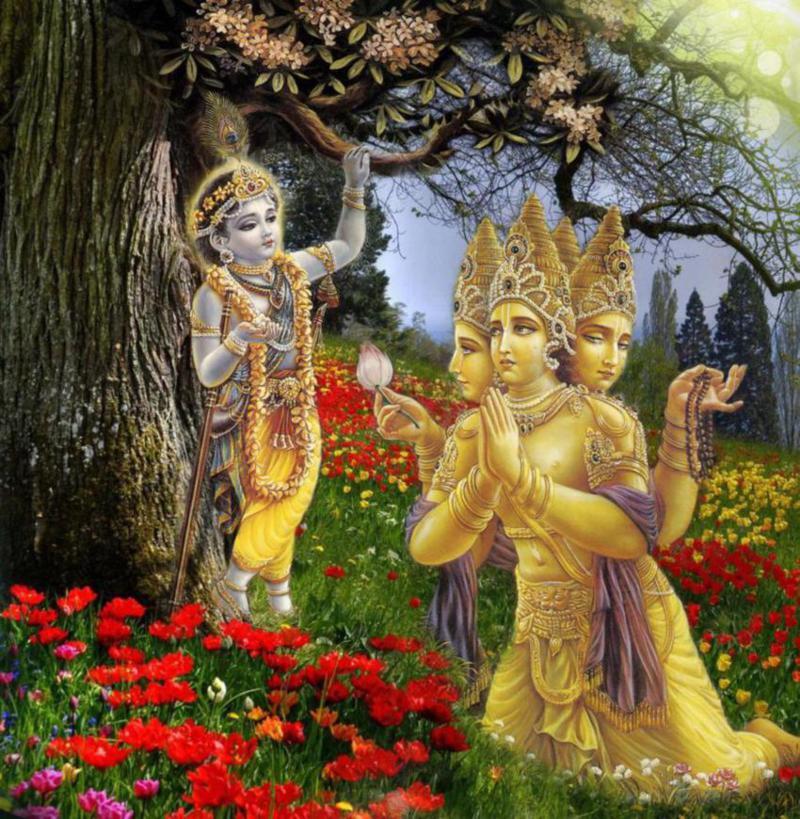
The tradition also gives him a second name. The summary of the third chapter of Antya-lila, written by Srila Bhaktivinoda Thakura and translated by Srila Prabhupada, speaks of "Haridāsa Ṭhākura, who was known as Brahma Haridāsa" (Chaitanya-charitamrita Antya 3, chapter summary). When a disciple asked about it, Prabhupada replied: "Yes, Srivas Acarya is incarnation of Narada Muni and Haridasa Thakura is incarnation of Lord Brahma, therefore sometimes Haridasa Thakura is called Brahma Haridasa." (Srila Prabhupada, letter to Jayapataka, 17 April 1970). Near the end of Haridasa's life Mahaprabhu Himself spoke of "this incarnation" of his:
loka nistārite ei tomāra ‘avatāra’
nāmera mahimā loke karilā pracāra
"Your role in this incarnation is to deliver the people in general. You have sufficiently preached the glories of the holy name in this world." (Chaitanya-charitamrita Antya 11.25)
Srila Prabhupada's purport joins the two names together: "Haridāsa Ṭhākura is known as nāmācārya because it is he who preached the glories of chanting hari-nāma, the holy name of God. By using the words tomāra avatāra (“your incarnation”), Śrī Caitanya Mahāprabhu confirms that Haridāsa Ṭhākura is the incarnation of Lord Brahmā." (Antya 11.25, purport). The Gaura-ganoddesha-dipika (93-95) describes him as Brahma Mahatapa, the son of Richika Muni, who appeared together with Prahlada Maharaja. This identity is explained in Srila Haridasa Thakura's biography. In his Navadvipa-dhama-mahatmya, Bhaktivinoda Thakura tells how this came about. Lord Brahma saw that his pride in being Brahma had kept him from the sweetness of Vraja, so he did austerities at Antardvipa and prayed to Gauranga for a birth free from that pride. The Lord granted it: "You will consider yourself lowly. You will be known as Haridāsa, and you will be free from pride. The Name will dance on the tip of your tongue three hundred thousand times a day" (Navadvipa-dhama-mahatmya 5.146-147).
Three Hundred Thousand Names a Day #
About Haridasa's daily life, every source agrees on one thing: the number of names he chanted. When Krishnadasa Kaviraja Goswami lists him among the branches of the Chaitanya tree, this is what he records:
haridāsa-ṭhākura śākhāra adbhuta carita
tina lakṣa nāma teṅho layena apatita
"The twentieth branch of the Caitanya tree was Haridāsa Ṭhākura. His character was wonderful. He used to chant the holy name of Kṛṣṇa 300,000 times a day without fail." (Chaitanya-charitamrita Adi 10.43)
This number appears again and again, through every stage of his life. In the forest at Benapola he chanted it before his tulasi plant, "throughout the entire day and night" (Antya 3.100). When a prostitute was sent to test him, he told her of his vow to chant ten million names in a month (Antya 3.124). Srila Prabhupada works out that this means 333,333 names a day for thirty days, plus ten more (Antya 3.124, purport). In the assembly of the Majumadaras at Chandapura, it was the mention of his three hundred thousand names that started the famous discussion on the holy name (Antya 3.176). That story is told in Teachings on the Holy Name. And at Puri, Mahaprabhu Himself gave the same figure (Antya 7.48).
Srila Prabhupada once did the arithmetic for a disciple: "Haridasa Thakura chanted 3 lakhs of names each day, that means 16 names in the mantra, 108x16 or 1,728 names in each round of mala, dividing 300,000 by 1,728 comes to roundabout 175 rounds on beads daily. And for us it is even difficult to chant 16 rounds! That is why Haridasa Thakura is 'namacarya.'" (Srila Prabhupada, letter to Yajnesvara, 2 January 1972)
The Lord's Own Praise #
Sri Chaitanya Mahaprabhu never hid His high regard for Haridasa. After their conversation at Puri about the yavanas and the trees, He went to His devotees and described Haridasa's qualities "as if He had hundreds of mouths," and Krishnadasa Kaviraja Goswami adds that among all the devotees, "Haridāsa Ṭhākura is the foremost." (Antya 3.93-94). When Haridasa begged the Lord not to touch him, calling himself "most fallen and untouchable," Mahaprabhu answered: "I wish to touch you just to be purified, for your purified activities do not exist in Me." He added that Haridasa was "far better than any brāhmaṇa or sannyāsī" (Madhya 11.188-191). That meeting is told in full in life with Sri Chaitanya Mahaprabhu at Puri.
The clearest praise came when the learned Vallabha Bhatta visited Puri and glorified Mahaprabhu for spreading the holy name. But the Lord saw that the scholar's heart was full of pride. So He turned the praise to His associates and named what He had learned from each of them (Antya 7.16-53). Of Haridasa He said:
haridāsa-ṭhākura — mahā-bhāgavata-pradhāna
prati dina laya teṅha tina-lakṣa nāma
"Haridāsa Ṭhākura, the teacher of the holy name, is the most exalted of all pure devotees. Every day he chants 300,000 holy names of the Lord." (Chaitanya-charitamrita Antya 7.48)
Then the Lord, whose own mission was to give the holy name to the world, said that He had learned its glories from Haridasa:
nāmera mahimā āmi tāṅra ṭhāñi śikhiluṅ
tāṅra prasāde nāmera mahimā jāniluṅ
"I have learned about the glories of the Lord’s holy name from Haridāsa Ṭhākura, and by his mercy I have understood these glories." (Chaitanya-charitamrita Antya 7.49)
On the day Haridasa left this world, Mahaprabhu gave His last and highest praise: "Haridāsa Ṭhākura was the crown jewel on the head of this world; without him, this world is now bereft of its valuable jewel." (Antya 11.97). That day is told in disappearance in the Lord's embrace.
What Srila Prabhupada Teaches From His Example #
Srila Prabhupada drew one practical lesson from Haridasa's life again and again: do not imitate his number, but do keep a fixed vow. Explaining the verse on the three hundred thousand names, he writes: "No ordinary person can chant so many names, nor should one artificially imitate Haridāsa Ṭhākura’s behavior. It is essential, however, that everyone fulfill a specific vow to chant the Hare Kṛṣṇa mantra. Therefore we have prescribed in our Society that all our students must chant at least sixteen rounds daily. Such chanting must be offenseless in order to be of high quality." (Adi 10.43, purport)
He gives the same instruction at the verse that describes Haridasa's cottage at Benapola:
nirjana-vane kuṭira kari’ tulasī sevana
rātri-dine tina lakṣa nāma-saṅkīrtana
"Haridāsa Ṭhākura constructed a cottage in a solitary forest. There he planted a tulasī plant, and in front of the tulasī he would chant the holy name of the Lord 300,000 times daily. He chanted throughout the entire day and night." (Chaitanya-charitamrita Antya 3.100)
In his purport Srila Prabhupada writes: "We can follow his example, however, by chanting sixteen rounds of the Hare Kṛṣṇa mahā-mantra on beads every day and offering respect to the tulasī plant." He says this practice is simple yet of "immense spiritual potency," and urges his followers "to follow Haridāsa Ṭhākura’s example rigidly." (Antya 3.100, purport). At the verse where Haridasa tells the prostitute to chant constantly and serve tulasi, Prabhupada adds that even those not used to it "are advised to chant at least sixteen rounds on their beads so that they may be trained." (Antya 3.137, purport)
The vow mattered to Haridasa to the very end. In his last illness at Puri, his rounds were not finished, so he took only a tiny bit of the prasada that Govinda brought, and he took even that only out of respect for it (Antya 11.17-20). When the Lord asked what his disease was, he named it plainly:
prabhu kahe, — ‘kon vyādhi, kaha ta’ nirṇaya?’
teṅho kahe, — ‘saṅkhyā-kīrtana nā pūraya’
"Śrī Caitanya Mahāprabhu further inquired from Haridāsa, “Can you ascertain what your disease is?” Haridāsa Ṭhākura replied, “My disease is that I cannot complete my rounds.”" (Chaitanya-charitamrita Antya 11.23)
Srila Prabhupada draws the lesson for every devotee: "If one cannot complete the fixed number of rounds he is assigned, he should be considered to be in a diseased condition of spiritual life. Śrīla Haridāsa Ṭhākura is called nāmācārya. Of course, we cannot imitate Haridāsa Ṭhākura, but everyone must chant a prescribed number of rounds." He adds that the sixteen rounds "must be chanted, and chanted loudly, so that one can hear himself and others." (Antya 11.23, purport). In the next verse the Lord, out of love, told the aging Haridasa that he could chant fewer names, since he was already liberated. Here Prabhupada notes that "Ṭhākura Haridāsa was the living example of how to follow the regulative principles." (Antya 11.24, purport)
Prabhupada also warned against copying Haridasa's solitary life. Mahaprabhu gave different orders to different devotees: Nityananda Prabhu to preach in Bengal, Rupa and Sanatana to uncover the holy places of Vrindavana, and Haridasa to stay at Puri and chant. "Consequently one should not try to imitate the behavior of Haridāsa Ṭhākura without being ordered by Śrī Caitanya Mahāprabhu or His representative." (Madhya 11.195, purport). In the same purport he quotes Srila Bhaktisiddhanta Sarasvati Thakura's song against the imitator who sits alone to chant: "pratiṣṭhāra tare, nirjanera ghare, tava hari-nāma kevala kaitava." In Prabhupada's translation, what such a person wants is "cheap popularity and not the actual qualifications of Haridāsa Ṭhākura." Prabhupada explains that a beginner should first work and preach under the direction of the spiritual master, and that "one should not try to imitate Haridāsa Ṭhākura at the beginning of one’s transcendental life." (Madhya 11.176, purport)
Not to Be Confused With Other Devotees Named Haridasa #
Sri Chaitanya Mahaprabhu's circle included other devotees named Haridasa, and the tradition is careful to keep them apart.
- Chota Haridasa (Junior Haridasa) was a devotee in the renounced order of life who used to sing for Mahaprabhu at Puri (Antya 2.102). At Bhagavan Acharya's request he begged fine rice from Madhavi-devi, the elderly and saintly sister of Shikhi Mahiti (Antya 2.103-107). For this, the Lord would no longer allow him to come before Him, saying: "I cannot tolerate seeing the face of a person who has accepted the renounced order of life but who still talks intimately with a woman." (Antya 2.113-117). His story fills Antya-lila chapter two, "The Chastisement of Junior Haridāsa," just before the chapter on Haridasa Thakura's glories (Antya 2).
- Dvija Haridasa is named as the seventy-second branch of Mahaprabhu's own tree (Adi 10.112). From Bhaktisiddhanta Sarasvati Thakura's Anubhashya, quoted in the purport, we learn that "He had two sons, named Śrīdāma and Gokulānanda, who were disciples of Śrī Advaita Ācārya," and that it is uncertain whether he wrote the Ashtottara-shata-nama (Adi 10.112, purport).
- Namacharya Haridasa Thakura is the devotee of Benapola, Chandapura, Phuliya and Siddha Bakula, the teacher of the holy name.
Wherever the name Haridasa appears in Gaudiya literature, the title Namacharya points to the one devotee from whom Mahaprabhu said He had learned the glories of the holy name.
