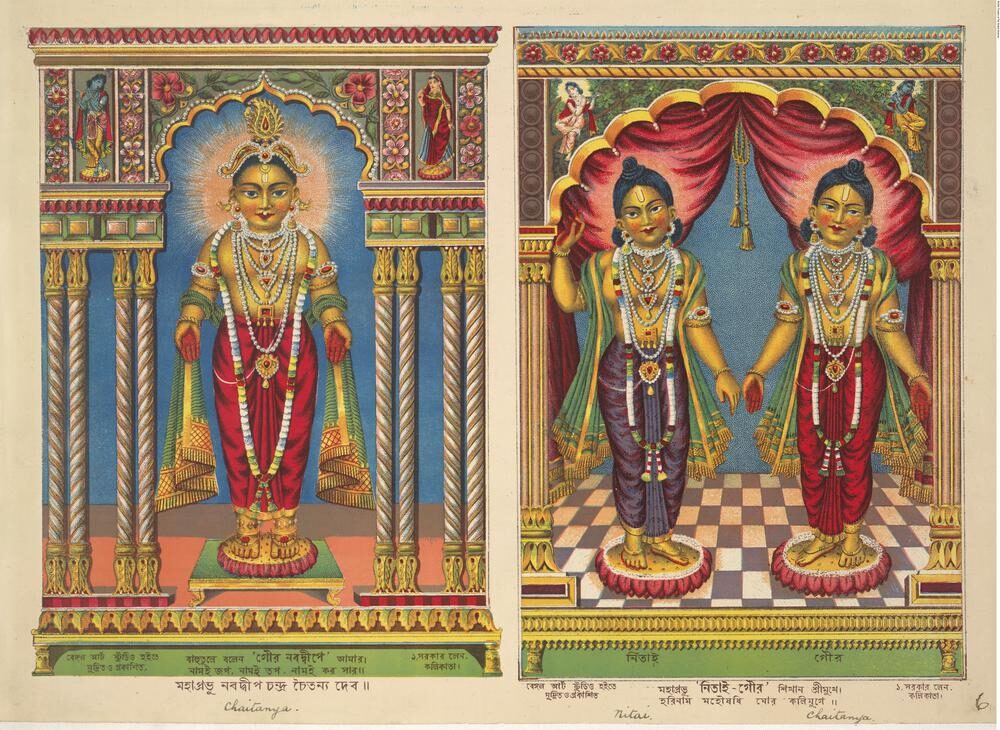
Krishnadasa Kaviraja describes the pattern of Chaitanya Mahaprabhu's life with unusual exactness. He was visible in this world for forty-eight years, from 1486 to 1534. The first twenty-four He spent as a householder in Nabadwip. The remaining twenty-four He spent as a sannyasi based at Jagannatha Puri. Of those, the first six were taken up by travel: to South India, back through Bengal, and to Vrindavana and Prayag. The last eighteen were spent continuously at Puri without leaving. This page is about those eighteen years, and especially the twelve at the end of them. The tradition regards those twelve years as the most inward part of His life, and the hardest to describe.
| Detail | Description |
|---|---|
| Years visible in this world | Forty-eight, from 1486 to 1534 |
| First twenty-four years | Householder life at Nabadwip |
| Next six years | Travel to South India, Bengal, Vrindavana and Prayag |
| Last eighteen years | Continuously at Jagannatha Puri, without leaving |
| Residence | The Gambhira, an inner room in Kashi Mishra's house |
| Closest companions | Svarupa Damodara Goswami and Ramananda Raya |
| Yearly gathering | The chariot festival, with the Bengali devotees staying four months |
The Gambhira at Kashi Mishra's House #
The house was chosen for Him. The devotees were looking for a place near the temple that would be quiet enough. King Prataparudra suggested the house of a brahmana named Kashi Mishra, close to the Jagannatha temple, private and calm. When the proposal reached Kashi Mishra, he said that he was fortunate. When the Lord arrived, he fell at His feet and surrendered himself and everything he owned. Inside that house was a small inner room, the Gambhira. Throughout the Gaudiya tradition, the last phase of Chaitanya Mahaprabhu's life is known by the name of this room, not by the name of the house. The site is still shown to pilgrims in Puri.
The Circle of Devotees at Puri #
The circle around Him formed quickly and hardly changed afterwards. Svarupa Damodara Goswami served as His confidential secretary. More importantly for later generations, he kept notes. The Chaitanya-charitamrita states plainly that its account of the middle and final pastimes rests on Svarupa Damodara's notebooks. The Lord had met Ramananda Raya on the Godavari and ordered him to resign his governorship. Ramananda Raya retired on full pension and moved to Puri. There he became the second of the two men whom the Lord allowed to be with Him through the nights. Paramananda Puri, an elderly godbrother of the Lord's own guru, was given a room in the same house. Gadadhara Pandit took kshetra-sannyasa, the vow never to leave the holy place. He settled at the Tota Gopinatha temple in a garden by the sea, and the Lord came there to hear him read the Bhagavatam. Govinda served as personal attendant and slept across the doorway of the Gambhira. Haridasa Thakura was a Muslim by birth, so he would not enter the temple. He was given a quiet place to live nearby. Sarvabhauma Bhattacharya, the Vedantist the Lord had converted in His first weeks at Puri, was constantly present. So were Jagadananda Pandit, Shankara Pandit and a changing group of Odia devotees.
Daily Darshana and the Yearly Visit From Bengal #
Two things happened regularly through these years. The first was daily: darshana of Lord Jagannatha in the temple, and kirtana. The Lord's ecstatic states in the temple courtyard, and especially at the Simha-dvara, the lion gate, are described so often in the Antya-lila that they no longer seem like special events. They are simply what happened. The second was yearly. Every year, at the season of the chariot festival, the devotees of Bengal came down to Puri in a large party organised by Shivananda Sena. Shivananda Sena took charge of the ferry tolls and lodgings for the group. It included Advaita Acharya, Nityananda Prabhu, Srivasa Pandit, wives and children, and on one famous occasion a dog. They stayed four months, through Chaturmasya, and went home. This was the Lord's one lasting contact with the movement He had left behind in Bengal, and He used it to give instructions. The most important came in the year He told Nityananda Prabhu to stop coming to Puri altogether and remain in Bengal to preach.
The Chariot Festival and the Seven Kirtana Parties #
The chariot festival itself was the centre of the year. Krishnadasa Kaviraja describes the Lord dividing His kirtana party into seven divisions with two mridangas each, fourteen drums in all, and dancing before the chariots as they were dragged along the sandy road from the main temple to the Gundicha temple. King Prataparudra swept the road ahead of the chariot with a golden-handled broom.
Cleansing the Gundicha Temple #
Chaitanya Mahaprabhu Himself established the practice of washing out the Gundicha temple with water before the deities arrive. The practice is still observed today. He did the scrubbing personally, and this is why the episode is remembered as a lesson in service, not as just a ceremony.
Radharani Calling Krishna Back to Vrindavana #
What He experienced in the festival is the theological heart of the Puri years, and the biographies are clear about it. As the chariot moved, He fell behind the procession, and the chariot stopped. When He came forward, it moved again. At one point He raised His arms and recited a verse. Krishnadasa Kaviraja says that nobody present understood it except Svarupa Damodara. In the verse a woman speaks. She says that the man who stole her heart in her youth is her husband again. The nights and the flowers and the breezes are the same as they were, and she herself is the same. Yet her mind is not happy here, and she longs for the riverbank where they first met. Then the Lord Himself explained it. The gopis of Vrindavana had once met Krishna again at Kurukshetra, after years of separation, and had not been comforted by it. Addressing Lord Jagannatha directly, He said: You are the same Krishna and I am the same Radharani, and We are meeting as We met at the beginning. But at Kurukshetra there are crowds and horses and chariots, and in Vrindavana there are flower gardens and bees and birds. Here You are dressed as a royal prince surrounded by warriors, and there You were a cowherd boy with a flute. Here there is not a drop of the happiness I had with You there. Come back to Vrindavana. Understood in this way, the whole Ratha-yatra is Radharani pulling Krishna's chariot away from His royal capital and back towards the village where He was loved without any thought of His power. This is why Gaudiya Vaishnavas identify the Gundicha temple with Vrindavana. It is also why the festival is performed in cities all over the world today with that meaning attached.
Refusing to Meet King Prataparudra #
But the same years also saw one of the most stubborn refusals of His life. Sarvabhauma Bhattacharya asked, on King Prataparudra's behalf, for a meeting with the Lord. The Lord covered His ears with His hands. For a man in the renounced order, He said, meeting a king is as dangerous as meeting a woman, and to do either is to drink poison. The Bhattacharya protested that this king was a great devotee. The Lord answered that the King might be a devotee, but he was still to be regarded as a poisonous snake. He warned that if the request were repeated, Sarvabhauma would not see Him in Puri again. Ramananda Raya tried later, and to him the Lord was blunter: there may be a great quantity of milk in a pot, but one drop of liquor makes it untouchable; the King has every good quality, but the single word "king" has infected everything. When this was reported to the King, he lost all hope: has Chaitanya Mahaprabhu come to deliver every kind of fallen soul except Prataparudra? He said that if he did not receive the Lord's mercy, his body and his kingdom were both useless to him.
The Campaign to Win an Interview #
What followed was a long effort by everyone around Him, full of affection and clever planning. Nityananda Prabhu obtained a used outer garment of the Lord's from Govinda and had it sent to the King. The King worshipped it as he would have worshipped the Lord Himself. Ramananda Raya, a skilled diplomat, brought the subject into conversation at every opportunity, until the Lord's resistance began to soften. When they pressed Him once more for a meeting, the Lord made another offer, which was also a joke about Himself: bring Me the King's son instead, since scripture says the son represents the father. The prince came. He was a beautiful boy with a blackish complexion, dressed in yellow. The Lord was reminded at once of Krishna, and He embraced him.
Sarvabhauma's Plan for the Balagandi Garden #
Finally Sarvabhauma Bhattacharya gave the King a plan. On the day of the chariot festival, after the dancing, the Lord would rest in the garden at Balagandi. Go there alone and out of your royal dress, he said, recite the chapters of the Bhagavatam that describe Krishna's dance with the gopis, and take hold of His feet while He is absorbed.
Prataparudra Receives the Lord's Embrace #
The King did exactly that. He asked the assembled devotees' permission before approaching. Then he knelt and began to massage the Lord's legs as He lay with His eyes closed, and he recited the gopis' song of separation. Chaitanya Mahaprabhu said, again and again, go on reciting. The King came to the verse in which the gopis call the narration of Krishna's activities the life of those who are suffering in this world. At that verse the Lord stood up and embraced him, crying that he was the most generous of men. The biographer stresses that at that moment the Lord did not know who the man was. Only afterwards did He ask. The King answered that he was the servant of the Lord's servants and hoped to be accepted as such. The Lord's mercy was given because of the King's service. It was not held back because of the royal office he held. Krishnadasa Kaviraja does not comment on the irony.
The Last Twelve Years in the Gambhira #
The last twelve years are a different matter altogether. The Chaitanya-charitamrita states that all through them the Lord was continuously overwhelmed, night and day, by separation from Krishna. It says that He passed His nights in the Gambhira with only Svarupa Damodara and Ramananda Raya. There He recited verses and tasted their meanings until morning. The verses came from Jayadeva's Gita-govinda, from the Bhagavatam, from Ramananda Raya's own play, from Bilvamangala Thakura's Krishna-karnamrita, and from eight verses of His own composition.
Chataka-Parvata, the Sea and the Fisherman #
As the Antya-lila records them, almost all the outward events of those years happened to Him without His intending them. One night Govinda and Svarupa Damodara found the three doors of His room bolted from inside and the room empty. They found Him unconscious outside the lion gate of the temple. His body had become unnaturally long, and the joints of His bones were loose. They brought Him back by chanting into His ear. He mistook a sand dune outside Puri, called Chataka-parvata, for Govardhana Hill and ran towards it. On a full-moon night He mistook the sea for the Yamuna and walked into it. The current carried Him towards Konarka. A fisherman pulled Him ashore in his net, thinking he had caught a very large fish. Then, from touching Him, the fisherman went mad for a short time. At night in the Gambhira He would stand and rub His face against the stone walls until it bled, so Svarupa Damodara had to arrange for Shankara Pandit to sleep in the room with Him.
Separation as the Highest Attainment #
The two great biographies record these years more than they try to explain them. Vrindavana Dasa Thakura, who covers the Nabadwip period at length, becomes brief. Krishnadasa Kaviraja, who covers this period, says again and again that the Lord spoke like a madman, that only Svarupa Damodara understood what He was saying, and that his own intelligence cannot enter into it. What the tradition takes from the Puri years is not mainly a set of teachings. Those were given elsewhere, to Rupa and Sanatana and Ramananda Raya. What it takes is a demonstration. Gaudiya Vaishnavism holds that the highest attainment in devotion is not union but a particular quality of separation, vipralambha-bhava. It holds that Chaitanya Mahaprabhu spent the last twelve years of His life showing it in a human body, so that the claim would not remain only a theory. The essence of what those nights produced is the set of eight verses He composed, described on its own page. After them the biography stops.
