Like several other parts of Shyamananda Pandit's life, his final years come down to us through sources that agree on the main events. But they disagree on some real details that can be checked. We report the different versions here, instead of picking whichever one sounds more authoritative.
| Detail | Description |
|---|---|
| Illness | Fell seriously ill at Nrisinghpur after decades of active preaching |
| Duration | About four months, despite Ayurvedic treatment and Rasikananda's care |
| Successor named | Rasikananda Prabhu, turbaned and declared Mahanta of the whole community |
| Disappearance date (fuller account) | Krishna-pratipada, month of Ashadha, 1623 AD |
| Disappearance date (Hridaya Chaitanya's own page) | Traditionally given as Shaka 1552 / 1630 AD |
| Place of samadhi | Disputed, see below |
A Final Illness at Nrisinghpur #
Two sorrows are remembered as coming just before this final illness. First, news reached Shyamananda that Hridaya Chaitanya had passed away at Kalna. For a time even the achievements of his own life felt empty to him, because everything he had built had been done only to please his guru. After a festival was held in Hridaya Chaitanya's honor, he was at last able to return to his preaching. Then came a second blow: the death of his own disciple Damodara, the once-proud yogi who had become a devotee. Shyamananda is remembered as never recovering from this loss, and from that day his health began to fail.
After decades of active preaching across Odisha and repeated journeys back to Bengal and Vrindavana, Shyamananda fell seriously ill while staying at Nrisinghpur. He was staying in the house of the local landholder Uddanda Roy, one of his own earlier converts. Several Ayurvedic physicians attended him, and Rasikananda Prabhu cared for him constantly, but over about four months his health did not improve. Shyamananda is remembered as accepting this calmly, without trying to fight it: "Please do not make more efforts for my recovery," he told the devotees gathered around him, "as I have received a call from Lord Sri Krishna to leave this world... Just perform Sri Hari-nama kirtana day and night."
Passing the Mantle to Rasikananda #
Before his departure, Shyamananda called Rasikananda Prabhu to his side, placed his own feet on his disciple's head, and transferred to him what the tradition calls his full spiritual power. In front of the assembled Shyamanandi community, he tied a turban on Rasikananda's head and applied tilaka to his forehead with his own hands. He declared him Mahanta, the formal head, of the entire community, and instructed everyone present to follow his direction from then on. This was a deliberate, public handing-over of leadership, not a private or informal one. Because of it, a recorded line of gurus that is still active today can trace itself back to Shyamananda through Rasikananda by name, and not by legend alone. Shyamananda told everyone present to accept Rasikananda's authority without exception. He declared plainly that "those who disobey Rasik shall be regarded as hostile to me," and he asked Rasikananda to look after his surviving wives and to keep expanding the preaching mission.
Two Disputed Details #
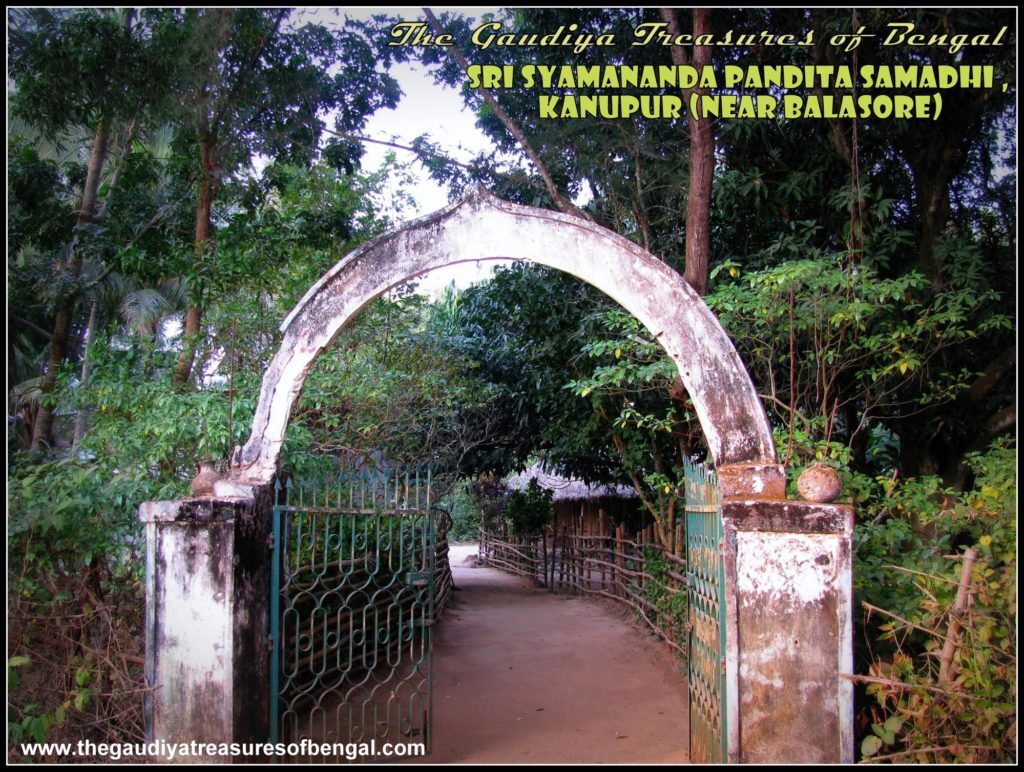
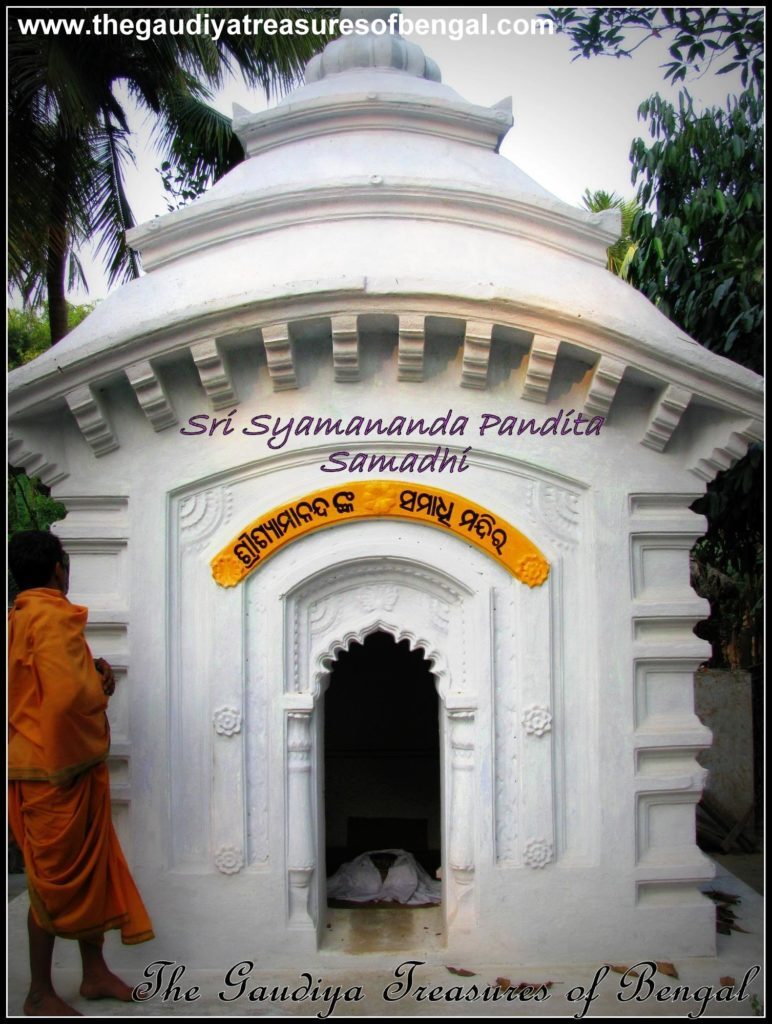
Sources disagree on both the exact year and the exact place of what followed. One detailed biography of Shyamananda's life comes from the tradition of his household line. It was translated from Bengali and draws on Narahari Chakravarti's Bhakti-ratnakara. It gives the date as the first lunar day of the dark fortnight (Krishna-pratipada) in the month of Ashadha, 1623 AD. It places his actual departure at Nrisinghpur, the same town, which is now generally identified with present-day Kanupur near Balasore in Mayurbhanj district. His samadhi and bhajana-kutir still stand there and are cared for by the descendants of his disciples. Hridaya Chaitanya's own page draws on a different set of sources. It gives Shyamananda's disappearance as Shaka 1552, which is 1630 AD, a difference of about seven years. Another account is repeated even more widely: the "Life of Shyamananda Pandit" translated by ISKCON Desire Tree, which Stephen Knapp's biography page also repeats. It agrees on the month and lunar day, but it places his passing, and his samadhi, at Gopiballabhpur instead of Nrisinghpur. The fuller account based on the Bhakti-ratnakara explains part of this. It records that two separate samadhis were set up after his passing: one at Nrisinghpur (Kanupur) and one at Vrindavana. The Vrindavana samadhi is at the exact spot beside the Radha-Shyamsundar temple where he had once found Radharani's anklet. But this account does not mention Gopiballabhpur as a third site. So a real difference between the traditions remains unresolved, and we state it plainly here. A third account places his passing more loosely "in the middle of the seventeenth century," later than either of the two specific years above. This is one more case of sources disagreeing on exactly when this happened.
What the Different Sites Preserve Today #
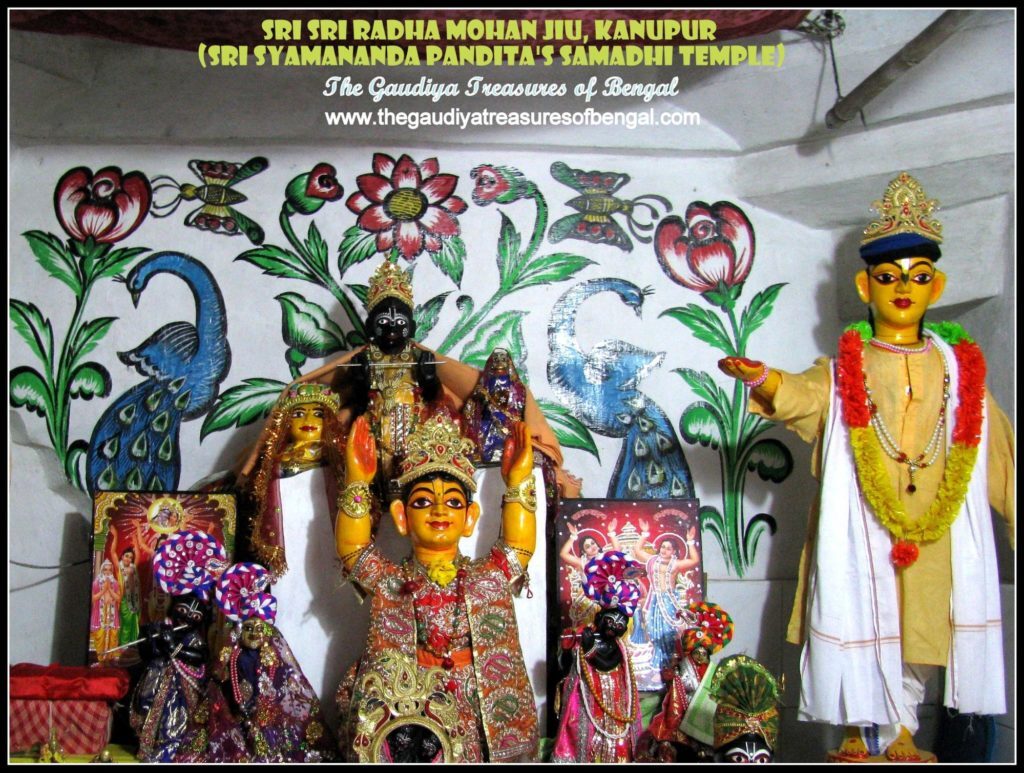
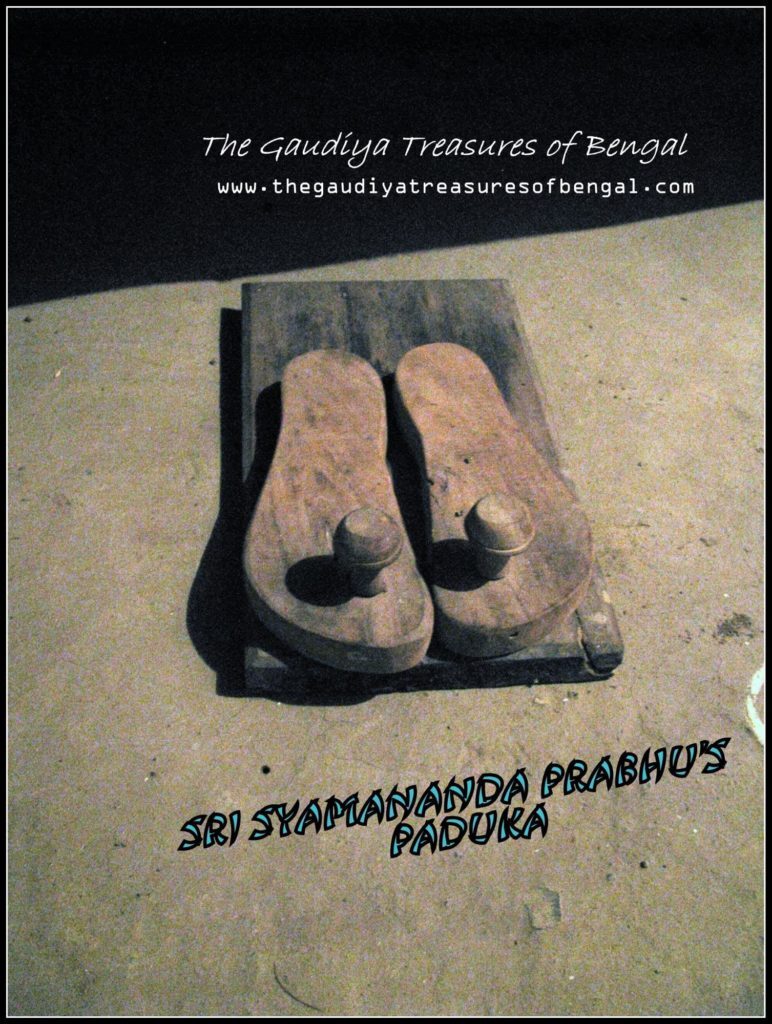
Whatever the exact year and the main place, physical traces of Shyamananda's life are kept at more than one place today. At Kanupur, near Balasore, his samadhi temple stands in a walled compound that devotees still call Gupta Vrindavana. Beside it is a pair of ponds that he is said to have dug and named Radha-kunda and Shyama-kunda. His simple wooden paduka (sandals) are also kept there. At Gopiballabhpur, the headquarters of the Shyamanandi community he built, his flute, palm-leaf prayer beads inscribed with verses of the Gita-Govinda, a Govardhana stone, and a manuscript of Srimad-Bhagavatam are kept and shown to visiting pilgrims. In Vrindavana, daily worship continues at the Radha-Shyamsundar temple he founded. The Deities there are the ones he received directly from Radharani's own mercy. The temple is now recognized as one of the seven original historic temples of the dhama.
A Funeral Attended by Thousands #
Rasikananda built the samadhi for his guru and performed the funeral rites himself. Another devotional account remembers Vaishnava and Muslim chiefs, zamindars, kings and queens all arriving by the thousands. They came to pay their last respects to the man who had converted the whole of Odisha. One traditional comparison places Shyamananda among the three great preachers in this way. Shrinivasa Acharya is said to embody the ecstasy of Sri Chaitanya Mahaprabhu Himself. Narottama Dasa Thakura is said to embody that of Nityananda Prabhu, and Shyamananda Pandit that of Advaita Acharya. These are three inconceivable moods. Non-devotees cannot grasp them, but the pure-hearted still relish them today.
A Legacy That Reaches Baladeva Vidyabhusana #
The line of formal initiation that Shyamananda started when he tied the turban on Rasikananda reached, within a few generations, one of Gaudiya Vaishnavism's most important philosophers. Rasikananda's own disciple Nayanananda Goswami initiated Radha-Damodara Goswami. Radha-Damodara Goswami in turn accepted as his disciple the scholar who became Baladeva Vidyabhusana. At the royal court of Jaipur in 1718, Baladeva Vidyabhusana's Govinda-bhashya secured the Gaudiya sampradaya's place among the recognized schools of Vedanta. The following year he personally installed the larger Deities still worshiped at Shyamananda's own Radha-Shyamsundar temple in Vrindavana. Traced this way, a recorded chain of gurus connects a milkman's son, accepted at Ambika Kalna despite his caste, to one of the most important defenses of its philosophy that the Gaudiya Vaishnava tradition ever made. The same chain also connects him to a "Shyamanandi parivar" that is still recognized today, under the name Jagadguru Sri Shyamananda Prabhu's Dwar Peeth, as one of the principal seats of the wider Gaudiya-Madhva sampradaya. Rasikananda Prabhu's own final chapter tells in full what Rasikananda himself built on this foundation. It covers his own decades of caste-crossing preaching across Odisha and his disappearance at the Kshira-chora Gopinatha temple in Remuna.
