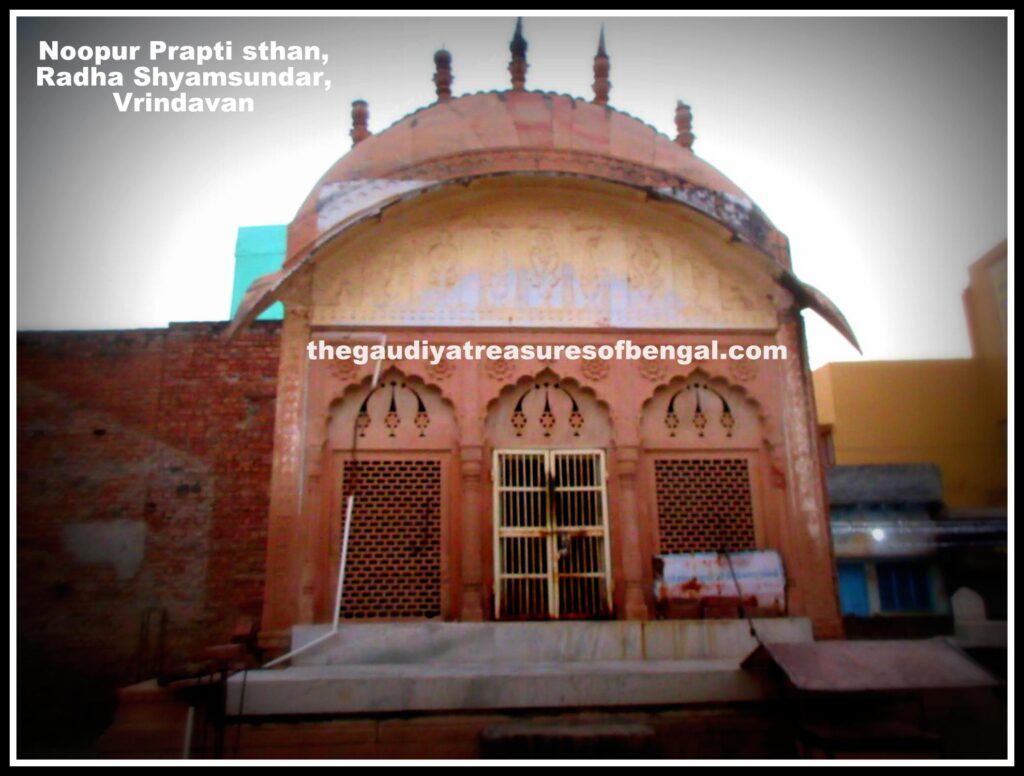
Krishnadasa's arrival in Vrindavana marks the real beginning of Shyamananda Pandit's own story, separate from his first guru's. He came already trained in devotion and service by Hridaya Chaitanya. In Vrindavana he came under Jiva Goswami. After the disappearances of Sanatana Goswami and Rupa Goswami, Jiva Goswami was by then the only surviving senior figure among the Six Goswamis of Vrindavana. Under Jiva Goswami, Krishnadasa received his philosophical training, met his closest companions, and was given the name by which history remembers him.
| Detail | Description |
|---|---|
| Teacher | Jiva Goswami, youngest and by then sole surviving senior Goswami |
| Service assigned | Drawing water daily from the Kanana-Kunja |
| Miracle | Finding Srimati Radharani's lost anklet; receiving Her darshan |
| New name | Shyamananda ("one who gives joy to Shyama") |
| Fellow students | Narottama Dasa Thakura and Shrinivasa Acharya |
| Later relic | The Deity of Sri Shyamsundar, received at the same spot |
Under Jiva Goswami's Care #
Arriving at Jiva Goswami's bhajana-kutir, Krishnadasa offered his obeisances and explained that Hridaya Chaitanya had sent him for instruction. According to one detailed account of his life, Hridaya Chaitanya had already written ahead: "I have a disciple named Duhkhi Krishnadasa. I am offering him to you. Teach him well in Krishna consciousness... when his mind is fixed... you may send him back to me." Whether or not those exact words were used, every version of the story agrees on two things. This was a planned and respectful handing over of a disciple from one guru to another, not an abandonment. And Jiva Goswami received the new arrival with real warmth. Krishnadasa studied the philosophy and scriptures of the Goswamis carefully. He wanted some service that would bring him physically closer to his new teacher. So he was given a simple daily task, filling Jiva Goswami's water pot from the Kanana-Kunja.
The Anklet at the Kunja #
During that ordinary daily task, something happened that gave Shyamananda his name and the defining mark of his life. One day Krishnadasa was drawing water at the Kanana-Kunja, deeply absorbed. There Sri-Sri Radha and Krishna eternally perform Their rasa-lila, unseen by unqualified eyes. Beneath a tree Krishnadasa found a golden anklet. It had been dropped there the night before, when Radhika's dancing had become so ecstatic that She did not notice its loss. He pressed it to his head in wonder and fell into ecstatic symptoms of his own. He wept and fainted with the anklet clasped to his heart. Then he buried it in a secret place for safekeeping.
Most accounts, including this fuller one based on Rasik-mangal, name the devotee who came looking for it the next day as Sri Lalita-devi herself, disguised as an elderly brahmani. (A few sources instead say Vishakha.) "Have you seen my daughter-in-law's ankle bell?" she asked Krishnadasa, saying that the girl had been careless. Krishnadasa was suspicious. He refused to hand it over without proof, and insisted that they go together to her village so that her own neighbors could identify it. His sincerity left Lalita no way out. She dropped the pretense and admitted the truth: the anklet belonged to Srimati Radharani, and both she and Radhika were pleased with him. When she offered him any boon he wished, Krishnadasa asked for only one thing, to know her real identity. Lalita-devi granted this and revealed her true spiritual form, though she did not yet give up her elderly disguise. Krishnadasa then begged to serve Radha and Krishna directly. So she gave him a confidential siddha-mantra of fifteen syllables for the constant vision of Radhika. She told him that his own perfected spiritual body (siddha-deha) would come to him in due course. Krishnadasa dug up the buried anklet, and in the process his ordinary iron spade turned to gold at his own touch. Then he returned the anklet to her hands.
After this, Krishnadasa bathed in Sri Radha-kunda and chanted the mantra Lalita had given him. He attained his own siddha-deha then and there, the form of a golden-complexioned manjari named Kanaka Manjari. In this form Lalita-devi brought him before Srimati Radharani Herself in the nikunja. There Radharani identified him as Her own eternal associate, Sri Krishna-priya. At Her direction, Lalita-devi touched the golden anklet to his forehead. Two vertical lines appeared there, with a dot in the middle where the anklet's tip had touched. This is the same tilaka Shyamanandi Vaishnavas still wear today. "From this moment," Lalita told him, "you shall be known as Shyamananda, for you have brought bliss (ananda) to Radha (Shyama) by returning Her anklet." Radharani then blessed him to return to the mortal world and complete his mission there. She promised him Her own eternal service once it was done. Looking on him with special mercy, She manifested the transcendental Deity of Sri Shyamsundarji from Her own lotus heart. Lalita-devi placed the Deity directly in his hands. "I am delivering this Deity to you for the welfare of the whole world," she told him. "As long as you live in this world, keep yourself engaged in His loving service." The full history of this Deity, and of the Radha-Shyamsundar temple built around it, is told on Establishing Deities and Preaching in Odisha.
A Guru's Anger, and a Dream That Corrected It #
Jiva Goswami confirmed the name the next morning, but he asked that the miracle itself not be spoken of in public. Even so, the news reached Hridaya Chaitanya at Ambika Kalna. He heard that his disciple had taken a new name and a new tilaka without his permission. So Hridaya Chaitanya traveled to Vrindavana himself and rebuked Shyamananda sharply, even physically, while the Vaishnavas present tried to calm him. All accounts agree that Shyamananda bore the rebuke without protest, certain that he had never actually left his first guru's service. That night, tradition holds, Radharani appeared to Hridaya Chaitanya in a dream and scolded him in turn. She, not his disciple, had chosen the name and the mark, and he had no right to overrule Her. By morning Hridaya Chaitanya had accepted what had happened and embraced Shyamananda warmly. This episode is told from the guru's side on Hridaya Chaitanya's own page. Across the tradition, it is seen as the moment when Hridaya Chaitanya's authority over his own disciple was corrected and confirmed at the same time, not reduced.
A Fuller Account of the Trial #
A fuller account of how this controversy actually played out is drawn from Rasik-mangal and Bhakti-ratnakara. It tells a longer and more dramatic story than a single private dream. In this telling, Hridaya Chaitanya first heard the news from disciples he had sent to find out what had happened. Jiva Goswami was bound by his promise of secrecy to Lalita-devi, so he protected the truth without actually lying. He told the disciples that Krishnadasa's tilaka and new name had come to Krishnadasa in a dream, in which his own guru, Hridaya Chaitanya, blessed him at Kanaka-kunja. When the disciples questioned Krishnadasa directly, he confirmed this answer. But when the disciples carried this explanation home, Hridaya Chaitanya had no memory of any such dream. He was not convinced. So he gathered a large party of twelve gopalas, sixty-four mohants and his own disciples, and traveled to Vrindavana himself to settle the matter in person.
There, before an assembly of the mohants of Vraja at the Rasasthali, Hridaya Chaitanya challenged Shyamananda directly. The name and tilaka, he said, would have to prove themselves or be washed away by his own hand. Shyamananda was given a moment to compose himself. He fell into a deep trance, and in his siddha form as Kanaka Manjari he found himself again before Srimati Radharani. She sent for Subala, Krishna's own friend. Subala is the Vraja form of Gauridasa Pandit, Hridaya Chaitanya's own guru. Subala placed the same tilaka and name on Kanaka Manjari's own body. He promised that if she remembered him at the crucial moment, neither would wash away. When Shyamananda's trance broke before the assembly, he asked the mohants to mark his forehead and chest again, and then to wash him with all the soap and water they wished. Hridaya Chaitanya himself scrubbed at his disciple's tilaka, and it began to fade. But as Shyamananda silently called on Gauridasa Pandit and Lalita-sundari, the mark and the name reappeared brighter than before, in front of the entire assembly. Hridaya Chaitanya accepted defeat with joy, not resentment. The account says he was proud of his own disciple's mystical victory.
Whichever version is followed, a private dream-correction or this public trial, every telling agrees on the outcome: Hridaya Chaitanya accepted what had happened and embraced Shyamananda as his own again.
A Second Test: Radha-bhava and a Guru's Forgiveness #
The reconciliation was not yet complete. Soon after, the party toured the forests of Vraja together with the visiting mohants. At Sanketa they came upon a troupe of actors performing rasa-lila, and those present who had spiritual vision saw the pastime itself unfold. Shyamananda wept without restraint. He was absorbed in gopi-bhava, the mood of a maidservant of Radhika in separation. But Hridaya Chaitanya's own relationship with Krishna, through Gauridasa Pandit, centers on sakhya-bhava, transcendental friendship, and he left the performance troubled, not joyful. The next morning he told Shyamananda plainly that this was not his own mood, and that there was no longer any reason for his disciple to stay with him.
Shyamananda answered that Gauridasa Pandit himself, in his form as Subala, is absorbed in Radha-bhava within the kunja. Shyamananda was the disciple of Gauridasa Pandit's own disciple. So, he said, a similar mood arising in him could hardly be a fault. Hridaya Chaitanya was unmoved. He struck Shyamananda again and again with a branch until the mohants present stepped in, horrified, telling him he would kill his own disciple. Shyamananda, for his part, refused their sympathy. He said that a guru's punishment was itself a sign of loving attention, not rejection. That same night, Chaitanya Mahaprabhu is said to have appeared to Hridaya Chaitanya in a dream. His own body and white chaddar were drenched in blood. "It is only by your mercy," Mahaprabhu told him, "that My body is soaked in blood. You have beaten Shyamananda, who is like My own self." Hridaya Chaitanya begged forgiveness at once. Mahaprabhu granted it on the condition that he perform twelve Vaishnava festivals in atonement. By morning, Hridaya Chaitanya had told the assembled mohants everything. He turned to Shyamananda with words that reversed everything he had said the evening before: "From this day forward, you are not my servant, but you are my life and soul." Shyamananda, true to the humility seen in every account of his character, refused even this honor. He insisted that he remained his guru's eternal servant regardless. He himself begged alms from the Vaishnavas of Vraja to help pay for the twelve festivals Hridaya Chaitanya had promised. Once they were completed, Hridaya Chaitanya returned to Bengal. Shyamananda stayed on in Vrindavana to continue his studies under Jiva Goswami, exactly as his guru had originally instructed.
Companions in Madhukari #
Alongside this defining episode, Shyamananda's years in Vrindavana were also simply years of shared study and shared poverty with two other young men under Jiva Goswami's guidance: Narottama Dasa Thakura and Shrinivasa Acharya. The three practiced madhukari together. This means begging from door to door just enough food for the day, the traditional discipline of a Vaishnava who has renounced the world. They studied the Goswamis' writings as one group. They became so close that later Gaudiya history remembers them as a single generation of preachers, not three separate careers. Chaitanya-charitamrita and Srimad-Bhagavatam teach two things in the verses cited here. The seed of devotional service comes only by the mercy of guru and Krishna together (CC Madhya 19.151). And brahminical qualification is a matter of quality, not birth alone (Srimad-Bhagavatam 7.11.35). Shyamananda's own Vrindavana years show both of these themes directly. When Jiva Goswami judged all three of them ready, he called them together and gave them a shared task that would shape the rest of their lives: carrying the Goswamis' scriptures home to Bengal. This is told on Carrying the Scriptures and the Vira Hambira Episode.
