Srila Shyamananda Pandit
The Milkman's Son Who Carried the Goswamis Home
The complete life, on one page: The main biography and every pastime page, in order, in one place
Introduction
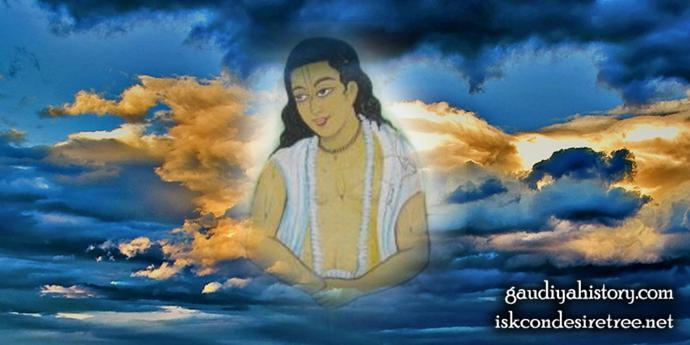
Srila Shyamananda Pandit was born Duhkhi, to a family of milkmen in rural Bengal. Together with Shrinivasa Acharya and Narottama Dasa Thakura, he became one of three preachers whom the Goswamis of Vrindavana sent home. They were sent to carry Gaudiya Vaishnavism into Bengal and Utkal (the older name for Odisha). Along the way, it was also carried into a family line of gurus. Historians and Srila Prabhupada's own purports both confirm that this line ran for centuries afterward. Until now he did not have a page of his own here, even though two other pages on this site talk about him at length. One is Hridaya Chaitanya, because Shyamananda was the disciple who made the name of that quiet Bengali householder-guru important in history. The other is Rasikananda Prabhu, because Shyamananda was Rasikananda's own guru.
| Detail | Description |
|---|---|
| Birth name | Duhkhi (also Dukhi, Dukhia), later Krishnadasa |
| Approximate birth year | c. 1535 AD, about a year after Sri Chaitanya Mahaprabhu's own disappearance |
| Birthplace | Dharenda Bahadurpur, near present-day Kalaikunda, Midnapur, Bengal |
| Family | Sadgopa (milkman) caste; father Krishna Mandal, mother Durika |
| Diksha-guru | Hridaya Chaitanya of Ambika Kalna |
| Siksha-guru in Vrindavana | Jiva Goswami, who gave him the name Shyamananda |
| Chief disciple | Rasikananda Prabhu |
| Literary works | Vrindavan Parikrama; Upasana Sara Samgraha; poems in Aprakashita Pada-ratnavali |
| Disappearance | Krishna-pratipada, month of Ashadha; exact year and place both disputed (see below) |
Scriptural evidence for the introduction (2)
kibā vipra, kibā nyāsī, śūdra kene naya
yei kṛṣṇa-tattva-vettā, sei 'guru' haya
Word for word
kibā: whether; vipra: a brāhmaṇa; nyāsī: a sannyāsī; śūdra: a śūdra; kene naya: why not; yei: anyone who; kṛṣṇa-tattva-vettā: a knower of the science of Kṛṣṇa; sei: that person; guru haya: is the spiritual master.
Whether one is a brahmana, a sannyasi or a shudra — regardless of what he is — he can become a spiritual master if he knows the science of Krishna.
From the purport: Purport excerpt: Srila Rasikananda, although born in a brahmana family, was initiated by Sri Syamananda Prabhu, who was not born in a caste brahmana family.
This is the very verse Srila Prabhupada's own purport uses Shyamananda and Rasikananda to illustrate; it is placed on the main page because it states, more directly than any other citation here, the single principle Shyamananda's whole life ran on.
na śūdrā bhagavad-bhaktās
te 'pi bhāgavatottamāḥ
sarva-varṇeṣu te śūdrā
ye na bhaktā janārdane
Word for word
na: not; śūdrāḥ: shudras; bhagavat-bhaktāḥ: devotees of the Lord; te api: they also; bhāgavata-uttamāḥ: first-class devotees; sarva-varṇeṣu: among all social classes; te: they; śūdrāḥ: shudras; ye: those who; na: not; bhaktāḥ: devotees; janārdane: of the Lord.
Devotees of the Lord are never shudras, even by birth in a shudra family; but among every class of men, those who are not devotees of the Lord are to be considered shudras.
Quoted by Srila Prabhupada in the same purport that names Shyamananda directly, this is the scriptural basis for treating a devotee's spiritual, not social, standing as what actually defines him.
Chapter 1
Early Life and Training Under Hridaya Chaitanya
Almost everything about Shyamananda Pandit's boyhood and first initiation is really part of someone else's story, the story of his guru. Hridaya Chaitanya of Ambika Kalna is the reason a milkman's son from rural Bengal became a Gaudiya Vaishnava acharya at all. That relationship is already told in depth on Discovering Duhkhi Krishnadasa and Training and Sending Him to Vrindavana. Those pages also cover a real disagreement between sources over whether the boy had heard his future guru's name before he ever left home. This page does not repeat all that. It gives only a short summary and then moves on to what came after, the actual journey to Vrindavana.
| Detail | Description |
|---|---|
| Birth name | Duhkhi (Dukhi, Dukhia), "the sorrowful one" |
| Birthplace | Dharenda Bahadurpur, near present-day Kalaikunda, Midnapur |
| Family | Sadgopa (Six-Gopa) caste of milkmen; father Krishna Mandal, mother Durika |
| Guru | Hridaya Chaitanya, disciple of Gauridasa Pandit, at Ambika Kalna |
| Name given at initiation | Krishnadasa |
| Destination after training | Vrindavana, on his guru's own order |
| Approximate birth year | c. 1535 AD, about a year after Sri Chaitanya Mahaprabhu's own disappearance (Shyamananda Charit) |
A Name That Remembered Grief #
Duhkhi's parents had already lost several children before his birth. They named him Duhkhi, meaning "sorrowful," a name sometimes softened to Dukhi or Dukhia. They did this partly to guard against losing another child. Tradition says it was also partly because of a vow that if this child lived, they would offer him to Vishnu's service. He grew up in a family of Sadgopas, milkmen counted among the sat-shudra communities of Bengal. Brahmanas were traditionally permitted to accept water from their hands. So the Sadgopas were not brahmanas themselves, but they were not among the lowest-ranked groups either. Every source agrees that he showed an unusual pull toward renunciation early, finished his schooling quickly, and grew restless the moment he heard local devotees speak of Gaura and Nityananda.
Shyamananda Charit places his birth about a year after Sri Chaitanya Mahaprabhu's own disappearance, around 1535 AD. That would make him the youngest of the three friends who later carried the Goswamis' books east together. Shrinivasa Acharya was already at least ten years old when Mahaprabhu departed this world. Narottama Dasa Thakura was born only shortly before that same disappearance, so he was close in age to Dukhi himself.
Leaving Home for Ambika Kalna #
Sources genuinely differ on how the meeting with Hridaya Chaitanya actually happened. Some say Duhkhi had already named him as his intended guru before leaving home. Others say he simply found him on arriving with a group of Ganga pilgrims. However it happened, what matters here is what both versions agree on. A boy of humble birth traveled a long and difficult road alone to a Bengali temple town. And a guru already known for his own extraordinary devotion to Sri Sri Gaura-Nitai chose to see past that birth instead of turning him away. Hridaya Chaitanya renamed him Krishnadasa on the spot. In time he formally initiated him with the Krishna mantra. Hridaya Chaitanya's own page connects this act directly to the same principle that Sri Chaitanya Mahaprabhu had already taught Ramananda Raya: that anyone who knows the science of Krishna can serve as guru, whatever their birth.
One detailed telling of this same episode leaves no doubt on this point. It says that Dukhi, still only a teenager, was already certain in his own mind who his guru would be, long before he ever left Bengal. "Hridoy Caitanya is my guru!" he is remembered as declaring to his own father. "He lives at Ambika Kalna, and his guru is Gauridasa Pandit, Mahaprabhu's own intimate associate." When his father objected that the road was long and his son only a boy, Dukhi answered simply that pilgrims bound for Bengal would look after him on the way. This account says his confidence came before he left, while other tellings say it came only once he arrived. Either way, every version agrees on what happened next.
Service Before Sanction #
All accounts agree that years of unusually complete service followed. It was not a matter of dramatic incidents. It was steady, humble attention to his guru's daily needs. One well-known detail is that he carried water on his head for the Gaura-Nitai Deities' garden until the friction wore his scalp raw. Hridaya Chaitanya discovered this only when he saw the wounds himself. He is remembered as recognizing that this quiet endurance showed his disciple had the qualification for something bigger than temple service at Ambika Kalna. In time Krishnadasa's own restlessness for Vrindavana came out. "Now I shall see the Yamuna," he said, since he had already bathed in the Ganges. His guru did not hold him back. "Yes, of course, you shall see it. You shall go to Braj-dhama," Hridaya Chaitanya told him. He gave him permission to travel on to the Six Goswamis, and to carry with him his own messages of respect for them.
An Extended Pilgrimage, By Rasik-mangal's Account #
Rasik-mangal describes at length what the permission Hridaya Chaitanya granted him actually meant in practice. It was not a short trip. It was a solo pilgrimage of well over a year, across the length of India, before Krishnadasa ever set foot in Vrindavana. He is remembered as visiting Vakreshwar, Vaidyanath, Gaya, Benares and Allahabad, then Brahma-tirtha, Chandra-tirtha, Nimsar, Ayodhya, Hastinapur, Kurukshetra, Haridvar and Badarikashram. He is remembered as going further still, to Dwaraka and other holy places along the western coast. This route took him through parts of the north that many Gaudiya Vaishnavas of his own time rarely traveled. Only after this did he turn back toward Puri and Navadvipa to see the sites of Mahaprabhu's own most intimate pastimes, and from there home to his native village in Odisha. Only after this long journey, and only on a second visit to his guru's house at Ambika Kalna, did Hridaya Chaitanya give him the specific instruction that would shape the rest of his life. He was to go to Vrindavana, carrying a personal letter of introduction, and study the Vaishnava literature under Jiva Goswami at Jiva's newly-established school for advanced students.
The Journey Itself #
As the story is told, Krishnadasa's route to Vrindavana became a pilgrimage of its own. He went through Navadwipa, where he sought out the old house of Jagannatha Mishra and met the aged Ishan Thakura. He went to Gaya, where Chaitanya Mahaprabhu had once taken initiation from Ishvara Puri. In Kashi he had darshan of Tapana Mishra and Chandrashekhara Acharya. Finally he went to Mathura and on to Vrindavana itself, where he sought out the bhajana-kutir of Jiva Goswami. What he found there, and what happened to him once he arrived, is told on Education in Vrindavana Under the Goswamis. From that point Duhkhi Krishnadasa's story stops being mainly Hridaya Chaitanya's story and becomes his own.
Scriptural evidence for this chapter (1)
kibā vipra, kibā nyāsī, śūdra kene naya
yei kṛṣṇa-tattva-vettā, sei 'guru' haya
Word for word
kibā: whether; vipra: a brāhmaṇa; nyāsī: a sannyāsī; śūdra: a śūdra; yei kṛṣṇa-tattva-vettā: anyone who knows the science of Kṛṣṇa; sei guru haya: he becomes guru.
Whether one is a brahmana, a sannyasi or a shudra — regardless of what he is — he can become a spiritual master if he knows the science of Krishna.
This is the same principle Hridaya Chaitanya had already put into practice by accepting and initiating Duhkhi, a milkman's son, years before Shyamananda would live it out himself in Odisha.
Chapter 2
Education in Vrindavana Under the Goswamis
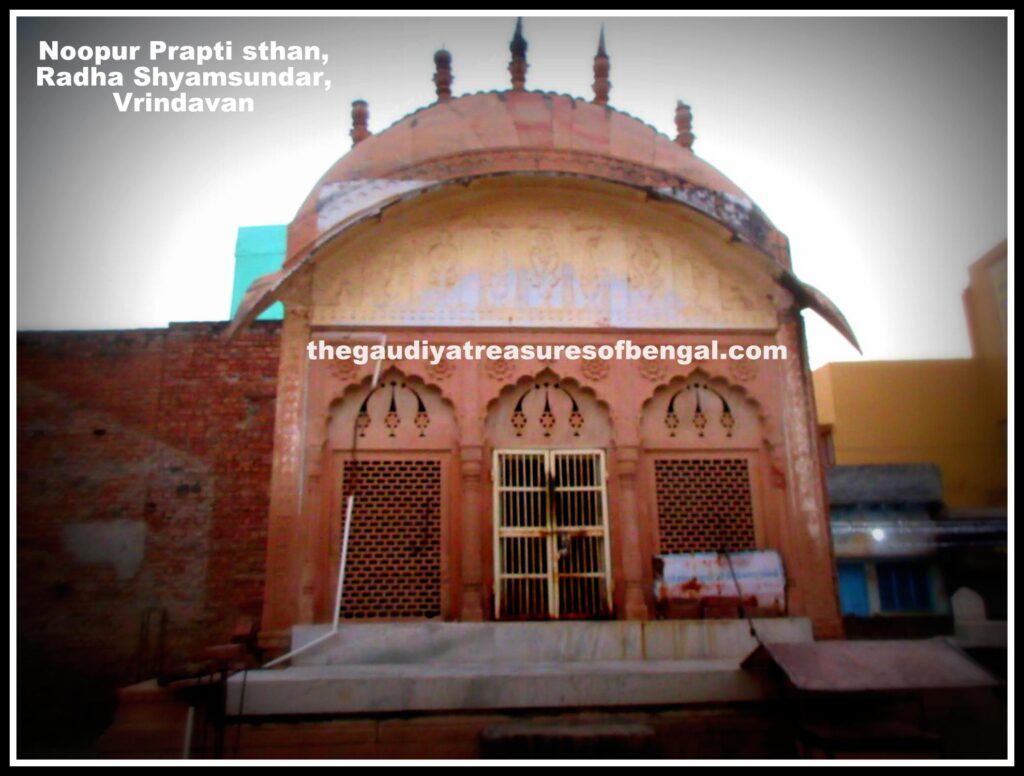
Krishnadasa's arrival in Vrindavana marks the real beginning of Shyamananda Pandit's own story, separate from his first guru's. He came already trained in devotion and service by Hridaya Chaitanya. In Vrindavana he came under Jiva Goswami. After the disappearances of Sanatana Goswami and Rupa Goswami, Jiva Goswami was by then the only surviving senior figure among the Six Goswamis of Vrindavana. Under Jiva Goswami, Krishnadasa received his philosophical training, met his closest companions, and was given the name by which history remembers him.
| Detail | Description |
|---|---|
| Teacher | Jiva Goswami, youngest and by then sole surviving senior Goswami |
| Service assigned | Drawing water daily from the Kanana-Kunja |
| Miracle | Finding Srimati Radharani's lost anklet; receiving Her darshan |
| New name | Shyamananda ("one who gives joy to Shyama") |
| Fellow students | Narottama Dasa Thakura and Shrinivasa Acharya |
| Later relic | The Deity of Sri Shyamsundar, received at the same spot |
Under Jiva Goswami's Care #
Arriving at Jiva Goswami's bhajana-kutir, Krishnadasa offered his obeisances and explained that Hridaya Chaitanya had sent him for instruction. According to one detailed account of his life, Hridaya Chaitanya had already written ahead: "I have a disciple named Duhkhi Krishnadasa. I am offering him to you. Teach him well in Krishna consciousness... when his mind is fixed... you may send him back to me." Whether or not those exact words were used, every version of the story agrees on two things. This was a planned and respectful handing over of a disciple from one guru to another, not an abandonment. And Jiva Goswami received the new arrival with real warmth. Krishnadasa studied the philosophy and scriptures of the Goswamis carefully. He wanted some service that would bring him physically closer to his new teacher. So he was given a simple daily task, filling Jiva Goswami's water pot from the Kanana-Kunja.
The Anklet at the Kunja #
During that ordinary daily task, something happened that gave Shyamananda his name and the defining mark of his life. One day Krishnadasa was drawing water at the Kanana-Kunja, deeply absorbed. There Sri-Sri Radha and Krishna eternally perform Their rasa-lila, unseen by unqualified eyes. Beneath a tree Krishnadasa found a golden anklet. It had been dropped there the night before, when Radhika's dancing had become so ecstatic that She did not notice its loss. He pressed it to his head in wonder and fell into ecstatic symptoms of his own. He wept and fainted with the anklet clasped to his heart. Then he buried it in a secret place for safekeeping.
Most accounts, including this fuller one based on Rasik-mangal, name the devotee who came looking for it the next day as Sri Lalita-devi herself, disguised as an elderly brahmani. (A few sources instead say Vishakha.) "Have you seen my daughter-in-law's ankle bell?" she asked Krishnadasa, saying that the girl had been careless. Krishnadasa was suspicious. He refused to hand it over without proof, and insisted that they go together to her village so that her own neighbors could identify it. His sincerity left Lalita no way out. She dropped the pretense and admitted the truth: the anklet belonged to Srimati Radharani, and both she and Radhika were pleased with him. When she offered him any boon he wished, Krishnadasa asked for only one thing, to know her real identity. Lalita-devi granted this and revealed her true spiritual form, though she did not yet give up her elderly disguise. Krishnadasa then begged to serve Radha and Krishna directly. So she gave him a confidential siddha-mantra of fifteen syllables for the constant vision of Radhika. She told him that his own perfected spiritual body (siddha-deha) would come to him in due course. Krishnadasa dug up the buried anklet, and in the process his ordinary iron spade turned to gold at his own touch. Then he returned the anklet to her hands.
After this, Krishnadasa bathed in Sri Radha-kunda and chanted the mantra Lalita had given him. He attained his own siddha-deha then and there, the form of a golden-complexioned manjari named Kanaka Manjari. In this form Lalita-devi brought him before Srimati Radharani Herself in the nikunja. There Radharani identified him as Her own eternal associate, Sri Krishna-priya. At Her direction, Lalita-devi touched the golden anklet to his forehead. Two vertical lines appeared there, with a dot in the middle where the anklet's tip had touched. This is the same tilaka Shyamanandi Vaishnavas still wear today. "From this moment," Lalita told him, "you shall be known as Shyamananda, for you have brought bliss (ananda) to Radha (Shyama) by returning Her anklet." Radharani then blessed him to return to the mortal world and complete his mission there. She promised him Her own eternal service once it was done. Looking on him with special mercy, She manifested the transcendental Deity of Sri Shyamsundarji from Her own lotus heart. Lalita-devi placed the Deity directly in his hands. "I am delivering this Deity to you for the welfare of the whole world," she told him. "As long as you live in this world, keep yourself engaged in His loving service." The full history of this Deity, and of the Radha-Shyamsundar temple built around it, is told on Establishing Deities and Preaching in Odisha.
A Guru's Anger, and a Dream That Corrected It #
Jiva Goswami confirmed the name the next morning, but he asked that the miracle itself not be spoken of in public. Even so, the news reached Hridaya Chaitanya at Ambika Kalna. He heard that his disciple had taken a new name and a new tilaka without his permission. So Hridaya Chaitanya traveled to Vrindavana himself and rebuked Shyamananda sharply, even physically, while the Vaishnavas present tried to calm him. All accounts agree that Shyamananda bore the rebuke without protest, certain that he had never actually left his first guru's service. That night, tradition holds, Radharani appeared to Hridaya Chaitanya in a dream and scolded him in turn. She, not his disciple, had chosen the name and the mark, and he had no right to overrule Her. By morning Hridaya Chaitanya had accepted what had happened and embraced Shyamananda warmly. This episode is told from the guru's side on Hridaya Chaitanya's own page. Across the tradition, it is seen as the moment when Hridaya Chaitanya's authority over his own disciple was corrected and confirmed at the same time, not reduced.
A Fuller Account of the Trial #
A fuller account of how this controversy actually played out is drawn from Rasik-mangal and Bhakti-ratnakara. It tells a longer and more dramatic story than a single private dream. In this telling, Hridaya Chaitanya first heard the news from disciples he had sent to find out what had happened. Jiva Goswami was bound by his promise of secrecy to Lalita-devi, so he protected the truth without actually lying. He told the disciples that Krishnadasa's tilaka and new name had come to Krishnadasa in a dream, in which his own guru, Hridaya Chaitanya, blessed him at Kanaka-kunja. When the disciples questioned Krishnadasa directly, he confirmed this answer. But when the disciples carried this explanation home, Hridaya Chaitanya had no memory of any such dream. He was not convinced. So he gathered a large party of twelve gopalas, sixty-four mohants and his own disciples, and traveled to Vrindavana himself to settle the matter in person.
There, before an assembly of the mohants of Vraja at the Rasasthali, Hridaya Chaitanya challenged Shyamananda directly. The name and tilaka, he said, would have to prove themselves or be washed away by his own hand. Shyamananda was given a moment to compose himself. He fell into a deep trance, and in his siddha form as Kanaka Manjari he found himself again before Srimati Radharani. She sent for Subala, Krishna's own friend. Subala is the Vraja form of Gauridasa Pandit, Hridaya Chaitanya's own guru. Subala placed the same tilaka and name on Kanaka Manjari's own body. He promised that if she remembered him at the crucial moment, neither would wash away. When Shyamananda's trance broke before the assembly, he asked the mohants to mark his forehead and chest again, and then to wash him with all the soap and water they wished. Hridaya Chaitanya himself scrubbed at his disciple's tilaka, and it began to fade. But as Shyamananda silently called on Gauridasa Pandit and Lalita-sundari, the mark and the name reappeared brighter than before, in front of the entire assembly. Hridaya Chaitanya accepted defeat with joy, not resentment. The account says he was proud of his own disciple's mystical victory.
Whichever version is followed, a private dream-correction or this public trial, every telling agrees on the outcome: Hridaya Chaitanya accepted what had happened and embraced Shyamananda as his own again.
A Second Test: Radha-bhava and a Guru's Forgiveness #
The reconciliation was not yet complete. Soon after, the party toured the forests of Vraja together with the visiting mohants. At Sanketa they came upon a troupe of actors performing rasa-lila, and those present who had spiritual vision saw the pastime itself unfold. Shyamananda wept without restraint. He was absorbed in gopi-bhava, the mood of a maidservant of Radhika in separation. But Hridaya Chaitanya's own relationship with Krishna, through Gauridasa Pandit, centers on sakhya-bhava, transcendental friendship, and he left the performance troubled, not joyful. The next morning he told Shyamananda plainly that this was not his own mood, and that there was no longer any reason for his disciple to stay with him.
Shyamananda answered that Gauridasa Pandit himself, in his form as Subala, is absorbed in Radha-bhava within the kunja. Shyamananda was the disciple of Gauridasa Pandit's own disciple. So, he said, a similar mood arising in him could hardly be a fault. Hridaya Chaitanya was unmoved. He struck Shyamananda again and again with a branch until the mohants present stepped in, horrified, telling him he would kill his own disciple. Shyamananda, for his part, refused their sympathy. He said that a guru's punishment was itself a sign of loving attention, not rejection. That same night, Chaitanya Mahaprabhu is said to have appeared to Hridaya Chaitanya in a dream. His own body and white chaddar were drenched in blood. "It is only by your mercy," Mahaprabhu told him, "that My body is soaked in blood. You have beaten Shyamananda, who is like My own self." Hridaya Chaitanya begged forgiveness at once. Mahaprabhu granted it on the condition that he perform twelve Vaishnava festivals in atonement. By morning, Hridaya Chaitanya had told the assembled mohants everything. He turned to Shyamananda with words that reversed everything he had said the evening before: "From this day forward, you are not my servant, but you are my life and soul." Shyamananda, true to the humility seen in every account of his character, refused even this honor. He insisted that he remained his guru's eternal servant regardless. He himself begged alms from the Vaishnavas of Vraja to help pay for the twelve festivals Hridaya Chaitanya had promised. Once they were completed, Hridaya Chaitanya returned to Bengal. Shyamananda stayed on in Vrindavana to continue his studies under Jiva Goswami, exactly as his guru had originally instructed.
Companions in Madhukari #
Alongside this defining episode, Shyamananda's years in Vrindavana were also simply years of shared study and shared poverty with two other young men under Jiva Goswami's guidance: Narottama Dasa Thakura and Shrinivasa Acharya. The three practiced madhukari together. This means begging from door to door just enough food for the day, the traditional discipline of a Vaishnava who has renounced the world. They studied the Goswamis' writings as one group. They became so close that later Gaudiya history remembers them as a single generation of preachers, not three separate careers. Chaitanya-charitamrita and Srimad-Bhagavatam teach two things in the verses cited here. The seed of devotional service comes only by the mercy of guru and Krishna together (CC Madhya 19.151). And brahminical qualification is a matter of quality, not birth alone (Srimad-Bhagavatam 7.11.35). Shyamananda's own Vrindavana years show both of these themes directly. When Jiva Goswami judged all three of them ready, he called them together and gave them a shared task that would shape the rest of their lives: carrying the Goswamis' scriptures home to Bengal. This is told on Carrying the Scriptures and the Vira Hambira Episode.
Scriptural evidence for this chapter (3)
brahmāṇḍa bhramite kona bhāgyavān jīva
guru-kṛṣṇa-prasāde pāya bhakti-latā-bīja
Word for word
brahmāṇḍa bhramite: wandering through the universe; kona bhāgyavān jīva: some fortunate living being; guru-kṛṣṇa-prasāde: by the mercy of guru and Krishna; pāya: gets; bhakti-latā-bīja: the seed of the creeper of devotional service.
According to their karma, all living entities are wandering throughout the universe. One who is very fortunate gets an opportunity to associate with a bona fide spiritual master by the grace of Krishna, and by the mercy of both receives the seed of the creeper of devotional service.
Cited here for the theme of a fortunate soul receiving the seed of bhakti through a guru's mercy, exactly what Shyamananda describes receiving from Jiva Goswami at the Kanana-Kunja.
yasya yal-lakṣaṇaṁ proktaṁ
puṁso varṇābhivyañjakam
yad anyatrāpi dṛśyeta
tat tenaiva vinirdiśet
Word for word
yasya: of whom; yat-lakṣaṇam: whatever symptoms; proktam: described; puṁsaḥ: of a person; varṇa-abhivyañjakam: indicating the social position; yat: if; anyatra api: in someone else also; dṛśyeta: should be seen; tat: that person; tena eva: by that very symptom; vinirdiśet: one should identify.
If a person is born in a shudra family but has all the qualities of a spiritual master, he should be accepted not only as a brahmana but as a qualified spiritual master also.
Cited for the theme of a devotee's real qualities, not his birth, being what identifies him, the same test Jiva Goswami is remembered as applying when he accepted and trained the newly arrived Krishnadasa.
Whatever position one may have, if he is fully conversant with the science of Krishna, he can become a bona fide spiritual master — this does not depend on birth.
From the purport: Purport excerpt: "Another great acharya, Sri Rasikananda, accepted Sri Syamananda as his spiritual master, although Syamananda was not born in a brahmana family."
Srila Prabhupada's own summary study of Chaitanya Mahaprabhu's teachings names Shyamananda directly, alongside Ishvara Puri, Madhavendra Puri and Gangananarayana Chakravarti, as a historical example of this principle.
Chapter 3
Carrying the Scriptures and the Vira Hambira Episode
When Jiva Goswami judged Shyamananda, Narottama Dasa Thakura and Shrinivasa Acharya ready, he gave the three of them a mission. They were to carry the actual handwritten books of the Vrindavana Goswamis safely to the Vaishnava community waiting for them in Bengal and Odisha. These were the only copies in existence. This mission mattered as much to the survival of Gaudiya Vaishnavism as any single sermon could have.
| Detail | Description |
|---|---|
| What was carried | The manuscripts of Rupa, Sanatana, Gopala Bhatta, Raghunatha Dasa and Jiva Goswami |
| Protection arranged | A cart, bullocks and armed guards, with a passport from the king of Jaipur |
| Where it was stolen | Near Vishnupura, in the kingdom of Vira Hambira |
| Who stayed behind to recover it | Shrinivasa Acharya |
| Shyamananda's own path | Returned directly to Ambika Kalna to report to Hridaya Chaitanya |
A Cargo More Precious Than It Looked #
By the time Jiva Goswami sent the three friends east, the Bhakti-rasamrita-sindhu, the Bhagavata-sandarbhas and the rest of the Goswamis' writings existed only as manuscripts in Vrindavana itself. The growing community of Gaudiya Vaishnavas in Bengal and Utkal had no direct access to any of it. Srimad-Bhagavatam teaches that hearing and chanting about Krishna cleanses the heart of "those who have developed the urge to hear" His message (Srimad-Bhagavatam 1.2.17). This cargo quite literally made that hearing possible for an entire region. Without these books reaching Bengal, there was no way for that hearing to happen on a large scale. Jiva Goswami arranged a cart, bullocks and armed guards. He also secured a passport from the king of Jaipur for safe passage, and then sent the three off with his blessing.
The Theft Near Vishnupura #
The party passed through the territory of Vira Hambira. He was a real historical ruler of the Malla dynasty at Vishnupura, in what is now Bankura district, West Bengal. One night dacoits working for the king took the party's cart. The king's court astrologers had wrongly predicted that it held gold and jewels, not books. What followed from that theft is one of the best-recorded and most important episodes in early Gaudiya Vaishnava history. Vira Hambira was eventually converted, he returned the manuscripts, and Vishnupura became a lasting center of Vaishnava culture and terracotta temple architecture. In its fullest and best-documented form, that story is part of Shrinivasa Acharya's life. He stayed behind at Vishnupura to recover the books while his two companions went on ahead. The Encounter With Vira Hambira tells it in full, including the real history behind Vira Hambira's reign, which readers can check. That history is not repeated here.
Two Different Roads Home #
With Shrinivasa Acharya staying at Vishnupura, Narottama Dasa Thakura and Shyamananda went on separately. Narottama continued toward Kheturigram, his own birthplace in Bengal. Shyamananda, for his part, returned directly to Ambika Kalna to report to Hridaya Chaitanya. The two embraced with real joy after the long separation. Hridaya Chaitanya was shaken by the news of the theft, even as he rejoiced at his disciple's safe return. Shyamananda settled back into guru-seva for a time. Sources say his happiness grew day by day, even while the fate of the stolen books was still uncertain.
Another devotional account tells this moment differently. It says he stayed with Narottama all the way to Kheturigram and then went on to Odisha alone. In that version he did not return directly to Ambika Kalna as told above. Both versions agree on the things that matter most. The books were lost near Vishnupura, Shrinivasa Acharya remained behind to recover them, and Shyamananda's own road finally led to Odisha. The sources do not agree on exactly which village he passed through first. This is a smaller detail, and we report it here without trying to settle it.
The Order That Sent Him to Odisha #
During this period at Ambika Kalna, Hridaya Chaitanya received troubling news of his own. One by one, the personal associates of Chaitanya Mahaprabhu who had once carried His teaching directly into Utkal desh were passing away. Without them the preaching there was fading. As his own page makes clear, Hridaya Chaitanya's own life was rooted at Ambika Kalna, not in Odisha. So instead of going himself, he gave the order that would shape the rest of Shyamananda's life: go to Utkal, and revive what was dying out. By his own account, Shyamananda left in real pain at parting from his guru, carrying "his guru's order on his head." The page Establishing Deities and Preaching in Odisha tells what he built once he arrived. It covers the Deities he installed, the disciples he gathered, and the young man named Rasikananda who would become his own foremost follower.
Scriptural evidence for this chapter (1)
śṛṇvatāṁ sva-kathāḥ kṛṣṇaḥ
puṇya-śravaṇa-kīrtanaḥ
hṛdy antaḥ stho hy abhadrāṇi
vidhunoti suhṛt satām
Word for word
śṛṇvatām: of those who have developed the urge to hear; sva-kathāḥ: His own words; kṛṣṇaḥ: the Personality of Godhead; hṛdi antaḥ sthaḥ: situated within the heart; abhadrāṇi: the desire to enjoy matter; vidhunoti: cleanses; suhṛt satām: the well-wisher of the truthful.
Krishna, the Personality of Godhead, who is the Supersoul in everyone's heart and the well-wisher of the truthful devotee, cleanses the desire for material enjoyment from the heart of a devotee who has developed the urge to hear His messages.
Cited for the value of the very literature Shyamananda, Narottama and Shrinivasa were entrusted to carry to Bengal, without it reaching there, this hearing could not happen at the scale it eventually did.
Chapter 4
Establishing Deities and Preaching in Odisha
Shyamananda Pandit's guru ordered him to revive the fading preaching work of Chaitanya Mahaprabhu's associates in Utkal desh. Shyamananda spent most of three decades on this work. What he built became one of the most successful regional missions in early Gaudiya Vaishnava history. Its success was measured not in sermons alone, but in Deities installed, temples founded, and a documented "Shyamanandi" community that still exists across Odisha and southern Bengal today.
| Detail | Description |
|---|---|
| Mission field | Dandeshwar, Rohini, Nrisinghpur, Balarampur, Gopiballabhpur and wider Utkal |
| Chief disciple found here | Rasikananda Prabhu, met at Rohini |
| Deities installed in Odisha | Radha-Govinda at Gopiballabhpur; Gokula Chandra at Basantia; Madana Mohana at Nadajal |
| Deities linked to him in Vrindavana | Sri Shyamsundar and, later, Radha-Shyamsundar together |
| Notable converts | Yogi Damodara; the Mughal officer nicknamed "Haribola"; the Pathan Sher Khan |
| Distinct kirtan style | Reneti (Ranihati) kirtan, from the Midnapur district |
| Literary works | Vrindavan Parikrama; Upasana Sara Samgraha; poems in Aprakashita Pada-ratnavali |
Why Odisha Needed Him #
By the time Shyamananda arrived, Odisha's Vaishnava community was in real difficulty. The generation of Chaitanya Mahaprabhu's own associates who had once made Puri a Vaishnava stronghold had mostly passed on. The political situation had also turned hostile. After the collapse of Emperor Prataparudra's dynasty, Pathan rule brought repeated warfare with the Mughals. Kala Pahara and other Pathan temple-breakers even defiled the Jagannath temple itself. Political relief came from Raja Man Singh, a Mughal general serving Akbar. By most accounts, Man Singh was himself a disciple in the Gaudiya Vaishnava line. He fought a decisive campaign along the Suvarnarekha river and drove the Pathans back to Cuttack. He restored Odisha's holy places, including the temple of Jagannath, to the care of their own devotees, and then went on to serve as governor of Bengal. Man Singh's victory made the ground safe again. Shyamananda, sent by Jiva Goswami and by Hridaya Chaitanya's own order, then filled that safe ground with the spiritual life Odisha had lost. The two are remembered together for bringing Vaishnava life back to the region that Mahaprabhu Himself had once made a centre of Vaishnavism.
Passing Through His Own Past #
On his way into Utkal, Shyamananda deliberately passed through his own birth village of Dharenda Bahadurpur, and through Dandeshwar, where his father had once lived. He preached in both places. The townspeople, who remembered him simply as their own Duhkhi returning home, showed visible joy. From there he reached Rohini, on the Subarnarekha River, and met the young Rasikananda, son of the local zamindar. This meeting is covered in detail, from the disciple's side, on Rasikananda Prabhu's own pages, in Discipleship Under Shyamananda Pandit. Rasikananda quickly became Shyamananda's foremost follower. For the rest of Shyamananda's life, much of what he achieved was in practice done through this one relationship.
When he arrived, he found that both his parents had already died while he was away. But he did not let that grief slow him down. He opened a preaching center in his own family's house at Dandeshwar and began his mission from there.
Winning Over a Proud Yogi and a Hostile Officer #
All accounts agree that Shyamananda preached through public kirtana and plain explanation of Chaitanya Mahaprabhu's teaching. A handful of episodes from his preaching were also striking enough to be remembered separately. At Chakulia, a learned yogi named Damodara refused to accept Shyamananda as his guru, out of pride in his own brahmana birth. Damodara was a scholar versed in Sankhya philosophy, yogic perfections and Adwaita Vedanta. Then a private mystic vision showed him a brahminical thread shining with light on Shyamananda's own body. In the yogi's own eyes, this was proof that bhakti was completely above birth. Damodara, his mother and his two wives all took initiation soon after. In another episode, a Pathan official named Sher Khan broke a sankirtana party's instruments out of contempt, not once but twice. Shyamananda answered the second disruption by calling out the names of Radha and Krishna in a piercing voice. Sher Khan and his men are remembered as coughing blood on the spot, with their beards and moustaches catching fire. That night Sher Khan dreamed that Allah Himself struck him. Allah declared that He was the same Supreme Lord whom Shyamananda worshiped in His most confidential feature, Sri Chaitanya Mahaprabhu. He also declared that Sher Khan should take initiation from Shyamananda alone. Shaken, Sher Khan fell at Shyamananda's feet the next morning and was initiated under the name Chaitanya Dasa. A Mughal viceroy of Medinipur was so moved at a festival that he could only chant "Haribol! Haribol!" again and again. Shyamananda gave him the name Haribola on the spot. Devotion, not birth, was the one qualification Shyamananda ever tested for. This was the same principle Hridaya Chaitanya had already shown him at Ambika Kalna, now put into practice on a much larger scale.
Gopiballabhpur and the Deities of Odisha #
Rasikananda had carried his family Deity with him after his own father's death left him unwelcome among quarrelling relatives. At Rasikananda's request, Shyamananda renamed this Deity Gopi-vallabha Raya. The settlement that grew up around this Deity's worship took the name Gopiballabhpur. It is still the headquarters of the Shyamanandi community today. In the region Shyamananda also installed further Deities himself. At Gopiballabhpur itself he installed Radha-Govinda, at the earnest request of wealthy local residents. They built a full temple complex, kirtana hall, kitchen, guest house and gardens to receive the Deity. He installed Gokula Chandra at Basantia. At Tamluk, a hostile tantric sannyasi had hidden away a Deity of Chaitanya Mahaprabhu, whose worship had earlier been begun by Vasudeva Ghosh. After a dramatic recovery of that Deity, Shyamananda restored its worship there. By tradition, each of these Deities became the center of a local devotee community that has continued largely unbroken since.
Forty Years With Rasikananda, and a Reneti Kirtan of His Own #
For the next forty years Rasikananda Prabhu preached at Shyamananda's side. Between them the two converted a remarkable range of Odisha's ruling and landholding families. Shyamananda himself brought in Bhimadhana Bhuiyan, the landlord of Ghatshila, along with Uddanda Roy and Rajyadhar Roy of Govindapur. Rasikananda's own converts included Baidyanatha Bhanja, the raja of Mayurbhanj, along with the rulers of Patashpur, Panchet and Mayna. Rasik Mangal and Shyamananda Prakash, the standard biographies of this period, credit the two of them with ending animal sacrifice across large parts of non-Vaishnava Odisha in the process.
Shyamananda's movement also left behind its own musical tradition. Among his followers there grew up a particular blend of classical kirtana and his own devotional mood. It came to be called Reneti kirtan, after the Ranihati Pargana of the Midnapur district where it began. For the same reason it is sometimes called Ranihati kirtan. It is still one of the special marks of the Shyamanandi Vaishnava community today.
Shyamananda Prabhu's Literary Works #
Preaching and pilgrimage left Shyamananda little time for writing, but a handful of works are attributed to him. Vrindavan Parikrama describes the important holy places of Vraja. The now-rare Upasana Sara Samgraha explains the science of devotional service in the way Jiva Goswami had taught him. Aprakashita Pada-ratnavali collects poems in his name describing one of Radhika's secret meetings with Krishna. Rasikananda Prabhu himself later composed a Sanskrit epic on his teacher's life, Shyamananda Shatakam, which is still valued among Shyamanandi Vaishnavas today.
Vrindavana's Own Radha-Shyamsundar #
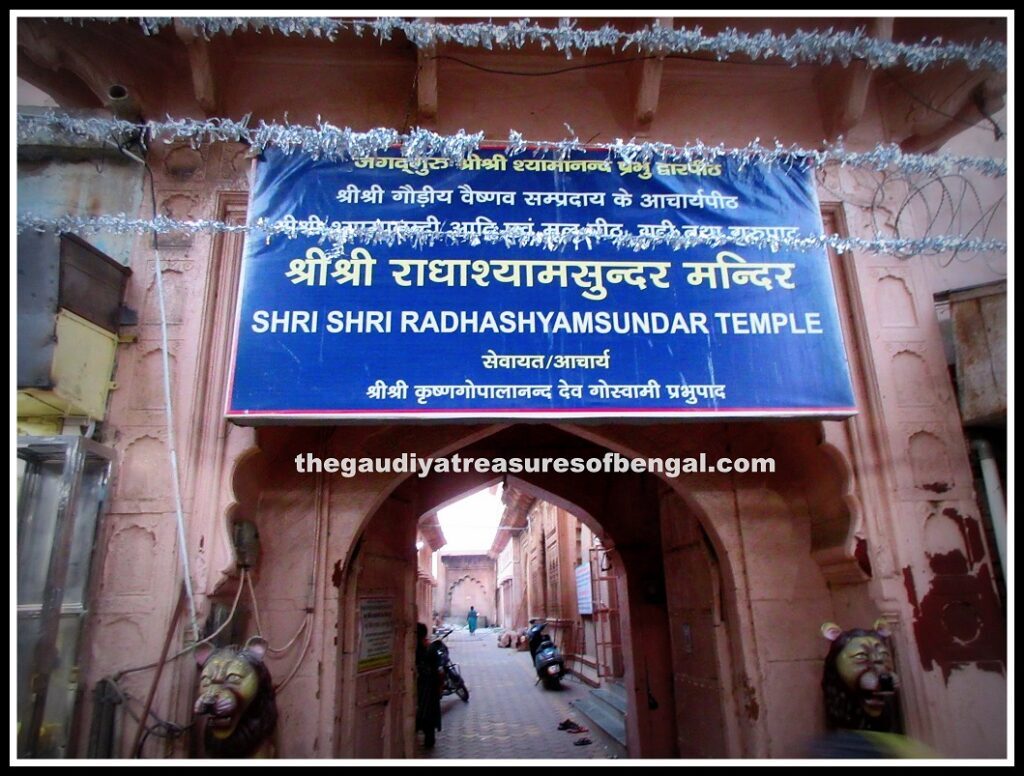
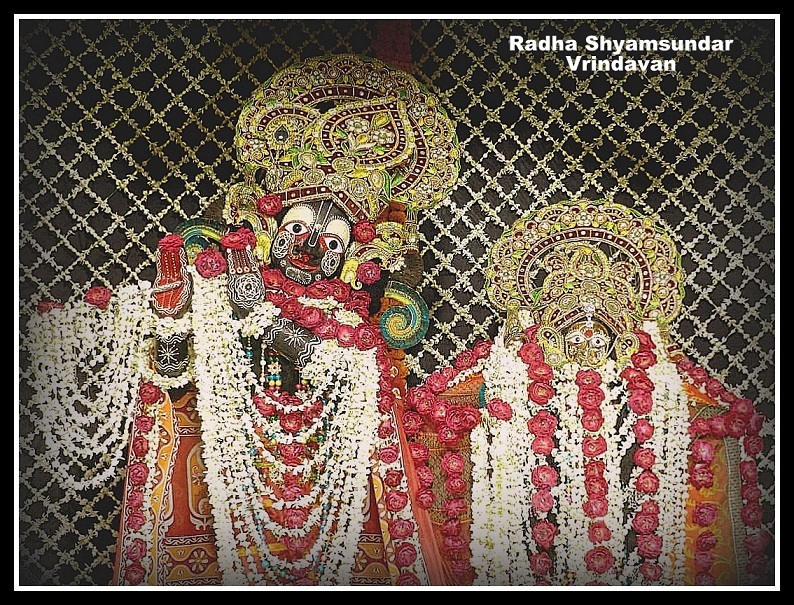
Shyamananda's Odisha mission was not his only lasting monument. In Vrindavana he installed the Deity Sri Shyamsundar in his own underground bhajana-kutir at Seva Kunja. This was at the very spot on the bank of the Kanana-Kunja where he had received Srimati Radharani's mercy and the anklet-shaped tilaka. Tradition holds that Radharani Herself gave this Deity directly on Vasanta Panchami (23 January) 1578 AD. The Deity was worshiped at first in Nidhuvan before finding its lasting home at Seva Kunja. Years later, in 1580 by one traditional account (Vasanta Panchami, 31 January, by a more precise dating), a self-manifest Deity of Radharani, called Lali, was discovered in the treasury of the King of Bharatpur. The king brought Her to Shyamananda, who arranged Her ceremonial marriage to Shyamsundar on Vasanta Panchami. The temple that grew from this pairing, Sri Sri Radha-Shyamsundar, still stands today. It is one of the seven historic original temples of Vrindavana, and one of the two principal dwar-peeths (seat-temples) of the wider Gaudiya-Madhva sampradaya. In 1719 Baladeva Vidyabhusana installed larger Deities there. Baladeva Vidyabhusana was a scholar who also descended from Shyamananda's own disciplic line through Rasikananda. This connection is told more fully on Final Days and Legacy.
Reunited With His Old Friends at Kheturi #
During these decades of preaching in Odisha, Shyamananda also traveled back to Bengal at least once for a festival that became very important. This was the installation of six Deities at Kheturigram, organized by Narottama Dasa Thakura. Jahnava Devi presided over it, and Vaishnavas from across Bengal, Odisha and Vrindavana attended. There Shyamananda was reunited with his old companions from their Vrindavana years, Narottama Dasa Thakura and Shrinivasa Acharya. Later the three were remembered together as the first generation of acharyas after the Six Goswamis. They helped bring together communities of Chaitanya's followers who had drifted apart since His disappearance. The fullest account of that festival, and what it achieved, is on Narottama's own page, The Kheturi Festival.
Scriptural evidence for this chapter (1)
patraṁ puṣpaṁ phalaṁ toyaṁ
yo me bhaktyā prayacchati
tad ahaṁ bhakty-upahṛtam
aśnāmi prayatātmanaḥ
Word for word
patram: a leaf; puṣpam: a flower; phalam: a fruit; toyam: water; yaḥ: whoever; me: unto Me; bhaktyā: with devotion; prayacchati: offers; tat: that; aham: I; bhakti-upahṛtam: offered in devotion; aśnāmi: accept; prayata-ātmanaḥ: of one in pure consciousness.
If one offers Me with love and devotion a leaf, a flower, fruit or water, I will accept it.
Cited for the simple, devotional standard behind every Deity Shyamananda installed across Odisha and at Vrindavana, the same standard his own preaching taught kings and dacoits alike.
Chapter 5
Marriage and Initiating Across Social Boundaries
Of all that is remembered about Shyamananda Pandit's personal life outside his preaching, his marriages are the hardest to be sure about. The sources disagree on this point, and we say so openly instead of hiding it.
| Detail | Description |
|---|---|
| Widely repeated tradition | Life of Shyamananda Pandit / Gaudiya History account: no marriage mentioned at all |
| Fuller household-lineage account | Bhakti-ratnakara-based biography: three marriages recorded |
| First wife (this account) | Gauranga Dasi, arranged by his father before his final departure for Vrindavana |
| Second wife (this account) | Shyampriya Dasi, daughter of Jagannatha Dasa of Badabalarampur |
| Third wife (this account) | Yamuna Thakurani of Mayurbhanj, accepted at Rasikananda's own request |
| Caste-crossing initiations | The brahmana yogi Damodara; the Muslim officer Sher Khan (Chaitanya Dasa) |
Two Traditions That Do Not Agree #
The version of Shyamananda's life most widely repeated online today is the "Life of Shyamananda Pandit" translated by ISKCON Desire Tree. Stephen Knapp's biography page and Gaudiya History's own entry repeat the same version. It describes him only as a renunciant preacher. In this version he left home once as a boy, never returned, and lived out his life as an unmarried sannyasi-style acharya. A separate, more detailed biography tells a very different story. It was translated from the tradition of the Shyamanandi household line, and it draws more directly on Narahari Chakravarti's Bhakti-ratnakara. It says that Shyamananda married, as his father arranged, before he finally left home for Vrindavana for good, and that he married twice more in later life. The sources really disagree, so both traditions are reported here. We do not choose one quietly, and we do not present either version as certain fact. A third source, another devotional account, states only in passing that "it is said he married three times," without naming any of the wives. This matches the number of marriages in the fuller tradition, but it does not confirm the details.
Three Marriages, By the Fuller Account #
According to this fuller tradition, Shyamananda's father arranged his first marriage, to a woman named Gauranga Dasi. This happened during a visit home, between an early pilgrimage and his final, decisive departure for Vrindavana. The account itself says the marriage "went against his wish," since his heart was already fixed on Krishna consciousness, not on household life. Later, during his active preaching years in Odisha, the same account records that Shyamananda married a second time. His second wife was Shyampriya Dasi, daughter of Jagannatha Dasa of Badabalarampur, and he married her at the repeated request of his own senior devotees. A third marriage followed still later. Rasikananda Prabhu brought a woman named Yamuna Thakurani, a resident of Mayurbhanj, to see Shyamananda, together with a large gift of offerings. This visit came directly after Rasikananda had initiated Vaidyanatha Bhanj, the raja of Mayurbhanj and head of that region's own kshatriya royal house. "Bound by the desire and request of Rasikananda Prabhu," the account says, Shyamananda accepted Yamuna Thakurani as his wife. The available sources do not directly state her family background. But the timing and the circumstances point in one direction. The bride came from Mayurbhanj together with gifts from the newly converted royal family. She came at the special request of the disciple who had just brought that royal house into the Vaishnava faith. All this points toward a marriage that connected Shyamananda, a man of humble Sadgopa birth, with Odisha's ruling kshatriya family line. On a personal level, such a marriage echoed the same crossing of caste lines that his preaching mission practiced in public.
What Both Traditions Agree On #
Whatever the truth of his married life, both traditions fully agree on the larger theme. Shyamananda, who was himself born outside the brahmana community, spent his adult life initiating people without regard to the caste boundaries of his time. Bhagavad-gita teaches directly that "those who take shelter in Me, though they be of lower birth... can attain the supreme destination" (Bhagavad-gita 9.32). Chaitanya Mahaprabhu also taught that "in the discharge of devotional service to the Lord, there is no consideration of the status of one's family" (Sri Chaitanya-caritamrita Antya 4.67). Fittingly, Srila Prabhupada himself quoted this verse in a 1977 lecture in Bhubaneswar. This is in the same Odisha region that Shyamananda once made his own field of preaching. The yogi Damodara and the Pathan officer Sher Khan are the two best-recorded examples of Shyamananda crossing these lines himself. Damodara was converted through a vision of Shyamananda's brahminical qualification, not his birth. Sher Khan threatened a sankirtana party, and after that he was initiated as Chaitanya Dasa. Both stories are told on Establishing Deities and Preaching in Odisha.
The Principle Handed Down One Generation Further #
Shyamananda first showed this principle in these individual cases. Later he turned it into a clear, lasting order for his own successor. When he sent Rasikananda Prabhu out to preach on his own, he told him directly to "distribute the Sri Hari-nama maha-mantra to everyone in Utkal, from the brahmanas up to the chandalas... without any discrimination." Rasikananda is remembered for carrying out this order for decades, converting kings, dacoits, and Muslim officials alike. Srila Prabhupada records in his purport to Sri Chaitanya-caritamrita Adi 7.45 that Rasikananda's family line continued for three to four hundred years afterward to initiate brahmana-born disciples, even though they were not brahmana-born themselves. That fuller story of the next generation is told on Rasikananda's own page, Initiating Across Caste Lines. Shyamananda's part in it was to live the principle first, in his own preaching and, by the fuller account of his life, in his own household as well.
Scriptural evidence for this chapter (5)
māṁ hi pārtha vyapāśritya
ye 'pi syuḥ pāpa-yonayaḥ
striyo vaiśyās tathā śūdrās
te 'pi yānti parāṁ gatim
Word for word
mām: of Me; hi: certainly; pārtha: O son of Pritha; vyapāśritya: particularly taking shelter; ye api syuḥ: even those who are; pāpa-yonayaḥ: born of a lower family; striyaḥ: women; vaiśyāḥ: merchants; tathā śūdrāḥ: as well as workers; te api: even they; yānti: go; parām gatim: to the supreme destination.
O son of Pritha, those who take shelter in Me, though they be of lower birth — women, vaishyas and shudras — can attain the supreme destination.
Cited for the theme running through both traditions of Shyamananda's marriages and his own initiations: that lower birth is no bar to full spiritual standing.
Even the lowest, who are called chandalas (dog-eaters), can be purified by association with a pure devotee.
Cited for the same theme applied specifically to the lowest-ranked castes, directly relevant to the charge Shyamananda would later give Rasikananda to initiate 'from the brahmanas up to the chandalas.'
yei bhaje sei baḍa, abhakta — hīna, chāra
kṛṣṇa-bhajane nāhi jāti-kulādi-vicāra
Word for word
yei bhaje: anyone who takes to devotional service; sei baḍa: he is exalted; abhakta: a nondevotee; hīna, chāra: most condemned and abominable; kṛṣṇa-bhajane: in discharging devotional service; nāhi: there is not; jāti-kula-ādi-vicāra: consideration of caste, family and so on.
Anyone who takes to devotional service is exalted, whereas a nondevotee is always condemned. Therefore in the discharge of devotional service to the Lord, there is no consideration of the status of one's family.
Srila Prabhupada quoted this exact verse in a 1977 lecture given in Bhubaneswar, Odisha, the same region Shyamananda spent decades preaching in centuries earlier.
na me 'bhaktaś catur-vedī
mad-bhaktaḥ śva-pacaḥ priyaḥ
tasmai deyaṁ tato grāhyaṁ
sa ca pūjyo yathā hy aham
Even though one is a very learned scholar in Sanskrit literature, if he is not engaged in pure devotional service he is not accepted as My devotee. But if someone born in a family of dog-eaters is a pure devotee with no motive for personal gain, he is very dear to Me — he should be given respect, his association should be accepted, and he should be worshiped exactly like Me.
This verse, quoted on a temple's own blog page about Shyamananda, states in the strongest possible terms the principle his life is remembered for; it is cited here as a scriptural parallel rather than presented as a verse Shyamananda himself is recorded quoting.
ṣaṭ-karma-nipuṇo vipro
mantra-tantra-viśāradaḥ
avaiṣṇavo gurur na syād
vaiṣṇavaḥ śva-paco guruḥ
A brahmana expert in the six brahminical duties and well versed in mantra and tantra cannot become a spiritual master if he is not a Vaishnava; but a Vaishnava, even from a dog-eater's family, is fit to become a spiritual master.
From the purport: Purport excerpt (Srila Prabhupada, spoken): "if a Vaishnava, even though he may come from the candala family, shvapaca, the dog-eater's family — that is considered the lowest in the human society — if he becomes a Vaishnava, he is fit for becoming spiritual master."
Spoken by Srila Prabhupada in the same 1977 Bhubaneswar lecture on the verse most associated with Shyamananda's own life, in the very region he preached in.
Chapter 6
Final Days and Legacy
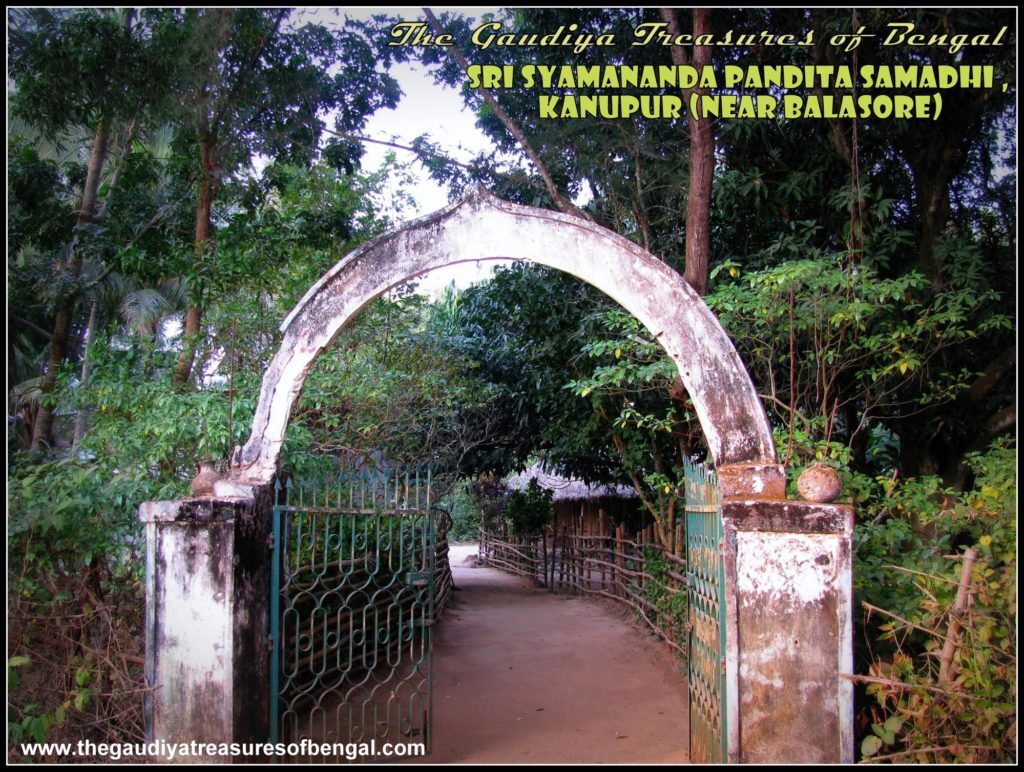
Like several other parts of Shyamananda Pandit's life, his final years come down to us through sources that agree on the main events. But they disagree on some real details that can be checked. We report the different versions here, instead of picking whichever one sounds more authoritative.
| Detail | Description |
|---|---|
| Illness | Fell seriously ill at Nrisinghpur after decades of active preaching |
| Duration | About four months, despite Ayurvedic treatment and Rasikananda's care |
| Successor named | Rasikananda Prabhu, turbaned and declared Mahanta of the whole community |
| Disappearance date (fuller account) | Krishna-pratipada, month of Ashadha, 1623 AD |
| Disappearance date (Hridaya Chaitanya's own page) | Traditionally given as Shaka 1552 / 1630 AD |
| Place of samadhi | Disputed, see below |
A Final Illness at Nrisinghpur #
Two sorrows are remembered as coming just before this final illness. First, news reached Shyamananda that Hridaya Chaitanya had passed away at Kalna. For a time even the achievements of his own life felt empty to him, because everything he had built had been done only to please his guru. After a festival was held in Hridaya Chaitanya's honor, he was at last able to return to his preaching. Then came a second blow: the death of his own disciple Damodara, the once-proud yogi who had become a devotee. Shyamananda is remembered as never recovering from this loss, and from that day his health began to fail.
After decades of active preaching across Odisha and repeated journeys back to Bengal and Vrindavana, Shyamananda fell seriously ill while staying at Nrisinghpur. He was staying in the house of the local landholder Uddanda Roy, one of his own earlier converts. Several Ayurvedic physicians attended him, and Rasikananda Prabhu cared for him constantly, but over about four months his health did not improve. Shyamananda is remembered as accepting this calmly, without trying to fight it: "Please do not make more efforts for my recovery," he told the devotees gathered around him, "as I have received a call from Lord Sri Krishna to leave this world... Just perform Sri Hari-nama kirtana day and night."
Passing the Mantle to Rasikananda #
Before his departure, Shyamananda called Rasikananda Prabhu to his side, placed his own feet on his disciple's head, and transferred to him what the tradition calls his full spiritual power. In front of the assembled Shyamanandi community, he tied a turban on Rasikananda's head and applied tilaka to his forehead with his own hands. He declared him Mahanta, the formal head, of the entire community, and instructed everyone present to follow his direction from then on. This was a deliberate, public handing-over of leadership, not a private or informal one. Because of it, a recorded line of gurus that is still active today can trace itself back to Shyamananda through Rasikananda by name, and not by legend alone. Shyamananda told everyone present to accept Rasikananda's authority without exception. He declared plainly that "those who disobey Rasik shall be regarded as hostile to me," and he asked Rasikananda to look after his surviving wives and to keep expanding the preaching mission.
Two Disputed Details #
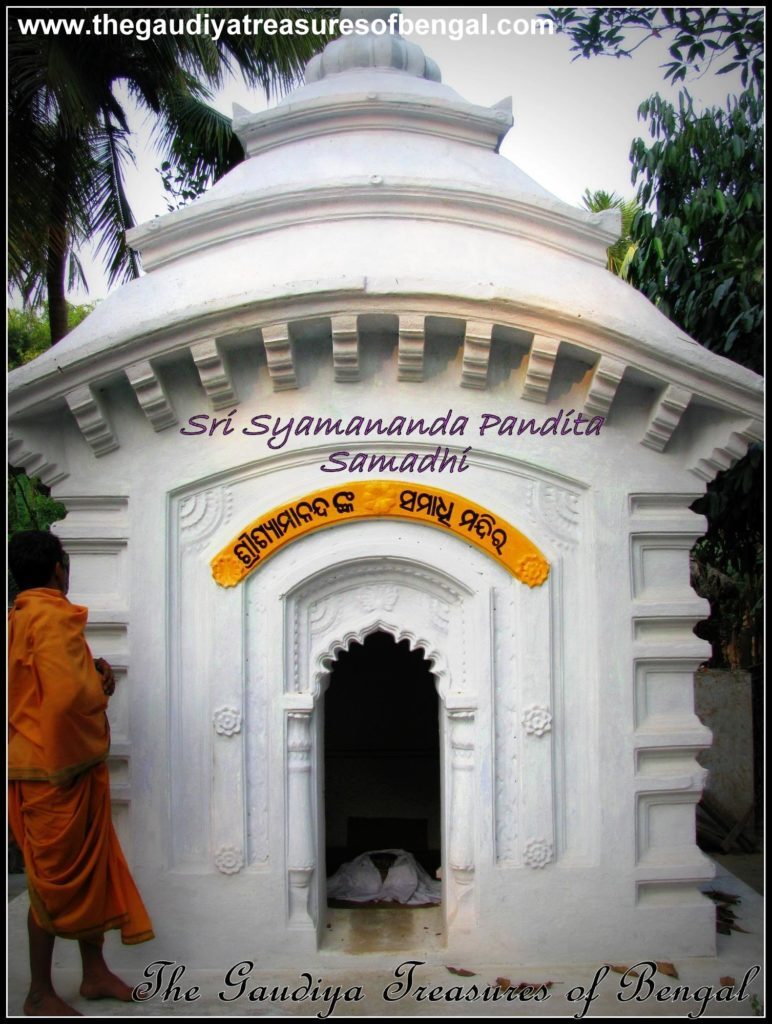
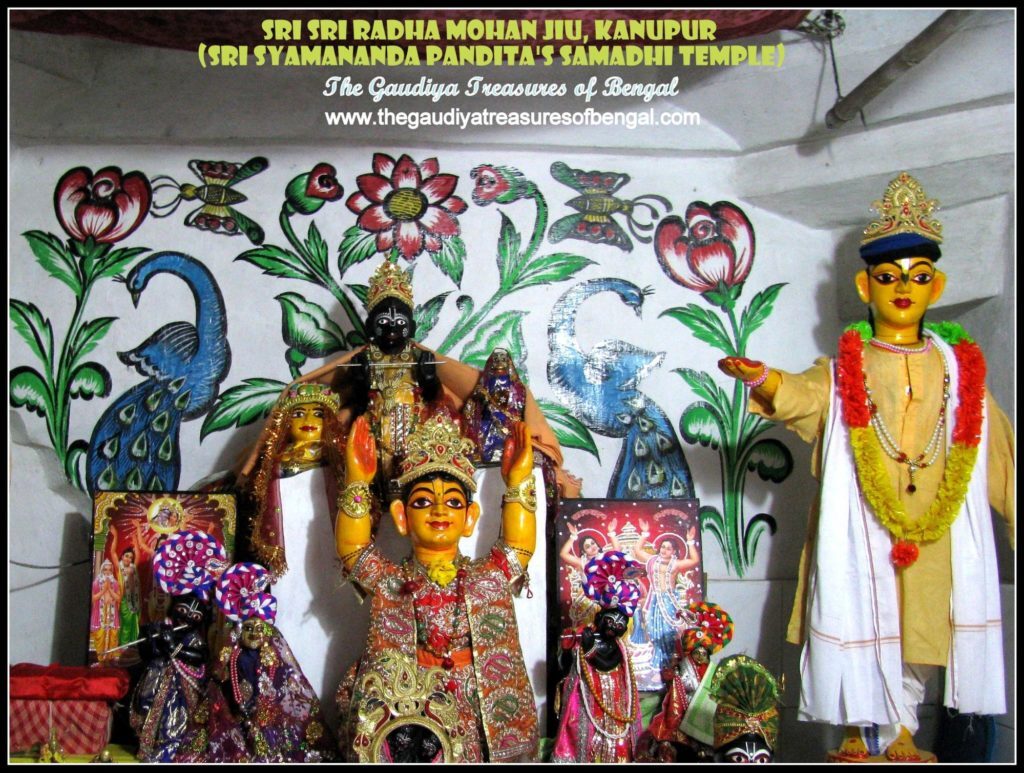
Sources disagree on both the exact year and the exact place of what followed. One detailed biography of Shyamananda's life comes from the tradition of his household line. It was translated from Bengali and draws on Narahari Chakravarti's Bhakti-ratnakara. It gives the date as the first lunar day of the dark fortnight (Krishna-pratipada) in the month of Ashadha, 1623 AD. It places his actual departure at Nrisinghpur, the same town, which is now generally identified with present-day Kanupur near Balasore in Mayurbhanj district. His samadhi and bhajana-kutir still stand there and are cared for by the descendants of his disciples. Hridaya Chaitanya's own page draws on a different set of sources. It gives Shyamananda's disappearance as Shaka 1552, which is 1630 AD, a difference of about seven years. Another account is repeated even more widely: the "Life of Shyamananda Pandit" translated by ISKCON Desire Tree, which Stephen Knapp's biography page also repeats. It agrees on the month and lunar day, but it places his passing, and his samadhi, at Gopiballabhpur instead of Nrisinghpur. The fuller account based on the Bhakti-ratnakara explains part of this. It records that two separate samadhis were set up after his passing: one at Nrisinghpur (Kanupur) and one at Vrindavana. The Vrindavana samadhi is at the exact spot beside the Radha-Shyamsundar temple where he had once found Radharani's anklet. But this account does not mention Gopiballabhpur as a third site. So a real difference between the traditions remains unresolved, and we state it plainly here. A third account places his passing more loosely "in the middle of the seventeenth century," later than either of the two specific years above. This is one more case of sources disagreeing on exactly when this happened.
What the Different Sites Preserve Today #
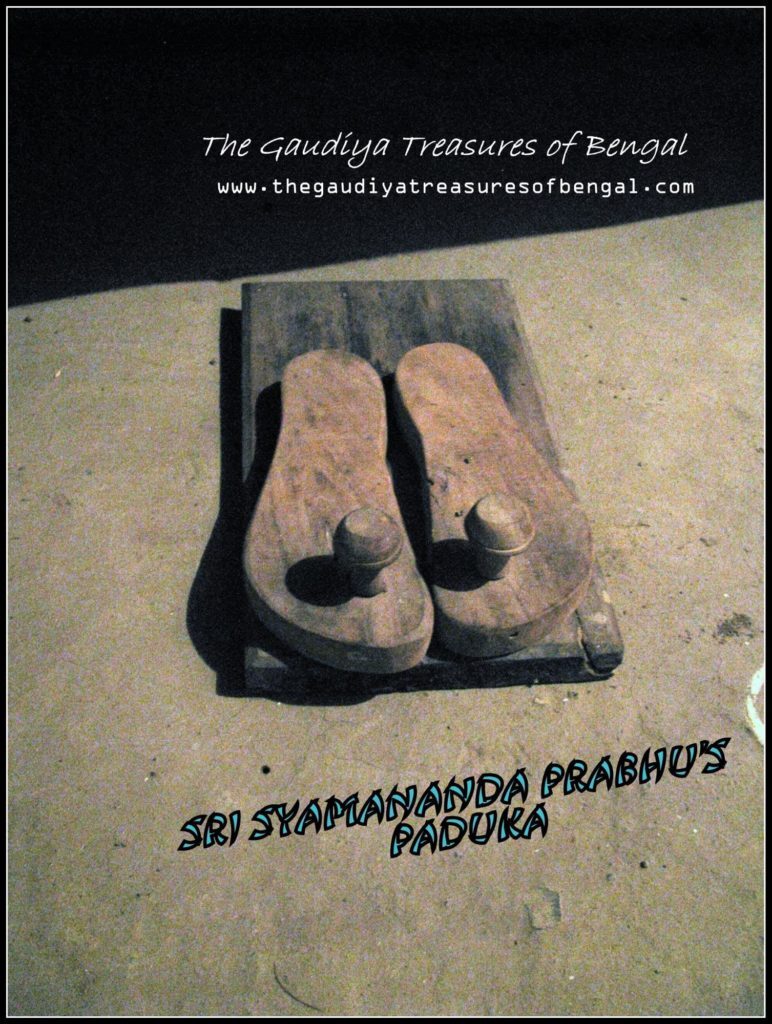
Whatever the exact year and the main place, physical traces of Shyamananda's life are kept at more than one place today. At Kanupur, near Balasore, his samadhi temple stands in a walled compound that devotees still call Gupta Vrindavana. Beside it is a pair of ponds that he is said to have dug and named Radha-kunda and Shyama-kunda. His simple wooden paduka (sandals) are also kept there. At Gopiballabhpur, the headquarters of the Shyamanandi community he built, his flute, palm-leaf prayer beads inscribed with verses of the Gita-Govinda, a Govardhana stone, and a manuscript of Srimad-Bhagavatam are kept and shown to visiting pilgrims. In Vrindavana, daily worship continues at the Radha-Shyamsundar temple he founded. The Deities there are the ones he received directly from Radharani's own mercy. The temple is now recognized as one of the seven original historic temples of the dhama.
A Funeral Attended by Thousands #
Rasikananda built the samadhi for his guru and performed the funeral rites himself. Another devotional account remembers Vaishnava and Muslim chiefs, zamindars, kings and queens all arriving by the thousands. They came to pay their last respects to the man who had converted the whole of Odisha. One traditional comparison places Shyamananda among the three great preachers in this way. Shrinivasa Acharya is said to embody the ecstasy of Sri Chaitanya Mahaprabhu Himself. Narottama Dasa Thakura is said to embody that of Nityananda Prabhu, and Shyamananda Pandit that of Advaita Acharya. These are three inconceivable moods. Non-devotees cannot grasp them, but the pure-hearted still relish them today.
A Legacy That Reaches Baladeva Vidyabhusana #
The line of formal initiation that Shyamananda started when he tied the turban on Rasikananda reached, within a few generations, one of Gaudiya Vaishnavism's most important philosophers. Rasikananda's own disciple Nayanananda Goswami initiated Radha-Damodara Goswami. Radha-Damodara Goswami in turn accepted as his disciple the scholar who became Baladeva Vidyabhusana. At the royal court of Jaipur in 1718, Baladeva Vidyabhusana's Govinda-bhashya secured the Gaudiya sampradaya's place among the recognized schools of Vedanta. The following year he personally installed the larger Deities still worshiped at Shyamananda's own Radha-Shyamsundar temple in Vrindavana. Traced this way, a recorded chain of gurus connects a milkman's son, accepted at Ambika Kalna despite his caste, to one of the most important defenses of its philosophy that the Gaudiya Vaishnava tradition ever made. The same chain also connects him to a "Shyamanandi parivar" that is still recognized today, under the name Jagadguru Sri Shyamananda Prabhu's Dwar Peeth, as one of the principal seats of the wider Gaudiya-Madhva sampradaya. Rasikananda Prabhu's own final chapter tells in full what Rasikananda himself built on this foundation. It covers his own decades of caste-crossing preaching across Odisha and his disappearance at the Kshira-chora Gopinatha temple in Remuna.
Scriptural evidence for this chapter (1)
kāśīte lekhaka śūdra-śrīcandraśekhara
tāṅra ghare rahilā prabhu svatantra īśvara
Word for word
kāśīte: in Varanasi; lekhaka śūdra: a writer considered a shudra; tāṅra ghare: in his house; rahilā prabhu: the Lord stayed; svatantra īśvara: being the fully independent Supreme Lord.
This time Lord Chaitanya stayed at the house of Chandrashekhara, although he was regarded as a shudra or kayastha, for the Lord, as the Supreme Personality of Godhead, is completely independent.
From the purport: Purport excerpt: "In the families of...Rasikananda-deva (a disciple of Syamananda Prabhu), the sacred thread ceremony is performed, as it is for the caste Gosvamis, and this system has continued for the past three to four hundred years."
Srila Prabhupada's own purport traces the caste-crossing principle Shyamananda lived by all the way down to Rasikananda's own family line, still active in Prabhupada's own lifetime.
- Hridaya Chaitanya (this site)
- Rasikananda Prabhu (this site)
- Jiva Goswami (this site)
- Shrinivasa Acharya (this site)
- SHYAMANANDA PRABHU - Biography - Gaudiya History
- Sri Shyamananda Prabhu - Stephen Knapp
- Life of Shyamananda Pandit - ISKCON ebooks (PDF)
- Sri Syamananda Prabhu - Disappearance - ISKCON Desire Tree
- A Short Biography of Sri Shyamananda Prabhu (trans. Demian Martins)
- Radha Shyamsundar Temple, Vrindavan - Founded by Shyamananda Pandit - The Gaudiya Treasures of Bengal
- Syamananda Pandita - Biography - Sripat Kanupur - The Gaudiya Treasures of Bengal
- Sri Chaitanya-caritamrita, Madhya-lila 8.128
- Sri Chaitanya-caritamrita, Adi-lila 7.45
- Sri Chaitanya-caritamrita, Antya-lila 4.67
- Teachings of Lord Caitanya, Chapter 31, The Supreme Perfection
- Lecture on CC Madhya-lila 8.128 -- Bhuvanesvara, January 24, 1977
