Srila Vishvanatha Chakravarti Thakura
Author of the Sarartha-darsini and Architect of Raganuga-Bhakti
The complete life, on one page: The main biography and every pastime page, in order, in one place
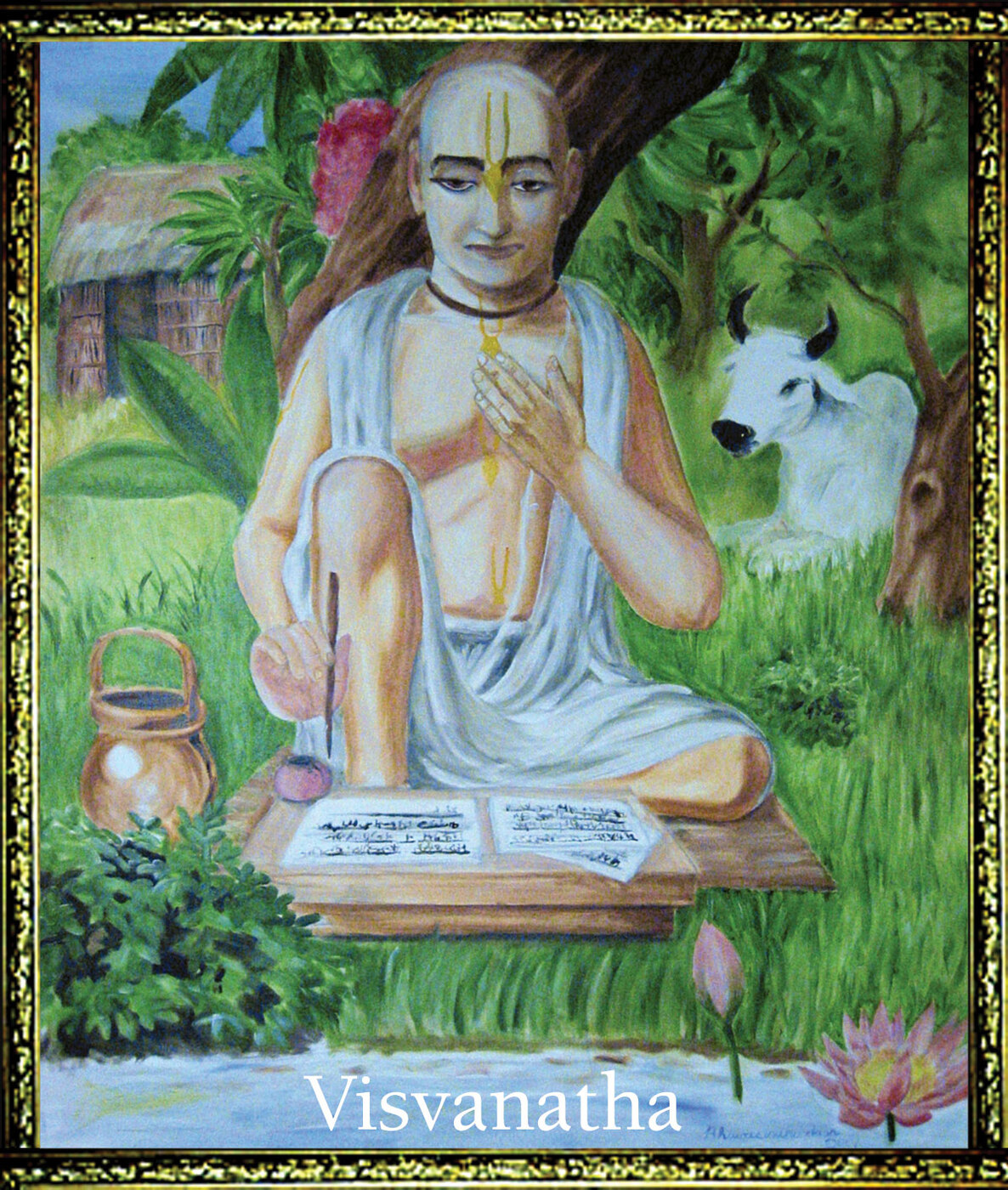
Introduction
viśvasya nātha-rūpo 'sau bhakti-vartma-pradarśanāt
bhakta-cakre vartitatvāt cakravarty-ākhyayā bhavat
"Because he revealed the path of devotion, he is regarded as one with Vishvanatha, the Lord of the universe himself; and because he stood foremost within the circle of devotees, he came to bear the name Chakravarti."
This verse of glorification, explaining the two halves of his own name, has traditionally introduced Srila Vishvanatha Chakravarti Thakura's life and stands here for the same reason.
Sometime in the middle of the seventeenth century, a boy was born in a Brahmana household in Bengal's Nadia district. He would become one of the most quoted commentators in the history of Gaudiya Vaishnavism. Apart from his own books, Srila Vishvanatha Chakravarti Thakura left almost no record of his personal life. There is no diary, and no memoir by people who saw him, of the kind that survives for Sri Chaitanya's own generation. Yet two of his works still shape how Gaudiya Vaishnavas, including Srila Prabhupada and the International Society for Krishna Consciousness, understand and practice raganuga-bhakti, the path of spontaneous loving devotion. These are his Sarartha-darsini commentary on the Srimad-Bhagavatam and his short book Raga-vartma-candrika.
| Detail | Description |
|---|---|
| Birth | c. 1626 (sources vary considerably, from the 1610s to the 1660s) |
| Birthplace | Devagrama village, Nadia district, Bengal (one source places the same village in present-day Murshidabad district) |
| Guru | Sources differ: Krishnacarana Chakravarti of Saiyadabad, or Krishnacarana's own disciple Radharamana Chakravarti, both in the line descending from Narottama Dasa Thakura |
| Disappearance | c. 1708, on Vasanta-panchami in the month of Magha |
| Place of disappearance | Radha-kunda, Vrindavana |
| Major works | Sarartha-darsini, Raga-vartma-candrika, Madhurya-kadambini, Sri Gurvastakam, an incomplete commentary on Sri Chaitanya-charitamrita |
| Pen name | Harivallabha Dasa, used for his Bengali devotional songs |
Scriptural evidence for the introduction (1)
he bhakta dvary ayam cancad-
valadhi rauti vo manak
prasadam labhatam yasmad
visistah sveva nathati
"O devotees, this poor creature is standing at your doorway, waving his tail and barking. Please let him have a little prasadam so that he may become exceptional among dogs and get the best of masters as his owner."
From the purport: Purport excerpt: "Here the acarya makes a pun on his own name: vis(istah), 'exceptional'; sva(iva), 'like a dog'; natha(ati), 'having a master.' Such is the perfection of Vaisnava humility."
Vishvanatha Chakravarti Thakura appended this verse, punning on his own name, to his own commentary on this closing verse of the Bhagavatam's Tenth Canto prayers of the personified Vedas; Srila Prabhupada reproduces and explains the pun in his purport.
Chapter 1
Birth and Early Life
A Brahmana boyhood in Nadia, an early gift for scholarship, and a marriage that failed to hold him at home.
Almost everything known about Vishvanatha Chakravarti Thakura's early life comes from later life-stories in the Gaudiya Vaishnava tradition, not from any writing of his own. Even these sources disagree on basic facts. This shows how little was recorded about the life of a man who became famous only through his books.
A Brahmana Household at Devagrama #
Vishvanatha was born in the village of Devagrama, into a Radhi-sreni Brahmana family, one of the recognized Brahmana communities of Bengal. Most sources place Devagrama in Nadia district. This is the same region that produced Sri Chaitanya Mahaprabhu himself a century and a half earlier. One source instead places the village in what is now Murshidabad district. Nadia and Murshidabad border each other, and district boundaries shifted over the centuries. So the disagreement may simply be about which district the village was counted in, as happens elsewhere in the record. It may not be a dispute about two different villages at all. But no source settles it clearly, so both claims are recorded here instead of quietly choosing one.
His father was named Rama Narayana Chakravarti, and Vishvanatha had two older brothers, Rambhadra and Raghunatha. Nothing is recorded of his mother.
The sources give very different dates for his birth. Wikipedia's infobox gives c. 1626. Other accounts convert traditional Shaka-era dates and arrive at 1638, or at 1654 Shaka (which different writers then turn into different Gregorian years). Others simply state he "appeared in 1638" or "in 1662" without further detail. No two of the sources we checked agree exactly, and we do not try to decide between them. We use c. 1626 here only because it is the date most commonly repeated, not because it is proven to be the most accurate.
A Scholar From Childhood #
The sources do agree that Vishvanatha showed unusual ability as a scholar from a young age. While still living in Nadia, he completed his studies in Sanskrit grammar, poetry (kavya) and rhetoric (alankara). This was the standard course of study in a traditional Bengali pandit's education. More than one account repeats a specific claim. As a student, he once defeated a visiting "conquering pandit," a traveling scholar who challenged local students to debate. At that time Vishvanatha was still officially a pupil, not a recognized teacher. No source gives this pandit's name or the subject of the debate. So the story should be read as a traditional example of his early brilliance, not as a recorded historical event.
Along with this early promise as a scholar, biographers say that from childhood he had no interest in worldly or family matters. Gaudiya Vaishnava biographies often describe saints who renounced the world in this way. But several independent sources say it specifically about Vishvanatha.
An Arranged Marriage, and a Departure #
Vishvanatha's father was worried that his son's spiritual leanings would take him away from family life. So he arranged his son's marriage at a young age, hoping this would keep him at home. The Gaudiya Vaishnava Abhidhana is a Bengali reference work on Gaudiya Vaishnava history that several later accounts cite. According to it, the plan did not work. Though Vishvanatha was properly married, he showed no attachment to household life. Before he finally left home, he is said to have personally taught his wife the Srimad-Bhagavatam. He asked her to take up devotional worship of the Lord while he was away.
Tradition also keeps a related episode from these years of preparation, before Vishvanatha's final departure for Vrindavana. At his parents' urging, his own guru asked him to spend at least one night in his wife's room. Vishvanatha agreed, but he spent the whole night chanting the holy names and did not touch her. His parents were disappointed, but his guru was not. The guru saw this as a clear sign that Vishvanatha's renunciation was genuine, not a mere formality. Soon after, the guru took Vishvanatha into his own household and set him to copying the Srimad-Bhagavatam by hand. In those days this was a slow task that took a great deal of time. While copying, Vishvanatha would sometimes fall into trance and show symptoms of spiritual ecstasy. Once, a local landowner saw the sun's heat turn aside from the very spot where Vishvanatha sat writing. Another time, rain fell all around him, but not a single drop touched him or his manuscript. The landowner spread word of what he had seen through the village. Vishvanatha himself was clearly uncomfortable with this attention.
These are among the very few surviving personal details about Vishvanatha the man, not Vishvanatha the author. So they are treated with care here. They come from a single line of sources that repeat one another, and no independent source confirms them. Still, they fit the wider pattern of his life that follows. He turned firmly away from household life and set out on the journey to Vrindavana that would shape the rest of his years.
A Region Already Marked by Sri Chaitanya #
Whichever village in Nadia district Vishvanatha actually came from, it was the same region where Sri Chaitanya Mahaprabhu had been born about a century and a half earlier, at Sridhama Mayapur. By Vishvanatha's lifetime, this part of Bengal had already produced several generations of scholars and devotees of the Gaudiya Vaishnava movement. A Brahmana family in the district would have grown up while that history was still fresh in people's memory. But none of the surviving sources describe Vishvanatha's own family as having any direct connection to Sri Chaitanya's associates.
What the Record Does Not Say #
We should also be clear about what these early sources do not tell us. By the time Vishvanatha grew up, all of the Six Gosvamis of Vrindavana had already passed away. So no account describes him meeting any of them in person. No source explains what exactly drew him toward the particular tradition he would spend his life writing about, beyond a general nature unsuited to household life. For this period of his life, the record holds only a small handful of repeated stories, not a connected account. This page gives just that handful, clearly marked as tradition and not as independently verified history. It does not fill the gaps with invented detail.
Chapter 2
Arrival in Vrindavana
From study at Saiyadabad to a bhajana-kutir at Radha-kunda that once belonged to Krishnadasa Kaviraja Gosvami.
Vishvanatha Chakravarti Thakura went from Bengal to Vrindavana in two stages. First he went to his guru's residence to complete his religious education. Only after that did he go to Vrindavana itself, where he would spend the rest of his life.
Study at Saiyadabad #
Before leaving Bengal, Vishvanatha traveled to Saiyadabad, in the Murshidabad region (the town survives today as part of Baharampur), to study devotional scripture directly under his guru. At this point the sources differ on an important question. Who exactly was his diksha-guru? Some accounts name Krishnacarana Chakravarti of Saiyadabad as the one who initiated him. They describe Krishnacarana as fourth in the disciplic line coming down from Narottama Dasa Thakura. Other accounts instead name Radharamana Chakravarti, a disciple of Krishnacarana, as Vishvanatha's actual initiating guru. In that version Krishnacarana is one generation further back. Both versions place Vishvanatha in the same line coming down from Narottama Dasa Thakura. They differ only on which of the two men at Saiyadabad actually gave him diksha. No available source settles this difference, so it is left here as an open question.
Whichever of the two was his initiating guru, Vishvanatha is said to have studied under him for a considerable period before departing for Vrindavana, and to have already begun composing devotional works during these years at Saiyadabad.
Renunciation and the Road to Vraja #
From childhood, as noted on the previous page, Vishvanatha had shown little interest in domestic life. Eventually, though the sources give no precise age or year, he renounced his household entirely and set out for Vrindavana, the forest region in present-day Uttar Pradesh identified in Gaudiya Vaishnava theology as Krishna's eternal abode on earth. His family attempted to bring him back. They did not succeed.
Settling at Radha-Kunda #
When he arrived in Vrindavana, Vishvanatha did not build a new residence of his own. Instead, he went to live with a Vaishnava named Mukunda Dasa. Mukunda Dasa lived on the bank of Radha-kunda in a bhajana-kutir, a small hut for solitary devotional practice. This hut had once belonged to Krishnadasa Kaviraja Gosvami, the author of Sri Chaitanya-charitamrita. Krishnadasa Kaviraja Gosvami had disappeared decades before Vishvanatha's birth, so the two men never met. Vishvanatha inherited the place and its living tradition of study, not a personal relationship. There he was surrounded by the manuscripts and teachings of Rupa Gosvami, Sanatana Gosvami and others of their time. Vishvanatha gave himself fully to the Gosvamis' literature. He began the long, steady work of writing commentaries that would fill the rest of his life.
While at Vrindavana, Vishvanatha also took up the worship of a Deity named Gokulananda, installed as Radha-Gokulananda. This Deity remains in Vrindavana to this day. The temple built around this Deity, the Radha-Gokulananda temple, later became the site of Vishvanatha's own samadhi. His samadhi stands in the same courtyard as the memorials of Lokanatha Gosvami and Narottama Dasa Thakura, two figures central to the generation just before his own.
From this base at Radha-kunda, Vishvanatha produced his most influential work, the Sarartha-darsini commentary on the Srimad-Bhagavatam. Over the following decades he also produced dozens of other commentaries and original works.
Living Inside the Gosvami Tradition #
Settling at Radha-kunda mattered for more than its location. It gave Vishvanatha access to the Gosvamis' writings. Over the century before, Rupa Gosvami, Sanatana Gosvami, Raghunatha Dasa Gosvami and others of their time had produced a huge body of Sanskrit devotional literature. It included philosophical works, poetry, drama and scriptural commentary. Much of it existed only in handwritten manuscripts. These were kept and copied by the small community of scholars who had renounced the world and went on living in Vrindavana after the Gosvamis themselves had disappeared. Vishvanatha lived at Radha-kunda among the keepers of this literature. So he could study the original texts closely over a long period, in a way that a visiting scholar could not easily do. Later sources describe him as having "very intently studied the books and letters of the Gosvamis," and these words show both his method and his advantage. He was not working from secondhand summaries. He worked directly from the tradition's own original writings.
The Deity of Gokulananda #
Alongside his textual work, Vishvanatha also took on the responsibility of Deity worship, establishing or continuing the service of Sri Sri Radha-Gokulananda in Vrindavana.
Tradition tells how that Deity actually reached him. A brahmachari on pilgrimage to Mathura is said to have dreamed that the Deity wished to be worshiped by Vishvanatha. But the brahmachari did not yet know who Vishvanatha was and had to look for him. When he found Vishvanatha and offered him the Deity, Vishvanatha declined. He lived only by begging alms and felt he could not provide the standard of worship the Deity deserved. The disappointed brahmachari left. But that same night Vishvanatha dreamed that the Lord Himself asked to be accepted and served in whatever way Vishvanatha could manage. In a matching dream of his own, the brahmachari was told to return. He did, and this time Vishvanatha accepted. Along with Gokulananda, Vishvanatha also took over the worship of a Govardhana-shila that had passed through an unusual line of keepers. Sri Chaitanya Mahaprabhu Himself had first given it to Raghunatha Dasa Gosvami, and it is said to bear Mahaprabhu's own fingerprint. After that it was worshiped in turn by Krishnadasa Kaviraja Gosvami, by Mukunda Dasa, and by Krishna-priya Thakurani, before it came to Vishvanatha. Both the Gokulananda Deity and this Govardhana-shila were later installed together in the Radha-Gokulananda temple.
This was not a small detail. In Gaudiya Vaishnava practice, scholarship and Deity worship were never treated as separate paths. A rasika commentator who explained the intimate moods of Radha and Krishna's Vraja pastimes was also expected to be personally engaged in serving Their arca-vigraha, or worshipable form. The temple that grew up around this Deity, the Radha-Gokulananda temple, would in time become known as much for housing Vishvanatha's own samadhi as for the Deity that gave it its name.
Chapter 3
Sarartha-Darsini and the Bhagavatam Commentary
Why Srila Prabhupada's own Bhagavatam purports return to Vishvanatha Chakravarti Thakura again and again.
Of everything Vishvanatha Chakravarti Thakura wrote, the Sarartha-darsini has left the deepest mark on how the Srimad-Bhagavatam is read and taught in the Gaudiya Vaishnava tradition today. Indirectly, it has also shaped how Srila Prabhupada explained the Bhagavatam to the modern world.
A Commentary Built Verse by Verse #
Tradition holds that Vishvanatha did not simply decide to write this commentary. He was told to write it. According to this tradition, Lord Krishna appeared to him in a dream and directly ordered him to write commentaries on the Gosvamis' books. After this, Vishvanatha began writing with unusual intensity. The same tradition tells of two signs that were taken to confirm this order. Clouds would shade him from the sun whenever he sat down to write. And once, while he was working on his Bhagavatam commentary, a heavy downpour flooded the area around him, but not a single drop touched Vishvanatha or his manuscript.
The Sarartha-darsini ("that which reveals the essential meaning") is Vishvanatha's commentary on the Srimad-Bhagavatam. It is especially celebrated for its explanation of the Tenth Canto, the canto about Krishna's birth and His pastimes in Vrindavana and Dvaraka. Going verse by verse, Vishvanatha explained not only the plain meaning of the Bhagavatam's Sanskrit but also the feelings and teachings that lie beneath it. He explained why a particular gopi might have spoken in a particular way. He explained what a specific word showed about a person's state of mind. He also showed how a detail that seems minor was connected to the deeper devotional mood (rasa) of the scene. He wrote a companion commentary, the Sararthavarsini, on the Bhagavad-gita. In a 1974 conversation in Paris with the French scholar of Indian thought Olivier Lacombe, Srila Prabhupada listed it among about ten major Sanskrit commentaries on the Gita.
A Constant Presence in Srila Prabhupada's Purports #
Anyone who reads Srila Prabhupada's Bhagavatam purports closely will meet Vishvanatha Chakravarti Thakura again and again. He is usually introduced with some form of the phrase "Srila Visvanatha Cakravarti Thakura comments." Sometimes the reference explains a single Sanskrit word. For instance, Prabhupada notes that Vishvanatha explained the word anvaha in Bhagavatam 8.1.8 to mean that Svayambhuva Manu murmured his austerities to himself instead of addressing anyone. At other times the reference explains a finer point about devotional feelings. Bhagavatam 10.22.12 describes the gopis bathing in the Yamuna. There Prabhupada draws on Vishvanatha's explanation of exactly why the modest, respectable gopis stayed in the water instead of at once facing Krishna about their stolen clothing. From Vishvanatha's brief note, Prabhupada builds up a whole imagined conversation between the gopis and the Lord.
This pattern repeats across every canto of the Bhagavatam that Prabhupada translated. In a 1970 conversation in Indore, Prabhupada relies on Vishvanatha's particular reading of the death of the sinful Ajamila. In Vishvanatha's reading, Ajamila, at the moment of death, truly remembered Lord Narayana. He did not merely say his son's name by chance. Prabhupada treats this difference as an important point of teaching, and he credits it directly to "the remark of Visvanatha Cakravarti Thakura." At Bhagavatam 6.13.2, in the story of Indra's return from killing Vritrasura, Prabhupada quotes Vishvanatha's own Sanskrit note word for word. It explains why Indra alone, among the returning demigods, did not go home immediately. This is a fine point in the story that the plain text of the verse does not itself spell out.
Vanipedia has collected Prabhupada's references to Vishvanatha. Its list gives dozens of further examples from across his purports and lectures. One is why the night of the rasa-lila dance felt endless to the gopis, even though it took up only a portion of Brahma's cosmic night. Others are the confidential reason why the Yadu dynasty was destroyed in the end, and the exact definition of a ghost and other technical Sanskrit terms. Another is the nature of offenses against Vaishnavas (vaishnava-aparadha), one of the two great obstacles to progress in devotional service.
An Incomplete Companion Commentary #
Vishvanatha also began a Sanskrit commentary on Sri Chaitanya-charitamrita itself, Krishnadasa Kaviraja Gosvami's biography of Sri Chaitanya Mahaprabhu, though, as later scholars note, he did not live to complete it. Even unfinished, it became one of the works later commentators and translators consulted directly.
Taken together, the Sarartha-darsini and its companion commentaries are Vishvanatha's most lasting service to the Gaudiya Vaishnava tradition. He did not bring a new philosophy. Instead, as a rasika, he listened closely to each line of the scriptures that earlier acharyas had established. In this way he brought out details of mood and meaning. Later readers would draw on these for the next three centuries, and Srila Prabhupada was very much one of them.
Still in Print #
The Sarartha-darsini has not remained a mere curiosity from history, kept only in old manuscripts. Complete English translations of the commentary on the later cantos of the Bhagavatam, including the Tenth, Eleventh and Twelfth, are still published and studied by Gaudiya Vaishnava scholars today, with the Sanskrit written in English letters. Translations of Vishvanatha's other tikas are published alongside them. These tikas are on the works of Rupa Gosvami, on the Gopala-tapani Upanishad, and, tradition adds, on works of Kavi Karnapura and Narottama Dasa Thakura as well. A whole tradition of commentary has grown up around one seventeenth-century Bengali Brahmana's line-by-line notes on scripture. Three hundred years later, it is still being actively translated and printed. This itself shows how central his particular way of reading the Bhagavatam has become to the wider Gaudiya Vaishnava world.
Scriptural evidence for this chapter (3)
From the purport: Purport excerpt: "Srila Visvanatha Cakravarti Thakura explains this verse as follows: 'The gopis were from most respectable families, and they might have argued with Krsna...'"
Prabhupada builds his entire purport reconstructing the gopis' imagined dialogue with Krishna directly out of Vishvanatha Chakravarti Thakura's commentary on this verse about the gopis bathing in the Yamuna.
From the purport: Purport excerpt: "Srila Visvanatha Cakravarti Thakura comments that the word anvaha means that he chanted or murmured to himself, not that he lectured to anyone."
A small but characteristic example of how Prabhupada leans on Vishvanatha's word-by-word Sanskrit glosses to settle a precise point of meaning in the Bhagavatam text.
brahmesendradaya iti; indrasya sva-dhisnya-gamanam nopapadyate vrtra-vadha-ksana eva brahma-hatyopadrava-prapteh
From the purport: Purport excerpt: "In this connection Srila Visvanatha Cakravarti Thakura comments..."
Prabhupada quotes Vishvanatha's own Sanskrit gloss verbatim to explain why Indra alone, unlike the other returning demigods, did not go straight home after Vrtrasura's death.
Chapter 4
Commentary on Chaitanya-Charitamrita
An unfinished Sanskrit tika on Krishnadasa Kaviraja Gosvami's great work, and how little else is known about it.
Srila Prabhupada's purports refer to the Sarartha-darsini again and again. Much less is recorded about Vishvanatha Chakravarti Thakura's work on Sri Chaitanya-charitamrita. It is better to say this plainly than to make a thin record seem fuller than it is.
An Unfinished Sanskrit Tika #
Krishnadasa Kaviraja Gosvami completed Sri Chaitanya-charitamrita, his great Bengali biography of Sri Chaitanya Mahaprabhu, in the late sixteenth century, decades before Vishvanatha was born. Some generations later, Vishvanatha began a Sanskrit commentary (tika) on this book. This was a natural project for him. He had settled in the very bhajana-kutir at Radha-kunda that had belonged to Kaviraja Gosvami himself, and he had spent years studying the Gosvami literature kept there. Sources that list his works agree that this commentary was still incomplete at the time of Vishvanatha's disappearance. But no source explains how much of the text it actually covers or why it was not finished.
Why It Still Matters #
Even though it is incomplete, Vishvanatha's commentary on Chaitanya-charitamrita has a special kind of authority. It is one of the earliest explanations in Sanskrit of a book that Krishnadasa Kaviraja Gosvami himself had written mainly for Bengali devotees. Vishvanatha's tika shows how the Vrindavana Gosvami tradition itself read Krishnadasa Kaviraja's great work, some generations after it was written. And it was written by someone who had lived for years in the very place where the book's author once lived and wrote.
We have not found any specific place where Srila Prabhupada quotes Vishvanatha's Chaitanya-charitamrita commentary by name in his own English purports to that book. This is different from the Sarartha-darsini, which he quotes often and by name, as recorded elsewhere. This does not mean that no such reference exists. It only means that none has turned up yet. It is more honest to say so than to suggest a connection that has not actually been checked.
Vishvanatha's tika should also be kept apart from two much later Bengali commentaries. Srila Prabhupada does draw on these openly and by name throughout his own Chaitanya-charitamrita purports. They are Bhaktivinoda Thakura's Amrita-pravaha-bhashya and Bhaktisiddhanta Sarasvati Thakura's Anubhashya. These were written about two centuries after Vishvanatha's Sanskrit tika, for different readers and in a different language. Neither should be confused with Vishvanatha's own earlier, unfinished work.
Part of a Larger Pattern #
Vishvanatha's incomplete Chaitanya-charitamrita tika should be seen together with the rest of his work. He wrote dozens of commentaries, working largely alone at Radha-kunda over several decades. Not every project was finished. Chaitanya-charitamrita is perhaps the richest book of theology in all Gaudiya Vaishnava literature, and it may simply have been the harder task. Still, what survives of his work places him among the few scholars before modern times who treated Krishnadasa Kaviraja Gosvami's book as worthy of a formal Sanskrit commentary, not only as a book to read and recite.
Readers who want the fuller picture of what Vishvanatha did complete should turn instead to his commentary on the Srimad-Bhagavatam. In that commentary, more than in his unfinished work on Chaitanya-charitamrita, we can most easily see in detail how he shaped the way the tradition reads its own scripture.
Chapter 5
Systematizing Raganuga-Bhakti
How Raga-vartma-candrika and Madhurya-kadambini gave later Gaudiya Vaishnavas a practical roadmap for spontaneous devotion.
The Sarartha-darsini is Vishvanatha Chakravarti Thakura's most quoted work. But his treatment of raganuga-bhakti, the path of spontaneous loving devotion, is his most original contribution to theology. Because of it, later generations remember him not only as a commentator but as someone who arranged the teaching into a clear system.
Two Kinds of Devotion #
Srila Rupa Gosvami wrote a century before Vishvanatha. He had already explained the difference between two kinds of devotion. Vaidhi-bhakti is devotional practice done mainly out of obedience to the rules and commands of scripture. Raganuga-bhakti is devotion practiced by following (anuga) the spontaneous loving attachment (raga) of Krishna's eternal associates in Vraja. Rupa Gosvami established the principle in his Bhakti-rasamrita-sindhu, but treated it fairly briefly. Vishvanatha touched on raganuga-bhakti again in his own short commentary on that work, the Bhakti-rasamrita-sindhu-bindu. Then he wrote a whole book on the subject, titled Raga-vartma-candrika ("the moonlight on the path of raga"). In it he explained raganuga-bhakti fully and step by step. Later Gaudiya Vaishnavas would accept this book as the standard early explanation of how raganuga-bhakti sadhana actually works.
The Raga-vartma-candrika has two sections. The first carefully explains how vaidhi and raganuga bhakti differ, and who is qualified for each. The second section turns to Krishna's two broad aspects as understood in Gaudiya theology. These are His majestic opulence (aisvarya) and His intimate sweetness (madhurya). It then turns to the particular personalities of Vraja, from Radharani Herself to Her attendants Lalita, Vishakha and Rupa Manjari. A raganuga practitioner is instructed to identify with and follow their particular mood (bhava).
Defending Parakiya-Rasa Against Svakiya-Vada #
Vishvanatha's systematic teaching on raganuga-bhakti did not appear out of nowhere. Tradition describes a real controversy he had to settle first. Decades after Jiva Gosvami's disappearance in 1608, a group among his own followers, influenced by Rupa Kaviraja and others, had begun to argue a different view. They said that Radha and Krishna should be worshiped as an eternally married couple (svakiya-vada), not as eternal lovers outside marriage (parakiya-vada). But parakiya was the position that Rupa Gosvami and Jiva Gosvami himself had generally taught as the highest expression of Krishna's Vraja pastimes. According to this same tradition, Vishvanatha drew on his deep study of the Gosvamis' own writings and answered these arguments one by one. In the end the svakiya-vada group could no longer defend its position in open debate.
The same tradition keeps a striking story from this period. A group of panditas who held to svakiya-vada could not bear their defeat. They are said to have plotted to attack Vishvanatha in the forest near Radha-kunda while he gathered flowers for his Deity's worship. As they waited in hiding, they met a young girl picking flowers instead. She told them she served Srimati Radharani and was gathering flowers so Radha could make a garland for Krishna, Her paramour. When the panditas turned to question her further, she had vanished, and Vishvanatha himself stood in the distance, still picking flowers. The panditas understood that they had somehow seen Vishvanatha's own siddha-deha, his eternal identity as one of Radha's manjari maidservants. They bowed down before him and begged forgiveness. Vishvanatha is then said to have put a single question to them: which village lies between Radha's home at Varsana and Krishna's home at Nandagrama? They answered Sanket. Then Vishvanatha asked them why Radha and Krishna would meet only in secret at Sanket by night, if They were truly married. Any married couple would naturally meet openly at either of Their own homes. The panditas had no answer. From that day they accepted him as their siksha-guru.
This tradition also names Vishvanatha's own eternal identity directly. In Krishna's pastimes, he serves Srimati Radhika as a manjari named Vinoda-manjari. This is the very kind of confidential service that the teaching of sadhaka-deha and siddha-deha, described below, was meant to help a practitioner attain.
Practicing in Two Bodies at Once #
Later writers describe a central idea in Vishvanatha's account of raganuga-bhakti sadhana using his own terms, the sadhaka-deha and the siddha-deha. A practitioner continues to perform ordinary devotional practice, such as hearing, chanting and temple service, in the sadhaka-deha, the present physical body. At the same time, within, the practitioner meditates continuously on a specific spiritual identity as one of Radha's eternal maidservants, a manjari, in Vraja. This identity is the siddha-deha, or perfected spiritual form. Vishvanatha taught that, in due course, Krishna grants the sincere practitioner the very siddha-deha that the practitioner has been meditating on continuously. In this way Vishvanatha gave later Gaudiya Vaishnavas a clear, practical explanation of how manjari-bhava could actually be developed, not merely described in theory. Manjari-bhava means identification with a specific confidential mood of service to Radha and Krishna.
This teaching did not stand apart from Rupa Gosvami's own foundation. It was built directly on it. Rupa Gosvami had already made clear that the qualification for raganuga-bhakti rests on lobha. Lobha is a spontaneous, almost irresistible hankering to attain the mood of one of Krishna's eternal Vraja associates. It arises from hearing about their love for Him. It does not rest on any external qualification of birth or formal initiation. In the Raga-vartma-candrika, Vishvanatha took that single qualifying principle and worked out in systematic detail what a practitioner who has such lobha should actually do with it. This is exactly the teaching of sadhaka-deha and siddha-deha described above.
From Sadhana to Perfection in Madhurya-Kadambini #
In a second major work, Madhurya-kadambini ("a bank of clouds raining sweetness"), Vishvanatha described the wider course of devotional life. He dealt not only with its most advanced stage but with the entire path leading up to it. The work has eight sections, sometimes called "showers," and it expands a single verse of Rupa Gosvami that describes how bhakti unfolds. Bhakti begins with sraddha (initial faith). It moves through sadhu-sanga (association with advanced devotees), bhajana-kriya (regulated devotional practice) and anartha-nivritti (the gradual clearing away of unwanted habits). It becomes stable in nishtha (steadiness) and ruci (a genuine taste for devotional life). It deepens into asakti (attachment), and finally it blossoms into prema, pure love of Krishna.
A Framework Still in Use #
Modern academic scholarship on Gaudiya Vaishnavism also studies this body of work. One well-known example is David Haberman's Acting as a Way of Salvation: A Study of Raganuga Bhakti Sadhana. Such scholarship sees these writings, built on Rupa Gosvami's foundation but greatly developed by Vishvanatha, as the main written basis for how raganuga-bhakti sadhana has actually been practiced and taught in the centuries since. Within ISKCON itself, Srila Prabhupada generally emphasized vaidhi-bhakti as the right starting point for practitioners. At the same time, he pointed toward raganuga-bhakti as the mature fruit of bhakti. This order fits the very progression the Madhurya-kadambini describes, from beginnings governed by rules to spontaneous love that goes beyond rules.
Two Treatises, One Purpose #
Read together, Raga-vartma-candrika and Madhurya-kadambini form a matched pair. One describes the destination, which is the specific inner mood that a raganuga practitioner aspires to. The other describes the road there, stage by stage, from a beginner's first spark of faith to the mature devotee's spontaneous love. Neither work invented the underlying theology. Both rest openly on foundations that Rupa Gosvami had laid a century earlier. Vishvanatha's gift was a clear structure. He gave named stages, clear definitions, and terms such as sadhaka-deha, siddha-deha, and the eight "showers" of the Madhurya-kadambini. These were exact enough that later acharyas could describe Gaudiya Vaishnava sadhana in consistent, teachable terms, not only in general devotional language. Later academic scholars entirely outside the tradition could do the same.
Chapter 6
Devotional Songs and Prayers
Sri Gurvashtakam, sung in ISKCON temples worldwide every morning, and the Bengali padavali songs of Harivallabha Dasa.
Of all the words Vishvanatha Chakravarti Thakura ever wrote, eight Sanskrit verses composed as a prayer to the spiritual master are the ones a devotee today is most likely to recite. This is true on any given morning, anywhere in the world.
Sri Gurvashtakam #
Sri Gurvashtakam, "Eight Prayers to the Spiritual Master," opens with the well-known line samsara-davanala-lidha-loka. This line compares the spiritual master to a life-giving cloud that puts out the blazing forest fire of material existence. Following the practice Srila Prabhupada established, devotees in ISKCON temples around the world sing Gurvashtakam each morning during mangala-arati, the first arati of the day, held before sunrise. Vishvanatha wrote this prayer several centuries ago. Because it is sung so often, it is now one of the most-recited pieces of Gaudiya Vaishnava literature. Today it perhaps reaches more people in a single week than his commentaries reached in his own lifetime.
Srila Prabhupada quoted individual verses of Gurvashtakam directly in his own teaching on more than one occasion. In a 1972 Bhagavad-gita lecture in Calcutta, he was discussing verse 2.41, on resolute intelligence. He cited the prayer's closing verse, yasya prasadad bhagavat-prasado, "by the mercy of the spiritual master one receives the mercy of Krishna," to show why a devotee's relationship with the guru cannot be separated from the relationship with Krishna Himself. In a letter to an Indian well-wisher, Dr. Channa Reddy, Prabhupada quoted a different verse of the same prayer. This verse describes how the spiritual master, along with his disciples, is always engaged in dressing and worshiping the Deity and maintaining the temple. Prabhupada used it to make a practical point about the standard of temple management ISKCON should keep.
Padavali Songs and Sanskrit Prayer Collections #
Besides Gurvashtakam, Vishvanatha wrote a large body of devotional poetry in Bengali under the pen name Harivallabha Dasa. These poems belong to the padavali tradition of short lyric songs to Radha and Krishna. This tradition had flourished in Bengal since the time of Chandidasa and Vidyapati, and Sri Chaitanya Mahaprabhu Himself is recorded as having loved to hear such songs. Writing devotional poetry under a different name, not his own scholarly name, was itself a familiar Vaishnava custom. It let the same author write both technical Sanskrit commentary and intimate Bengali devotional song, while keeping each kind of writing under its own name.
He also compiled a collection of his own Sanskrit devotional prayers under the title Stavamrita-lahari ("a wave of the nectar of prayer"). Among other works, it includes the Sankalpa-kalpadruma. This work has 104 verses of prayer to Radharani, asking for specific services to Her during each of the eight periods of the day and night in Krishna's eternal Vraja. This structure follows the ashta-kaliya-lila, the "eightfold daily pastimes," which is a standard pattern in later Gaudiya Vaishnava meditation. It is used to picture Krishna's unending day in Goloka Vrindavana. The Stavamrita-lahari also preserves Vishvanatha's other Sanskrit compositions in praise of Radha and Krishna. His longer devotional poem (mahakavya), Sri Krishna-bhavanamrita, is a separate work. Sankalpa-kalpadruma is often republished today as a book of its own, separate from the larger collection that first contained it.
Among Vishvanatha's other works is the Mantrartha-dipika, his explanation of the kama-gayatri mantra. Tradition preserves the story of how it came to be written. Working from the standard scriptural sources, Vishvanatha had concluded that the mantra contained twenty-five full syllables. But when he read Krishnadasa Kaviraja Gosvami's Chaitanya-charitamrita, he found it stated there were only twenty-four and a half. Vishvanatha did not want to conclude that such a respected author had simply made a mistake. But he could find no other way to explain the contradiction. So he decided to fast until the matter was settled, even at the cost of his life. Srimati Radharani is said to have appeared to him in a dream before dawn. She told him that Krishnadasa Kaviraja's figure was correct, and that the syllable vi in the mantra counts as only a half. She also directed him to a text called Varnagama-bhasvat for the full explanation. Vishvanatha found the book, completed his study, and finished the Mantrartha-dipika on that basis.
A Note on Attribution #
Several well-known Gaudiya Vaishnava songs addressed to the spiritual master are sometimes loosely thought of as one group, but not all of them are Vishvanatha's. The Bengali song "Gurudeva! Krpa-bindu diya," widely sung in ISKCON kirtan today, was in fact composed some two centuries later by Srila Bhaktivinoda Thakura, as part of his Saranagati collection. It was not written by Vishvanatha Chakravarti Thakura. The works reliably credited to Vishvanatha are chiefly Sri Gurvashtakam, the Harivallabha Dasa padavali songs, and the Stavamrita-lahari prayer collection.
Why the Songs Endure #
Vishvanatha Chakravarti Thakura gave raganuga-bhakti a clear system, as discussed on a separate page. It is fitting that today he is remembered chiefly through a short prayer, not through his technical treatises. Gurvashtakam is not a philosophical argument. It is eight verses addressed directly and personally to one's own spiritual master. The verses move from the guru's role in delivering the disciple from material suffering to the guru's engagement in Deity worship and scriptural instruction. They end with a closing prayer that whoever recites these verses with attention at the auspicious hour before dawn will attain direct service to Krishna at the time of death. In this sense Gurvashtakam is a short, practical companion to everything Vishvanatha wrote at greater length elsewhere. The same rasika taste that produced page after page of Sarartha-darsini commentary and the ordered stages of the Madhurya-kadambini also produced these eight verses. They are simple and direct enough to be sung, understood and felt by a new devotee on their very first morning in a temple.
Scriptural evidence for this chapter (1)
sri-vigraharadhana-nitya-nana-
srngara-tan-mandira-marjanadau
"The spiritual master is always engaged in the temple worship of Sri Sri Radha and Krsna. He also engages his disciples in such worship. They dress the Deities in beautiful clothes and ornaments, clean Their temple, and perform other similar worship of the Lord."
From the purport: Purport excerpt: "Srila Visvanatha Cakravarti Thakur states in this connection... The temple should be maintained as cleanly and beautifully as the Deity is worshiped."
Srila Prabhupada quoted this Gurvastakam verse in a letter to Dr. Channa Reddy to make a practical point about the standard of Deity worship and temple cleanliness ISKCON temples should maintain.
Chapter 7
Disappearance and Legacy
The mission to Jaipur that produced the Govinda-bhashya, a disputed disappearance date, and three centuries of continuing influence.
Vishvanatha Chakravarti Thakura's final years are remembered mainly for one important decision, not for events in his own life. His death is remembered for the place where it happened, not for a date that everyone agrees on.
The Challenge at Jaipur #
According to tradition, by the last part of his life Vishvanatha had become the recognized senior authority of the Gaudiya Vaishnava community centered at Vrindavana. Because of this position, he became indirectly involved in a controversy at the court of the Maharaja of Jaipur, Sawai Jai Singh II. Scholars of a rival Vaishnava sampradaya (sources vary on exactly which one) spoke before the assembled court. They argued that the Gaudiya Vaishnavas had not produced a formal commentary of their own on the Vedanta-sutra. So, they said, the Gaudiyas had no proper claim, based on Vedantic authority, to worship their own Deities. Some accounts add that they also objected specifically to the Gaudiya practice of worshiping Srimati Radharani alongside Krishna. Jai Singh himself was a Gaudiya Vaishnava by initiation. But it is reported that the rules of the assembly bound him to act on the challenge. So he quietly sent word to Vrindavana, asking the sampradaya to produce the commentary that the objection demanded.
Vishvanatha was too old to make the journey and debate the point in person. So he sent a younger scholar associated with Vrindavana's temple community, Baladeva Vidyabhushana, to travel to Jaipur and answer the challenge. Traditional accounts describe Baladeva praying before the Govindaji Deity for several days. Then, within a remarkably short time, he completed a full Vedanta-sutra commentary, the Govinda-bhashya. The tradition credits this achievement to Krishna's direct inspiration. This work secured the Gaudiya sampradaya's recognition as an authentic Vedantic school at Galta, near Jaipur. Tradition dates this event to 1718, a decade or so after Vishvanatha's own disappearance. The assembly honored Baladeva with the title "Vidyabhushana," ornament of learning.
It is less certain how close the personal bond between the two men actually was. Some sources describe Baladeva plainly as Vishvanatha's disciple. Others describe a looser connection through the circle of scholars around Vrindavana's temple community, and do not mention a formal guru-disciple relationship.
Disappearance at Radha-Kunda #
Vishvanatha is said to have passed away at Radha-kunda, the same place he had made his home for decades. The day is given as Vasanta-panchami, the fifth day of the bright fortnight of the month of Magha. In the Gaudiya Vaishnava calendar, this date is still associated with his memory. Most sources place this event around 1708. But at least one source states that he entered samadhi as early as 1674. None of the material we consulted explains this difference of several decades, so no single date should be taken as certain. His samadhi (memorial tomb) stands today in the courtyard of the Radha-Gokulananda temple in Vrindavana, alongside the samadhis of Lokanatha Gosvami and Narottama Dasa Thakura. So the three men, from different generations, rest within sight of one another in death, just as they belonged to the same line of teachers in life.
An Influence Outliving the Man #
Sri Bhaktisiddhanta Sarasvati Thakura once summed up Vishvanatha Chakravarti Thakura's place in the tradition in a single sentence, calling him "the protector, guardian, and acharya during the middle period (1600-1700) of the historical development of Gaudiya Vaishnavism."
If we look at his influence and not his biography, Vishvanatha Chakravarti Thakura's legacy has lasted an extraordinarily long time. His Sarartha-darsini remains one of the most frequently cited sources in Srila Prabhupada's Bhagavatam purports. His Raga-vartma-candrika and Madhurya-kadambini are still studied as the main early step-by-step explanations of raganuga-bhakti sadhana. They are studied both within the Gaudiya Vaishnava tradition and in academic scholarship on it. And his Gurvashtakam is, in all likelihood, being sung somewhere in the world at this very moment. It is sung by devotees who may know nothing else about the seventeenth-century Bengali Brahmana who wrote it three hundred years ago at Radha-kunda.
Honored Without Being Fully Known #
There is something fitting, and a little touching, in how Vishvanatha Chakravarti Thakura is remembered. These pages have explored much uncertainty about his life: the disputed birthplace, the unresolved question of his diksha-guru, and the conflicting dates for his own disappearance. Yet almost none of this has ever slowed the spread of his actual written words. In a 1974 conversation in Paris, Srila Prabhupada himself placed Vishvanatha plainly within the direct chain of teachers that he named as his own spiritual lineage. He named the six Gosvamis of Vrindavana, then Srinivasa Acharya, then Krishnadasa Kaviraja Gosvami, then Narottama Dasa Thakura, "then Visvanatha Cakravarti Thakura, then Jagannatha dasa Babaji, then Bhaktivinoda Thakura." ISKCON devotees recite this traditional list of acharyas daily in the parampara-pranama prayers. The list names the main teachers of each generation. It does not claim an unbroken chain in which each one gave diksha directly, person to person, to the next. The gap of roughly a century between Vishvanatha's own disappearance and Jagannatha Dasa Babaji's era is itself a reminder of this. The list traces a lineage of teaching and realization, more than a strict succession from each teacher directly to the next. In any case, Srila Prabhupada placed Vishvanatha in this list, after Narottama Dasa Thakura and before Bhaktivinoda Thakura. This itself shows how firmly Vishvanatha's place in the tradition has always been accepted, even though many details of his own life remain uncertain.
Closing
A Brahmana Family in Nadia #
Vishvanatha was born into a Radhi-sreni Brahmana family, one of Bengal's traditional Brahmana communities. He was the son of Rama Narayana Chakravarti and the younger brother of Rambhadra and Raghunatha. The sources that describe his childhood agree on very little beyond this. But several of them repeat one detail. As a schoolboy at Nadia, he finished his studies in grammar, poetry and rhetoric very quickly. He is also remembered for once defeating a visiting pandit in open debate while he was still a student himself.
From childhood, biographers say, he showed no attachment to household life. His father, hoping to keep him at home, arranged his marriage while he was still young. It did not work. Later accounts state that before leaving home for good, Vishvanatha personally taught his wife the Bhagavatam. He asked her to take up devotional worship of the Lord while he was away. If this account is true, it is one of the very few surviving pictures of him as a person, not only as an author.
Mapping the Path of Spontaneous Love #
Vishvanatha's most original contribution to theology was his clear, step-by-step explanation of raganuga-bhakti. This is devotion practiced by following, rather than merely regulating, spontaneous loving attachment to Krishna. His Raga-vartma-candrika has two sections. It explains how vaidhi-bhakti (rule-based devotion) differs from raganuga-bhakti. It also explains how a practitioner may inwardly identify with a particular eternal associate of Radha in Vraja, a maidservant, or manjari, while outwardly continuing ordinary devotional practice. His Madhurya-kadambini is built on a single verse of Rupa Gosvami. It describes every stage of bhakti, from first faith, through the company of saints, up to the final flowering of prema, pure love of Krishna. Together these two works became standard guides for how Gaudiya Vaishnavas describe the inner life of devotion, and they still are.
Prayers Still Sung Today #
Surprisingly, the work of his that reaches the most people today is not a commentary. It is a short Sanskrit prayer, Sri Gurvastakam, the "Eight Prayers to the Spiritual Master". It opens with the words samsara-davanala-lidha-loka. It is sung every morning during mangala-arati in ISKCON temples around the world. So, in this sense, Vishvanatha's own words are recited more widely today than at any point in his lifetime. He also wrote many Bengali devotional songs under the pen name Harivallabha Dasa. And he compiled a collection of Sanskrit prayers to Radha and Krishna known as Stavamrta-lahari.
Disappearance and a Debated Connection #
Late in his life, tradition holds, Vishvanatha was too old to travel to Jaipur to answer a challenge. The challenge came from rival scholars who questioned the Gaudiya sampradaya's authority to worship its own Deities. So he sent a younger scholar of the Vrindavana temple circle, Baladeva Vidyabhushana, to go in his place. This mission produced the Govinda-bhashya and the title "Vidyabhushana." The sources used here do not make fully clear how close the two were personally. Some call Baladeva his disciple. Others describe a looser connection through the scholarly community of Vrindavana. Vishvanatha is said to have passed away at Radha-kunda on Vasanta-panchami in the month of Magha. This is commonly dated to around 1708, though a few sources place his samadhi decades earlier. His memorial stands today in the courtyard of the Radha-Gokulananda temple in Vrindavana. His commentaries remain among the Gaudiya Vaishnava sources most often quoted in Srila Prabhupada's own writings.
Songs in the Vaishnava Song Book #
The Vaishnava Song Book carries 4 songs attributed to Srila Vishvanatha Chakravarti Thakura. See the full author page here.
- Sri Visvanatha Cakravarti Thakura - Gaudiya History
- Visvanatha Cakravarti Thakura - Biography (Pastimes) - Gaudiya History
- A Short Biography of Srila Visvanatha Cakravarti Thakura - ISVARA.org
- Sri Vishvanatha Chakravarti Thakura - ISKCON Bangalore
- Vishvanatha Chakravarti Thakura - Stephen Knapp
- Viswanath Chakravarti Thakur - Hare Krsnas (harekrsna.com)
- Teachings of Srila Visvanatha Cakravarti Thakura - Vanipedia
- Srimad-Bhagavatam 10.87.50, Purport - Vedabase
